Stationery Shop Poly Mailers Cost: Quote Smart for Buyers
Many stationery retailers still treat shipping packaging as a single line item, then get surprised when the math shifts once the orders start moving. In practice, stationery shop poly mailers cost stays lower than corrugated packaging only when the product is flat, light, and matched to the right mailer size. A planner, sticker pack, journal refill, or note card set does not need a carton that eats shelf space, adds tape time, and pushes freight weight up for no good reason. It needs a mailer that fits cleanly, seals well, and keeps the quote tied to the actual job.
The better way to judge stationery shop poly mailers cost is to look at the whole pack-out picture instead of the printed price on a supplier sheet. A mailer that saves 8 cents but adds 20 seconds of labor, or creates a 2 percent return rate because the adhesive fails, is not really the lower-cost choice. Shops shipping hundreds or thousands of slim stationery items each month usually find the best answer is a well-sized poly mailer with stable unit cost, predictable MOQ, and a realistic path to bulk pricing. That is the part buyers tend to miss when they compare only the bag price and call it a day.
Stationery Shop Poly Mailers Cost: Why They Beat Boxes
For a stationery shop shipping notebooks, sticker packs, journal refills, or compact gift sets, packaging decisions often start with habit rather than math. Boxes feel familiar, sure, but they bring hidden costs fast. Oversized cartons need void fill, more tape, extra storage, and additional pick-and-pack time. A flat order can move through a poly mailer in one motion: insert, seal, label, and ship. That is why stationery shop poly mailers cost often lands lower on the full invoice, even though the per-bag price is only one piece of the puzzle.
Labor is where the difference becomes obvious. If a worker saves 15 to 25 seconds per order by using a self-seal mailer instead of building a small box, the savings stack up quickly. At 1,000 orders a month, 20 seconds per order equals roughly 5.5 labor hours. That is not a minor detail, and it changes the economics of stationery shop poly mailers cost in a way many buyers miss when they focus only on material price.
Cheap mailers are not automatically cheap shipments. A weak adhesive strip, a thin film that tears at the corners, or a bag that is too large for the product can wipe out the initial savings in a hurry. Returns are expensive. Repacking is expensive. Replacement shipments cost even more. So yes, stationery shop poly mailers cost is also a reliability question, not just a pricing question.
A good mailer should lower touch time, not just carton price. If it does not improve speed, fit, and seal confidence, the invoice tells only half the story.
Item profile matters more than tradition. Flat, light, low-fragility stationery usually belongs in a poly mailer. Rigid mailers make sense for items that must stay flat and need more bend protection. Corrugated still has a place for bulkier kits or fragile bundles. For notebooks, sleeves of stickers, pen sets, washi tape packs, and planner accessories, stationery shop poly mailers cost less when the format matches the product instead of forcing the product to fit a packaging habit.
Sample packs help buyers make that decision before a full run goes into production. A 10-piece test can reveal seal behavior, size issues, and the feel of the film before the larger order lands on the dock. A few minutes of testing now often prevents an expensive fit problem later. For related formats and packaging mixes, see Custom Packaging Products and compare options against your shipment profile.
Product Details: What Buyers Actually Get
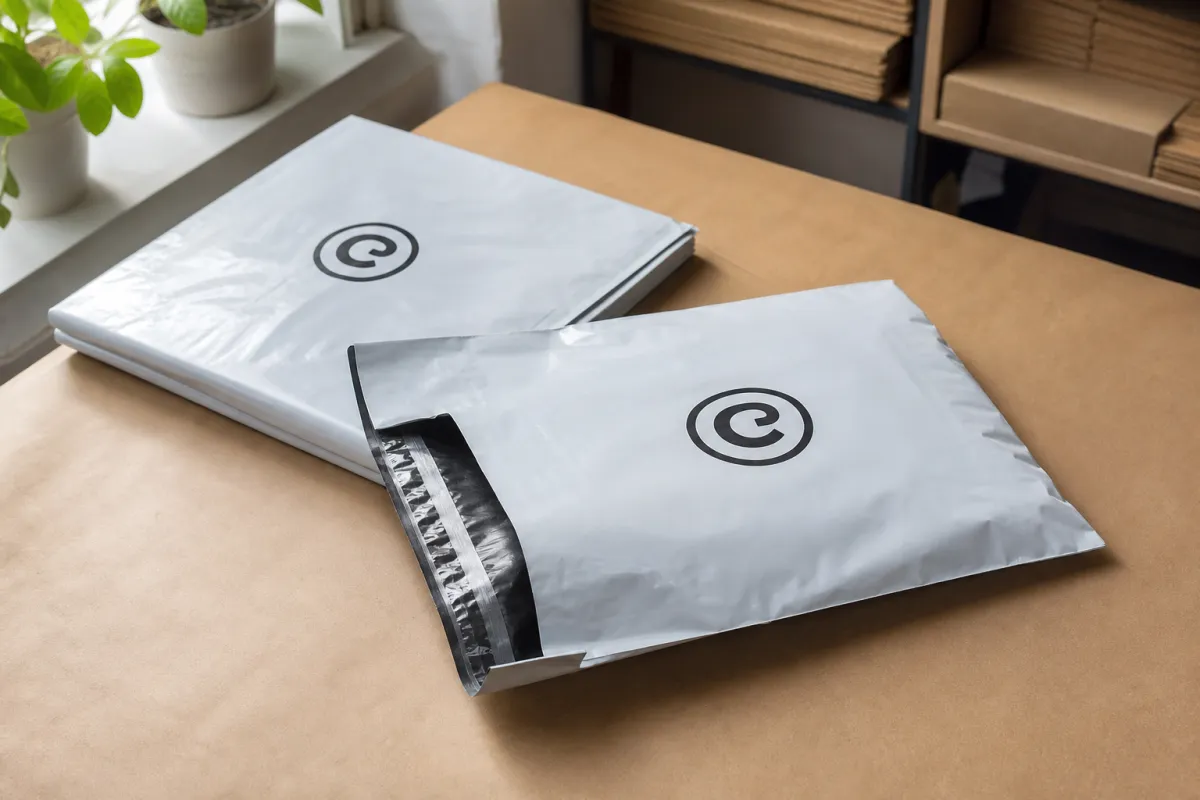
Most stationery shop poly mailers are made from co-extruded LDPE film, paired with a pressure-sensitive self-seal strip and an opaque exterior for privacy. That build is common because it balances cost, flexibility, and basic parcel protection. Inside, the film usually carries a darker layer so contents do not show through. Outside, the surface may be matte or gloss depending on the brand look and the print method. Buyers asking about stationery shop poly mailers cost should always confirm the film structure, because a plain bag and a branded bag are not the same product.
Finish changes the feel more than many people expect. A white body looks clean and retail-friendly. A black body reads more premium and gives stronger opacity. Matte surfaces hide scuffs better in transit, while gloss can make ink colors look sharper. Some buyers want a small logo and return address only; others want a fully branded panel with artwork across the face. Each choice changes the unit cost, yet it also changes how the parcel feels the first time a customer holds it. For low-ticket stationery, presentation still matters. The mailer is often the first branded object a buyer handles after checkout.
Common uses are easy to spot: journals, planners, notebooks, envelopes, sticker sheets, pen sets, washi tape packs, and small gift bundles that ship flat. These products work well in a package that looks neat and closes quickly. A sloppy bag with too much slack can make a modest order look careless. A well-sized poly mailer, by contrast, makes the shipment feel deliberate. That is one reason stationery shop poly mailers cost can support brand perception instead of serving only as transport.
There is a practical side to that presentation as well. The buyer-facing experience affects repeat purchase confidence. When a customer gets a tidy tear-open mailer that opens easily, the unboxing feels organized even if the order value is small. That matters for stationery, where margins may be tight and the brand earns trust through consistency. If you want to compare a dedicated format, take a look at Custom Poly Mailers and review the standard build against your product list.
Product details also shape cost in direct ways. Thicker film, stronger adhesive, and custom print all add value, yet they also raise the price. That does not make them poor choices. It simply means the quote should spell out exactly what is being paid for. A buyer comparing stationery shop poly mailers cost needs to know whether the supplier is quoting a stock bag, a printed bag, or a higher-spec version with stronger sealing performance and a cleaner packaging presentation.
Specifications That Change Stationery Shop Poly Mailers Cost
Size is the first lever. Measure the item plus closure margin, not only the product dimensions. A mailer that is too large wastes film, looks sloppy, and raises freight density. A mailer that is too tight risks split seams and a weak seal. That is why stationery shop poly mailers cost should always be compared using actual item size, not a guessed fit from a catalog page. The right size usually cuts waste and improves pack speed at the same time.
Thickness is the second lever, and many buyers approach it too casually. A 2.5 mil film may be enough for very flat stationery and short parcel routes. A 3 mil build is a common middle ground for better puncture resistance. A 4 mil option adds more tolerance for heavier bundles or longer shipping lanes. The goal is not to buy the thickest film. The goal is to Buy the Right film. Every extra increment changes stationery shop poly mailers cost, but the wrong thickness can cost more if the shipment fails in transit.
Print specification is the third lever. One-color logos usually keep setup charges lower and are often the most economical branding choice. Large ink coverage, multiple colors, or strict color matching can raise tooling fees and production complexity. A simple design often performs better than a busy one in parcel packaging anyway. Clean typography, a small logo, and one strong brand color can look sharper than a crowded layout while keeping the quote closer to the lower end of stationery shop poly mailers cost.
Closure details matter too. A stronger self-seal adhesive helps reduce returns and re-taping. Tamper-evident seals add customer confidence, especially for premium stationery bundles. Tear strips and side gussets can improve opening and packing behavior, though they also change the structure and the pricing. If the bag opens cleanly and seals reliably, operations usually run more smoothly. That operational gain should be counted alongside the invoice number when assessing stationery shop poly mailers cost.
Warehouse efficiency is another cost driver that rarely appears in the product quote. How many bags fit in a carton? How much pallet space do they take? How many cartons fit on a shelf? A packaging buyer may notice a small unit price difference and miss the storage impact. For recurring orders, those details matter. Better carton counts can reduce receiving labor and improve space use, which lowers true stationery shop poly mailers cost across the month.
For buyers who want a quick comparison, the table below shows how the spec stack typically changes both pricing and use case.
| Option | Best For | Typical Unit Cost at 5,000 Pieces | Notes |
|---|---|---|---|
| Plain stock poly mailer, 2.5 mil | Low-fragility, flat stationery with no branding | $0.08-$0.12 | Lowest setup burden; best if speed and cost per piece matter more than branding |
| Custom printed mailer, 3 mil, one color | Most stationery retail orders | $0.12-$0.19 | Balanced option for brand presence, privacy, and predictable bulk pricing |
| Custom printed mailer, 4 mil, full coverage | Heavier bundles, premium presentation, longer shipping lanes | $0.18-$0.30 | Higher setup charges and more film usage, but better durability and stronger shelf appeal |
Those figures are not fixed, and they should never be treated like a promise. Size, print coverage, destination, and order history all move the quote. Even so, the pattern is steady: the more a mailer is asked to do, the more the stationery shop poly mailers cost climbs. That is normal. The smart move is to pay for the features that actually prevent failure or improve customer experience, and skip the extras that do not change the result. No need to overbuild the package just because it sounds safer.
Stationery Shop Poly Mailers Cost, MOQ, and Quote Factors
The first number you see is rarely the number you should compare. A useful quote breaks down raw film, print setup, tooling fees, packaging, freight, and any import or compliance charges if the order crosses borders. If those pieces are hidden inside one line item, the buyer loses visibility. That is where people get caught. A quote can look low until setup charges or shipping terms are added, and then the real stationery shop poly mailers cost ends up much higher than expected.
MOQ works the same way. Custom printing requires artwork handling, plate or screen preparation, machine setup, and line scheduling. That setup work makes low quantities inefficient for the supplier, so the minimum order usually rises with complexity. Stock mailers often allow lower minimums because no print setup is needed. If your project is small, ask whether a simplified design, a standard size, or a single-color print can bring the MOQ down without weakening the brand. That adjustment can change stationery shop poly mailers cost more than any debate over film thickness.
Volume matters. Larger runs usually lower cost per piece because fixed charges spread across more units. That is why buyers should request tiered pricing. The difference between 2,000 and 5,000 pieces, or between 5,000 and 10,000 pieces, can reveal more than one flat number ever will. A good supplier shows where the breakpoints land and whether the extra inventory is worth the savings. In many stationery programs, the right tier reduces stationery shop poly mailers cost enough to justify a more deliberate reorder cycle.
Here is the comparison most buyers need to see before approving a print run:
- Plain stock mailer: lowest setup burden, lower MOQ, limited branding.
- One-color custom mailer: moderate setup charges, stronger brand presence, usually the best middle ground.
- Multi-color custom mailer: higher tooling fees, more proofing, stronger visual impact if the artwork is simple and clear.
- Full-coverage premium mailer: higher material and print cost, best for collections or gift-focused stationery.
The hidden cost traps are usually small and irritating, not dramatic. Artwork revisions add time. Rush production adds cost. Split shipments add freight. If the size is not locked early, a reprint can wipe out the savings from the original order. That is why I tell buyers to freeze the spec before chasing discounts. A clean brief lowers the chance of rework and keeps stationery shop poly mailers cost easier to control.
For buyers shipping under quality-sensitive programs, transit testing and material documentation are worth requesting. ISTA test families are useful references for parcel distribution conditions, and they help set a sensible bar for seal integrity and film durability. If the supplier can share test results, film specs, or basic performance data, that adds confidence. It does not make the packaging perfect, but it does make the quote more trustworthy. In a category where small savings can disappear quickly, trust is part of stationery shop poly mailers cost.
Process, Timeline, and Production Steps
The order flow is straightforward, though each step carries real weight. It usually starts with spec intake: item dimensions, desired mailer size, print colors, quantity, and destination. Then comes artwork review, proof preparation, proof approval, production, quality control, packing, and dispatch. Delays tend to come from those handoffs. If the brief is vague, the proof takes longer. If the artwork is not clean, file corrections take longer. If the seal or size is not confirmed early, stationery shop poly mailers cost can rise when the order has to be adjusted or repeated.
Stock and custom timelines are not the same. Stock orders move faster because the bags are already made. Custom Printed Mailers need artwork approval, setup, scheduling, and production time. A small one-color run can move faster than a full-coverage multi-color job, but no buyer should expect a universal turnaround. Quantity and destination matter. So does whether the order ships domestically or crosses a border. A realistic timeline is usually more useful than a bold promise, especially if the buyer is planning seasonal stationery demand and wants to lock stationery shop poly mailers cost before inventory peaks.
The proofing step is the real decision point. Confirm the size, logo placement, seal position, film color, and artwork resolution before approving anything. A tiny adjustment on screen can become a large problem in production. I have seen clean artwork turn into fuzzy print simply because the original files were not prepared at the right resolution. That kind of mistake is avoidable. It also affects perceived value, because a mailer that prints cleanly makes the shipment feel more polished. If the proof is correct, stationery shop poly mailers cost stays tied to the intended spec instead of drifting during production.
Quality control should never be treated as a formality. Seal checks, film consistency, print alignment, and carton counts all matter. If the adhesive is inconsistent, the customer experience suffers. If the print is offset, the brand looks sloppy. If the carton count is wrong, warehouse receiving slows down. The best suppliers track these basics because they know replacement cost is far higher than prevention cost. Buyers comparing stationery shop poly mailers cost should ask how the supplier handles QC, not only what the unit price is.
There is also a sustainability angle that some stationery buyers care about. If your operation uses paper inserts, inserts made from FSC-certified sources can help support chain-of-custody claims. For more on that standard, see FSC. The poly mailer itself is still a plastic shipping format, so it should be chosen deliberately. The practical question is not whether the packaging is perfect. It is whether the format is efficient, fit-for-purpose, and aligned with the order profile. That is the most honest way to manage stationery shop poly mailers cost.
Why Choose Us for Stationery Shop Poly Mailers
Consistency is what buyers really purchase. They want mailers that seal the same way every time, print cleanly, and arrive on a predictable schedule. That matters more than a sharp price that shifts from batch to batch. For stationery operations, the shipping experience is part of the brand. A clean bag can make a modest order feel intentional. A sloppy one can make even a premium notebook look like a commodity. That is why a well-managed quote for stationery shop poly mailers cost is not only about saving money; it is about controlling the customer’s first physical touchpoint.
Direct manufacturing support reduces friction on repeat orders. Once the artwork, sizing, and reorder spec are documented, the next run becomes easier to price and easier to approve. That is a major advantage for buyers who reorder monthly or quarterly. There is less back-and-forth, fewer surprises, and less risk of changing the wrong detail. Over time, that stability lowers both the administrative burden and the true stationery shop poly mailers cost tied to each shipment.
We also focus on the tradeoff that matters most: strength, appearance, and budget. A one-size-fits-all supplier may push a stock option that is too large or too plain for your brand. A focused packaging partner looks at item profile first, then recommends the size and spec that fit the shipment. That is usually where the savings appear. A better fit means less film waste, fewer labor seconds, and fewer transit issues. In other words, the right recommendation can improve stationery shop poly mailers cost without forcing you into a weak or overbuilt format.
For stationery brands, the merchandising benefit is real. A clean branded mailer turns a low-ticket order into a more deliberate package. That can lift perceived value without adding much weight or complexity. A full box is not the answer for every shipment. A flat, well-printed poly mailer can be the smarter move, especially for notebooks, sticker kits, and slim accessories. If you need broader sourcing support, the team page for Custom Packaging Products is a useful place to compare packaging formats before you lock the spec.
Our view is simple: the best mailer is the one that performs without wasting material, labor, or time. That is why we pay attention to print alignment, seal strength, carton planning, and practical reorder behavior. A buyer can judge us on the same metrics we use internally. If the bags arrive consistent, the quote is easier to trust. If the spec is clear, the next reorder is faster. And if the package feels right in the hand, stationery shop poly mailers cost starts to make sense as a business decision instead of a line-item debate.
Next Steps: Build a Quote That Matches Your Order
If you want a quote that reflects the real order, send the basics first: item dimensions, target mailer size, quantity, print colors, destination, and target ship date. Those six details usually determine most of the quote shape. If the pack is small and flat, the pricing can be very efficient. If the artwork is complex or the quantity is low, the setup charges will matter more. Either way, a precise brief makes stationery shop poly mailers cost easier to compare across suppliers.
Ask for unit pricing at multiple volumes, not just one number. That is the easiest way to see whether a higher MOQ pays back through lower cost per piece. In many cases, the 5,000-piece tier beats the 2,000-piece tier so clearly that the bigger order becomes the better commercial choice. In other cases, the inventory risk outweighs the savings. You do not know until the supplier shows the tiers. That is why serious buyers keep the comparison grounded in stationery shop poly mailers cost rather than relying on a single quote line.
Request a sample or digital proof before approval, especially if logo placement, seal performance, or privacy coverage matters to your brand. A proof catches avoidable mistakes. A sample shows how the material feels and how the seal behaves. Those two checks can prevent a lot of noise later. They are not expensive steps. They are insurance. And in a category where a small production flaw can create expensive rework, insurance is part of stationery shop poly mailers cost.
Most buyers should compare total landed cost, not only product price. Freight, setup fees, and reprint risk can change the final number in a meaningful way. That is the real standard. If a supplier can explain the quote clearly and tie every charge to a spec choice, you can make a sharper decision. If the brief is ready, the comparison becomes simple: what size, what print, what MOQ, what timeline, and what total cost per piece.
Send the specs, ask for tiered pricing, and insist on a proof. That is the shortest path from estimate to order, and it keeps stationery shop poly mailers cost aligned with the actual shipment instead of a guess. That part is kinda the whole point.
What is the typical stationery shop poly mailers cost per unit?
The unit price depends on size, film thickness, print coverage, and order volume. Plain stock mailers are usually the lowest-cost option, while custom printed versions carry setup charges and artwork costs. A useful quote will show several quantity tiers so you can see how the cost per piece moves as volume rises.
What MOQ should I expect for custom stationery shop poly mailers?
MOQ usually rises when the order uses custom print, multiple colors, or specialty materials. Stock mailers generally have lower minimums because they do not require the same setup work. If the order is small, ask whether a standard size or a one-color logo can reduce the minimum.
How does printing affect stationery shop poly mailers cost?
A single-color logo is usually the most economical print option. Large ink coverage, multiple colors, and exact color matching can raise tooling fees and production costs. Simplifying the artwork often lowers the quote without changing the core brand look.
How long is the lead time after artwork approval?
Lead time depends on whether the order is stock or custom, plus the quantity and print complexity. Custom orders usually need proof approval, scheduling, production, and packing before shipping. Ask for the timeline from approval to dispatch so you can plan replenishment without guesswork.
What details should I send for the fastest quote?
Send item dimensions, desired mailer size, quantity, material thickness, print colors, and destination. Include whether you need stock or custom, and whether samples or proofing are required. The more specific the brief, the faster you can compare stationery shop poly mailers cost across options.