Buyer Fit Snapshot
| Best fit | Sustainable Cosmetic Cartons Wholesale projects where brand print, material claims, artwork control, MOQ, and repeat-order consistency need to be specified before quoting. |
|---|---|
| Quote inputs | Share finished size, material target, print colors, finish, packing count, annual reorder estimate, ship-to region, and any compliance wording. |
| Proofing check | Approve dieline scale, logo placement, barcode or warning zones, color tolerance, closure strength, and carton packing before bulk production. |
| Main risk | Vague material claims, crowded artwork, missing packing details, or unclear freight terms can make a low unit price expensive after revisions. |
Fast answer: Sustainable Cosmetic Cartons Wholesale: Board, Finish, Dieline, and Unit Cost should be specified like a repeatable production item. The safest quote records material, print method, finish, artwork proof, packing count, and reorder notes in one written spec.
Production checks before approval
Compare the actual filled-product size with the drawing, then confirm tolerance on folds, seals, hang holes, label areas, and retail display edges. Reserve space for logos, QR codes, warning copy, and material claims before decorative graphics fill the panel.
Quote comparison points
Review material grade, print process, finish, sampling route, tooling charges, carton quantity, and freight assumptions side by side. A quote is only useful when the supplier can repeat the same color, closure quality, and packing count on the next order.
Sustainable cosmetic cartons wholesale sounds simple until a shipment shows up with crushed corners, dull print, and a fold line that looks like it lost a fight. Then the "cheap" carton stops being cheap. It starts collecting problems.
Serums, creams, lotions, balms, and lip products all need the same basic thing from a carton: protection, shelf appeal, and a clean arrival. Miss one and the whole box looks like a regret. That is why sustainable cosmetic cartons wholesale is a sourcing decision, not a slogan you toss into a deck and hope nobody checks. If the board, print, and structure do not work together, the carton becomes expensive clutter.
The false savings show up fast. Low quotes often come back as reprints, damaged stock, slower retailer approvals, and complaints about packaging that feels weak in hand. Better materials, a tighter spec, and a production plan that respects reality usually cost less over the life of the order. That is the part people learn after the first mistake, not before.
Here, the focus stays on the decisions that matter in sustainable cosmetic cartons wholesale: carton style, paperboard choice, finish selection, MOQ, Pricing, and Lead time. No filler. No packaging theatre. Just the details that help a carton survive transit, sit well on shelf, and not embarrass the brand.
Sustainable Cosmetic Cartons Wholesale: Why Buyers Switch
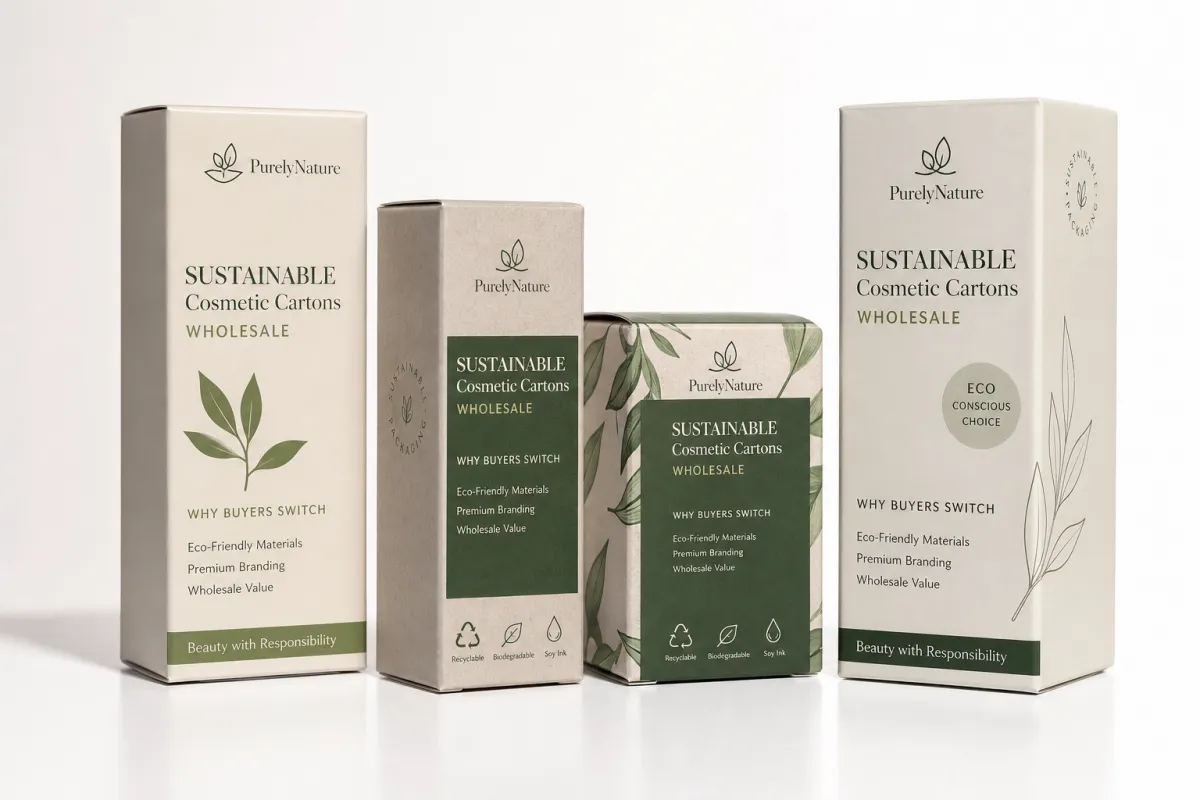
Sustainable cosmetic cartons wholesale usually starts with a simple discovery: the carton that looked fine on a quote sheet does not look fine in real life. Weak board, soft corners, sloppy registration, or a print surface that eats color can drag a product down before a customer even opens the cap. Buyers notice. Retail buyers notice faster.
The switch usually happens for three reasons. A brand wants better shelf presence. The team wants a carton that feels solid, not flimsy. The packaging manager wants fewer damage claims eating into margin. A carton can look nice and still fail the shipping test. It can also arrive clean and still feel too light for a premium SKU. Sustainable cosmetic cartons wholesale matters because it addresses those issues together when the spec is built properly.
Commercially, the upside is easy to explain. Sustainable claims help in retailer conversations, especially for clean beauty, natural skincare, and private-label lines that need a sharper story than "we picked the cheapest supplier." FSC-certified board, recyclable board where it fits the product, and lower-impact ink and coating systems give the brand something real to stand behind. That matters. Vague eco language does not. Sustainable cosmetic cartons wholesale works best when the proof shows up in the board, the print method, and the waste controls.
Hard numbers matter too. If a supplier cannot tell you the board grade, caliper, coating type, and print process, the sustainability claim is probably dressed up marketing. Ask for the numbers that actually mean something: recycled content percentage, FSC chain-of-custody status, whether the finish uses aqueous coating or film lamination, and how production waste is handled. That is how sustainable cosmetic cartons wholesale becomes a real category instead of a buzzword with better lighting.
A carton that saves two cents and triggers a return is not cheap. It is just expensive with better branding.
Retailers care about documentation, consistency, and how the packaging behaves on the shelf. They do not care that a supplier says "eco" with a straight face. They care whether the carton arrives clean, fits the product, and gives the shelf a controlled, intentional look. Sustainable cosmetic cartons wholesale gives brands a better answer because it shows the box was designed on purpose, not by accident.
I have seen teams chase a lower unit price only to spend the difference three times over on replacements. That pattern is not rare. It is kind of the default when the carton spec is treated like an afterthought instead of part of the product.
Product Details: Carton Styles That Protect and Sell
Sustainable cosmetic cartons wholesale works best when the carton matches the product weight, opening style, and retail role. A daily-use skincare carton does not need the same build as a holiday gift set. That sounds obvious. Plenty of teams still get it wrong. They overbuild cheap SKUs and underbuild premium ones. Both choices waste money, just in different ways.
Tuck-end folding cartons
Tuck-end cartons are the workhorse of cosmetic packaging. They fit lightweight serums, eye creams, lip balms, and small lotion bottles because they are efficient to make and easy to scale. A 300gsm to 400gsm paperboard is common here, with enough stiffness for shelf display without turning the carton into a brick. For sustainable cosmetic cartons wholesale, this is usually the easiest format to quote, sample, and repeat.
Reverse tuck works well when opening direction matters for shelf presentation. Straight tuck can feel a little cleaner when the artwork and fold lines line up properly. Add a dust flap if the closure needs a neater fit or better panel alignment. If the product is narrow, top-heavy, or prone to shifting, a locked bottom or insert may do a better job than trying to bully a standard tuck design into handling more weight than it should.
Sleeves and display-ready cartons
Sleeves are useful when the brand wants a leaner visual, a quick assembly flow, or a wrap around an inner tray. For gift sets, they pair well with a simple insert that keeps the pieces in place without making the box feel overdesigned. Sustainable cosmetic cartons wholesale often includes sleeves because they cut board usage while still leaving plenty of room for branding.
Display-ready cartons do more than move product from point A to point B. They open into a shelf unit, which helps with retail presentation and cuts down on extra merchandising work. Seasonal launches, travel kits, and counter display items benefit from that. The catch is obvious: if the tear-away panel or opening line fails, the display looks damaged before it ever reaches the shelf. Nobody wants that kind of surprise.
Rigid-style cosmetic boxes
Rigid-style boxes are not for every SKU, and they should not pretend to be. They make sense for prestige kits, holiday sets, high-ticket skincare, and products where the unboxing moment is part of the price tag. The board is usually 1.5mm to 2.5mm chipboard wrapped with printed paper. That adds cost, but it gives the carton a heavier feel that folding cartons cannot copy.
For sustainable cosmetic cartons wholesale, rigid structures can still be handled responsibly if the wrap paper, adhesive use, and inner tray design are planned with restraint. A well-built folding carton often beats a wasteful rigid box with no clear reason to exist. The structure should earn its keep, not just look fancy in a mockup.
Carton style also affects legal copy and brand storytelling. Ingredient highlights, shade names, skin claims, QR codes, batch codes, and regulatory text all need room. If the layout is squeezed, the box starts looking cluttered and cheap. The carton has to hold the product, support the copy, and still look composed. That is the job. Not glamorous. Just necessary.
Specifications: Materials, Finishes, and Print Options
Sustainable cosmetic cartons wholesale lives or dies on the spec sheet. Two cartons can look nearly identical from a distance and behave completely differently in production. One uses a bright SBS board with sharp print. Another uses recycled stock with a softer face and different ink uptake. Treating those as the same is how surprises get invited into the schedule.
Paperboard choice comes first. SBS gives a smooth, bright surface and strong color consistency, which helps when the artwork uses clean typography or skin-tone photography. Kraft board gives a more natural tone and works well for minimalist, botanical, or ingredient-led branding. Recycled board reduces virgin fiber use, but the surface and print sharpness depend on the mill and coating. For sustainable cosmetic cartons wholesale, that tradeoff matters because the look of the carton is part of the product story.
FSC-certified stock is one of the cleaner sustainability signals because it is documented, not guessed. The Forest Stewardship Council provides the framework, which helps brand and compliance teams verify the claim. For shipping and transit quality, some teams also compare cartons against ISTA methods, especially when products travel inside master shippers or e-commerce packs. Sustainable cosmetic cartons wholesale should be tested against the way the box actually moves, not the way the pitch deck imagines it moves.
Ink and coating decisions matter just as much. Soy-based or vegetable-based inks are common buyer requests. Water-based coatings are often preferred when the carton needs a matte or soft-touch appearance without a heavy plastic feel. Aqueous coating is a practical middle ground because it protects the print, resists scuffing better than bare paper, and keeps the finish simpler than full lamination in many cases. If the product needs a premium accent, spot UV, foil stamping, and embossing can all play a role. All three at once? Usually overkill. The carton is not trying to win a costume contest.
Here is the part buyers should request on every quote for sustainable cosmetic cartons wholesale:
- Board thickness: 300gsm, 350gsm, 400gsm, or rigid board with caliper listed clearly.
- Finish type: aqueous, matte, gloss, soft-touch, or no film laminate.
- Color target: Pantone references or a Delta E target if color accuracy matters.
- Print method: offset, digital, or a combined process if the run mixes quantities.
- Regulatory space: room for ingredients, warnings, barcode, batch code, and recycling mark.
If the product is low-price and fast-turn, overbuilding the carton wastes money for no reason. If the product lives in prestige skincare, weak board and dull print make the brand look careless. Sustainable cosmetic cartons wholesale is not about picking the most expensive spec. It is about picking the right one and not pretending those are the same thing.
Finish choices also change recyclability and perceived value at the same time. A soft-touch laminate feels premium, but it can complicate recovery compared with a simple aqueous coating. A foil stamp can lift a luxury line, but only if it actually improves the design. Spraying foil across every panel because the option exists is how a carton ends up looking loud instead of expensive.
There is also a practical point here that gets skipped too often: the same finish can behave differently on different board stocks. A matte coat on kraft is not going to read like matte on SBS, and a heavy ink coverage can make recycled board look muddy if the artwork was built for brighter stock. That is not a failure of sustainability. It is just print physics doing its thing.
Sustainable Cosmetic Cartons Wholesale Pricing and MOQ
Sustainable cosmetic cartons wholesale pricing comes down to a few variables buyers can control. Material grade, board thickness, print complexity, finishing steps, carton dimensions, and order quantity all move the number. The rest is noise. A supplier who gives a flat price without explaining those inputs is either hiding something or guessing.
MOQ works the same way. A simple single-SKU folding carton can often start around 500 to 1,000 units per design, especially when the print is straightforward and the structure is standard. Add specialty finishes, multiple SKUs, rigid construction, or custom insert work, and the minimum climbs. That is not a trick. It is just setup cost and waste distribution showing up in the quote. Sustainable cosmetic cartons wholesale gets more efficient as volume rises because the prep cost gets spread across more units.
At lower volumes, the unit price looks higher because plates, setup, make-ready time, die-cut tooling, and waste allowance still need coverage. At larger volumes, those same costs get diluted. That is why a 5,000-piece run usually lands in a better price band than a 1,000-piece run. The math is dull. The math also runs the factory. Good buyers ask for price breaks at 1,000, 3,000, 5,000, and 10,000 pieces so the decision is based on real thresholds, not hunches.
For sustainable cosmetic cartons wholesale, here is a practical comparison buyers can use when reviewing quotes:
| Option | Typical MOQ | Unit Price Range at 5,000 | Best For | Main Tradeoff |
|---|---|---|---|---|
| Standard SBS folding carton | 500-1,000 | $0.18-$0.28 | Daily skincare, lip care, mass-market beauty | Less natural look than kraft or recycled stock |
| FSC-certified recycled board carton | 1,000-2,000 | $0.21-$0.34 | Clean beauty, natural brands, retail compliance | Surface brightness and print sharpness can vary |
| Kraft carton with simple print | 1,000-2,000 | $0.18-$0.30 | Minimalist, ingredient-led, earthy branding | Dark artwork can lose contrast on the board face |
| Premium carton with foil or embossing | 2,000-5,000 | $0.34-$0.62 | Prestige skincare, launch kits, holiday sets | More setup time and higher production risk |
| Rigid-style cosmetic box | 1,000-3,000 | $0.75-$1.60 | Luxury sets, gift packaging, high-ticket products | Heavier, more expensive, less efficient to ship |
That table is a starting point, not a promise. A carton with multiple spot colors, heavy coverage, or complex die-cutting can move outside those ranges. Tight tolerances and custom inserts can do the same. The key is comparing like with like. I have seen buyers compare recycled board against virgin SBS and then label one supplier "expensive." That is not a fair comparison. That is bad procurement wearing a confident expression.
The lowest quote is often the one with the weakest board, the sloppiest registration, or the biggest freight surprise. Sustainable cosmetic cartons wholesale should be judged on total landed value: unit price, sample quality, defect rate, carton performance, and freight handling. If one quote is 7% lower but the carton crushes in distribution, it was never actually cheaper.
Process and Timeline: From Dieline to Delivery
Sustainable cosmetic cartons wholesale runs best when the process is boring. Confirm the dimensions, approve the dieline, check the artwork, lock the material spec, and then produce. The more the project bounces between revisions, the more money it burns. Packaging is not poetry. It is a sequence of steps that either hold together or fall apart.
Measurement comes first. Get the product size right, including the pump, cap, shoulder, applicator, or any other feature that changes the usable space. A bottle that rattles in the carton will rub the corners and look tired before it ever reaches a shelf. A fit that is too tight will wrinkle panels or fight the closure. Sustainable cosmetic cartons wholesale depends on accurate internal dimensions because the wrong size turns a good-looking carton into a headache.
- Confirm the product profile. Measure the unit, the closure, and any insert needs.
- Review the dieline. Check fold positions, glue areas, barcode space, and copy placement.
- Approve the sample type. Structural sample, printed proof, or final production sample each serves a different purpose.
- Lock the artwork. Verify colors, legal text, recycling marks, and claims language.
- Start production. Confirm quantity, pack-out, and shipment schedule before the run begins.
The sample stage matters more than most teams admit. A plain structural sample checks size and closure. A printed proof checks color and layout. A final production sample checks the full build under real print and finish conditions. Skip that, and surprise becomes part of the project plan. Sustainable cosmetic cartons wholesale rewards buyers who treat samples like a gate, not a suggestion box.
Timelines depend on complexity. A straightforward folding carton with standard print can often move in 12-15 business days after proof approval. Add specialty finishes, inserts, multi-SKU artwork, or rigid construction, and the schedule can stretch to 18-25 business days or more. Late artwork, unclear color standards, or a product measurement that changes midstream will delay the job. None of that is mysterious. It is just preventable.
Common slowdown points are predictable:
- the dieline was approved before the product measurement was finalized;
- the brand changed the label copy after proof approval;
- the color standard was "close enough" instead of clearly defined;
- the insert size was estimated, not measured;
- the finishing list grew after the quote was issued.
Clean communication saves money. Sustainable cosmetic cartons wholesale is easier when the supplier gets one complete file set, one correct size sheet, and one decision path. The project moves faster, the sample is more useful, and the launch date stays intact. That is the goal. Not drama. Not mystery. Just cartons that show up on spec.
A quick reality check: if your first artwork file is still changing after the dieline is approved, the schedule is already slipping. I have watched that happen more times than I can count, and it never gets cheaper on the second pass.
Why Choose Us for Wholesale Cosmetic Cartons
Sustainable cosmetic cartons wholesale is only useful if the supplier can control the result. A factory-backed operation gives better control over material sourcing, print consistency, and timeline coordination than a chain of handoffs with polite emails and very little accountability. That is not a sales flourish. That is how packaging production works.
What should a serious supplier actually provide? Clear specs. Honest MOQ guidance. Dieline support. Sample handling fast enough to keep the project moving. A production team that understands cosmetic packaging is not the same thing as a shipping carton. Sustainable cosmetic cartons wholesale should come with direct answers, not vague "we can do it" language that vanishes once the artwork gets complicated.
At Custom Logo Things, the useful part is not the pitch. It is the spec discipline. If you need sustainable cosmetic cartons wholesale for a daily-use skincare line, the board and finish should be practical, not overbuilt. If you are building a premium launch, the print and structure need to support the price point without turning the carton into a fragile trophy. That balance is the work.
For brands running repeat programs or multiple SKUs, our Wholesale Programs page is the right starting point. It keeps structure, board type, and artwork rules aligned before anyone burns a week inventing packaging from scratch. If you need to compare line items across different product sizes, the same Wholesale Programs path keeps the process cleaner and the quotes easier to read.
Responsible sustainability claims matter here too. A lot of suppliers talk a big game, then cannot explain whether the stock is FSC-certified, recycled, or just printed in a shade that looks green from six feet away. That is not enough. Sustainable cosmetic cartons wholesale should come with documented material options, finish choices that are actually printable, and production details that hold up under basic scrutiny. If a supplier cannot explain the paperboard, the ink, or the coating, keep looking.
Operational credibility matters just as much. Export handling, packaging engineering support, and the ability to match mass-market or luxury requirements are not extras. They are the difference between a clean launch and a week of apologizing to people who should not need apologies. A supplier that keeps color stable, die-cuts cleanly, and packs tightly is worth more than a flashy quote with no follow-through.
Here is the blunt version. Buyers are not paying for vague promises. They are paying for cartons that arrive on spec, on time, and with enough visual quality to justify the shelf price. Sustainable cosmetic cartons wholesale should feel calm by the time it gets to production. If it still feels uncertain at that stage, something was missed early.
If you want the honest version, that calm only happens when the carton spec is finished before production starts. Not halfway through. Not after the first sample. Before. That is the part that keeps a launch from turning into a mess.
Next Steps for Sustainable Cosmetic Cartons Wholesale Orders
Sustainable cosmetic cartons wholesale gets easier the moment it stops being a generic packaging request and starts being a spec-driven purchase. Send the supplier the product dimensions, the target quantity, the finish preference, and the artwork files. That gives them enough information to quote something real instead of tossing numbers at you and calling it service.
The order of decisions matters. Lock the carton structure first. Then choose the material. Then set the print method and finish. Then approve the sample. Reverse that order and you end up redesigning a finished quote because someone changed the board or the closure after the artwork was already built. Teams do that to themselves more often than they should.
Here is the checklist I would use for sustainable cosmetic cartons wholesale:
- Product data: exact dimensions, weight, closure style, and any insert requirement.
- Brand needs: shelf position, target customer, and whether the carton needs a premium feel or a natural look.
- Material target: FSC board, recycled content, kraft, SBS, or a specific caliper range.
- Print and finish: offset, foil, embossing, spot UV, aqueous coating, or matte lamination.
- Commercial terms: MOQ, unit price by tier, sample cost, lead time, and freight method.
Compare suppliers on more than headline price. Ask for the dieline. Ask for the spec sheet. Ask for sample photos. If a supplier refuses to show what the carton looks like before production, that is not efficiency. That is risk with nicer wording. Sustainable cosmetic cartons wholesale should be proven before the full order lands.
If you are ordering multiple SKUs, ask for one master spec sheet so the board, finish, and print standards stay aligned across the line. That saves time later when the second or third product comes through. Shared materials can reduce cost too, because production setup becomes more efficient. Nothing glamorous there. It just works.
So move in the right order, compare like for like, and choose the carton that supports the product instead of fighting it. If you are preparing a new run, start with one complete dieline, one clear material choice, and one realistic quantity. That is the cleanest way to get useful quotes for sustainable cosmetic cartons wholesale and keep the project from drifting.
What is the typical MOQ for sustainable cosmetic cartons wholesale?
Common MOQs often start around 500 to 1,000 units per SKU for standard folding cartons. Special finishes, custom structures, or multiple sizes usually increase the minimum order quantity. If you need a lower MOQ, simpler print specs and shared board stocks usually help.
Which materials work best for sustainable cosmetic carton wholesale orders?
FSC-certified paperboard and recycled paperboard are the most common buyer-friendly options. Kraft works well for natural or minimalist branding, while SBS is better when you need crisp print detail. The best choice depends on your product weight, shelf position, and sustainability target.
How do I keep costs down without weakening the carton?
Use a standard structure instead of a fully custom build when the product does not need extra reinforcement. Limit premium finishes to one or two effects instead of stacking foil, embossing, and spot UV everywhere. Confirm the right board thickness early so you do not pay for overbuilt packaging you do not need.
How long does production usually take for sustainable cosmetic cartons wholesale?
Simple orders can move faster, while complex print and finish combinations take longer. Artwork approval, sample approval, and dieline confirmation are the usual timeline drivers. If you want a clean schedule, approve specs early and do not treat revisions like a hobby.
Can I order custom printed sustainable cosmetic cartons wholesale for multiple SKUs?
Yes, but each SKU should be checked for size, print layout, and MOQ impact. Shared materials and standardized structures can reduce cost across a line. For multi-SKU projects, ask for one master spec sheet so production stays consistent.


