Buyer Fit Snapshot
| Best fit | Sustainable Label Rolls Wholesale for Packaging Buyers projects where brand print, material claims, artwork control, MOQ, and repeat-order consistency need to be specified before quoting. |
|---|---|
| Quote inputs | Share finished size, material target, print colors, finish, packing count, annual reorder estimate, ship-to region, and any compliance wording. |
| Proofing check | Approve dieline scale, logo placement, barcode or warning zones, color tolerance, closure strength, and carton packing before bulk production. |
| Main risk | Vague material claims, crowded artwork, missing packing details, or unclear freight terms can make a low unit price expensive after revisions. |
Fast answer: Sustainable Label Rolls Wholesale for Packaging Buyers should be specified like a repeatable production item. The safest quote records material, print method, finish, artwork proof, packing count, and reorder notes in one written spec.
Production checks before approval
Compare the actual filled-product size with the drawing, then confirm tolerance on folds, seals, hang holes, label areas, and retail display edges. Reserve space for logos, QR codes, warning copy, and material claims before decorative graphics fill the panel.
Quote comparison points
Review material grade, print process, finish, sampling route, tooling charges, carton quantity, and freight assumptions side by side. A quote is only useful when the supplier can repeat the same color, closure quality, and packing count on the next order.
Sustainable label rolls wholesale is not just a matter of printing a green claim on the carton and moving on. Buyers feel the difference on the packing floor, where a well-made roll feeds cleanly, keeps waste down, and avoids the little stops that quietly eat into a shift. Fewer misfeeds, fewer rejected labels, fewer reprints, less trim waste, and less time spent fixing a nagging problem are the real signs that the order was specified well.
I have seen teams get tripped up by the smallest mismatch. A core size that is off by a hair can jam an applicator. The wrong unwind direction can make the label peel at the wrong angle and start a string of problems nobody wants to babysit. Adhesive that is too aggressive may leave residue, while adhesive that is too weak can lift on corrugated or fail in chilled storage. That is how sustainable label rolls wholesale stops being a sourcing decision and turns into an operations issue.
Custom Logo Things helps buyers tighten the spec before production starts. The goal is simple: sustainable label rolls wholesale that feeds correctly, holds up in the actual environment, and supports the package instead of making more work for the team. A label that behaves well is usually the greener choice too, because it avoids scrap and rework. That matters more than the lowest number on the first quote sheet.
Sustainable Label Rolls Wholesale for High-Volume Packing Lines
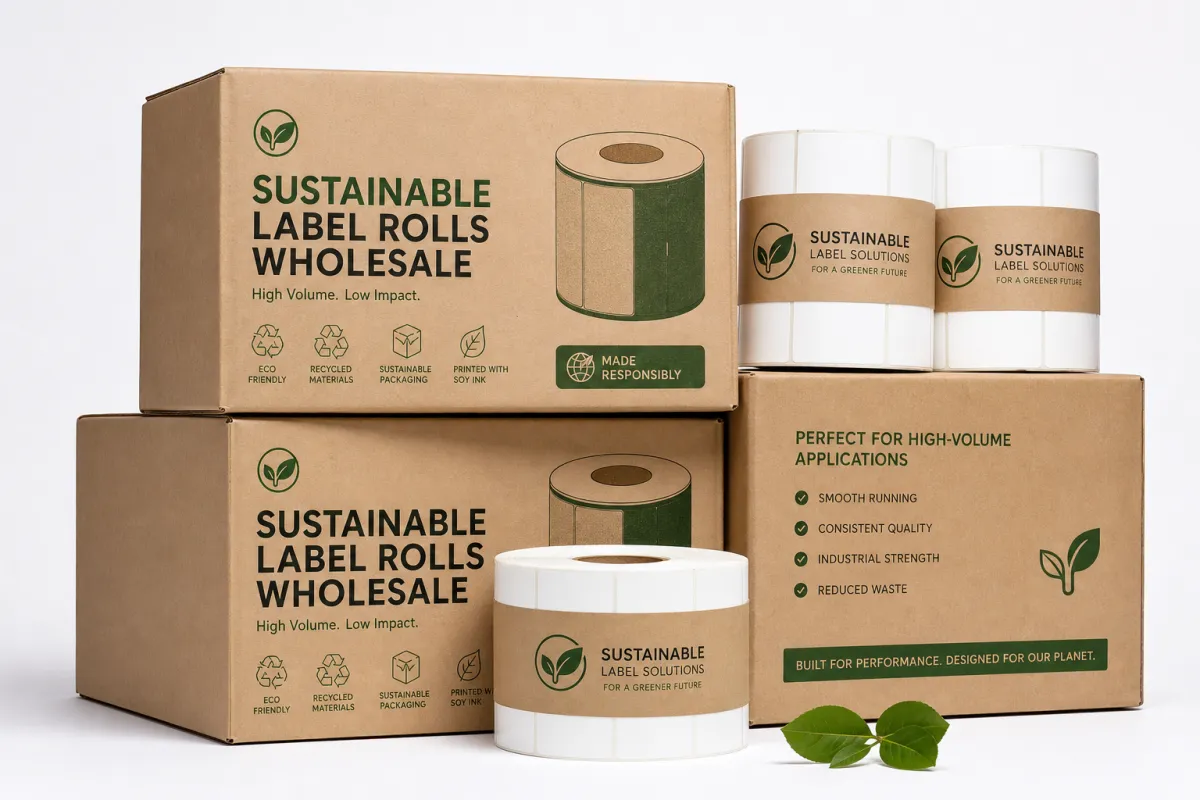
High-volume packing lines do not leave much room for guesswork. A label that curls, skews, or grabs too hard can slow output one case at a time, and those seconds pile up fast across a shift. Sustainable label rolls wholesale has to be judged by how it performs in production, not by a polished claim on a spec sheet. If a roll runs cleanly, it usually saves material, labor, and frustration all at once.
A bad spec can create more waste than the sustainability story saves. If the core is wrong, the roll sits poorly in the dispenser. If the unwind is wrong, the label peels badly and starts feeding problems. If the adhesive does not suit the box or bottle surface, people start pulling off failed labels and applying replacements by hand. That is not responsible packaging. That is just expensive, and kinda annoying for everyone involved.
The useful questions are direct: does the roll feed the way the line expects, does the adhesive behave on the target surface, and does the label width stay within the machine’s comfort zone? Sustainable label rolls wholesale works best when the material, adhesive, and roll format are matched to the actual production setting rather than to a marketing message. That is the part that separates a decent order from one that keeps paying for itself.
Practical rule: if a label saves a little material cost but slows the line even slightly, it is probably the wrong label. Sustainable sourcing should cut waste, not move it somewhere less visible.
For brands shipping at scale, the value is clear. Sustainable label rolls wholesale should reduce purchase cycles, keep artwork and specs stable from reorder to reorder, and make inventory planning easier to trust. That means fewer surprises, fewer emergency substitutions, and fewer moments where the team has to ask why a batch behaves differently from the last one. Those questions cost time, and they are rarely fun to answer.
- Operational gain: steady feeding through manual and automatic application.
- Waste reduction: less scrap from curl, misalignment, and residue.
- Buying benefit: repeat orders with locked specs and clearer forecasting.
- Sustainability gain: right-sized materials and less rework across the run.
The strongest buyers start with one practical question: will this label work on my line? If the answer is fuzzy, the quote is not ready yet. Sustainable label rolls wholesale is supposed to make production easier, not add another variable to manage.
Product Details: What You Actually Get in a Roll Order
A roll order looks tidy from the outside. It rarely is. A proper sustainable label rolls wholesale specification has several parts, and each one affects fit, feed, and print quality. The main pieces are roll width, outer diameter, core size, unwind direction, face stock, liner, and adhesive. Leave one out, and the simple order turns into a troubleshooting session.
Roll width and outer diameter determine whether the labels fit a dispenser or printer correctly. A small desktop printer may only accept a 1-inch core and a tighter roll diameter. An automatic applicator may need a 3-inch core, a specific unwind, and a maximum outer diameter so the roll does not bind. Sustainable label rolls wholesale depends on actual measurements, not estimates pulled from memory or a sample that happened to be close enough.
Face stock is the visible label material. It may be recycled paper, FSC-certified paper, uncoated stock, or a more durable film if the application calls for it. Liner is the carrier behind the label. Adhesive is what keeps the label attached to the package surface. Print method matters too, since digital, flexo, and thermal transfer each respond differently to material and coating choices. Manual application can tolerate a little more flexibility. Machine application usually needs tighter tolerances. That is just how the equipment behaves.
Common applications include shipping labels, barcode labels, ingredient labels, product labels, and Branded Packaging Stickers. The best sustainable label rolls wholesale orders are built around the use case rather than a broad “eco label” category. A shipping label that lives indoors for a few days does not need the same finish as a refrigerated product label. A shelf-facing retail label needs a different print surface than a warehouse tracking label. One-size-fits-all sounds neat on paper, but it usually fails the first real test.
Wholesale buyers should also expect batch-to-batch consistency. That means the same label count per roll, the same carton spec, and the same print result every time the order repeats. For a packaging program that reorders each month, stable behavior matters more than a one-time discount. Cheap labels that vary from pallet to pallet are not cheap for long. The hidden cost shows up in downtime and rework, and it shows up fast.
- Core size: commonly 1 inch, 1.5 inch, or 3 inch.
- Unwind: top, bottom, left, or right, depending on the dispenser or printer.
- Roll count: matched to application speed and changeover frequency.
- Packing: carton counts and palletization should be confirmed before production.
When buyers compare suppliers, a useful file pack includes the dieline, the application method, the substrate preference, and the expected temperature or moisture exposure. That may not sound exciting, but it saves real time and real money. Procurement rarely needs glamour. It needs fewer surprises and fewer corrections after the fact.
Sustainable Label Rolls Wholesale Specs: Materials, Adhesives, and Finish
The material conversation is where sustainable label rolls wholesale starts to separate careful buyers from hopeful ones. A label can qualify as sustainable for different reasons: recycled content, FSC sourcing, lower material weight, reduced liner waste, or better runnability that cuts scrap. No single material solves every need. The right choice depends on the package, the line, and the environment the label has to survive.
Recycled paper is often the first place buyers start. It is a practical fit for shipping labels, product labels, and many branded applications that do not need strong moisture resistance. FSC-certified paper is another solid option when chain-of-custody matters. Buyers who need a clearer responsible-sourcing claim often prefer it because the standard is easy to explain to a compliance team or retailer. Verification matters too, and the FSC system gives that claim more substance than vague green language ever could.
Compostable-looking paper alternatives get plenty of attention, though appearance is not the same as certification. If a buyer expects municipal compostability or industrial composting, the specification has to prove it. Otherwise the label may look sustainable without fitting any real disposal stream. That is presentation, not responsibility.
Adhesive choice is where many wholesale orders drift off course. Permanent adhesive is the standard when the label needs to stay put. Removable adhesive is better for temporary promotions, warehouse relabeling, or surfaces that should not be damaged. Freezer-safe adhesive is designed for low temperatures, and high-tack adhesive helps on rough corrugate or textured packaging. In sustainable label rolls wholesale, the adhesive has to match the surface and the environment, or the label becomes waste the moment it is applied.
Finish matters too. Matte creates a softer look and works well for writeable or utilitarian labels. Gloss can improve shelf impact and deepen color. Uncoated stock is easy to write on and often fits shipping or batch coding. Varnish can add protection without the heavier footprint of full lamination. Lamination has its place when abrasion or moisture is a real risk, but it should not be treated as a default. A dry carton label that never sees friction usually does not need that much protection.
Print compatibility deserves a direct answer. Thermal transfer, digital print, and flexo all react differently to surface coating and liner type. A supplier that understands sustainable label rolls wholesale should be able to tell you whether the material holds ink, resists smudge, and stays readable after handling. Barcode scannability is not optional. A label that looks good but fails a scan test is just decoration.
Practical testing standards help here. For shipping and distribution labels, buyers often refer to durability and transport behavior under standards from groups like ISTA. That does not mean every label needs a transport abuse test, but it does mean the spec should match the package’s real handling conditions.
| Material Option | Best Use | Typical Advantage | Tradeoff | Usual Cost Impact |
|---|---|---|---|---|
| Recycled paper | Shipping, product, barcode labels | Simple sustainability story, good printability | Lower moisture resistance | Baseline to slight premium |
| FSC-certified paper | Retail and branded packaging | Clear responsible sourcing claim | Certification requirements add review time | About 5% to 12% higher |
| Uncoated paper | Writeable or short-life labels | Good for batch coding and quick application | Less abrasion resistance | Often the lowest-cost paper choice |
| Durable film with responsible sourcing claims | Cold chain, moisture, rough handling | Strong durability and scuff resistance | Harder sustainability narrative, higher cost | About 15% to 30% higher |
That table is the kind of detail most buyers need and many vendors avoid. Sustainable label rolls wholesale works best when the tradeoffs are visible before the order is cut. Once the buyer knows the environment, the line speed, and the label’s required lifespan, the material choice becomes much easier to defend.
The smartest move is usually to choose the lightest, simplest spec that still survives the actual use case. If the label only lives three days in a dry carton, there is no reason to pay for overbuilt durability. If the label goes onto chilled glass or rough recycled corrugate, under-specifying it to save a few cents is a false economy that comes back through the back door.
Sustainable Label Rolls Wholesale Pricing, MOQ, and Unit Cost
Pricing for sustainable label rolls wholesale depends more on spec than on volume alone. Buyers often ask for the best price, though that phrase is too vague to be useful on its own. Material choice, print coverage, size, adhesive, finish, and order quantity all move the number. A plain recycled paper roll with minimal print coverage is not priced the same way as a custom-shaped, full-color, freezer-safe label with tight tolerances. Treating them as if they should cost the same only wastes time.
A practical way to think about it looks like this. For moderate wholesale runs, simple paper label rolls can land around $0.02 to $0.08 per label depending on size, print coverage, and quantity. More complex builds with specialty adhesive, heavier ink coverage, or premium finishing can move into the $0.08 to $0.20 range or higher. That is not a promise. It is a working range. The final number depends on the spec, and anyone pretending otherwise is selling a story rather than a quote.
MOQ is where new buyers often get caught. Lower minimums are useful for testing, but they rarely produce the best unit cost. Once the artwork is locked, the die is confirmed, and the spec stays stable, larger repeat orders usually become far more efficient. That is one of the quiet benefits of sustainable label rolls wholesale: a buyer can test with a smaller run, then scale once the line behavior is proven.
Ask for three quote formats whenever possible. First, per-label pricing. Second, per-roll pricing. Third, landed cost with freight included. A cheap unit price can hide costly shipping, inefficient carton packing, or roll lengths that force more machine changeovers. The lowest number on the page is often the least honest one. Not always, but often enough to make you look twice.
Common cost traps tend to show up in the same few places:
- Over-specifying finish: paying for gloss, varnish, or lamination when the label never sees abrasion.
- Wrong roll length: forcing too many changeovers, which adds labor and slows throughput.
- Unclear adhesive: choosing a premium adhesive because the surface was not described well enough.
- Excess print coverage: using full coverage where a simpler layout would do the job.
- Reorder mismatch: changing specs later and losing the cost advantage of repeat production.
For teams comparing programs, a side-by-side view helps:
| Order Type | MOQ Behavior | Typical Lead Time | Price Position | Best For |
|---|---|---|---|---|
| Stock-style recycled paper rolls | Lower MOQ | Faster | Lowest | Testing and repeat shipping needs |
| Custom printed FSC paper rolls | Moderate MOQ | Moderate | Mid-range | Brand packaging and regular reorder programs |
| Specialty adhesive or freezer-safe rolls | Higher MOQ often applies | Longer | Higher | Cold chain, rough surfaces, demanding environments |
| Highly custom roll specs | Highest MOQ | Longest | Highest | Strict applicator fit or premium retail launches |
Sustainable label rolls wholesale should be quoted so the buyer can compare like for like. If one supplier includes freight, proofing, and packing detail while another gives a flat figure with no context, the flat figure is not the better deal. It is simply less complete.
Process and Timeline: From Quote to Delivery
A clean order process makes sustainable label rolls wholesale easier to buy and easier to repeat. The workflow should be clear enough that procurement, brand, and production can all follow it without a chain of unnecessary meetings.
The process usually starts with a quote request. The best requests include label dimensions, core size, roll count, unwind direction, application method, substrate preference, target print method, and expected order quantity. If there is an existing label or a photo of one, include that too. It helps compare the spec against a real example instead of a vague description. For sustainable label rolls wholesale, detail cuts rework.
Proof review comes next. Artwork alignment, barcode placement, bleed areas, and copy placement all get checked here. Missing dimensions slow the process down. So does asking for “something eco-friendly” without any material guidance. The proof stage is the last practical chance to fix a problem before production begins.
A sample or pre-production check follows, especially when the label will run on an applicator or in a cold environment. One test roll exposing a feed issue is far cheaper than finding the same issue after a full shipment reaches the dock. Good sustainable label rolls wholesale programs build in that check instead of treating it as a luxury.
Lead times vary by complexity. Repeat orders with known specs move faster. Custom materials, custom shapes, exact color matching, and specialty finishes add review time. As a planning range, repeat label rolls may ship in roughly 7 to 12 business days after approval, while more custom runs often need 12 to 18 business days or more. If the order depends on specialty material sourcing, add extra buffer. That is not pessimism. That is just sane procurement.
The biggest delays usually come from incomplete measurements, vague adhesive requirements, and artwork files that need cleanup. Each of those problems is avoidable, though buyers still send incomplete specs all the time. Sustainable label rolls wholesale works best when the buyer treats the quote process like part of production rather than a quick email exchange.
Timing matters even more for launches and seasonal programs. If labels are tied to a product release, build enough room for proofing, sample checks, and a reprint buffer if needed. Discovering a roll issue two days before shipment is a reliable way to lose a week.
- Request stage: gather size, core, material, adhesive, and quantity.
- Proof stage: review artwork, dieline, and barcode placement.
- Test stage: run a sample on the actual printer or applicator.
- Production stage: lock the spec and move the full run.
- Delivery stage: confirm carton count, pallet plan, and reorder notes.
The process is not complicated. It just needs to be followed. Sustainable label rolls wholesale becomes much easier when everyone agrees on the spec before the first roll is made.
Why Choose Us for Sustainable Label Rolls Wholesale
For buyers, the real value is not a slogan. It is fewer problems. Sustainable label rolls wholesale from Custom Logo Things is built around accurate specs, repeatable quality, and clear communication so the labels perform the way the line expects them to perform. That sounds basic because it is basic. In packaging, basic is often the best result. Basic keeps production steady.
We focus on the practical side of the order: the material that fits the use case, the adhesive that holds without creating cleanup problems, and the roll setup that works with the printer or applicator. That is the difference between an attractive quote and a usable order. If you are buying sustainable label rolls wholesale, you need the order that works on the floor, not just the one that looks good in an inbox.
Buyers also deserve honest tradeoffs. Not every sustainable option suits every packaging program. Recycled paper is excellent for many labels, though not for every cold-chain application. FSC paper is a strong choice for responsibly sourced packaging, but it still needs the right adhesive and print setup. A durable film can be the correct answer in a harsh environment, even when it is not the easiest sustainability story to tell. Real procurement is full of those compromises. Pretending otherwise does not help anyone.
Support matters because the spec conversation can get messy quickly. We help with material guidance, proof review, and practical advice on roll length, core size, and application fit. That reduces the chance of ordering the wrong configuration and helps avoid a second run just to correct the first one. Sustainable label rolls wholesale should make reorder planning easier, not harder.
For brands managing multiple packaging formats, one supplier can make the detail work simpler. That matters even more when matching labels must stay aligned across product lines. If you also need matching Custom Labels & Tags or want a broader ordering structure through our Wholesale Programs, it is easier to keep specs consistent from one item to the next. Fewer suppliers. Fewer mismatched assumptions. Less cleanup for your team.
Buyers usually care most about stable quality, straight pricing, and reorder consistency. Those are the things that prevent line stops and emergency substitutions. A label order should not turn into a weekly project. Sustainable label rolls wholesale should arrive, feed, stick, and repeat. That is the standard.
Bottom line: the best wholesale label program is the one your team barely has to think about after approval. If the labels keep working, nobody misses the drama.
We also keep the spec grounded in responsible sourcing without turning the order into a science experiment. If a buyer needs recycled content, FSC traceability, or a lower-waste roll format, we can shape the quote around those needs. If the label has to survive moisture, abrasion, or cold storage, we say that plainly too. The value of sustainable label rolls wholesale is not in claiming everything. It is in getting the right thing.
Actionable Next Steps Before You Request a Quote
If you want a useful quote for sustainable label rolls wholesale, gather the basics first. Better input means less back-and-forth later, and that saves time on both sides. That is not a sales trick. It is just how production works.
Start with the label size. Confirm the core size, unwind direction, roll count, and whether the labels will be applied by hand or by machine. Add the substrate preference if you already know it, such as recycled paper or FSC-certified paper. Then share the target quantity and the reorder rhythm. If you reorder every month, say so. That changes the conversation. Sustainable label rolls wholesale is much easier to quote when the usage pattern is clear.
If possible, send a sample image or a current spec sheet. Even a phone photo can help identify waste drivers. A label that is too large, too glossy, too sticky, or too short on the roll can often be improved before the first dollar is spent. Adjusting the spec is usually better than paying for a mistake. Funny how that still counts as good service.
Then compare three things side by side: material cost, application speed, and reorder consistency. The cheapest label is not the best if it slows the line or changes behavior from batch to batch. The cleanest sustainable label rolls wholesale decision usually sits where those three factors stay balanced.
- Request samples: test the label on the real surface, not a theory.
- Confirm artwork: check size, barcode placement, and compliance text.
- Approve the spec sheet: lock material, adhesive, roll format, and count.
- Plan the reorder: set a threshold so you do not rush the next run.
- Document the winner: save the spec that worked so future orders stay consistent.
That last step matters more than people expect. A good label program is a repeatable one. Once the winning spec is approved, keep it on file and use it. No mystery versions. No quiet substitutions. No “close enough” adjustments that end up costing more later.
If you are ready to compare options, ask for a quote with exact measurements, material preference, adhesive type, and application method. That is the clearest path to a real number. If the goal is to keep the line moving while reducing waste, sustainable label rolls wholesale is the right place to start.
For packaging buyers who want fewer surprises and more control, sustainable label rolls wholesale gives you a practical way to buy with clearer specs, less waste, and better repeatability. The next step is simple: lock the right material, adhesive, and roll format before the first order goes to press.
What makes sustainable label rolls wholesale actually sustainable?
The sustainability comes from the substrate, adhesive choice, and waste reduction, not just the marketing line on the carton. Recycled content, FSC-certified paper, right-sized roll specs, and cleaner feed all help. A roll that runs without misfeeds or reprints is usually more sustainable than a fancy material that creates production waste.
How do I choose the right adhesive for wholesale label rolls?
Match the adhesive to the surface and environment. Permanent adhesive suits long-term hold, removable adhesive works for temporary use, and freezer-safe or high-tack options are better when temperature or surface texture demands it. Test on the actual package before you place a large order. If the label lifts or leaves residue, the run gets expensive fast.
What MOQ should I expect for sustainable label rolls wholesale?
MOQ depends on size, material, print complexity, and whether the order is stock or fully custom. Smaller MOQs are useful for testing, but larger repeat orders usually lower unit cost. Ask for MOQ by spec so you can compare like for like instead of getting fooled by a vague low number.
How long does production usually take for custom label rolls?
Simple repeat jobs move faster than custom materials, custom die shapes, or exact color matching. The main time sinks are proof approval, artwork cleanup, and material sourcing. If your launch date matters, build in time for a sample check before full production. That buffer is cheaper than a rush reprint.
Can I get a quote for eco-friendly label rolls wholesale with specific specs?
Yes, and a good quote should include material, adhesive, size, roll count, and print coverage. Share your application method and line speed so the recommendation fits the actual use case. The better the spec sheet, the less back-and-forth you need before pricing gets real.


