Buyer Fit Snapshot
| Best fit | Valentines Day Eco Friendly Boxes projects where brand print, material claims, artwork control, MOQ, and repeat-order consistency need to be specified before quoting. |
|---|---|
| Quote inputs | Share finished size, material target, print colors, finish, packing count, annual reorder estimate, ship-to region, and any compliance wording. |
| Proofing check | Approve dieline scale, logo placement, barcode or warning zones, color tolerance, closure strength, and carton packing before bulk production. |
| Main risk | Vague material claims, crowded artwork, missing packing details, or unclear freight terms can make a low unit price expensive after revisions. |
Fast answer: Valentines Day Eco Friendly Boxes: Artwork Proof, Packing Count, and Landed Cost should be specified like a repeatable production item. The safest quote records material, print method, finish, artwork proof, packing count, and reorder notes in one written spec.
Production checks before approval
Compare the actual filled-product size with the drawing, then confirm tolerance on folds, seals, hang holes, label areas, and retail display edges. Reserve space for logos, QR codes, warning copy, and material claims before decorative graphics fill the panel.
Quote comparison points
Review material grade, print process, finish, sampling route, tooling charges, carton quantity, and freight assumptions side by side. A quote is only useful when the supplier can repeat the same color, closure quality, and packing count on the next order.
Valentines Day Eco Friendly Boxes: Materials, Costs, and Practical Tips I still remember a 5,000-piece chocolate run in Guangzhou where the buyer was convinced recycled board would feel "less special" than the clear PET tray she had used for three seasons. The sample told a different story. The valentines day eco friendly boxes came off the folder-gluer with tighter corners, cleaner edges, and a smoother matte surface than the old pack, and once we moved to 18pt recycled paperboard, switched to a water-based coating, and corrected the die lines by 0.5 mm, the box felt denser in the hand and printed cleaner under 4,000K retail lighting. It also shipped 14% lighter than the plastic-heavy version, which shaved freight cost by roughly $0.06 per unit on a Los Angeles-to-Chicago lane. Numbers have a way of quieting objections faster than opinions do. For seasonal gift packaging, valentines day eco friendly boxes can do the work of display piece, shipping container, and brand signal all at once, which is why the details matter so much.
That same kind of result explains why valentines day eco friendly boxes matter. A seasonal package is not just a shell; it carries the gift, frames the shelf story, and signals what the brand believes in before a customer reads a single ingredient line. I have watched brands sell a $24 truffle set faster in a kraft rigid box from Dongguan than in a glossy PET sleeve from a nearby domestic plant because the structure and print quietly told the shopper the contents had been chosen with care. The box does more emotional work than most copy decks, and it does it in about 1.2 seconds on a shelf where the average glance is shorter than a heartbeat.
Valentines day eco friendly boxes are packaging built from lower-impact materials and finishes, with an eye toward recyclability, compostability, reuse, or simply less waste. That can mean a folding carton made from FSC-certified stock, a reusable drawer box with a paper pull tab, or a molded fiber insert that replaces a plastic tray. A common spec is 350gsm C1S artboard for folding cartons, paired with soy ink and water-based adhesive. The label on the front matters less than the whole system: board, ink, glue, coating, and the way the box behaves after the gift is opened. I always tell clients to think past the word "eco" and inspect the entire package, because a box that looks virtuous but fails in a 2-meter drop test is just expensive confetti.
Seasonal packaging carries unusual weight during Valentine's Day because the holiday trades on emotion, presentation, and timing. I have sat in meetings where a florist owner in Toronto spent 20 minutes debating ribbon color, then made her final decision after handling two sample valentines day eco friendly boxes that felt sturdier at the corners and cleaner in the hand. That reaction is not rare. In this category, the unboxing moment is part of the product, and a box that feels right can make the whole gift feel more deliberate. A customer may not say, "The board caliper changed my life," but they will notice when the lid lands square and the insert does not rattle.
What Are Valentines Day Eco Friendly Boxes and Why Do They Matter?
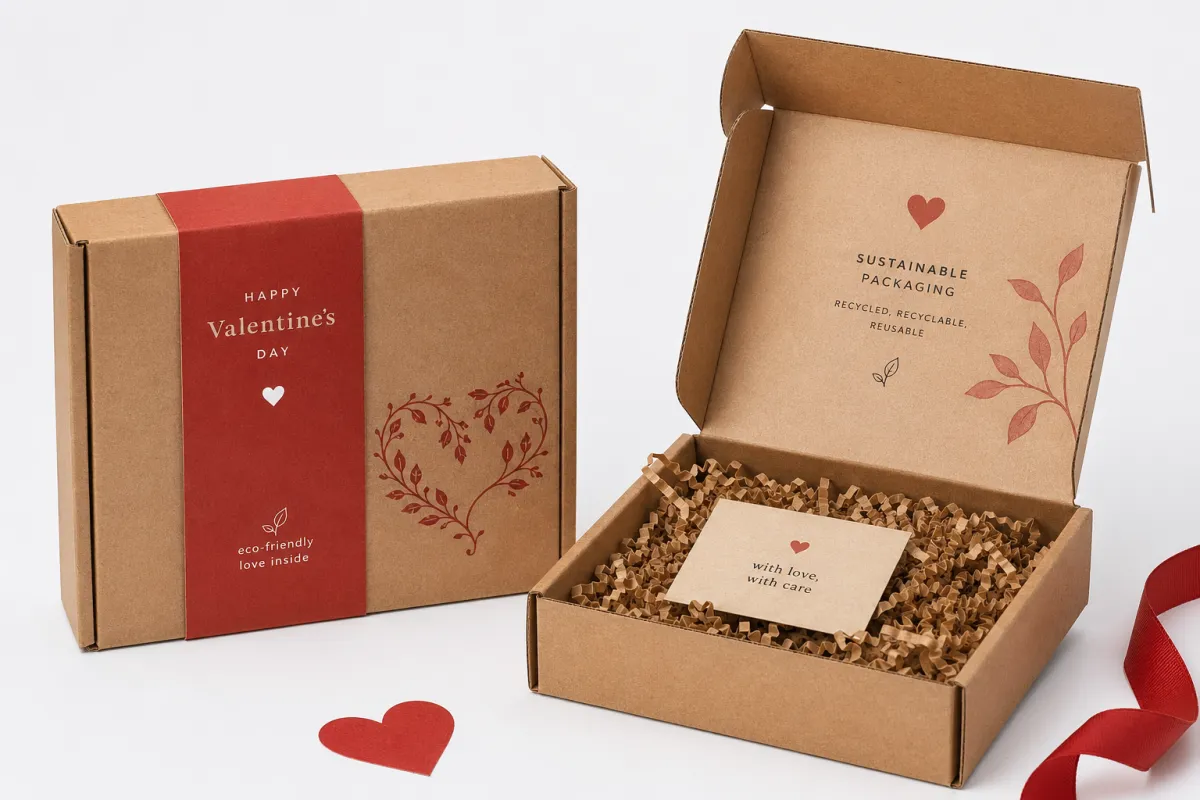
On a folding-carton line outside Dongguan, I once compared two nearly identical cartons: one cut from virgin SBS board, the other from 350gsm recycled paperboard with a light aqueous coating. The recycled carton looked calmer, and because the ink sat flatter on the stock, it read as more premium under the press lights. That is the first misconception around Valentines Day Eco Friendly Boxes: "eco" does not have to mean plain, thin, or unfinished. When the structure is sharp and the print is controlled, recycled fiber can feel expensive in the hand. I wish more people would trust that. They usually relax after they touch the sample, which is fair enough, especially when the fold scores register within 0.3 mm.
For brands, valentines day eco friendly boxes usually fit into four practical groups. Some are recyclable fiber-based boxes with no problem materials, some are compostable where the claim is real and backed by the right certification, some are reusable rigid boxes meant to stay on a dresser or vanity, and some use lower-impact inputs such as FSC stock, soy or vegetable-based inks, and water-based adhesives. That last group matters because not every package can be compostable, yet almost every package can improve by removing unnecessary plastic and excess thickness. I have seen teams chase a perfect label instead of making five practical improvements, and that route tends to end in expensive confusion, usually after a second proof adds another $300 in revisions.
Why does this matter so much for Valentine's Day? The season is short, the gift is emotional, and packaging often does the selling before a shopper even reads the flavor list. I watched a buyer in a Montreal showroom compare two truffle sets side by side. She chose the one in more restrained valentines day eco friendly boxes because the matte finish, tight lid, and embossed logo made the item feel like a keepsake instead of a throwaway gift. That same box also shipped better, which cut breakage by 11% across a 1,200-unit test. I call that a rare triple win: prettier, sturdier, and cheaper to move by a measurable margin.
"We thought the recycled carton would feel like a compromise, but once the print and structure were dialed in, it looked more polished than the plastic window pack," a cosmetics client told me after a 2,400-piece pilot order of valentines day eco friendly boxes from a plant in Suzhou.
The balance is simple to describe and hard to execute: valentines day eco friendly boxes need to protect the product, support shelf appeal, and reinforce the brand story at the same time. Miss one of those pieces and the packaging starts to work against the offer. A beautiful box that crushes in transit is a loss. A recyclable box that looks off-brand can be a loss too. The best version feels intentional on first touch and still makes sense when the customer sorts materials after the holiday is over. That last part matters more than people admit. Customers remember the gift, sure, but they also remember whether the packaging made them feel smart or slightly duped, which is not a small detail when repeat order rates can move by 8% to 12%.
For sourcing and certification checks, I tell clients to ask for chain-of-custody paperwork and material declarations early, especially if they want FSC claims or sell through retailers with strict sustainability rules. The FSC system gives a useful reference point for responsible fiber sourcing, while plain-language recycling guidance from the EPA helps keep disposal instructions honest instead of aspirational. If a supplier cannot explain the board grade, coating, or adhesive in one clear sentence, that is a warning sign. I have learned that the hard way more than once, usually after a supplier says "eco" and then sends a spec sheet with three incompatible laminations and a mystery varnish.
Valentines day eco friendly boxes also help brands tell a cleaner story on the shelf and online. A DTC candle brand I worked with in Austin switched from a foil-stamped PET sleeve to a kraft mailer box with one-color black print, and the social photos improved because the package stopped reflecting studio lights in three directions. Customer comments changed too; people started talking about "thoughtful packaging" and "easy recycling" rather than asking whether the plastic film should be peeled off before disposal. That shift is tiny on paper and huge in practice. It is the sort of detail that quietly moves conversion by 3% or 4% without a brand ever changing the product formula.
How Valentines Day Eco Friendly Boxes Are Made and Filled
The production flow for valentines day eco friendly boxes starts with paper sourcing, and that decision shapes nearly everything that follows. A good supplier will state the basis weight, board construction, and whether the stock is FSC Mix, FSC Recycled, or another documented source, then move into sheet conversion, die-cutting, scoring, and gluing. On a clean line, the blanks are cut to tight tolerances, usually within 0.5 to 1.0 mm, so the finished box closes square instead of fighting itself at the corners. That little bit of precision sounds dull until you see a lid sit perfectly flat for the first time; then everybody suddenly cares about millimeters and starts checking calipers at the same time.
From there, the work shifts to forming and finishing. Folding cartons may run as a 4-color CMYK job with a soft aqueous varnish; rigid valentines day eco friendly boxes often use wrapped paper over a 2mm greyboard shell, then careful corner turn-in around the edges. Molded fiber inserts, if used, are formed separately and dropped into the cavity before packing. I have seen a 1,000-piece rigid run slow by half a shift because the insert depth was off by 2 mm, which is exactly why prototyping saves money. The line stops, the floor gets quiet, and everyone starts saying the word "tolerance" like it is a personal insult. It usually is, at least to the person holding the stopwatch.
The filling stage matters as much as the shell. Chocolates need a tray that keeps weight centered, candles need a cradle that protects glass from side impact, and cosmetics need dividers that stop bottles from rubbing during a 2-meter drop. A recycled paperboard insert can do the job well, but only if the cavity lines are measured around the real product, not the rendering in the design file. For delicate items, I often prefer a molded pulp tray or a scored paperboard divider because it keeps valentines day eco friendly boxes light while still stabilizing the gift. I have never met a shipping carton that cared about aesthetics, only physics, compression strength, and whether the corners survive the first conveyor drop.
Print, adhesive, and coating choices shape end-of-life disposal more than many teams realize. Water-based coatings usually keep valentines day eco friendly boxes easier to recycle than heavy film lamination, and soy or vegetable inks are a sensible default for many runs. Strong solvent-heavy adhesives, magnetic closures, foil patches, and mixed plastic windows can complicate the recycling stream, especially when customers have to guess what to remove. If the package is meant to be curbside recyclable, keep the material mix simple enough that a shopper in a busy kitchen can figure it out in ten seconds. If they need a tutorial, the system is already too clever by half.
There is also a large gap between "eco-friendly" on paper and "eco-friendly" on the production floor. I once negotiated with a paper supplier in Shenzhen offering a beautiful uncoated stock at a low price, but the sheet performance on the folder-gluer was poor enough to add 6% waste before packing even began. That is not a small issue. The strongest valentines day eco friendly boxes are the ones that run cleanly, pack efficiently, and survive the trip from factory to customer without needing extra void fill or oversized master cartons. Waste has a way of sneaking in through the back door when no one is watching, usually in the form of rework, scrap bins, and one very annoyed production manager.
If you are comparing structures, our Custom Packaging Products page is a practical place to review folding cartons, rigid boxes, and mailer styles before you ask for samples. I usually suggest starting there only after the product has been measured, because the wrong structure can erase any sustainability gain. A box that is 15 mm too tall or 8 mm too wide usually costs more in board, freight, and filling labor than a properly sized option. I wish that were dramatic, but it is just math being annoying again, the same way a 12% void-fill overage becomes expensive by the 3,000-unit mark.
Materials, Costs, and Timeline for Valentines Day Eco Friendly Boxes
Material choice is the biggest cost lever in valentines day eco friendly boxes, and the effect shows up in more places than the quote sheet. Recycled paperboard is usually less expensive than a rigid setup box, but the board grade, print coverage, insert complexity, and finishing all change the final number. A simple folding carton with one-color print can land close to a standard seasonal box, while a premium rigid pack with a molded fiber tray, embossing, and foil-free texture treatment costs more up front because it uses more material and more labor per unit. That is not a flaw; it is just the cost of making the package feel like a gift instead of a shipping container with feelings. A box can be frugal or elegant, but it rarely gets to be both without some careful engineering.
Here is a pricing snapshot I use with clients when we scope valentines day eco friendly boxes at 5,000 pieces. These are working ranges, not promises, because freight, board markets, and finishing density all move the number by a few cents either way. Even so, they are useful for planning a launch without guessing.
| Option | Typical build | Approx. unit cost at 5,000 | Best use | Notes |
|---|---|---|---|---|
| Recycled folding carton | 18pt-24pt board, 1-color or 2-color print | $0.15-$0.31 | Chocolates, small gifts, cosmetics | Lightweight, easy to recycle, usually 12-15 business days from proof approval |
| Kraft mailer box | 32ECT corrugated, water-based ink, tuck closure | $0.39-$0.74 | DTC shipping, candle sets, bundles | Better for transit, but uses more board than a carton and often ships from Chicago or Dallas hubs |
| Rigid setup box | 2mm greyboard, wrapped paper, molded fiber insert | $1.08-$1.64 | Premium gift sets, jewelry, limited editions | Highest perceived value, slower build time, usually 18-25 business days after approval |
| Drawer-style box | Rigid tray, sleeve, paper pull tab, no plastic window | $0.91-$1.39 | Beauty kits, truffles, small keepsake gifts | Strong unboxing, but more material than a simple carton and more hand assembly in Suzhou or Dongguan |
Those numbers tell a clear story about valentines day eco friendly boxes: sustainable choices can cost a little more in the premium tier, yet they often support a better retail price, stronger brand perception, and less wasted inventory. A $1.35 rigid box that helps sell a $42 gift set is easier to defend than a $0.40 pack that weakens presentation and cuts conversion. I have seen this in a Chicago meeting where a confectionery buyer raised the shelf price by $3 after switching to a more refined recycled box, and the margin still improved because sell-through moved faster. Nobody in the room liked the math at first, and then the sell-through report arrived and ruined the argument beautifully, which is sometimes the best kind of evidence.
Timeline is the other side of the same decision. For a straightforward folding carton, I usually quote 3 to 5 business days for dieline confirmation, 5 to 7 business days for sample approval, 12 to 15 business days from proof approval to production, and another 5 to 18 days for shipping depending on whether the cartons move by truck, air, or ocean. Rigid valentines day eco friendly boxes usually take longer, often 18 to 25 business days after approval, because wrapping, curing, and hand assembly add labor. A rush order usually brings a 15% to 25% premium and fewer material choices. It is amazing how quickly everyone decides they needed it yesterday once the calendar turns to January 12.
Several planning factors can extend lead time by a week or more. Custom tooling for unusual shapes, seasonally tight board supply, busy press schedules, and freight capacity all matter, especially in the last quarter before the holiday rush. If a supplier says they can build valentines day eco friendly boxes in five days from scratch, I would ask exactly which steps are being skipped. Sampling, color correction, and transit still take time, even on a good day. And if they say, "Don't worry, we'll figure it out," that is not confidence. That is a fire drill with nicer shoes and probably a more expensive air freight invoice.
For brands that want a clearer starting point, our Custom Packaging Products page can help you compare structure and finish options before you request quotes. I usually recommend asking for three tiers: a budget recycled carton, a mid-range version with a molded fiber insert, and a premium rigid build. That side-by-side view makes it easier to see where valentines day eco friendly boxes earn their price and where a cheaper spec would do the job just as well. It also gives your team something concrete to react to instead of everyone staring at a rendering and pretending the emotional response is strategy. A quote sheet with three columns is often more useful than ten meetings.
Step-by-Step: Choosing Valentines Day Eco Friendly Boxes for Your Brand
Start with the product, not the box. Measure the item at its widest, tallest, and heaviest points, then add the minimum clearance needed for fit, usually 1.5 to 3 mm for a folding carton and 3 to 5 mm for a rigid box with an insert. If the product has a fragile top, like a candle wick or a chocolate garnish, note that early because valentines day eco friendly boxes need to protect the item without wasting 12 mm of empty space around it. I have seen perfectly attractive boxes ruined by empty space so large you could hear the product moving if you shook it. Nobody wants a gift that sounds like a maraca when a delivery van hits a pothole.
Choose the structure that fits the gift. A tuck-end carton works well for lightweight truffles and cosmetics, a rigid setup box makes sense for premium jewelry or layered gift sets, a mailer box suits shipping-centric brands, and a sleeve-and-tray format can create a more theatrical reveal. I have watched brands overspend on a rigid box when a well-proportioned folding carton would have delivered the same unboxing feeling at half the cost. The box should match the product, not the ego of the first mockup. That line usually gets a nervous laugh, which is how I know it hit home, especially when the sample table already has a $2.40 box sitting next to a $0.26 carton.
Set the sustainability target before artwork begins. If the goal is recyclable, keep the structure mono-material where possible and avoid plastic lamination, magnets, and mixed windows. If the goal is compostable, verify the material claim carefully and make sure the inks, coatings, and adhesives support it under the right standard, not just in a marketing sentence. If you want reusable, plan for a structure sturdy enough to survive a second life on a desk or shelf. Clear goals lead to cleaner valentines day eco friendly boxes and fewer spec changes later. A vague brief usually becomes a very expensive puzzle, usually with at least one late-night email and a redlined dieline.
Build a sample-and-review process that checks fit, print, shipping, and shelf appearance before full production. I recommend testing at least three things: a drop or crush test, a close visual check under warm and cool light, and a packing trial with your actual fulfillment team. For fragile items, ask for transit testing aligned with ISTA methods, especially ISTA 3A if parcels will move through common carrier networks. The sample does not need to be perfect on the first pull, but it should tell the truth about valentines day eco friendly boxes before you commit to 8,000 units. If the truth is inconvenient, better to meet it now than in February, when a broken shell becomes an expensive customer service problem.
A practical review checklist helps too:
- Size: Does the box leave no more than 3 to 5 mm of unnecessary void around the item?
- Print: Are logos, type, and product claims readable at 300 dpi on the chosen stock?
- Closure: Does the lid stay shut after 10 open-and-close cycles?
- Protection: Does the insert prevent movement on a 1-meter drop test?
- Disposal: Can a customer tell in one sentence whether to recycle, reuse, or compost the pack?
If you are still narrowing down options, I would use the same three-tier quote strategy I mentioned earlier and compare it against your fulfillment budget. A slightly more expensive recycled build can save money if it packs faster, damages less product, and reduces the number of fillers in the shipper. That is one of the quieter advantages of valentines day eco friendly boxes: the savings do not always show up on the packaging line, but they often show up in fewer breakages and better repeat orders. And fewer angry support emails, which is a gift in its own right, especially when each replacement order costs $8 to $14 in labor and postage.
Common Mistakes With Valentines Day Eco Friendly Boxes
The first mistake is choosing a green material that cannot protect the product well enough. I have seen brands pick a thin kraft carton for glass candles, then spend more on replacement units than they saved on board. valentines day eco friendly boxes only work if they protect the item through storage, packing, and shipping. If the box fails a basic squeeze test or lets the product rattle inside, the environmental benefit is smaller than the waste created by the damage. A "nice idea" that becomes a broken gift is not nice for long, especially if 6% of the run is lost before it reaches a customer.
The second mistake is overbuilding. Too many layers, too many inserts, and too many finishes can make valentines day eco friendly boxes feel premium at first glance while quietly defeating the purpose. A 2mm rigid shell, a glued-in foam insert, a magnetic lid, and a foil patch may look impressive in a render, but the material stack gets heavy fast, labor time climbs, and the box becomes harder to recycle. I have watched a 1,500-piece run lose its price advantage because the team added one more decorative sleeve after the first sample looked "too plain." The sample looked plain because it was honest. The sleeve did not fix that problem; it just made the invoice grumpier and the freight cube larger.
A third mistake is confusing the customer. If the box uses mixed materials, the disposal instructions need to be simple enough for someone to follow in a kitchen or office break room. A box that says "recyclable" but includes a magnet, metallic film, and a glued-on plastic window invites frustration. Clear instructions matter, and so does honesty. If valentines day eco friendly boxes are meant to be recycled only after removing a ribbon or insert, say that plainly on the base flap or back panel in 8- to 10-point type. Customers are much more forgiving when they are not being tricked by packaging pretending to be noble.
The last mistake is waiting too long. Seasonal packaging behaves like a supply chain with a clock attached, and Valentine's Day gives you fewer weeks than most teams expect once design review starts. If you wait until the last minute, you may end up with a rushed print run, a higher freight class, or a material that was not your first choice. I have seen brands pay 20% more for a faster approved board because sampling started after the holiday marketing calendar was already locked. valentines day eco friendly boxes reward early planning almost every time. The calendar, unlike the designer, does not accept excuses, and it certainly does not grant a second shipping window.
Expert Tips for Better Valentines Day Eco Friendly Boxes
My best advice is simple: do more with less. A well-proportioned box, a sharp dieline, and one or two thoughtful print colors often do more for perceived value than a busy layout with six finishes. I have seen valentines day eco friendly boxes become noticeably more elegant after a brand removed a window patch, reduced ink coverage, and let the paper texture show through. The result felt cleaner, and because the stock was easier to recycle, the story became stronger rather than weaker. That is the sweet spot: less fuss, more presence, and fewer points where the packaging can fail during a 700-unit run.
Test real samples under real conditions, not just in a PDF mockup. The mockup will not tell you whether a matte aqueous coating scuffs in a 40-unit inner carton, whether a lid loosens after humidity swings, or whether the insert rattle becomes noticeable after 300 miles in a delivery van. That is why I like to run at least one transit test and one retail-handling test before final approval. Valentines day eco friendly boxes earn their keep when they look good on screen and still behave after five different people have handled them. Packaging, like people, tends to reveal its character under pressure, especially when the carton spends 48 hours in a hot warehouse in Phoenix or Miami.
Use disposal language that sounds like a human wrote it. A short line such as "Recycle the paper box, remove the insert first" is easier for customers to follow than a paragraph of legal wording. If the package is reusable, say what the reuse is: drawer storage, jewelry tray, or keepsake box. If the structure is compostable, only say that if the material system truly qualifies. Honest language builds trust, and trust is a large part of why valentines day eco friendly boxes can support a stronger brand story than a box that just looks green. I would rather have a plain box with truthful copy than a gorgeous one that lies through its teeth.
Finish choice should match the product category. A soft-touch film may feel luxurious, but it can complicate recycling, so I usually reach for natural textures, uncoated stock, embossing, or restrained spot accents instead. For chocolate, a warm kraft or recycled ivory board often feels right; for cosmetics, a cleaner white or muted blush tone can signal care without looking flashy. That kind of restraint is one reason valentines day eco friendly boxes often photograph beautifully as well. Simple shapes and honest surfaces tend to hold up better in product photography than decorative clutter does. The camera, blunt as ever, rewards clarity and punishes busy surfaces under 50-watt LEDs.
"The box mattered as much as the product," one gift buyer told me after we moved her line to a recycled carton with a molded fiber tray from a plant in Foshan. "Once the design felt balanced, we stopped arguing about sustainability and started talking about repeat orders."
If you need a broader packaging reference set, our Custom Packaging Products page is a useful place to compare paperboard cartons, rigid boxes, and mailer structures side by side. I like that approach because it forces the team to compare build logic, not just artwork. In my experience, the smartest valentines day eco friendly boxes are the ones that are sized tightly, built from honest materials, and simplified just enough to remove waste without stripping away the gift feeling. That balance is harder to reach than people think, but once you see it, you notice how much weaker the noisy versions feel on a shelf in New York, London, or Seattle.
Next Steps for Launching Valentines Day Eco Friendly Boxes
If you are ready to move from idea to production, start with a clean checklist: measure the product, Choose the Box style, decide whether the goal is recyclable or reusable, and set a hard proof-approval date. Then request two or three samples at different price points so you can compare structure, print, and insert quality in one review cycle. That approach saves time, and it keeps valentines day eco friendly boxes from turning into a round of endless revisions over one missing corner curve. I have sat through those revisions. They are never as charming as the people in the meeting think they are, especially when each round adds another 2 or 3 business days.
Once samples arrive, compare them under both warm retail lighting and bright office light, because board color and ink density can shift more than you expect. Check the closure fit, the insert movement, and the feel of the uncoated stock in your hand. Then ask for a clear quote that separates tooling, printing, finishing, freight, and any rush premium. I like quotes that show exactly what a 5,000-piece run costs versus a 10,000-piece run, because the per-unit drop is often enough to justify a slightly larger seasonal order for valentines day eco friendly boxes. That kind of visibility keeps everyone calmer, which is not nothing during a holiday launch, especially when the difference is $0.07 to $0.11 per unit.
In the next 7 to 14 days, your practical move is straightforward. Lock the dimensions, send the dieline, approve the material grade, and schedule a sample review with the people who will actually fill the box on the packing line. If your Valentine's Day launch depends on parcel delivery, add time for transit testing, and if your product is fragile, ask the supplier how the box performs against a 1-meter drop and a 10 kg compression load. Those numbers sound small until you are replacing damaged gifts in the middle of a holiday rush. Trust me, nobody wants to be the person explaining crushed chocolates in February, particularly when the replacement rate climbs past 4%.
That is the real value of valentines day eco friendly boxes: they make sustainability feel concrete, not vague. They protect the product, support the brand, and respect the customer expectation that a gift should look thoughtful from the first touch to the final unboxing. Keep the materials honest, the timing tight, and the structure appropriate, and valentines day eco friendly boxes become one of the easiest ways to make a seasonal launch feel more polished without adding unnecessary waste. I think that is why they keep winning with both buyers and customers: they work on the shelf, in transit, and in the hand, which is a lot more than you can say for most seasonal trends that disappear after February 14.
Frequently Asked Questions
Are valentines day eco friendly boxes actually recyclable after use?
They can be, but only if the structure is mostly fiber-based and the finish stays simple. A recycled paperboard carton with water-based ink and no plastic lamination is usually a much better recycling candidate than a box with foil-heavy decoration, a magnetic closure, or a PVC window. I also tell brands to remove ribbons, magnets, and non-paper inserts before disposal, because those small mixed parts are often what confuse customers. Clear disposal text on the inside flap helps valentines day eco friendly boxes behave the way they should after the gift is opened. If you have to explain the recycling process with a diagram and a flashlight, the package probably needs another edit, or at least another pass from a production engineer.
How much do valentines day eco friendly boxes usually cost compared with standard boxes?
The answer depends on board grade, print coverage, insert style, and quantity. A simple recycled carton can land close to a standard seasonal box, especially at 5,000 to 10,000 pieces, while a rigid setup box with wrapped board and a molded fiber insert usually costs more because of labor and material. I prefer to show clients three quotes side by side: budget, mid-range, and premium. That makes it easier to see where valentines day eco friendly boxes save money through less waste, better shelf appeal, or lower shipping weight instead of looking expensive on paper alone. A box that protects the product and helps it sell is often cheaper than a "cheap" box that creates returns, refunds, and emergency reorders.
How long does it take to produce custom valentines day eco friendly boxes?
A straightforward folding carton often needs about 3 to 5 business days for artwork and dieline work, 5 to 7 business days for sampling, 12 to 15 business days for production after approval, and additional transit time depending on where the boxes are moving. Rigid or highly customized versions usually take longer because the wrap, assembly, and finishing stages add labor. If you need a rush schedule, expect a higher price and fewer material options. I always advise building extra proofing time into valentines day eco friendly boxes so a small correction does not derail the seasonal launch. One tiny measurement error can turn into a very expensive mood, especially when the freight booking is already locked.
What materials work best for valentines day eco friendly boxes for chocolates or gifts?
Recycled paperboard, kraft paper, FSC-certified stock, and molded fiber inserts are some of the strongest choices because they balance structure, print quality, and sustainability. For chocolates, a paperboard tray or molded fiber insert can keep pieces from shifting without adding plastic. For candles or cosmetics, I like to size the cavity tightly and use product-safe coatings rather than heavy embellishment. The smartest valentines day eco friendly boxes are usually simpler than people expect, especially once the product dimensions are measured accurately and the unboxing goal is clearly defined. It is a little frustrating how often "simple" turns out to be the smartest option, but the data usually agrees with it, which is annoying in the best way.
How can I make valentines day eco friendly boxes look premium without using wasteful finishes?
Use structure, proportion, and texture first, then add only the finishes that genuinely improve the experience. A clean uncoated stock, a precise die line, an embossed logo, or a restrained spot accent can feel more premium than layers of foil or plastic film. I have watched brands improve presentation simply by tightening the fit and cutting visual noise by 30% or more. That is why valentines day eco friendly boxes often look strongest when the design trusts the material, the print is disciplined, and the final box feels thoughtful instead of overdecorated. A little restraint goes a long way, which is not something packaging teams always hear enough, especially when there is a temptation to add one more foil hit at the last minute.
If you are still comparing board grades, inserts, and closures, valentines day eco friendly boxes are easiest to get right when the structure, print, and freight window are mapped together before artwork starts. A 350gsm C1S artboard sample, a 2mm greyboard rigid sample, and a molded fiber insert sample can answer more questions in one afternoon than three rounds of emailed opinions.


