Buyer Fit Snapshot
| Best fit | Shipping Carton Burst Strength projects where brand print, material claims, artwork control, MOQ, and repeat-order consistency need to be specified before quoting. |
|---|---|
| Quote inputs | Share finished size, material target, print colors, finish, packing count, annual reorder estimate, ship-to region, and any compliance wording. |
| Proofing check | Approve dieline scale, logo placement, barcode or warning zones, color tolerance, closure strength, and carton packing before bulk production. |
| Main risk | Vague material claims, crowded artwork, missing packing details, or unclear freight terms can make a low unit price expensive after revisions. |
Fast answer: Shipping Carton Burst Strength: Board, Finish, Dieline, and Unit Cost should be specified like a repeatable production item. The safest quote records material, print method, finish, artwork proof, packing count, and reorder notes in one written spec.
Production checks before approval
Compare the actual filled-product size with the drawing, then confirm tolerance on folds, seals, hang holes, label areas, and retail display edges. Reserve space for logos, QR codes, warning copy, and material claims before decorative graphics fill the panel.
Quote comparison points
Review material grade, print process, finish, sampling route, tooling charges, carton quantity, and freight assumptions side by side. A quote is only useful when the supplier can repeat the same color, closure quality, and packing count on the next order.
I still remember the first carton failure that made me stop trusting a clean visual check. The boxes came off the line in Shenzhen looking crisp, the print registration was dead on, and the pallet wrapped up like a textbook example with 3,000 feet of 80-gauge stretch film. Then the load sat in a hot trailer near Guangzhou for 14 hours, one liner substitution changed the board feel, and the cartons started giving way in transit. That shipment turned into a lesson I have repeated ever since: a shipping carton burst strength guide is not about buying the biggest number on a quote sheet, it is about choosing a carton that survives the route you actually ship, not the route you wish you had. If you are building a new packout, the shipping carton burst strength guide should sit next to the product drawing, not behind it.
Most buyers still treat carton strength like a single dial. It never works that way in the plant, and it certainly does not work that way in the warehouse. The shipping carton burst strength guide I use on live programs starts with the product, then the carrier path, then the board build, then the cost per unit. That order keeps waste out of the spec and keeps a buyer from paying for a stronger carton simply because the first sample looked thin in the hand. A box that survives a 20-yard warehouse walk in Dongguan is not the same thing as package protection through pallet stacking, dock storage, route vibration, and a trailer that bakes in July humidity in Texas. I have been burned by that mistake more than once, and it is annoying every time. A good shipping carton burst strength guide keeps that order honest.
Shipping Carton Burst Strength Guide: What It Means
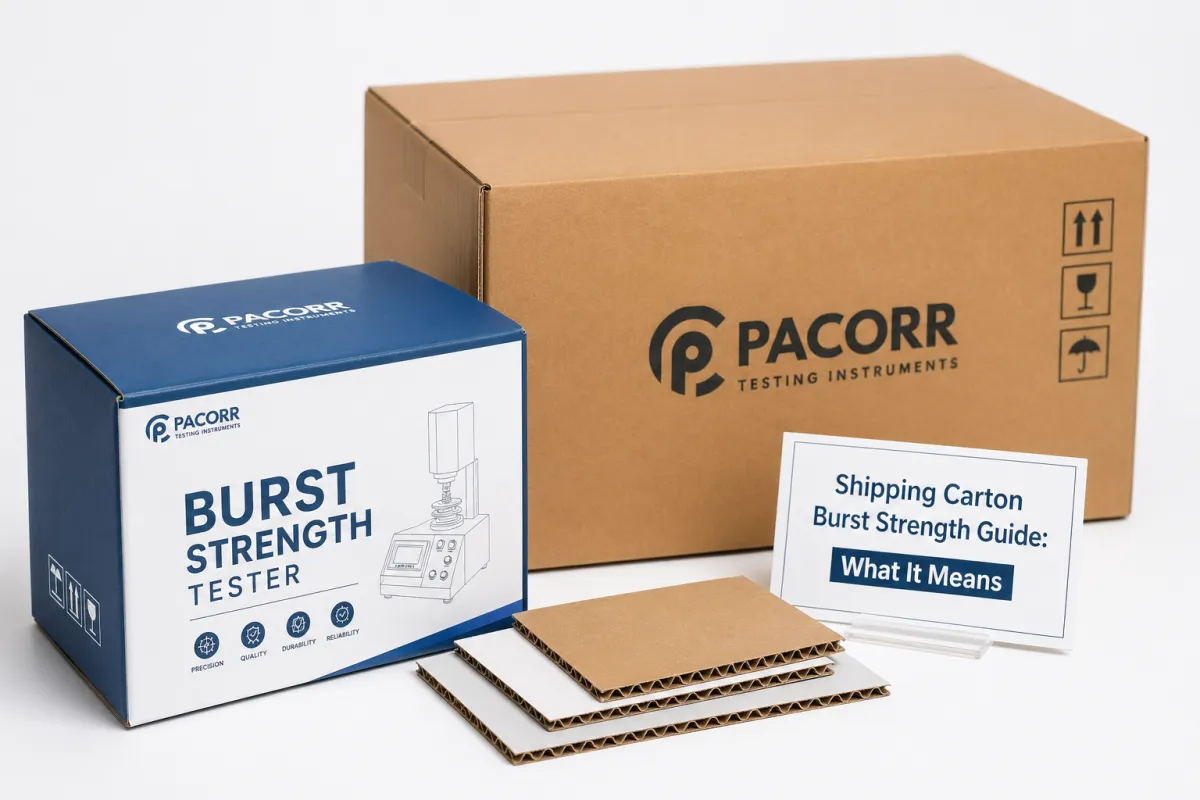
Burst strength is the pressure a corrugated carton can take before the board ruptures. It is a measure of face resistance, not a promise of indestructibility. When I explain the shipping carton burst strength guide to a packaging buyer, I keep it plain: the number tells you how much pressure the paper structure can absorb before it tears or splits under a direct load. If the board is weak, a sharp internal edge, a crushed corner, or a rough transfer from one conveyor to the next can turn a decent shipment into a claim in seconds. On a 275# corrugated shipper, that failure point can still show up if the seam is weak or the glue line is uneven by even 2 to 3 mm. In practice, the shipping carton burst strength guide is a routing tool, not a lab trophy.
That matters because real shipping is not gentle. Cartons get stacked in a fulfillment center near Dallas, dropped onto pallet corners, dragged across stretch wrap, and left near dock doors where the air is wet and the floor stays cold. A carton with a good burst rating gives you margin when the route is rough. A lighter spec can still work, but only if the product is small, centered, and not likely to get shoved around by handlers who treat every truck like a rush job at the tail end of a long shift. I have watched more than one perfect-looking box meet the floor like a bad punchline, usually after a 36-inch drop from a lift table. That is why the shipping carton burst strength guide starts with abuse, not appearance.
The number on the spec sheet is useful, but it is not a complete durability score. It does not tell you how the carton behaves in long compression stacks. It does not tell you whether score lines are too deep, whether the die-cut is pinching the panel, or whether a heavy flood of ink has softened the board at the edges. The shipping carton burst strength guide helps you read the carton, yet it does not replace sample testing with the real product, the real insert, and the real seal pattern. If a carton is built on 350gsm C1S artboard, that is a folding-carton conversation, not a corrugated-shipper conversation, and mixing those terms usually leads to a bad spec and a late-night reprint. The shipping carton burst strength guide is useful precisely because it keeps those categories separate.
“The box did not fail because it looked bad. It failed because the board was wrong for the route.” A plant manager in Suzhou said that to me after we opened a pallet that had been sitting near a dock door through two days of damp air and a 17 degree Celsius temperature swing.
I have watched brands spend too much on a higher burst spec just to feel safer, then turn around and pay freight on a carton that did not need to be that heavy. I have also seen the opposite happen, where a buyer shaved a few cents by dropping one liner grade and then swallowed thousands in replacements after the side seam opened in transit. The shipping carton burst strength guide is really a matching exercise. Match the carton to the route. Match the board to the product. Match the cost to the actual risk. If that sounds obvious, the number of times I have had to say it in a conference room in Atlanta and Monterrey says otherwise. The shipping carton burst strength guide works because it keeps the decision tied to route risk, not gut feel.
For the broader test language behind packaging performance, ISTA lays out shipping test methods that keep the discussion grounded in real abuse scenarios instead of one lab number. If fiber sourcing matters to your team, FSC is a useful reference for certified material supply chains. Neither one replaces hands-on box testing, and both are better used as part of a packaging conversation that stays tied to the actual route, the actual pallet height, and the actual climate lane from Ningbo to Long Beach. That combination is where the shipping carton burst strength guide becomes practical instead of theoretical.
How Do You Test a Corrugated Carton for Burst Strength?
The classic burst test is old equipment doing a job that still matters. A diaphragm pushes against the corrugated board until the board fails, and the result gets recorded as a rating. In a lot of packaging meetings people still call it the Mullen test, which tells you how deeply the language is rooted in plant practice and supplier habit. In the shipping carton burst strength guide, that matters because you are looking at a measured resistance point, not a marketing phrase from a catalog. A lab in Qingdao, for example, may test to a standard protocol while your actual carton still gets crushed by corner pressure on a pallet that sits 6 high in humid storage. The shipping carton burst strength guide only works when the test is read as one part of a bigger transit story.
What belongs on the spec sheet? I want the burst rating, the board construction, and the liner description in plain view. A supplier may show 200# test, 275# test, or another burst-based class, and the corrugated box marking should match the board that is actually shipping. If the outside liner changes, if the flute profile changes, or if recycled content rises sharply, the carton can feel different even when the dimensions stay identical. Two cartons with the same footprint can behave very differently. One can shrug off a light crush. The other can split at a corner when a forklift kisses the pallet wrap. That little “kiss” from a forklift has caused me more grief than I care to admit, especially on 24 x 18 x 12 inch shippers packed to 28 lb gross weight. A careful shipping carton burst strength guide keeps those changes visible.
There is a limit to what the test tells you. It measures board resistance, not every possible shipping abuse case. A carton can carry a respectable burst spec and still fail if the product is heavy on one side, if the insert floats inside the box, or if the pallet is stacked five high in a humid warehouse in Houston. The shipping carton burst strength guide works best alongside drop testing, stack testing, and at least one real shipment through the actual carrier lane. I like to see a 30-inch drop, a 24-hour rest period, and a second inspection after the carton has crossed a dock at 80 percent relative humidity. That is the point where the shipping carton burst strength guide becomes a field tool instead of a lab note.
I once sat across from a client who insisted that a 275# carton was the only safe answer for a 2.8 lb product. We tested three cartons with the real retail insert, the real tape pattern, and the real void fill. The 200# version held. The 275# version held too. The difference lived in the cost and in the extra dead weight moving through the shipping system. The answer was not “stronger.” The answer was “correct.” That is the sort of decision the shipping carton burst strength guide should force you to make with confidence, especially when the production order is 8,000 units and the freight lane runs through Phoenix in August.
One more point that gets blurred too often: burst strength is about face rupture resistance, while ECT is about edgewise compression for stacking. They do not solve the same problem. A lot of bad buying choices start when somebody hears “stronger carton” and assumes every number on the sheet means the same thing. It does not. The shipping carton burst strength guide gives you one useful lens, not the whole camera, and that distinction matters when a 32 ECT carton is priced lower than a 275# burst spec but will not survive the same lane. In corrugated board terms, the edge crush test and the Mullen test answer different questions.
Key Factors That Change Carton Burst Strength
The board itself is the first variable that matters. Liners matter. Flutes matter. Recycled content matters. A kraft outer liner behaves differently from a heavily recycled face, and a B-flute single-wall carton does not perform like a C-flute carton with the same outside size. In the shipping carton burst strength guide, I tell buyers to stop looking only at the finished box and start looking at the paper stack under the skin. That is where the useful strength lives, especially if the carton is made in Vietnam, Taiwan, or Eastern China where mill choices can change from one run to the next. The shipping carton burst strength guide makes linerboard and flute profile part of the buying conversation.
Moisture is the silent killer. I have watched carton performance fall apart in a warehouse where boxes sat on a concrete floor for two days before pack-out and picked up enough dampness to soften the board. The cartons still looked clean. They were not dry. Hot trailers, monsoon-season humidity, and cartons staged near dock doors can all reduce real-world performance quickly. If your shipment moves through climate swings, the shipping carton burst strength guide should push you toward a safer spec or tighter storage discipline, and that can mean moving cartons off concrete onto pallets within 24 hours of receipt. That kind of warehouse control matters as much as the burst rating itself.
Print coverage and finishing can matter more than people expect. Heavy ink coverage, UV coating, lamination, deep die-cuts, and aggressive score lines all change how a carton behaves after it leaves the press. Long panels and tight folds create stress points that never show up on a flat drawing. I learned that on a cosmetics order from Los Angeles where the outside print looked beautiful but the score crushed just enough to weaken one side panel. The fix was not a fancier burst number. It was a smarter design around the score and less heavy ink on the face, plus a switch from a full-bleed flood to a 60 percent coverage pattern. The shipping carton burst strength guide should always include the effect of print and finishing.
Box size and load distribution are the last major variables, and neither one is minor. A carton carrying one 10 lb item centered in the middle behaves differently from a carton carrying four 2.5 lb items that slide during transit packaging. A wide, shallow carton with a heavy center can create panel stress that no rating alone will solve. The shipping carton burst strength guide works best when the box and the product are treated as one system instead of two separate purchase orders. A 19 x 13 x 6 inch shipper packed with loose glass bottles will need a very different treatment than a 12 x 12 x 12 inch carton with Molded Pulp Inserts. That is where transit packaging decisions start to shape the outcome.
- Liner choice: Virgin kraft outer liners usually stand up better than heavily recycled liners in the same weight class, especially on 275# and 32 ECT cartons.
- Flute structure: B-flute, C-flute, and double-wall builds behave differently under puncture and crush, with double-wall often used for 40 lb to 60 lb gross shipments.
- Humidity: Even a good carton can soften after hours in a wet trailer or on a cold concrete floor, especially above 70 percent relative humidity.
- Print and coating: Large ink coverage and heavy finishing can change panel behavior and score performance, which is why a six-color flood is not just an aesthetic choice.
- Load pattern: Uneven product weight creates stress points that the lab sheet will not warn you about, particularly in cartons with off-center inserts.
At a client meeting in Los Angeles, we changed a food subscription box from a 100 percent recycled liner to a mixed kraft face after the first pallet test showed top-panel scuffing and edge splitting. We never jumped to a much higher burst spec. We changed the board build and saved $0.09 per unit on a 12,000-piece run, with production still landing inside a 13-business-day window from proof approval. That is the kind of fix the shipping carton burst strength guide should surface before the production order is locked. The shipping carton burst strength guide should also make room for practical cost control.
If your product is fragile, temperature-sensitive, or part of a tight ecommerce shipping promise, do not treat the outer carton like a disposable shell. It is part of package protection, part of brand presentation, and part of the freight bill. That is why brands source from Custom Packaging Products and not from a random warehouse shelf. They need the carton to perform a job, not just occupy space, whether the shipment leaves from Chicago, Louisville, or a 3PL in New Jersey. The shipping carton burst strength guide belongs in that sourcing discussion from the start.
Shipping Carton Burst Strength Guide: Cost and Pricing
Stronger board usually costs more. Sometimes just a few cents. Sometimes a lot more, especially when the supplier has to switch mills, change liner stock, or adjust minimum order quantities around custom print. In the shipping carton burst strength guide, I tell buyers to stop asking, “What is the cheapest box?” and start asking, “What is the cheapest box that survives the route?” Those are not the same question, and they never show up on the same row in a spreadsheet. A carton built in Dongguan on 275# stock may be $0.13 more than a 200# option, but the damage reduction can pay for that spread in the first 3,000 units. A smart shipping carton burst strength guide keeps that tradeoff visible.
Here is a simple comparison table I use when evaluating carton options. The numbers are examples, not a promise, because board markets move and supplier pricing changes with quantity, print coverage, and lead time. Even so, the ranges help with planning.
| Carton Spec | Typical Use | Approx. Add-On vs. Basic Spec | Notes |
|---|---|---|---|
| 200# burst test | Light to medium products, controlled routes | $0.00 to $0.06 per unit | Often enough for cleaner ecommerce shipping lanes and lower abuse risk |
| 275# burst test | Heavier items, rough handling, mixed warehouse storage | $0.05 to $0.14 per unit | Better margin for package protection, but not always needed |
| 32 ECT equivalent class | Stacking-focused applications | $0.00 to $0.08 per unit | Useful when compression matters more than face rupture resistance |
| Double-wall build | High-risk transit packaging and heavier SKUs | $0.12 to $0.35 per unit | More protection, more freight weight, and usually a bigger footprint on the budget |
The table looks neat. Procurement never does. Minimum order quantities can swing the quote much more than people expect, especially on custom print. A run of 5,000 cartons may price very differently from 20,000 cartons because setup cost gets spread over fewer pieces. On one order I handled with Smurfit Westrock, the unit price on a 6-color custom shipper dropped by almost $0.11 when the customer moved from 4,000 to 12,000 pieces. The board spec stayed put. The math changed. In another case, a supplier in Foshan quoted a 14 to 15 business day production window only after final artwork approval, which mattered more than the $0.03 board difference. A practical shipping carton burst strength guide has to account for lead time as well as unit cost.
Over-specifying is expensive in two places. First, you pay for a stronger carton you may never need. Second, if the heavier build adds weight or requires a bigger flute, freight can climb too. On parcel programs, that extra weight hurts. On pallet programs, it affects cube and load planning. I have seen brands lose more money from unnecessary carton weight than from the actual burst difference itself. That is why the shipping carton burst strength guide belongs in the pricing conversation, not tucked away in engineering alone. A carton that adds 0.2 lb per shipment across 25,000 parcels can quietly add hundreds of dollars in zone 4 and zone 5 freight.
There is also the hidden cost of replacing damaged goods. A carton that costs $0.08 less but triggers 2 percent more breakage is not cheap. It is a trap with a friendly label on it. I would rather see a buyer spend $0.05 more on the right spec than eat return freight, customer service time, and a second outbound shipment. That holds especially true in order fulfillment, where labor adds up fast and every re-pack means one more person touching the product twice, usually for 90 seconds to 2 minutes per order. The shipping carton burst strength guide helps turn that hidden damage cost into a line item you can actually evaluate.
If you need a box style that fits a specific product footprint, start with Custom Shipping Boxes and compare the board grade before you compare the print. If the item is flat and low profile, I sometimes steer brands toward Custom Poly Mailers because the dimensional weight savings can beat the carton savings, especially for apparel and soft goods. That is not a universal fix. It depends on the SKU, the carrier, and the destination zone, and on whether the package leaves from a facility in New Jersey or a cross-dock in Southern California. A strong shipping carton burst strength guide should leave room for that kind of format shift.
Shipping Carton Burst Strength Guide: Step-by-Step Selection Process
The quickest way to Choose the Right box is to stop staring at catalog numbers and start with the actual product. The shipping carton burst strength guide I use with clients starts with weight, fragility, shape, and movement inside the carton. A 1.2 lb skincare set in molded paper pulp inserts is not the same job as a 14 lb hardware kit with loose parts. You Need to Know whether the item shifts, whether it has sharp edges, and whether it can survive a 6 ft drop in the lane it actually ships through, whether that lane runs through Memphis, Dallas, or Toronto. The shipping carton burst strength guide only becomes useful once the product behavior is clear.
- Profile the product: Record exact weight, dimensions, surface fragility, and any internal movement. A difference of 0.4 lb can change the carton choice.
- Map the route: Identify parcel, pallet, warehouse, and climate exposure. Hot trailers, long storage, and overseas transit packaging each add risk.
- Choose a starting spec: Pick a burst rating or comparable board grade, then ask the supplier for a written spec sheet with liner details and coating notes.
- Order samples: Test 10 to 20 units with your real product, real tape, and real inserts. Do not test a naked carton and pretend that tells the story.
- Run route checks: Use drop tests, stack tests, and at least one sample shipment before production approval. A lab result alone is not enough.
- Lock the timeline: Allow 5 to 10 business days for samples, 12 to 15 business days from proof approval to production for many custom runs, and a final fit check before full launch.
That process sounds basic because it is. The mistake is skipping steps. A buyer wants the spec today, the quote tomorrow, and the delivery next week. Then the cartons arrive, the product shifts 18 mm in transit, and everybody acts surprised. The shipping carton burst strength guide saves time only if the samples are actually used instead of being treated like display pieces. A team that tests on Tuesday and signs off on Friday usually avoids a reorder that would have taken another 10 to 12 business days. The shipping carton burst strength guide also cuts down on rushed reprints.
I also tell teams to look at the whole packaging stack, not just the outer shipper. If the insert is loose, the carton takes more abuse. If the tape pattern is weak, the seam opens earlier. If the product sits in a bag with no internal restraint, the corners take the hit. That is why I often build the selection around the complete shipping carton burst strength guide plus the interior shipping materials, not just the face strength on the paper spec. A 2-inch wide reinforced tape line, for example, can outperform a stronger carton with a weak 1-strip closure. In transit packaging, the closure pattern matters as much as the board grade.
One of my better factory-floor memories came from a negotiation with a Georgia-Pacific rep over a 20,000-piece food carton. The buyer wanted 275# because it sounded safer. The supplier priced it at a premium of $0.12 per unit. We tested the packed product on three cartons, changed the insert height by 4 mm, and kept the 200# grade. The customer saved $2,400 on the run and cut the return rate more than the old spec ever had. That is exactly the kind of detail the shipping carton burst strength guide should expose before the order moves to production. The shipping carton burst strength guide is really a decision filter.
Use your suppliers like engineers, not like quote machines. Ask for the liner basis weight, the flute type, the finish, the seam style, and the expected lead time. If a supplier cannot tell you whether the board is meant for stacked pallet distribution or more delicate parcel use, that is a warning sign. You are buying more than paper. You are buying how the paper behaves under pressure. A converter in Xiamen that can show a die-line, a board spec, and a 3-day sample turnaround is usually worth more than a vague promise from a broker with no mill relationship. The shipping carton burst strength guide works best when the supplier can speak the same language.
Common Mistakes When Specifying Burst Strength
The first mistake is treating burst strength and ECT like twins. They are not. They solve different problems. Burst strength tells you about resistance to rupture. ECT tells you about stacking and edgewise compression. In the shipping carton burst strength guide, I see this confusion every month, usually from teams inheriting a spec sheet without asking why the number was chosen. A 32 ECT carton and a 275# burst carton may look similar on paper, but they do not behave the same on a pallet in a cold warehouse in New Jersey. A correct shipping carton burst strength guide starts by separating those two tests.
The second mistake is jumping straight to the highest number. Bigger is not automatically better. A stronger carton can waste budget, add freight weight, and still miss the real failure point if the insert is poor or the load shifts inside the box. I once watched a brand switch to a “premium” carton and still lose product because the void fill was cheap and inconsistent. They fixed the wrong problem and celebrated the wrong metric. That gets expensive quickly, especially on a 10,000-unit run where the carton itself only represented $1,200 of the total damage exposure. The shipping carton burst strength guide should keep the team focused on the weakest link, not the biggest number.
The third mistake is ignoring humidity, storage time, and warehouse stacking pressure. Board performance changes when cartons sit in a wet dock or a hot trailer for hours. The box can look clean and still be soft. The shipping carton burst strength guide should make you ask where the cartons are stored, how long they sit, and whether they are kept off the floor on pallets. If the answer is vague, the risk is real. A carton stored 48 hours on a concrete slab in Miami will not behave like one packed the same day in Phoenix. That is a storage control problem, not just a carton problem.
The fourth mistake is skipping sample testing with product, inserts, and tape. Paper specs do not protect a shipment by themselves. If the carton is for ecommerce shipping, test it with the same fulfillment team that will pack the order, the same tape pattern, and the same seal strength. I have seen a 3-strip tape pattern outperform a stronger carton with a lazy single-strip seal. The carton was not the hero. The process was. A $0.02 tape upgrade can save far more than a $0.10 carton upgrade. The shipping carton burst strength guide only works when process and material are tested together.
One more thing: do not let a polished print spec hide a weak box. Fancy graphics do not rescue bad board. A carton that bursts at the corner after one rough transfer is still a failed carton. The shipping carton burst strength guide is about package protection, not just shelf appeal. If the shipper includes a high-gloss coating, a metallic ink, or a 6-color flood, make sure the print house also proves the board can still pass the handling test. The finish should support the carton, not disguise it.
Expert Tips and Next Steps for Shipping Carton Burst Strength
Request a written spec sheet every time. I want board grade, burst rating, liner type, flute type, coating, and print coverage listed clearly. If your supplier only sends a vague one-line quote, ask for more detail. The best suppliers do not mind. They know the numbers matter. The shipping carton burst strength guide becomes much easier to use when the spec is documented instead of implied, and when the sample is tied to a named production plant in Dongguan, Nashville, or Mexicali. The shipping carton burst strength guide should always be anchored to a real plant, not a generic promise.
Order a sample batch and run the ugly tests. Drop it from 30 inches if the product ships by parcel only. Stack it three high if it moves through pallet storage. Let it sit overnight in a humid room if the route crosses warm regions. If the product is expensive, spend the extra $75 to $150 on real testing. That is cheaper than one replacement shipment, and it gives you actual data instead of guesswork. On a 500-piece pilot run, that test budget is usually smaller than the cost of two damaged cartons and one customer complaint. The shipping carton burst strength guide pays for itself when it stops one bad launch.
Build a sign-off checklist. It should list product weight, carton dimensions, burst spec, insert type, seal method, and approval owner. In my experience, half the mistakes happen because three teams assumed somebody else had already checked the carton. Nobody had. A checklist fixes that. So does one person owning the final sign-off. Fancy words do not stop a crushed carton. A named person does, and a dated approval on a proof from 2024-11-18 is better than a Slack message no one can find later. The shipping carton burst strength guide is strongest when sign-off is simple.
Use the supplier comparison to your advantage. One mill may quote a lower price but a longer lead time. Another may have a better burst rating but a higher MOQ. A third may offer a cleaner print finish and a lower defect rate. I have negotiated with International Paper, Georgia-Pacific, and regional converters, and the winning quote is rarely the cheapest line item. It is the one that fits the route, the timeline, and the damage risk at the same time. A supplier in the Midwest with a 12-business-day window can beat a lower quote from a coastal vendor if your launch date is fixed. A good shipping carton burst strength guide makes that comparison fair.
If your team handles a mix of SKUs, keep the shipping carton burst strength guide beside the packing SOP. That way the warehouse sees the spec as a working instruction, not a marketing memo from three departments ago. The payoff is fewer surprises in order fulfillment, cleaner quality checks, and fewer “we need to ship replacements again” emails that nobody enjoys reading. A laminated SOP on the packing line, updated quarterly, is usually more useful than a slide deck nobody opens. The shipping carton burst strength guide should live where the cartons are packed.
For brands building a larger shipping system, I often pair the outer carton review with the rest of the transit packaging set: inserts, tape, labels, and the right inner pack. That is where Custom Packaging Products helps because the outer box cannot do all the work alone. If the shipment is small, lightweight, or promo-driven, changing the ship format can save more than a stronger carton ever would. I have moved clients from cartons to Custom Poly Mailers for specific SKUs and cut shipping cost by $0.18 to $0.34 per parcel on standard zone-3 delivery, especially on apparel shipped from facilities in Ohio and Pennsylvania. The shipping carton burst strength guide is one piece of a larger packaging system.
My blunt advice is simple: start with the product, not the number. Then use the shipping carton burst strength guide to choose the lowest spec that survives the route, the warehouse, and the first month of real shipping. That is the cheapest carton That Actually Works, and that is the one I would put my name on after a 15-business-day production run and one final pallet check in the receiving dock. The shipping carton burst strength guide should leave you with confidence, not extra cardboard.
How do I choose the right shipping carton burst strength for my product?
Start with the product weight, fragility, and shipping distance, then add a margin for stacking and handling abuse. Test one or two sample specs with real product before you order a full run, because the cheapest carton is rarely the cheapest outcome once damage, returns, and replacement freight enter the picture. A 2.3 lb candle set shipping from Portland to Miami may need a different carton than the same set moving one state over. The shipping carton burst strength guide makes that difference easier to see before production starts.
What is the difference between burst strength and ECT in shipping cartons?
Burst strength measures resistance to rupture under pressure, while ECT measures edgewise compression strength for stacking. Use burst strength when puncture resistance and board toughness matter more than pure pallet stacking performance, and do not assume the two numbers are interchangeable. A carton built for 45 lb pallet stacks can still fail face burst on a sharp corner. The shipping carton burst strength guide should always keep those two tests separate.
Does humidity lower shipping carton burst strength?
Yes. Moisture softens corrugated board and can reduce performance before the carton looks damaged. If cartons move through humid warehouses or hot trailers, choose a safer spec, keep them off the floor, and limit storage time before pack-out. A 24-hour dwell in a 78 percent humidity room can change how the board feels in hand. The shipping carton burst strength guide should account for that storage reality.
How much more does a higher burst strength carton usually cost?
A stronger board usually adds only a few cents per carton, but the exact increase depends on size, quantity, print coverage, and supplier setup. Ask for side-by-side quotes so you can compare the carton price against damage costs, returns, and reshipments. On a 10,000-piece order, that difference might be $300 to $1,400 overall. The shipping carton burst strength guide helps you decide whether that premium is worth paying.
What should I test before changing shipping carton burst strength?
Test the actual packed product, inserts, tape pattern, and pallet stacking so the carton spec reflects real shipping conditions. Run sample shipments through your normal route and review any crush, burst, or corner damage before you scale up to volume. A real test should include at least one transit leg of 100 miles or more if your normal lane is regional. The shipping carton burst strength guide works best when the test matches the route.
The last thing I want you to do is buy a box by habit. A proper shipping carton burst strength guide helps you Choose the Right corrugated carton, protect the product, and keep freight costs sane without paying for strength you do not use. That is the real win: fewer damaged shipments, tighter specs, and a box that survives the route instead of just surviving the meeting. If your team can tie the spec to a 12 to 15 business day production schedule, sample it with the real insert, and confirm the result with one final pallet check at the dock, the decision gets much easier. The next step is straightforward: profile the product, test two board options, and lock the one that passes your route without extra cardboard hanging around. The shipping carton burst strength guide should make the next shipment calmer than the last one.