Buyer Fit Snapshot
| Best fit | Void Fill Selection Packaging Material projects where brand print, material claims, artwork control, MOQ, and repeat-order consistency need to be specified before quoting. |
|---|---|
| Quote inputs | Share finished size, material target, print colors, finish, packing count, annual reorder estimate, ship-to region, and any compliance wording. |
| Proofing check | Approve dieline scale, logo placement, barcode or warning zones, color tolerance, closure strength, and carton packing before bulk production. |
| Main risk | Vague material claims, crowded artwork, missing packing details, or unclear freight terms can make a low unit price expensive after revisions. |
Fast answer: Void Fill Selection Packaging Material: Material, Print, Proofing, and Reorder Risk should be specified like a repeatable production item. The safest quote records material, print method, finish, artwork proof, packing count, and reorder notes in one written spec.
Production checks before approval
Compare the actual filled-product size with the drawing, then confirm tolerance on folds, seals, hang holes, label areas, and retail display edges. Reserve space for logos, QR codes, warning copy, and material claims before decorative graphics fill the panel.
Quote comparison points
Review material grade, print process, finish, sampling route, tooling charges, carton quantity, and freight assumptions side by side. A quote is only useful when the supplier can repeat the same color, closure quality, and packing count on the next order.
Void fill how to choose is one of those packaging decisions that looks minor until a carton spends 18 minutes on a parcel hub conveyor, gets dropped 24 inches onto a chute, and arrives with a split corner or a scuffed finish. I still remember a pallet of machined aluminum housings from a plant near Louisville, Kentucky: the cartons were clean, the tape was straight, and the 50 mm gaps inside gave the parts just enough room to drift, rub through the anodizing, and crush one seam on the final-mile route. The boxes had that frustrating "looks fine from the dock" quality that keeps operations managers staring at tracking data at 6:45 a.m.
That kind of failure is exactly why void fill how to choose matters. The right material stops product movement, keeps the pack-out stable, and helps the carton behave like a controlled system instead of a loose container full of air and bad assumptions. The wrong material adds cost, slows the line by 8 to 20 seconds per order, frustrates packers, and still lets damage slip through. I have seen teams pay twice: once for the fill, then again for reships and credits. That is an expensive way to learn a basic lesson.
Teams often treat void fill like a side note, as though any crumpled paper, air cushion, or molded tray solves the same problem. It does not. Void fill how to choose depends on product shape, carton size, shipping lane, labor skill, and the actual damage pattern you see, whether that is scuffing, corner crush, vibration wear, or product shift over a 200-mile ground route. If the carton is behaving like a maraca after a 36-inch drop test, the material choice is not a guess; it is a diagnosis with a tape measure attached.
For reference, I keep ISTA 3A, ASTM D4169, and the packaging specs from a lab in St. Louis open whenever I compare material classes, and I pay close attention to the numbers rather than the sales language. A carton that survives 10 drops at 18 inches and 1 hour of vibration on a bench is one thing; a carton that survives three days in a FedEx or DHL network is another. That is why void fill how to choose becomes useful. I trust lab data, but I trust a battered shipping carton in Atlanta or Chicago even more if the story matches the numbers.
Void fill how to choose: what it is and why it matters
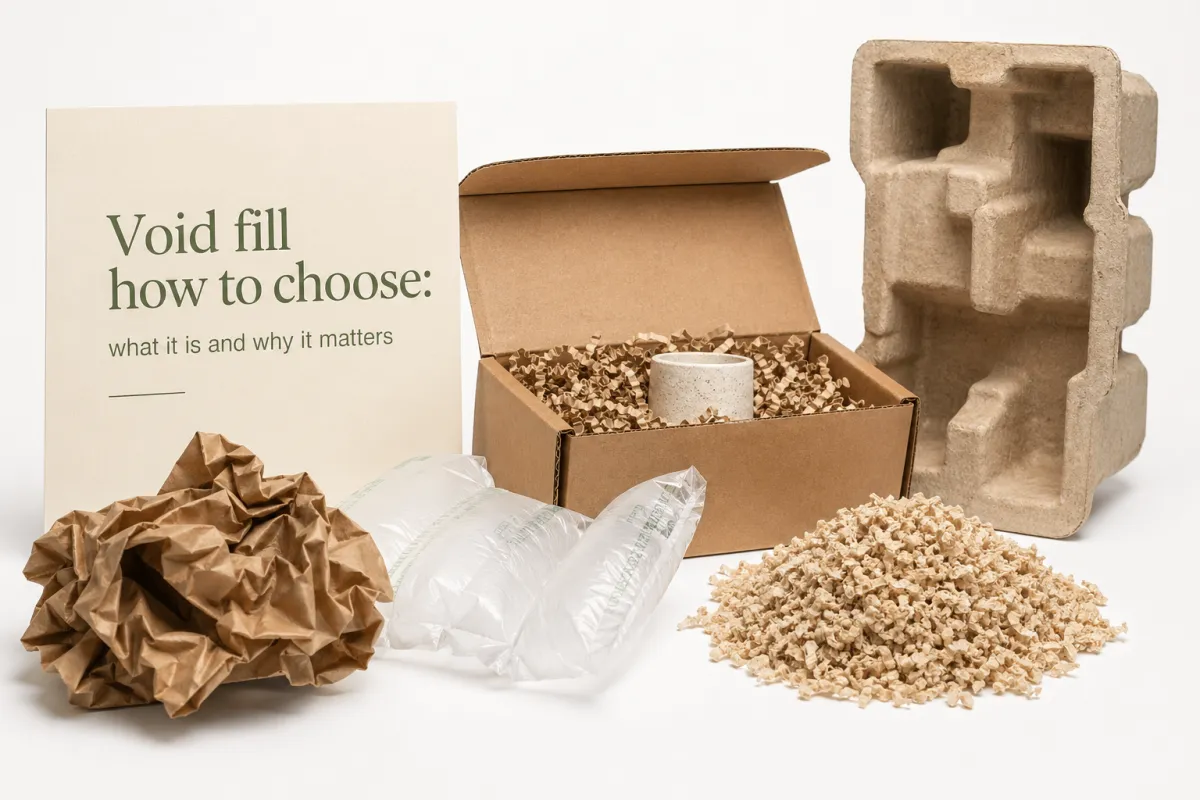
Void fill is the material you add to empty space inside a shipping carton so the product does not move, tilt, or slam into the box wall during handling. In plain terms, void fill how to choose is about deciding what should occupy that empty space and how that choice changes your damage rate, your pack time, and the way the shipment feels when a customer opens it. It sounds almost dull until you watch a fragile item bounce around inside a carton with 32 mm of free space on each side like a bolt in a five-gallon bucket.
The difference between void fill and cushioning gets mixed up constantly, and that confusion creates more bad specs than people admit. True cushioning is designed to absorb shock, spreading impact across a larger area and lowering peak force at a corner or edge. Void fill is often there to stabilize, hold, and prevent movement first. A rolled kraft sheet stuffed around a product and a die-cut foam insert may both reduce movement, but they are not doing the same job. Void fill how to choose starts with that distinction, because "we just need more paper" often collapses two separate engineering problems into one sloppy request.
At a co-pack line I visited outside Dallas, the team was using loose paper to keep bottled skincare in place. The bottles did not need deep shock absorption; they needed the space around the necks and shoulders filled so the cartons would not sag and the glass would not kiss the sidewall during a 28-mile courier run. Once they switched to a tighter kraft pack-out and standardized the carton dimensions to 12 x 9 x 7 inches, breakage dropped because the product stayed centered instead of wandering. That is void fill how to choose in real life, not theory, and the operators were relieved because they were tired of re-taping three cartons out of every hundred.
The reason this matters is simple: cartons fail when internal movement turns vibration into impact. A box with 25 mm of dead space on every side acts like a small rattling chamber, and the product becomes its own source of damage. A carton with controlled fill behaves more like a fitted package, even if the material is lightweight and inexpensive. Get void fill how to choose right, and the package looks neater, ships safer, and usually costs less to service after the fact. I say "usually" because packaging, like freight invoices from Memphis or Newark, has a habit of making the obvious look negotiable.
Too many teams chase the wrong metric first. They ask, "What is the cheapest fill?" before they ask, "What kind of movement are we trying to stop?" That order matters. Void fill how to choose should begin with the failure mode, then move to the material, then to cost, not the other way around. Otherwise, you end up doing buyer math on the front end and damage math on the back end, which is a miserable trade when a single claim can erase the savings from 2,000 units of filler.
"We thought we had a carton problem, but it was really a space problem. Once we stopped the product from shifting, the damage reports changed by 17% in the first month."
That comment came from a packaging supervisor at a fulfillment center outside Columbus after we reworked a small-parts pack-out running about 1,200 orders a day. The cartons were not failing because the board was weak; they were failing because the product had room to build momentum over a 400-mile regional lane. Void fill how to choose is often a space-management decision dressed up as a material decision, and that is why the box needs to be measured before the filler gets ordered.
Paper, air pillows, foam, molded pulp, loose fill, and custom inserts can all enter the discussion. The right answer is rarely universal. Void fill how to choose is a match between the product, the carton, the shipping lane, and the amount of risk you are willing to carry. If that sounds less glamorous than a sales deck, good. A package that survives a 36-inch drop in Phoenix is worth more than a presentation that wins applause in a conference room in Manhattan.
How do you choose the right void fill?
Start with the product's failure mode, the carton's extra space, and the shipping lane. If the item shifts, scuffs, or takes impact in transit, void fill how to choose should point you toward the material that stops movement with the least labor and the smallest carton possible. For fragile goods, that often means a better balance of cushioning, dunnage, and carton stabilization rather than the cheapest filler on the quote sheet.
If you want the short answer, it is this: pick the void fill that controls motion without creating a bigger problem somewhere else. A fill that is cheap but slows the pack bench, or a fill that protects well but forces a larger carton, usually loses in the real world. I have seen teams save three cents on filler and spend six dollars on freight. That math is not cute; it is just expensive.
Void fill how to choose based on how it works
The mechanics are straightforward once you slow them down. Void fill works by filling unused volume, limiting product shift, and helping the pack stay stable when it meets vibration, compression, or a rough handoff at a carrier hub. Void fill how to choose starts with that mechanical job description, because a material that does one job well may fail at another if the carton is too large or the product is too fragile. A 16-ounce bottle and a 4-pound cast part do not want the same inside geometry, even if the outer carton looks similar.
Crumpled kraft paper behaves differently from air pillows. Paper can conform around odd shapes, wedge into corners, and create a tighter, more friction-heavy pack-out. Air pillows are light and fast to dispense, which is exactly why high-throughput ecommerce operations in places like Reno, Nevada, or Charlotte, North Carolina, like them for repeated small parcels. Loose fill can surround awkward shapes, but it tends to migrate, settle, and create a mess if the product is heavy or the shipping lane is long. Foam-in-place and molded inserts are more controlled, but they introduce equipment, lead time, and higher unit cost. Void fill how to choose means understanding what each of those behaviors does inside the box, not just what it looks like on a product sheet.
I once walked a line in a small plant near Indianapolis where the operators were packing painted steel housings by hand. They had a simple 18 x 12 x 10 RSC carton, but the product sat off-center, and the line kept using extra filler because the box was "just a little too roomy." The issue was not the filler; it was the carton logic. We tightened the carton selection, changed the pack orientation by 90 degrees, and the operators used 14% less material while the packs felt more rigid. That is the kind of practical lesson that makes void fill how to choose more about system design than material shopping.
Manual stations and automated systems change the equation too. At a manual bench, a packer can tear a sheet of kraft, shape it, and tuck it into a corner in seconds. On an automated line, speed matters more, so air pillows or paper conversion systems may be better because they dispense repeatable units and reduce variance between shifts. A conversion unit in a Dallas-area facility may spit out 100 pillows a minute, while a hand-stuffed paper station might cap out at 12 to 18 orders per hour per packer. Void fill how to choose has to account for the line itself, not just the box, because a beautiful spec that forces a 22-second slowdown is not a beautiful spec for long.
Shipping mode matters as well. Parcel networks punish loose packs with vibration and repeated drops, while LTL shipments face more compression, pallet stacking, and forklift handling. Final-mile delivery adds another layer because cartons may be loaded by hand, squeezed into vans, or left on a porch where July heat in Dallas or January cold in Minneapolis can change how a material behaves. Void fill how to choose should match the route, not just the SKU. I have seen a carton pass a bench demo and fail in the wild because a driver treated the route like a personal bowling lane, and the carton lost the first frame.
A simple picture helps: if the package has dead space, the product accelerates inside the carton before it hits the wall. If you fill that space correctly, the product never gets a running start. That single idea explains a lot of breakage reports, and it is why I keep saying void fill how to choose is really about controlling motion. The whole game is reducing opportunities for the item to become a little wrecking ball over a 40-mile ride or a 1,400-mile linehaul.
Key factors that shape void fill how to choose
Product fragility comes first. Glass, coated metal, electronics, cosmetics, and printed retail goods all behave differently under movement and pressure. A lacquered tray can scuff from one rough edge of paper; a ceramic item may crack from a point load; a flash drive kit may survive compression but fail from handling errors that leave a connector exposed. Void fill how to choose starts with the weakest point on the product, not the strongest, because the strongest point is usually not the one that breaks at the UPS hub in Hodgkins, Illinois.
Shape matters almost as much as fragility. Square cartons are easy. Irregular parts, long cylindrical items, and nested assemblies create pockets that are hard to stabilize unless the fill material conforms well. I have watched teams try to use the same air pillow arrangement for a bottle, a flat box, and a molded plastic part, then wonder why only one of the three looked good in transit. Void fill how to choose has to respect geometry. Physics is annoyingly consistent that way, especially when the product has a 6-inch handle and a 14-inch body.
Carton size variance is another sneaky cost driver. If your incoming boxes vary by 15 mm on each dimension, your fill requirement changes too, and that can push dimensional weight higher than expected. I have seen small teams waste more freight money by oversizing the carton than they ever saved on filler. Void fill how to choose includes the carton spec, because a package with too much internal space often costs more to ship than a tighter pack with a slightly better material. It is a strange accounting trick: a few millimeters on paper can turn into real money in freight across zones 3 through 7.
Labor is just as real as the material bill. If one fill option needs two hands, repeated tearing, or awkward machine adjustments, packers will get inconsistent after the first shift or two. On a Tuesday afternoon in a facility outside Atlanta, I watched a crew abandon a technically fine paper system because it required too much wrist action at a pace of 700 orders per hour. The material was not the problem; the workflow was. Void fill how to choose must fit the people using it every day, including the night shift that starts at 10:00 p.m. and the temp crew that arrives on Monday morning with coffee and no context.
Sustainability and customer experience matter too. Recyclable paper is often easier to explain to customers than mixed plastics, and FSC-certified paper can support sourcing goals when the supplier chain is documented. The EPA's recycling guidance is a useful reference point for companies that want to think clearly about end-of-life sorting and consumer behavior, especially when cartons are opening on kitchen counters in San Diego or apartment floors in Philadelphia. Void fill how to choose should not ignore disposal friction, because customers notice whether the material makes a clean unboxing or a frustrating cleanup. Nobody enjoys fishing tiny plastic bits out of a dog's water bowl in Austin, and yes, I have heard that complaint more than once.
Warehouse conditions also shape the answer. A humid dock in Savannah can soften some papers, a cold storage room in Minneapolis can change how fast foam expands, and a small facility with limited staging space may not want bulky rolls or large resin inventories. Supplier Lead Times matter too. If a material takes 12 weeks to land from a plant in Guangdong and your promos spike every Friday, that is a supply chain risk, not just a procurement note. Void fill how to choose needs to be grounded in what the building can actually support. A material that only works if the universe behaves perfectly is not much of a material.
Here is the practical order I use with clients in Chicago, Austin, and Toronto:
- Identify the product’s failure mode.
- Match the fill style to the carton geometry.
- Check how fast the line must run.
- Measure disposal, storage, and supplier reliability.
Bottom line: void fill how to choose is not just a material selection. It is a decision about product safety, labor flow, ship cost, and customer experience all at once. Miss one of those and the "best" option stops being the best very quickly, even if the per-unit quote came in at $0.04 lower than the competitor's.
Void fill how to choose based on cost and pricing
A lot of conversations get too narrow at this point. People compare unit prices and stop there, but void fill how to choose based on cost and pricing should include material, labor, storage, equipment, and damage exposure. A roll of kraft paper that looks cheap can become expensive if packers spend an extra 12 seconds per order shaping it. A machine-fed air pillow system can look pricey on paper and still save money if it cuts damage claims and labor fatigue. I have had people tap a calculator like it is a courtroom prop, only to discover the math was missing half the case.
In a supplier negotiation I sat through in Shenzhen, the buyer kept pushing for a lower molded pulp price on a per-piece basis. The supplier finally laid out the reality: the unit price was only one piece of the equation, because the carton was being redesigned, the minimum order quantity was 5,000 units, and freight from the port added another layer of cost. A similar order later came back at $0.15 per unit for 5,000 pieces once the fiber blend, mold charge, and ocean freight were included. Once the team compared total landed cost instead of unit cost alone, the better answer was obvious. Void fill how to choose becomes much easier when the math is honest, and honest math usually sounds less exciting than a sales pitch from a conference booth in Las Vegas.
Here is a practical comparison using typical ranges I have seen in active operations. Your numbers will vary by region, volume, and spec, but this gives a real working frame for void fill how to choose. If your supplier is in Wisconsin, Monterrey, or Suzhou, the freight and labor assumptions will shift, sometimes by more than the material itself.
| Material | Typical use | Approx. cost per packed order | Labor speed | Strengths | Trade-offs |
|---|---|---|---|---|---|
| Crumpled kraft paper | Mixed SKUs, irregular items, general ecommerce | $0.05 to $0.12 | Fast to moderate | Flexible, recyclable, easy to train on | Needs consistent packer technique and storage space for rolls |
| Air pillows | Light goods, high-throughput parcel lanes | $0.03 to $0.08 | Very fast | Low weight, clean presentation, easy dispensing | Can feel flimsy for heavier goods and needs machine support |
| Loose fill | Odd shapes, legacy gift packs, specialty items | $0.06 to $0.15 | Moderate | Conforms around unusual shapes | Messy, settles in transit, poor line cleanliness |
| Foam-in-place | High-risk or fragile products, premium shipments | $0.20 to $0.55 | Moderate | Excellent fit and stabilization | Higher equipment and training burden |
| Molded pulp inserts | Custom product families, retail-ready packs | $0.18 to $0.60 | Fast once set up | Repeatable, professional presentation, recyclable options | Tooling and lead time can be higher |
The table helps, but the real answer sits in total cost per shipped unit. If a cheaper fill creates 2% more damage on 10,000 monthly orders, the replacement cost can wipe out any savings fast. I have seen one cosmetics client in New Jersey spend an extra $0.07 per order on better paper and save more than $4,000 a month in reships and customer service work. That is not a rounding error; that is a line item with teeth. Void fill how to choose cannot stop at the supply invoice.
Dimensional weight is another trap. A fill system that pushes you into a larger carton can increase freight by $0.80 to $2.50 per shipment depending on the lane. That is huge compared with a few cents of material. Void fill how to choose should always ask whether the fill lets you keep the smallest safe carton, because cartoning and void fill are joined at the hip, especially when a carton goes from 12 x 10 x 8 inches to 14 x 12 x 10 inches just to make the filler fit.
There is also the cost of consistency. A material that is easy to use across three shifts will usually outperform a slightly cheaper option that only works when the best packer is on duty. Consistency saves rework, claims, and training hours. Void fill how to choose is really about the cost of standardization. If every shift can run it, you have a process. If only one person can make it look right, you have a personality contest with a freight bill.
If you want a simple formula, I use this one with operations teams:
Total cost per order = material + labor + freight impact + damage rate + storage cost.
That formula does not capture every nuance, but it keeps the team honest. Void fill how to choose gets much clearer when everyone sees the full landed picture instead of a single line item from a quote. Numbers may not be romantic, but they have excellent instincts for exposing weak assumptions, especially when the quote includes a 6-week lead time and a minimum order of 8 pallets.
Step-by-step process for void fill how to choose
I prefer a methodical process because it saves arguments later. Void fill how to choose works best when you treat it like a controlled packaging trial rather than a guess. Start by auditing the product catalog. List dimensions, weights, carton sizes, surface finishes, fragility points, and any items that already show damage trends. If you have 20 SKUs, focus on the 5 that drive most of the shipments or most of the claims, especially the items that leave from your Cincinnati or Phoenix warehouses every weekday before noon.
Next, build a shortlist of two to four candidates. Do not test every material under the sun. That just burns time and makes the spreadsheet look like a migraine. Pick options that make sense for your product mix: kraft paper and air pillows for most ecommerce lines, molded pulp for repeat shapes, foam for high-risk items, or loose fill only if the catalog really calls for it. Void fill how to choose becomes manageable when the field is narrowed to real contenders, not a warehouse aisle full of random samples.
Then test with real orders, not empty box demos. I tell clients to pack actual SKUs in the actual carton they ship most often, with the same tape, the same seal pattern, and the same operator who will use the method later. Measure movement by shaking the carton, flipping it gently, and checking whether the item stays centered. Then run a small transit test. If you can use an ISTA procedure such as ISTA 3A or a comparable drop and vibration sequence, even better. ASTM D4169 is another reference point when customers want a structured test plan. Void fill how to choose gets much more reliable when the test mirrors the lane instead of a showroom version of it.
One client in Ohio did exactly this with a line of precision metal components. Their first instinct was foam because it "looked professional," but the packers disliked the smell, the setup was slower, and the cost per order was almost triple the paper option. After a week of tests and a 30-day damage review, paper won because it kept the parts from moving while preserving throughput. Void fill how to choose should reward what the line can sustain, not what looks impressive in a sample box. I still remember one operator in Toledo muttering, "Fancy doesn't ship the orders," which was hard to argue with at 2:15 p.m. on a Tuesday.
Measure these things during the trial:
- Product movement inside the carton.
- Average pack time per order.
- Material used per shipment.
- Operator comfort and error rate.
- Damage after transit or drop simulation.
Give the test enough time to tell the truth. I usually like one week for data gathering, one to two weeks for sample packs and operator feedback, then a 30-day review if the shipment volume is steady enough to show patterns. Void fill how to choose should never be finalized after ten pretty sample packs on a clean table in a conference room. A clean table is great for lunch. It is not a shipping lane, and it does not include rain, forklifts, or a 9:30 p.m. pallet move.
Once a winner emerges, build the rollout plan. Update the SOP, write the reorder points, train the night shift, and confirm where the rolls or bags will live in the warehouse. If a new system needs a dispenser or a machine, document maintenance and spare parts before launch. Void fill how to choose is not finished when the sample gets approved; it is finished when the line can run it every day without drama. The goal is boring consistency, which is a surprisingly noble packaging ambition in a plant that ships 2,800 orders before lunch.
"The material decision was easy once we saw the packers could keep the same speed. The real win was the standard work, and the claim rate dropped from 3.2% to 1.4% in six weeks."
Common mistakes when figuring out void fill how to choose
The biggest mistake I see is buying the cheapest fill because the quote looks nice. A low unit price means very little if the material causes product rub, extra labor, or a pile of returns. Void fill how to choose should never be reduced to a purchasing trick. The packaging floor will tell the truth within a week if the choice was weak, usually in the form of bruised corners, grumpy packers, and an email thread nobody wants to read at 7:30 a.m.
Overpacking is another bad habit. People think more material equals more protection, but that is not always true. Too much fill can press on fragile edges, distort the carton, or create a bulge that gets crushed in stacking. I watched a retailer in Columbus overstuff premium candle sets with paper so aggressively that the outer flaps bowed outward and the printed cartons arrived bruised. They were using more material and getting worse results. Void fill how to choose needs restraint. Sometimes the bravest thing a team can do is stop adding more stuff and measure the actual gap.
Underpacking is just as risky, especially with irregular shapes. A product that seems stable on a bench can start shifting the moment a driver takes a curve or a sorter drops the carton a few inches. Small gaps become momentum chambers. Void fill how to choose should always respect vibration, not just static appearance. The box may sit still on a table in Denver, but tables do not deliver packages across 500-mile routes.
Another mistake is using one material for every SKU in a mixed catalog. That sounds tidy to procurement, but mixed catalogs are rarely tidy in the warehouse. A flat boxed item, a glass bottle, and a curved molded part may need different pack-out behaviors. Void fill how to choose becomes more accurate when you allow for a two- or three-material strategy instead of forcing one universal answer. I know that feels less elegant to the spreadsheet, but elegance is overrated if it increases breakage by even 1.5%.
Packers get overlooked too often. If a material is hard to dispense, loud, dusty, or awkward to form, consistency falls apart by the end of the shift. I have seen beautiful packaging specs fail because the third shift never used the material the same way the day shift did. Void fill how to choose must include human behavior, because the best package in the world is only as good as the person building it. A spec that depends on saintly patience and a perfect wrist motion is not a spec; it is a wish with a SKU number.
There is also a control issue. If nobody tracks damage claims after the change, the team may assume the new fill is working when the problem has merely moved downstream. I like to watch return reasons, customer photos, and carrier damage notes for at least a month after a change. Void fill how to choose should be measured against outcomes, not impressions. "It feels better" is not the same thing as "returns fell by 18%." The second one pays rent, and usually in dollars rather than compliments.
My blunt opinion? Teams usually regret the choices they made without a real trial more than they regret spending a little extra on the right material. That has been true in small shops in Ohio, national distribution centers in Tennessee, and contract packaging rooms in Southern California. I have not once met a claims manager who said, "We really should have saved those three cents." The ones who survived the quarter were usually the ones who bought the sample reels and ran the test.
Expert tips and next steps for void fill how to choose
If you want a cleaner decision, build a scoring matrix. I use six categories: protection, labor speed, cost, sustainability, storage footprint, and customer presentation. Give each option a 1-to-5 score and weight the categories by what matters most to your operation. Void fill how to choose becomes far less emotional when the team can see why one material wins on protection but loses on speed, or why another is cheap but rough on presentation. Numbers calm arguments. Not all arguments, but enough of them to get through a Tuesday meeting in under 45 minutes.
Bring the right people into the room before the final choice. Operations sees the line speed, quality sees the damage rate, procurement sees the contract, and customer service hears the complaints from the first 200 customers who open the box. If only one of those voices is heard, you usually get a partial answer. Void fill how to choose works best when the whole shipping process is represented. I would even add a packer or two, because the people actually wrapping and stuffing the cartons tend to spot nonsense almost immediately, usually by the third sentence.
Ask suppliers specific questions. Can the material run on your current equipment? What is the minimum order quantity? How much storage space does it need? Is it recyclable in your market? Can they show a case study from a product like yours? I also ask for sample rolls, dispenser recommendations, and changeover guidance. If the product is a custom insert, I want the drawing, the board spec, and the lead time in writing, such as 12-15 business days from proof approval for a 350gsm C1S artboard insert run in Dongguan or Nashville. Void fill how to choose gets easier when the supplier is helping you solve a real line problem instead of just selling material.
There is a reason I keep saying to test before you scale. A small trial on one priority SKU can teach you more than a polished sales deck. Pick one item, test two materials, and measure the results on actual packed orders. Track the data for protection, time per order, and cost per shipment. Then expand only if the numbers stay steady. It sounds methodical because it is. Packaging rewards the unglamorous people who measure first and celebrate later, usually after the 30-day damage report lands in the inbox.
Here is the sequence I recommend:
- Select one high-volume or high-risk SKU.
- Choose two candidate void fills.
- Run pack tests and a short transit test.
- Measure damage, labor, and cost.
- Roll out the winner with updated SOPs.
One more practical tip: do not forget presentation. Customers notice whether the box opens cleanly, whether the material sheds dust, and whether the package feels deliberate or thrown together. I have seen brands win loyalty with a better unboxing experience even when the product itself did not change. Void fill how to choose is partly about protection and partly about the story the package tells when it lands on the customer’s table in Seattle, Orlando, or Montreal. A neat interior can make a product feel cared for; a chaotic interior can make a brand feel rushed, even if the item itself survived just fine.
My advice after two decades around corrugators, pack benches, and supplier tables is simple. Start with the product, respect the line, verify the transit risk, and make the numbers tell the truth. Void fill how to choose gets easier once you stop asking for one perfect material and start asking for the right fit for this carton, this SKU, and this shipping lane. That is the cleanest way I know to handle void fill how to choose. It is not flashy, but it works, and honestly I trust "works" more than "sounds impressive," especially when the freight bill arrives from Memphis with a three-page attachment. The quickest path is usually the smartest one: pick the SKU that causes the most claims, test two fills against real orders, and lock the winner into the SOP before the next reprint run or promo wave.
FAQs
How do I choose void fill for fragile products?
Start with the product's weakest point, such as a glass edge, a painted corner, a coated surface, or an exposed component that can rub. Void fill how to choose for fragile items means preventing movement first, then adding cushioning if the item also needs shock protection. I always recommend testing the actual carton you ship most often, because a fragile item can fail simply from having 20 mm more empty space than it should. I have seen a small gap in a 10 x 8 x 6-inch carton cause a large repair bill, which feels almost rude when the SKU cost only $11.40.
What is the best void fill how to choose method for ecommerce orders?
For ecommerce, the best method is usually the one that balances speed, low damage, and easy packer training. High-volume light goods often work well with air pillows, while mixed catalogs frequently do better with kraft paper because it is flexible and familiar. If returns are costly or presentation matters a lot, void fill how to choose should favor the option that creates the most consistent pack quality, not just the lowest unit price. The prettiest material is useless if it slows the line to 6 orders an hour when you need 18.
How do I choose void fill that keeps shipping costs down?
Compare the full landed cost, including material, labor, damage claims, and dimensional weight effects. Void fill how to choose for cost control means using the smallest amount of fill that still stops product movement, since overfilling can increase box size or push you into a higher freight tier. A side-by-side test with real orders will usually show which option lowers total cost per shipped unit, not just supply spend. I would trust that test more than any quote that arrives with bold fonts, a 4-page brochure, and promises of miracle savings.
Should I choose paper, air pillows, or foam void fill?
Paper is often best when you need flexibility, recyclability, and fast manual packing. Air pillows usually fit light, high-throughput shipments where low weight and quick dispense matter most. Foam is better for higher-risk or highly sensitive products, especially when a custom fit is needed and the extra material cost is justified. Void fill how to choose comes down to product risk, line speed, and how much control the package needs inside the carton. If the SKU is delicate and the route is rough, foam may win; if the SKU is light and the team is moving fast, paper or air can be smarter.
How long does it take to test void fill and make a final choice?
A focused trial can start in a few days if your product list is small and sample materials are easy to source. Plan one to two weeks for pack tests and packer feedback, then a 30-day review if you want real shipping and damage data. Void fill how to choose should not be finalized until you have compared protection, speed, and cost on actual packed orders, not just on a bench demo. If anyone says they can "know for sure" in an afternoon, I would politely keep my hand near the exit and ask for the carrier claims report.
Related packaging resources
Use these related guides to compare specs, costs, quality checks, and buyer decisions before making the final call.