Buyer Fit Snapshot
| Best fit | Branded Packaging for Ecommerce Business projects where brand print, material claims, artwork control, MOQ, and repeat-order consistency need to be specified before quoting. |
|---|---|
| Quote inputs | Share finished size, material target, print colors, finish, packing count, annual reorder estimate, ship-to region, and any compliance wording. |
| Proofing check | Approve dieline scale, logo placement, barcode or warning zones, color tolerance, closure strength, and carton packing before bulk production. |
| Main risk | Vague material claims, crowded artwork, missing packing details, or unclear freight terms can make a low unit price expensive after revisions. |
Fast answer: Branded Packaging for Ecommerce Business: Quote Scope, Sample Proof, MOQ, and Lead Time should be specified like a repeatable production item. The safest quote records material, print method, finish, artwork proof, packing count, and reorder notes in one written spec.
Production checks before approval
Compare the actual filled-product size with the drawing, then confirm tolerance on folds, seals, hang holes, label areas, and retail display edges. Reserve space for logos, QR codes, warning copy, and material claims before decorative graphics fill the panel.
Quote comparison points
Review material grade, print process, finish, sampling route, tooling charges, carton quantity, and freight assumptions side by side. A quote is only useful when the supplier can repeat the same color, closure quality, and packing count on the next order.
Branded Packaging for Ecommerce Business: A Smart Start
If you sell online, branded packaging for ecommerce business can turn a $28 skincare order, a $74 candle set, or a $112 apparel bundle into something customers remember, photograph, and mention in reviews. I still remember opening a plain white mailer for a $68 skincare order and thinking, "Well, that was... aggressively unmemorable." Then I saw the same product in a printed mailer with a two-color insert, and the whole thing felt like it had a point of view. The product did not change. The perception did. And that difference tends to show up in repeat sales, review language, and the way customers describe your brand to other people, especially once order values move out of impulse-buy territory.
A good packaging partner works in the narrow but valuable space where packaging has to do three jobs at once: protect the item, represent the brand, and keep fulfillment moving without friction. A practical starting spec is often a 350gsm C1S insert paired with a 32 ECT corrugated mailer, because that combination gives you enough stiffness for print and enough resilience for parcel handling. Honestly, I think the best branded packaging for ecommerce business is rarely the loudest package in the room. It is the one that looks deliberate at the door, fits the warehouse workflow, and survives the carrier network without turning into a damage claim after three sorting centers and a weekend delay in Phoenix. That is the quiet test, and it is a harder test than a glossy mockup makes it look.
Most people miss one thing: packaging is not a single object. It is a chain of small decisions, and each one sends a signal. A half-millimeter print shift, a weak flap, or a flimsy insert can undo a polished website in seconds. I have watched a founder spend six months perfecting homepage typography, only to ship a carton that arrived looking like it fought a raccoon and lost. That is why I treat branded packaging for ecommerce business as a business system, not a decoration project, because the cheapest mistake often shows up as a replacement shipment, a support ticket, and a customer who does not order again.
What Branded Packaging for Ecommerce Business Really Means
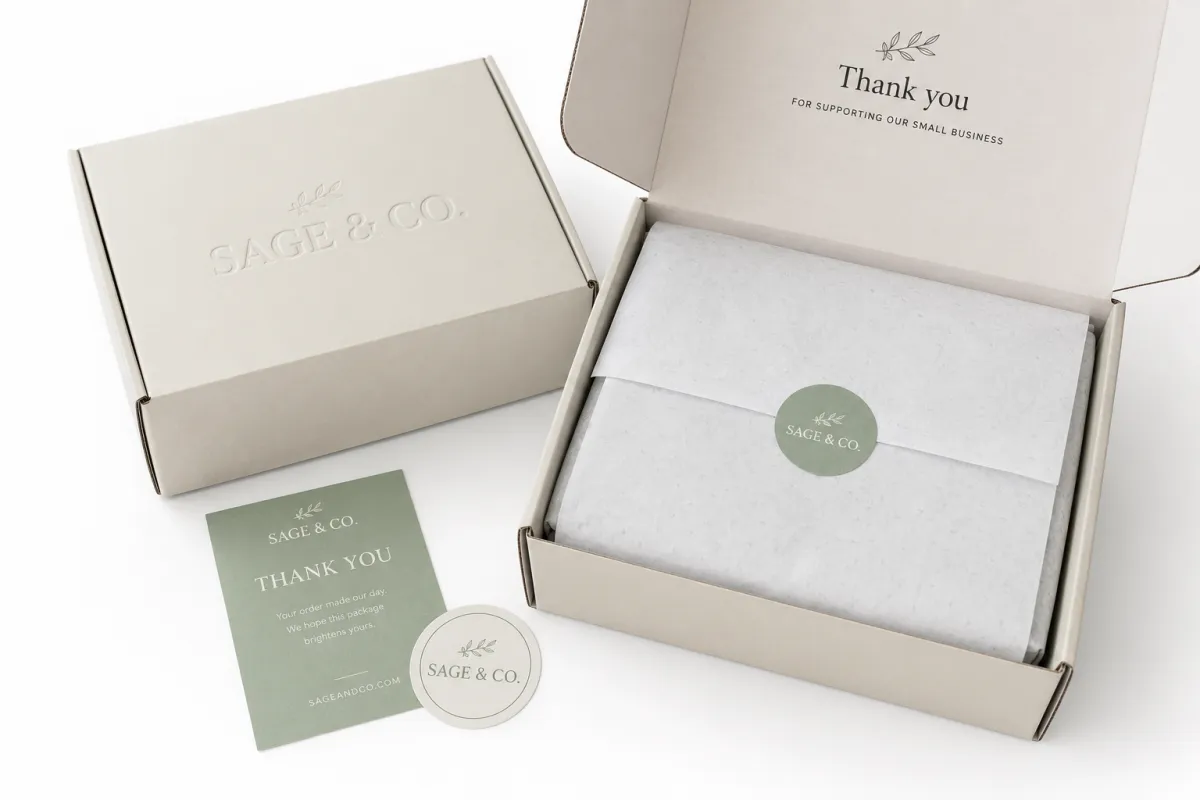
A plain corrugated shipper says, "We sent something." A thoughtful package says, "We planned this." The difference sounds minor until you see it in customer reviews, social posts, and support tickets. I have watched a generic kraft mailer make a premium candle brand feel forgettable, then watched that same brand move to branded packaging for ecommerce business and start receiving comments like, "The unboxing felt expensive." Same product. Same retail price. Different story. That is the part that makes a lot of founders sit up a little straighter, especially when the packaging cost moved by only a few cents per unit.
At its core, branded packaging for ecommerce business means every packaging touchpoint a customer notices before, during, and after opening the order. That includes the outer shipper, a printed mailer, tissue, tape, inserts, a seal, a thank-you card, and even the first line of copy inside the box. It is more than a logo on a carton. It is package branding that carries through the full delivery experience and makes the customer feel like the brand thought past checkout. In practice, that often means using one spot color, one recycled-paper insert, and one consistent tone across the box, the confirmation email, and the return slip.
That matters in ecommerce because the customer usually meets your packaging before they meet your team. A store with four products can still look established if the box structure, print quality, and presentation feel consistent. Small brands feel this pressure most sharply because they often compete with larger players that have heavier ad budgets. I have seen a 12-product startup look more mature than a 200-SKU catalog simply because its branded packaging for ecommerce business was coherent, clean, and repeatable. Weirdly, packaging can do what ad spend cannot: it can make a small business feel settled, even when the warehouse is still using folding tables and hand-applied labels.
"The box made the purchase feel like a decision, not a click." That was a comment from a client's customer after they switched to printed tissue, a one-color insert, and a rigid outer shipper with a properly rated corrugated mailer.
The line between decorative packaging and strategic packaging is easy to miss. Decorative packaging exists to look nice. Strategic packaging exists to look nice, ship safely, and encourage a second order. That second part matters more than most founders expect. A package that uses less filler but crushes in transit is not smart. A premium-looking box that adds 40 seconds of labor per order is not smart either. Good branded packaging for ecommerce business should support the brand without dragging down operations. If it makes the packing team groan every morning, that is not a brand touchpoint; that is a problem wearing lipstick.
I once visited a small fulfillment room outside Chicago where the owner had a simple note taped to the wall: "Pretty does not beat practical." She had switched from oversized mailers to right-sized Custom Printed Boxes, cut void fill by 22%, and reduced damage claims from 3.4% to 1.1% over 90 days. That kind of result turns branded packaging for ecommerce business into a measurable asset instead of a vague marketing expense. It also turns a skeptical operations manager into a believer, which is not nothing, especially when each claim costs money in labor, reshipment, and time nobody planned for.
How Branded Packaging for Ecommerce Business Works
The customer journey starts before the parcel arrives. It begins at checkout, where the order confirmation email, the packaging promise, and the shipping estimate shape expectations. Then the box lands on the doorstep, and the package has to perform in stages: first glance, first touch, opening, product reveal, reuse, and sharing. Each stage gives branded packaging for ecommerce business a chance to reinforce trust or create friction. You can almost hear it happen in sequence: "Nice box," then "Oh, this is thoughtful," then maybe, "I should order again." That reaction does not need a script. It only needs a package that respects the moment.
Think of the packaging stack as layers. The outer shipper protects against transit abuse. Protective filler absorbs movement. The inner box or mailer carries the visual identity. Inserts communicate care, product education, or a reorder incentive. Labels and seals support security and logistics. A simple QR code can point to a reorder page, a how-to video, or a review request. In that sense, branded packaging for ecommerce business can move beyond presentation and become part of the conversion path. It is not magic, just a very tidy little funnel made of paper, ink, and common sense.
The production workflow matters just as much as the customer journey. Most teams start with a brief, then move into dielines, material selection, artwork, proofing, sample production, approval, and manufacturing. I have seen a team lose 11 days because they approved artwork before checking flap depth on a mailer. I have also seen a brand save nearly two weeks by locking dimensions early and keeping the first sampling round disciplined. Structural decisions affect schedule more than people expect, especially in branded packaging for ecommerce business. If you have ever watched three departments argue over a fold line, you know why this step gets tense fast.
Good packaging design also has to match the warehouse. If your team ships 300 orders a day, a package that takes 15 extra seconds to assemble creates a real labor cost. If your products range from two ounces to 32 ounces, one elegant box may not fit the whole catalog. That is why I ask about product mix, carton count, and packout speed before recommending any branded packaging for ecommerce business solution. The right packaging for a candle is not always the right packaging for a vitamin subscription box. Different shapes, different weights, different headaches, and usually different board grades, like E-flute for light goods and heavier corrugate for more fragile items.
One often overlooked part is the digital tie-in. A printed QR code inside a mailer can point to setup instructions, a reorder page, or a loyalty offer. A short insert can ask for a review seven days after delivery. That does not make the package feel tech-heavy. It makes the package useful. The best branded packaging for ecommerce business behaves like a bridge between the order and the next action, especially if the QR lands on a mobile page that loads quickly on a basic connection.
For teams building out a fuller system, the range of Custom Packaging Products can help connect the creative side to the practical side. And if you want to see how package changes perform in the field, the before-and-after stories in Case Studies are often more useful than a glossy mockup, particularly when the samples came from plants in different regions and had to hold up under real shipping conditions.
Key Factors That Shape the Result
Material choice is the first big decision, and it shapes cost, feel, and protection. Corrugated board is the workhorse for shipping. Paper mailers fit lighter goods that do not need much crush resistance. Rigid boxes create a premium feel, but they cost more and usually require more careful packing. Tissue, inserts, and sleeve wraps add texture and messaging without rebuilding the structure from scratch. In branded packaging for ecommerce business, each material changes the experience in a different way. Some are doing heavy lifting. Others are there to whisper, "Yes, someone thought about this."
Print method matters just as much. One-color flexographic print can be efficient for simple marks and clean branding. Full-color graphics can create stronger unboxing impact, especially on Custom Printed Boxes. Foil stamping, embossing, and spot varnish add contrast and tactility, yet they work best in moderation. I have seen too much foil make a box feel like a trade show giveaway instead of a serious product package. The smartest branded packaging for ecommerce business choices usually combine one or two premium accents with strong typography and disciplined color use, such as matte black on uncoated kraft or a single deep blue on white board.
Consistency is where many brands stumble. If the website uses a deep navy and the box arrives in a washed-out blue-gray, customers notice. If the tone on the homepage feels direct and confident but the inside copy sounds generic, the experience fractures. Color accuracy, logo placement, and copy tone all matter. Good package branding makes the package feel like it belongs to the same company that built the site, wrote the emails, and answered the support ticket. Otherwise, the customer gets a tiny identity crisis before they even touch the product.
Sustainability is now part of the brief, not an afterthought. Buyers ask about recycled content, FSC-certified paper, and reduced plastic use, and they are right to ask. If you want a factual reference point, the FSC site explains forest certification clearly, and the EPA recycling guidance is a practical baseline for material choices. Sustainability claims should still be specific. "Recyclable" means little if the package combines five mixed materials that are hard to separate. Honest branded packaging for ecommerce business beats vague eco language every time. Vague claims age badly, and customers can smell them from across the room.
Operational constraints decide whether the design survives reality. Is the box stackable on a 48 x 40 pallet? Will it survive a 3-foot drop? Does it trigger expensive dimensional weight charges? Can your team pack 150 orders in an hour without fighting the closure? These are not small questions. They separate packaging that looks good in a mockup from Packaging That Works in a live shipping line. If you want a technical benchmark, transit testing references from ISTA are worth reviewing before you approve a new program, especially if your cartons travel through hot weather, winter routes, or a distribution network that does not handle fragile goods kindly.
Honestly, many brands overspend here. They chase a dramatic finish and ignore the hidden costs: replacement damage, slower packing, and awkward storage. I once sat in a supplier negotiation where a client wanted a three-layer laminated box with a magnetic closure for a $24 accessory. The sample looked beautiful, but the unit economics were upside down. We shifted them to a printed rigid mailer with a paper sleeve and cut cost while keeping the premium feel. That is the kind of tradeoff branded packaging for ecommerce business should make possible. Beautiful is nice. Beautiful and profitable is better.
Cost and Pricing: What You Really Pay For
Unit price matters, but it is only one part of the bill. Artwork, tooling, proofing, freight, storage, and spoilage can move the real number more than the per-piece quote. A box quoted at $0.18 per unit can still cost far more in total if you need a custom die, two proof rounds, and split shipments. That is why I separate sticker price from program cost whenever we talk about branded packaging for ecommerce business. Otherwise you end up celebrating a low quote and then wondering why the budget is doing acrobatics.
Volume changes everything. A run of 2,500 pieces may be priced very differently from a run of 10,000 because setup work is spread across more units. That is the upside. The tradeoff is storage: bigger runs need more square footage and more cash upfront. In a client meeting last spring, a founder wanted the lowest possible unit cost on printed mailers, but her warehouse had room for only six pallets. The real answer was a three-stage rollout, not a giant one-time buy. Smart branded packaging for ecommerce business decisions balance cash flow against volume efficiency.
There is a useful way to think about common cost drivers. Bigger boxes use more board. More print colors raise press complexity. Specialty finishes raise labor. Inserts add materials and assembly time. Custom tape, tissue, and seals can look modest on their own but add up over 5,000 orders. If the packaging needs two SKU versions because your product sizes vary, that doubles artwork management and often doubles proofing. For many teams, the first mistake is not paying too much; it is underestimating how many moving parts sit inside branded packaging for ecommerce business.
| Packaging Option | Typical Starting Price | Best Use | Tradeoff |
|---|---|---|---|
| Printed paper mailer | $0.12-$0.28/unit at 5,000 units | Lightweight apparel, accessories, small kits | Lower crush protection than corrugated |
| Custom printed corrugated box | $0.18-$0.45/unit at 5,000 units | General ecommerce shipping, giftable products | Higher board cost and storage space |
| Rigid presentation box | $1.10-$3.50/unit at 1,000 units | Premium launches, influencer kits, luxury retail packaging | More expensive and slower to assemble |
| Printed insert card | $0.03-$0.09/unit at 10,000 units | Reorder prompts, instructions, thank-you messaging | Low physical protection by itself |
| Branded tissue and seal | $0.05-$0.16/unit at 5,000 units | Unboxing presentation, soft goods, gift orders | Mostly experiential, not structural |
The table above is directional, not a quote. Real pricing depends on size, stock, ink coverage, shipping lane, and whether you are using standard tooling or custom dies. Still, it points to a core truth: the cheapest unit is not always the cheapest program. A more expensive package that reduces breakage by 1.5% can save more than it costs, especially if your return or replacement rate is already high. A lot of people want a straight answer here, but packaging has a frustrating habit of saying, "It depends," and meaning it.
I like to budget branded packaging for ecommerce business in three layers. First, the essential layer: protection, dimensions, and shipping compliance. Second, the brand layer: print, color, and messaging. Third, the performance layer: repeat purchase prompts, QR codes, and inserts. If money is tight, spend first on the element customers touch immediately. That is usually the mailer or outer box. Then add one visible enhancement such as tissue or a printed insert. Trying to buy every signal at once usually wastes money, and a $0.07 tissue sheet is not the place to pretend you are funding a luxury launch in Milan.
For the most part, a package that costs a few cents more per order can pay for itself if it lifts repeat purchases, improves review language, or cuts damage claims. That is not guaranteed, and anyone who promises a fixed return is overselling. Still, the economics are real. If your average order value is $42 and your reorder rate climbs by even 3%, the math can move quickly. That is why I treat branded packaging for ecommerce business as a margin conversation, not a decoration conversation.
Step-by-Step Launch Timeline
The first step is a packaging audit. Put 10 current orders on a table and look at them honestly. Which parts feel generic? Which boxes arrive dented? Which inserts are ignored? Which labels peel? A quick audit often reveals more than a branding workshop. I have seen clients discover that their biggest problem was not the box art at all; it was that the product rattled inside a box that was too large. That matters because branded packaging for ecommerce business has to solve the product-fit problem before it solves the mood problem.
Next, define goals with numbers. Decide the protection level, the target unit cost, the brand priorities, and the sustainability requirements. If you ship glass, you may want a double-wall corrugated shipper and a drop-test standard. If you ship soft goods, a lighter mailer may be enough. If your warehouse is already crowded, the packaging may need to nest flat and ship in one-pallet increments. Good branded packaging for ecommerce business begins with constraints, not with color swatches. I know, less glamorous than mood boards, but the warehouse does not care about Pinterest. It cares about whether the pallet fits through the aisle.
Then comes concept and sampling. A structural change can add one to three weeks. Artwork revisions can add another few days. Proof approval sounds simple until someone notices the logo is 2 mm too close to the flap edge. I have watched a supplier remake a sample board three times because the customer kept changing the product depth after the fact. We got there eventually, but only because the brief was locked before production. That is a classic lesson in branded packaging for ecommerce business: early decisions are cheaper than late corrections.
Testing is not optional. Sample review should include fit checks, tape checks, closure checks, and, if the product is fragile, drop testing. A basic reference point is the kind of transit validation described by ISTA, because packages do not fail in a vacuum; they fail under vibration, compression, and impact. A warehouse trial matters too. If the team cannot pack the order at speed with the new materials, the rollout is not ready. Practical branded packaging for ecommerce business is proven in the warehouse, not just in a presentation deck.
Finally, plan the launch like an operations project. Set reorder triggers, storage counts, and a run-rate forecast. Align marketing so the website imagery matches the box. Train customer service so they know what changed and why. One client of mine built a tiny launch calendar with four milestones and saved two emergency rush orders simply by watching inventory levels weekly. That is what organized branded packaging for ecommerce business looks like: fewer surprises, more control, and a cleaner handoff between the factory and the fulfillment team.
If your team is comparing formats, the safest rollout is often a pilot on one hero product or one shipping lane. Start with the box or mailer customers notice first, then add the second layer only after the first one proves itself in live orders. That is how branded packaging for ecommerce business grows without causing chaos in the warehouse, especially if the first pilot is a manageable run and the reorder threshold is set before inventory gets tight.
Common Mistakes That Weaken the Experience
The first mistake is overbranding. If every surface is crowded with logos, claims, icons, and taglines, the package starts to feel louder than premium. A box does not need to shout to be remembered. In fact, restrained branded packaging for ecommerce business often looks more expensive because it gives the eye somewhere to rest. It feels calmer. Calmer usually reads as more confident.
The second mistake is choosing thin or oversized materials to save money. A box that flexes in transit or leaves too much empty space can increase damage and return friction. I once reviewed a cosmetics packout that used a lighter board to save a couple of cents per unit. The result was a sharp increase in crushed corners after carrier handling. That kind of math can wreck a margin story. The goal of branded packaging for ecommerce business is not the lowest material cost; it is the best total outcome.
The third mistake is designing for one hero SKU and ignoring the rest of the catalog. A mailer that fits a six-ounce bottle perfectly may fail on a 14-ounce bottle or a bundled kit. Then the team either pads the product awkwardly or prints a second package in a rush. That kind of fragmentation gets expensive fast. Good branded packaging for ecommerce business systems are built with SKU variability in mind from the beginning, whether the lineup has 3 SKUs or 37.
The fourth mistake is treating the inside of the box as dead space. It is not dead. It is message space. A 90 x 54 mm insert card can explain product care, point to a reorder page, or thank the buyer in a way that feels human. Tissue, seals, and padding are small, but they carry some of the strongest emotional cues in product packaging. I have seen more customer excitement from a smart insert than from an expensive outer finish. The irony is almost funny: the tiny piece of paper often does more brand work than the fancy outer box.
The fifth mistake is ignoring operations. A beautiful carton that slows pick-and-pack speed by 20 seconds per order will create trouble by month two. A package that needs extra tape, extra folding, or extra hand labor will not stay popular with the warehouse team. In my experience, the best branded packaging for ecommerce business is the version the operations manager also likes. If the person on the line rolls their eyes at it, trust me, that opinion will not stay private for long.
There is another subtle mistake: copying retail packaging language into ecommerce packaging without adapting it. Shelf packages are designed to compete for a glance in a store. Ecommerce packages are designed to survive transport and then create delight at the door. Those are related jobs, but they are not identical. A brand that understands that difference usually gets better results from its branded packaging for ecommerce business investment, especially if the shipping route includes long conveyor runs before the parcel ever reaches a porch.
Expert Tips and Next Steps for a Better Rollout
Start small and prove the idea. One hero product. One lane. One packaging format. That is usually enough to learn whether the concept works in the real world. A small pilot also makes it easier to compare damage rates, reorder rates, and customer feedback without drowning in variables. I have seen brands spend six figures on a full redesign when a modest pilot would have answered most of the questions. That is why I recommend a staged approach to branded packaging for ecommerce business, especially if the first pilot can be sampled and produced on a short timeline.
Test a modest upgrade before a full system. A printed mailer, a branded insert, or a better tissue wrap can reveal a lot about customer response. If the upgrade lifts engagement, move to the next layer. If it does not, you have lost less money and learned more quickly. This is a practical way to treat branded packaging for ecommerce business like a controlled experiment instead of a blind bet. And frankly, I would rather be slightly boring and correct than wildly creative and stuck with a pallet of regrettable boxes.
Track a handful of metrics, and keep them simple: repeat purchase rate, damage rate, social shares, support tickets, and reorder speed. If your support team sees fewer complaints about crushed corners and your social team sees more organic unboxing mentions, that is useful evidence. If the numbers move in the wrong direction, the packaging may look better but perform worse. That tension is common, and honest branded packaging for ecommerce business work should surface it early, ideally within the first month of a pilot.
Write the copy like a person talking to one customer, not like a brochure talking to a committee. "Thanks for ordering" is warmer than "We appreciate your business." A short line about care, shipping, or reuse can make the package feel human without sounding fake. I have seen a 14-word message outperform a full paragraph because it was specific and unforced. That is another reason branded packaging for ecommerce business matters: the words inside the package are part of the product experience, and a short read should feel clearer than a brand manifesto.
Use the resources you already have. If you need a broader view of formats and substrates, Custom Packaging Products is a good place to see what is available before you lock a spec. If you want to understand how other brands solved similar problems, Case Studies can show which choices held up under real shipment conditions, including runs from Ontario to California and from Guangzhou to Texas.
Here is the 30-day action plan I would give a founder tomorrow: audit your current packaging in week 1, request 2 to 3 samples in week 2, compare quotes and lead times in week 3, and approve a pilot run in week 4. Keep the order volume modest so you can measure the result before scaling. That kind of disciplined launch turns branded packaging for ecommerce business from a vague ambition into a repeatable program, with enough room to course-correct before the second purchase cycle begins.
If you do it well, the package becomes part of the sales cycle. The box lands, the product feels more valuable, the review reads more positively, and the next order becomes easier to win. That is the real payoff of branded packaging for ecommerce business: not just a prettier parcel, but a stronger commercial story from the first touch to the repeat sale.
What Should Branded Packaging for Ecommerce Business Include?
At minimum, branded packaging for ecommerce business should include an outer shipper or mailer, a protective layer, one clear brand element, and a simple next step for the customer. For most brands, that means custom packaging built around the product size first and the visual story second. A printed box, a mailer box, or a rigid sleeve can work if it protects the item and still leaves room for the unboxing experience.
The strongest setups usually combine three things: structure, presentation, and communication. Structure keeps the product safe. Presentation makes the order feel intentional. Communication does the commercial work, whether that is a reorder code, a care card, or a review prompt. That is why branded packaging for ecommerce business often performs best when it includes package inserts, branded tissue, and a concise message that feels useful rather than decorative.
If you are deciding what to add first, start with the piece the customer sees immediately after opening the parcel. Then add one secondary layer only if it supports the product and the workflow. A box does not need six signals to feel premium. In many cases, one strong printed surface, one insert card, and one well-fitted protective layer are enough to make branded packaging for ecommerce business feel credible, memorable, and practical at the same time.
FAQ
What is branded packaging for an ecommerce business?
It is the customized packaging system customers interact with from shipment to unboxing, including boxes, mailers, inserts, tape, labels, and protective materials. In practice, branded packaging for ecommerce business should protect the product, reinforce the brand, and make the delivery feel more deliberate than a generic shipper. A practical example is a 350gsm insert inside a 32 ECT mailer with one-color print and a thank-you card sized for the product cavity.
How much does branded packaging for ecommerce business usually cost?
Cost depends on materials, print complexity, volume, and extras such as inserts or specialty finishes. A $0.18 unit quote can still rise once tooling, freight, and storage are added, so the cheapest unit price is not always the cheapest program for branded packaging for ecommerce business. For example, a 5,000-piece printed mailer may land in the low-cent range before freight, while a 1,000-piece rigid box can sit well above a dollar per unit.
How long does branded packaging take to produce?
Simple printed mailers can move faster than fully custom cartons, but sampling, proof approval, and manufacturing still add lead time. Structural changes and custom inserts usually take longer, so a safe plan for branded packaging for ecommerce business includes buffer time for revisions and shipping delays. In many programs, production is typically measured in business days after proof approval, not counting transit from overseas or domestic plants.
Which branded packaging upgrades should small ecommerce brands start with?
Start with the outer shipper or mailer, then add one or two high-visibility touchpoints such as tissue, stickers, or an insert card. The best first step in branded packaging for ecommerce business is usually the element customers see immediately after delivery. A tissue wrap, a useful insert, and a printed seal often deliver more visible change than a full box redesign.
How do I know if branded packaging is working?
Track repeat orders, unboxing mentions, support tickets, and damage rates before and after the change. If customers describe the brand more clearly and the warehouse sees fewer replacements, that is a strong sign your branded packaging for ecommerce business program is doing real work. A good benchmark is a drop in damage claims paired with more social posts and fewer "arrived damaged" emails.
If you start with one SKU, one shipping lane, and one clear message, branded packaging for ecommerce business becomes less of an aesthetic expense and more of a repeat-sale system. The practical takeaway is simple: choose packaging that protects the product first, add one brand cue customers will actually notice, and test it in live orders before you scale. That order of operations saves money, keeps the warehouse sane, and gives the brand something customers can feel the second the box hits the doorstep.


