Buyer Fit Snapshot
| Best fit | Water Based Ink Labels Wholesale projects where brand print, material claims, artwork control, MOQ, and repeat-order consistency need to be specified before quoting. |
|---|---|
| Quote inputs | Share finished size, material target, print colors, finish, packing count, annual reorder estimate, ship-to region, and any compliance wording. |
| Proofing check | Approve dieline scale, logo placement, barcode or warning zones, color tolerance, closure strength, and carton packing before bulk production. |
| Main risk | Vague material claims, crowded artwork, missing packing details, or unclear freight terms can make a low unit price expensive after revisions. |
Fast answer: Water Based Ink Labels Wholesale: Specs, Pricing, Process should be specified like a repeatable production item. The safest quote records material, print method, finish, artwork proof, packing count, and reorder notes in one written spec.
Production checks before approval
Compare the actual filled-product size with the drawing, then confirm tolerance on folds, seals, hang holes, label areas, and retail display edges. Reserve space for logos, QR codes, warning copy, and material claims before decorative graphics fill the panel.
Quote comparison points
Review material grade, print process, finish, sampling route, tooling charges, carton quantity, and freight assumptions side by side. A quote is only useful when the supplier can repeat the same color, closure quality, and packing count on the next order.
Water Based Ink Labels Wholesale: Specs, Pricing, Process
A label does more than name the product. It carries the first impression, the handling behavior, the shelf read, and sometimes the complaint email too. The ink, the stock, the adhesive, and the finish all show up in the final result. They affect odor, application speed, shelf presence, and whether the pack feels intentional or just kind of thrown together. For brands comparing water based ink labels wholesale, that detail matters because the print system has to look clean, run consistently, and survive packing, storage, and shipping without drama. Buyers usually want the same few things: predictable color, a sensible MOQ, and a label structure that does not create headaches on the line.
Water based ink labels wholesale is a buying decision, not a branding speech. The value shows up in repeatable unit costs, easier reorders, and a print process that stays manageable in routine production. Match the label spec to the container, the adhesive, and the environment, and the result is not just attractive graphics. It is a label that keeps doing its job on every run.
Why water based ink labels wholesale are a smarter buy
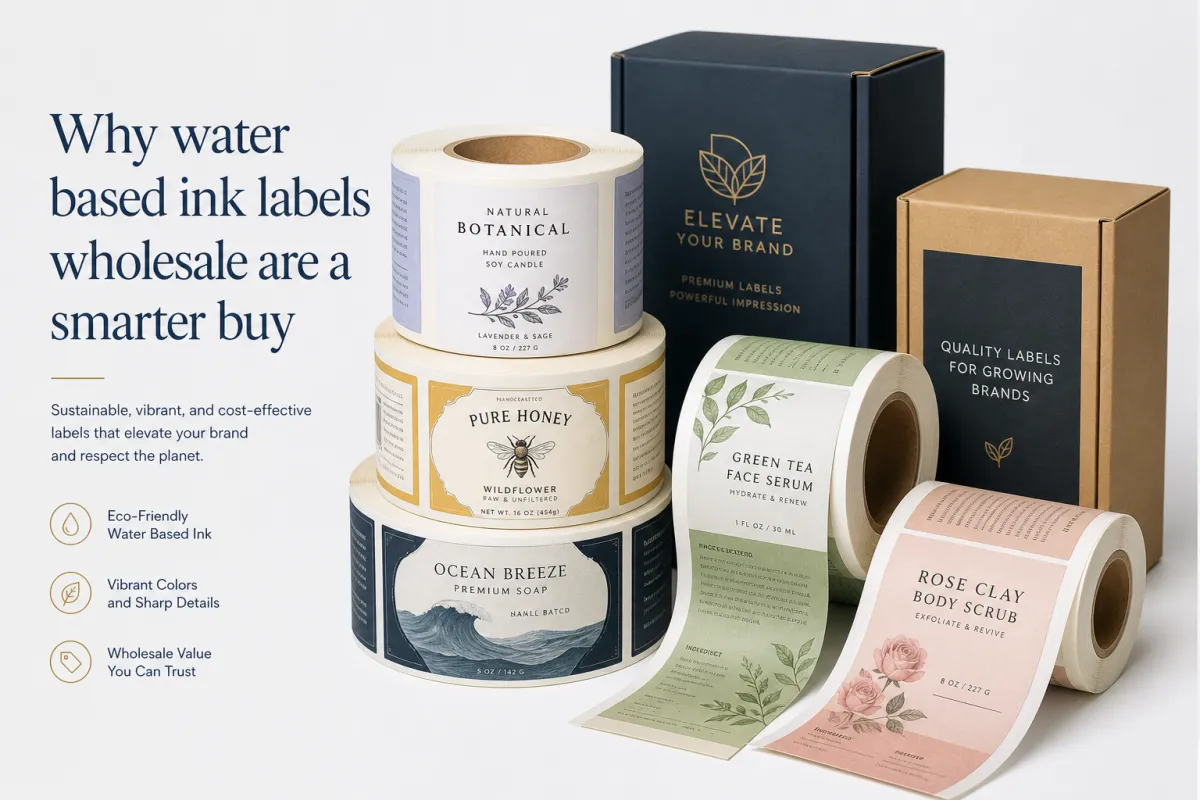
People on a packaging floor notice practical problems first. A label that smells harsh, feels tacky, or slows down application gets attention fast. I've seen teams blame artwork when the real issue was a mismatch between ink, substrate, and adhesive. That is one reason water based ink labels wholesale remain a useful option for many brands: the print system can be easier to manage, less aggressive in odor, and more comfortable for teams working near the press or the finishing line.
Repeatability is another reason buyers keep coming back to it. Water based ink labels wholesale programs are built for consistency, which matters when a brand needs the same result across multiple runs and multiple purchase cycles. The team can lock in dimensions, substrate, adhesive, and finish, then reorder with less guesswork. Seasonal products, private label lines, and steady-volume SKUs all benefit from that kind of predictability.
The practical upside is usually more useful than the marketing angle. Lower solvent content can improve press-room conditions, and many paper-based constructions print very well with water based ink once the coating and absorbency are chosen properly. So water based ink labels wholesale is less about making a grand statement and more about choosing a label system that prints clearly, handles well, and stays dependable over time.
From a packaging buyer's point of view, the best label is the one that does not create extra meetings. The artwork looks right, the proof matches the approved target, and the finished roll feeds smoothly into application equipment. That is the standard that matters. Water based ink labels wholesale can meet it when the project starts with realistic specs and a clear read on the package surface, storage conditions, and shelf-life needs.
In real production, the right wholesale label prints cleanly, applies the same way every time, and does not turn the line into a mess.
If your packaging team is still comparing structures, start with the use case before you talk price. A paper label for a dry shelf product, a refrigerated bottle, and a corrugated shipper are three different jobs. Once that is clear, water based ink labels wholesale gets easier to quote, easier to test, and easier to repeat.
For buyers who want to compare broader label structures, our Custom Labels & Tags page is a useful place to review formats, and our Wholesale Programs page explains how repeat production is handled for larger accounts.
Product details: materials, finishes, and print methods
Water based ink labels wholesale orders work best when the construction matches the substrate and the ink behaves the way the surface expects. Paper stocks are the most common starting point. Coated paper gives stronger color density and sharper text, while uncoated paper creates a more natural look and is easier to write on after application. Writable stocks are handy for batch coding, date marking, or retail items that need a hand-applied note.
Film can still play a role in water based ink labels wholesale production, but it needs more attention. If the label must survive moisture, condensation, or abrasion, the surface energy of the film and the drying behavior of the ink need to be checked before full production. Some jobs need a primer or a topcoat, especially when the label will face cold storage, friction, or long transit times. The goal is not to pick the flashiest face stock. The goal is to pick the one that performs in the real world.
Finish matters too. A matte finish gives a softer, more natural presentation and usually suits craft beverages, health products, and organic-style branding. Gloss increases contrast and makes saturated brand colors pop, which is useful for retail packs that need strong shelf visibility. Specialty coatings can help with rub resistance or moisture handling, but they should be specified for a reason, not as decoration. For water based ink labels wholesale, finish belongs in the performance spec.
Print method changes the buying decision as well. Flexographic printing often fits larger, repeatable runs because setup becomes efficient at scale and color control stays stable once the job is dialed in. Digital production works well for shorter runs, versioned artwork, and faster sampling because it avoids some tooling overhead. For water based ink labels wholesale, the right method depends on quantity, color complexity, and how often the label will be reordered.
The sustainability angle deserves a careful read. A label that uses water based ink is not automatically recyclable, compostable, or lower-impact in every case. The whole structure still matters: face stock, adhesive, coating, release liner, and how the label behaves in sorting systems. When paper sourcing matters, many buyers ask for FSC-certified stock from FSC. When shipping or transit durability needs a check, testing against ISTA methods can be useful. That kind of specification discipline gives water based ink labels wholesale real operational value.
One more practical point: the ink and substrate should be matched before the quote is finalized. A heavily inked dark background on an absorbent uncoated sheet will not behave the same way as a light design on smooth coated paper. If the artwork depends on small text, barcodes, or color-critical logos, the print strategy should be chosen with those details in mind. That is how water based ink labels wholesale stays predictable from the first roll to the last roll.
Specifications for water based ink labels wholesale orders
The fastest way to get a useful quote for water based ink labels wholesale is to define the technical specs before asking for price. Start with label size, then shape, then whether the labels will ship on rolls or sheets. After that, add core size, unwind direction, and application method. Those details sound basic, but they affect the die, the finishing setup, and whether the labels will run cleanly on your equipment.
Color is the next decision point. Brand colors that look fine on screen can shift once they hit paper, especially if the face stock is uncoated or the ink coverage is heavy. For water based ink labels wholesale, it helps to define whether you need a digital proof, a physical sample, or a press-approved target before production starts. If color accuracy matters for a retail brand or a premium pack, set that expectation early instead of fixing it after the first shipment lands.
Durability needs plain language. Will the product sit in ambient retail storage, or will it move through refrigeration? Is there condensation on the container? Will the label touch oils, handling gloves, carton dust, or the scuffing that comes from packing and transport? These are not small points. They shape the adhesive choice, the stock choice, and whether a protective coating is worth the extra cost. For water based ink labels wholesale, durability is part of the specification.
Adhesive selection deserves its own line in the quote request. Glass, corrugate, PET, HDPE, and other common packaging surfaces do not behave the same way. A label that holds beautifully on glass may struggle on a low-surface-energy plastic container unless the adhesive is built for that surface. If the label must perform in cold conditions, specify freezer-grade or moisture-resistant adhesive early. Buyers who treat adhesive as a side note usually pay for it later. In water based ink labels wholesale, the adhesive often decides whether the label feels premium or frustrating.
Compliance and plant requirements belong in the brief too. Food-adjacent packaging may need clear documentation, retailer labeling rules may affect dimensions or barcode placement, and some facilities require internal approval before a new label enters production. If the job has a barcode, leave room for scan quality checks. If the label is used on regulated packaging, confirm the exact path with your compliance team before printing. That is the kind of discipline that keeps water based ink labels wholesale moving without rework.
A practical quote request usually includes:
- Label width and height, or the full dieline
- Shape: rectangle, circle, oval, custom cut
- Quantity per roll or sheet
- Core size and unwind direction
- Face stock preference
- Adhesive requirement
- Finish: matte, gloss, or protective coating
- Artwork file format and brand color references
When those basics are clear, water based ink labels wholesale becomes easier to quote accurately, easier to sample, and much easier to reorder later.
Pricing and MOQ for water based ink labels wholesale
Pricing for water based ink labels wholesale comes down to a handful of variables that show up on every job sheet. Size is one of the biggest. A larger label uses more substrate, more ink coverage, and more cutting area. Color count matters too, because more print passes usually add setup time and make registration more sensitive. Die shape, finish, and adhesive type also affect cost, especially if the job needs a custom contour cut or a specialty surface treatment.
MOQ, or minimum order quantity, exists for a simple reason: setup has a cost. The press has to be prepared, the artwork has to be approved, the die has to be set, and the finishing line has to be configured. Smaller runs can absolutely be produced, but the unit price tends to be higher because those setup costs are spread across fewer labels. For water based ink labels wholesale, that is normal, and it is one reason buyers often move from a small pilot run into a larger repeat order once the label is approved.
Here is a practical way to think about pricing tiers for water based ink labels wholesale. These ranges are illustrative, not a promise, because the final quote still depends on coverage, paper choice, and finishing requirements. Even so, they help buyers compare options without guessing.
| Order level | Typical use | Indicative unit price | What changes the most |
|---|---|---|---|
| Sample / pilot run | Fit check, adhesion test, color approval | $0.22-$0.45 each | Setup is spread across fewer pieces, proofing adds time |
| Mid-volume wholesale run | Launch inventory, seasonal production | $0.10-$0.22 each | Better press efficiency, better material yield |
| Repeat bulk order | Stable SKU, reorder stock | $0.05-$0.14 each | Lowest setup burden, easiest packing and shipping |
Those numbers make more sense once you see the hidden drivers. A full-bleed design with heavy ink coverage will usually cost more than a minimalist label with one or two colors. A complex die shape may add tooling cost. Special proofing, rush handling, or nonstandard packaging format can also change the number. For water based ink labels wholesale, freight and packing format may matter more than expected if the labels are shipping overseas or need protective cartonization.
It also pays to compare quotes on more than price alone. A slightly higher quote can be the better buy if it gives you cleaner color control, stronger adhesion, or a more reliable lead time. In many purchasing teams, the cheapest label becomes expensive the moment it jams applicators or arrives with inconsistent roll tension. That is why experienced buyers judge water based ink labels wholesale by total fit, not only by the unit number on the quote.
A useful rule of thumb: if you are still proving the label, pay for the sample stage and learn from it. If the label is already approved and the SKU has stable demand, move into the larger wholesale tier. The unit economics usually improve quickly once the setup is locked in. That is one of the practical strengths of water based ink labels wholesale programs when they are structured well.
Process and timeline: from proof to shipment
The normal workflow for water based ink labels wholesale is straightforward when the artwork and specs are complete. It starts with artwork review, where the file is checked for bleed, safe area, barcode placement, and dieline alignment. Then the label structure is confirmed: stock, adhesive, finish, and quantity. After that comes proofing, production, finishing, packing, and shipment. Each step can move fast when the files are clean and the decisions are made early.
Proofing is where many projects gain or lose time. A digital proof is useful for checking layout, text, and dieline placement, but it will not fully show how a color behaves on paper or how a coating changes the feel of the finished label. A physical sample takes longer, yet it gives a much better read on real-world appearance and adhesion. For water based ink labels wholesale, a physical sample is the safer choice if the package will face refrigeration, abrasion, or a premium color target that needs to match closely.
Typical lead times vary with complexity, but a practical schedule often looks like this: one to two business days for artwork review, one to three business days for proofing if no major changes are needed, five to ten business days for production after approval, and a short window for finishing and packing. Freight is separate and depends on destination. If the job includes custom cutting, extra finishing, or special packing, the timeline can stretch. That is not a problem; it is simply how water based ink labels wholesale stays controlled instead of rushed.
File preparation matters more than many buyers expect. A properly set bleed can prevent unwanted white edges. A clear safe area can keep text off the trim line. High-resolution artwork, usually vector where possible, helps preserve crisp type and barcode clarity. If the dieline is wrong, the entire job can slip. That is why the front end of water based ink labels wholesale depends on careful review before the press ever starts moving.
Once a label is approved and the spec is locked in, reorder production is usually faster. The artwork is already set, the die is already confirmed, and the production team knows the expected outcome. That is one reason wholesale customers value stable label programs: they save time on the second and third run, not just money on the unit cost. If your packaging line depends on consistency, water based ink labels wholesale works best when the project is managed as a repeatable system instead of a one-off print job.
Here is the simple path I recommend for buyers who want less friction:
- Send the label size, shape, quantity, and surface type.
- Attach artwork files and brand color references.
- State whether you need a sample, a digital proof, or a direct production run.
- Confirm the target delivery date and storage conditions.
- Approve the proof only after the real-world use case has been checked.
That process keeps water based ink labels wholesale on schedule and cuts down on avoidable revisions.
Why choose us for water based ink labels wholesale
What buyers usually want from water based ink labels wholesale is not a dramatic pitch. They want a supplier who understands the relationship between the substrate, the adhesive, the press setup, and the container surface. That is where technical guidance matters. A label can look fine in a mockup and still behave badly on a cold bottle, a textured carton, or a fast-moving application line. Good recommendations prevent those problems before they show up in production.
Clear communication matters just as much as print quality. Wholesale buyers need direct answers on MOQ, lead time, proofing options, and reorder consistency. If the quote is vague, the whole project becomes harder to manage internally. The better approach is simple: define the spec, confirm the print method, state the expected use environment, and keep the approval path easy to follow. That is how water based ink labels wholesale should be handled from the start.
Experience shows up in the small details that save time later. Correct unwind direction helps applicators run smoothly. Stable roll tension prevents handling issues. A sensible finish reduces scuffing in transit. For water based ink labels wholesale, those details are not minor. They are what separate a label that merely prints from a label that works in production and still looks good on the shelf.
Honest application-fit advice matters too. Sometimes a buyer asks for a construction that looks attractive but is not a good match for the packaging line. In those cases, the right answer is not to force the sale. It is to adjust the stock, adhesive, or finish so the label behaves the way the product needs. That is the right mindset for water based ink labels wholesale, especially when the labels will be reordered in volume and used across multiple production cycles.
Sustainable packaging goals are easier to support when the label is specified carefully from the beginning. Water based inks, FSC-certified paper when requested, efficient print planning, and a label structure that matches the end use all help a brand make better sourcing decisions. No single label fixes everything, and that honesty matters. A well-planned water based ink labels wholesale program can fit a responsible packaging strategy without giving up print quality or operational reliability.
If your team wants a straightforward route, send the specs, the artwork, and a photo of the actual package. That gives the quoting team enough information to match the label to the real use case instead of a guess. For water based ink labels wholesale, that is usually the difference between a generic response and a useful production plan.
Next steps to place your wholesale label order
The cleanest way to move forward with water based ink labels wholesale is to send one complete message with the essentials: label dimensions, quantity, substrate preference, packaging surface, durability needs, and target delivery date. If you already have artwork, include it. If you have brand color references, include those too. A photo of the bottle, jar, carton, or pouch is often more useful than a paragraph of assumptions because it shows exactly how the label will live on the package.
If you are not sure whether you need a sample, a press proof, or a direct production run, say so. That single question can save time on both sides. A physical sample is worth the extra step when the label must handle moisture, friction, or premium color matching. A direct production run can make sense when the structure is already proven and the reorder conditions are stable. Either way, water based ink labels wholesale works best when the approval path is clear before the job starts.
Once you receive the quote, compare three things together: the recommended construction, the MOQ, and the lead time. Those three numbers tell you more than unit price alone. A lower quote is not helpful if the label needs a second round of revisions or if it cannot survive the packaging environment. A practical water based ink labels wholesale decision balances cost, performance, and repeatability.
From there, approve the proof, confirm the production schedule, and keep the reorder file organized for the next run. That last step matters more than most people think. The better the records, the faster the next wholesale order moves. For brands that want steady supply, water based ink labels wholesale should feel like a managed system, not a fresh puzzle every time.
So the actionable takeaway is simple: do not ask for a price first. Ask for a label built around the actual package, the actual environment, and the actual run size. Send the specs, artwork, and target delivery date together, then judge the quote on fit, MOQ, and lead time. That is how water based ink labels wholesale turns into a repeatable program instead of a one-off fix.
Frequently asked questions
What materials work best for water based ink labels wholesale orders?
Paper stocks are usually the easiest fit for water based ink labels wholesale, especially when the brand wants a natural look and dependable print clarity. Coated paper gives sharper color and cleaner small type, while uncoated paper feels more tactile and writable. If the label needs moisture resistance or refrigeration performance, the adhesive and topcoat matter as much as the face stock, so the whole structure should be specified together.
Are water based ink labels wholesale durable enough for refrigerated products?
Yes, they can be, but only when the construction is matched to condensation, cold storage, and handling conditions. Durability depends on the full system: substrate, adhesive, and any protective coating or laminate. For water based ink labels wholesale, it is smart to test the label on the actual container and in the actual storage environment before full production, because refrigeration can expose weak points that look fine at room temperature.
How is MOQ set for water based ink labels wholesale pricing?
MOQ usually reflects setup cost, material usage, press time, and finishing requirements. Smaller runs can be produced, but the unit price is typically higher because the setup is spread across fewer labels. Once the artwork and production settings are approved, a reorder usually becomes more efficient. That is one reason water based ink labels wholesale works best for stable SKUs and recurring packaging programs.
What affects the quote for water based ink labels wholesale most?
Size, quantity, color count, material, finish, and die shape are the biggest pricing drivers. Special requirements such as rush turnaround, custom proofing, and unusual packing formats can also affect the number. The best way to compare quotes for water based ink labels wholesale is to compare the full specification, not just the sticker price, because durability and run consistency can matter more than a small difference in unit cost.
Can you match brand colors on water based ink labels wholesale runs?
Yes, but color matching should be defined early with artwork files, references, and approval expectations. Paper choice, coating, and ink coverage all affect how a brand color appears on the finished label. A proof or sample is the safest way to confirm the result before the full run is released. That is especially true for water based ink labels wholesale projects where the label sits on shelf-facing packaging and color accuracy affects the brand presentation.