Buyer Fit Snapshot
| Best fit | Custom Woven Hang Tags Wholesale projects where brand print, material claims, artwork control, MOQ, and repeat-order consistency need to be specified before quoting. |
|---|---|
| Quote inputs | Share finished size, material target, print colors, finish, packing count, annual reorder estimate, ship-to region, and any compliance wording. |
| Proofing check | Approve dieline scale, logo placement, barcode or warning zones, color tolerance, closure strength, and carton packing before bulk production. |
| Main risk | Vague material claims, crowded artwork, missing packing details, or unclear freight terms can make a low unit price expensive after revisions. |
Fast answer: Custom Woven Hang Tags Wholesale: Specs, Pricing, Process should be specified like a repeatable production item. The safest quote records material, print method, finish, artwork proof, packing count, and reorder notes in one written spec.
Production checks before approval
Compare the actual filled-product size with the drawing, then confirm tolerance on folds, seals, hang holes, label areas, and retail display edges. Reserve space for logos, QR codes, warning copy, and material claims before decorative graphics fill the panel.
Quote comparison points
Review material grade, print process, finish, sampling route, tooling charges, carton quantity, and freight assumptions side by side. A quote is only useful when the supplier can repeat the same color, closure quality, and packing count on the next order.
Custom Woven Hang Tags Wholesale: Specs, Pricing, Process
Custom woven Hang Tags Wholesale solve a very specific problem. The product is done. The box is decent. The photos look good. Then the tag shows up looking like it was borrowed from a sample bin. That kind of mismatch is brutal. Cheap tags drag down good products, and buyers notice faster than most brands expect.
At Custom Logo Things, the real question is not whether a tag looks fine in a mockup. It is whether custom woven hang tags wholesale will hold up in production, match the rest of the product packaging, and keep its shape after handling, shipping, and merchandising. That is the test. Woven construction usually passes it better than flimsy alternatives, especially when the tag has to survive a few rounds of folding, packing, and shelf display without looking tired.
Custom Woven Hang Tags Wholesale: Why Buyers Switch
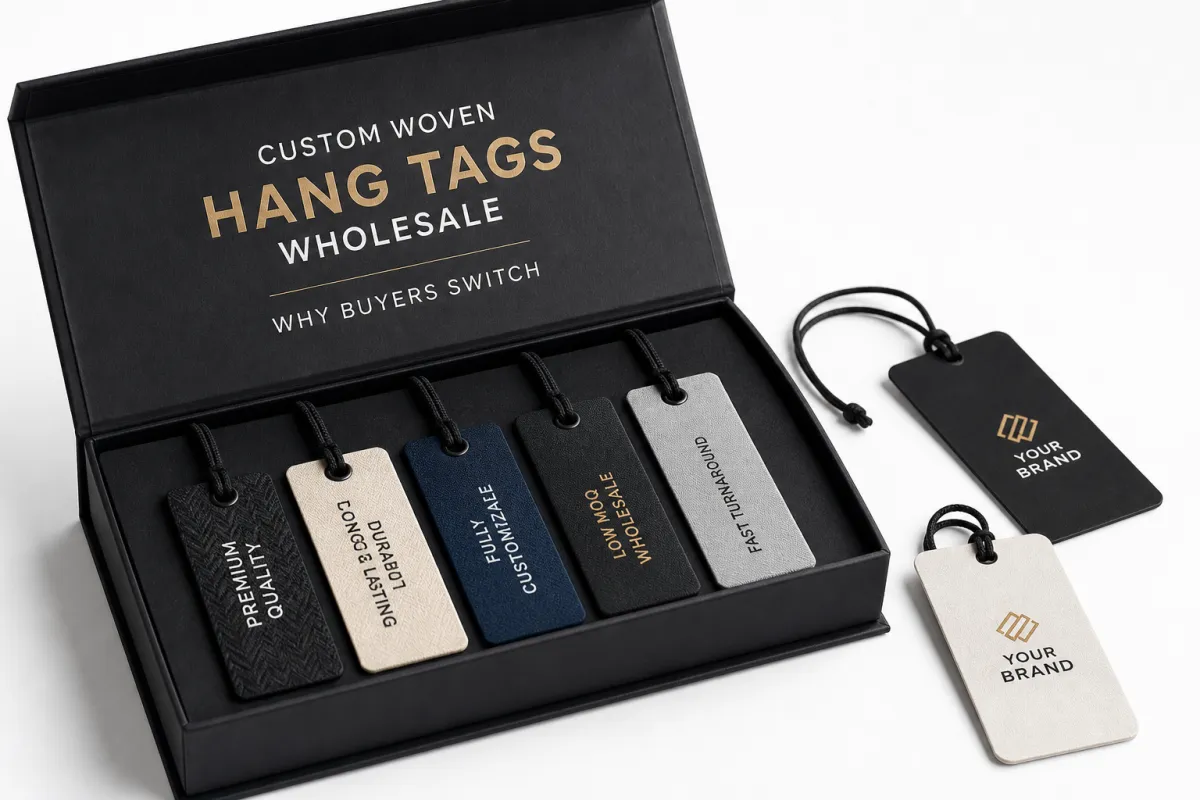
Most packaging teams do not switch for fun. They switch because the old setup leaks value. A thin paper tag can work for a low-risk item, but it often feels disconnected from the rest of the presentation. Custom woven hang tags wholesale fix that by adding texture, structure, and a more deliberate finish. The tag feels built into the brand, not slapped on at the last minute.
That difference shows up across categories. Apparel brands use custom woven hang tags Wholesale for Premium denim, outerwear, basics, and capsule collections. Accessory brands use them on hats, scarves, bags, and belts. Gift set programs use them to tie the message together when the rest of the branding packaging includes rigid cartons, inserts, or ribbon. Even in high-volume retail packaging, a woven tag can create a stronger first impression than a paper insert alone.
There are three business reasons buyers keep coming back to woven tags. First, woven construction holds shape better, so the product looks more consistent on the shelf. Second, readability stays cleaner when the weave is specified well, which matters for size, SKU, or care information. Third, repeat orders get easier when the tag format is standardized. That is why custom woven hang tags wholesale often make more sense for ongoing programs than one-off decorative pieces.
The comparison is not really paper versus woven. It is temporary versus intentional. A tag that frays, curls, or wrinkles makes a premium item feel discounted. A woven tag with clean edges and balanced color separation does the opposite. It lifts perceived value without changing the actual product cost.
Practical rule: if the tag has to survive packing, shipping, and repeated handling while still looking polished on display, custom woven hang tags wholesale are usually the stronger fit.
I've seen brands spend good money on a premium box, then clip on a tag that looks like a placeholder. The whole package loses authority. That mismatch is more expensive than it looks because it weakens the product story. A tighter system, including custom woven hang tags wholesale, usually delivers better shelf impact than a pile of unrelated pieces.
What Custom Woven Hang Tags Include
Custom woven hang tags wholesale usually include a woven face, a backing or reinforcement choice, and an attachment method that fits the product. The face is where the brand name, logo, size, or short message appears. The backing may be folded, stitched, laminated, or kept as a single layer depending on the structure. Attachment can involve string, loop, ring, side-seam placement, or a neck placement when the tag needs to sit with the product instead of hanging loose.
Buyers usually ask what can be customized without turning the job into a production headache. The answer is: quite a lot, but not everything should change at once. With custom woven hang tags wholesale, the most useful variables are size, shape, weave density, yarn color count, edge finish, and how the tag attaches. Those are the knobs that affect appearance and cost. More elaborate shapes or layered construction can look great, but they also increase setup time and can complicate quoting.
Common formats include folded tags, straight-edge tags, looped tags, and tags placed at the side seam or neck area. Folded versions work well when you need a compact format with extra room for brand copy. Straight-edge tags are simpler and usually easier to scale. Loop style pieces are useful when the tag needs to sit visibly on apparel or accessories. Side-seam placements make sense when the brand wants the tag to feel integrated rather than dangling. For many programs, custom woven hang tags wholesale work best when the format matches the item instead of forcing one universal shape.
There is also a strategic question: should the woven tag replace a paper hang tag or sit beside one? The answer depends on the product and the message. If the item needs a short, durable brand marker, custom woven hang tags wholesale can replace a paper tag cleanly. If the product also needs legal copy, barcodes, pricing, or a longer story, the woven tag may work best as the premium layer while a paper tag handles transactional information. That layered approach often shows up in retail packaging programs where the brand wants both visual polish and practical data.
For teams already ordering Custom Labels & Tags, the decision is usually about hierarchy. Labels can handle interior information and product marking. Woven hang tags can handle the external first impression. Together, they support a more coherent identity across the item, the carton, and the outer shipment. That kind of consistency matters just as much as the tag itself.
In plain terms, custom woven hang tags wholesale include more than a logo on fabric. They include the fit between the item, the copy, the finish, and the job the tag has to do. If the order is not doing all four, the spec needs to be simplified or reconsidered.
Specifications That Decide Quality and Cost
Specs drive everything. Price. Lead time. Readability. Even how confident the final tag feels in hand. With custom woven hang tags wholesale, the most important specification is not one single item; it is the relationship among dimensions, yarn colors, weave count, texture, and attachment method. Change one input and the whole production profile shifts.
Dimensions come first because they determine how much information can fit without crowding. A compact tag may work for a logo and size marker, while a larger format may be better for brand copy or layered messaging. Color count matters because each additional color adds complexity to the weave and can affect registration. Tighter weave counts usually improve detail and text clarity, but they may also increase cost. A softer hand-feel can make the tag more pleasant on clothing, while a denser weave can improve legibility. There is no universal best choice. There is only the best choice for the product category.
Attachment method also affects cost and function. A simple looped attachment can keep the tag neat and easy to apply. A stitched edge or reinforced backing may improve durability but adds a production step. If the tag will be visible on the front of a garment or accessory, finish quality matters more than it would for an interior marker. That is why custom woven hang tags wholesale should never be quoted from a logo file alone. The use case has to be clear.
For buyers comparing options, it helps to split the visual variables from the production variables. A tag can look elegant while still being efficient to make. Another can look busy and expensive without improving the sell-through experience. Practical packaging judgment beats excitement here. If the product already includes custom printed boxes, a hang tag may need to coordinate with the box rather than fight it.
What should be sent for an accurate quote? Usually the most useful items are artwork files, preferred Pantone references, approximate quantities, size targets, attachment preference, and any compliance or care-copy requirements. If the tag has to match a specific brand palette, Pantone references reduce guesswork. If the product sits under a retailer’s packaging standards, that requirement should be stated early. If the order is part of a broader branding packaging rollout, say so. Better brief, better pricing accuracy.
For shipping-sensitive programs, it helps to think about test criteria too. Many teams use packaging standards as a reference point, especially if the finished goods will be boxed, palletized, or moved through multiple handling stages. For broader testing context, the ISTA protocols are useful when the package needs to survive transit and handling with predictable results. If a program uses paper components or recycled content in the wider package system, the FSC framework often comes into the conversation as well.
Here is the blunt truth: better specs do not always mean more expensive specs. Sometimes a cleaner design, fewer color changes, and a more efficient shape lower cost while improving the final result. That is one reason custom woven hang tags wholesale are worth planning carefully instead of treating them like a small accessory order.
Custom Woven Hang Tags Wholesale Pricing and MOQ
Pricing is where many buyers lose the thread. They ask for a number before the spec is stable, then compare quotes that do not describe the same item. Custom woven hang tags wholesale are priced on quantity, design complexity, size, color count, finishing, and packaging format. The biggest driver is usually not the logo. It is the total production effort required to make the order repeatable at the requested level of detail.
Wholesale pricing usually rewards volume in noticeable steps. A first run of 500 pieces will often carry a much higher unit cost than a repeat order of 3,000 or 5,000 pieces. That is not random. Setup, proofing, and machine time are spread across a larger run. For buyers, the question is not just “What is the cheapest quote?” It is “Which quantity gives the best value for this launch and the next reorder?”
Minimum order quantity matters just as much. MOQ is usually tied to size, color count, and weave complexity. A simple two-color version may have a lower MOQ than a dense, multi-color tag with specialty finishing. Smaller test orders are possible in some programs, but custom woven hang tags wholesale are most efficient once the order reaches standard wholesale volume. For seasonal launches, that creates a useful decision point: test with a smaller run, or lock in a larger quantity and lower the per-unit cost.
To make that tradeoff clearer, the table below shows how custom woven hang tags wholesale typically behave across volume tiers. The numbers are directional, not universal, because design and finishing can change the outcome quickly.
| Order Tier | Typical Use | Common Specs | Typical Unit Range | Notes |
|---|---|---|---|---|
| Starter run | Launch tests, small capsule collections | 500-1,000 pieces, 1-2 colors, simple edge | $0.22-$0.42 | Higher setup share; useful for proofing market response |
| Standard wholesale | Seasonal replenishment, core styles | 1,500-3,000 pieces, 2-4 colors, standard attachment | $0.14-$0.28 | Often the best balance of price and flexibility |
| Volume program | Ongoing retail supply, multiple SKUs | 5,000+ pieces, streamlined format, repeatable spec | $0.09-$0.20 | Best value when the same tag repeats across styles |
Those ranges show why standardization matters. If every SKU uses a different tag size, edge, or color count, wholesale pricing gets harder to control. If a brand standardizes one or two base sizes and only changes the variable copy, custom woven hang tags wholesale become much easier to budget. Larger custom packaging programs do this all the time because it keeps procurement predictable.
There are also practical ways to keep costs in check without making the tag feel cheap. Limit the number of color changes. Keep the shape efficient. Choose a size that lets the weave support the artwork instead of forcing the artwork into a cramped layout. Share final quantities up front so the quote reflects reality. Those steps do not just lower cost. They reduce revisions, delays, and reproofs.
If the brand is weighing a premium presentation against a leaner budget, it can help to compare custom woven hang tags wholesale with other parts of the package system. A slight reduction in box embellishment or insert complexity sometimes frees enough budget to upgrade the tag. For many buyers, that trade is smart because the tag is the first thing a shopper touches. The box may open the sale. The tag often closes the impression.
One more pricing reality: not all savings are worth chasing. A quote that looks lower on paper can become more expensive if the artwork needs repeated corrections, the lead time slips, or the order arrives with color inconsistency across production lots. Custom woven hang tags wholesale should be judged on total program cost, not just the line item. If the supplier cannot explain where the savings come from, that quote is probably hiding a little mess somewhere.
Ordering Process, Proofing, and Production Timeline
A clean ordering process saves more money than a small discount ever will. The usual flow for custom woven hang tags wholesale starts with a brief, moves to a quote, then artwork review, proof approval, production, inspection, and shipping. Each step has a reason. Skip one, and the risk lands somewhere else.
Proofing is the step buyers should care about most. It is where weave detail, color alignment, copy placement, and edge treatment can be checked before production starts. A good proof does not just show the logo. It shows whether the logo is readable at the chosen size, whether the colors separate cleanly, and whether the tag format fits the product. In custom woven hang tags wholesale, proofing is the cheapest time to catch a problem.
Realistic timelines depend on design complexity and current production load. Simple orders can often move from proof approval to finished goods in about 12-15 business days. More complex custom woven hang tags wholesale projects, especially those with multiple colors, unusual dimensions, or special finishing, may need longer. If the order is tied to a product launch, the schedule should include room for artwork revisions and internal approvals. Rush orders are possible in some cases, but only if the brief is clean and the spec is stable.
What slows projects down the most? Missing artwork, unclear specs, and approval delays. Those sound obvious, but they are the usual culprits. A buyer may have the right concept but not the final file. A brand may like the general look but not confirm the exact size. A marketing team may need three sign-offs before production can start. Custom woven hang tags wholesale work best when everyone knows who is approving what and by when.
It also helps to treat packaging as a system rather than a stack of isolated parts. If the hang tag needs to coordinate with Custom Packaging Products or support a retailer-specific display, proofing should check all of it together. The same applies to Wholesale Programs with multiple styles. A tag that works on one SKU may need slight adjustments for another, especially if the attachment point or garment shape changes. That is normal. It is also why experienced buyers keep the approval chain tight.
Below is the kind of process discipline that usually keeps custom woven hang tags wholesale on track:
- Send a complete brief with quantity, size target, colors, and attachment style.
- Review the quote against the exact spec, not a rough idea.
- Check the proof for readability, copy placement, and edge behavior.
- Approve only after the tag matches the rest of the packaging system.
- Confirm shipping details and reorder expectations before production closes.
That sequence may look basic, but basic is what protects margin. The more consistent the process, the more reliable custom woven hang tags wholesale become for launch planning and replenishment. Nobody needs drama from a tiny piece of fabric that was supposed to be simple.
Why Choose Us for Custom Woven Hang Tags Wholesale
The strongest supplier is not always the one with the flashiest sample. It is the one that can repeat the result at scale. That matters because custom woven hang tags wholesale are only useful if the next order looks like the first. Once a brand starts distributing across stores, marketplaces, or seasonal drops, consistency becomes a business requirement, not a nice-to-have.
At Custom Logo Things, the value is in practical support: clear spec guidance, proof checks, and repeatable ordering for ongoing programs. That kind of discipline matters more than a single sample because wholesale buyers need fewer surprises, not more. When custom woven hang tags wholesale are part of a larger packaging design system, the supplier should help protect the look across SKUs, not just ship a box of tags.
There is also a cost argument here. Commodity sourcing can save a small amount at the purchase order stage, then create problems later through color drift, inconsistent attachment quality, or poor communication around reorders. Those problems get expensive fast when a brand is trying to keep retail packaging aligned across a full line. A supplier that manages specs carefully can reduce that risk in a way that shows up on the balance sheet, not just in the sample room.
Good support also helps brand teams move faster. If the supplier can flag a design issue before production, the buyer does not waste days cleaning up avoidable mistakes. If reorder tracking is organized, the next season starts from a known spec instead of a fresh guess. That is the kind of operational value that makes custom woven hang tags wholesale worthwhile for brands with more than one SKU.
For buyers comparing tag suppliers, here is the simplest test: ask how they handle repeat orders, proof revisions, and spec changes. If the answers are vague, the risk is probably higher than the price suggests. If the answers are specific, the program is more likely to stay controlled. That is especially true for brands that care about both presentation and speed.
Buyer’s test: if a supplier cannot explain the spec, the proof, and the reorder path in plain language, the order is probably not ready for wholesale scale.
Custom woven hang tags wholesale work best when the supplier treats them as part of the brand system, not a side item. That is the difference between a tag that merely exists and a tag that supports sales, presentation, and repeat buying.
Next Steps to Finalize Your Custom Woven Hang Tags
If the order is moving forward, the fastest path is simple. Prepare the artwork, approximate quantity, target size, brand colors, attachment preference, and deadline. That gives the supplier enough information to quote accurately and flag any production issues early. For custom woven hang tags wholesale, clarity up front almost always saves time later.
It is also smart to ask for a proof or sample before committing to full production. That is especially useful if the brand is choosing between a more premium look and a lower-cost version. A proof can show how the weave reads at the chosen size, whether the hand-feel matches the product, and whether the tag sits correctly beside the item or inside the package. In many cases, the best decision comes from comparing one version that is stripped down and one version that is more finished.
That comparison matters more than most teams expect. A lean spec may work beautifully for a startup bundle or entry-level style. A more detailed spec may be the right move for hero products, limited editions, or items competing in crowded retail packaging. The right answer depends on the product, the margin, and the channel. Not every style needs the same amount of detail. Not every brand needs the same finish level. The order should reflect that reality.
From there, the decision path is straightforward: confirm specs, lock MOQ, approve timing, and plan the reorder sequence. That is the discipline that keeps custom woven hang tags wholesale useful after the first shipment lands. When the supply chain is set up correctly, the tag stops being a project and becomes part of the brand operating rhythm.
If your next launch needs a sharper presentation, custom woven hang tags wholesale are worth serious attention. They support stronger shelf appeal, cleaner repeat orders, and a more coherent package branding system. And if the tag has to work alongside Custom Labels & Tags, Custom Packaging Products, or Wholesale Programs, the right spec can pull the whole presentation together instead of leaving it fragmented. For brands that care about value, custom woven hang tags wholesale are often the most efficient place to raise the standard without adding unnecessary complexity.
The practical takeaway is simple: start with the product, not the decoration. Match the weave, size, and attachment to how the item is sold, handled, and displayed, then keep the spec tight enough to reorder without guesswork. That is how custom woven hang tags wholesale stop being a small accessory choice and start doing real work for the brand.
FAQ
What is the minimum order for custom woven hang tags wholesale?
MOQ usually depends on size, color count, and weave complexity rather than one fixed number. Smaller test runs are possible in some programs, but pricing usually gets more efficient once the order reaches standard wholesale volume. Ask for the MOQ before approving artwork so the spec matches your launch budget and volume needs.
How long do custom woven hang tags wholesale orders usually take?
Lead time depends on proof approval speed, design complexity, and current production load. Simple orders can move faster, while custom shapes, more colors, and special finishes add time. A realistic plan often includes about 12-15 business days after proof approval, with extra time added if artwork is still changing.
Which products work best with woven hang tags wholesale?
They are a strong fit for apparel, premium accessories, gift bundles, and retail items that need a refined presentation. They also work well when a brand wants a more durable tag than paper can provide. Use them when the tag needs to feel like part of the product experience, not an afterthought.
Can I get a sample before placing a custom order?
Yes, ask for a sample or proof if weave clarity, finish, or attachment style matters to the decision. A proof helps verify layout, copy placement, and color intent before full production. Sampling is especially useful when you are comparing a premium look against a lower-cost option.
How do I keep custom woven hang tags wholesale costs down?
Standardize size, limit color changes, and keep the shape efficient for production. Share clear artwork and final quantities up front to avoid quote revisions and delays. Ordering in larger volumes usually lowers unit cost and makes reorders more efficient.

