Buyer Fit Snapshot
| Best fit | Sustainable Packaging Life Cycle projects where brand print, material claims, artwork control, MOQ, and repeat-order consistency need to be specified before quoting. |
|---|---|
| Quote inputs | Share finished size, material target, print colors, finish, packing count, annual reorder estimate, ship-to region, and any compliance wording. |
| Proofing check | Approve dieline scale, logo placement, barcode or warning zones, color tolerance, closure strength, and carton packing before bulk production. |
| Main risk | Vague material claims, crowded artwork, missing packing details, or unclear freight terms can make a low unit price expensive after revisions. |
Fast answer: Sustainable Packaging Life Cycle: Material, Print, Proofing, and Reorder Risk should be specified like a repeatable production item. The safest quote records material, print method, finish, artwork proof, packing count, and reorder notes in one written spec.
Production checks before approval
Compare the actual filled-product size with the drawing, then confirm tolerance on folds, seals, hang holes, label areas, and retail display edges. Reserve space for logos, QR codes, warning copy, and material claims before decorative graphics fill the panel.
Quote comparison points
Review material grade, print process, finish, sampling route, tooling charges, carton quantity, and freight assumptions side by side. A quote is only useful when the supplier can repeat the same color, closure quality, and packing count on the next order.
What Is Sustainable Packaging Life Cycle? A Practical Guide
What is sustainable packaging life cycle? The short answer is simple: it tracks a package from raw material sourcing to manufacturing, shipping, use, recovery, and disposal. The useful answer is messier. A carton can carry a recyclable label and still be a poor choice if the coating, adhesive, or local recycling system cannot handle it. That is the point where what is sustainable packaging life cycle stops sounding like a slogan and starts doing real work.
For custom packaging buyers, that matters more than a lot of teams want to admit. The biggest sustainability gains often happen before a package ever reaches a customer, not after it lands in a bin. Better structure, less empty space, lighter board, and smarter print specs can cut waste and cost at the same time. So what is sustainable packaging life cycle, really? It is not a hunt for one magical material. It is a way to see trade-offs clearly enough to Choose the Right format for product packaging, retail packaging, and branded packaging without guessing.
"A recyclable label does not guarantee a recoverable package. The recovery system is part of the design."
What Is Sustainable Packaging Life Cycle? Start Here
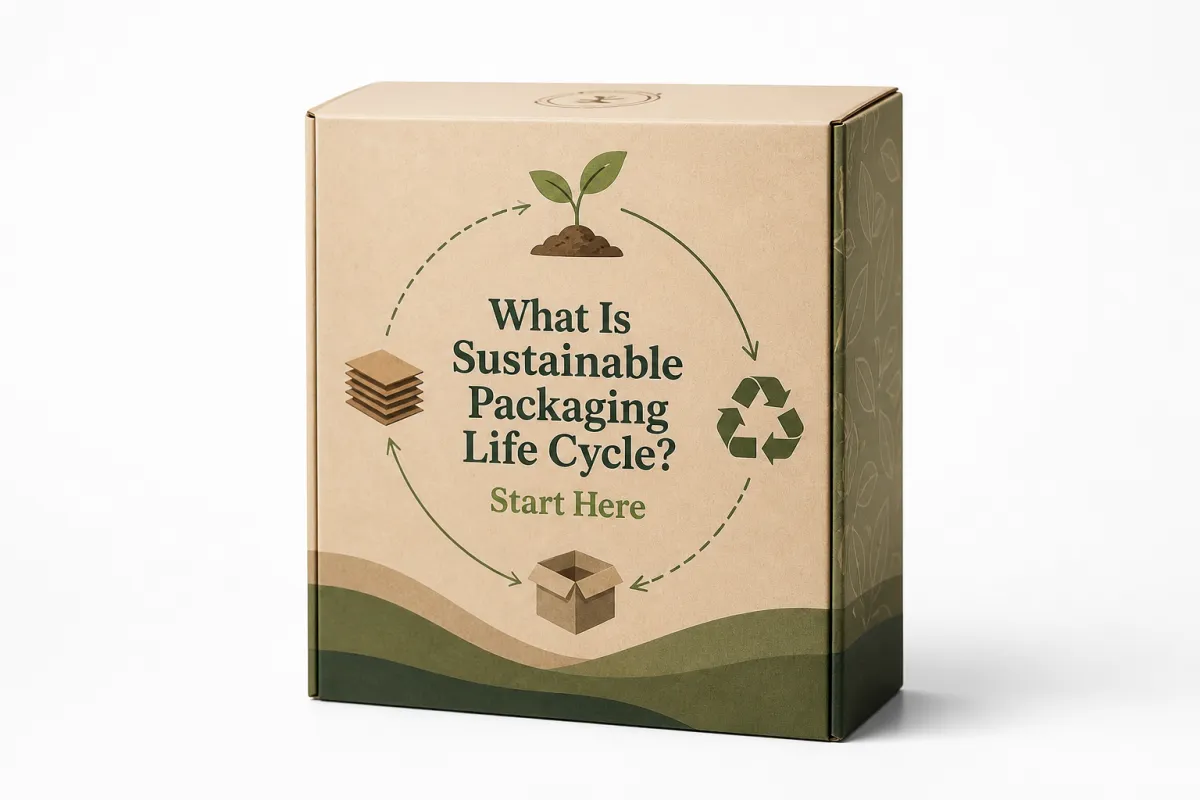
What is sustainable packaging life cycle in plain English? It is the full journey of a package, from the tree, resin, or recycled feedstock all the way to how it gets reused, recycled, composted, or landfilled. That journey includes extraction, conversion, printing, filling, shipping, consumer handling, collection, sorting, and end-of-life outcomes. If one of those stages breaks, the package may look sustainable on paper and still fail in the real world.
The annoying part is that a package can be made from recycled fiber and still create more waste than a simpler option if it crushes in transit and causes product loss. What is sustainable packaging life cycle really asking is not, "What material sounds green?" It asks, "Which package performs best across the whole system?"
From a packaging buyer's angle, the life cycle matters because the expensive problem is often hidden. A slightly cheaper substrate may raise damage rates by 2% to 3%, and that can wipe out the savings fast. I have seen that pattern in custom printed boxes, corrugated shippers, and presentation packaging. What is sustainable packaging life cycle helps teams compare the full picture instead of chasing one feature like recycled content or compostability.
There is also a sharp difference between a marketing claim and a life cycle view. A claim says, "This package is recyclable." A life cycle view asks whether the package is actually recovered in the markets where it will be sold, whether the finish interferes with sorting, and whether the consumer knows what to do with it. If the answer is weak in one market and strong in another, the claim may still be technically valid, but the sustainability story is thin.
Honestly, this is where a lot of packaging teams get stuck. They choose a format because it sounds responsible, then learn later that local infrastructure changes the outcome. What is sustainable packaging life cycle removes that blind spot. It forces the team to think in systems: material choice, print method, shipping behavior, and recovery path all in one view.
For a Custom Logo Packaging buyer, that system view can translate into better package branding without extra waste. A tighter mailer, a stronger folding carton, or a right-sized insert can do more than decorative add-ons. What is sustainable packaging life cycle is not anti-design. It rewards packaging design that is clean, durable, and honest about the real end-of-life path.
What Is Sustainable Packaging Life Cycle in Practice?
What is sustainable packaging life cycle in practice? It starts with sourcing and ends with disposal or recovery, but the important part is how each stage changes the next one. A raw material with a low-impact profile can still lose its advantage if the converting process is wasteful, the package is oversized, or the recovery stream is weak. That is why lifecycle thinking and formal life cycle assessment are related but not identical.
Lifecycle thinking is the everyday version. It helps a packaging team compare options without needing a full scientific study for every SKU. A formal life cycle assessment, by contrast, uses defined boundaries, impact categories, and data sets to measure environmental effects more precisely. What is sustainable packaging life cycle often sits between the two: enough structure to make a rational choice, enough flexibility to move fast.
Take a folding carton, for example. If you switch from a 16 pt board with a heavy aqueous coating to an 18 pt board with a simpler print treatment, the result may improve or worsen depending on the weight added, the shipping cube, and the local recycling system. What is sustainable packaging life cycle is useful because it shows how one design decision can ripple downstream. Heavier board may protect the product better, but it also raises material use and freight weight. Simpler finishing may improve recyclability, but only if it still meets shelf and handling requirements.
The same logic applies to mailers and corrugated shippers. A poly mailer can use less material than a rigid box, yet it may be a poor fit for premium package branding or fragile items. A corrugated box may be easier to recover, but if it is poorly sized, the empty air inside becomes a shipping penalty. What is sustainable packaging life cycle asks the buyer to compare the whole system, not just the bin label.
Packaging boundaries matter too. If a company measures only the package itself and ignores freight, the numbers can mislead. If it measures only manufacturing and ignores returns or damage, the same problem shows up. What is sustainable packaging life cycle depends on the scope chosen, and changing that scope can completely change the result. That is not a flaw. It is the reason the approach is worth using.
For a stronger decision, many teams use a simple sequence:
- List the package components and material weights.
- Check the converting steps, print processes, and finishing layers.
- Estimate freight impact from size, weight, and pallet density.
- Review consumer handling, reuse potential, and recovery options.
- Compare end-of-life outcomes in the actual market where the package will be sold.
That list looks basic, but it catches most of the expensive mistakes. What is sustainable packaging life cycle is not about solving everything with one metric. It is about making the trade-offs visible before a production run locks them in.
For teams building Custom Packaging Products, this stage is where design and operations need to sit in the same room. The design team may care about appearance and structure. Operations may care about fill speed and damage. Procurement may care about MOQ and freight. What is sustainable packaging life cycle gives all three a shared language.
Key Factors That Change the Packaging Life Cycle Result
What is sustainable packaging life cycle depends on a handful of variables that can swing the answer more than people expect. Material type is the obvious one, but it is only the start. Paperboard, corrugated board, molded fiber, plastics, glass, and hybrid structures each have different impact profiles, conversion requirements, and recovery realities.
Paper-based formats often win on consumer familiarity and curbside acceptance, but they are not automatically better. A heavily laminated carton can be harder to recycle than a plain corrugated shipper. Plastics can sometimes reduce weight and protect product more efficiently, which matters when the package is travel-heavy or fragile. Glass can be endlessly recyclable in theory, yet its weight can drive transport emissions up quickly. What is sustainable packaging life cycle asks which of those trade-offs matters most for the specific SKU.
Finishes matter more than many buyers think. Ink coverage, foil stamping, soft-touch lamination, plastic windows, and aggressive adhesives can all complicate recovery. A matte varnish may be fine. A multilayer film can be another story. What is sustainable packaging life cycle is where the detail shows up: one coating can change whether a package fits a common recycling stream or becomes contamination.
Transport is another major lever. A package that is 10% lighter and 15% more cube-efficient may reduce freight cost and emissions at the same time. That is especially true in e-commerce, where dimensional weight drives pricing and excess air becomes a direct expense. If a package performs better in trucks or pallets, the life cycle footprint often improves before the consumer ever touches it. What is sustainable packaging life cycle is often decided by the box count per pallet, not the message printed on the outside.
End-of-life reality is the hard part. Recycling access varies city by city. Composting infrastructure is inconsistent. Reuse only works when people actually reuse the package, which is not guaranteed. Local collection rules can make a package technically recyclable but practically unrecoverable. That is why what is sustainable packaging life cycle cannot rely on a single claim printed on the box.
Certification helps, but only when it matches the actual supply chain. FSC certification can support responsible fiber sourcing when chain-of-custody is documented. Recycled-content claims can be meaningful if they are verified and traceable. Compostability claims should line up with recognized standards such as ASTM D6400 or ASTM D6868, plus the disposal system that exists where the package will be used. What is sustainable packaging life cycle turns certification from a badge into a check against reality.
One more factor deserves attention: damage. A package that protects a premium product with a 99% success rate may create less waste overall than a thinner package that fails more often. That sounds obvious, but it gets ignored a lot. What is sustainable packaging life cycle is not just about material reduction. It is about total system waste, including the product inside the box. If the package fails, the whole sustainability story starts to wobble.
For buyers working in branded packaging, the message is straightforward. A cleaner structure can be better than a flashy one. A design that uses fewer mixed materials is easier to explain and easier to recover. The best result usually comes from a system choice, not a single material choice.
| Option | Typical unit cost impact | Strengths | Watch-outs |
|---|---|---|---|
| Plain corrugated shipper | Low to moderate | Widely recyclable, strong for transit, easy to right-size | Can look plain unless print design is considered carefully |
| Folding carton with light coating | Moderate | Good shelf presence, efficient for retail packaging, lighter than many rigid options | Coatings and laminates can affect recovery |
| Poly mailer | Low | Lightweight, compact, often efficient for shipping | Recovery depends on local film collection access |
| Molded fiber insert system | Moderate to high | Good cushioning, strong fiber story, useful for premium presentations | Tooling and MOQ can be higher than simple inserts |
For performance testing, the ISTA test methods are a practical benchmark for ship testing and distribution risk. For recycling behavior, the EPA recycling resources are a useful reminder that infrastructure and participation shape the outcome just as much as material choice does. What is sustainable packaging life cycle only works when those real-world conditions are part of the evaluation.
Cost and Pricing in the Sustainable Packaging Life Cycle
What is sustainable packaging life cycle has a pricing story that is usually more interesting than the sticker price. Buyers often focus on unit cost first, because that number is easy to compare. The final bill also includes tooling, art changes, minimum order quantities, freight, storage, waste, and any rework caused by failed tests or late approvals.
A custom package that costs $0.18 per unit is not automatically cheaper than one that costs $0.24. If the cheaper one increases damage, creates higher freight cost because it ships poorly, or requires more secondary packaging, it can become the more expensive choice. What is sustainable packaging life cycle matters here because it pushes the team toward total landed cost instead of sticker price.
There are also pricing advantages to smart sustainability work. Right-sizing often cuts corrugated usage by 8% to 15%. Lightweighting can reduce freight charges. Simplifying print coverage can lower setup complexity. In some cases, a slightly better substrate pays for itself through lower returns, fewer replacements, and less scrap. That is why what is sustainable packaging life cycle is not just an environmental lens. It is a cost-control lens.
Sustainability can still increase cost in the short term. A switch to FSC-certified board, a molded fiber insert, or a custom compostable film may require new tooling or a higher MOQ. The point is not to pretend otherwise. The point is to compare that added cost against the actual value created. What is sustainable packaging life cycle helps teams ask whether the premium buys lower damage, better compliance, or stronger brand trust.
Here is a practical pricing lens that many packaging teams use:
- Unit price.
- Tooling and plate costs.
- MOQ and storage impact.
- Freight and pallet efficiency.
- Damage, return, and rework risk.
- Compliance or claim-verification costs.
When those six pieces are measured together, the cheapest quote often stops looking cheapest. What is sustainable packaging life cycle gives buyers permission to compare packages the way finance teams already compare other purchases: by cash impact, not just by line item.
There is a second pricing point that gets missed often. Custom printed boxes with fewer materials can lower labor at packing stations. If a design is easier to fold, fill, and seal, that saves time on every run. One extra second per unit sounds minor until it is multiplied across 50,000 units. What is sustainable packaging life cycle includes those operating costs because they are part of the real decision.
If a supplier offers a lower price, ask what changed. Was the board downgauged? Was the coating simplified? Did the print area shrink? Did the minimum order increase? Those questions usually reveal whether the savings are real or temporary. What is sustainable packaging life cycle is useful because it prevents false economies.
In practice, the most valuable budget move is often not a dramatic redesign. It is a cleaner specification. Remove unnecessary layers, confirm the real shipping environment, and avoid premium finishes that do not improve function. That is usually where the long-term savings live.
Process and Timeline: From Concept to Production
What is sustainable packaging life cycle also shapes the schedule. A package can look simple on a mood board and still take weeks to finalize once sustainability criteria enter the picture. The workflow usually runs from brief to shortlist, then structure, print planning, samples, testing, approval, and launch. Each step can move fast or drag depending on how clearly the team defines the target.
Set realistic timing expectations. A straightforward material swap may take a few weeks if the supplier already carries the board or film and the print spec is simple. A structural redesign with new tooling, multiple mockups, and sustainability verification can take several months. What is sustainable packaging life cycle often stretches timelines because it asks for evidence, not assumptions.
The most common delays show up in a few places:
- Sustainability review of materials and claims.
- Supplier lead times for new substrates or tooling.
- Lab testing for compression, drop, or vibration performance.
- Proof corrections and artwork revisions.
- Compliance checks for certifications or labeling language.
Testing should not be an afterthought. If the package is used for shipping, methods tied to ISTA, ASTM, or similar distribution standards can show whether a lighter or simpler package actually survives handling. What is sustainable packaging life cycle is strongest when testing happens early enough to influence design, not after production has already started.
One way to shorten the cycle without cutting corners is to lock the performance spec early. Decide what must be true before ordering: load strength, drop resistance, retail appearance, print quality, or recovery compatibility. Then decide which claims need verification before approval and which can be documented later. What is sustainable packaging life cycle becomes much easier to manage when the team knows what it is trying to prove.
For launch planning, align packaging, operations, and marketing around the same calendar. Packaging may need 12 to 20 business days after proof approval. Testing can add another week or two. If the package is tied to a promotion or retail rollout, that time matters. What is sustainable packaging life cycle is not just a material conversation; it is a project management issue.
Here is a simple way to think about timing:
- Simple change: material swap, no tooling, limited artwork updates.
- Moderate change: new finish, new insert, or revised dieline.
- Complex change: new format, new test plan, or new recovery claim.
That framework helps teams avoid the most common trap: underestimating how long a "better" package takes to validate. What is sustainable packaging life cycle is not slower by nature. It is slower when the definition is vague.
Step-by-Step Guide to Evaluating Your Own Packaging
What is sustainable packaging life cycle becomes most useful when you apply it to one SKU at a time. Broad sustainability goals are fine, but packaging decisions get made at the item level. A coffee mug, a candle, a beauty kit, and a subscription box all create different demands. A single checklist can keep the process grounded.
Step 1: Audit the current pack. List every component: box, insert, tape, label, coating, adhesive, ink coverage, and any secondary wrap. Record the weight of each piece if you can. For many packages, the surprise is not the outer box. It is the small insert, wrap, or finish that quietly adds cost and complexity. What is sustainable packaging life cycle starts with knowing exactly what you have.
Step 2: Map the flow. Trace the journey from supplier to customer and back again. Where is the package stored? How far does it travel? Is it handled once or many times? Does the consumer reuse it, flatten it, or toss it immediately? What is sustainable packaging life cycle is only meaningful if you can see the flow from end to end.
Step 3: Identify the pain points. Look for waste, emissions, and disposal problems. Maybe the package arrives damaged at a 1.5% to 2% rate. Maybe the print finish makes the package hard to recycle. Maybe the inner pack is oversized and driving freight cost. What is sustainable packaging life cycle gives you a way to rank those issues instead of treating them all equally.
Step 4: Compare options by three measures. Performance, cost, and end-of-life realism should all be in the same review. A package that scores well in one column but badly in the others is not a strong choice. This is where decision matrices help. What is sustainable packaging life cycle should never be split into separate meetings for design, procurement, and sustainability. That is how mixed signals creep in.
Step 5: Test against real conditions. Use shipping stress, shelf life, filling speed, and customer handling as the proving ground. If the package is for retail packaging, check shelf impact and pallet stability. If it is for direct-to-consumer shipping, check vibration and drop behavior. What is sustainable packaging life cycle is practical only when the package survives the life it actually lives.
Step 6: Set a measurable target. That target could be recycled content, lower board weight, fewer components, better damage reduction, or a higher recovery rate in the intended market. Pick one primary outcome and one or two secondary outcomes. What is sustainable packaging life cycle works best when the team knows what success looks like.
One useful shortcut is to ask whether the package can be simplified before it gets redesigned. Often the answer is yes. Remove one material layer, reduce print coverage, or eliminate a decorative insert that does not influence protection or brand experience. What is sustainable packaging life cycle rewards restraint more often than embellishment.
For many brands, the first improvement is not dramatic. It is a smaller box, a cleaner inner fit, or a less complex finish. Those changes can reduce waste and make the package easier to communicate. That is especially true in branded packaging, where the design should support the product instead of fighting it.
Common Mistakes and Expert Tips for Better Decisions
What is sustainable packaging life cycle is easy to misuse if the team starts with the claim instead of the system. The biggest mistake is greenwashing language. If a package is called eco-friendly without proof tied to the actual recovery stream, the claim gets weak fast. A better approach is to name the material, the certification, and the end-of-life assumption plainly.
Another mistake is choosing a material purely for end-of-life marketing while ignoring shipping damage. That can backfire quickly. A package that looks good in a recycling conversation but breaks during transit creates more waste, not less. What is sustainable packaging life cycle makes that trade-off visible. It reminds teams that a damaged product is often the least sustainable outcome of all.
Overengineering is another quiet cost driver. Extra layers, oversized cartons, and decorative finishes may look premium, but they often add material, labor, and freight cost without adding much value. Honestly, I think this happens because teams confuse visual complexity with quality. What is sustainable packaging life cycle pushes the opposite instinct: simplify where the customer will not notice the loss.
Here are a few practical expert tips:
- Design for the local recycling system where the package will actually be used.
- Keep material mixes simple whenever possible.
- Verify recycled-content, FSC, or compostability claims before print approval.
- Use test data, not assumptions, for shipping performance.
- Compare packages with a decision matrix that includes cost, performance, and recovery.
That last point is worth repeating. A decision matrix keeps the conversation honest. Sustainability, performance, and price should be reviewed together, not in separate silos where each team defends its own favorite answer. What is sustainable packaging life cycle works because it makes those trade-offs visible on one page.
One more thing: do not assume the most sustainable option is always the lightest. A thinner board that reduces freight weight but increases damage rates can end up worse. The same is true for a package that looks recyclable but includes a hard-to-remove film. What is sustainable packaging life cycle is a comparison method, not a verdict.
When a brand wants better package branding without the waste, the best move is often to sharpen the structure and simplify the finish. A clear layout, a strong logo treatment, and good typography can carry more brand value than a stack of decorative layers. In custom printed boxes, restraint usually reads as confidence.
If a team asks for one rule of thumb, this is mine: protect the product first, then remove everything that does not support protection, recovery, or clarity. What is sustainable packaging life cycle turns that rule into a repeatable process.
Next Steps: Apply the Sustainable Packaging Life Cycle
What is sustainable packaging life cycle becomes valuable the moment you apply it to a real package. Pick one SKU, not the whole catalog. Score that package against the full journey: sourcing, conversion, shipping, use, recovery, and disposal. A single pilot keeps the work concrete and helps the team see where the biggest gains are hiding.
Start with a 30-day action list. Gather current specs. Request samples of alternative boards, films, or inserts. Confirm recycling or composting options in the target market. Compare total landed cost, not just unit price. What is sustainable packaging life cycle is easiest to operationalize when the first pass is simple and measurable.
Then align the people who influence the outcome. Procurement needs the cost model. Design needs the structural and print constraints. Operations needs the fill-speed and damage data. Marketing needs the claim language to be accurate. What is sustainable packaging life cycle works only when those groups are looking at the same criteria.
From there, decide whether to redesign, simplify, test a new substrate, or keep the current format and improve one weak point. Not every package needs a full overhaul. Sometimes the right answer is a better insert, a lighter board, or a cleaner finish. What is sustainable packaging life cycle is a tool for progress, not a demand for perfection.
For brands buying through custom packaging suppliers, that approach can protect both margins and credibility. Better packaging decisions usually show up in fewer damages, less waste, and a cleaner customer experience. And yes, the logo still matters. The structure around it matters just as much.
What is sustainable packaging life cycle is not a buzzword if you use it as a checklist for real-world trade-offs. It helps teams see the gap between claims and outcomes, between a nice material story and an actually effective package. Applied one SKU at a time, what is sustainable packaging life cycle becomes one of the most practical tools a packaging buyer can use. The move is simple: measure the whole system, strip out unnecessary layers, and pick the format that protects the product with the least amount of junk around it.
What is sustainable packaging life cycle in simple terms?
It is the full journey of a package, from raw material sourcing through manufacturing, shipping, use, and end-of-life handling. What is sustainable packaging life cycle matters because it measures the trade-offs across the whole system, not just one attribute like recycled content or recyclability. A package is only truly better when it performs well and fits the recovery options where it will actually be used.
How do you measure the sustainable packaging life cycle for a custom box?
Start by listing materials, weights, coatings, adhesives, and the production steps involved. Then compare shipping efficiency, damage rates, and end-of-life options in the markets where the package will be sold. What is sustainable packaging life cycle can begin with a simple scorecard, then move to a formal life cycle assessment if the decision is high-stakes or heavily regulated.
Is recyclable packaging always better in the sustainable packaging life cycle?
No. Recyclability depends on local collection systems, contamination, and whether the package is actually captured after use. What is sustainable packaging life cycle also has to account for product damage, excess material, and shipping waste. A recyclable format that performs poorly overall can be worse than a simpler alternative.
What affects the cost of sustainable packaging most?
Material selection, print complexity, order quantity, and tooling usually drive the biggest cost swings. Freight, storage, and damage rates can also change the total landed cost more than the unit price does. What is sustainable packaging life cycle helps buyers see that the lowest sticker price is not always the cheapest option once waste and rework are included.
How long does it take to switch to a more sustainable packaging option?
Simple material swaps can move faster, while custom structural changes usually require sampling, testing, and approval time. Lead time depends on supplier availability, compliance checks, and whether the package needs performance validation. What is sustainable packaging life cycle often runs from a few weeks to several months, depending on complexity.

