Buyer Fit Snapshot
| Best fit | Shipping Boxes for Ecommerce projects where brand print, material claims, artwork control, MOQ, and repeat-order consistency need to be specified before quoting. |
|---|---|
| Quote inputs | Share finished size, material target, print colors, finish, packing count, annual reorder estimate, ship-to region, and any compliance wording. |
| Proofing check | Approve dieline scale, logo placement, barcode or warning zones, color tolerance, closure strength, and carton packing before bulk production. |
| Main risk | Vague material claims, crowded artwork, missing packing details, or unclear freight terms can make a low unit price expensive after revisions. |
Fast answer: Shipping Boxes for Ecommerce: Material, Print, Proofing, and Reorder Risk should be specified like a repeatable production item. The safest quote records material, print method, finish, artwork proof, packing count, and reorder notes in one written spec.
Production checks before approval
Compare the actual filled-product size with the drawing, then confirm tolerance on folds, seals, hang holes, label areas, and retail display edges. Reserve space for logos, QR codes, warning copy, and material claims before decorative graphics fill the panel.
Quote comparison points
Review material grade, print process, finish, sampling route, tooling charges, carton quantity, and freight assumptions side by side. A quote is only useful when the supplier can repeat the same color, closure quality, and packing count on the next order.
Shipping Boxes for Ecommerce: How to Choose the Right Fit
Shipping boxes for ecommerce can either protect margin or quietly eat it alive. A carton that is just 1 or 2 inches too large can push a light product into higher dimensional weight charges, and that is before you count the extra void fill, the slower pack time, or the replacement shipment when the first one arrives damaged. I have watched teams obsess over a few cents on the box and then bleed money on the freight. That part is kind of funny, until it is your budget.
From a packaging buyer’s perspective, shipping boxes for ecommerce are not just outer packaging. They are part of package protection, part of ecommerce shipping, and part of the first real impression a customer gets when the parcel lands on the doorstep. People love to treat the carton like a afterthought. It is not. The box touches shipping cost, labor, and customer experience at the same time. That makes it one of the few packaging choices that can move several numbers at once.
Most businesses do not lose money because the box itself is expensive. They lose money because the box is the wrong size, the wrong strength, or the wrong style for the product. Then they reorder late, rush freight, and wonder why packaging feels annoying. It is annoying. But it is fixable. Shipping boxes for ecommerce get a lot easier once you stop guessing and start measuring like you mean it.
This guide covers what shipping boxes for ecommerce do, how they move from sample to shipment, what drives price, and how to choose a style that fits your products without padding the budget for no reason. If you also need related Custom Packaging Products, a clean Custom Shipping Boxes program, or matching Custom Poly Mailers, the same rules still apply: fit, protection, freight, and consistency.
What shipping boxes for ecommerce actually are
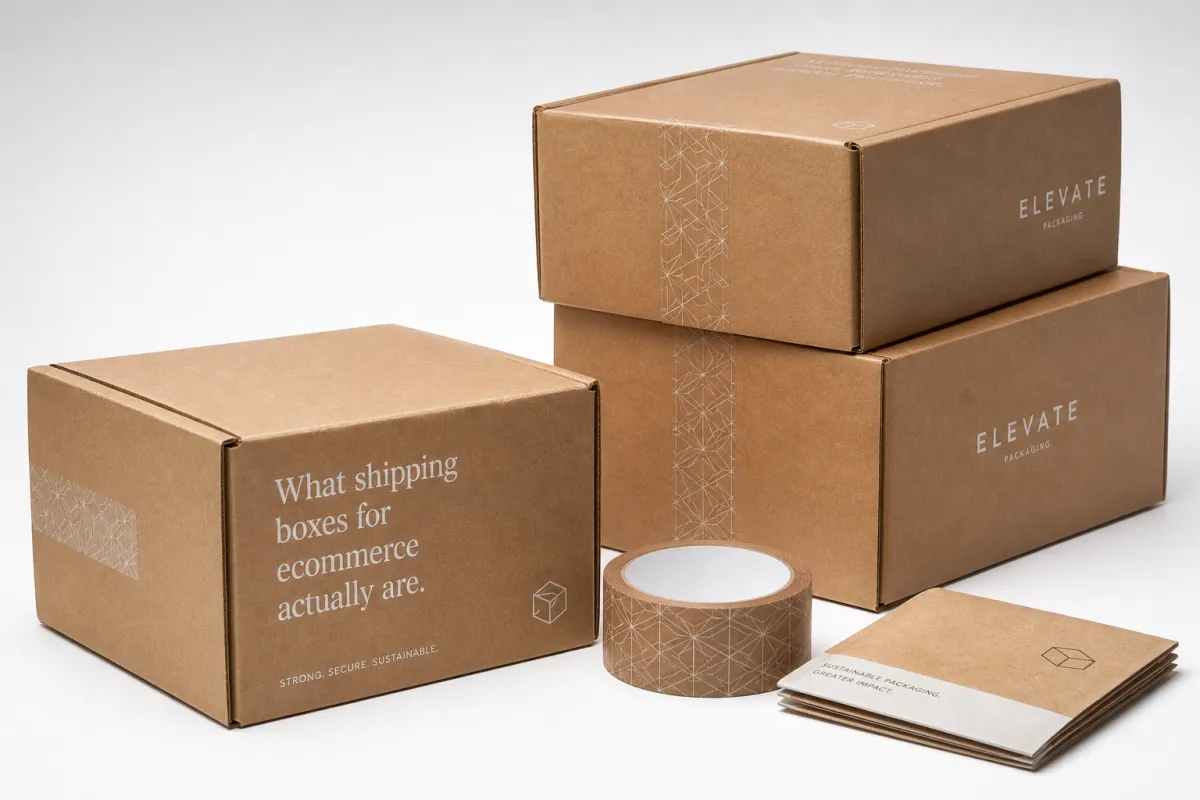
Shipping boxes for ecommerce are the outer carton that keeps products protected in transit, gives carriers something predictable to handle, and creates a brand touchpoint that customers notice whether you planned for it or not. That sounds basic. It is basic. And yet people still pick cartons like they are grabbing a random grocery bag. The right box protects the product, speeds up fulfillment, and reduces the kind of complaints nobody wants to explain to finance.
Think about a candle, a skincare set, or a small bundle of accessories packed into a carton that is only slightly oversized. Add void fill, seal it, and now the shipment may jump to a higher pricing tier because of dimensional weight. For lightweight products, that extra space can matter more than the product weight itself. In plain English, shipping boxes for ecommerce affect shipping cost even when the item inside barely weighs anything.
Size and strength need to work together. A box can be perfectly sized and still fail if the board grade is too light for the route, if the corners collapse under stacking, or if the product rattles around inside. A box can also be overbuilt, which sounds safe until the unit price, freight, and storage volume start looking ridiculous. The right box is the one that fits the product, the carrier, and the actual packing process your team uses every day.
Branding matters too, but not in the dramatic way a lot of packaging decks pretend. The carton does not need to give a speech. It needs to look intentional. Clean print, the right finish, and a structure that supports the product can make a shipment feel polished without going overboard. Once branding starts inflating unit cost without improving transit packaging or customer perception, you are buying decoration. Pretty is fine. Profitable is better.
- Protection: keeps goods from shifting, crushing, or scuffing during handling.
- Efficiency: helps the warehouse pack faster with less guesswork at pack-out.
- Cost control: reduces dimensional weight surprises and overspend on filler.
- Brand fit: makes the shipment feel deliberate instead of generic.
So when someone asks what shipping boxes for ecommerce actually are, the honest answer is simple: they are the packaging decision that touches nearly every part of the delivery experience. Get them wrong and the costs show up fast. Get them right and the whole system gets quieter.
How shipping boxes for ecommerce move through the process
The process starts before the box ever reaches the warehouse. First, measure the product correctly. Not the marketing dimensions. The real ones. Then account for inserts, tissue, molded pulp, bubble wrap, sleeves, or any other shipping materials you plan to use. Only after that do you define the carton size. Reverse the order and you end up designing around the box instead of the product, which is how packing stations turn into expensive problem-solving departments.
Once the size is set, the next step is sample approval. This is where many teams save themselves from a bad run. A sample tells you whether the item shifts, whether the seal is strong, whether the lid bows, and whether the packout still feels reasonable after the product goes inside. It is much easier to reject one sample than 2,000 printed cartons. That kind of regret is expensive and not especially charming.
After sample approval comes production, then packing, then carrier pickup. Delays usually show up in familiar places: artwork revisions, back-and-forth on carton dimensions, or underestimating how long it takes to get a box through review and into a run. Stock cartons can often ship in days if inventory exists. Custom boxes usually need more time, especially if the design includes multiple print colors, special finishes, or a structural change. For many brands, simple custom runs land somewhere around 2 to 4 weeks after approval, while larger or imported orders can stretch longer.
That timeline matters for order fulfillment. A brand launching a new SKU should not wait until the product is already in the warehouse to think about shipping boxes for ecommerce. Build the box plan into the calendar early. If you sell seasonal items or run promotion spikes, set reorder points before the shelf is empty. A one-week packaging delay can snowball into missed shipments, then customer service tickets, then a margin problem. Packaging has a habit of showing up in places people assume it cannot reach.
- Measure the product: capture the actual packed dimensions, not just the item alone.
- Define the protection layer: account for inserts, cushioning, and movement control.
- Request samples: test fit, seal, and compression before production.
- Approve artwork and structure: keep the design aligned with the box size and print method.
- Plan inventory: set reorder points based on weekly usage plus buffer stock.
Stock boxes and custom boxes solve different problems. Stock is faster and usually better for testing. Custom is better when your products are repeatable, your volume is stable, and the right fit changes your shipping math enough to justify the setup. If a company is still learning its packout, I usually prefer a pilot run before scaling. A little discipline here prevents a lot of dead inventory later.
Key factors that decide the right shipping box
The first factor is product dimensions. That sounds boring because it is. Boring is good. Measure the item at its widest points, then add room for the protection system you actually plan to use. A fragile product may need 0.5 to 2 inches of clearance depending on the insert style. A rigid product may need less. The point is not to maximize empty space. The point is to build a packout that survives real handling without forcing the carrier to transport a half-empty cube of air.
The second factor is board strength and carton construction. Single-wall corrugated works for many lightweight items and standard ecommerce shipping. Double-wall makes more sense for heavier products, fragile contents, or boxes that will sit in stacks before shipment. If a carton is going through rough handling, long transit, or repeated pallet stacking, the box needs enough compression strength to hold shape. Stronger does not automatically mean smarter. It means more cost, more freight weight, and more storage volume. The right answer depends on the load.
The third factor is the shipping method and carrier pricing. USPS, UPS, and FedEx do not care about your brand story. They care about size, weight, zone, and how much space the parcel takes on the truck. That is where dimensional weight can turn a reasonable product into a surprisingly ugly invoice. If your box dimensions cross a pricing threshold, a slightly smaller carton can save more than a cheaper board grade ever will. That is why carton selection should be tied to carrier math, not just aesthetic preference.
The fourth factor is branding and unboxing. I am not against good-looking boxes. Far from it. Print should support the product, not inflate the cost for a design flex that nobody notices after the carton gets recycled. A clean logo, a strong color choice, or a simple interior message can make shipping boxes for ecommerce feel brand-aware without pushing the budget into nonsense territory. In practice, the best unboxing experience is often the one that feels sturdy, tidy, and easy to open.
The fifth factor is sustainability. Buyers talk about this more, and they should. Right-sizing reduces waste immediately. Using recycled content where possible helps. Cutting filler where the box already fits helps even more. The smarter move is not to make a box flimsy and call it responsible. It is to reduce excess material while still protecting the product. For buyers looking at certifications, FSC-certified material options can support a responsible sourcing story, while packaging teams can also look at carrier and waste guidance from sources like the EPA when evaluating materials and end-of-life choices.
There is also a practical standards angle. If you need a damage-testing framework, the ISTA methods are a useful starting point for understanding drop tests, compression testing, and transit simulation. No, a warehouse shake test is not the same thing. A fast tug and a hopeful nod do not count.
Practical rule: if the box looks great but adds shipping cost, labor, or damage risk, it is not a good box. It is an expensive decoration.
Used well, shipping boxes for ecommerce should help you balance protection, speed, and cost. If one of those three gets ignored, the other two usually end up paying for it.
Shipping boxes for ecommerce cost and pricing
Price is where a lot of teams get lazy. They ask for a unit quote, compare a few numbers, and stop there. That is a mistake. The price of shipping boxes for ecommerce depends on size, board grade, print coverage, quantity, finishing, tooling, and freight. Two boxes that look similar on paper can land very differently once all the real costs are counted.
Stock boxes usually cost less upfront because the supplier is already carrying the shape and does not need custom setup. They are useful for small runs, new products, or brands still learning demand. Custom boxes cost more per unit at lower volumes, but they often pay for themselves when the fit reduces dimensional weight, when print supports conversion, or when the box eliminates filler and packing labor. That is the tradeoff. Not glamorous, but useful.
Here is the part people skip: landed cost. A box that costs a few cents less but requires more freight space, more storage, more packing time, and more replacements can easily end up being the wrong choice. When shipping boxes for ecommerce are oversized, the hidden cost is usually not the carton. It is the parcel rate, the damage allowance, and the extra minute someone spends stuffing void fill into a box that should have been smaller in the first place.
Minimum order quantities matter too. A lower unit price can look attractive until it forces you to buy more than you can store or use in a reasonable window. Cash gets trapped in inventory, and now the “cheap” option is sitting in the corner becoming dust with a barcode. For small brands, a slightly higher unit cost may be smarter if it keeps inventory flexible and avoids stale stock.
| Option | Typical use | Approximate unit cost | Lead time | Best fit |
|---|---|---|---|---|
| Stock corrugated carton | Standard ecommerce shipping for common sizes | $0.35-$1.20 depending on size and quantity | Days if in stock | Testing, small runs, fast replenishment |
| Custom unprinted box | Right-sized transit packaging with no branding | $0.45-$1.50 depending on board and volume | 2-3 weeks often | Fit-first programs, steady reorder volume |
| Custom printed box | Branded shipments with logo and color | $0.60-$2.50+ depending on coverage | 2-4 weeks or longer | Brand presentation, repeat SKUs, customer-facing orders |
| Double-wall specialty carton | Heavier or fragile products | $1.20-$3.50+ depending on size | Often similar to custom timing | Protection, stacking, long transit routes |
The table gives ranges, not promises. Supplier region, board grade, print method, and freight can shift those numbers. Still, the framework is useful. When shipping boxes for ecommerce are chosen well, the box may cost a little more but save money in the places that matter: fewer damages, lower carrier charges, less labor, and fewer customer complaints.
My practical pricing lens is simple: pay more only when the change returns value. Better fit that lowers dimensional weight? Worth it. Better board that cuts damage rates? Worth it. Fancy print that only looks good on a sales deck? That one needs a harder look.
Step-by-step guide to choosing shipping boxes for ecommerce
If you want to choose shipping boxes for ecommerce without wasting money, start with the product, not the packaging fantasy. Measure the exact item, then note whether it needs inserts, molded trays, tissue, protective sleeves, or another layer. A box should fit the real packout, not the single SKU sitting naked on a table. That mistake alone creates a lot of bad ordering.
Next, choose the box style. A mailer works well for lighter products, subscription items, and compact gift sets. A regular slotted carton is usually the workhorse for general shipping. Heavier or fragile products may need stronger construction or a double-wall box. If the product has movement risk, the box shape should support restraint first and appearance second. In most warehouses, nobody cares what the carton looked like in the mockup if it fails after the first bump.
Then test samples in the real world. Not in theory. In the real world. Pack the product, tape it, stack it, ship it, and inspect it after transit. Try a few routes. Try a few carriers. Try a few temperatures if the product is sensitive. A box that survives hand handling in a calm office can still fail once it meets delivery vans, sortation belts, and impatient warehouse stacking. That is exactly why shipping boxes for ecommerce need a test run before you commit to volume.
Use fit, not guesswork
A good fit leaves enough room for protection but not enough to invite movement. If you hear the product knocking around inside, the carton is already wrong. The ideal packout keeps the item steady with the least material necessary. This helps with package protection and cuts filler use, which in turn can lower cost and improve the customer experience. The best shipping boxes for ecommerce often feel almost boring because they are so efficient.
Compare more than one supplier
One quote is not a strategy. Ask for sample boxes, pricing tiers, and lead times at the same time. Compare a few dimensions, not just one. Sometimes a slightly smaller carton lowers the shipping charge enough to outweigh a marginally higher box price. Sometimes a cleaner structure packs faster and saves enough labor to matter. If your current supplier only offers one option, that is not convenience. That is a limitation wearing a polite smile.
Plan around volume and reorder timing
Build the order in phases if you are uncertain. Start with a pilot run, measure damage and returns, then scale into a larger order once the carton has proven itself. This is especially useful for new product lines, seasonal bundles, and products that are still changing. When shipping boxes for ecommerce are ordered too aggressively too early, the company ends up sitting on the wrong box while the real box is still being redesigned.
To make the decision even easier, use a simple matrix like this:
- Light, compact products: mailers or lighter single-wall cartons.
- Standard retail items: regular slotted cartons with right-sized inserts.
- Fragile or heavier items: stronger board, better cushioning, maybe double-wall.
- Brand-led shipments: custom printed cartons once the dimensions are proven.
If your assortment is broad, a packaging matrix by SKU can save hours in order fulfillment. It removes the guesswork from packing stations, reduces training time, and keeps the team from forcing every product into the same carton just because that carton happens to be nearby. That kind of laziness is expensive. So is the damage that follows.
Common mistakes with shipping boxes for ecommerce
The most common mistake is oversized boxes. Brands ship air, pay for air, and then wonder why parcel spend is climbing even though the product did not change. Shipping boxes for ecommerce should be sized around the actual packout, not around a vague fear that “bigger is safer.” Bigger is only safer if the product needs the extra room. Otherwise it is just more expensive.
Another common mistake is choosing the box before testing the packout. A box can look great in a mockup and still fail once inserts are added, tape is applied, or the product shifts during handling. This is where damage rates start creeping up. The box may survive a quick squeeze test and still fail during real transit. Those are not the same test, despite what some warehouse folklore says.
SKU variety also causes trouble. One box size rarely works for every product in an ecommerce catalog. Forcing it usually means more void fill, more wasted space, and more damaged corners on odd-shaped items. If you sell a line with different dimensions, build a small set of shipping boxes for ecommerce instead of trying to make one carton handle every job. A three-box system is often better than a one-box fantasy.
Printing too early is another costly move. Teams get excited, approve a branded design, and then later discover the dimensions need a change. Now they have dead inventory with the wrong size, wrong artwork, or both. That is the packaging version of buying furniture before measuring the room. It feels productive until the delivery truck shows up.
Underordering is the last big miss. A lot of brands wait too long, then rush a reorder and accept whatever is available. That usually means higher freight, fewer options, and a price penalty for being late. If shipping boxes for ecommerce are part of a stable program, lock the reorder point early and add buffer stock for seasonal spikes. Emergency orders rarely feel heroic once the invoice lands.
- Oversized carton: higher dimensional weight and more filler.
- No sample testing: hidden fit problems and avoidable damage.
- One-size-fits-all thinking: waste across varied SKU sizes.
- Premature print approval: expensive inventory that is hard to fix.
- Late reordering: rushed lead times and fewer practical choices.
Most of these mistakes are not technical failures. They are planning failures. That is the good news, because planning is easier to fix than material science. The right shipping boxes for ecommerce do not need a miracle. They need a process.
Expert tips and next steps for shipping boxes for ecommerce
Start with a box matrix. Keep it simple. Map your top SKUs to one of a few carton sizes and note the ship class, cushioning type, and pack instructions. Once that matrix exists, the team stops improvising at the bench. Packing becomes repeatable, and repeatable is what order fulfillment needs if you want lower error rates and fewer training headaches.
Ask suppliers for three things at once: sample boxes, price tiers, and lead times. A quote without sample timing is half an answer. A sample without pricing is half an answer. You need all three to make a real decision on shipping boxes for ecommerce. If a supplier cannot provide that, they are not helping you buy packaging. They are helping you collect emails.
Set your reorder point from actual weekly use, then add buffer stock for seasonality and promotions. If your sales jump around, use a higher buffer. If your product line is steady, you can keep the buffer tighter. Either way, do not wait until the pallet is nearly empty. Late packaging orders lead to rushed freight, awkward substitutions, and more expensive shipping materials than necessary. It is a very avoidable mess.
Compare box fit against carrier cost every time. The cheapest carton is not cheap if it triggers dimensional weight penalties or more damage claims. The right shipping boxes for ecommerce often cost a little more at the unit level and save a lot more in the total system. That is why I keep pushing landed cost instead of unit cost. Unit cost is a fragment. Landed cost is the bill.
Here is a practical action list:
- Measure your top SKUs and note the real packout.
- Test two or three shipping boxes for ecommerce with actual shipments.
- Compare carton cost, freight, labor, and carrier charges together.
- Pick the smallest box that protects the product reliably.
- Place a pilot order, then scale after you review damage and returns.
If you are building a new packaging program, review the broader mix too. Some products ship best in cartons, others in mailers, and a few need a hybrid approach with inserts and protective wraps. The point is not to force every item into the same box. The point is to build a shipping system that fits your catalog, your margin, and your fulfillment pace.
Shipping boxes for ecommerce are one of those decisions that looks simple until you price the wrong version. Then suddenly everyone becomes a packaging expert. Funny how that works.
FAQ
What size shipping boxes for ecommerce should I use?
Pick the smallest box that still allows for product protection, inserts, and a little packing tolerance. Measure the product at its widest points, then add room for cushioning or void fill, usually 0.25 to 2 inches depending on fragility. Test a few sizes in real packing conditions before locking in a production run. That is the fastest way to avoid oversized shipping boxes for ecommerce that quietly raise cost.
Are custom shipping boxes for ecommerce worth it?
They are worth it when the box size affects shipping cost, damage rates, or brand perception enough to justify the setup and minimum order. Custom boxes usually make the most sense for repeat SKUs with steady volume. If volume is low or product lines change often, start with stock boxes and upgrade later. Shipping boxes for ecommerce only pay off when the fit and the system around them actually improve.
How much do shipping boxes for ecommerce cost?
Cost depends on size, board grade, print coverage, quantity, and freight. Stock boxes can be inexpensive upfront, while custom boxes often cost more per unit but may save money through better fit and lower shipping charges. Always compare landed cost, not just the quoted unit price. That is the only way shipping boxes for ecommerce make sense financially.
How long does it take to get shipping boxes for ecommerce made?
Stock boxes can ship quickly, sometimes within a few days if the supplier has inventory. Custom printed boxes usually need design approval, sampling, and production time, often around 2 to 4 weeks or longer for larger orders. Build in extra time if you need freight shipping or if your order is coming from overseas. Shipping boxes for ecommerce are easy to order late and hard to fix late.
What is the best shipping boxes for ecommerce option for fragile items?
Use a box with enough compression strength and room for inserts, cushioning, or double boxing if needed. Choose a size that prevents movement inside the carton, because loose product is what usually causes breakage. Test with real transit conditions, not just a quick hand squeeze in the warehouse. For fragile products, shipping boxes for ecommerce should be chosen for protection first and branding second.
The takeaway is simple: choose shipping boxes for ecommerce by testing the packout, checking carrier pricing, and buying only what your actual volume can support. Measure the real product, run a small pilot, and lock the carton spec only after the box survives transit and the math still works. That is how shipping boxes for ecommerce stop being a weak link and start doing a real job.

