Buyer Fit Snapshot
| Best fit | Poly Mailer Thickness Selection projects where brand print, material claims, artwork control, MOQ, and repeat-order consistency need to be specified before quoting. |
|---|---|
| Quote inputs | Share finished size, material target, print colors, finish, packing count, annual reorder estimate, ship-to region, and any compliance wording. |
| Proofing check | Approve dieline scale, logo placement, barcode or warning zones, color tolerance, closure strength, and carton packing before bulk production. |
| Main risk | Vague material claims, crowded artwork, missing packing details, or unclear freight terms can make a low unit price expensive after revisions. |
Fast answer: Poly Mailer Thickness Selection: Material Claims, Seal Quality, and Freight Cost should be specified like a repeatable production item. The safest quote records material, print method, finish, artwork proof, packing count, and reorder notes in one written spec.
Production checks before approval
Compare the actual filled-product size with the drawing, then confirm tolerance on folds, seals, hang holes, label areas, and retail display edges. Reserve space for logos, QR codes, warning copy, and material claims before decorative graphics fill the panel.
Quote comparison points
Review material grade, print process, finish, sampling route, tooling charges, carton quantity, and freight assumptions side by side. A quote is only useful when the supplier can repeat the same color, closure quality, and packing count on the next order.
I get asked some version of what thickness poly mailer do i need almost every week, and the honest answer usually starts with a number people do not love hearing: 2.5 mil, 3 mil, 4 mil, or 6 mil are not interchangeable once a parcel starts bouncing through a conveyor, a drop chute, and a truck route with a half-dozen handoffs. I still remember a batch of soft tees that sailed through testing in a 2.5 mil bag, then a nearly identical run split at the seam because the inner carton had sharper corners and the packer underfilled the mailer by about 3/4 inch. Same garment. Same carrier. Different outcome. Packaging has a funny way of exposing assumptions fast.
That is why what thickness poly mailer do i need is really a procurement question with money attached to it. A stronger film can add $0.02 to $0.05 per unit, which looks tiny until you are buying 25,000 pieces and the delta turns into $500 to $1,250 before freight. Seal width, flap overlap, resin blend, and bag dimensions matter too. I have seen a buyer pay for heavier film and still end up with a 1.8 percent return rate because the adhesive strip was only 1/2 inch wide. A package can be thick and still be badly built. Shipping does not care much about optimism.
The most common mistake is treating mil count like a magic shield against damage. It is not. A 6 mil mailer with a weak closure can still fail, and a 2.5 mil co-extruded LDPE/LLDPE bag with a 1.5 inch adhesive flap can outperform a heavier bag that is stuffed too tightly. If you are asking what thickness poly mailer do i need, start with the product geometry, the route length, and the handling profile. Weight matters, but corners, zippers, inserts, and internal movement usually matter more. The bag cannot negotiate with physics, even if the sales deck sounds very confident.
What Thickness Poly Mailer Do I Need? Start With the Real-World Surprise
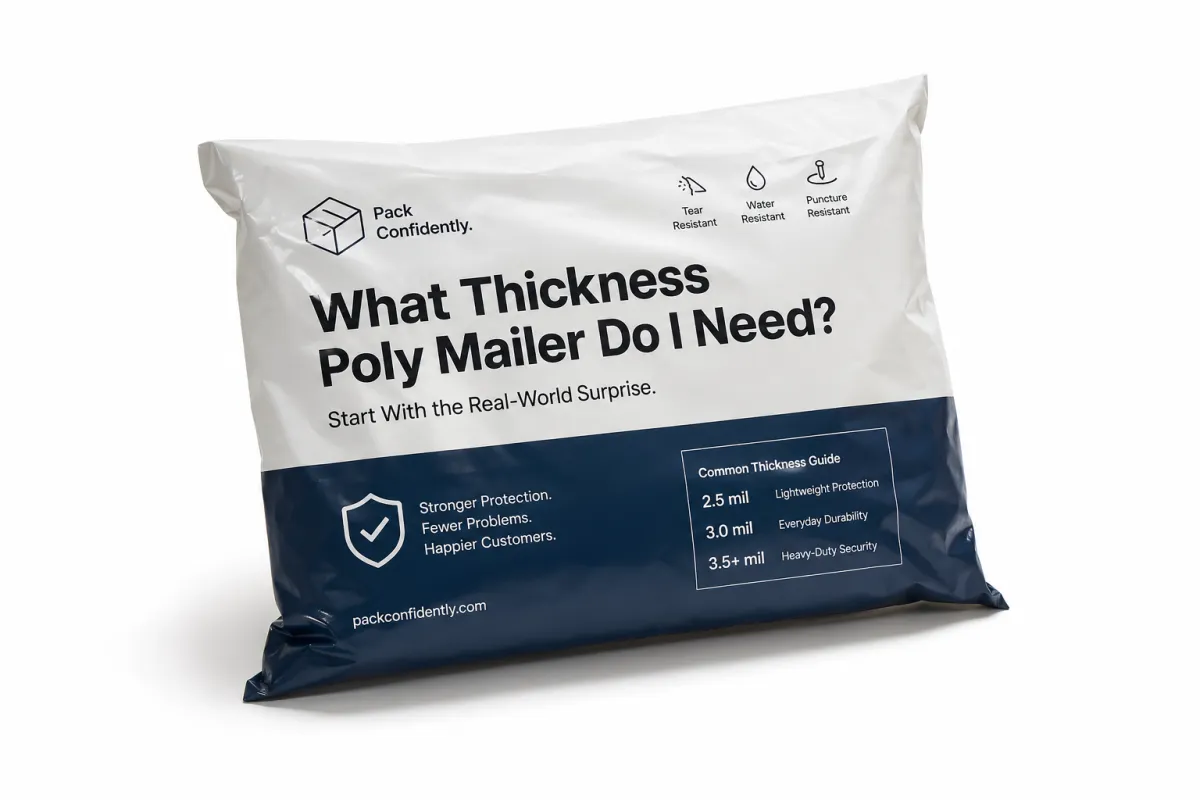
The first thing I tell clients is simple: what thickness poly mailer do i need is not answered by a scale alone. A 12-ounce bundle of socks and a 12-ounce accessory box behave differently after 10 minutes in a sort facility, a 3-foot slide down a chute, and a ride in a tote with other parcels rubbing against it. The mailer feels the corner pressure, the friction, and the overfill long before anyone sees a tracking scan. A 14 x 19 bag can fail if the product sits even 3/4 inch too tall, while a 16 x 20 bag of the same mil may pass without a wrinkle.
On a packing line in Shenzhen, I watched two loungewear orders go out back to back. The first was a stack of jersey sets in a 2.5 mil mailer with a 1.5 inch seal and no insert. It passed. The second looked nearly identical until a folded hanger board and a corrugated promo card were added; the bag split at the seam after a 20-second tumble test. Same product family, same carton count, different answer to what thickness poly mailer do i need. The buyer had approved a sample in an office at 72 degrees, but the warehouse ran much warmer and changed how the adhesive behaved. Small differences can cost a full pallet.
"Thicker" sounds safe because it sounds like insurance, and buyers like words that feel protective. The numbers tell a less flattering story. I have seen a 4 mil bag fail because the flap was too short by 1/4 inch, and I have seen a 2.5 mil bag survive because the product was flat, the seal had 1.5 inches of overlap, and the internal load was under 1.2 pounds. That is the part many teams miss when they ask what thickness poly mailer do i need. The bag is not responding to hope. It is responding to dimensions, friction, and how the load sits under pressure.
Mil is a thickness measurement equal to one-thousandth of an inch, so 2.5 mil is 0.0025 inches and 4 mil is 0.0040 inches. That number sounds thin until you compare film structure, seal strength, and puncture resistance. Two bags both labeled 3 mil can perform very differently if one uses a cleaner co-extrusion line and a better resin blend. I have seen 3 mil samples from Ningbo outperform 4 mil samples from a lower-control plant because the seal edge was more consistent by 0.4 mm. So yes, what thickness poly mailer do i need matters, but the label alone is never the whole story.
What Thickness Poly Mailer Do I Need When Protection Matters Most?
If protection is the main concern, then what thickness poly mailer do i need comes down to abuse tolerance under realistic shipping conditions: puncture, stretch, tear, and seam stress. A 3 mil co-extruded mailer with a 1.5 inch adhesive strip can outperform a 4 mil film if the seal zone is inconsistent by even 0.2 inch. A thicker wall gives more margin, but not automatically. In testing, a well-made 3 mil bag from Dongguan can beat a sloppy 4 mil bag from a factory that trims the seal area too tightly. Packaging can be unfair in that way, especially when the numbers on the quote sheet look friendly.
Here is the practical range I use with clients who want a direct answer to what thickness poly mailer do i need:
- 2.5 mil for soft, low-risk items like folded T-shirts, socks, and leggings that stay flat in transit.
- 3 mil for everyday ecommerce shipments that need more tear resistance without becoming stiff or bulky.
- 4 mil for heavier soft goods, multi-item orders, and products that shift inside the bag during a 5- to 7-day transit.
- 6 mil for rough handling, sharp profiles, returns, and parcels that need to survive repeated use or re-sealing.
I would not treat those numbers as laws. I would treat them as starting points backed by 20 or 30 sample packs, not one nice-looking prototype. A soft hoodie in a 2.5 mil bag can be fine if the fold is tidy and the seams are not under stress, while a candle set wrapped in tissue and nested beside a rigid insert can fail on the first corner drop. That is why what thickness poly mailer do i need has to be tied to geometry. A flat item spreads stress across the film; a boxy item concentrates it at the corners. The film does not care what the marketing team called the product.
Seal quality is another detail people like to ignore because it is boring, and boring details are where damage claims go to grow. A wide adhesive strip or a strong heat seal can do more for real-world performance than jumping from 3 mil to 4 mil. I have seen clients save more by widening the seal area by 1/4 inch than by changing film thickness at all. On one order of 10,000 units, that change cost less than $120 and cut seal-related complaints within two shipping cycles. That is often the smartest answer to what thickness poly mailer do i need: not thicker, just better built.
Weather exposure matters too. A bag sitting on a damp dock in Miami, Florida or riding through a humid transfer hub in Manila, Philippines does not care about brand language. Moisture can reduce grip on the adhesive closure, and cold can make some films stiffer by the time they hit a Chicago sort center in January. If your shipping lane includes outdoor staging, transfer hubs, and long handoffs, the real answer to what thickness poly mailer do i need may be one step heavier than the answer for local parcel delivery. Logistics exposes weak specs fast, usually before the second scan.
| Thickness | Typical Use | Performance Notes | Cost Impact |
|---|---|---|---|
| 2.5 mil | Soft apparel, socks, lightweight textiles | Light, flexible, best for low puncture risk | Lowest unit cost |
| 3 mil | Everyday ecommerce, moderate handling | Better tear resistance without much bulk | Small step up |
| 4 mil | Heavier garments, bundled items, returns | More puncture margin and better abuse tolerance | Noticeable but still manageable |
| 6 mil | High-risk, sharp, or re-usable shipping | Stiff, strong, and better for rough transit | Highest unit cost and weight |
If you want a technical frame of reference, I usually point teams to ISTA for drop and vibration language, plus packaging education resources from the Packaging School. Those standards exist because a parcel may see several drops, compression events, and conveyor transfers before delivery. I am not saying every ecommerce brand needs a lab setup. I am saying the terminology around puncture resistance, transit simulation, and seam integrity exists for a reason. The spec should survive a shipping route, not just a buyer's hunch about what thickness poly mailer do i need.
One more point: thicker is not automatically better if the item is already bulky. Overfilling a mailer stretches the seal line and creates a failure point no matter what the label says. I once worked with a client in Los Angeles who insisted on a 6 mil bag for rigid home goods because they thought premium meant more plastic. The bag held, but the parcel looked overpacked, the packing line slowed by 11 seconds per unit, and the customer still complained because the shipment arrived looking awkward. So yes, what thickness poly mailer do i need also includes the question, "How will this behave after it is packed, stacked, and shipped?" That is not a side note. That is the whole decision.
What Thickness Poly Mailer Do I Need Based on Product, Weight, and Surface
The cleanest way to answer what thickness poly mailer do i need is to group products by how they behave, not just how much they weigh. Soft apparel is easy. Folded textiles are usually easy too. Once you move into boxed accessories, rigid merchandise, or anything with a hard edge, the answer changes quickly. A 7-ounce T-shirt and a 7-ounce beauty box do not create the same stress in the wall of the bag, and that difference is where many purchasing decisions go wrong. I have seen a zipper pull, a button, and even a cardboard hang tab each cause a separate tear pattern in the same week.
For soft apparel, I usually start with 2.5 mil or 3 mil if the fold is clean and the item is not overstuffed. For hoodies, sweatpants, or multi-piece bundles, I move closer to 3 mil or 4 mil because the bulk creates internal movement. That movement is what tears film over time. If you are asking what thickness poly mailer do i need for a catalog with 8 to 12 apparel categories, do not use one number for everything unless you enjoy reships and customer service tickets. I say that with affection for the support team, who usually pay for everyone else's shortcuts with extra time on the phone.
Surface texture matters more than most people admit. A smooth cotton tee slides inside a bag with almost no abrasion. A garment with snaps, zippers, rivets, or rough embroidery behaves like a small grinding tool at the corners. The same applies to product inserts and rigid sleeves. A matte-coated box from a plant in Jiaxing can still punch through film if the edge sits at the wrong angle. That is why what thickness poly mailer do i need is often answered by inspecting the sharpest point, not the average item. The average item is a pleasant fiction. The sharpest point is the thing that tears the film on day three.
Wet environments and returns are their own category. A return parcel usually sees more handling, more re-taping, and more compression than the original outbound order. If the bag is being reused, I do not like pushing thin film just to save $0.01 or $0.02. That penny gets eaten by damaged returns and extra service time very quickly. If your operation handles reverse logistics, the answer to what thickness poly mailer do i need often jumps to 4 mil or higher, plus a stronger closure strategy. One brand I advised in Toronto reduced return damage after moving from a 2.5 mil reclosable bag to a 4 mil co-extruded return mailer with a 2 inch seal tab.
Branding changes the equation too. A matte finish, custom print, or premium feel can make the package look more valuable, but it does not improve physical performance unless the film spec changes. I have sat in meetings where the marketing team wanted a soft-touch black mailer for unboxing drama, then the operations team showed me that the warehouse was shipping mixed-size orders with rigid accessory boxes and metal hardware. That is not a design problem. That is a what thickness poly mailer do i need problem wearing a better outfit. Fancy packaging does not cancel puncture risk, and the carrier is not impressed by mood boards.
For brands that want both appearance and durability, I usually ask for the film spec and the finish spec together. If you are exploring Custom Poly Mailers, make sure the supplier tells you the measured thickness, the seal style, the print side, and whether the finish is matte, gloss, or a blended surface. I also ask for the resin type, such as LDPE, LLDPE, or a co-extruded blend, because those details influence stretch and tear behavior. If the answer sounds vague, slow down. Vague answers are where bad shipments are born in batches of 5,000.
Order mix matters too. A single SKU is easy. A catalog with tees, gifts, bundles, and replenishment packs is not. If a brand ships 80 percent apparel and 20 percent boxed accessories, I often recommend giving the heavier-risk SKU its own mailer spec rather than forcing everything into one compromise. That is the difference between a packaging strategy and a guess. It is also the difference between confidently answering what thickness poly mailer do i need and pretending every item is a folded T-shirt. Pretending is cheap; reshipping is not, especially when carrier labels run $3.40 each.
Step-by-Step: How to Decide the Right Thickness for Your Order
If you want a process instead of a hunch, this is the one I use when someone asks what thickness poly mailer do i need. Start with the product itself. Measure it folded, boxed, or bagged. Weigh it in the actual shipping configuration, not loose on a scale. Then write down the details that usually get forgotten: corners, zippers, clips, hang tags, batteries, inserts, and anything else that can press into the film wall. A spec sheet without those details is mostly decoration. A little harsh, maybe. Still true, especially when a 1/4-inch difference in width changes the whole decision.
Next, shortlist two or three thickness options. If your first instinct is 2.5 mil, test 2.5 mil and 3 mil. If you think 4 mil is likely enough, test 3 mil, 4 mil, and maybe 6 mil for a stress comparison. You are not trying to be fancy. You are trying to answer what thickness poly mailer do i need with evidence from the actual product. I have seen teams argue for 45 minutes about a 0.5 mil difference and then realize the real problem was a zipper box that was 3/4 inch too tall. The poor bag had been blamed for a sizing error.
Then pack real samples. Not paper dummies. Not empty bags stuffed with tissue just to make the meeting feel productive. Real inventory. Real folds. Real seals. If your team uses a table sealer, a hand seal, or the peel-and-stick flap, test that exact method. The packaging line is part of the product, and the adhesive reacts differently at 65 degrees than it does at 88 degrees. I learned that in a warehouse outside Ho Chi Minh City, where the sample looked perfect in the office and then started lifting at speed on the line. That was a very expensive way to ask what thickness poly mailer do i need a second time.
After packing, simulate the actual trip. Shake the parcel for 15 to 20 seconds. Stack three or four bags on top of it. Drop it from waist height onto a hard floor, then check the seams, corners, and closure. If you have a returns flow, reopen and reseal one of the samples to see whether the closure still grips after pressure. A lot of buyers never do this, which still surprises me. They approve a spec because the bag looks good on a table under bright lights, then act shocked when carrier handling turns it into a rescue mission. That is not testing. That is hoping.
Here is the framework I like to use after testing:
- Damage rate: Which sample survived without tears, corner punctures, seam splits, or seal failure?
- Packing speed: Which bag was easiest to load, close, and stack at your normal pace?
- Cost per unit: What is the real difference at 1,000 pieces, 5,000 pieces, and 25,000 pieces?
- Customer feel: Which option fits the brand without looking oversized or underbuilt?
- Landed cost: How much do freight, storage, and carton count change the total picture?
If you want a broader packaging view while you test, compare the mailer choice against the rest of your shipping materials in our Custom Packaging Products catalog. That helps you see whether the mailer is doing too much work or whether a small insert, sleeve, or secondary wrap would lower the risk. I have seen teams fix a persistent tear issue by changing the internal fold pattern and reducing the packed height by 1/2 inch, which is cheaper than asking what thickness poly mailer do i need after every complaint. Sometimes the answer is not thicker film. Sometimes it is a better fold and a calmer packing bench.
We thought the answer was 2.5 mil because the sweater line was light. After one week of drop tests and a few ugly returns, we moved the gift set SKU to 4 mil and cut damage claims hard. That change cost us $0.03 per bag and saved us far more than that in replacement shipments and customer support hours.
That quote came from a client who ships bundled apparel and accessories out of a distribution center in Columbus, Ohio. The lesson was not always use thicker film. The lesson was that a real test beats an opinion. If you want the short version of what thickness poly mailer do i need, it is this: measure, test, drop, and decide with your own product in the bag, not the sample held under perfect lighting. The real one is the one that has to survive the carrier's 4 a.m. shift.
What Thickness Poly Mailer Do I Need for Cost and Pricing?
Price is where the conversation usually gets strange, because everyone wants a tougher bag until the quote arrives. The truth is that what thickness poly mailer do i need has a cost side and a risk side. A thicker mailer might add only $0.02 to $0.05 per unit, which sounds tiny until you multiply it by 20,000 orders and see a $400 to $1,000 increase before freight. That is still cheaper than reshipping if your damage rate drops by even 1 percent. I have seen monthly reports change quickly after one small packaging decision with a large failure rate.
I have had suppliers in Guangzhou, Ningbo, and Vietnam pitch the classic "just go thicker" line because it simplifies quoting and makes the bag sound premium. Sometimes they are right. Sometimes they are selling a heavier spec because it is easier for them, not because it is smarter for you. I once negotiated a run where the 4 mil option came in at $0.18 per unit for 5,000 pieces, while the 3 mil option was $0.14. On paper, the gap looked small. On freight and storage, the heavier bag pushed the carton weight up enough to matter. So what thickness poly mailer do i need cannot be answered by unit price alone.
You also have to factor in carton count and warehouse space. Thicker film usually means heavier cartons and sometimes fewer bags per case. That changes pallet efficiency. If you are shipping a lot by air, the extra weight is even more painful. If your warehouse charges by pallet position, a bulkier mailer can quietly become a storage tax. No one likes that surprise. It is the sort of surprise that makes operations managers stare at a spreadsheet and ask who approved the spec, which is never a pleasant meeting. I have sat through several, and the room gets quiet fast when the pallet math appears.
The hidden cost of under-spec'd mailers is usually worse than the extra cents for better film. Damage claims. Replacements. Customer service time. Brand trust. One retail client told me they were getting 2.8 percent more reships after they switched to a thinner bag to save a fraction per order. That was a bad trade. They thought they were answering what thickness poly mailer do i need in the cheapest way possible, but they were really paying for mistakes later. There is nothing glamorous about paying twice for the same order.
Here is the pricing lens I use:
- If the upgrade adds less than 1 percent to total order cost and cuts visible damage, it is usually worth testing.
- If the thicker option raises freight, storage, and packing time, the unit price is not the full story.
- If the product is high-margin, customer-facing, or frequently returned, paying a little more can be the cheaper move overall.
If sustainability is part of the procurement discussion, compare your material choice against recognized standards and claims. The FSC site is useful when you are dealing with paper-based components elsewhere in the pack, and it keeps the conversation grounded in actual certification language instead of vague green buzzwords. A poly mailer spec is still a poly mailer spec, but smart buyers usually think in a full-pack system, not just one component. That is another reason what thickness poly mailer do i need should be tied to the whole shipping setup. The bag, the insert, the label, and the route all affect the outcome.
And if your team is trying to forecast budget, build a table with three columns: unit cost, freight impact, and damage risk. Then compare 2.5 mil, 3 mil, and 4 mil over a 10,000-piece run. That exercise usually ends the debate faster than a 2-day Slack thread. Numbers have a way of doing that. Rude, maybe. Useful, absolutely. I have never seen a spreadsheet roll its eyes, which is probably why people keep arguing with them anyway.
Common Mistakes That Lead to the Wrong Poly Mailer Thickness
The first classic mistake is choosing by weight alone. I see it constantly. A buyer says, "It is only 10 ounces, so 2.5 mil should be fine." Maybe. Maybe not. If the item has a hard edge, a zipper pull, or a small box inside, the bag might fail long before weight becomes the issue. That is why what thickness poly mailer do i need should always include shape, not just ounces or grams. A shipping bag cannot read a label and understand the danger hidden in a corner.
The second mistake is thinking every thicker bag is automatically stronger. It is not. Film quality matters, and so does the seal area. A weak adhesive strip on a thick bag is still weak. I have seen mailers fail right at the flap because the adhesive was inconsistent by 3 to 4 mm across the run. That is not a material-thickness problem. That is a manufacturing-control problem. If you want a better answer to what thickness poly mailer do i need, ask about the whole construction, not just the headline mil. The headline is marketing. The construction is reality.
The third mistake is trying to force one spec across an entire catalog. This is how brands end up with a mailer that is perfect for tees but awkward for gift sets, or fine for socks but too small for bundled hoodies. I would rather see a brand use two or three mailer specs than one compromise bag that frustrates everybody. Different SKUs deserve different answers to what thickness poly mailer do i need, because they create different risk profiles. One size fits all sounds efficient until it starts producing avoidable damage at scale.
The fourth mistake is overbuying thickness because it feels premium. Sometimes that is just branding theater. If the package is lightweight and soft, a super-thick mailer can make the brand look clunky. It can also slow packing speed because the material fights the hands of the packer. I have watched a warehouse team lose 8 to 10 seconds per pack because the bag was so stiff that opening it became a mini wrestling match. Multiply that by 8,000 orders and the "premium" decision starts looking expensive in a hurry. There is a point where the bag starts winning the fight, and nobody enjoys that.
The fifth mistake is skipping the real shipping route. The bag does not travel from your desk to the customer in a straight line through a perfect tunnel. It goes through pick, pack, sortation, truck, hub, maybe rain, maybe a conveyor jam, maybe a careless toss. If your answer to what thickness poly mailer do i need ignores the route, you are guessing. Guessing is not a supply chain strategy. It is a fast way to buy extra work and a second round of complaints.
One more thing: do not assume a sample you held in your hand represents the production run perfectly. I have been in meetings where a polished pre-production sample looked fantastic, then the actual run arrived with a slightly different film feel because the resin blend changed from a 100 percent virgin lot to a 70/30 blend. That is why I push buyers to ask for a spec sheet, a production note, and a sample tied to the exact material structure. If the supplier cannot tell you whether the bag is co-extruded, what the seal width is, or what the printed-side treatment is, they are not really helping you answer what thickness poly mailer do i need. They are just making a nice-looking problem.
Expert Tips and Next Steps: Lock the Spec Before You Buy
If you want the shortest path to a good decision, ask your supplier for a spec sheet that lists mil, dimensions, seal style, material structure, and finish. Not a vague quote. Not "strong bag." Not "premium mailer." Specific numbers. I have found that the more precise the sheet, the fewer surprises later. It sounds boring. It saves money. That is usually how packaging works. The boring part is where the margin lives, and where the headaches go to die. A good sheet from a factory in Shenzhen or Jiaxing will usually include seal width down to the millimeter and film gauge within a tight tolerance.
For brands shopping what thickness poly mailer do i need, I suggest ordering a small run first, even if the price improves at higher volumes. A test order of 500 to 1,000 pieces can reveal fit issues, seal issues, and packing speed problems that a sample alone will never show. Have the actual packing team use them. Not the office team. The office team is famous for loving samples that do not have to survive a shift, which is charming and useless. No offense to the office team, but a desk test is not a shipping test. A 500-piece trial in the warehouse will tell you more than five polished presentations.
Timeline matters too. A typical Custom Poly Mailer project needs 3 to 5 business days for artwork review, 2 to 4 business days for proof approval, and 12 to 15 business days from proof approval to production completion. Add 7 to 18 days for ocean or air transit depending on whether the bags ship from Shenzhen, Ningbo, or Dongguan to Los Angeles, Vancouver, or Rotterdam. If the quote says 12 to 15 business days from proof approval, that is production time only, not the full timeline. Build a buffer. If you are doing custom print, ask whether artwork changes the minimum order quantity or lead time. I have seen a simple color tweak add 4 extra days because the press had to reset plates and confirm ink density.
Here is the checklist I give clients who are still deciding what thickness poly mailer do i need:
- Measure the packed product size, not just the item alone.
- Note every hard edge, zipper, clip, insert, and label placement.
- Test at least two thicknesses with real inventory and real seals.
- Drop, shake, and stack the packed samples under normal warehouse conditions.
- Check seal performance after pressure, heat, and handling.
- Compare landed cost, not just unit price.
- Choose the lightest spec that survives the real route.
If you are building a broader packaging plan, start with the mailer and then look at the rest of the system. That is where smart buying lives. A well-chosen mailer can reduce void fill, simplify packing, and make the whole shipment feel cleaner. If you are still deciding between options, the best move is usually to compare samples side by side, ask for exact pricing, and treat the first run like a controlled test, not a forever decision. That is how I answer what thickness poly mailer do i need Without Wasting Money on guesswork or emergency reorders.
And if you want my blunt opinion: most brands should not default to the thickest option. They should default to the lightest option that survives a real shipping test with the actual product, actual team, and actual route. That answer is often 2.5 mil for soft goods, 3 mil for general ecommerce, and 4 mil when the package has corners, bundles, or return risk. For anything sharp, heavy, or awkward, I would test up from there before placing a large order. Simple rule. Fewer headaches. More sleep. And fewer people standing around a packing bench arguing about a mailer like it is a federal policy decision.
What thickness poly mailer do I need for T-shirts and lightweight apparel?
For soft apparel, what thickness poly mailer do i need is often answered with 2.5 mil to 3 mil, as long as the garments are folded cleanly and there are no sharp inserts or hard tags. If the order includes hoodies, multi-piece bundles, or heavier fabric, I would move up a step and test both options. One packed sample through your normal shipping route will tell you more than a shelf full of opinions.
Is 2.5 mil strong enough for everyday ecommerce shipping?
Yes, for many lightweight soft goods, 2.5 mil is fine. No, if the product can poke, scrape, or shift a lot in transit. That is the whole trick with what thickness poly mailer do i need: the number alone does not decide the outcome. The bag has to survive packing, handling, and delivery without stretching open or splitting at the seam, especially after a 5- to 7-day route.
What thickness poly mailer do I need for custom printed mailers?
Choose thickness based on the product first, then layer branding on top. If the mailer is part of the customer experience and will be seen on arrival, a sturdier film can feel more premium. Before you commit, ask the supplier whether printing changes the lead time, minimums, or available film options. That keeps what thickness poly mailer do i need tied to both performance and production reality, not just artwork.
How much more does a thicker poly mailer cost?
The jump from a thinner film to a heavier one is often just a few cents per unit, but those cents add up fast at scale. For example, a move from $0.14 to $0.18 per unit on 5,000 pieces adds $200 before freight. Freight and storage can also rise if thicker film means heavier cartons or larger packed volume. If you are comparing what thickness poly mailer do i need, weigh the added unit cost against the cost of damage, reships, and customer complaints.
What thickness poly mailer do I need for heavy or sharp items?
For heavy, rigid, or sharp-edged products, move beyond the lightest options and test thicker films with stronger seals. If corners press into one spot, add cushioning or switch packaging formats instead of trusting thickness alone. When in doubt, request samples from two or three suppliers and run a small damage test before you place a full order. That is the safest way to answer what thickness poly mailer do i need without paying for a mess later.
If you take one thing from this, make it this: what thickness poly mailer do i need is not a trivia question. It is a packaging spec shaped by product form, shipping abuse, sealing method, and cost. I have seen brands waste money by going too thick and lose even more by going too thin. The sweet spot is the bag that survives your real route, supports your brand, and does not force you into avoidable re-ships. That is the answer I would put my name on. If a supplier gives you a one-line answer, ask for the test data, the seal spec, and the sample that matches the production run. Then choose the lightest mailer that passes those tests and keep the rest of the budget for the parts of the shipment that actually need it.