Buyer Fit Snapshot
| Best fit | Wholesale Compostable Garment Bags for Sustainable Shipping projects where brand print, material claims, artwork control, MOQ, and repeat-order consistency need to be specified before quoting. |
|---|---|
| Quote inputs | Share finished size, material target, print colors, finish, packing count, annual reorder estimate, ship-to region, and any compliance wording. |
| Proofing check | Approve dieline scale, logo placement, barcode or warning zones, color tolerance, closure strength, and carton packing before bulk production. |
| Main risk | Vague material claims, crowded artwork, missing packing details, or unclear freight terms can make a low unit price expensive after revisions. |
Fast answer: Wholesale Compostable Garment Bags for Sustainable Shipping should be specified like a repeatable production item. The safest quote records material, print method, finish, artwork proof, packing count, and reorder notes in one written spec.
Production checks before approval
Compare the actual filled-product size with the drawing, then confirm tolerance on folds, seals, hang holes, label areas, and retail display edges. Reserve space for logos, QR codes, warning copy, and material claims before decorative graphics fill the panel.
Quote comparison points
Review material grade, print process, finish, sampling route, tooling charges, carton quantity, and freight assumptions side by side. A quote is only useful when the supplier can repeat the same color, closure quality, and packing count on the next order.
Wholesale Compostable Garment Bags for Sustainable Shipping
Wholesale compostable garment bags are not a decorative trend, and they are not a cure-all. They are useful where packaging pain already exists: returns, retailer compliance checks, return-to-sender loops, and customer complaints that begin with packaging quality before anyone has inspected the garment itself. In busy operations, one weak bag can trigger a chain of manual fixes, so the material choice matters as much as the artwork.
For e-commerce operators, boutiques, and fulfillment teams, wholesale compostable garment bags can reduce odor complaints, improve acceptance with retailers, and make unboxing feel intentional instead of rushed. A thin bag that tears in the sortation lane rarely saves money, even if it looks polished at the packing table. It gets reprocessed, replaced, or re-shipped, and the hidden labor is where cost often balloons. The bag is never the only problem, but it is one of the first packaging signals buyers and customers notice.
When properly specified, these bags support a realistic sustainability strategy: fewer avoidable plastic touches, cleaner brand intent, and clearer handling instructions tied to operational behavior. They do not replace sustainable operations; they expose gaps in them. The brands that get the best results treat wholesale compostable garment bags as a measurable quality element, not a press release line. In many pilot reviews, teams start with environmental claims and end up caring just as much about complaint reduction and warehouse efficiency.
Why do wholesale compostable garment bags make sense?
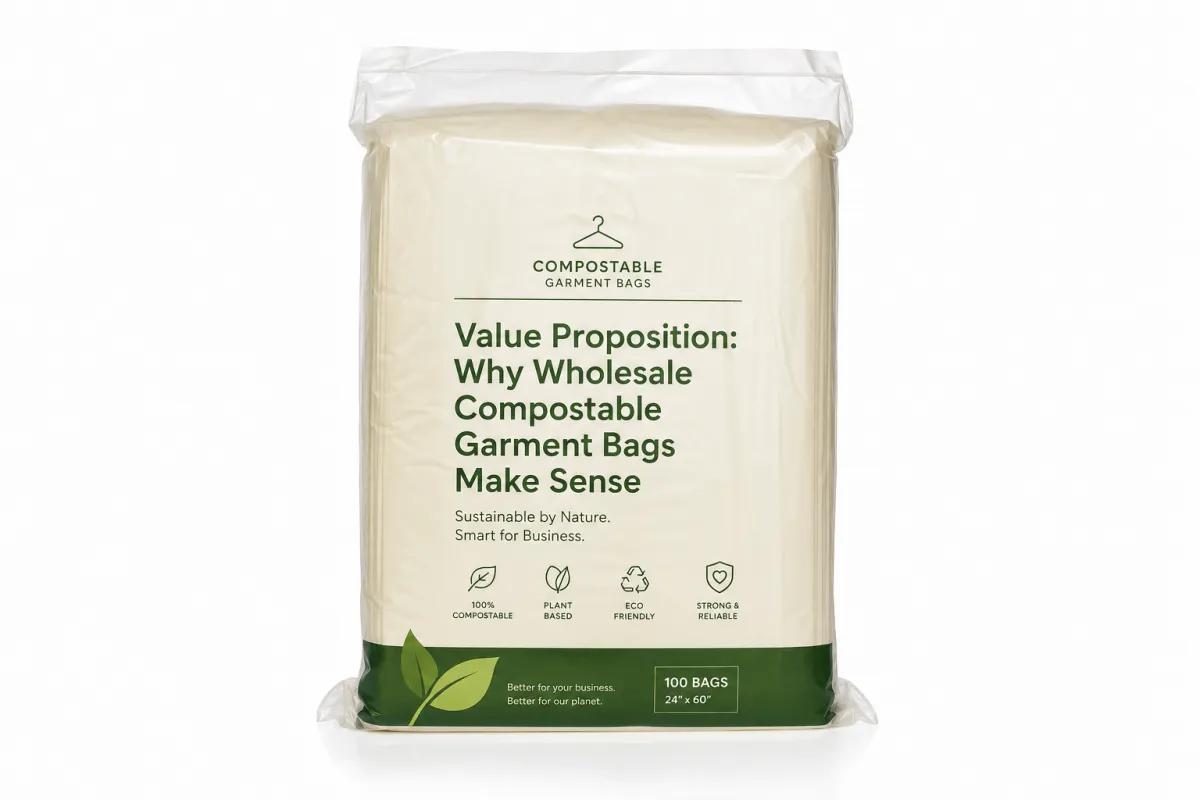
A practical example lands the point faster than any high-level pitch. A mid-size fashion brand moving 20,000 orders a month with 3,000 returns felt the cost of packaging in labor terms, not just in the procurement line. Each weak bag created rework: open bag, replace film, reseal, re-pack, and then a support ticket later. Wholesale compostable garment bags became their way to stabilize that loop, especially once the bag type was tied to the return path and product category.
For buyers, the value is usually three-way, not one-way. First is visible execution: channels and retailers read packaging quality before they even handle the garment. Second is positioning: premium or selective channels increasingly verify whether brand promises survive contact, not just copy on a homepage. Third is service stability: odor, barcode failures, seal drift, and rough handling all create complaint chains that are expensive to fix after launch. In those situations, the right bag gives teams less drama, not just better graphics.
Poly remains the lowest unit-cost baseline and still performs well in some moisture-heavy routes. Paper sleeves can work in certain channels, but they crease under load and can underperform with humidity and stacked cartons. Bio-based alternatives look impressive until procurement asks for traceability details and disposal routes tied to real facilities. Wholesale compostable garment bags sit between these ends by balancing brand alignment, compostability claims, and practical shipping behavior, provided the film, seal, and closure are selected correctly for your route.
A lot of people still carry the wrong assumption: eco-friendly means fragile. In real use, puncture tolerance, moisture resilience, and compressive strength matter more than brochure language. A garment bag that fails in transit is one more line item for complaints and one less line item for margin protection.
“A bag that tears on the receiving line is not a sustainability win. It is a return waiting to happen.”
Decision logic is straightforward once the pressure points are known. If return handling, retailer acceptance, or premium presentation is critical, wholesale compostable garment bags usually belong in the shortlist before standard poly. If your only objective is the absolute lowest sticker price, conventional poly often wins on paper and initial invoice totals. The downside appears in complaint volume, rework, and hidden fulfillment cost, which are rarely visible until the first full pallet lands.
Department stores, luxury boutiques, and selective marketplaces usually treat garment packaging as part of product identity. In those contexts, wholesale compostable garment bags are not a decorative afterthought; they are a checkpoint on brand and compliance performance. If your buyers are scanning for quality consistency across stores, this is a packaging decision you notice only when it fails.
- Choose compostable when stronger sustainability positioning, cleaner presentation, and defensible disposal narratives matter at volume.
- Keep standard poly when margins are extremely tight, and moisture tolerance or ultra-high volume throughput is the hard ceiling.
- Use paper or sleeves for short-haul, rigid, low-risk items where barrier performance is not central to protection.
- Run controlled trials when returns, humidity, or premium positioning are strategic and each cent in cost can move retention or repeat-rate outcomes.
Product Details: Materials, Construction, and Use Cases
Wholesale compostable garment bags usually begin at the film level: composition, barrier target, and how the material behaves after repeated handling. In real operations, PLA-based and PLA/PBAT blends are common, with starch modifiers used to tune flexibility and processing feel. Typical apparel structures sit in the 35-70 micron range for standard garments, while heavier styles can need 60-90 microns depending on tear profile and logistics stress. Going below the range often creates early failures; going too thick pushes freight and storage penalties faster than expected.
Common bag structures
Flat sleeves dominate for folded basics and smaller tops because they are easy to store, easy to auto-feed, and easy to cost-model. Gusseted formats become essential for dresses, knitwear, and mixed-piece sets where depth and shape change once loaded. Zip-lock reseal options fit higher-touch scenarios where customers open, inspect, and reclose, especially in direct-to-consumer return-heavy environments. Shoulder-style constructions are still underused, but they help with suits, blazers, and structured outerwear that resist deep compression.
Moisture tolerance is where many specs fail under pressure. Ask for repeat handling tests under hot warehouse swings, dust exposure, and carton abrasion; do not rely on lab-only ideal-condition PDFs. Activewear and maternity lines are where residue transfer and odor are most obvious, because the material touches skin-adjacent surfaces and customer sensitivity tends to be high. If a fabric smells “off” after repack, brand reputation absorbs that hit quickly.
Print methods and finishing limits
Wholesale compostable garment bags at scale usually move on flexographic printing when cost stability matters and unit counts rise. Digital remains useful for rapid artwork changes and short seasonal lines, but its economics can shift once volume climbs. Gloss-heavy or foil effects, high-impact finishes, and aggressive coating stacks can interfere with compostability claims and should be validated before approval. A pretty finish that compromises performance or claim integrity becomes a compliance problem before it becomes a branding win.
Confusion between compostable and recyclable labeling still pops up in too many supplier decks. Compostable status depends on validated standards and disposal pathways, commonly under ASTM D6400 or EN 13432 frameworks and documented test support. Recyclable status, by contrast, depends on local collection streams and end-market acceptance. Label language should match real-world verification, not intent. The Sustainable Packaging Coalition has practical language frameworks, and ISTA is still useful for physical transit stress validation.
Best-fit use cases
Wholesale compostable garment bags earn the strongest performance in direct-to-consumer programs, premium storefronts, and workflows where presentation and consistency are both non-negotiable. Bridal and occasionwear often benefit most because unboxing contributes to perceived value as much as pricing. Activewear teams use them to avoid the “cheap plastic” association that can quietly pull down trust among younger customers. Sample rooms and showrooms also value the repeatable structure, barcode clarity, and claim confidence during client handling.
For teams comparing biodegradable garment covers and standard options, the deciding factor is usually stress behavior, not copy language. If a bag looks clean but deforms on route, the brand loses more than aesthetics; it loses repeat intent.
Specifications for Wholesale compostable garment bags Buyers
Wholesale compostable garment bags procurement starts with measurable specs, not impressions. If tolerance drifts 3-5 mm and your operation still “feels fine,” that comfort usually collapses at conveyor speed. Flatness, profile consistency, and feed behavior decide whether your team spends time moving product or fixing it.
- Film thickness: 35-50 microns for light tops; 50-70 microns for dresses and knit blends; 70-90 microns for coats and heavier outerwear.
- Seal strength: commonly 1.2 to 2.0 N/15 mm, adjusted by seam style, closure type, and blend behavior.
- Tear resistance: require cross-direction and machine-direction results, plus sample retention data, not generic “acceptable” language.
- Burst performance: map pass/fail to folded garment mass, carton style, and expected handling intensity.
- Moisture and dust resistance: define expected warehouse RH bands, humidity tolerance, and dust exposure level.
- Flatness and trim tolerance: confirm edge consistency that preserves feeding on auto-baggers and label stations.
Size planning often swings outcomes more than spec sheets suggest. Compact tops and kidswear can use narrower flat formats to protect fit and reduce carton waste. Dresses and knitwear often need extra depth to avoid seal distortion and awkward folds. Suits, coats, and structured garments often need shoulder or gusset support, especially when shipment windows include long hauls or stacked freight. Bags that are oversized waste cube space and raise freight cost; undersized bags increase manual intervention, damage, and variable labor.
| Use Case | Typical MOQ | Typical Unit Price | Best For | Main Tradeoff |
|---|---|---|---|---|
| Standard flat compostable bag | 1,000-5,000 pcs | $0.18-$0.32 | Tops, tees, folded basics | Less depth for bulkier garments |
| Gusseted compostable bag | 1,000-3,000 pcs | $0.24-$0.42 | Dresses, knitwear, multi-piece sets | More material and slightly higher freight |
| Resealable zipper style | 1,000-3,000 pcs | $0.28-$0.50 | Premium apparel, returns, travel-ready reuse | Higher assembly complexity |
| Heavy outerwear / shoulder style | 500-2,000 pcs | $0.32-$0.60 | Suits, coats, luxury wardrobes | Largest material use |
| Conventional poly bag | 5,000+ pcs | $0.05-$0.12 | Lowest-cost mass packing | Weaker sustainability narrative |
That table is a starting map, not a final decision. Priorities decide the outcome: cost ceiling, premium expectation, or compliance reliability. In many apparel programs, the practical middle remains wholesale compostable garment bags because the unit premium is controlled and operational risk is typically lower than alternatives with weaker fit. ASTM D6400, EN 13432, and local labeling language should be verified before full approval, especially if your markets straddle multiple jurisdictions. A supplier with weak documentation is not just unclear; they are introducing avoidable risk.
Quality teams should define acceptance gates early: lot-to-lot consistency, seam performance, fold-flat behavior, print registration tolerance, and defect thresholds for wrinkles, pinholes, and barcode drift. A barcode near fold lines or low contrast is a known path to scanner failure, especially in fast-paced pick cycles. That is workflow failure, not design artistry.
Machine compatibility is a hidden gate in many failed rollouts. Some wholesale compostable garment bags run cleanly on vertical bagging lines but stall on horizontal models if top geometry is too soft. Seal jaw width, dwell time, and heat profile can determine whether production stays smooth or turns into manual patching for an afternoon. Share model family, feed speed, and hourly throughput targets in the first sample brief, or your supplier will optimize blind.
Pricing, MOQ, and Cost Planning for Wholesale compostable garment bags
Wholesale compostable garment bags are usually priced across five buckets: base material, artwork complexity, style geometry, setup cost, and finishing or processing. That split explains why costs move so much between quotes. A simple flat SKU may look predictable, while a resealable, printed, high-precision shape can jump unpredictably if one variable shifts.
Low-volume pilots often look expensive because setup, sampling, and approvals are spread across fewer units. A 500-piece batch can appear costly per unit versus a 1,500-piece batch with almost the same construction. That is why phase planning matters: pilots should reduce risk, not become your permanent operating model.
A practical planning path often looks like this:
- Prototype / pilot: 100-500 pcs, used for fit, print review, scanner test, and line behavior checks.
- Starter order: 500-1,500 pcs, suitable for category test and short launch windows.
- Operating order: 1,500-5,000 pcs, where unit economics begin to stabilize and process ownership starts to hold.
- Scale order: 5,000+ pcs, used once artwork and warehouse flow are confirmed.
Unexpected cost leaks happen every quarter: extra proof rounds, late design corrections, upgraded inserts, and return freight. A bag that adds only a few millimeters in width can increase carton count and dispatch cost. So the right number is not unit price. It is landed cost across packaging, fulfillment, and complaint exposure.
For wholesale compostable garment bags, buyers should compare more than piece price. A quote that is two cents lower but raises claim disputes or warehouse downtime rarely protects margin in the long run. Ask for a landed-cost model that includes freight, QC hold, duties when applicable, and contingency for forecast volatility. Reliability in lead time often matters more than a one-time saving.
Printed compostable structures in apparel frequently land in the $0.18-$0.32 band for simpler runs and $0.24-$0.50 when closures, certification, and heavier builds are required, before larger volume breaks kick in. These ranges are directional and shift with art complexity, inserts, certification depth, and regional freight conditions. Treat them as planning bands, not fixed prices.
Low-MOQ sampling still has its place for speed and learning, but repeating it every quarter without scale discipline delays true leverage. The better play is pilot to validate assumptions, then set a quarterly forecast and lock tiered pricing. That is how wholesale compostable garment bags move from pilot curiosity into a mature purchasing category. If you are building a broader purchase plan, the Wholesale Programs page is a useful starting point for volume-based ordering logic.
Process & Timeline: From Brief to Delivery
Teams that run wholesale compostable garment bags well use one pattern: brief, material confirmation, sample, pilot, QC sign-off, production, final inspection. It looks linear, and it often is. Most execution breaks happen when people skip confirmation steps to preserve launch speed.
For standard packaging on stable material, a common timeline is 2-4 business days for brief intake and initial pricing, 3-5 days for proofing, 5-7 days for samples or pre-production, and 12-20 days for manufacturing after formal approvals. Certification requirements, unusual closures, and stricter visual standards can extend this. Rush handling usually trims revision time and usually pushes cost upward.
File standards should be locked from the start: editable vectors, Pantone references where color consistency matters, clean dielines, barcode logic, repeat direction, and protected margins near seams. Barcode or seam conflicts are production errors, never design style errors, and they vanish when the file package is precise. In short: discipline in documentation saves your people from improvising at 2 a.m.
A low-risk run starts with design freeze and a controlled soft-launch lane. Even a 200-300 unit validation batch can reveal seal drift, scanner errors, carton fill ratio, and complaint profile before a full conversion. Acceptance criteria should be explicit in the PO: what fails, who decides failure, and when replenishment is paused. That prevents “we thought the spec was implied” delays.
Most timeline delays trace to the same cluster: late compliance documents, last-minute PO shifts, barcode contrast changes, and unclear closures. Once sample production starts, even tiny artwork edits can become expensive schedule events because every change hits tooling and approval windows. Post-approval changes to size, material, or closure should trigger re-quote logic and revised lead-time assumptions.
Transit validation should mirror real handling, not just office demonstrations. Drop testing, carton compression, and in-line feeding trials on your actual fulfillment equipment are more predictive than studio photos. If your route has rough handling, test for rough handling. The ISTA framework helps here because it ties mechanical behavior to plausible abuse patterns instead of idealized transport stories.
In execution, the teams that perform best use one phrase over and over: clear inputs, controlled changes, fast correction. That is how wholesale compostable garment bags stay on schedule without constant firefighting.
Why Choose Us for wholesale compostable garment bags at Scale
Scale exposes supplier quality fast. For wholesale compostable garment bags, a capable partner is not just good at samples—they are explicit about material sourcing, certification records, MOQ structure, and change-order economics before production starts. Buyers need certainty in three places: specification discipline, timeline reliability, and revision handling once reality moves.
At Custom Logo Things, the practical advantage is execution mechanics. A dedicated project lead keeps context centralized and reduces the classic “three contacts, three versions of truth” problem. In cross-functional launches, that alone reduces rework and speeds approvals. I have seen teams recover two to three working days just from having one accountable contact instead of an inbox chain.
The recurring objections are usually familiar: cost, barcode compatibility, shelf-life, and durability for heavier garments. Each is solvable with testing language and shared criteria. Cost comparisons should use total landed impact, not item price only. Barcode planning should include scanner model, belt speed, and lighting conditions, not just black-and-white contrast in a PDF. Shelf-life depends on storage reality—dock heat, UV, and humidity, not theoretical storage assumptions. Durability should be validated by garment type; there is no room for generic “good enough” assumptions.
For teams running pre-automation checks, compliance reviews, and line integration before scale, wholesale compostable garment bags can be integrated as a stable manufacturing item instead of a one-off marketing deliverable. If first runs show weak reseal performance or seam variation, the fix should be formalized before replenishment, not patched in weekly escalation meetings.
One-off custom projects can look perfect on a render and still fall apart in repeat operations. Scale programs need repeatable dimensions, print consistency, reliable closure performance, and dispatch timing from first batch to the fiftieth. Buyers detect this difference within weeks, often before financial close.
When building a broader Wholesale Programs strategy, finalize packaging architecture before demand escalates. Clear technical specs, stable price bands, and auditable certification claims remove friction before full order deployment. Packaging that sounds sustainable but cannot survive fulfillment is not a long-term option, and it can damage trust with both retailers and customers.
Next Steps: Build a Low-Risk Rollout
A reliable rollout for wholesale compostable garment bags starts narrow and then expands. Pick a controlled SKU set, define quarterly dispatch targets, and decide whether each SKU uses a standard or reinforced format from day one. You do not want to discover hidden complexity after finance and marketing already scaled in.
- Submit garment-level dimensions, average weight bands, and closure preference in your first brief.
- Lock dielines, barcode placement, color references, and print notes before sample approval.
- Approve certification goal and claims wording at the start, including local disposal assumptions.
- Run physical and digital samples through the actual packing path, not a clean office environment.
- Release pre-production only after fit, scan reliability, and seal checks pass at operating speed.
Ownership should be explicit and boring. Procurement controls PO terms and change logic. QC owns fit, barcode readability, and seal consistency checks. Logistics owns carton fit, storage conditions, and shipping cadence. Shared ownership creates rich discussion; unclear ownership creates unresolved defects.
Post-launch, track metrics like a quality manager, not a design team. Watch defect rate, damage rate, complaint categories, and reorder cadence weekly for the first two cycles. A defect rate above 2% in the first 1,000 units usually means immediate root-cause review. Split odor, tear, and barcode defects into separate buckets so teams can isolate material issues, print issues, and process issues quickly.
Returns reuse tests are an underrated signal. If reseal performance drops after first opening, customers perceive a short-lived premium, and that expectation damage is harder to fix later. Treat reuse as part of acceptance, not a marketing bullet. Wholesale compostable garment bags should survive first open, short storage, and repacking without collapse.
Here is the takeaway: treat these bags as a system input, not a branding prop, and you will usually win on both sustainability claims and operating stability. If your chosen bag cannot pass your own real-world test pack repeatedly, it is not a strategic material.
In other words, choose a wholesale compostable garment bag setup that will keep working after launch day, because that is the moment most packaging programs are actually tested. If your team keeps the same spec through at least one full quarter with stable complaints and stable freight, you likely picked the right path. For larger rollouts, review the Wholesale Programs structure early so the packaging plan and the order plan move together.
Frequently Asked Questions
What is the price difference between wholesale compostable garment bags and regular plastic garment bags?
Most buyers see a moderate premium, often in the $0.10 to $0.30 range per unit, depending on size, closure, artwork complexity, and order volume. The premium can be reduced when pilot findings are reused and when design simplicity is maintained. In premium channels, teams usually measure the difference against complaint rates and acceptance consistency rather than unit price alone.
What MOQ is common for wholesale compostable garment bags in first orders?
First orders commonly fall between 500 and 2,000 units, with simpler styles sometimes lower when artwork is already approved and the material baseline is established with the supplier. These runs are useful for validation and should be treated as learning batches. They are not usually the final economics baseline for wholesale compostable garment bags.
Do wholesale compostable garment bags work with standard barcode scanners and fulfillment workflows?
Yes, when barcode placement, contrast, and test conditions are built from day one for real operations. Positioning near folds or seams is a known failure point, and glossy or reflective areas can reduce scan reliability. Run scan checks at your actual conveyor speed and lighting, then confirm sample compliance before scale.
Can compostable garment bags be customized with premium finishing without breaking certification claims?
Yes, when finishing materials, inks, and coatings are validated against the claimed material pathway. Finish stacks should be finalized before purchase order lock, not after tooling approval, especially where claims language and inspection schedules are involved. If certification impact is unclear, ask for pre-production confirmation and a written decision path before launch.
How long does it take to deliver bulk wholesale compostable garment bags?
Standard flow is often 10-15 business days from proof approval to production-ready sampling, followed by 12-20 days for manufacturing and dispatch, depending on complexity and quantity. Rush options can shorten this but usually increase cost and shrink correction time. If specifications are stable and acceptance gates are already proven, delivery can remain predictable even as order volume rises.

