Buyer Fit Snapshot
| Best fit | Compare Sustainable Packaging Materials for Logistics projects where brand print, material claims, artwork control, MOQ, and repeat-order consistency need to be specified before quoting. |
|---|---|
| Quote inputs | Share finished size, material target, print colors, finish, packing count, annual reorder estimate, ship-to region, and any compliance wording. |
| Proofing check | Approve dieline scale, logo placement, barcode or warning zones, color tolerance, closure strength, and carton packing before bulk production. |
| Main risk | Vague material claims, crowded artwork, missing packing details, or unclear freight terms can make a low unit price expensive after revisions. |
Fast answer: Compare Sustainable Packaging Materials for Logistics should be specified like a repeatable production item. The safest quote records material, print method, finish, artwork proof, packing count, and reorder notes in one written spec.
Production checks before approval
Compare the actual filled-product size with the drawing, then confirm tolerance on folds, seals, hang holes, label areas, and retail display edges. Reserve space for logos, QR codes, warning copy, and material claims before decorative graphics fill the panel.
Quote comparison points
Review material grade, print process, finish, sampling route, tooling charges, carton quantity, and freight assumptions side by side. A quote is only useful when the supplier can repeat the same color, closure quality, and packing count on the next order.
Compare Sustainable Packaging Materials for Logistics
The first time I watched a warehouse swap plastic air pillows for recycled paper on a Midwest parcel lane, the sustainability report looked better right away. The pack station did not. Operators were walking farther for refills, the dispenser jammed twice before lunch, and throughput dipped enough that the shift lead asked for the old setup back by Friday. That is the part most procurement decks skip: if you want to compare Sustainable Packaging Materials for logistics in a way that actually survives the floor, you have to measure the lane, not the label.
The cleanest answer is usually less glamorous than marketing would like. Recycled corrugated and molded pulp solve the broadest set of logistics problems, while reusable systems pay off only when the return loop is disciplined and the loss rate stays low. A box is not sustainable because it says so. A package is sustainable when it protects the product, moves through the warehouse without friction, and does not create a pile of claims on the other side. That is the real test when you compare sustainable packaging materials for logistics.
There is also a simple truth that shows up again and again in shipping audits: the cheapest packout on paper is often the most expensive one after damage, repack labor, dimensional weight, and customer service are counted. I have seen a packaging change save three cents per unit and cost three dollars per return. Not every lane is that dramatic, but the pattern is common enough to matter. And honestly, it is kinda the whole story.
So this review looks at performance, recovery path, warehouse speed, customer acceptance, and cost behavior together. Those are the forces that decide whether a packaging change lasts one quarter or one budget cycle. If your team needs to compare sustainable packaging materials for logistics for ecommerce, retail replenishment, or palletized freight, the material choice should flow from those conditions first.
"The best package is the one that stays invisible after delivery because it did its job without creating a second problem."
Quick Answer: Compare Sustainable Packaging Materials for Logistics
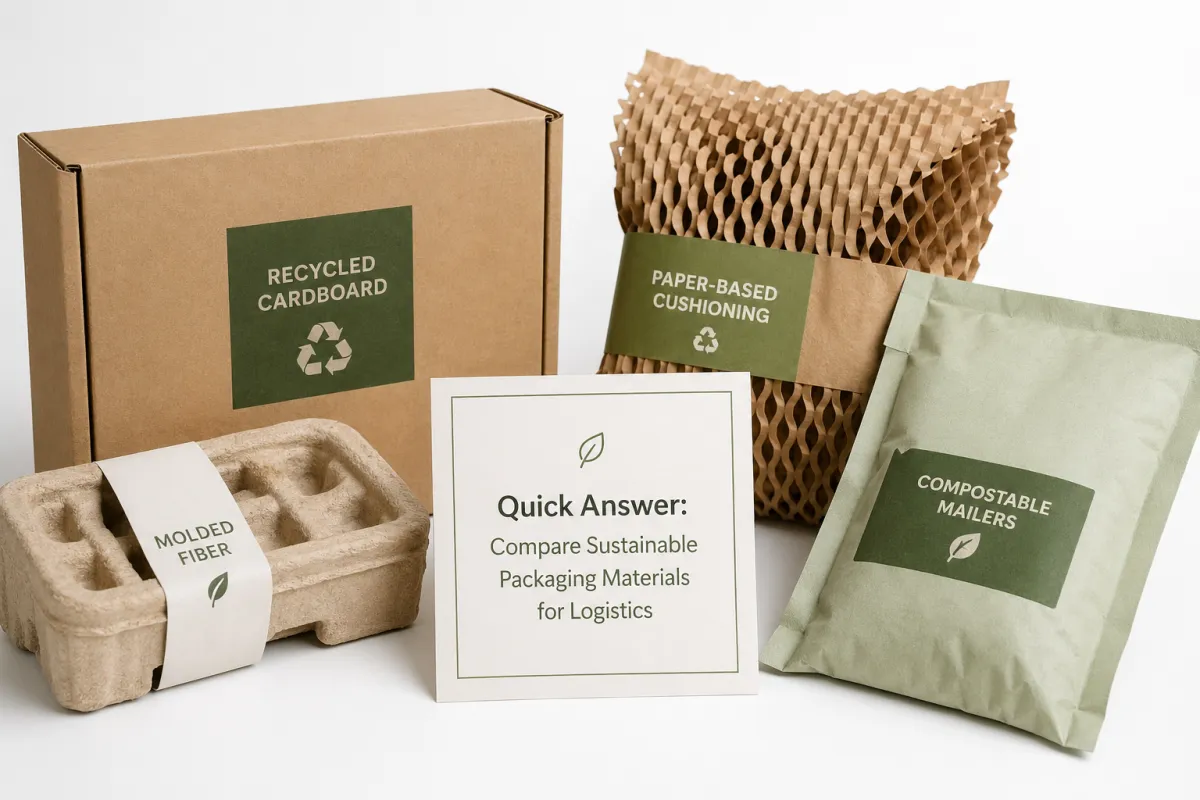
If you need the short version, compare sustainable packaging materials for logistics by damage rate, cube efficiency, pack speed, and consistency before you look at the sustainability story. In many lanes, a recycled corrugated shipper with kraft paper fill beats a more complicated option that slows operators and varies from batch to batch. A material can look inexpensive at purchase order stage and still cost more once labor and freight are included.
For fragile goods, molded pulp is often the practical middle ground. It stabilizes products, works with Custom Printed Boxes, and usually reduces reliance on loose fill that inflates dimensional weight. For high-volume palletized freight, recycled corrugated cardboard remains the safest operating baseline because crews already know how to use it, suppliers can source it quickly, and stack behavior is predictable. If your team wants to compare sustainable packaging materials for logistics without getting lost in theory, start there.
Reusable totes are powerful in a closed-loop system, but only if return capture is reliable. If those totes disappear into mixed channels, the economics fall apart fast. Mushroom-based cushioning, starch-based loose fill, and bio-based films can all solve specific problems, yet none of them is a universal default. The real question is whether the material eliminates the failure mode you care about most.
For standards and validation, I trust ISTA test methods for parcel and unit-load decisions, and EPA recycling guidance for sorting out what is actually recoverable versus what just sounds eco-friendly. Those anchors keep the conversation grounded. Compare sustainable packaging materials for logistics with method and evidence in view, and the debate gets a lot less fuzzy.
For teams balancing branded packaging with distribution speed, a simple recycled structure with restrained graphics is usually the safest starting point. That is where Custom Packaging Products can be useful: design clarity without adding unnecessary packout complexity. The temptation is to overbuild the unboxing moment; the smarter move is to compare sustainable packaging materials for logistics first, then add brand detail only where the lane can support it.
Compare Sustainable Packaging Materials for Logistics: Top Options
Here is the working inventory. I am using logistics criteria as the filter: cushioning behavior, stacking strength, moisture tolerance, recovery route, and line compatibility. If you compare sustainable packaging materials for logistics in a real warehouse, those factors matter more than a polished product sheet. The materials below are the ones I see most often in redesigns, shipping audits, and cost reviews.
| Material | Typical Use | Strength Profile | Operational Fit | Recovery Path | Directional Cost at 5,000 Units |
|---|---|---|---|---|---|
| Recycled corrugated board | Shipper boxes, partitions, inserts | Strong stacking, good crush resistance | Excellent on existing lines | Widely recyclable | $0.38-$1.25 per unit |
| Molded pulp | Trays, end caps, custom immobilization | Very good product fit, moderate moisture sensitivity | Good if geometry is stable | Recyclable or compostable depending on fiber and local rules | $0.28-$0.95 per unit |
| Recycled paper void fill | Light to medium parcel protection | Good against shifting, limited against severe shock | Fast, low training burden | Recyclable in many streams | $0.05-$0.18 per shipment |
| Starch-based loose fill | Light items, void fill in low-risk lanes | Fair cushion, weak under humidity and static handling | Messier, lower line cleanliness | Compostable claims vary by product | $0.06-$0.22 per shipment |
| Mushroom-based cushioning | Premium protective inserts, display-sensitive goods | Good compression behavior, but supply quality is less standardized | Best in controlled programs | Often compostable under defined conditions | $0.60-$2.10 per unit |
| Reusable totes | Closed-loop retail replenishment, returns-heavy flows | High durability, strong cube efficiency over many trips | Needs tracking and return discipline | Reusable for many cycles | $6-$18 upfront, then amortized |
| Bio-based films | Bundling, overwrap, light protection | Useful as a wrap, not a primary shock absorber | Easy to run if gauges match equipment | Depends on resin and local recovery | $0.04-$0.20 per unit |
These numbers are directional, not universal. Paper grades, tooling complexity, resin selection, and true order volume can shift them quickly. Still, a pattern shows up in nearly every sourcing discussion: compare sustainable packaging materials for logistics by total job performance, not by material story alone. A paper fill can be perfect for a lightweight bottle and a poor fit for a glass set. A molded pulp tray may look expensive next to loose fill, yet become cheaper once breakage drops.
Recycled corrugated remains the broadest-fit option because it handles variation without drama. It is the baseline for palletized freight, subscription refill boxes, and most ecommerce shippers. Molded pulp is the targeted option. It matters most when the product has to be held in a fixed position, not just surrounded by filler. For teams comparing sustainable packaging materials for logistics in retail packaging programs, that distinction drives most of the right choices.
Paper-based systems are often overlooked because they seem plain. Kraft paper, scored pads, and recycled wraps move quickly, keep the waste stream simpler, and usually reduce floor clutter at pack stations. In practical terms, that means fewer loose fillers arriving at the customer door and less staging space occupied in the warehouse. The tradeoff is straightforward: compare sustainable packaging materials for logistics against expected shock exposure. Paper performs well in controlled parcel movement; it is not the best answer for severe drop events or rough handling.
Reusable containers deserve a serious look, but only if the operation can support them. They work in retail replenishment, interplant transfer, and returns-heavy channels with solid tracking. They fail in open channels where containers are lost, mixed, or treated as disposable. Compare sustainable packaging materials for logistics honestly and reusable options become an operations decision first, not a branding decision.
How do I compare sustainable packaging materials for logistics for this lane?
The most durable framework starts with a reality check: what matters most in this lane today, and what is likely to matter six months from now? In many projects, the first answer is not “highest recycled content” but “best protection against the failure I keep paying for.” If damage is happening on edges, you need immobilization. If claims spike on palletized routes, you need stacking integrity. If complaints focus on hard-to-open packaging, opening behavior should move to the top of the list.
My process is simple, though not always quick. First, map the damage signature. Second, map the operational friction. Third, map the end-of-life path in the destination markets. If your life-cycle assumptions are not realistic, a package can look green on paper without actually supporting circularity. That gap matters more than most teams admit.
Carbon footprint belongs in the conversation earlier than it usually appears. A material that adds one more handling step at the warehouse may still have a better footprint than a lighter option that increases freight cube and transport emissions. When you compare sustainable packaging materials for logistics properly, local recycling access, transport effects, and disposal behavior all have to sit on the same table as protection performance.
Do not rank winners by category alone. I have seen teams select a fashionable bio-based film because it matched a sustainability deck, then add more paper fill to compensate, which increased carton size and freight cost. I have also seen plain recycled corrugated outperform more exotic alternatives because it reduced overtime and cut route damage. The method is repeatable: compare sustainable packaging materials for logistics at the package level, then again at the shipment level.
Detailed Reviews of the Best Materials for Logistics
Recycled corrugated board is still the workhorse. If I had to set one benchmark and compare sustainable packaging materials for logistics against it, this is where many programs begin. Corrugated is easy to source, familiar to operators, and available in multiple flute profiles, edge crush strengths, and recycled content levels. A 32 ECT carton can handle many light parcel applications; 44 ECT or double-wall makes more sense for stacked heavy loads. It also fits naturally into branded packaging programs because print, die-cutting, and scoring are well established.
Corrugated is not fancy, and that is part of why it is dependable. People know how to fold it, pack it, and store it. Spare stock is manageable because most facilities already know how to handle it. It is one of the easiest materials to standardize across SKUs. If your team is comparing sustainable packaging materials for logistics while trying to reduce change-management risk, corrugated is often the most predictable first baseline.
Molded pulp is strongest when movement control is the main issue. Electronics, glass, cosmetics, and irregular shapes benefit from its precision fit. The real advantage is limiting internal migration, vibration abrasion, and cumulative rattling. Many failures are not caused by one giant impact; they come from a series of small hits that add up. Molded pulp trays and end caps frequently reduce that micro-motion better than loose fill alone. Compare sustainable packaging materials for logistics on that kind of damage, and molded pulp often comes out ahead.
There are tradeoffs. Some pulp structures are sensitive to moisture, and tooling timelines matter. A custom mold can add several weeks, and design changes can stretch approval if the product geometry is still shifting. Still, if those forms reduce breakage and cut unpacking chaos, they often pay back quickly in service levels. For higher-value lanes, compare sustainable packaging materials for logistics by damage avoidance and operational stability, not just insert unit cost.
Recycled Paper Void Fill is the low-disruption choice for many parcel programs. It is quick to implement, easy to train, and familiar to packers. If your line already runs paper dispensing, replacing loose plastic cushioning can be done with minimal downtime. The operational upside is real: cleaner recycling pathway, less waste on the floor, and less mess at receipt. The downside is equally real: severe transit and high-jerk routes can expose weakness. Compare sustainable packaging materials for logistics and this often lands as a middle option, not the strongest or the weakest.
Starch-based loose fill has a clean environmental narrative, but the operating reality is mixed. It can fit lightweight products and controlled fulfillment flows, yet it can also bring static, dust, and housekeeping headaches. Humidity and fill consistency matter; a small shift in pack technique can produce different outcomes from one shift to the next. I am not gonna pretend it is the right answer everywhere. Compare sustainable packaging materials for logistics with starch fills only on lanes where order profiles are stable and the team can hold quality tight.
Mushroom-based cushioning is compelling because it mixes brand story with real protective value. Mycelium inserts can perform well for premium and shaped products, and in the right composting pathway they strengthen end-of-life messaging. Supply is improving, but it is still less broad than corrugated or paper. Price can rise at low volumes. For stable programs with enough demand, a pilot makes sense. For broad networks, compare sustainable packaging materials for logistics and treat mycelium as a strategic option rather than a default.
Bio-based films are often oversold. They can help with bundling and light wrapping, but they do not replace structural cushioning. If a lane needs compression resistance and shock absorption, this format alone is not enough. It belongs in a system where other components do the heavy lifting. Compare sustainable packaging materials for logistics with that architecture in mind and you avoid building a package around a misunderstood material.
One pattern repeats across almost every implementation: the strongest teams ask not, “Which material is the greenest in theory?” but, “Which material lowers total risk for this lane without creating avoidable complexity?” That frame keeps the focus on throughput, claims, and customer experience. If package appearance matters, a simple recycled base paired with custom printed boxes can preserve branding while keeping cube and labor under control.
Price Comparison: Material Cost vs Landed Cost
Raw material price is easy to read and easy to misread. To compare sustainable packaging materials for logistics properly, you need landed cost: material, labor, packing speed, dimensional weight, damage replacement, and reverse-handling overhead. A box that is cheaper by a few cents but slows packing by 20 seconds is not cheaper in a busy network. A slightly higher-priced insert that cuts breakage from 2.4% to 0.9% often improves margin almost immediately.
The most important shift is from unit economics to system economics. Compare sustainable packaging materials for logistics by cost per shipped unit, cost per protected unit, and cost per avoided claim. That framework shows where the leaks are. If you only compare sticker price, you can end up with a lower bid that creates overtime, transport penalties, and customer frustration. Finance sees the savings first; operations sees the cleanup later. Both are right.
Volume behavior sharpens the picture:
- Prototype and pilot runs: Off-the-shelf corrugated and paper-based systems usually win because speed and low tooling complexity matter most.
- Mid-volume orders: Molded pulp, custom inserts, and hybrid designs become viable when they reduce damage or improve cube efficiency.
- Full-scale production: Reusable systems and standardized molded components can improve economics if demand is steady and the route is predictable.
The biggest mistake is assuming the lowest unit price is the winning option. I have watched a lower-cost filler create hidden costs in rework and returns. I have also seen custom forms with higher day-one spend reduce breakage enough to pay back through service savings. Compare sustainable packaging materials for logistics against actual throughput and actual damage, and the “cheapest” path changes quickly.
For teams building a business case, track these four numbers for each option:
- Cost per ship unit - What each packout contributes before freight and claims.
- Cost per protected unit - What each successful shipment effectively costs after transit risk is included.
- Minutes per pack - Whether line productivity stays stable without a training spike.
- Cost per avoided claim - Savings from fewer damage events, returns, and support contacts.
That framework is especially useful where custom packaging meets commercial pressure. If you are balancing branded packaging with logistics performance, the right setup may include Custom Packaging Products that improve product retention while preserving shelf-ready appearance. Compare sustainable packaging materials for logistics using total landed cost and fewer decisions will drift from a spreadsheet into an expensive operational surprise.
Freight cube is another cost layer that gets missed far too often. A package that expands carton footprint can trigger dimensional surcharges even when the product weight stays light. That is why teams sometimes move away from loose-fill-heavy systems and toward molded pulp or better-fit corrugated inserts. Compare sustainable packaging materials for logistics with carton shape and volume in view, not just protective material, because one cubic inch can erase the savings on the whole lane.
Process and Timeline: From Spec to Production
Packaging upgrades should follow a sequence, not improvisation. The cleanest way to compare sustainable packaging materials for logistics is to audit, sample, test, revise, approve, pilot, then scale. Skipping steps invites a pilot success that fails on the floor. The early audit should document product weight, vibration sensitivity, current damage patterns, pack speed, and dimensional limits. Without that baseline, comparison stays opinion.
Timelines usually stretch more than teams expect. A straightforward paper-based change can go from sample to launch in a few weeks if supplier stock is aligned and the design is simple. Tool-based formats or custom molds extend the schedule. Print approvals extend it further. New supplier onboarding extends it again. If you are comparing sustainable packaging materials for logistics while also redesigning a carton structure, budget for each stage. A realistic plan might include 2-3 weeks for sampling, 1-2 weeks of testing, and 1-3 weeks of pilot correction.
Testing should beat aesthetics every time. I would not launch without these checks:
- Drop tests tied to the actual parcel height and handling profile of your line.
- Compression tests for palletized and stacked freight.
- Humidity exposure for routes with hot docks, cold trailers, or damp storage.
- Line-fit checks for impact on pack rate and operator fatigue.
- Transit simulation where possible, based on known route severity.
For standards, ISTA methods remain a practical benchmark for parcel and unit-load behavior. ASTM D4169 is also widely used for distribution-cycle validation. Compare sustainable packaging materials for logistics against those standards and you get evidence instead of adjectives. The package only proves itself in your lane, not in a marketing brochure.
Most implementation delays are people and process, not technical barriers. Old inventory must run down. Staff need coaching. Labels and artwork may need small edits. Machine settings may need adjustment if stiffness, tear resistance, or compression behavior changes. Even modest grade changes in corrugated can affect folding, sealing, or stack behavior. That is why controlled pilots are non-negotiable. Compare sustainable packaging materials for logistics in one lane first, and scale only after operators and claims data agree.
Do not switch the full catalog in one cutover. Start with one high-value or high-damage segment and let the team adapt on a narrow set. Feedback loops tighten. Failures show up in days, not months. That speed can save a lot of rework and keep the launch from turning into a broad operational disruption.
How to Choose the Right Sustainable Material for Your Lane
The strongest decision starts with lane behavior. Compare sustainable packaging materials for logistics by walking through four questions: What is the product? How far does it travel? What handling conditions does it face? And which failure is most expensive when it happens? A regional cosmetics box is not comparable to a national glass product with heavy interline handling. Match the failure profile, not the sustainability headline.
Decision framework I use:
- Fragility: If the item is brittle, prioritize immobilization, fit, and shock control.
- Distance: More handling opportunities usually require stronger protection and tighter packaging standards.
- Environment: Temperature and humidity can change material behavior, especially in paper and fiber systems.
- Channel: Parcel, pallet, retail replenishment, and returns all reward different material choices.
Automation changes the equation. A format that works well by hand can struggle on a high-speed line. Recycled paper fill may be ideal in a manual station and less useful in a fully automated one. Molded pulp is excellent when geometry is stable, but tooling and consistency matter. Reusable totes are efficient in closed-loop programs, yet they demand tracking, retrieval, and storage discipline. Compare sustainable packaging materials for logistics with the actual workflow before you lock the design.
Consumer behavior is often overlooked. Some markets recycle corrugated automatically, while others do not separate materials consistently. Some regions support molded fiber recovery, others do not. A packaging claim only holds if the end-of-life route is real in that channel. That is why clearly recyclable corrugated and well-documented paper systems are often easier to defend than broad “eco” language that cannot be consistently recovered.
If your team is down to two finalists, keep it simple: run a side-by-side pilot against the baseline and pick the option with stronger protection and lower total risk. Do not evaluate five formats at once. Too many options create noise and decision fatigue. Compare sustainable packaging materials for logistics in a narrow pilot window, and force a decision using hard metrics: damage rate, pack speed, freight profile, and claims trend.
For teams also supporting retail and branded packaging, enforce design discipline. A restrained printed appearance, clean interior structure, and a clear opening method can still look intentional without pushing cost higher than the lane can carry. Compare sustainable packaging materials for logistics and this kind of discipline often becomes an advantage because consistency in fulfillment beats decorative complexity in most networks.
Compare Sustainable Packaging Materials for Logistics: Our Recommendation
If I compress the field to practical action, the answer is stable: recycled corrugated is the best general-purpose base, molded pulp is the best fit-first specialist, and paper-based systems are the fastest deployment option for lower-shock shipments. Compare sustainable packaging materials for logistics lane by lane, and those three categories cover most use cases without creating unnecessary complexity.
Use recycled corrugated for broad ecommerce and palletized freight where stack height and consistency matter most. It is flexible, familiar, and usually the easiest to source quickly. It also gives your team a dependable base for custom printed boxes when branding needs to stay sharp. In many businesses, this is the best balance of recyclable structure, line efficiency, and claims reduction.
Use molded pulp when products need precision support and movement control. If failure data shows corner crush, abrasion, or internal migration, molded pulp deserves a serious look. Compare sustainable packaging materials for logistics against those failure modes, and this format often rises because it addresses the real cause of damage instead of masking it.
Use paper-based void fill and wraps for light to medium loads where speed and simplicity matter more than severe shock absorption. They are easy to launch, easy to replenish, and often easier for customers to recycle. These materials are not universal solutions for high-impact lanes, but they are strong contenders in stable, controlled flows.
A practical next move is simple: request samples from your top two formats, run pack-out tests in one actual lane, and track three outcomes: damage rate, pack time, and customer complaints. Then pilot the winner before committing at volume. Compare sustainable packaging materials for logistics in the field, not just in sample-room conditions. That is where the data becomes honest.
Before full release, document:
- Unit cost at actual volume tiers.
- Labor minutes per packout and training implications.
- Transit damage rate versus your baseline.
- Customer feedback on opening, disposal, and presentation.
- Supplier lead times and backup sourcing depth.
This documentation protects future reviews. It helps finance understand why a slightly higher-cost insert was selected, and it helps teams scale to other SKUs, packaging variants, or branded lines with less guesswork. Compare sustainable packaging materials for logistics while keeping those future lanes in view, and the recommendation stays resilient.
In practical terms, compare sustainable packaging materials for logistics by validating the top performers against a real baseline, not by searching for the perfect theoretical material. The right structure lowers damage, keeps packers productive, and still leaves room for packaging that looks intentional instead of heavy-handed.
FAQs
How do I compare sustainable packaging materials for logistics on real costs, not just unit price?
Track labor, damage, rework, returns handling, freight cube, and inbound/outbound handling changes alongside base material price. Compare each option by cost per shipped unit and cost per protected unit, not by carton cost alone. Use a pilot lane and measure breakage and pack speed before committing to full-scale pricing.
Which sustainable packaging material protects fragile products best in logistics?
Molded pulp is often strongest for products that need custom fit and immobilization. Reinforced corrugated with inserts is often a dependable all-around choice for mixed parcel loads. For very fragile SKUs, test drop and crush strength against your worst-case lane behavior. If you compare sustainable packaging materials for logistics only by appearance, you can miss the format with better real-world protection.
Is molded pulp cheaper than corrugated for logistics packaging?
Corrugated usually starts cheaper because tooling and sourcing are faster. Molded pulp can become more cost-effective over time when it cuts damage, improves fit, or reduces handling waste. At scale, molded pulp can be competitive if designs are stable and reused across SKUs. The correct way to compare sustainable packaging materials for logistics is landed cost plus transit performance together.
How long does it take to switch to sustainable packaging materials for logistics?
Simple paper-based changes can move fairly quickly if the packout is stable and the supplier has standard inventory. Custom molded or tool-dependent formats take longer because design, approvals, and line adaptation all add time. Include testing, pilot rollout, and inventory transition so you do not destabilize shipping. Early-stage comparison of sustainable packaging materials for logistics reduces the chance of a rushed launch.
What tests should I run before choosing a sustainable logistics package?
Run drop, compression, and vibration checks that mirror your route profile. Verify moisture behavior, line compatibility, and pack speed under normal throughput. Compare your current damage rate and pack-out time against each candidate. That is the clearest way to compare sustainable packaging materials for logistics in a format operations, quality, and finance can trust.
Compare sustainable packaging materials for logistics with the same discipline you would use for any production change: measure the lane, test the format, and trust operating data over the pitch deck. If you keep doing that consistently, recycled corrugated and molded pulp will usually lead the shortlist, while reusable systems stay relevant only when the reverse logistics network is reliable and enforced. The goal is not a greener label. The goal is to compare sustainable packaging materials for logistics, choose the structure that protects product and service, and launch with fewer hidden costs downstream.
The most actionable takeaway is this: pick one lane, keep the current packout as the baseline, and compare no more than two sustainable materials at a time using damage rate, pack speed, cube, and complaint volume. If one option wins on all four, that is your answer. If it wins on two but loses on two, you have not found the right material yet. Keep testing until the package fits the route, the line, and the customer experience together.


