Buyer Fit Snapshot
| Best fit | Custom Poly Bags with Hang Hole Wholesale projects where brand print, material claims, artwork control, MOQ, and repeat-order consistency need to be specified before quoting. |
|---|---|
| Quote inputs | Share finished size, material target, print colors, finish, packing count, annual reorder estimate, ship-to region, and any compliance wording. |
| Proofing check | Approve dieline scale, logo placement, barcode or warning zones, color tolerance, closure strength, and carton packing before bulk production. |
| Main risk | Vague material claims, crowded artwork, missing packing details, or unclear freight terms can make a low unit price expensive after revisions. |
Fast answer: Custom Poly Bags with Hang Hole Wholesale: Material Claims, Seal Quality, and Freight Cost should be specified like a repeatable production item. The safest quote records material, print method, finish, artwork proof, packing count, and reorder notes in one written spec.
Production checks before approval
Compare the actual filled-product size with the drawing, then confirm tolerance on folds, seals, hang holes, label areas, and retail display edges. Reserve space for logos, QR codes, warning copy, and material claims before decorative graphics fill the panel.
Quote comparison points
Review material grade, print process, finish, sampling route, tooling charges, carton quantity, and freight assumptions side by side. A quote is only useful when the supplier can repeat the same color, closure quality, and packing count on the next order.
Custom Poly Bags with Hang Hole Wholesale Buying Guide
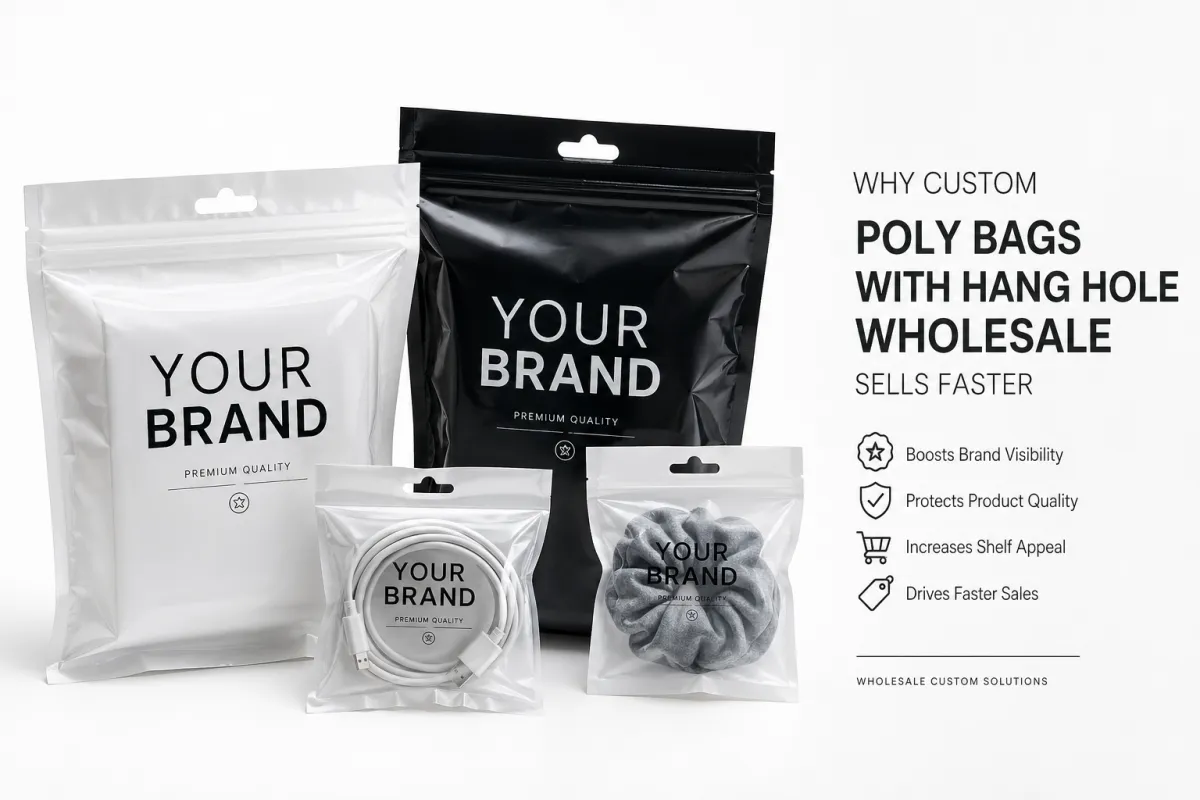
Miss the hanging point in retail packaging and the product loses shelf presence before a shopper even touches it. Custom Poly Bags with hang hole wholesale solve that failure in a direct, practical way: one clean hole, placed with care, turns a loose pack into something that can live on a peg, face forward, and stay visible long enough to earn the sale. The difference sounds small. The economics are not small at all.
I have sat through enough packaging reviews to see the same scene play out again and again. The product is solid, the artwork looks polished on screen, and the first physical sample exposes the weak link. The hole is too high. The seal crowds the top edge. The bag twists on the hook. Staff fix the problem with tape, clips, or repacking, and nobody calls that "packaging waste" because it lands in operations instead. It still costs money, though. In medium-size accounts, those hidden labor touches can stack up fast, and that extra friction is usually what turns a clean quote into a messy year.
Retail packaging works like a logistics system wearing a marketing suit. If the bag hangs cleanly, it helps the product do its job. If the bag fights the display fixture, the product starts behind schedule. Buyers who source Custom Poly Bags with hang hole wholesale usually care about that first, then care about print, finish, and premium touches after the functional pieces are locked.
From a supply perspective, this is less about aesthetics and more about mechanical reliability. In a point-of-sale hanging system, a bag is not a flyer or a postcard. It is a moving connector between carton and shelf. That makes small geometric details operationally powerful.
And yes, the hole placement sounds like a tiny spec. It kind of is. But tiny specs are where the headaches live.
Why do custom poly bags with hang hole wholesale sell faster?
Store-ready packaging beats last-minute fixing
A pack that hangs correctly gets treated like inventory. A pack that cannot hang gets treated like a problem. Store teams do not have spare minutes to rework every shipment, especially in categories with frequent replenishment. If a bag requires a second set of hands, scissors, or tape before it can go out, it becomes the item that gets pushed aside. That delay has a cost, and the cost shows up in slower shelf rotation.
Custom Poly Bags with hang hole wholesale are less about decorative convenience than operational friction. Less friction means less time spent opening cartons, sorting packs, and improvising display fixes. It also means fewer errors during restock. A pack that can be picked up and hung without hesitation tends to reach the sales floor faster, and speed on the floor often matters more than a clever finish nobody sees.
Small beauty items, hardware kits, accessories, sample packs, and giftable goods all benefit from this. When the packaging opens predictably and lands on the hook without twisting, the stock team moves faster. When the top edge folds badly or the hole is off-center, the product slows down. A buyer may never see the extra minutes, yet those minutes accumulate across hundreds or thousands of units.
If a basket is rotated at retail four times per week, a consistent extra 12 seconds per pack can turn into nearly an hour of staff time every hour of movement. That is not theoretical; that is exactly the kind of hidden drag that keeps stock in back rooms.
The print can be attractive and still fail if the display interface is wrong. The opposite is also true. A plain pack with the right hole placement often outperforms a prettier pack that cannot hang. That tradeoff gets ignored more often than it should.
What changed on shelf when hanging works right
Picture a retail chain restocking small tool organizers on standard peg hooks. The old bags were flat, with no dedicated hole and no reliable mounting point. They looked fine in a mockup. In the store, they rotated, slipped, and landed crooked. Associates had to re-seat the packs by hand. A better version with fixed hole placement, cleaner fill geometry, and stronger seal control reduced the restocking step to one motion: pick, hang, move on.
Custom Poly Bags with hang hole wholesale improve the parts of packaging that actually touch the sales floor:
- Visibility: the label stays upright and readable instead of drifting sideways or flipping backward.
- Order speed: staff can replenish faster when every bag follows the same mounting logic.
- SKU control: fixed dimensions and consistent hole placement make it easier to group products by category.
Packaging is not decoration first. It is a handling system first. For small and medium products, the right hole position and the right top structure can remove a surprising amount of friction from the warehouse-to-rack path. That is one reason buyers who switch to Custom Poly Bags with hang hole wholesale often notice cleaner merchandising almost immediately.
For pegboard packaging in medium-width retail aisles, this improvement is especially visible. A stable bag face means the pack reads as intentional instead of accidental.
Skip the functional part and the price tag looks lower while the labor bill quietly rises. Bags that hang poorly often create hidden costs through rework, damage, and display inconsistency. Those costs are harder to spot in a quote, which is exactly why they get ignored.
Why wholesale buyers treat this as a core line item
Bulk buying always comes back to repeatability. Wholesale teams care about unit cost, but they care just as much about whether the same result appears every time the order runs. Custom Poly Bags with Hang hole wholesale eliminate the need for extra hang cards, clips, or secondary display tricks in many categories. The pack itself becomes the display interface, which is what buyers expect from serious retail packaging.
For teams already using peg hooks, front-facing fixtures, or wall displays, this format usually fits the existing workflow instead of forcing a redesign. The point is not to make packaging feel elaborate. The point is to make the product easy to move, easy to stock, and hard to misplace.
Need a quick check before ordering? Look at the restocking path. If the product already lives on hooks or needs to live there, a hang-hole bag is usually the cleanest starting point. The packaging decision becomes straightforward once the display hardware is real instead of theoretical.
In many wholesale programs, this is the same logic that drives shelf-ready packaging standards. If the pack can perform a routine consistently, the rest of the merchandising stack becomes easier.
What you get in custom poly bags with hang hole wholesale
Core structure and film behavior
Buyers often ask what they are paying for beyond "a plastic bag." The answer is a complete package structure: film type, thickness, seal style, closure style, hole format, and print layout. The film does most of the heavy lifting. It controls clarity, stiffness, puncture resistance, and how the package behaves after shipping and restocking. In practical production terms, low-density polyethylene, high-density polyethylene, and recycled-content blends are common, and each one brings a different balance of appearance and durability.
Gloss and matte are both useful, just in different settings. Gloss can look sharper under dim store lighting. Matte can cut glare in bright retail environments and make print feel less flashy. Neither is automatically better. The right choice depends on the shelf, the product, and how much the pack needs to do visually before the customer picks it up.
Seals matter just as much. Heat-sealed edges are standard in many wholesale custom poly bags with hang hole wholesale orders because they are dependable and easy to inspect. Some production lines use ultrasonic sealing for certain applications, though that tends to add process sensitivity and is not the best fit for every high-volume run. Stronger tear resistance, cleaner edge integrity, and stable closure behavior should be discussed early, before artwork gets locked and tooling starts.
For high-turn categories, you often see a pattern: buyers begin with aesthetics, then return to structural checks after they review returns and damage reports. At that point, they realize structure is usually the cheaper thing to adjust before launch than after first-quarter losses start.
Bag formats buyers actually request
Three formats account for most commercial demand:
- Flat bags. Best for lighter SKUs and flatter products, with the fastest turnaround in many runs.
- Gusseted bags. Better for thicker items or mixed bundles that need more internal room without stretching the film.
- Header-style retail packs. Useful when the top edge needs a cleaner branded area and a more controlled opening.
For small hardware sets and accessories, flat and gusseted styles are the practical choices. The gusset depth matters more than many buyers expect. Too shallow, and the pack bulges or distorts the hang line. Too deep, and the pack carries empty volume that looks wasteful on shelf. That visual imbalance can make the product feel overpacked or oddly thin, depending on how the fill lands.
Print placement adds another layer. A single-color logo can look strong when the geometry is right. Full-color artwork gives the brand more room to move, but the proofs need tighter control, especially on small packs. Dense color near folds or seals can lose sharpness during production and turn a sharp design into a blurry one. The same issue appears in many point-of-sale packaging lines: the print looks right in digital proofs, then drifts in physical tension at runtime.
Print options without fantasy
Most teams choose from four broad routes: one-color, one-color with spot detail, full-color CMYK, or premium special effects. One-color is usually the easiest to control and often the least expensive. Full color gives broader brand expression but demands cleaner proofing and better file discipline. Barcode placement deserves its own attention because scanners do not care how attractive the layout is.
For custom poly bags with hang hole wholesale runs that include legal copy or compliance language, keep those elements in calm zones away from folds, seals, and the hole edge. A barcode placed over a weak area or a fold can fail once the pack is filled and hung. That failure can look random on the floor and expensive in the back office. In practice, scanner problems are often design problems wearing a production label.
A clean hierarchy works best: logo, product name, required copy, barcode, and a single supporting callout if needed. Too many claims compress the layout and lead to sticker fixes later. Sticker fixes are usually a symptom, not a strategy.
If a retailer needs strict auditability, the print stack should support readable warning text in the first pass. Retouching after production is both expensive and operationally risky.
Hole style and hardware compatibility
The hang hole is the mechanical interface between your pack and the fixture. It should be selected for the real hardware on the store floor, not for the idea of hardware. Three styles appear most often:
- Round holes for standard hook and rod use.
- Euro-style reinforced holes or grommets for heavier packs and repeated handling.
- Rectangular slots or punched openings for specific retail systems.
Choose the hole based on the fixture, the weight of the product, and the way store staff actually handle the pack. A large reinforced opening can crowd neighboring SKUs on a tight peg run. A tiny punch can split under load. A sample test costs less than a redesign, and it usually reveals problems the mockup cannot show.
The same logic works across jewelry cards, keychains, sample packs, hardware kits, craft bundles, battery packs, and consumables that need readable labeling. Bulky rigid items are a different story. Thin film is meant to support and display, not force a shape that does not want to sit still.
In many fulfillment centers, this is where custom poly bags with hang hole wholesale and product profile matching keep teams from replacing 5-10% of incoming units due to handling stress.
Specifications that matter before you order
Material and thickness: don't order by appearance alone
The first question should not be color or finish. It should be how much stress the bag will actually face. Thickness affects clarity, puncture resistance, and shelf feel. Too thin, and tearing starts around stress points. Too thick, and the package becomes expensive bulk that eats storage and freight space. For many consumer SKUs, practical thickness ranges often fall around 1.5 to 4 mil, depending on film type, geometry, and the final seal design.
Delicate products need different treatment than soft goods or flat stationery. Hanging packs usually take the most stress near the hang hole and the top edge. That area may need reinforcement or a layout that spreads the load more evenly. Wholesale buyers do better when they plan for repeated handling instead of treating the first sample as proof that the pack can survive a season.
Good suppliers should be able to explain tensile behavior, tear resistance, and failure points in plain language. Vague claims about strength are cheap. Measurable limits are what matter. Ask for them before the order starts moving.
Ask specifically about whether the film can run through repeated peg insertion cycles without edge fatigue. In one catalog review I saw, bags with better edge durability reduced hang-related failures by more than a third over a quarter. That was not a fancy innovation; it was just the right film in the right place.
Dimensions: lock these before proofing
Width, length, and gusset depth need to be fixed early. Measure the finished product, not the shipping carton, and build from there. Add room for insertion, a little movement tolerance, and top clearance for the hang-hole area. The top edge needs breathing room so the display function does not crowd the print or squeeze the seal.
Width is the dimension buyers underestimate most often. A bag that is too narrow grips the product and distorts the face. A bag that is too long creates awkward empty space and makes the retail pack look underfilled. Flat items can tolerate a little extra length. Irregular shapes need more depth than a quick visual guess suggests.
A simple planning formula helps more than a long debate:
Fill space = item width + clearance + fold allowance + insertion tolerance.
If the result leaves no room for labels, the spec is too tight. A smaller label can be adjusted in a pinch. A split seam cannot be rescued by graphic design.
Misjudged usable fill space is one of the fastest ways to waste money in custom poly bags with hang hole wholesale runs. Oversizing raises film use and freight volume. Undersizing drives returns and repacks. Both outcomes punish margin in different ways.
At volume, a 2 mm error in hole-to-product clearance can become a recurring complaint by the second pallet. In contrast, a correct spec can stay stable across repeated SKU extensions.
Print readiness: bleed, safe zones, and busy art
Printing is where a clean spec turns into a finished product or a pile of revisions. File requirements should be clear from the first exchange. Bleed matters because registration can move. Safe zones matter because folds, seals, and hang holes compress the layout. Pantone or CMYK references should be defined according to the print method so color drift does not become a surprise later.
Dense art on tiny panels creates problems fast. Packaging with very high coverage can look strong in a design file and underperform at actual shelf distance, especially under LED lighting. Busy patterns also slow inspection because small defects hide inside the visual noise. A cleaner field with a strong brand block often reads better from several feet away and carries less risk in production.
For custom poly bags with hang hole wholesale jobs that include full-color art, expect proofs with crop marks, color notes, and exact barcode placement. Warning text should be legible at normal viewing distance. If a shopper cannot read required copy from arm's length, the layout needs another pass.
Closures, vents, and specialty needs
Special requirements tend to show up late, which is exactly why they cause delays. Ask about them early:
- Closure type: heat seal, zip, press-to-seal strip, or tear notch.
- Perforation: useful for consumer opening, but it can reduce edge strength.
- Vent holes: helpful for pressure-sensitive items, though they change moisture behavior.
- Food-safe or anti-static needs: required for specific product classes and never worth guessing on.
Electronics and cosmetic samples often need anti-static behavior. Consumable goods may need different certification entirely. Ask the supplier one direct question: "Is this material explicitly appropriate for our product class?" That single line cuts through a lot of fuzzy assumptions.
Recycled or recyclable material requests can still fit a wholesale program, but they may alter haze, color depth, or print brightness. That tradeoff is real. Some channels care more about the sustainability message than the sharpness of the print. Other channels care about shelf impact and branding first. The right answer depends on the channel, not the slogan.
Some buyers already run a sustainability matrix with three or four packaging classes. Adding custom poly bags with hang hole wholesale there helps keep tradeoffs visible and avoids one-off exceptions.
Why wrong specs cost real money
Once the spec is locked, changes get expensive quickly. A 10% width increase can raise film usage enough to add another dollar or two per hundred units in some runs. Switching from one-color to full-color at the last minute can drive unit cost up by 30-60%, depending on size and quantity. Moving the hang hole after proof can invalidate artwork, tooling settings, and the production schedule in one step.
Start with the basics: clarity, size, hole location, legal copy, and barcode placement. Then fine-tune finishes. Many costly mistakes happen because teams optimize the artwork first and only later ask production to solve the physical side.
For buyers managing a wide catalog, that discipline protects consistency across branded packaging and keeps revisions from multiplying across product lines.
Another hidden cost pattern appears when teams use generic tolerances for very specific SKUs. A margin for one category can become a tax for another.
Custom poly bags with hang hole wholesale pricing and MOQ
What drives the unit cost
Price has a structure. It is driven by four main factors:
- Bag format and size.
- Film thickness and material complexity.
- Print complexity and color coverage.
- Order quantity plus add-ons like reseal strips or anti-static treatment.
Think in bands instead of chasing a single magic number. A simple flat pack in a conservative run sits in one cost zone. The same pack with full-coverage color, a reinforced hole, and a custom closure can cost close to twice as much. That is not a mystery. The real question is whether the added cost pays back through stronger presentation, fewer returns, or faster sell-through.
Many teams forget that the cheapest-looking unit price is sometimes the least efficient total. In an environment where handling touches are measurable, a $0.02 improvement in line efficiency can outweigh a slightly higher pack cost per unit.
Typical unit-cost ranges by quantity
| Format | Specs | 5,000 pcs | 20,000 pcs | 50,000+ pcs |
|---|---|---|---|---|
| Flat bag, 1-color | Basic hang hole, 1.5-2.5 mil film, simple seal | $0.09-$0.14 | $0.06-$0.10 | $0.05-$0.08 |
| Flat bag, 4-color | Standard bleed, barcode zone | $0.16-$0.24 | $0.13-$0.18 | $0.11-$0.15 |
| Gusseted bag, full color | Reinforced hang area, moderate gusset | $0.19-$0.30 | $0.15-$0.24 | $0.12-$0.20 |
| Header/stand-up style | Premium closure, larger format | $0.32-$0.48 | $0.27-$0.38 | $0.22-$0.34 |
| Special features | Reseal + vent + anti-static profile | $0.25-$0.42 | $0.21-$0.35 | $0.18-$0.30 |
These figures are directional. Freight, artwork support, and setup charges can move the final landed cost. Region, machine type, and material availability all matter. The shape of the curve stays the same though: quantity lowers unit cost because fixed setup gets divided across a larger batch.
Use them as a planning guide, not a promise. In high-volume chains, even a 4-7% freight swing can erase the per-unit gains from color choices if routing changes at the last minute.
MOQ is not a random obstacle
Minimum order quantity exists because the production process has startup costs. Registration, proofing, setup, inspection, and waste all have to be absorbed somewhere. A tiny run often pushes too much of that cost onto each unit. That is why MOQ acts more like a process control than a penalty.
MOQ usually changes with design complexity:
- Simple one-color and plain geometry often support lower minimums.
- Complex print or structural features usually require higher minimums to stay efficient.
- Tooling-heavy custom features tend to raise the threshold further.
Low-volume testing still has a path. Keep the first spec straightforward: standard film, controlled graphics, and a common size. Then move to a more elaborate second run once demand proves the case. That approach reduces dead stock and keeps cash from getting trapped in the warehouse.
Tradeoff between standard and fully custom retail-ready packaging
The honest comparison is simple. A stock-like shell is cheaper. A fully custom shell is more expensive. Neither side is magical. If the hook spacing is fixed and the product needs exact mounting, custom is the correct answer. If the main goal is to look presentable and stay within budget, a simpler structure may do the job better.
For custom poly bags with hang hole wholesale, the choice often looks like this:
- A cleaner standard shell with one branded panel can keep unit cost under control.
- A premium full-bleed design with exact hole hardware can improve shelf pull, but the price will reflect it.
Most strong brands keep one core pack for regular replenishment and a second pack for promotions or seasonal pushes. That split keeps baseline inventory simple while still allowing higher-impact branding where it matters most.
In a forecast-driven model, this split can reduce variance in cash flow because the base structure remains stable and only one SKU carries a higher margin buffer.
"A predictable quote is better than a pretty sample" is a rule I hear often. The point is not to diminish design. The point is to avoid the kind of surprises that turn a clean order into a string of exceptions.
Hidden costs to budget for
Unit price is only part of the story. Watch the charges that rarely show up until later:
- Tooling or plate charges: often $80-$350 depending on method and complexity.
- Proofing revisions: two clean rounds are often included, with extra rounds adding cost.
- Freight and palletizing: stack height, route, and freight class can change the final total.
- Packaging inserts: labels, dividers, hang cards, and similar extras add up faster than expected.
Those items are real. Budget for them before sign-off. Tight timelines make the risk worse when artwork is still moving or when samples need adjustment. The right question is not "What is the cheapest number?" The better question is "What is the full landed cost, including rework risk?"
For teams comparing channels, include handling labor and returns as part of the financial review. They are often the missing line item in the first quote comparison.
Custom poly bags with hang hole wholesale process and timeline
Order flow from inquiry to shipment
Most wholesale jobs move through the same sequence:
- Quote request: quantity, size, material direction, and target date arrive first.
- Spec confirmation: width, length, hole style, and closure get locked.
- Artwork review: print files, safe zones, and legal copy get checked.
- Proof approval: digital or physical proof receives final sign-off.
- Production: film conversion, printing, sealing, and QC happen.
- Shipping: freight is booked and the cartons move out.
For many standard runs, proof approval to production-ready stock often lands in the 12-15 business day range. Shipping sits outside that clock. Domestic freight may add 2-5 business days. Overseas transit can add 7-14 days or more, customs permitting.
Delays usually begin before the factory starts, not after. Missing copy, unclear sizes, or slow approvals create the bottleneck. No production line can compress a vague brief into a fast result.
In our field observations, simple briefs move nearly 30% faster through the same factory network than briefs that need two or more revision cycles. That difference is usually not machine capacity; it is information clarity.
Information that speeds approvals
Incomplete information slows everything. Send exact dimensions, quantity bands, print direction, and destination zip code up front, and the quote gets sharper. Include these items in one batch:
- Finished product dimensions with tolerance.
- One approved logo file, vector preferred.
- Barcode format and size.
- Expected hang hardware at retail.
Five scattered emails create more delay than one complete package. Teams lose time when a "final" note arrives with missing zip code, then another change appears after slotting has already started. That is how schedule drift begins.
Compliance-sensitive goods need clearer direction. State any testing or inspection needs early. If a buyer expects ISTA handling tolerance checks or ASTM-style behavior, write that into the order confirmation rather than assuming it will be inferred. Clear testing language prevents a lot of costly back-and-forth.
Delay traps that add days
Three problems cause most of the delays:
- Unclear artwork: missing font files, tiny logos, and no safe zone plan.
- Late approvals: design and legal review landing at different times.
- Spec changes after proof: hole moves, size tweaks, and closure swaps after tooling.
A clean approval process uses one signed master spec and one revision log. Once a change lands after proof, even a small change can force a new setup or hand adjustments. That is expensive. It also wastes the time already spent checking the approved file. Freezing the version before production is boring, and boredom saves money.
For custom poly bags with hang hole wholesale programs tied to promotions, lock the timeline early and protect release dates with internal sign-off windows. Without that, the project drifts from "standard run" into "expedited run," usually with extra charges.
Real-world timeline example
Say a buyer orders 20,000 gusseted bags with one-color print, two warning lines, and one barcode. The artwork is complete on day one. A realistic timeline might look like this:
- Day 2: approved quote.
- Day 4: proof confirmed.
- Day 7: production begins.
- Day 12: quality release.
- Day 14-18: regional ship-out.
That path is believable for a first run with clean paperwork. A repeat order with the same approved file usually moves faster because setup knowledge already exists. Buyers who ask for a one-week finish usually need to simplify the spec first. Speed is possible, but it has to be earned through clarity.
Why buyers choose us for custom poly bags with hang hole wholesale
Consistency before cleverness
Lowest price sounds attractive until reprints, returns, and store complaints start stacking up. In this category, buyers usually stay with suppliers who are steady, precise, and clear. A retail pack that runs the same way every time is worth more than a flashy promise. custom poly bags with hang hole wholesale only work as a long-term solution when the output is repeatable from batch to batch.
That repeatability comes from discipline, not noise. Dimension lock, print guides, QC checkpoints, and a clear release process matter more than polished email language. Weak suppliers often talk well and produce loosely. The better partner gives the buyer fewer surprises and fewer reasons to chase updates.
In many organizations, this becomes a decision about predictability, not personality. A supplier that responds consistently under pressure often beats a supplier that overpromises and underdelivers in every quarter-end review.
Production support that reduces expensive mistakes
Real support shows up in the parts that protect the order:
- Choosing a size that fits the actual stock, not just the drawing.
- Placing the hang hole where the retail hardware actually sits.
- Matching the film and closure to the amount of handling the pack will see.
One barcode in the wrong place can turn a clean PDF into a bad pallet. We see that pattern often enough to treat it as a warning sign. A barcode that sits on a fold line or a high-stress area may scan fine on screen and fail after filling. That is why file review matters before production, not after.
Many teams believe a late fix will solve the problem. It usually does not. Once proof gets locked, every change becomes a cost event. Better to over-brief than to under-brief and scramble later.
The most practical teams use custom poly bags with hang hole wholesale as an anchor spec, then allow controlled variation only where margin data proves upside.
Quality control checkpoints buyers should expect
A proper QC process for these orders should include:
- Film thickness verification against the ordered spec.
- Seal integrity and pull-strength checks.
- Hang-hole alignment and reinforcement inspection.
- Print registration and color consistency checks.
- Punch or tear-point verification where relevant.
- Carton-level random sampling and tear or leak inspection where appropriate.
If a bag fails those checks and the supplier allows it to pass, the problem does not disappear on its own. Buyers should ask for a corrective sampling plan and a clear release standard. Reputable factories usually have one already. If they do not, that tells you a lot.
For broader material and sourcing guidance, references from FSC can help when recycled content claims are part of the conversation. That does not replace your legal obligations, but it does strengthen the sourcing record when sustainability is part of the brand story.
Service that saves operational friction
The best support is practical. Fast quoting. File feedback that catches errors before they become costly. Direct pushback when a design is too crowded or the spec is fighting the retail fixture. For many buyers, that is the main reason to keep one partner for custom poly bags with hang hole wholesale. One source that can tell you whether the bag will work in humidity, on the hook, and inside the shipment is worth more than a string of vague approvals.
If your catalog also includes mailers or bubble formats, browsing related lines like Custom Poly Mailers can help standardize structure choices across the line. Broader catalog planning sits well alongside Custom Packaging Products.
By the time the cartons arrive, the buyer should not still be solving mysteries. The packs should be ready to hang, easy to count, and stable enough that the next order is already obvious.
Next steps for custom poly bags with hang hole wholesale orders
Use this checklist before you ask for a quote
- Confirm finished product dimensions, including the thickest point and corner tolerance.
- Choose the material family and film strength based on handling, not appearance alone.
- Select print style: one-color with spot detail, two-color, or full-color.
- Decide hole format and hole-to-edge spacing.
- Set target quantity and expected delivery region.
- Prepare barcode text, warning language, and care symbols exactly as they should appear.
A buyer who has this list ready usually gets a cleaner quote and a faster approval cycle. Missing pieces do not kill the project, but they do slow it down. Time, in packaging, is part of the bill.
Prepare two or three option sets
Bring options, not a single fantasy spec. Two or three workable choices make the decision easier and expose tradeoffs early. A clean baseline and a slightly premium route are usually enough to start:
- Option A: lower-cost one-color, standard gusset, plain hole.
- Option B: moderate full-color, reinforced hole, tighter branding.
- Option C: premium with reseal and anti-static requirements.
Then score each option on appearance, durability, and landed cost. That comparison is practical. It also keeps the conversation away from personal taste and back toward performance. A premium pack that improves shelf appeal by a small margin and raises cost by a large margin may still lose. A premium pack that cuts complaints or returns can pay for itself quickly.
Use the rest of your packaging plan as a reference point. For broader planning, Wholesale Programs can help keep the sourcing structure aligned. A cleaner spec sheet is often the best place to start when the workflow feels messy.
When comparing custom poly bags with hang hole wholesale against alternative formats, include sell-through impact, return rates, and repack activity in your decision matrix. That is where the better route usually becomes obvious.
How to frame the final decision
Over-customization is easy to sell and hard to manage. Resist it until the fundamentals are stable. Lock the hole placement, test the fill space, confirm the legal copy, and choose one consistent color standard. custom poly bags with hang hole wholesale work best when the output looks predictable from one run to the next. Predictability is what turns a packaging buy into a supply plan.
If the decision is happening now, the next step is not choosing the fanciest artwork package. The next step is preparing exact sizes and a corrected file set so the quote can move without avoidable revisions. Better specs now lead to cleaner custom poly bags with hang hole wholesale decisions later.
When everything else is equal, buy for fit-to-retail and workflow first. The strongest pack is the one that gets packed, hung, sold, and reordered without a stack of fixes attached to it.
That is where disciplined sourcing wins. Not by being loud. By being exact. Exact work gets custom poly bags with hang hole wholesale from concept to sales floor without the usual pileup of exceptions.
What size should I order for custom poly bags with hang hole wholesale?
Start with the finished product dimensions and add measured allowance. For many SKUs, 15-25% clearance covers insertion and sealing comfort, then extra room should be reserved above the product for the hang area so the hole does not crowd print or pressure points. Thick or irregular items need gusset depth that reflects the real bulge, not just the flat width. A dry run sample is useful before final sign-off, especially for peg display, because the hook must still engage cleanly at worst-case thickness.
How much do custom poly bags with hang hole wholesale usually cost?
Price moves with size, film thickness, print complexity, and quantity. A basic single-color pack can be substantially lower than a full-color premium pack, often by 20-50% depending on volume. Add-ons such as reseal strips, reinforced holes, or anti-static treatment raise the unit cost. Larger runs reduce the per-unit price because setup costs are spread across more pieces.
What is the minimum order for custom poly bags with hang hole wholesale?
MOQ is not fixed across the market. It changes with format, print method, and material complexity. Simple flat designs usually support lower minimums, while custom closure features and more complex print builds raise the threshold. Keeping the spec clean is the best way to reduce MOQ pressure: standard size, controlled print area, and only the features that serve the product.
How long does production take for custom poly bags with hang hole wholesale?
Timing depends on artwork quality, material availability, and factory capacity. For many standard runs, proof approval to production-ready shipment often falls in the two-week range, with freight added separately. Spec changes after proof, unclear files, or slow approvals can add several days. Rush scheduling is possible in some cases, but it depends on material stock and the current queue.
Can custom poly bags with hang hole wholesale be printed with barcodes and warnings?
Yes. Barcode and warning copy can be built into most standard workflows. Keep quiet space around the barcode and avoid placing essential text across folds, heat zones, or too close to the hang-hole edge. Mis-scans and unreadable warnings are much easier to prevent during proofing than to fix after production starts.


