Buyer Fit Snapshot
| Best fit | Wholesale Kraft Paper Void Fill for Packing projects where brand print, material claims, artwork control, MOQ, and repeat-order consistency need to be specified before quoting. |
|---|---|
| Quote inputs | Share finished size, material target, print colors, finish, packing count, annual reorder estimate, ship-to region, and any compliance wording. |
| Proofing check | Approve dieline scale, logo placement, barcode or warning zones, color tolerance, closure strength, and carton packing before bulk production. |
| Main risk | Vague material claims, crowded artwork, missing packing details, or unclear freight terms can make a low unit price expensive after revisions. |
Fast answer: Wholesale Kraft Paper Void Fill for Packing: Material, Print, Proofing, and Reorder Risk should be specified like a repeatable production item. The safest quote records material, print method, finish, artwork proof, packing count, and reorder notes in one written spec.
Production checks before approval
Compare the actual filled-product size with the drawing, then confirm tolerance on folds, seals, hang holes, label areas, and retail display edges. Reserve space for logos, QR codes, warning copy, and material claims before decorative graphics fill the panel.
Quote comparison points
Review material grade, print process, finish, sampling route, tooling charges, carton quantity, and freight assumptions side by side. A quote is only useful when the supplier can repeat the same color, closure quality, and packing count on the next order.
Wholesale Kraft Paper Void Fill for Smarter Packing
Wholesale Kraft Paper Void fill does quiet work, and that is exactly why serious fulfillment teams pay attention to it. The material looks plain on a pallet. Inside a carton, it changes the outcome. Empty space stops behaving like a hidden liability, and the box starts acting like a package that was actually built for transit instead of merely closed and prayed over.
I have watched pack stations where a few inches of paper changed the rhythm of the whole line. Operators stopped re-packing. Corners stopped crushing as often. The box count at the end of the shift stayed the same, but the amount of chaos dropped. That is the part people miss when they only compare void fill by the price of a roll. The real cost lives in labor, damage claims, and the awkward little delays that pile up until the floor feels behind all afternoon.
Shipping damage rarely starts with a dramatic failure. More often, it starts with motion: a product slides, then bumps, then leans into the carton wall, and by the time the package reaches the customer the weakest point has already been found. Wholesale Kraft Paper void fill interrupts that chain early. It stabilizes the product, reduces abrasion, and gives the carton something close to internal structure. Not glamorous. Very useful.
What Is Wholesale Kraft Paper Void Fill?
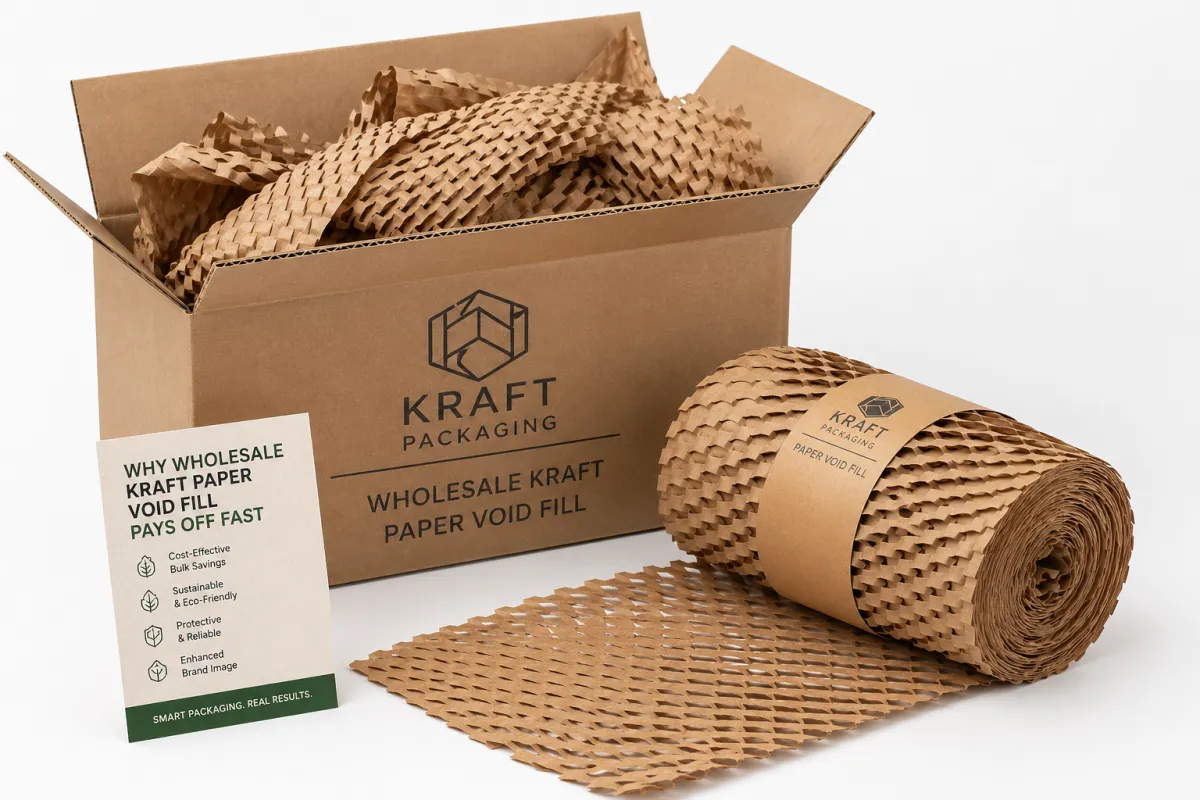
Wholesale kraft paper void fill is kraft paper supplied in rolls or converted formats for blocking, bracing, and filling unused space inside cartons. The paper is pulled, formed, and tucked by hand or through a dispenser, then compressed enough to hold the product in place without turning the box into a brick. In plain terms, it is paper dunnage that can cushion, stabilize, and keep the load from shifting around during transit.
The mechanical behavior matters more than the marketing label. Good kraft paper has enough fiber strength to resist tearing too early, enough body to hold shape after crumpling, and enough flexibility to fit odd-shaped gaps. If the paper is too soft, it collapses after the carton settles. If it is too stiff, operators fight it, and the line slows down. That balance is where wholesale kraft paper void fill earns its keep. And yes, the balance can be a little fussy; packing material kinda has to be.
That makes the product useful for a wide range of shipments: glassware, cosmetics, auto parts, books, hardware, supplements, and mixed-SKU orders that never seem to fit the same way twice. If a box has dead space, the paper can fill it. If a product needs a little bracing on the sides, the paper can do that too.
Common supply formats include:
- Roll format for high-frequency pack stations and tabletop dispensers.
- Converter format for quicker tear-off and easier handling.
- Single-ply paper for light loads and smaller voids.
- Multi-ply paper for larger cartons, heavier products, and tougher transit conditions.
Source quality matters. Recycled content is often a priority, but recycled paper is not automatically equal across suppliers. Fiber length, moisture behavior, and roll build all affect how the paper feeds and forms. Some sourcing teams also require FSC certified paper, especially when the buyer has a corporate sustainability policy or retail compliance requirement. That certification should be verified against the actual supplied material, not assumed because a catalog says so.
Sustainability claims are strongest when they stay specific. Wholesale kraft paper void fill is often chosen as a fiber-based alternative to plastic dunnage, and that comparison is fair. It can align with recycling programs more cleanly than mixed-material options and fits many biodegradable packaging goals. Still, most shipping teams care first about the day-to-day result: smoother packing, fewer claims, and less mess at the station. The EPA recycling resources are a useful reference for general guidance, though local acceptance rules still win in the real world.
Placement matters more than people expect. A dispenser positioned close to the packer's dominant hand can shave a few seconds off each carton. That sounds tiny until you repeat it 800 or 1,200 times in a shift. Then it becomes a labor story, a posture story, and sometimes a fatigue story.
Why Wholesale Kraft Paper Void Fill Pays Off Fast
Most carton failures start with the same enemy: empty air. Space inside the box lets products move, collide, and settle into the wrong position. The carton may look fine when it leaves the dock, but the load has already started shifting. Wholesale kraft paper void fill interrupts that process. It is not decorative, and it is not a filler in the casual sense. It is structural support in paper form.
Mixed-SKU fulfillment makes the case even stronger. One order needs a narrow wedge of fill. The next order needs a full cushion around a fragile item. The station cannot keep changing materials every time the box changes size. Wholesale kraft paper void fill adapts to those shifts without forcing the team to stock multiple dunnage types. That flexibility reduces corner crush, keeps products centered, and cuts the odds of a return tied to movement inside the carton.
There is also a labor angle that tends to get underestimated. A pack line is a timing machine, even if nobody likes to call it that. If the paper snags, tears badly, or needs too much shaping, the whole line slows down. A 2-second gain on 1,000 cartons is a little more than 33 minutes recovered. That is not a theory exercise; that is a half hour back in the shift. Over a month, the math gets hard to ignore.
The cost story is straightforward: fewer repacks, fewer claims, faster closeout, less waste. Buyers often compare void fill by looking at the price of a roll. That comparison is incomplete. The better question is how much protection the material delivers per packed carton. A stronger wholesale kraft paper void fill spec can use less material, hold the load more securely, and lower transit damage enough to pay for itself faster than a cheaper roll that performs poorly.
"If the box still shifts after you fill it, the problem is usually fit, not quantity. The carton, the void, and the paper need to work as one system."
Testing standards from ISTA help keep the conversation tied to transit behavior rather than optimism. A paper that looks fine on the bench can behave very differently after vibration, compression, and drop forces. Wholesale kraft paper void fill earns its place when it holds up in that more demanding environment.
There is a simpler reason teams keep using paper-based fill: people understand it fast. Training stays short. Disposal stays simple in most operations. The packer does not need a new skill set, just a material that does its job without fuss.
Wholesale Kraft Paper Void Fill Product Details
The best wholesale kraft paper void fill products are built for repeatable use, not showroom impressions. The paper needs enough tensile strength to pull cleanly, enough compressive resistance to stay in place, and enough bulk to create support without gobbling up material by the handful. That combination is what turns a humble roll into a useful packing tool.
In my experience, the most common mistake is choosing paper that feels good in the hand but performs poorly in the box. A roll can seem soft and premium, then collapse the moment a heavier item settles onto it. The opposite happens too: a paper can feel sturdy but be so stiff that operators use more of it than necessary because it does not shape well. Those are small failures, but they add up fast.
Wholesale kraft paper void fill is commonly used for three jobs:
- Blocking to stop the product from sliding end to end.
- Bracing to keep the item centered and reduce side-to-side motion.
- Filling to close off unused space so the carton behaves like a packed load, not a loose container.
Common supply formats include roll stock for pack stations, converted formats for easier handling, and multi-ply builds for heavier cartons. The choice depends on the pack profile, not on a theoretical ideal. A station shipping small books and cosmetics all day has different needs than a warehouse sending out cast parts and glass jars. Same material family, different job.
Buyers also look at the environmental side of the spec. Recycled content is common, but the percentage alone does not tell you how the roll will feed. Moisture exposure, core strength, and winding consistency matter just as much. If the paper is stored in a humid dock area or stacked directly on concrete, it can change behavior before it ever reaches the dispenser. Keep wholesale kraft paper void fill dry, clean, and off the floor. That is not a fancy recommendation, but it prevents a lot of nuisance problems.
On active pack lines, the paper should move in a predictable way from the roll to the carton. Dispenser compatibility matters here. Some operations need a simple tabletop pull system. Others need a feed path that keeps the roll aligned during fast packing. A nice-looking spec sheet means very little if the paper is awkward at the station where the work actually happens.
There is also a hidden ergonomics benefit when the material behaves well. If the packer can reach, pull, and shape the paper without twisting or overreaching, the station feels calmer. That matters on long shifts. Nobody brags about back strain, and nobody should have to.
Specifications That Matter Before You Order
The spec sheet is where a smart wholesale purchase begins. Wholesale kraft paper void fill is not a single universal product, and the wrong roll can slow the line or create waste that never shows up in the initial quote. Width is usually the first specification to review because it controls how quickly the paper fills the carton and how much maneuvering the operator needs to do.
Roll length, core size, basis weight, GSM, and ply count come next. Buyers sometimes want one clean number to solve the whole problem, but packing performance depends on the carton mix, product weight, and pace of the station. A 10-inch roll can work well for small, precise voids. A 12-inch, 15-inch, or 18-inch roll may be better for broader shipping programs. In higher-volume facilities, the wider paper can reduce the number of packing motions per box, which is a big deal over a full shift.
Basis weight and GSM usually tell you where the paper sits on the strength-versus-ease curve. Lighter grades are often fine for smaller voids and lower-risk shipments. Heavier grades tend to hold up better when cartons are large, products are heavier, or the route sees rough treatment. The paper needs enough strength to hold shape after crumpling, but not so much density that the operator has to wrestle it. That is why wholesale kraft paper void fill should be tested against the real product and the real line, not only read on a spec sheet.
Storage affects performance. Paper reacts to moisture. A roll staged in a damp corner, left near dock humidity, or stored directly on a concrete floor can change before it ever reaches the pack station. That leads to soft spots, feed problems, and inconsistent forming. The fix is plain: keep the rolls dry, clean, and elevated.
The table below gives a practical comparison of common options buyers often review when specifying wholesale kraft paper void fill.
| Option | Typical Use | Common Spec Range | Typical Wholesale Price Range | Best Fit |
|---|---|---|---|---|
| Light single-ply roll | Small voids, light products, short pack cycles | 10-12 in. width, 45-55 GSM | $18-$28 per roll | Low-risk cartons and smaller orders |
| Standard single-ply roll | Mixed-SKU fulfillment, general bracing | 12-15 in. width, 55-70 GSM | $24-$38 per roll | Most warehouse packing stations |
| Heavy multi-ply roll | Larger boxes, heavier goods, longer transit | 15-24 in. width, 70-90 GSM | $34-$58 per roll | Higher protection needs and faster fill volume |
Those figures are directional. Freight distance, order size, paper grade, and whether the order is stock or custom will all move the final number. Even so, comparing wholesale kraft paper void fill by width, weight, and construction gives buyers a much clearer picture than looking at roll price alone. A lower-priced roll that takes more material per carton can end up costing more in the end.
Dispenser compatibility deserves its own check. Some lines use tabletop dispensers with simple pull-and-tear action. Others need controlled feed so the roll stays aligned and the operator does not waste motion. The best spec is the one that fits the workflow already in place. If it looks elegant on paper but awkward on the floor, it is the wrong spec.
Wholesale Kraft Paper Void Fill Pricing and MOQ
Pricing for wholesale kraft paper void fill depends on more than the paper itself. Grade, dimensions, order quantity, freight distance, and whether the spec is stock or made to order all shape the quote. To make comparisons fair, ask suppliers to quote the same width, the same basis weight, the same roll length, and the same pallet count. If those details drift, the numbers can look close while the value is not.
MOQ is part of the wholesale logic. Pallet-level orders are common because they fit production planning and freight planning more cleanly. For repeat buyers, larger commitments often improve unit pricing and give the operation a steadier replenishment rhythm. If the material is being used every day, a planned reorder cycle usually beats a one-off purchase.
Cost per packed carton is the better metric. That is where the real comparison lives. A cheaper roll may require more pulls, more paper, or more time to stabilize the load. A slightly heavier wholesale kraft paper void fill can still lower total cost if it packs faster and protects better. On a busy line, labor time is often the hidden expense that skews the whole calculation.
Here is a practical way to read quotes:
- Verify the roll specs first. Width, length, core, and GSM should match the same baseline.
- Separate freight from unit cost. A low price can vanish once shipping is added.
- Estimate usage per carton. Find out how many cartons one roll will realistically fill.
- Track damage reduction. Lower claim rates often matter more than a small discount.
- Review replenishment rhythm. Regular wholesale kraft paper void fill orders can steady inventory and cash flow.
Stock and custom orders behave differently. Stock wholesale kraft paper void fill is usually faster to source and easier to budget. Custom builds help when a specific width or roll length is needed for a packing setup that does not fit standard dimensions. If a supplier can hold your spec in a replenishment program, that adds another layer of stability. It is one reason many buyers review Wholesale Programs early rather than treating them as a final step.
The costliest mistake is buying paper that looks close enough but does not fit the actual pack pattern. If the team has to use too much of it to make up for poor fit, the savings disappear. A sound wholesale kraft paper void fill choice should reduce cost through better pack speed, fewer reworks, and fewer transit problems, not only by trimming pennies from the quoted roll price.
Process and Timeline for Wholesale Orders
Wholesale ordering works best when the supplier gets useful information from the start. If the request is only "we need paper," the quote will be broad and the result may miss the mark. A better starting point includes carton dimensions, weekly or daily volume, the damage issues you are seeing, the pack method, and the delivery cadence you want. That gives the supplier enough context to recommend a wholesale kraft paper void fill spec that fits the operation instead of guessing at one.
The sequence often looks like this:
- Discovery: review the carton mix, product weight, and void patterns.
- Sample review: test one or two widths or weights on the live pack line.
- Approval: confirm the final spec, reel build, and pallet count.
- Production or reservation: schedule stock pull or make-to-order manufacturing.
- Freight planning: set delivery timing around inbound space and consumption rate.
The sequence looks simple on paper and still saves time later. Spec changes after an order starts are where delays begin. Wholesale kraft paper void fill is easy to test and easy to reject when it is wrong, which means the fastest orders are usually the ones where the buyer supplies solid information up front. One or two sample rolls are often enough to confirm feed behavior, tear resistance, and the amount of paper needed per carton.
Lead time depends on format. Standard stock wholesale kraft paper void fill can often ship in a few days, while custom widths, special roll diameters, or private-labeled builds usually take longer. A reasonable planning range for standard orders is 3-7 business days to ship, depending on inventory and freight zone. Custom orders often fall closer to 10-15 business days after proof approval or final spec sign-off. Those are planning ranges, not guarantees, and seasonal demand can push them around.
Forecasting matters more than many buyers realize. When a packing team runs out and has to rush an order, freight cost often eats the savings. A better pattern is to monitor weekly usage, set a reorder point based on actual carton count, and keep a reserve for spikes. Wholesale kraft paper void fill works best as part of a supply plan, not as an emergency patch.
Packaging standards belong in the conversation too. Buyers who validate shipping performance should understand how the paper fits into drop, vibration, and compression testing. The void fill should support the pack-out, not work against it. A supplier with packaging experience can help prevent the common mistake of over-specifying material because it feels safer rather than because it performs better.
Teams that want to standardize purchasing across several packaging items often bundle paper, tape, and other shipper supplies under one replenishment model. That is where a well-organized Wholesale Programs page or ordering path becomes useful, because it keeps repeat purchases aligned and reduces the chance of mismatched spec changes from one order to the next.
What to Expect From a Reliable Supply Partner
Catalog language is cheap. Performance is not. That is the lens worth using for wholesale kraft paper void fill. The goal is not to buy the prettiest roll on a spec sheet. The goal is to get a material that feeds cleanly, forms predictably, and protects the product without creating extra work for the packing team.
Consistency matters just as much as grade. A roll that changes from shipment to shipment creates its own set of problems. Feed tension shifts. Dispensing changes. Usage becomes harder to forecast. For teams that depend on repeatable output, stable spec control is not a minor detail. It is part of labor planning.
Sustainability should stay practical. Fiber-based void fill fits well into programs built around recycled materials, post-consumer content, and cleaner material handling. Some buyers need FSC certified supply because of policy requirements, and that can be addressed during sourcing. Others want to move away from plastic dunnage and simplify disposal. Either way, the material has to earn its place by performing on the line and in transit.
That is why wholesale kraft paper void fill should be treated as part of a packaging system, not as a roll in isolation. Carton size, product weight, dispenser style, and the shipping lane all affect the recommendation. A paper that works in one facility may be too heavy in another. A lighter roll that seems cheaper can still create higher costs if it slows packing or fails to protect the product. Honest guidance matters because no two pack patterns behave exactly alike.
If you are comparing material options, the strongest questions are usually the plainest ones:
- How much void is in the average carton?
- How fast does the line need to pack?
- Do we need a heavier grade for longer transit or mixed handling?
- Is the material being staged in a dry, clean area?
- What is the expected reorder rhythm for wholesale kraft paper void fill?
Those answers tell you more than a polished brochure. They also help align the order with the way the operation actually runs, which is where better decisions usually happen. A buyer who knows carton profiles and shipping profiles can make a sharper wholesale kraft paper void fill purchase than one who is simply chasing the lowest quoted roll.
For teams that want a repeatable path forward, a reliable supply partner should be able to show sample consistency, explain what the roll will do under compression, and be honest about where the paper is not the right fit. That last part matters. Trust gets built when someone says, "This grade will be fine for your lighter cartons, but I would not use it for the heavier route lanes." Straight talk beats polished sales language every time.
Next Steps to Order the Right Wholesale Kraft Paper Void Fill
The fastest way to choose wholesale kraft paper void fill is to start with a carton audit. Look at the box sizes you ship most often, identify where the biggest empty spaces appear, and note which products still move after standard packing. That review usually shows whether the issue is width, weight, dispenser type, or simply not enough material in the right places.
Request samples in the exact width and weight range you expect to buy. Test them on the live pack line, not on a desk. Watch how quickly the operator can fill a box, how much paper is needed to stabilize it, and whether the roll behaves consistently from start to finish. Wholesale kraft paper void fill should make the line easier to run. If it adds extra steps, the spec is off.
It also helps to set a reorder point based on real usage. If one roll fills 40 cartons at the current pack pattern, and the line ships 400 cartons a week, the math is easy. Build in a cushion for higher-volume days, and confirm that your preferred wholesale kraft paper void fill spec is available in a steady replenishment program. That one step can prevent rush freight charges and line slowdowns.
If the team is already looking at broader packaging consolidation, this is a good time to review other shipper supplies too. Paper, tape, labels, and carton sizes all affect one another. A better void fill spec can reduce the need for oversized cartons, which can lower freight density without changing the product. The paper decision can influence more than one line item on the shipping budget.
For buyers who want a repeatable path forward, the right wholesale kraft paper void fill order is the one that matches the carton mix, the packer's workflow, and the freight environment. That combination gives the best chance of lower damage, better pack speed, and less waste across the board. Get those three pieces aligned, and wholesale kraft paper void fill stops behaving like a commodity buy and starts acting like an operating advantage.
FAQ
What width should I choose for wholesale kraft paper void fill?
Match the width to your most common carton sizes and the amount of empty space you usually need to fill. Wider rolls move faster in larger boxes, while narrower widths give better control for smaller cartons and lighter products. If your box mix varies a lot, test two widths on the same packing line before you lock in a wholesale kraft paper void fill spec.
What basis weight works best for wholesale kraft paper void fill?
Lighter grades are usually enough for small voids and low-risk shipments. Heavier grades are a better fit when cartons are larger, products are heavier, or transit conditions are rougher. The most reliable way to choose is to compare sample rolls against your actual product movement and pack speed, then confirm which wholesale kraft paper void fill option keeps the carton stable with the least waste.
Is wholesale kraft paper void fill recyclable?
It is typically recyclable where clean paper is accepted by local programs. Keep it free from tape, labels, food residue, and plastic contamination so it stays eligible for recycling. Always confirm with your local recycler or waste provider because accepted materials can vary by region, even when the paper itself is a good candidate for recycling.
What is the typical MOQ for wholesale kraft paper void fill?
MOQ depends on the roll size, whether the order is stock or custom, and the supplier's production setup. Pallet-level orders are common for wholesale buyers who need repeat replenishment, and larger commitments often improve pricing and freight efficiency. If you are planning regular use, a standing wholesale kraft paper void fill schedule usually works better than buying one pallet at a time.
How long does wholesale kraft paper void fill take to ship?
Standard stock formats can usually move faster than custom widths or special roll builds. Lead time depends on order volume, production schedule, and how far the freight has to travel. A forecasted reorder plan helps reduce rush orders and keeps supply steady for active packing operations, which is especially helpful if wholesale kraft paper void fill is used across multiple pack stations.
Wholesale kraft paper void fill works best when it is chosen with the carton, the pack line, and the shipping lane in mind. That is the practical route to better protection, smoother packing, and fewer surprises after the box leaves the dock.
The actionable takeaway is simple: audit your top cartons, request two sample widths, run them through the live line for a small batch, and choose the spec that protects the product with the least paper and the least operator fuss. That is the version that actually holds up once the shipping clock starts ticking.