Buyer Fit Snapshot
| Best fit | Sustainable Void Fill for Shipping projects where brand print, material claims, artwork control, MOQ, and repeat-order consistency need to be specified before quoting. |
|---|---|
| Quote inputs | Share finished size, material target, print colors, finish, packing count, annual reorder estimate, ship-to region, and any compliance wording. |
| Proofing check | Approve dieline scale, logo placement, barcode or warning zones, color tolerance, closure strength, and carton packing before bulk production. |
| Main risk | Vague material claims, crowded artwork, missing packing details, or unclear freight terms can make a low unit price expensive after revisions. |
Fast answer: Sustainable Void Fill for Shipping: Quote Scope, Sample Proof, MOQ, and Lead Time should be specified like a repeatable production item. The safest quote records material, print method, finish, artwork proof, packing count, and reorder notes in one written spec.
Production checks before approval
Compare the actual filled-product size with the drawing, then confirm tolerance on folds, seals, hang holes, label areas, and retail display edges. Reserve space for logos, QR codes, warning copy, and material claims before decorative graphics fill the panel.
Quote comparison points
Review material grade, print process, finish, sampling route, tooling charges, carton quantity, and freight assumptions side by side. A quote is only useful when the supplier can repeat the same color, closure quality, and packing count on the next order.
How to Choose Sustainable Void Fill for Smarter Shipping
The first time I had to explain how to choose Sustainable Void Fill to a room full of operators in Columbus, Ohio, I started with a sentence nobody in the room forgot: the filler that looks best in a sustainability deck is often the one that causes the most friction on the packing line. One manager nodded so hard I thought he might tip out of his chair. We had just watched a paper-based option win praise for 100 percent recycled content, then drive a 3.4 percent damage rate on 12 oz glass jars shipped across a 640-mile lane to Charlotte, North Carolina. Returns rose. Replacements rose. So did customer complaints, which is usually the moment people stop admiring the brochure and start looking at the numbers.
That is the real issue. Void fill is not decorative packing fluff. It is part of the shipping system, and how to choose sustainable void fill means weighing protection, labor, waste, freight, and disposal together. The most responsible choice is rarely the loudest claim. It is the option that protects the product, fits the workflow, and avoids hidden costs that show up later in the quarter, usually on a Tuesday when finance sees a $9,600 jump in refunds. Honestly, a lot of packaging decisions are made by people who have never watched a carton travel from a pick line in Reno, Nevada, to a porch in Newark, New Jersey. That is where the weird truths live.
Sustainable does not mean one thing, and that confusion causes expensive mistakes. Recycled content is not the same as recyclability, compostable is not the same as reusable, and a filler can sound thoughtful while still being a poor fit if it slows packers from 48 orders per hour to 31. If you want to understand how to choose sustainable void fill, the full system deserves scrutiny, not just the label on the spec sheet. I learned that the hard way years ago in a warehouse outside Louisville, Kentucky, staring at a pallet of material that looked virtuous and behaved like a tiny logistical prank.
How to Choose Sustainable Void Fill: What It Really Means
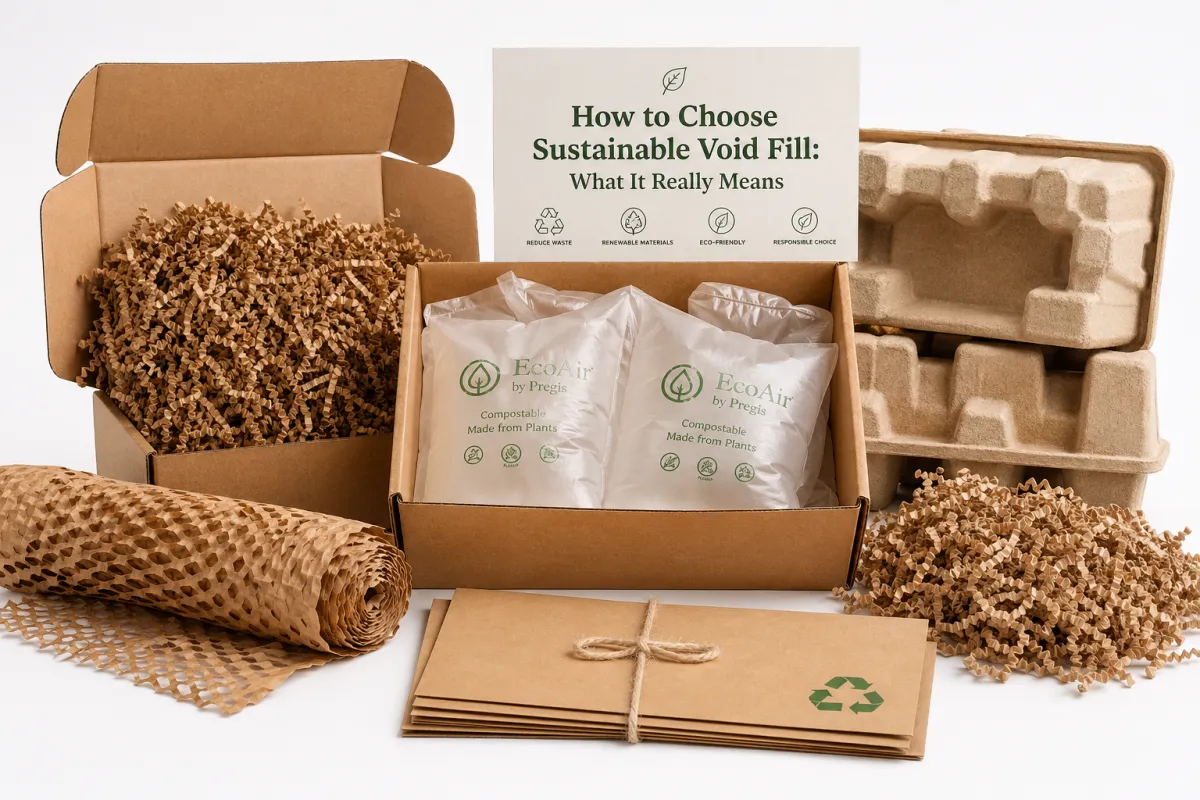
I tend to start with the part most teams skip. Sustainable void fill is not the filler that photographs well beside a plant pot and a kraft box. It is the filler that protects the product while using fewer total resources and creating less operational waste, whether that means recycled paper dunnage from a converter in Monterrey or molded fiber inserts from a plant in Grand Rapids, Michigan. That definition comes from years of standing on factory floors where line speed, damage rates, and customer behavior collide in the same hour. You can smell the difference too - coffee, cardboard dust, and forklift exhaust from a 40,000-square-foot distribution center.
At a corrugated plant outside Atlanta, Georgia, I watched a team replace loose-fill peanuts with paper wadding because the story sounded greener. On paper, the switch looked tidy. In practice, the new material required 18 percent more hand movement, the packs varied from operator to operator, and the carton flaps stopped closing with the same reliability on a 2 a.m. shift. Damage claims improved on one SKU and got worse on two others, including a 16 oz candle shipped 480 miles to Nashville, Tennessee. That sort of result explains why how to choose sustainable void fill starts with function, not optics. I still remember one operator muttering, "Great, now the box looks better while it breaks worse," after we measured a 7-second delay per order.
Four labels get treated as if they mean the same thing, and they do not:
- Recycled content: the material includes recovered fiber or resin, which can reduce virgin resource use, such as 60 percent post-consumer paper in a sheet made in Richmond, Virginia.
- Recyclable: the material can enter a recycling stream, but only where collection and sorting systems accept it, which varies between Seattle, Washington, and rural counties with fewer than 25,000 residents.
- Compostable: the material is intended to break down under defined composting conditions, often 55 C to 60 C industrial composting, which is not widely available in most ZIP codes.
- Reusable: the material can be used more than once, which works best when the reverse flow actually functions across a 3 to 5 day return cycle.
A packaging manager in Phoenix, Arizona, once told me, "We bought the most recyclable filler available." Then she laughed, because her customer base was spread across 37 states and many of those customers had no practical way to recycle it. The claim was technically accurate. The outcome was not. How to choose sustainable void fill becomes far clearer once the question shifts from, "What is this made of?" to, "What happens after the box is opened?" That second question tends to be the one nobody wants to answer at first, which is usually a sign it matters, especially when the return address is in Omaha, Nebraska, and the package lands two time zones away.
Void fill works like insurance for empty space. The cheapest policy often becomes the most expensive one if it fails in transit. A carton with visible gaps lets the product move, and movement is where damage starts. That is true whether the shipment contains 8 oz candles, 30 ml skincare bottles, wireless chargers, or premium apparel boxes with rigid presentation sleeves. I have seen a beautiful unboxing moment ruined by one sloppy cavity. It is amazing how a $0.20 material choice can create a $20 headache, especially when the average replacement includes a $7.50 outbound label and a $4.90 customer-service cost.
"We thought we were buying paper. We were really buying fewer complaints, faster packout, and a better unboxing story - and the paper only worked because it fit all three on a 52-box test in Dayton, Ohio."
That line came from a client who finally understood that how to choose sustainable void fill is a decision about tradeoffs, not a search for a perfect material. The best option is the one that survives the real world, not the one that wins a label test in isolation. I wish packaging worked like a brochure. It does not. It works like a treadmill set to "surprise," usually after a 6:15 a.m. inbound truck drops 1,200 units at dock door 7.
How Sustainable Void Fill Works in Real Shipping Operations
Step out of theory and the picture gets sharper. Sustainable void fill has to do four jobs at once: cushion, immobilize, absorb shock, and resist crush. If it does only one of those well, the rest of the burden usually shows up somewhere else. I have seen a recycled air pillow system protect lightweight apparel boxes beautifully, then fail inside a cosmetic kit because the inserts shifted under vibration on a 700-mile ground route from Chicago, Illinois, to Raleigh, North Carolina. The box arrived fine until it did not, which is a deeply unhelpful state of affairs when the claims rate jumps from 0.8 percent to 2.1 percent in one month.
That is why how to choose sustainable void fill cannot happen in a vacuum. Product weight matters. Box size matters. Transit distance matters. Carrier handling matters. A 2-pound order moving across a metro area in San Diego, California, is a different animal from a 14-pound mixed-SKU shipment crossing two hubs and sitting on a porch through a rainy weekend in Baltimore, Maryland. I have watched the same filler look brilliant in one lane and absurd in another. Shipping has a way of humbling everyone involved, especially when a parcel spends 27 hours in a trailer at 92 F.
The main categories each have a lane:
- Paper void fill: fast to deploy, familiar to packers, and often easy for customers to recycle if local rules allow it, especially when supplied in 12-inch by 700-foot rolls.
- Molded fiber: strong for shaped support and premium presentation, though it may require tooling or a higher up-front commitment, often from a plant in North Carolina or Tennessee.
- Recycled air pillows: light, storage-efficient, and useful for larger voids when the product is not especially fragile, with inflation speeds of 25 to 40 pillows per minute.
- Starch-based loose fill: useful for light cushioning, though it can create static, dust, and cleanup issues in some environments, especially in dry climates like Denver, Colorado.
- Reusable inserts: effective in closed-loop or controlled distribution systems, especially when boxes come back or are used repeatedly through a 10 to 12 cycle reuse plan.
At a fulfillment center in Columbus, Ohio, I watched a supervisor measure pick-pack speed before and after switching from crumpled paper to pre-perforated paper sheets. The packers saved 11 seconds per order on average, which sounds minor until you multiply it by 4,800 parcels a day and 5 shifts a week. Small frictions do not stay small for long. That is one of the least glamorous truths behind how to choose sustainable void fill. The warehouse does not care about our intentions. It cares about what slows the line and what keeps the box intact at 3 p.m. on a Friday.
The workflow side matters just as much as the material side. If a filler arrives in awkward bundles, sheds dust, tangles in dispensing hardware, or forces operators to overuse it "just to be safe," the environmental benefit shrinks. A recycled material can still produce more waste if the pack station keeps overfilling cartons by 20 percent or adds a second layer to every 14-inch shipper. I have seen people do exactly that because nobody gave them a clear fill target. Humans are very inventive, especially when they are nervous and under a stopwatch from a supervisor with a clipboard. That is one more reason how to choose sustainable void fill should include the pack line, not just the purchase order.
For testing discipline, the packaging industry has standards for a reason. The ISTA test methods are useful because they move you beyond instinct and into controlled evaluation. I also like the EPA's recycling guidance at epa.gov/recycle, especially when you need to check whether the disposal story matches local reality instead of marketing copy. I have had more than one "eco-friendly" promise collapse the moment someone checked an actual municipal guideline in Portland, Oregon, or confirmed whether a city accepts paper film liners at all.
Put differently, how to choose sustainable void fill is a systems decision. Material, machine, people, product, and parcel network all shape the result. Ignore one of those pieces and the whole setup starts acting like it has a grudge, usually right after a 900-unit promotion launches on a Monday morning.
How to Choose Sustainable Void Fill Based on Product Risk
The product should lead the decision, not the filler. Fragility, shape, and resale value tell you more about how to choose sustainable void fill than any brochure ever will. A boxed T-shirt in a 13-inch mailer needs a different protective profile than a frosted glass serum bottle in a 9-inch rigid carton. A premium candle does not fail the same way as a phone charger with a lithium battery. I know that sounds obvious, but I have sat in enough meetings in Minneapolis, Minnesota, to learn that obvious ideas often need a seatbelt and a flashbulb.
I once helped a beauty client compare two shipping setups for a 4 oz glass jar with a metal lid. One system used recycled paper void fill in a standard mailer. The other used molded fiber corners with a small paper collar. The second option cost about $0.07 more per order on a 10,000-unit monthly run, yet it cut visible scuffing and lid loosening enough to reduce returns by 22 percent over eight weeks. That is the sort of math that changes procurement meetings. It also changes how people talk about "expensive" materials, usually with less confidence and more calculator tapping.
When I map risk, I start with one question: what fails first in transit? The answer is usually corner impact, vibration, shifting, compression, or puncture. That answer tells you more about how to choose sustainable void fill than the word "fragile" ever will. "Fragile" is a label. Failure mode is a plan. A fragile ceramic mug in a 14 by 10 by 6 carton from Tampa, Florida, needs different support than a 1-pound set of earbuds shipping from Austin, Texas.
For example:
- Glass and ceramics: need immobilization first, then cushioning, then crush resistance, often with 2 to 4 mm of controlled movement in the carton.
- Cosmetics and personal care: need clean presentation, leak control, and stable positioning, especially for 30 ml and 50 ml containers.
- Electronics: need shock absorption and movement control, with attention to static and component protection at 40 percent to 55 percent relative humidity.
- Apparel and accessories: often need box fill for presentation more than hard cushioning, particularly in 1.5 lb parcels.
- Luxury gifts: need both protection and a structured unboxing feel, which changes the filler choice and the insert geometry.
Brand expectations sit right next to product risk. If your customer opens the box on camera, a crumbled filler or dusty loose fill can undermine the experience even if the product arrives intact. I have seen teams accept a slightly higher material cost because they wanted a cleaner opening moment and less cleanup for the end customer. That is not vanity. It is brand math. People remember how a package feels in their hands, and they remember the little irritations too, especially when the gift is headed to a rooftop apartment in Brooklyn, New York, and the recipient is filming the opening on an iPhone 15.
Box geometry matters too. A large empty cavity with a heavy item in the middle is not the same as a snug carton with only 10 to 15 mm of movement. In the first case, how to choose sustainable void fill may point toward structured inserts or layered paper dunnage. In the second, a lighter recycled air pillow solution may be enough. The box is not just a container; it is part of the engineering problem, especially when a 200 gsm mailer has to protect a 2.2 lb item shipped 1,100 miles from Phoenix, Arizona, to Minneapolis, Minnesota.
| Product Risk | Void Fill Approach | Why It Often Works | Watchouts |
|---|---|---|---|
| Low-risk apparel | Paper or recycled air pillows | Fast packout and low material weight | Overfilling can erase savings on a 50,000-unit month |
| Mid-risk beauty | Molded fiber or layered paper | Better immobilization and premium look | May need format-specific training and a 2-week pilot |
| High-risk glass | Structured inserts plus targeted void fill | Controls shifting and absorbs shock | Higher up-front cost, but fewer claims on 500-mile lanes |
| Controlled reuse | Reusable inserts | Best fit for closed-loop distribution | Reverse logistics must be reliable across 3 to 10 returns |
That table is the operational version of how to choose sustainable void fill: start with the risk, then match the material to the failure mode. Not the other way around. If you reverse that logic, you end up shopping for virtue instead of performance, which is how people end up buying a nice-looking insert that fails after one week in a 78 F warehouse in Dallas, Texas.
Sustainable Void Fill Cost: Pricing, Waste, and ROI
People ask for the cheapest option for a reason. Packaging spend lands on the P&L, and nobody enjoys a surprise there. The lowest unit price, though, is not always the cheapest total choice. How to choose sustainable void fill properly means tracking landed cost, not just the invoice line, especially when freight, labor, and breakage are coming from three different departments. I have watched plenty of "cheap" buys become expensive after a 7 percent return rate and a 13-minute service call got their say.
In one supplier negotiation I sat through last spring in St. Louis, Missouri, a paper-based void fill quote came in at $0.21 per cubic foot while a molded fiber option looked expensive at first glance. Once labor savings, reduced box size, and lower breakage were added in, the molded fiber solution landed much closer to parity than anyone expected. That pattern shows up often. The material that looks expensive on paper can win once the hidden costs are pulled into view. Procurement usually notices this about five minutes before finance does, which is a fun little tradition. It is also why how to choose sustainable void fill should begin with total cost, not sticker price.
Here are the big cost drivers I watch:
- Raw material source: recycled content, virgin fiber, starch, or recovered plastic all price differently, sometimes by 18 percent to 30 percent across regions.
- Conversion method: sheeted, die-cut, molded, inflated, or loose-fill formats have different labor and machinery costs, including maintenance on a $4,000 dispenser.
- Freight weight and cube: a light filler that ships in compact rolls can save more than a cheaper bulky material on a 1,200-mile lane.
- Minimum order quantity: smaller businesses may pay more if they cannot absorb larger runs of 5,000 or 10,000 units.
- Storage footprint: some fillers occupy very little space; others consume rack space fast, which matters when a pallet costs $18 per month to store.
- Damage exposure: every avoidable return or replacement changes the economics, especially when each return costs $12.40 to process.
Waste shows up in three directions. Internal waste includes over-dispensing, offcuts, and damaged inventory. Freight waste includes oversized cartons and avoidable dimensional weight. Customer waste includes confusing disposal that leaves the product in the trash because the buyer does not know what to do with it. I have watched brands celebrate a recyclable filler, then learn that customers in apartment buildings in Queens, New York, were not recycling it anyway because the bins were full or the sorting rules were unclear. The planet, frustratingly, does not give bonus points for good intentions.
If you want a working benchmark, recycled paper-based systems have shown quotes from roughly $0.18 to $0.42 per packed-box equivalent depending on format, volume, and dispenser setup. Molded fiber often starts higher, but it can earn its keep through speed and lower breakage. Recycled air pillows can look inexpensive until film compatibility and replacement frequency enter the calculation. The point is not that one number wins. The point is that how to choose sustainable void fill means measuring the whole order, not the roll on the receiving dock.
The comparison below is the kind I build before a rollout. Prices are directional because region, MOQ, and freight move them around, but the structure matters more than the exact cent figure. A supplier in Charlotte, North Carolina, may quote differently than one in Tijuana, Mexico, and that spread can be 12 percent on the same spec.
| Material | Typical Starting Cost | Best Fit | Strengths | Watchouts |
|---|---|---|---|---|
| Paper void fill | $0.18-$0.42 per packed box equivalent | General ecommerce, medium-risk goods | Familiar, recyclable in many streams, easy to explain | Can be overused; pack speed depends on dispenser quality |
| Molded fiber | $0.28-$0.65 per unit or insert set | Beauty, premium goods, shaped support | Strong presentation and stability | Tooling or higher setup time may be required |
| Recycled air pillows | $0.15-$0.35 per packed box equivalent | Lightweight items with larger voids | Low storage cube, fast fill, light freight | Puncture risk and disposal perception can be issues |
| Starch-based loose fill | $0.12-$0.30 per cubic foot | Low-weight cushioning and temporary fills | Low cost, easy to dispense in some setups | Mess, static, and customer cleanup concerns |
| Reusable inserts | $0.10-$0.30 per cycle after upfront investment | Closed-loop or repeat-shipping programs | Excellent waste reduction over time | Needs reverse logistics and standardization |
That table only works if the afterlife of the material is taken seriously. A "cheap" filler that causes a 1 percent uptick in breakage can cost more than a cleaner option with a stronger fit. That is why how to choose sustainable void fill should always include a damage-rate review, not just a procurement review. I have yet to meet a CFO thrilled by surprise returns, especially not when the loss comes in at $27,000 per quarter.
How do you choose sustainable void fill in a live test?
I have never seen a serious packaging change succeed without a controlled test. A six-month lab program is not necessary for every filler swap, but guesswork is a bad substitute for data. The cleanest path for how to choose sustainable void fill is a short, structured pilot using real orders, ideally 100 to 300 parcels from a live line in Jacksonville, Florida, or another fulfillment site with standard carrier handoffs. I trust live cartons more than a slide deck every single time.
Here is the timeline I recommend for most teams:
- Week 1: Audit current damage, pack time, and material use on your top 10 SKUs, including average carton dimensions and outbound zones.
- Week 1-2: Shortlist two or three void fill options and request samples plus documentation, including recycled-content percentages and any ASTM or ISTA references.
- Week 2: Run bench tests with actual product weights, not dummy blocks, and record any movement greater than 5 mm.
- Week 3: Pack live orders on one shift and measure speed, rework, and customer feedback across at least 150 shipments.
- Week 4: Review results, update training notes, and decide whether to roll out or revise, then set a 30-day check-in for claim trends.
At a client site in Dallas, Texas, we ran a side-by-side test with 300 orders split between recycled paper and molded fiber. The lab numbers were close, but the live packout told a different story. One material looked better under drop tests from 30 inches, yet the other won because it shaved 9 seconds per order and reduced mispacks by 17 percent. That is why how to choose sustainable void fill needs real pack-station behavior, not only spec sheets. The warehouse is a brutally honest place, which I actually appreciate.
Your test checklist should include:
- Fill volume: how much material is actually used per shipper, tracked in cubic feet or grams.
- Speed per order: how long the packer needs to secure the product, ideally timed over 50 units.
- Drop and vibration performance: ideally aligned with ISTA-style methods, including corner and edge drops.
- Carton integrity: whether the box still closes and stacks properly on a 48 by 40 pallet.
- Customer reaction: what buyers say about opening, cleanup, and disposal in post-purchase surveys.
- Training impact: whether new hires can use it consistently after a 15-minute demo.
If you want a formal framework, pair your pilot with a standard such as ASTM D4169 or an ISTA procedure. Standards do not make the decision for you, but they keep everyone honest. They are especially useful when a supplier promises that how to choose sustainable void fill should be simple without showing any data. Simplicity is lovely; wishful thinking is not, and neither is a claim that skips the 25-inch drop test.
Training is often the hidden variable. I have seen a strong material fail because packers were not shown how much to use, where to place it, or what good fill looks like in a finished carton. Plan for a short SOP, a 15-minute floor demo, and a fallback inventory plan in case the first option misses the mark. A good rollout often needs 2 to 4 weeks, and complex operations in three shifts or two facilities may need 6 weeks.
Sample packs and supplier coordination also take time. In my experience, a vendor can send trial units in 3 to 5 business days from a warehouse in Indianapolis, Indiana, but a full material change with updated inventory controls often takes 10 to 15 business days after approval, and longer if tooling or custom dispenser parts are involved. That is normal. Good packaging work is rarely instant, and how to choose sustainable void fill well means giving the process enough room to work. Rushing usually costs more later, which is a little insult the budget never sees coming.
"The test that mattered was not the prettiest one. It was the one that matched our pack line on Tuesday morning in Newark, New Jersey, when the orders were stacked to the ceiling and the scanner battery was already at 12 percent."
Common Mistakes When Choosing Sustainable Void Fill
The most expensive mistakes are usually the simplest. The first is selecting a filler on marketing language alone. I have seen "eco" claims send teams in the wrong direction because the material had weak cushioning, poor local recycling support, or batch-to-batch inconsistency from one run in Louisville, Kentucky, to the next. How to choose sustainable void fill is not about trusting the label; it is about verifying the behavior. Labels are fine. Boxes that arrive intact are better, especially when the carton travels 850 miles and lands at 6 p.m. on a Friday.
The second mistake is overpacking. It happens constantly. Packers err on the safe side, supervisors want low damage, and suddenly the carton is stuffed with 40 percent more filler than the product actually needs. That extra material increases freight, raises waste, and can make the customer experience worse because the box becomes harder to open and dispose of. I have watched customers tear at a box like it owed them money, usually with kitchen scissors in hand and a 22-inch mailer on the counter.
The third mistake is ignoring workflow. A filler can be environmentally better and still fail operationally if it tangles, sheds, or slows the line. I remember a supplier conversation in San Jose, California, where the pitch kept circling recycled content while the operators kept pointing at the dispenser jam. The conversation changed only when we put a stopwatch on the line and saw the time rise from 41 seconds to 58 seconds per pack. Numbers ended the argument. They usually do, eventually.
The fourth mistake is forgetting the end user. A material that is technically recyclable but practically inconvenient may still end up in landfill. If customers need to separate a liner, rinse residue, or sort by material type, many will not bother. That is not laziness. It is friction, and packaging disposal has to fit real behavior. Many teams accidentally outsource the hard part to the buyer, who may be opening the box in a Chicago apartment at 9 p.m. with no recycling bin in sight.
Here are the red flags I look for:
- Claims with no recycled-content percentage or certification support, such as a vague "made with recycled material" line and no number.
- Materials that require a special disposal path few customers can access, especially outside major cities like Seattle or Boston.
- Fillers that improve sustainability metrics but worsen damage rates above 1.5 percent.
- Options that demand major pack-station retraining for little benefit, such as a 3-day course to save 2 cents per order.
- Products that look good in samples but fail once the line hits volume, often after 500 units or more.
Another mistake hides in plain sight: branding misalignment. Some companies want the unboxing to feel rustic or handcrafted, but the filler ends up looking cheap, dusty, or inconsistent. I have seen premium brands lose trust over a crumpled interior that made the package feel secondhand. For branded packaging, the interior has to support both performance and presentation, because the box is part of the story the customer remembers. If the inside looks tired, the whole package feels tired. It really is that simple, and that annoying, particularly when the outer carton uses a crisp 18 pt SBS print while the interior looks like warehouse scrap.
One practical way to avoid these mistakes is to write down decision rules before calling any supplier. If you define what matters - damage rate, pack speed, disposal ease, box size, and brand fit - you are less likely to be swayed by a polished sample or a persuasive pitch deck. That is the discipline behind how to choose sustainable void fill. I would rather have a boring scorecard than a glamorous mistake, especially if the scorecard keeps a 2.8 percent claim rate from becoming a 4.1 percent claim rate.
Expert Tips and Next Steps for Sustainable Void Fill
If you want the fastest gain, start with your highest-volume SKU or your highest-damage SKU, not your easiest one. That is where how to choose sustainable void fill produces visible results. The biggest return usually comes from the biggest shipping lane, and the data tends to be cleaner there too. I love easy wins as much as the next person, but easy is not where the money usually hides, especially if your top SKU ships 8,000 units a month from a hub in Memphis, Tennessee.
Ask suppliers for documentation before you place a meaningful order. I want to see recycled-content percentages, certification details, disposal guidance, and a clear explanation of the recommended use case. If the vendor cannot say where the material performs best, that tells you something. If they can, better still. Honest vendors are usually specific. The vague ones tend to talk in circles until somebody asks about breakage, and then the room gets very quiet, especially when the quote includes a 12-week lead time from a plant in Shenzhen, China, or a 6-week lead time from Michigan.
Build a simple scorecard. Mine usually has five columns: protection, cost, labor speed, waste handling, and brand fit. I score each option from 1 to 5, then compare totals after a live test. It is not fancy. It works because it forces the team to discuss tradeoffs instead of chasing one metric and ignoring the rest. And yes, somebody always tries to fight about the weighting, usually over whether labor speed should count for 20 percent or 30 percent. That part is practically tradition.
If your operation ships across multiple channels, split the logic by channel. Ecommerce, retail replenishment, and wholesale often need different void fill choices. A filler that works beautifully for DTC might be wrong for pallet-to-store cartons leaving a distribution center in Reno, Nevada. That nuance matters more than most procurement decks admit. One-size-fits-all packaging usually means "fits no one especially well," particularly when a single carton has to survive both parcel carriers and a cross-dock transfer.
When I visited a packaging supplier in Shenzhen, Guangdong, the plant manager told me they had stopped selling one filler to a brand client because the carton size and product weight were wrong for the material. That is good practice. A supplier who says "yes" to everything is not always helping you. The best partner knows that how to choose sustainable void fill includes knowing when not to use a product. I respect that kind of restraint. It saves everybody a future apology and a freight claim that costs $160 to file.
So, what should you do next?
- Audit one month of damage data on your top SKUs, including units shipped, claims, and average carton size.
- Test two filler options side by side on real orders, ideally 100 per option from the same fulfillment site.
- Measure pack time, not just product arrival quality, using a stopwatch with 1-second increments.
- Check disposal instructions against actual customer behavior in at least two regions, such as California and Texas.
- Write a one-page rollout standard that explains how to choose sustainable void fill in plain language for packers and supervisors.
If you do those five things, you will already be ahead of most teams. Keep the decision tied to real packout data, not packaging claims, and you will avoid the costly mistake of buying a filler that looks sustainable but behaves badly. That is the heart of how to choose sustainable void fill, and it is the difference between a pretty package and a smart one. I have enough respect for operations to say this plainly: the pretty one is nice, but the smart one pays the bills, especially when it keeps a $3.20 fulfillment cost from creeping up to $3.74.
How do I choose sustainable void fill for fragile products?
Start with the failure mode, not the material name. Fragile products usually need better immobilization and stronger shock absorption than low-risk items, so how to choose sustainable void fill begins by testing the product at its real shipping weight and in its real carton size. A 12 oz mug, a 30 ml serum bottle, and a circuit board in an anti-static sleeve do not need the same cushion profile. Check both protection and cleanup, because a filler that protects well but frustrates packers or customers can still be the wrong choice, especially if the average pack time jumps by 8 seconds.
Is paper always the best answer when choosing sustainable void fill?
Not always. Paper is often a strong option, but it is not automatically the best for every box size, product type, or pack station. I use it when I need a familiar, recyclable material with decent general cushioning, but I compare it against molded fiber or reusable inserts for higher-risk shipments from places like Grand Rapids, Michigan, or Des Moines, Iowa. The right answer is the one that reduces damage and fits the operation with the least waste, which is really what how to choose sustainable void fill is about. Paper can be excellent. Paper can also be the wrong tool wrapped in a nice story.
What is the cheapest sustainable void fill option in practice?
The lowest unit price is not always the cheapest total option, because labor time, freight weight, and damage rates change the real cost quickly. For many businesses, recycled paper-based options or right-sized corrugated solutions can be cost-effective if they reduce overuse and shipping waste. I would measure total cost per shipped order, not cost per pound or per carton of filler, when deciding how to choose sustainable void fill. A material priced at $0.15 per unit can still lose if it adds 14 seconds of labor and raises claims by 1 percent.
How long does it take to switch to a new void fill?
A small test can happen in days, but a reliable rollout usually takes a few weeks because you need data from real orders and packer feedback. Plan time for supplier samples, drop testing, training, and stock transition so the change does not disrupt fulfillment. If your operation is high volume or highly regulated, allow extra time for approvals and documentation, often 12 to 15 business days from proof approval for custom runs. That timing is part of how to choose sustainable Void Fill Without creating operational chaos.
How can I tell if void fill is truly sustainable?
Look for specific proof: recycled content percentage, third-party certifications, disposal instructions, and clear material composition. Ask whether the material is recyclable, compostable, reusable, or simply made with less plastic, because those claims are not the same thing. Then confirm that the filler fits local waste streams and your customers' ability to actually dispose of it correctly, whether they live in Portland, Oregon, or Atlanta, Georgia. That is the most practical way to judge how to choose sustainable void fill with confidence.
What should I do if the greener option slows my line?
Do not force it. A filler that improves a sustainability metric but cuts throughput enough to create overtime, mistakes, or extra overpacking is usually the wrong choice for that operation. Measure whether the slowdown is coming from the material itself, the dispenser setup, or a training gap, then retest. In a lot of warehouses, the fix is not switching materials again; it is changing the pack standard so the team knows exactly how much to use and where it belongs. That sounds kind of basic, and it is, but basic is often what saves the month.
Can sustainable void fill reduce freight costs too?
Yes, if the replacement lets you right-size cartons or trim excess cube. A lighter or more compact material can lower dimensional weight and make your outbound freight easier to control. I have seen a team save money simply by moving from oversized loose fill to a flatter paper format that let them use one smaller carton across a few best-selling SKUs. That kind of change is not flashy. It just keeps creeping costs from slipping into the rate card like a thief.
What is the clearest sign I picked the wrong void fill?
Damage rates rise, packers start overusing the material, or customers complain that the box is annoying to open and dispose of. If two of those show up at once, the fit is probably off. That is the part many teams miss: a filler can look sustainable on a spec sheet and still create waste in practice. If the line hates it, customers hate it, or claims move the wrong direction, go back and test a second option. No ego needed.
Practical takeaway: start with the product's failure mode, test two or three materials on live orders, and pick the option that protects the item, keeps pack speed steady, and matches how your customers can actually dispose of it. That is how to choose sustainable void fill without falling for a nice-looking label.


