Buyer Fit Snapshot
| Best fit | Wholesale Kraft Shipping Sleeves projects where brand print, material claims, artwork control, MOQ, and repeat-order consistency need to be specified before quoting. |
|---|---|
| Quote inputs | Share finished size, material target, print colors, finish, packing count, annual reorder estimate, ship-to region, and any compliance wording. |
| Proofing check | Approve dieline scale, logo placement, barcode or warning zones, color tolerance, closure strength, and carton packing before bulk production. |
| Main risk | Vague material claims, crowded artwork, missing packing details, or unclear freight terms can make a low unit price expensive after revisions. |
Fast answer: Wholesale Kraft Shipping Sleeves: Pricing, Specs & MOQ should be specified like a repeatable production item. The safest quote records material, print method, finish, artwork proof, packing count, and reorder notes in one written spec.
Production checks before approval
Compare the actual filled-product size with the drawing, then confirm tolerance on folds, seals, hang holes, label areas, and retail display edges. Reserve space for logos, QR codes, warning copy, and material claims before decorative graphics fill the panel.
Quote comparison points
Review material grade, print process, finish, sampling route, tooling charges, carton quantity, and freight assumptions side by side. A quote is only useful when the supplier can repeat the same color, closure quality, and packing count on the next order.
The first time I watched wholesale kraft shipping sleeves cut a freight bill, the buyer stopped talking about finish quality and started asking about dimensional weight. I was standing beside a packing line in Shenzhen, Guangdong, while a carton spec was being adjusted by 4 mm, and that tiny change let us fit 24 more units into the master case. The outbound lane moved 11 fewer cartons per pallet, the freight line dropped by $68 on that shipment, and the conversation shifted from packaging as decoration to packaging as a shipping decision. I remember thinking, a little smugly, that packaging people finally get to say "I told you so" without sounding annoying. That is why wholesale kraft shipping sleeves keep replacing heavier cartons for brands that care about margin as much as presentation.
I have seen the same pattern show up with apparel, books, flat media kits, and subscription inserts from Dongguan to Ningbo. A sleeve uses less board than a full rigid carton, stores flat on a 1.2-meter warehouse rack, ships with less dead weight, and still gives you a clean surface for branding. The result is not flashy, but it is useful, and useful packaging tends to survive budget reviews. For many teams, wholesale kraft shipping sleeves cut packaging spend without forcing the product into an oversized brown cube that wastes space and labor on the packing table.
People often stop at unit price and call it a day. That habit costs money on the back end. Smarter buyers compare wholesale kraft shipping sleeves against the full landed cost: paper, print, packing labor, cartonization, freight, storage, and the damage rate tied to transit packaging. That is the number that actually shows up on the margin sheet, and it is usually where the real decision gets made. A quote that looks like $0.13 on paper can become $0.21 once you add stuffing labor in Foshan and a slower loading pattern at the warehouse dock.
I find sleeves make the most sense for flat goods and light ecommerce shipments where package protection matters, but the product does not need a rigid carton. Books, apparel, print collateral, vinyl inserts, calendars, and subscription kits all fit the format well. If you are building a broader Wholesale Programs plan or pairing sleeves with other Custom Packaging Products, the sleeve is often the lowest-friction place to begin, especially for SKUs that stay within a 3 mm to 8 mm thickness range.
This is not a sermon about sustainability. Kraft is useful because it is practical, easy to print, and simple to store in a warehouse bay without creating a mess. Some buyers want recycled content, some want FSC paper, and some want a repeatable spec that keeps order fulfillment moving through the Guangzhou and Shenzhen supply chain. Fair enough. The factory floor responds to clear numbers, not packaging philosophy. And if you have ever watched a pallet of over-engineered packaging chew up half a loading dock, you know exactly why I say that.
What Are Wholesale Kraft Shipping Sleeves Used For?
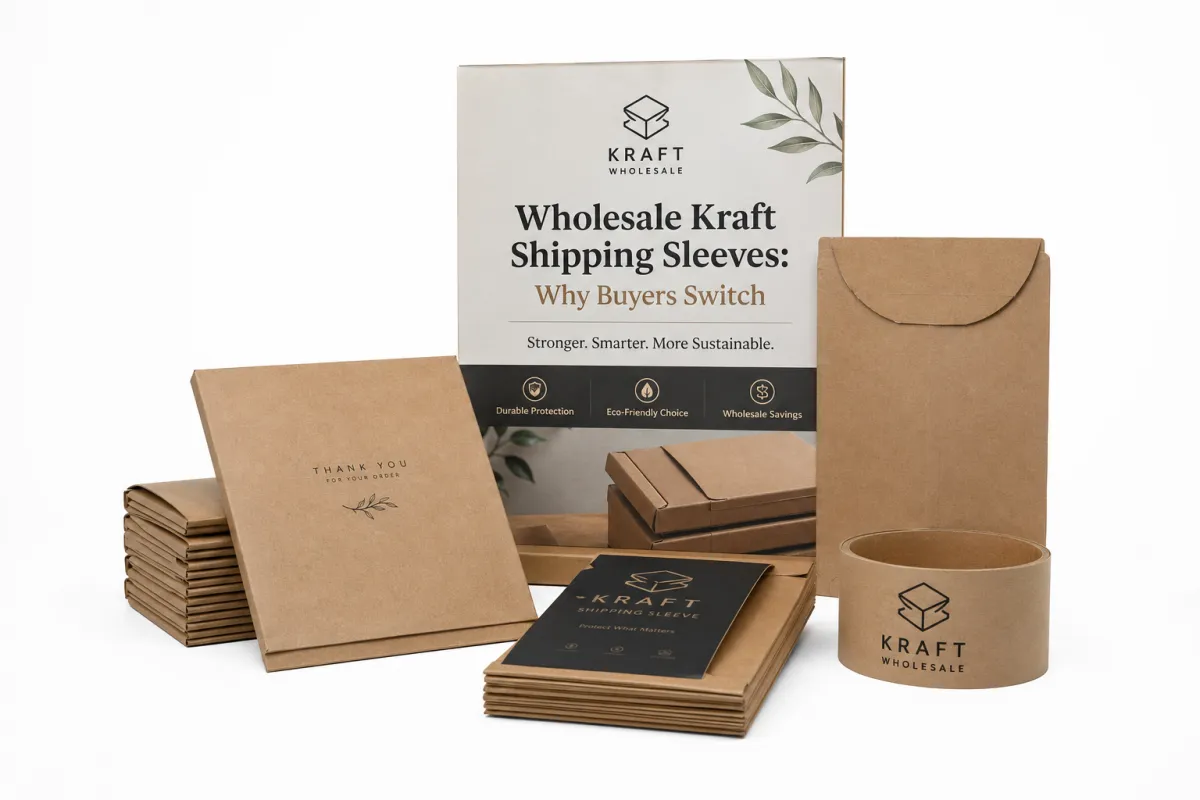
Wholesale kraft shipping sleeves are used to hold flat products, protect corners, reduce void space, and create a branded outer face without the cost of a full rigid box. They work especially well for books, apparel, print collateral, vinyl inserts, calendars, subscription kits, and other lightweight items that need a clean presentation and tighter ecommerce shipping control. In practice, that means less wasted board, lower dimensional weight, and faster pack-out on the line.
For brands that care about the customer unboxing moment, wholesale kraft shipping sleeves also give you a printable surface that looks intentional without becoming fussy. A well-fitted sleeve keeps the product aligned, reduces rattling in transit, and makes the package feel more disciplined the second it comes out of the carton. That is why buyers often compare them against kraft paper mailers, custom mailers, and other flat-pack packaging before committing to a final spec.
There is also a practical retail side to this. On a shelf or in a fulfillment bin, a sleeve keeps the product readable. It does not hide the item the way a bulky box can, and it does not collapse into a soft, shapeless thing after a few handoffs. That is a small detail until you are shipping a few thousand units a week and the packing table starts telling you where your weak points are. Then it becomes obvious pretty fast.
Wholesale Kraft Shipping Sleeves: Why Buyers Switch
I still remember a client meeting with a DTC apparel brand that had been using a small rigid mailer for every folded tee. The product looked polished, sure, but the packaging cost kept creeping into the wrong column. We changed them to wholesale kraft shipping sleeves with a tighter footprint, and the revised pack-out dropped freight by roughly $0.27 per order on their main lane from Dongguan to Los Angeles. No drama, no flashy redesign, just a cleaner packaging system that behaved better in the truck and at the packing table. The warehouse supervisor literally grinned, which is rare enough to mention.
That is the business case in plain language. Wholesale kraft shipping sleeves use less material than full rigid packaging, which lowers paper cost, reduces shipping weight, and frees up storage space on the warehouse shelf. A carton-flat sleeve can make a staging area feel twice as functional without moving a single racking beam, and the lift is easy to feel once the line starts running at 800 orders a day. It is a boring kind of improvement, and boring is usually what pays the bills.
The other reason buyers switch is presentation. A well-made sleeve keeps the product visible and tidy, which matters in ecommerce shipping and retail replenishment. Customers see a branded front panel, a crisp fold, and a product that does not rattle around like loose hardware in a bin. That controlled look builds trust faster than a lot of expensive packaging that tries to be louder than the product. A neat 1-color logo on 350gsm kraft can do more work than a busy four-color panel if the fit is tight.
In my experience, the move usually comes after a total landed cost review, not after a brainstorming session about brand mood. One buyer I worked with in Chicago thought they were saving money with a heavy box. Then we compared materials, freight, and pack labor across 15,000 units. The wholesale kraft shipping sleeves won decisively because the whole system got cheaper, not just the supplier quote. That matters more than a lot of teams want to admit, especially after three meetings and a latte that went cold at 9:40 a.m.
They also fit more business models than people expect. I have used wholesale kraft shipping sleeves for books, apparel, flat goods, mail-order collateral, sticker packs, and subscription inserts. The sleeve gives enough structure for shipping materials to stay orderly, but it does not force you into the cost of a full box if the product does not need one. For a 280 gsm insert pack, for example, the sleeve can be the difference between a $0.18 pack and a $0.31 pack once labor is counted.
One more practical point: sleeves are easier to standardize across SKUs. If your product range stays close in size, one die can often cover multiple variations with a few insert changes or artwork revisions. That reduces setup churn, and setup churn is where packaging budgets quietly leak out through the side door. I have seen that leak happen so many times that I now treat it like a fact of life, not a surprise, especially in multi-SKU programs running out of Shenzhen and Foshan.
Another reason buyers switch is simple warehouse sanity. Sleeves stack flat, count cleanly, and are easier to pull in the right sequence when a team is trying to keep a lane moving. A full box might look stronger on a spec sheet, but if the packer has to fight with it six hundred times a shift, the math gets ugly. A sleeve does not fix every problem, of course, but it does remove a few unnecessary ones. That is usually enough.
"We thought we were buying a box problem. We were actually buying a freight problem." That was a real line from a fulfillment manager after we switched their SKU family to wholesale kraft shipping sleeves for a 6,000-piece run from Dongguan.
Wholesale Kraft Shipping Sleeves Product Details
So what is a shipping sleeve, exactly? It is a folded paperboard or kraft-based wrapper that encloses a product on one or more sides while staying lighter and simpler than a full rigid carton. Compared with an envelope, it is usually stiffer and more presentation-focused. Compared with a mailer, it is often more custom-fit. Compared with a box, it is usually cheaper, flatter, and quicker to pack on a real line. And yes, a real line has opinions, usually expressed through jammed corners and somebody sighing near the tape gun in the last 15 minutes of a shift.
Wholesale kraft shipping sleeves are usually built from natural brown kraft, recycled kraft, or printable paperboard with a kraft finish. You can keep the uncoated natural look, or you can add a clean one-color logo, a stamped mark, or full-panel graphics if the brand needs more shelf presence. For a premium display-side version, some buyers spec a 350gsm C1S artboard face with a kraft backer, then keep the outer shipping surface natural so the sleeve still reads as practical instead of precious.
Structure matters more than most buyers think. Some wholesale kraft shipping sleeves are open on two sides. Some use tuck ends or score lines. Some are made for manual insertion, while others are shaped to run through a semi-Automated Packing Line with a Kallfass wrapper or a similar station in the workflow. If your team is fulfilling 500 units a day, manual loading may be fine. If you are at 8,000 units a day in Dongguan, pack speed starts to matter in a very direct way. I have stood on both sides of that line, and one of them has more coffee and less patience.
Print methods change the economics too. A simple one-color logo on wholesale kraft shipping sleeves is the most cost-efficient branded route. Full-coverage printing costs more because of ink coverage, setup, and color control. Inside print can add a nice unboxing moment, but it also introduces another pass through the production schedule. There is nothing mystical there, just plates, press time, and labor on a Heidelberg or similar offset line in Shenzhen or Wenzhou.
Here is the part buyers like to skip and then regret later: a sleeve should support the product, not choke it. I have seen brands over-spec their packaging and then wonder why cartons crush in transit. With wholesale kraft shipping sleeves, the better result comes from fit, fold accuracy, and repeatable structure, not from throwing extra board at the problem and hoping the warehouse gods approve. A clean 1 mm to 2 mm fold allowance often performs better than a heavy board upgrade that adds cost without fixing the actual issue.
For brands that also need companion packaging, it often makes sense to quote a sleeve alongside Custom Shipping Boxes or compare it with Custom Poly Mailers. Different products need different transit packaging logic. A sleeve is not always the answer, and anyone pretending otherwise is usually selling inventory, not advice. A 250 gsm sleeve can work beautifully for a flat insert, while a 400 gsm box still makes sense for a fragile kit.
Two practical examples:
- An apparel brand used wholesale kraft shipping sleeves to hold folded shirts and a small thank-you card, which reduced void space and kept pack-outs consistent on 2,000 monthly orders.
- A book publisher used a heavier kraft sleeve with scored folds so the book corners stayed clean during order fulfillment and outbound stacking on pallets bound for Chicago and Dallas.
The tactile part matters too. Kraft stock has a dry, honest feel that matches the way a lot of brands want to present themselves right now. Not glossy. Not overdone. Just clean, grounded, and easy to trust. If the product is doing the heavy lifting, the sleeve should behave like a frame, not a spotlight.
Wholesale Kraft Shipping Sleeves Specifications That Matter
If you want clean wholesale kraft shipping sleeves, ask for the specs before you ask for the price. That sounds obvious, yet half the pricing chaos I see starts with a vague email like, "Need sleeve, about this size, maybe printed." That kind of brief forces the factory to guess, and guessing is expensive. Give the dimensions, product weight, target finish, and artwork rules up front so the quote reflects the real job. If the product is 230 mm by 160 mm by 12 mm, say that in millimeters, not "roughly tablet-sized."
The first spec is size. Measure the product length, width, and thickness, then decide how snug you want the sleeve to fit. For flat goods, I usually allow just enough clearance for easy insertion without corner crush. A sleeve that is too loose looks sloppy. A sleeve that is too tight slows packing and raises damage risk. The sweet spot is boring, and boring is exactly what keeps the line moving. A 2 mm allowance on each side can save more labor than a thicker board change.
Paper weight matters too. Many wholesale kraft shipping sleeves fall in the 250gsm to 400gsm range, depending on the product and how much stiffness you need. A 300gsm recycled kraft can work for lighter inserts. A 350gsm stock is safer for heavier flat goods or premium presentation. I have watched buyers save $0.03 a unit by dropping board weight and then spend $0.11 more on damage claims. That trade rarely looks clever after the first complaint lands in customer service.
Tolerance is another point people forget to ask about. If the dieline is loose by 2 mm to 3 mm, the sleeve can shift during packing or rub at the corners. Good production should stay within a tight tolerance that matches your product. Ask your supplier to confirm the expected variance in width, depth, and fold positions before the run starts, not after a pallet is already wrapped in stretch film. For a 5,000-piece run, a 1.5 mm variance is manageable; a 4 mm drift is where returns begin.
For branded projects, print area matters as much as print method. A neat logo in the center of the panel is easy. A full-bleed wrap on wholesale kraft shipping sleeves takes better control of artwork and color. Inside print can be effective for inserts or seasonal campaigns, but it is not free. Every extra impression adds setup, registration checks, and another place where the factory can catch a problem before it reaches your dock. A one-color mark on the front often gives the best cost-to-impact ratio.
Sustainability specs should be documented, not guessed. If you need FSC paper, ask for the certificate trail. If recycled content is part of the brief, request the actual percentage and a written statement. For broader packaging standards, I often point buyers to the official resources from ISTA test methods and FSC certification so they are not relying on marketing fluff from a random sales deck. A 30% post-consumer recycled claim is very different from a 100% recycled sheet, and the paperwork should say so.
Before production, request a dieline and a physical sample. That one step catches size drift, print placement issues, and fold problems early. I learned that the hard way years ago when a client approved a sleeve on screen and then discovered the tuck flap sat 5 mm too low. We fixed it, but not before the team wasted two days arguing over a problem that a sample would have exposed in ten minutes. I still get a little cranky thinking about that one, especially because the run was already booked in Ningbo.
For wholesale kraft shipping sleeves, I recommend checking these specs in writing:
- Exact external and internal dimensions
- Paper weight or board caliper
- Fold style and opening direction
- Print method, color count, and ink coverage
- Surface finish, if any
- Recycled content or FSC documentation
- Dimensional tolerance and sample approval steps
If you are comparing two samples and one feels "fine" while the other feels a bit tighter and cleaner, trust the tighter one. Packaging has a way of revealing itself after the first few hundred units, not on the first look. A spec that is technically correct but awkward in the hand usually costs more later, even if the quote looks pretty enough in the spreadsheet.
Wholesale Kraft Shipping Sleeves Pricing and MOQ
Pricing for wholesale kraft shipping sleeves comes down to five things: size, stock, print complexity, quantity, and how much handwork the structure needs. Add finish, inserts, or special folds, and the number moves again. There is no secret formula here, just factory math, paper usage, and labor counted honestly. I like that part, actually. Numbers behave better than opinions, especially when the quote is coming out of Dongguan or Foshan and has to hold up after a customs review.
At low volume, setup costs dominate. At higher volume, the unit price drops because the factory spreads tooling, plate charges, and press setup over more pieces. That is why a quote for 1,000 sleeves and a quote for 10,000 sleeves can feel like two different products. The material may be similar, but the production economics are not even close. A 1,000-piece run might sit at $0.38 per unit, while a 10,000-piece run with the same artwork could land near $0.15 per unit for 5,000 pieces and dip further with cleaner specs.
Here is a practical pricing table I would use as a starting point for wholesale kraft shipping sleeves. These are example ranges, not a promise carved into stone. Real pricing changes with artwork, paper market swings, and shipping lane costs. A 350gsm C1S artboard-facing sleeve will usually price higher than an unprinted 300gsm kraft sleeve because the coating and print control add factory time.
| Option | Typical MOQ | Common Stock | Print Style | Estimated Unit Price at 5,000 pcs | Best For |
|---|---|---|---|---|---|
| Unprinted natural sleeve | 1,000-3,000 | 300gsm kraft | No print | $0.09-$0.14 | Simple ecommerce shipping and internal packing |
| One-color logo sleeve | 3,000-5,000 | 350gsm kraft | 1 PMS color | $0.15-$0.27 | Branded apparel, books, subscription kits |
| Full-coverage branded sleeve | 5,000-10,000 | 350gsm-400gsm kraft | 2-4 colors or heavy coverage | $0.31-$0.56 | Premium retail presentation and launch kits |
MOQ exists because setup costs are real. Plates cost money. Press setup takes time. Cutting rules and folding adjustments take labor. That is why a supplier may quote a minimum order of 3,000 or 5,000 pieces on wholesale kraft shipping sleeves even if the material itself is inexpensive. A factory does not open a machine for a short run unless the setup and the schedule justify it. And frankly, they should not, because a 2-hour setup on a Bobst die-cutter in Shenzhen is not free.
There are ways to control cost without wrecking the packaging. Simplify the artwork. Keep one or two print colors. Standardize the sleeve size across SKUs. Reduce special folds unless they solve a real problem. If the goal is better margin in order fulfillment, not a trophy for most complicated packaging, then keep the structure clean and the spec easy to run. A straightforward sleeve also packs faster on a line moving 700 to 1,200 orders a day.
I also push buyers to compare wholesale kraft shipping sleeves on landed cost, not just ex-factory price. Freight, import handling, storage, and packing labor can easily add 15% to 35% on top of the unit quote depending on route and volume. A sleeve that is $0.03 cheaper at the factory can end up more expensive once it needs larger cartons or more handling in the warehouse. On a 10,000-piece order, that gap can become a real budget line instead of a rounding error.
One supplier negotiation in Dongguan came down to a paper spec adjustment. We swapped a fancy stock for a cleaner 350gsm kraft with the same print layout, and the factory held the quote at $0.24/unit on 8,000 pieces. The buyer did not care about the paper mill's poetry. They cared that the numbers made sense, and sensible people usually do, especially when they are signing off from Chicago or Atlanta on a Tuesday afternoon.
For brands comparing wholesale kraft shipping sleeves against other shipping materials, the best move is to request pricing in three quantity tiers. Try the minimum, then a middle tier, then the next sensible step up. That shows where the curve bends and helps you decide whether cash flow or per-unit savings matters more right now. A quote at 3,000, 5,000, and 10,000 pieces is usually enough to see the break point without making the factory build an entire pricing essay.
Useful cost controls include:
- Use a standardized sleeve size for multiple SKUs.
- Keep print to one color if the brand can tolerate it.
- Ask for carton-packing efficiency so freight quotes stay honest.
- Test a sample before approving a larger custom print run.
One thing I always tell buyers: if the quote looks unusually low, check what is missing. Sometimes the sample cost is buried elsewhere. Sometimes freight is not included. Sometimes the stock is technically correct but much thinner than the supplier made it sound. That does not make the vendor bad, but it does mean you need a clean comparison before you commit.
Wholesale Kraft Shipping Sleeves Process and Timeline
The cleanest production runs for wholesale kraft shipping sleeves follow the same basic path every time: quote, spec check, artwork review, proof, sample, production, and shipment. It sounds simple because the workflow is simple, but only if the inputs arrive complete and accurate the first time. The factory cannot read your mind, no matter how many times somebody forwards the same half-finished spreadsheet from a laptop in New York at 11 p.m.
Stage one is the quote request. Send the dimensions, target stock, print method, quantity, and delivery destination. If you already know the packing method, say so. If the sleeves need to work with an automated line, say that too. The more specific the brief, the less back-and-forth later, and the fewer opportunities there are for the quote to drift. A clear brief with mm measurements and a target warehouse in Los Angeles usually gets a cleaner answer than "we need something nice."
Stage two is artwork and dieline review. A lot of delays happen here. If the print file is a low-resolution JPG or the dieline is missing panel labels, the factory has to stop and ask questions. A clean vector file in the correct layout can shave days off the cycle for wholesale kraft shipping sleeves, especially when the printer is running a narrow window on a Bobst die-cutter or a comparable finishing line in Guangdong. I have seen a simple art cleanup save 48 hours without changing the structure at all.
Stage three is proofing and sample approval. I always tell clients to request a physical sample when the order is brand new or the fit matters. One sample can prevent a run of 10,000 bad pieces, and that math is not subtle. I once watched a brand approve a sleeve visually, then reject it after sample testing because the inner product slid during shipping. Good catch. Cheap catch too, because the sample cost $35 and the avoided reprint would have been near $2,400.
A realistic timeline for wholesale kraft shipping sleeves usually looks like this:
- Quote and spec confirmation: 1-2 business days
- Artwork and proof review: 2-4 business days
- Sample approval, if needed: 3-7 business days
- Production: 10-18 business days depending on print complexity
- Freight booking and dispatch: 3-10 business days depending on lane
If the job is simple, a fast turnaround is possible. If the job includes multiple colors, special folds, or a new size, build extra time into the schedule. Rush orders can happen, but only when the factory calendar allows it and the spec is tight. Everyone likes urgency until they are the one standing beside the folding line at 11 p.m. checking whether the glue pattern still lands in the right place. I have done that more than once in Shenzhen, and I do not recommend making it a hobby.
To speed up production, send these items up front:
- Final product dimensions and weight
- Artwork files in vector format
- Target quantity and tier interest
- Shipping address and delivery deadline
- Sample requirement, if any
Wholesale kraft shipping sleeves also work well when paired with a broader packaging plan. If your product needs a box for long-haul distribution but a sleeve for retail display, it is smart to coordinate both. That is where a lot of brands quietly improve ecommerce shipping and presentation at the same time, especially when the outer carton is shipping from Ningbo and the branded sleeve is packed in Foshan.
The timeline gets even smoother when decision-makers stay aligned. I have watched projects stall for three days because one team wanted a recycled stock and another wanted a brighter print surface. Neither side was wrong, but the delay cost more than the upgrade would have. That is the sort of thing that makes packaging feel slow when the real issue is simply unclear direction.
Why Choose Us for Wholesale Kraft Shipping Sleeves
After enough factory visits and supplier negotiations, the difference between a decent quote and a clean production run usually comes down to the details. I have stood beside lines where a tiny dieline mistake turned into a pallet of unusable sleeves. I have also seen a sharp supplier save the job by spotting the error before ink hit board. That gap is where a real packaging partner matters for wholesale kraft shipping sleeves, especially on runs above 5,000 pieces where rework gets expensive fast.
What buyers should expect is simple: clear specs, honest minimums, and print consistency that does not wander from proof to production. If a supplier cannot explain the board choice, the folding style, or the print method in plain language, I would walk. Fast. Confusion is not a feature, and it rarely gets cheaper later. A supplier should be able to say, for example, "350gsm kraft, one PMS color, 12-15 business days from proof approval," without fumbling through three different answers.
At Custom Logo Things, the value is practical. We help you compare structures, confirm fit, and keep communication tight so you are not chasing three different people for the same answer. That matters if you are coordinating wholesale kraft shipping sleeves with launch calendars, replenishment cycles, or multiple SKUs at once. It also matters when your team in Chicago wants one answer and your warehouse in Dallas wants another by Friday.
Strong sourcing relationships matter too. When paper costs move, or a factory fills capacity, a connected supplier is more likely to protect your price and keep your lead time honest. I have seen buyers get burned by vendors who quoted one number in week one and found three surprise fees by week three. The invoice should not feel like a hostage note, yet some vendors still try that trick with freight surcharges and "special handling" lines.
We also check the boring stuff that saves money later: dieline accuracy, print placement, carton counts, and whether the spec actually fits the product the client is shipping. That kind of control is what keeps wholesale kraft shipping sleeves from becoming a pretty headache. If the proof looks perfect but the fold is off by 3 mm, we would rather catch it in the sample room in Shenzhen than in a returns email from a customer in Austin.
For brands scaling packaging across categories, we can also coordinate matching programs with Custom Packaging Products. If your lineup includes apparel, accessories, or lightweight shipments, sleeves, boxes, and mailers can be quoted as part of one plan instead of three disconnected purchases. That tends to make the buyer's life less annoying, which is usually a win, especially when the invoice lands before the quarter closes.
"The quote was not the cheapest. The final spend was." That was a client line after we tightened the spec on wholesale kraft shipping sleeves and removed two useless production steps on a 9,000-piece order.
My honest view? A good packaging supplier should be boring in the best way. No mystery surcharges. No hand-wavy specs. No sketchy promises. If the project is straightforward, it should feel straightforward. If it is complex, the supplier should tell you exactly where the risk sits and what it costs to reduce it, whether the job ships from Shenzhen, Dongguan, or Wenzhou.
Wholesale kraft shipping sleeves are one of those packaging choices where the right sourcing partner can save you more than a single quote difference. They can save you freight mistakes, labor mistakes, and the kind of reprint disaster that ruins a launch schedule. I have lived through those calls. They are not fun. They are also avoidable, which is the nice part, especially when proof approval, sample timing, and board spec are handled in the first week.
And because this is usually where people try to get fancy, I will say it plainly: the best supplier is the one that notices the small stuff before you do. That might mean catching a bad tuck direction, flagging a weak score, or telling you the board is too soft for the way your team packs. That kind of honesty is worth more than a prettier quote.
Next Steps for Wholesale Kraft Shipping Sleeves Orders
If you are ready to price wholesale kraft shipping sleeves, send the product dimensions, target quantity, artwork files, and shipping destination first. That is the fastest path to a real quote. If you send a screenshot and a hope, you will get a delay. If you send exact specs, you will get useful numbers. A request with 230 mm by 160 mm by 12 mm, 350gsm kraft, one-color print, and delivery to Los Angeles gets a cleaner reply than "similar to last time."
For first-time orders, ask for a dieline and a pre-production sample. That step catches fold problems, print shifts, and fit issues before they become expensive. I have seen brands skip sampling to "save time" and then spend twice the time fixing the mess. That is classic false economy. A $30 sample can protect a $3,000 to $8,000 print run, which is the sort of math that tends to age well.
It also helps to confirm three decisions before you request pricing on wholesale kraft shipping sleeves: the stock, the print method, and the delivery date. Once those are clear, the supplier can quote against actual production, not guesses. If you are comparing options, ask for two or three quantity tiers so you can see where the unit cost and cash flow line up best. A 3,000-piece tier, a 5,000-piece tier, and a 10,000-piece tier usually reveal the break point quickly.
If your project needs broader packaging support, start with the sleeve and then build outward. A package may need an outer box, a mailer, or a printed insert. That is normal. Not every SKU should live in the same structure, and forcing it usually makes the numbers worse. A sleeve may carry the retail presentation while a box carries the freight stress, and that split can save a lot of budget over a 12-month replenishment cycle.
For teams that want to move quickly, I recommend preparing this short checklist before the first inquiry:
- Exact product dimensions and weight
- Target sleeve style and opening direction
- Logo files or final artwork
- Estimated order volume
- Required ship date and destination
- Any FSC, recycled content, or print requirements
Once those items are ready, pricing moves faster and revisions drop. That is how you keep wholesale kraft shipping sleeves from turning into an endless email thread. It also gives you a cleaner path into order fulfillment because the packaging is built around the product, not around wishful thinking. A clean brief can shave 2 to 3 days off the quote cycle, which matters when a launch window is already tight.
So the practical move is simple: define the product, decide the fit, choose the stock, and request a sample before you chase the lowest number. That order of operations keeps the project grounded and saves everyone from the expensive kind of guesswork. If you do that, wholesale kraft shipping sleeves usually behave exactly the way you wanted them to from the start.
If you want a practical, no-nonsense quote, send the spec. We will tell you what is possible, what it costs, and where the trade-offs sit. That is the job. And yes, wholesale kraft shipping sleeves still deserve that level of attention even when the packaging looks simple on the surface, because a sleeve that costs $0.15 at 5,000 pieces and ships in 12-15 business days is only simple after the details are handled correctly.
FAQ
What is the MOQ for wholesale kraft shipping sleeves?
MOQ depends on sleeve size, print method, and paper stock. For many wholesale kraft shipping sleeves jobs, the practical floor is tied to setup costs, plate charges, and production efficiency. A simple unprinted run may start around 1,000 to 3,000 pieces, while printed custom runs often land at 3,000 to 5,000 pieces or more. Ask for tiered pricing so you can compare the minimum against the better unit cost at higher quantities, such as $0.22 at 3,000 pieces versus $0.15 at 5,000 pieces.
How long do wholesale kraft shipping sleeves take to produce?
Timeline depends on proof approval, sample needs, and print complexity. Simple wholesale kraft shipping sleeves can move from proof to shipment in roughly 10 to 18 business days after approval, while custom printed runs with samples may take longer. The fastest way to avoid delays is to send final dimensions, artwork, quantity, and shipping details up front, because a clean brief often lands a first proof in 1 to 2 business days and production at 12-15 business days from proof approval.
Can wholesale kraft shipping sleeves be printed with my logo?
Yes, most wholesale kraft shipping sleeves can be printed with one-color or multi-color branding. One-color logos are usually the most cost-efficient, while full-panel or inside print adds cost and time. Vector files, clean artwork, and a proper dieline keep the approval process moving without endless corrections. A single PMS color on 350gsm kraft often gives a strong result without pushing the unit price out of range.
What kraft weight is best for shipping sleeves?
The right paper weight depends on product size, shipping method, and how much stiffness you need. Many wholesale kraft shipping sleeves use 250gsm to 400gsm stock, with heavier items usually needing stronger board and tighter tolerances. If you are unsure, request a sample and test fit before placing a larger run. For most flat ecommerce goods, 300gsm is a good starting point, while 350gsm offers more stiffness for premium presentation.
Are wholesale kraft shipping sleeves recyclable?
Many wholesale kraft shipping sleeves are recyclable when they use a simple paper structure without mixed materials or heavy plastic additions. Recycled content and FSC options may be available depending on the spec. Confirm the exact material build before making a sustainability claim, because vague claims are how brands get themselves into trouble. A sleeve made from 100% paperboard with no lamination is easier to recycle than a laminated mix built for display.
Should sleeves replace boxes for every product?
No. Wholesale kraft shipping sleeves are a better fit for flat, light, or presentation-oriented products, but they are not the right answer for everything. Fragile items, irregular shapes, and products that need strong crush resistance still belong in a box or a more protective transit structure. The cleanest choice is the one that protects the product without spending extra on material or labor you do not need.
That is the short version: wholesale kraft shipping sleeves make sense when you want lower material cost, lighter freight, cleaner presentation, and a spec that is easy to repeat without drama. If you send the right dimensions, artwork, and volume, the quote gets clearer, the sample gets faster, and the final packaging does what it is supposed to do. No theater. Just wholesale kraft shipping sleeves that fit, print cleanly, and keep your shipping materials from wasting money on every order cycle.


