A Woven Labels Supplier Quote for electronics sellers should read like a production brief, not a vague unit price. It should state the finished size, weave, fold, backing, quantity, sample cost, setup fee, packing, freight, and production timeline before bulk work begins.
That detail matters because woven labels for electronics brands appear on cable kits, device sleeves, accessory pouches, repair kits, staff apparel, retail inserts, and launch bundles. A small label can affect how premium the package feels in product photos, under store lighting, and in hand. If the quote does not define the construction, buyers are comparing assumptions rather than suppliers.
If you are still building the brief, review the wider Custom Labels & Tags options first, then send a cleaned-up spec for pricing. For direct help with a quote request, use the Contact Us page so the supplier can respond to one clear version of the job.
What a quote should include before anyone approves production
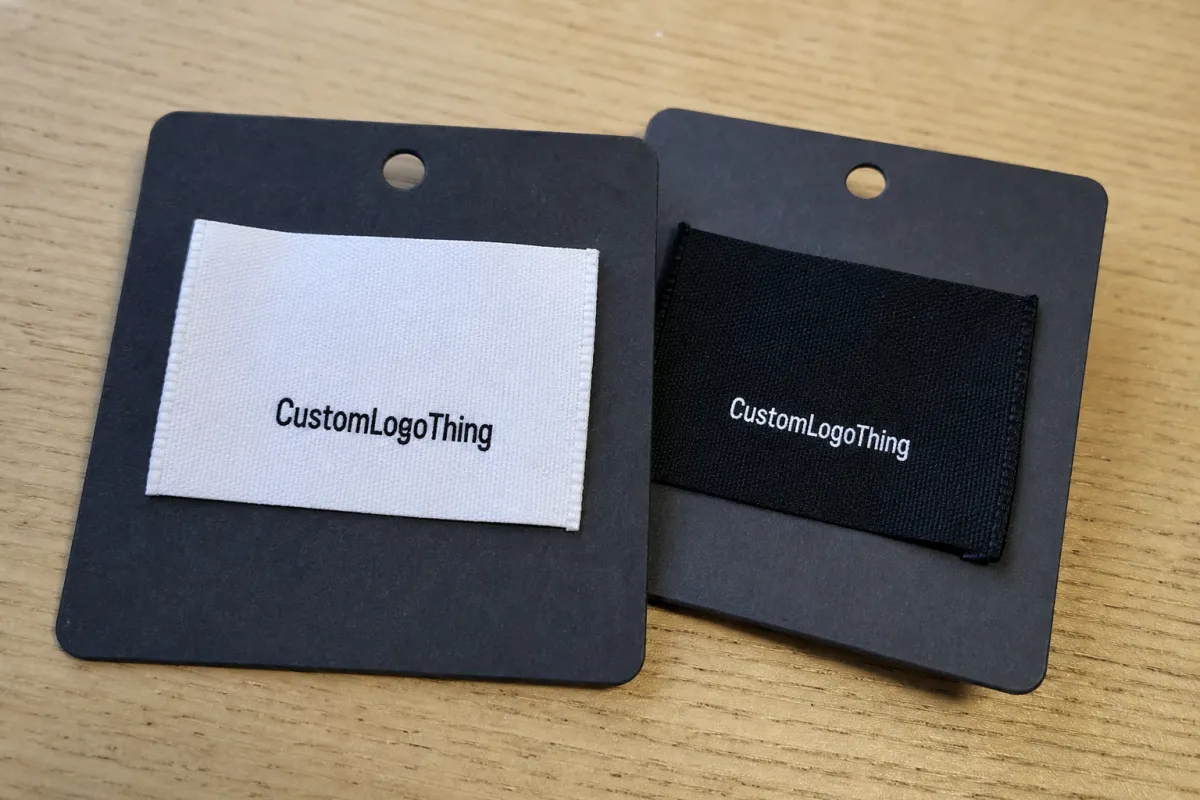
The quote should begin with the physical build: weave type, finished size, fold style, color count, edge finish, backing, quantity, sample cost, setup charge, freight, and estimated production time after approval. A line that says “$0.12 each” is not enough unless it explains exactly what that price covers.
Use case should also appear in the request. A pouch label gets rubbed by zippers and hands. A retail insert is judged visually at close range. A staff garment label must tolerate washing and skin contact. A quote that ignores placement and handling is incomplete.
Ask whether the price assumes one label orientation, one application method, and one packing format. A sew-on label, adhesive label, cut-and-fold label, and flat bulk-packed label can be priced differently. That is normal, but the difference should be visible before approval.
Quote test: if two suppliers cannot price the same size, fold, weave, backing, quantity, packing format, and destination, you do not yet have a clean comparison.
Tooling, sampling, bulk production, freight, and rework policy should be listed separately. This exposes weak pricing quickly. A low headline unit cost can lose its advantage once setup charges, sample fees, shipping, duties, brokerage, or destination fees are added.
Repeat-order handling also belongs in the quote. If the supplier keeps the approved artwork, thread references, loom settings, and tolerance notes, future runs are easier to control. If every reorder starts from scratch, color drift, size drift, and fold differences are more likely.
Construction choices that change the look, feel, and cost
Damask is often the best woven option for electronics accessories because it holds fine detail more cleanly than many standard weaves. It works well for compact logos, small icons, and premium pouches. Satin feels smoother and softer, which can suit apparel-style merchandise or presentation items. Taffeta is usually lower cost, but the texture and edge clarity are less refined.
The right choice depends on the artwork. If the logo has thin strokes, small type, or dense shapes, the supplier may need to simplify the design or increase the label size. If the mark is a simple wordmark or icon, satin or taffeta may be enough. Reducing design complexity is often better than forcing a detailed logo into a label that is too small to weave cleanly.
Fold style affects both appearance and attachment. Center fold suits seam insertion on pouches or soft goods. End fold works when the label is stitched flat at both sides. Straight cut is simple for flat applications. Loop fold and mitre fold are useful when the label acts as a hanging point or visible brand tab on cable sleeves, cases, or charging-accessory bags.
Backing should be named directly. Sew-on backing is the most durable for repeated handling. Iron-on backing may work on apparel or promotional soft goods, but heat compatibility must be checked first. Adhesive backing can suit short-term packaging or presentation layers, but it is rarely ideal for heavy wear or long-term retail handling.
- Damask: best for crisp logos, fine detail, and premium accessory pouches.
- Satin: smoother and softer, useful for simple apparel-style items and presentation pieces.
- Taffeta: lower cost, suited to plain designs where price matters more than texture.
- Matte thread: helps reduce glare in product photos and bright retail lighting.
Matte thread is worth considering for e-commerce photography. Glossy thread can flare under LED lighting and make a small label look louder than intended. A lower-sheen finish often reads cleaner beside coated cartons, molded plastic, polished accessories, and high-resolution printed inserts.
Color count also changes price and readability. One or two thread colors keep the label simple and reduce mismatch risk. Three or four colors allow more detail, but add setup complexity. Edge treatment should be defined as well, especially if the label is exposed on a pouch edge or used as a decorative brand element.
Artwork, sizing, and specs that prevent avoidable delays
Send vector artwork whenever possible. AI, EPS, SVG, or a production-ready PDF gives the supplier clean paths to translate the design into woven thread. A flattened PNG may look acceptable on screen but fail in weaving because thread cannot reproduce every pixel, gradient, shadow, or hairline rule.
State size in millimeters, with finished dimensions and fold allowance separated. A center-fold label may show a visible size of 20 mm x 40 mm, but the woven piece needs extra length for the fold and seam allowance. Cut length, folded length, stitch margin, and tolerance should not be left open to interpretation.
Legibility has limits. Tiny text below roughly 5 points, narrow icon strokes, dense QR codes, and detailed compliance marks can break down unless the label is enlarged or simplified. For many electronics packaging jobs, woven labels are best for identity and presentation, while printed inserts or paper tags handle logistics, QR codes, and compliance content.
If the label touches apparel or soft goods, keep compliance data separate from brand artwork unless the required layout is already confirmed. Rules vary by market. For packaging materials used alongside textile labels, guidance from the Forest Stewardship Council may be useful when paperboard, hangtags, or inserts are part of the same launch package.
A good proof should show finished size, thread colors, fold, backing, edge finish, and placement notes. A better proof includes tolerances. Small woven items can shift slightly during production; a practical tolerance around +/-1 mm is common on many labels, though dense weaves and special folds may behave differently.
Sampling is worth asking for when the design is detailed, the label is small, or the product sits in a premium tier. A swatch stage in the $25 to $60 range can prevent a 5,000-piece bulk order that looks wrong in hand. If the supplier credits sample cost against the first production order, confirm that in writing.
Cost, MOQ, and unit pricing for launch budgets
Woven label pricing usually moves on five variables: quantity, size, thread count, fold style, and finishing. A simple one-color straight-cut label for a cable pouch may land around $0.08 to $0.16 per unit at moderate quantities. A denser damask label with three or four colors, center fold, soft edge, and tighter inspection can sit closer to $0.18 to $0.35 per unit at 5,000 pieces.
MOQ is important, but tiered pricing is more useful than a single minimum. Some suppliers can support 500 pieces for a trial run. Others set 1,000 or 3,000 pieces as the practical minimum. Ask for 1,000, 3,000, 5,000, and 10,000 piece pricing if the launch plan can support it. Price breaks often appear when setup, thread preparation, and finishing labor are spread across enough units.
Packing format can change the real cost. Bulk packing is usually least expensive but may require extra handling during assembly. Sorted bundles, SKU-specific packs, or individual packing can save time on the line, but they add labor and packaging cost. The quote should show which format is included.
| Spec Scenario | Typical MOQ | Estimated Unit Range | Best Use |
|---|---|---|---|
| One-color taffeta, straight cut, sew-on | 500-1,000 pcs | $0.08-$0.16 | Basic cable kits, internal accessory pouches |
| Two-color damask, center fold, sew-on | 1,000-3,000 pcs | $0.14-$0.26 | Premium pouches, device sleeves, branded soft goods |
| Four-color damask, end fold, tighter tolerance | 3,000-5,000 pcs | $0.22-$0.38 | Retail-facing inserts, launch kits, multi-SKU programs |
| Adhesive woven label, matte thread, custom size | 1,000-3,000 pcs | $0.12-$0.30 | Short-term packaging, presentation layers, internal branding |
These ranges are practical planning numbers, not fixed offers. Final pricing can move with label width, stitch complexity, thread availability, inspection level, packing format, and shipping method. Rush production can also add cost if the supplier must interrupt a standard production queue.
Buyers should budget for error prevention. If the label appears on an expensive product bundle, spending more on proofing, sampling, or tighter finishing can be cheaper than reworking packaging or discounting inventory that looks off-brand.
Production steps and timing from proof to shipment
A typical woven label order moves through quote confirmation, artwork proofing, sampling or swatch approval, and bulk production. Timing depends on artwork quality, thread availability, finishing requirements, and production queue. If the design needs revision or a second sample, the timeline extends.
Proofing is where many delays are prevented. Check spelling, size, fold, thread colors, backing, and placement notes before approving. Confirm how revisions are handled. Minor adjustments may be simple; changes to size, color count, fold, or backing may require a fresh proof or new sample.
Sampling is especially useful when the label will be visible on premium packaging or close to the product surface. It confirms thread density, contrast, texture, and sheen beside the rest of the package. For electronics sellers, that comparison matters because woven labels often sit near coated cartons, molded plastic, metal finishes, or high-resolution print.
Bulk production usually starts only after proof or swatch approval. Once production begins, the main timing variables are queue length, material availability, finishing capacity, and inspection level. If the labels are needed for a kit build, include receiving and warehouse handling time before assembly begins.
Freight should be quoted separately whenever possible. Express shipping may be useful for a launch rescue, but standard shipping is usually better for planned replenishment. Confirm whether the timeline is business days after approval and whether transit time is included or separate.
What a reliable supplier proves before the first run
A reliable supplier proves process control, not just speed. They should explain how they match thread colors, review artwork for weave limits, inspect finished labels, and handle orders that fall outside the agreed spec. If a supplier cannot describe its quality checks, the quote may be cheaper because fewer checks are included.
Ask for examples of recent work in a similar size, weave, or material range. The supplier does not need to reveal private client details, but general samples can show weave density, fold quality, edge finish, and color consistency. That is enough to judge whether they understand small-format branding.
Deviation handling matters. Manufacturing variation exists, so the key question is how it is measured, reported, and corrected. A good supplier should have a practical answer about inspection criteria, remake thresholds, and replacement policy if labels arrive outside the approved tolerance.
For electronics sellers, product lines often expand quickly. A supplier that keeps approved artwork, dimensions, thread references, and packing notes can save time on reorders. If the first order is part of a wider branding update, the Custom Labels & Tags page can help compare woven labels with related tags and marking formats.
How to compare repeat-order quotes without hidden costs
Repeat orders should reference the original size, construction, approved artwork, tolerance, and packing format. If the buyer has to rebuild the job from memory, the chance of a mismatch increases.
When comparing repeat quotes, focus on what changed. Quantity may unlock a lower unit price. Freight may change because of destination or shipping method. A setup fee may return if the old thread color is no longer stocked. These variables are acceptable when they are transparent.
Packaging efficiency can also affect the quote. Some electronics sellers need labels pre-sorted by SKU, colorway, carton, or production run. That may save warehouse labor but cost more at the source. The quote should say whether sorting, bundling, or special pack counts are included.
Version control is simple but important. If the logo, text, size, fold, or backing changes, reflect that update in the quote file name and order note. That helps prevent an old approved file from being reused by accident.
For long-running product lines, keep one master specification sheet with the approved construction, tolerance, thread colors, packing format, and reorder contact. Then the next quote becomes a verification step instead of a fresh design process.
What to send for the fastest accurate quote
The fastest quote requests are complete. Send the artwork file, finished size, fold style, weave preference, number of colors, backing, quantity, target ship-to country, packing preference, and whether sampling is required. If the label is for a soft good, include a photo or short note showing where it will be sewn or applied.
State the label goal as well. Is it a premium visible brand mark, a hidden seam tag, or a light-duty identifier for a kit? The same artwork can be priced differently depending on whether appearance, durability, or cost efficiency matters most.
Ask for quote clarity in return. A useful response should separate unit price, sample cost, setup fee, packing, freight, and special handling. Compare options by total landed cost, not headline unit price alone.
If you need a general discussion before sending art, the Contact Us page is the simplest place to start. A brief question before quoting is usually faster than correcting a mismatch after proof approval.
FAQs
Can woven labels work for electronics packaging even if the product is not textile-based?
Yes. Woven labels are often used on pouches, wraps, sleeves, inserts, and accessory kits. The key is choosing the right backing and finish for the actual surface and handling method.
Is damask always worth the extra cost?
Not always. Damask is often better for fine detail and premium presentation, but simpler designs may work well in satin or taffeta if the buyer wants lower cost or a softer visual effect.
What is the safest way to avoid quote surprises?
Use one complete spec sheet and ask each supplier to quote the same size, fold, weave, backing, packing format, quantity, and destination. That makes comparisons more reliable.
Should the quote include a sample?
Usually yes, especially for small labels or premium packaging. A sample or swatch can catch visual issues before bulk production and confirm texture, sheen, and fold quality.
How many internal links should I include in a quote page or article?
Two or more relevant internal links is a practical minimum. In this article, the main internal references point to Contact Us and Custom Labels & Tags because they support the next step in the buying process.
For electronics sellers, the best Woven Label Quote is the one that makes production easy to repeat. It defines the label clearly, shows the real cost drivers, and leaves little room for guesswork.


