A fleece lined beanies woven label quote is useful only when it reflects the real product: the beanie construction, label format, artwork limits, sewing method, packing, quantity, and delivery date. For a typical production program, a 500 MOQ order often prices at about $2.50-$4.00 per unit for a standard two-color woven label on a basic acrylic beanie, while more complex lining, packing, or artwork pushes the number higher. Fleece adds warmth, but it also adds bulk. That bulk changes how the cuff folds, how the label sits, and how much handling is required in sewing.
Woven labels are common on cold-weather headwear because they hold cleaner edges than many direct decoration methods on textured knit. They can look retail-ready, survive repeated wear, and keep a small brand mark readable when the artwork is simplified for thread instead of screen resolution. Typical label constructions use polyester damask or satin weave, often with 50D or 75D polyester yarns, and can be specified to OEKO-TEX Standard 100 when the buyer wants skin-contact textile assurance. The quote needs to account for those production realities before the order is approved.
Why fleece-lined beanies need durable woven branding
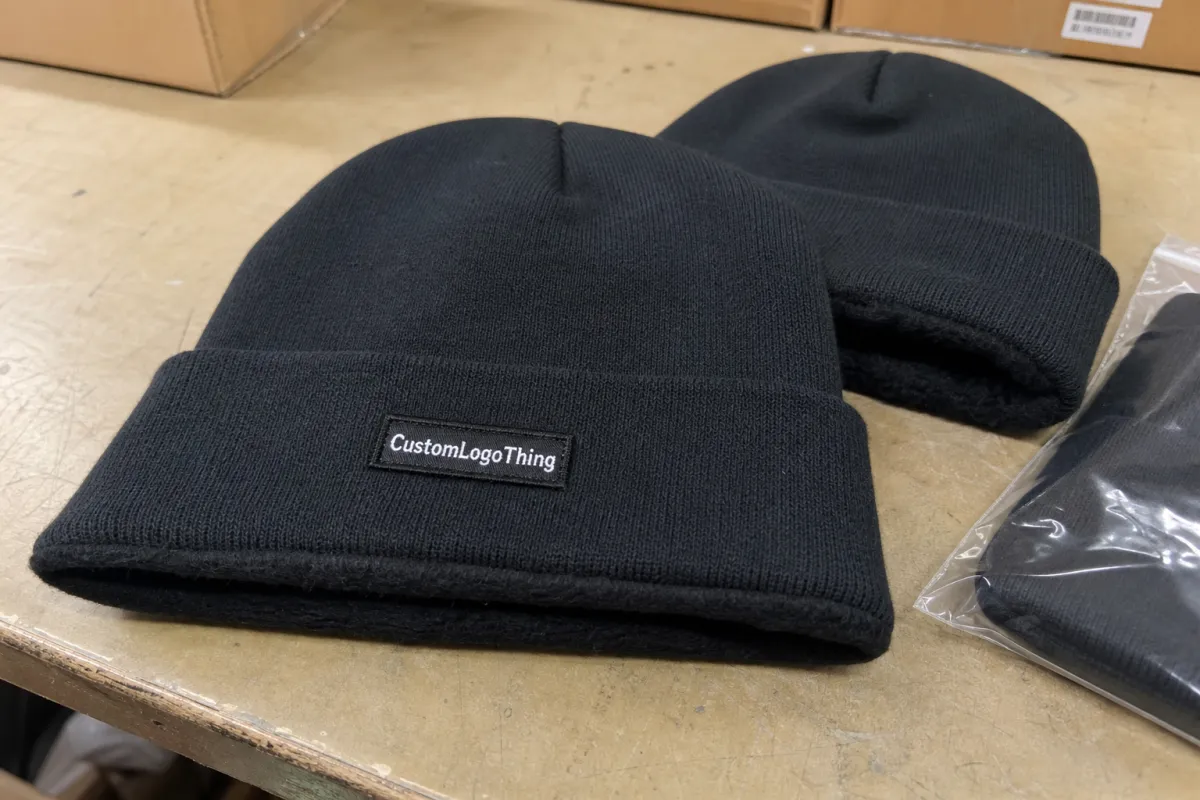
Fleece-lined beanies are not just thicker versions of standard knit hats. The lining changes stretch, cuff behavior, and needle resistance at the sewing point. A printed logo may look acceptable on a flat proof, then lose sharpness once the beanie is worn, stretched, washed, or stored in a bag. Knit movement and surface texture make small artwork harder to control, especially on 7-gauge or 12-gauge acrylic shells paired with 180-240 gsm polar fleece linings.
Woven labels reduce that risk because the logo is built with thread. Borders, blocks, and short brand names usually hold better when the artwork is designed for weaving. On a 25 mm by 50 mm label, a simple mark, short name, and border can stay readable. Tiny script, thin outlines, gradients, and detailed illustrations usually need simplification before production. A good rule is to keep the smallest text at roughly 5.5 pt or larger at final size and avoid strokes under about 0.2 mm.
Practical note: If the artwork only works at screen resolution, it probably needs a second pass before it can be woven cleanly.
Placement should match the beanie style. A cuffed beanie gives the strongest front-facing branding and works well for photos, employee gear, and retail displays. A slouch beanie may look better with a side label or lower-edge placement so the logo does not fight the shape. Seam placement can feel more integrated, but it is usually quieter from normal viewing distance. For apparel programs that need social compliance, buyers often ask for WRAP or BSCI documentation; if the trim is recycled, GRS may also be relevant.
Construction details that affect the final look and hand feel
The beanie build drives the final appearance. A single-layer acrylic knit is easier to sew and usually gives a flatter label attachment. A fully fleece-lined beanie adds warmth and structure, but it also adds thickness. Some styles are lined only through the crown. Others carry fleece through the cuff. That difference affects comfort, fold depth, and how the finished label sits. In production, the shell is commonly knit on a circular knitting machine, then cut, linked, or overlocked before the fleece lining is inserted and the crown is closed on a flatlock or single-needle operation.
Common woven label formats each solve a different problem. A center-fold label folds in half and can be sewn into a seam or applied at an edge. An end-fold label has tucked edges for a clean patch look. A loop-style label wraps over a cuff or edge and gives a familiar apparel finish. A seam-in label sits inside the construction for a more integrated result. The right format depends on visibility, artwork size, beanie thickness, and the desired hand feel. Labels are typically cut and folded after jacquard weaving, then inspected for edge fray, weave density, and color registration.
Sewing complexity changes pricing. A small end-fold label on a standard front cuff is straightforward. A seam-in label on a thick lined beanie takes more handling because the operator must control the outer knit, fleece lining, and label at the same time. On orders with multiple body colors, multiple label positions, or mixed SKU packing, that labor should be priced from the start. A production line usually uses single-needle lockstitch or narrow zigzag sewing, with a top-stitch allowance of about 2-3 mm from the label edge to keep the attachment flat and secure.
Key specifications to lock before production
A clean quote starts with a complete spec set. If the details are vague, the first number is only a budget estimate. For a production order, lock the construction, label, placement, packing, and schedule before final pricing. The most useful quote is built from a clear tech pack, one artwork version, one label size, and one packing method, not from a loose reference image.
Confirm these details before requesting pricing:
- Beanie construction: single-layer knit, fully fleece-lined, crown-lined, or cuff-lined.
- Label size: common formats include 20 mm x 40 mm, 25 mm x 50 mm, and 30 mm x 60 mm.
- Fold style: end-fold, center-fold, loop-fold, straight cut, or seam-in.
- Color count: most woven labels work best with 2 to 6 thread colors, depending on size and detail.
- Placement: front cuff, side seam, lower edge, back seam, or a custom position.
- Packing: bulk packed, individually polybagged, belly banded, or retail labeled.
Artwork has limits. Woven labels are strong for clean shapes and controlled color blocks. They are weaker for tiny text, fine gradients, and thin line art. Text under about 5 mm can fill in or disappear depending on weave density and font choice. If the logo depends on delicate details, thicken or simplify those details before proofing. For organic cotton components, GOTS may be relevant; for recycled polyester labels or hang tags, GRS is often requested.
Pantone references help with color direction, but thread is not ink. A close thread match may still look warmer, cooler, duller, or brighter under different lighting. Compare samples under the lighting that matters most for the program, whether that is retail, warehouse, office, or outdoor use. Expect a practical color tolerance rather than a perfect Pantone match, especially on dark marled yarns and textured fleece.
A digital proof confirms layout, label size, fold style, thread colors, and placement. It does not prove the final weave will read at the chosen size. For detailed logos, first-time programs, or larger orders, a strike-off or physical sample is safer. It can catch small type, crowded borders, and color contrast problems before the full run starts. A simple sample flow is PDF proof, woven strike-off, sewn pre-production sample, then bulk approval. Inspection checkpoints should include label width and length, stitch tension, seam puckering, color placement, barcode or size label accuracy, and carton count before shipment.
Packaging should also be defined early. Bulk cartons are simplest. Retail programs may need individual polybags, UPC labels, size stickers, hang tags, carton sorting, or SKU labels. Those choices affect labor, carton count, and shipping weight. If paper hang tags are required, FSC-certified paper may be useful; the Forest Stewardship Council explains the paper certification framework. For apparel trim and packaging, buyers also commonly ask for OEKO-TEX Standard 100 on textile components and WRAP or BSCI on the sewing operation when compliance paperwork is part of the vendor approval process.
Fleece lined beanies woven label quote: pricing, MOQ, and unit cost
Final price is driven by label size, thread color count, sewing placement, order quantity, lining thickness, packing, and schedule. A larger label takes more material and loom time. More thread colors can increase setup complexity. A fully lined cuff usually takes longer to sew than a lighter single-layer style. A basic 25 mm x 50 mm damask label on a standard acrylic beanie can stay near the low end of the range, while a dense six-color design with individual polybagging adds labor and packing cost.
MOQ matters because setup work exists whether the order is 100 pieces or 1,000. Artwork review, proofing, label production, sewing setup, and packing all take time. Smaller runs can be possible, but the unit cost rises because those fixed steps are spread across fewer pieces. In practice, many buyers see 100-249 pieces as a sampling or event range, 250-499 as a test market run, and 500+ as the point where unit cost usually becomes much more efficient.
| Order scenario | Typical quantity range | Common unit cost range | Best fit |
|---|---|---|---|
| Small event run | 100-249 pieces | $7.50-$12.50 per beanie | Staff gifts, small teams, limited promos |
| Standard branded run | 250-499 pieces | $4.50-$7.50 per beanie | Company stores, field crews, seasonal merch |
| 500 MOQ production run | 500-999 pieces | $2.50-$4.00 per unit | Core retail drops, repeat programs, distributor orders |
| Higher-volume program | 1,000-5,000 pieces | $1.95-$3.50 per beanie | Retail, distributor programs, multi-location orders |
| Custom packing add-on | Any run size | $0.18-$0.65 per piece | Polybagging, barcode labels, hang tags, carton sorting |
These ranges are for planning, not guaranteed pricing. A thick fleece-lined acrylic beanie with a six-color woven patch and individual retail packing will not cost the same as a two-color loop label on a standard cuffed hat. Freight, fabric availability, rush timing, custom-dyed body colors, and mixed SKU packing can also move the quote. For example, a rush order may need air freight or overtime sewing, which usually adds cost even if the garment spec stays the same.
Compare supplier quotes carefully. Check whether each price includes sample cost, setup charges, proof revisions, label production, sewing, shipping estimate, and overrun or underrun terms. A quote for loose labels is not the same as a quote for labels sewn onto finished beanies. A quote with one proof revision included is not the same as a quote that charges separately for every correction, strike-off, and pre-production sample. Ask whether the seller includes needle changes, thread matching, carton labeling, and QC photos in the base price.


