Woven Labels Unit Cost for Ecommerce: What Actually Moves the Number
For apparel sellers, woven Labels Unit Cost for ecommerce can look like a minor sourcing line until the first shipment is packed and checked against the brand standard. Then the label becomes something else entirely: a tiny piece of production that affects presentation, handling time, and how finished the product feels when it lands on a customer’s table.
That is why experienced buyers treat labels as a manufacturing decision, not a decorative one. A well-spec’d woven label can do three jobs at once. It identifies the brand, supports a cleaner packout, and keeps the garment looking intentional without adding much bulk or weight. In a category where margins are usually tight, those small efficiencies matter.
The cost question is rarely just “what is the unit price?” It is “what does this label do for the line as a whole?” A label that reduces the need for extra branding pieces, avoids rework, and arrives consistent on every carton can be cheaper in practice than a slightly lower quote that creates friction later.
A label that saves three cents but adds one manual correction step is not a bargain. The real cost shows up in labor, not just on the invoice.
Why woven labels can lower your ecommerce packaging cost per order
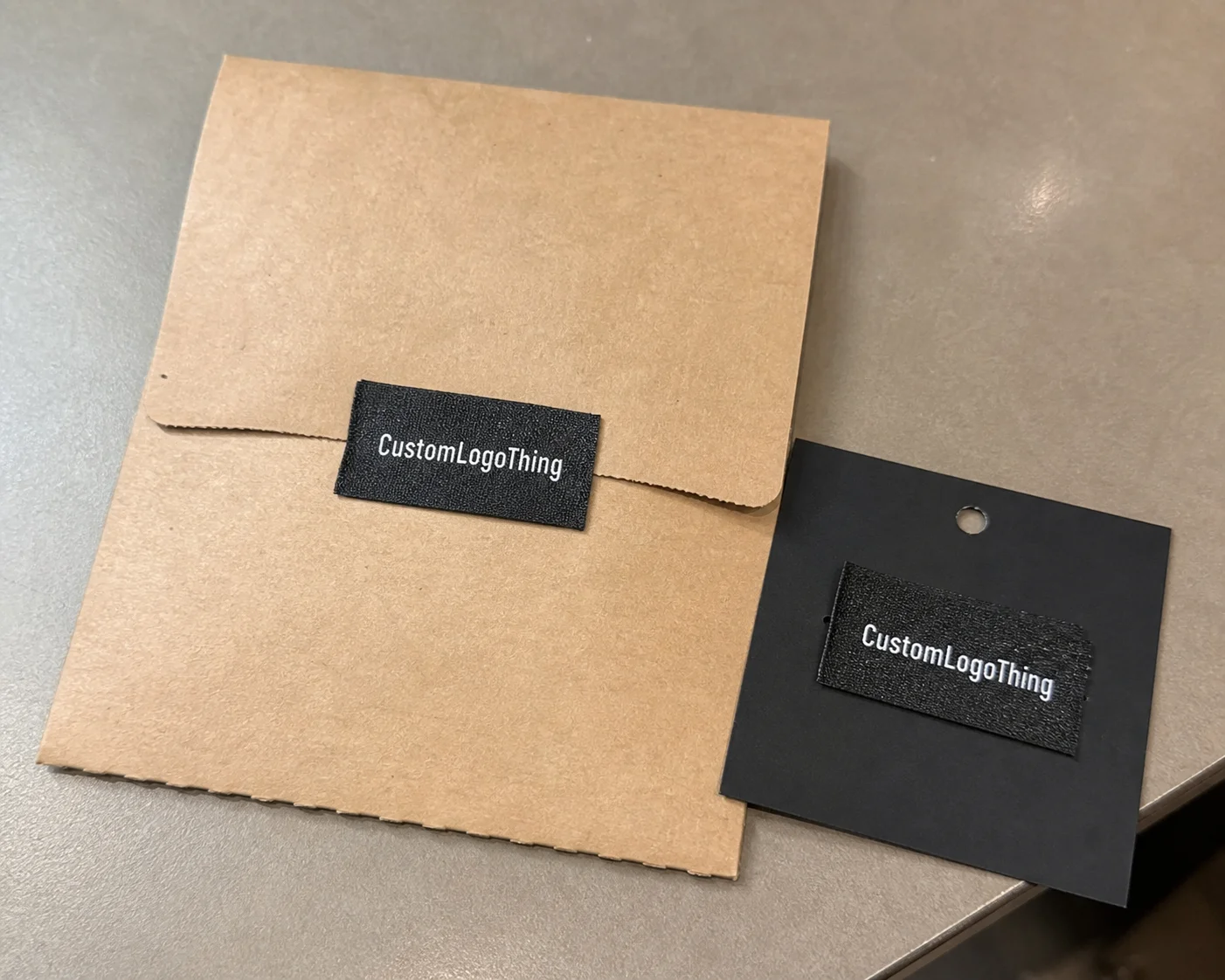
Woven labels have a strange economics problem: they are physically small, but they affect how the whole order is judged. That makes them useful in ecommerce, where the customer usually sees the product first through packaging, photography, and unboxing rather than a retail shelf.
A crisp neck label or side seam label can replace less durable brand touches, such as a loose sticker or a paper insert that feels generic after one glance. It also avoids the hidden friction of extra packaging steps. Every added insert or accessory means another handling action, and another chance for inconsistency.
There is a practical comparison here. A brand can spend more on oversized packaging elements and still look less polished than a brand that spends carefully on one well-made woven label and keeps the rest of the packout clean. That is not theory. It is a pattern buyers see repeatedly once a line moves from sample stage into real fulfillment.
For ecommerce, the label also carries a signaling effect. It suggests permanence. It tells the customer the product was made to be kept, not just shipped. That matters most on apparel, where the difference between “finished” and “unfinished” often comes down to details most buyers never consciously name.
The best way to think about woven Labels Unit Cost for ecommerce is to compare the label against the jobs it performs. A label that supports brand recognition, improves presentation, and keeps the packout simple can be the lower-cost option even if its raw unit price is not the lowest on the spreadsheet.
One more thing is easy to miss: labels influence reorders. If the first run looks right and the next run matches it, the brand avoids repeated proofing, correction, and remakes. That is a cost control problem as much as a branding problem.
What drives woven label pricing for ecommerce
The quote for a woven label is usually built from a handful of variables, and buyers who understand those variables ask better questions. Size, weave density, fold type, thread count, and quantity all matter. So does the actual artwork. A simple logo mark is one thing; a label with small type, multiple lines, and tight spacing is another.
Material choice changes the conversation too. Damask is often the most practical option for ecommerce brands that want sharp detail and a polished hand feel. It usually handles fine text better than a cheaper weave and gives a cleaner result on most apparel. Satin can feel smoother and look refined on the face, while taffeta is often chosen when the spec can tolerate a more basic appearance and the buyer wants to stay closer to the budget end.
Fold style adds another layer. An end fold, center fold, straight cut, or miter fold is not just a finishing preference. It changes how the label is handled in production, how it is sewn into the garment, and how much finishing labor is involved. That means the quote can move even when the artwork stays the same.
There is a good reason to separate appearance from production reality. A design may look simple on screen and still require denser weaving because of small text or fine lines. The opposite happens too. Some labels look busy on the mockup but are easy to produce because the spacing is forgiving. Buyers who ignore that difference usually overpay for detail they do not need, or under-spec a label and end up with poor readability.
| Label style | Typical use | Indicative unit cost | What moves the price most |
|---|---|---|---|
| End fold damask | Neck labels, brand tags, side seam labels | $0.05-$0.12 per piece at mid-volume | Color count, width, and fold precision |
| Center fold | Care labels, combined brand and size labels | $0.04-$0.10 per piece at higher volume | Length, text density, and finishing |
| Straight cut | Simple branding, sew-in tabs, bulk applications | $0.03-$0.09 per piece | Edge finish, quantity, and thread density |
| Miter fold | Premium presentation, specialty garments | $0.07-$0.15 per piece | Alignment, extra finishing, and labor |
Those numbers are planning ranges, not universal quotes. They are most useful when a buyer needs a starting point before sending the spec out. On a 1,000-piece order, setup and proofing can weigh heavily on the per-unit price. On a 5,000- or 10,000-piece run, the same setup is spread more efficiently, which usually brings the label cost down in a visible way.
MOQ is the next lever. A low minimum order can be useful if the design is new or the line is unproven, but the cheapest MOQ is not always the cheapest path overall. Some small-run offers carry higher setup or tooling charges, so the unit number looks modest only until freight and finishing are added. If the brand expects to reorder quickly, a slightly larger run can produce a better landed cost and fewer production headaches.
Specifications buyers should confirm before pricing woven labels
Good pricing starts with good input. When a buyer sends vague artwork and no size target, the quote usually comes back padded for risk or gets revised later. Neither outcome is helpful. A clean spec sheet speeds up the process and reduces the chance of a surprise after the sample arrives.
The fields that matter most are straightforward:
- Finished size: the actual dimensions after folding, not just the flat cut size.
- Fold type: end fold, center fold, miter fold, straight cut, or a custom finish.
- Placement: neck label, side seam label, care tab, or external brand tag.
- Color count: the number of thread colors used, including any background color.
- Artwork format: vector is preferred, with text locked and checked before submission.
- Quantity: the first run plus realistic reorder volume if pricing should reflect repeat business.
Placement matters more than many buyers expect. A neck label sits against skin and needs to feel softer. A side seam label can usually tolerate a firmer hand. A care label has to remain readable after washing and wear, which pushes the design in a slightly different direction. These are not cosmetic differences; they affect the material choice, weave density, and finishing method.
Artwork is where a lot of quotes are won or lost. Small text has to survive the weaving process, not just the mockup. Fine lines can disappear if the design depends on screen-level detail. Script fonts are especially risky at small sizes. A buyer who simplifies the art before quoting often saves more money than one who tries to force a complex design through production and fixes it later.
Before asking for a price, it helps to lock five items internally:
- Final finished size and garment location.
- Whether the label is brand-only, care-only, or a combined version.
- The exact color count, including background thread if applicable.
- Whether the artwork has already been approved by the brand team.
- The target delivery date and whether the order is for launch or replenishment.
If the broader product line also needs printed trim pieces or matching branding components, it helps to keep the category organized under Custom Labels & Tags. Consistent spec naming reduces quoting errors and keeps revisions from spreading across separate purchase requests.
Pricing tiers, MOQ, and real tradeoffs
Woven Labels Unit Cost for ecommerce becomes more useful once you compare pricing by volume tier instead of treating every quote as isolated. A small run is usually expensive per piece because setup is spread across fewer labels. Mid-volume orders tend to be the sweet spot for most ecommerce brands. Large runs bring the unit cost down further, but only if the design is stable and the label will not change soon.
The logic is simple. Fixed work such as artwork prep, loom setup, proofing, and finishing does not scale linearly with quantity. The same amount of prep may support a few hundred labels or several thousand. That is why a 1,000-piece order and a 10,000-piece order can look very different on the unit line even if the spec is identical.
That said, inventory has a cost. Buying too many labels ties up cash and storage space. It also creates a risk that a logo update, size change, or compliance change will make the stock obsolete before it is used. The best MOQ is the one that matches the brand’s reorder rhythm, not the one that simply looks attractive on a quotation sheet.
Comparing suppliers on price alone usually misses the real issue. Some include sampling, shipping, and setup in one number. Others split them out. A quote that looks low can become the highest landed cost once all the extras are added. For small ecommerce orders, those differences matter more than they do on a massive wholesale run.
Use this as a simple comparison frame:
| Quote element | Why it matters | Buyer check |
|---|---|---|
| Sample cost | Shows whether approval work is billed separately | Ask whether it is credited back on production |
| Unit price | The core cost per finished label | Match the same size, fold, and color count across quotes |
| Setup charges | Covers first-run preparation and file handling | Check whether they repeat on reorders |
| Shipping | Changes landed cost fast on small runs | Confirm carrier, packing method, and destination |
One useful habit is to ask for pricing at two or three quantity levels. The shape of the quote often tells you more than the quote itself. If the unit cost falls sharply between 1,000 and 5,000 pieces, the supplier is probably absorbing fixed setup costs in a standard way. If the price barely moves, there may be a hidden charge elsewhere or a production method that does not reward scale.
Production steps, lead time, and approval process
Woven labels move through a predictable sequence: artwork review, digital proof, sample approval, weaving, finishing, inspection, and packing. If the process is clean, it usually runs on schedule. If it is not, the lead time grows. Most delays come from bad inputs, not from the loom itself.
A realistic lead-time range for standard woven labels is often 10 to 15 business days after proof approval, depending on quantity and current workload. More complex artwork, unusual finishing, or larger runs can extend that. Rush production is possible in some cases, but it depends on capacity and on how complete the file is when it arrives.
The usual delay points are easy to identify:
- Artwork that is unreadable or too low in resolution.
- No clear instruction on fold type or finished size.
- Revision requests after the proof has already been approved.
- Late changes to the shipping address or delivery window.
For ecommerce teams, the practical fix is to lock the calendar before the order is placed. If the label has to arrive before a seasonal release, say so. If the line is already live and the label is replenishment stock, that should be clear too. Production planning works better when it matches the actual sales cycle instead of a generic factory estimate.
Quality control matters here, even on a small component. The right check is not just “does the label match the proof?” It is also “does it sit correctly once sewn?” and “does the color still read well under normal retail lighting?” Some issues only show up once the label is attached to a finished garment. That is where sample approval earns its keep.
For brands that manage packaging as a system, not a collection of separate pieces, the broader shipping environment matters too. The ISTA testing framework is a useful reference when cartons, inserts, and outer packaging are part of the same order. The label itself is only one component, but consistency across all components keeps the product presentation coherent.
Why ecommerce brands compare suppliers on consistency, not just price
A low quote can still become expensive if the labels vary from batch to batch. Color drift, rough edges, inconsistent folds, and bad cutting all create rework or slow down fulfillment. None of that shows up well in a unit-price comparison, but all of it affects margin and brand perception.
Consistency matters more in ecommerce than it often does in one-off retail production because the same SKU may be shipped for months. The buyer expects the second carton to look like the first. If the next run changes size or color subtly, the brand starts paying for the difference in customer service, returns, or quiet dissatisfaction that never gets logged cleanly.
That is why a strong supplier is not simply the one with the cheapest label. It is the one that can repeat the spec cleanly. Stable color matching, clean finishing, and predictable folds reduce surprises, and surprises are expensive when the product is already live.
There is a secondary effect too. When woven labels are part of a larger branding set that includes paper inserts or packaging notes, buyers need to be careful about material claims. Paper components can be sourced to recognized standards such as FSC, but woven labels are a different material category and should not inherit claims they do not actually meet. That distinction sounds small. It is not. It affects both compliance and credibility.
In a practical sourcing model, the supplier should be able to handle repeat business without forcing the buyer to rebuild the spec every time. That means the first quote is clear, the sample is accurate, and the reorder path is boring in the best possible way. Nothing dramatic. Just a label that arrives on spec and keeps doing the same job on the fifth run that it did on the first.
How to get an accurate quote
The fastest way to get a useful quote is to send the full spec on the first pass. That means size, fold type, quantity, color count, artwork file, attachment method, and delivery target. A vague request forces the supplier to guess. A precise request lets them price the job the way it will actually be produced.
Artwork should be as clean as possible before it goes out. Vector files are ideal, but if the only available file is a high-resolution image, the text still has to remain readable at label size. If a line of copy is critical, make that clear. If the order is a launch sample rather than a full production run, say that too. Sampling and production do not always have the same economics.
Ask for the sample cost and the production unit cost separately. That is the cleanest way to compare suppliers. A low sample fee with high production pricing can distort the total, and the reverse can happen as well. Once the first sample comes back approved, the production order should follow the same spec without surprise revisions.
Buyers often get the best result by treating the first production run as the validation point. Check the hand feel, the stitch line, the fold, the color under normal light, and the legibility of the smallest text. If the label works on the first order, standardize it and keep it stable. That is where woven labels unit Cost for Ecommerce stops being an abstract quote exercise and becomes part of a repeatable margin model.
FAQ
How do I estimate woven labels unit cost for ecommerce orders?
Start with the basics: quantity, finished size, fold style, color count, and weave density. Those are the variables that change the quote most quickly. Ask for pricing that separates sample cost, setup, and unit price so you can compare suppliers on the same basis. If you expect to reorder, include that in the conversation because reorder volume can change the real cost picture.
What MOQ is typical for custom woven labels?
MOQ depends on the supplier and on how complex the label is. A simple design usually supports a smaller minimum than one with dense text or multiple folds. The right MOQ is not the smallest one offered; it is the one that fits your reorder cycle without creating excess stock. Short-run options can work for a launch, but they often carry a higher unit cost.
Which woven label style gives the best value for ecommerce brands?
Damask labels are often the best value because they combine readable detail with a polished look. End fold and center fold versions are common on apparel because they sew cleanly and fit most garment types. The best value is usually the style that balances appearance, durability, and sewing efficiency for the exact product you are shipping.
How long does woven label production usually take?
A standard timeline is often 10 to 15 business days after proof approval, but that changes with volume and finishing complexity. The fastest way to keep the schedule tight is to send final artwork and respond quickly to proofs. If the delivery date is fixed, it should be stated before production begins so the schedule can be built around it.
What should I send to get an accurate quote fast?
Send the finished size, fold type, quantity, color count, artwork file, and placement on the garment. Include whether the order is a sample, a first production run, or a reorder. If you have a launch date or a replenishment deadline, add that too. The more complete the input, the less room there is for assumptions in the price.
The practical takeaway is simple. The lowest label price is not always the lowest cost, and the most expensive label is not always the best one. The right answer depends on how the label is built, how it is used, and how often it will be reordered. That is the real shape of woven labels unit cost for ecommerce.