Woven Neck Labels Supplier b2b sourcing matters because the label is small but consequential. It sits against skin, survives washing, appears in close-up product photos, and can make an otherwise good garment feel unfinished if the weave, fold, or text quality is off.
Woven Neck Labels are simple in concept: yarn is woven on a loom to form brand, size, care, or origin information. In practice, they require the buyer to manage artwork limits, fold style, readability, hand feel, and repeatability. The best outcomes come from clear specs and disciplined sampling, not from hoping the factory will infer what was intended.
A label can be tiny and still control the first impression. If the weave, fold, or text size is off, the whole garment feels less finished.
Woven neck labels supplier B2B sourcing: what buyers need to know
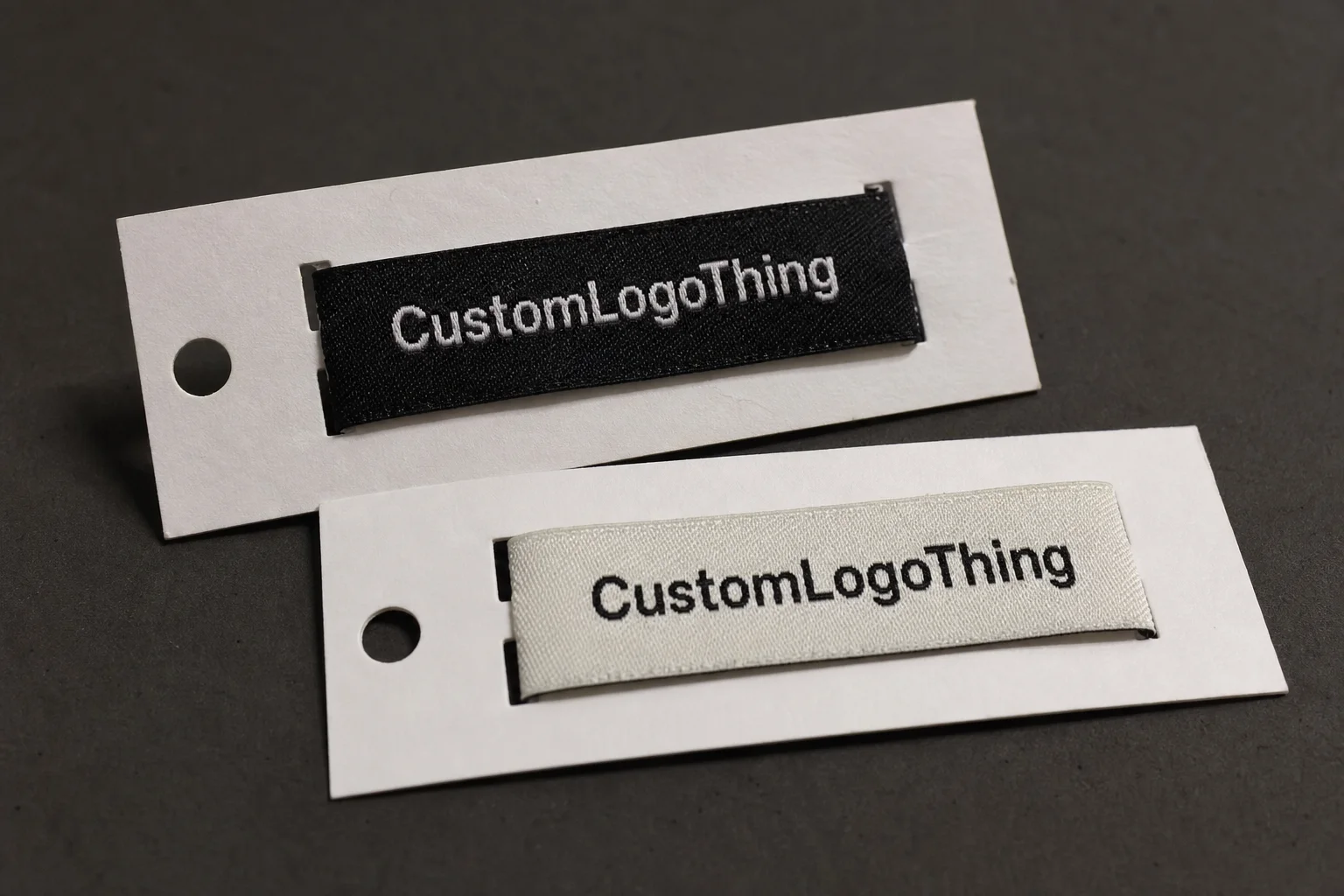
A woven neck label is built from thread, not ink. That means the design has to be translated into weave structure, thread count, and color placement. Logos, icons, and text that look fine on a screen can become muddy once the label is reduced to actual size.
Most buyers need more than branding. Neck labels often need size, care instructions, fiber content, and country-of-origin information. Fold type also matters. A center fold, end fold, Manhattan fold, or straight cut each affects how the label is sewn and how much visible area remains after attachment. If the supplier cannot explain those options clearly, the sourcing process is too loose.
For B2B sourcing, the main difference from a one-off custom order is repetition. Brands are usually managing multiple SKUs, seasonal reorders, and tighter consistency across production runs. A soft hand feel may be important for childrenswear, while a denser weave may be better for premium outerwear. Broader trim programs, including Custom Labels & Tags and recurring buying through Wholesale Programs, become useful when the label order is part of a larger supply plan.
The practical rule is to remove ambiguity before the loom is set up. Once dimensions, text, fold, and color targets are vague, every later step becomes more expensive. A supplier can only reproduce what is actually defined.
Readability is not the same as approval. A dark-on-dark weave may technically match the brand palette and still fail in low light. A color that is close on a deck can feel off once translated into thread. Buyers should evaluate labels as physical components, not as graphics.
How woven label sourcing works from artwork to carton
The standard path is brief, artwork review, loom setup, sample, approval, bulk production, inspection, packing, and shipping. When one of those steps is skipped, the order usually becomes less predictable later.
Artwork review is where most problems are caught. Woven labels are not printed labels with unlimited resolution. Thin lines, hairline text, gradients, and crowded layouts often need simplification. The safest revisions are usually structural: widen spacing, reduce copy, or remove decorative detail that cannot survive at label scale.
The proof should show the label at real size. A design that looks balanced on a monitor can collapse once it is reduced to 30 or 40 millimeters. A production-ready proof should show fold type, dimensions, thread colors, and text hierarchy. A flat mockup without technical context is not enough to approve bulk production.
Revision timing also matters. Changing thread shade before loom setup is manageable. Changing fold type after approval often triggers a redraw or a second sample. Adding care text after the proof is signed off can push the schedule because the layout has to be rebuilt around the new copy. Once bulk production starts, every change has a cost.
Packing should match the sewing workflow. Some factories want cut-and-folded bundles, others prefer rolls, and some can use flat stacks. The cheapest format on paper is not always the cheapest at the line. If a garment plant has to spend more time sorting labels, labor can erase the savings.
Cost, MOQ, and unit price: what actually moves the number
Price is driven by structure. Size, weave density, number of colors, fold type, edge finish, backing, and quantity all affect the quote. A small label with simple text and two colors is usually near the lower end of the range. A denser multi-color label with premium finishing moves up quickly because setup, loom time, and waste increase.
For buying decisions, separate unit price from landed cost. A woven neck label can often land around $0.05 to $0.12 each at stronger volumes, while more complex versions may sit around $0.14 to $0.30+ depending on size and finishing. That number is incomplete if it does not include sampling, freight, duties, trim packing, or rush charges. A low per-piece quote that requires expensive shipping is not actually low.
| Spec level | Typical setup | Indicative unit price | What pushes cost up |
|---|---|---|---|
| Basic neck label | 1-2 colors, standard fold, simple text | $0.05-$0.10 at higher quantities | Small MOQ, rush timing, special backing |
| Mid-complexity label | 3-4 colors, tighter weave, brand + size detail | $0.08-$0.16 | Fine text, color matching, custom fold |
| Complex label | Dense artwork, multiple finishes, premium hand feel | $0.14-$0.30+ | High stitch density, low quantity, extra QC |
MOQ is usually about setup economics. The supplier has loom preparation, proofing, and finishing labor to recover, so lower quantity normally means higher unit cost. That is predictable rather than arbitrary. If you have several versions, ask whether they can be scheduled together so the setup is shared.
Most price inflation comes from unnecessary detail. Buyers often request artwork that cannot be read at label size, add colors because they exist in the brand deck, or ask for packaging upgrades that do little for garment handling. An experienced supplier should be able to point out where simplification reduces cost without hurting readability or durability.
Quality control also affects cost. A dense, multi-color label with tight tolerances needs more inspection than a simple one. If a supplier prices both at the same risk level, the quote may be too casual. The right comparison is not the cheapest number; it is the best match between spec and production reality.
For repeat orders, a slightly higher quote can be cheaper over time if the supplier retains approved files, keeps the same thread chart, and reproduces prior runs without rebuilding the job from scratch. Repeatability has value, especially when the same label appears across seasons.
Lead time and production steps: what to expect before you promise a delivery date
Lead time is a chain, not a single number. A realistic schedule includes quote review, artwork cleanup, sample production, approval, bulk production, inspection, packing, and transit. A smooth order may move from final artwork to bulk production in roughly 12 to 15 business days, then add shipping time based on route and freight method.
The biggest lead-time risks are ordinary rather than dramatic. Missing dimensions, unclear fold type, late approval, color corrections after sampling, peak season pressure, and freight congestion are the usual causes of delay. The job rarely fails in one big moment. It slips through small gaps in control.
Sample timing and bulk timing are not the same. A supplier may produce a sample in a few days and still need two more weeks for bulk because loom scheduling, finishing capacity, and packing inventory are separate constraints. Buyers often overread fast sampling as proof of fast production, which creates bad delivery promises downstream.
The most useful question is direct: if the specification is approved today, what is the actual ship-date range? A careful supplier will answer with a window that reflects production load and transit uncertainty. That is more useful than an optimistic promise.
Inspection should happen at actual size and under real lighting, not just on a screen. A woven label needs to be checked for readability, edge quality, hand feel, and fold accuracy. If the edge feels abrasive, the letters close up, or the fold does not sit correctly after sewing, the defect matters because the label is worn against skin.
If labels are part of a broader packaging system, material compliance can affect the order too. For paper-based components, standards such as FSC may be relevant. In those cases, the label order should not be separated from the rest of the package plan if traceability is part of the buying requirement.
A practical supplier comparison checklist for better quotes
The best supplier comparison starts with the sample and the discipline behind it, not the price. A clean sample should have readable text, stable weave, accurate color, and a finish that suits the garment. If the label is close but visually soft, the weave count may be too low. If it feels rough, the hand feel is already a problem.
Communication quality is an early warning sign. A supplier that misses dimensions, fold type, or quantity on the quote often misses details later too. One mistake is not fatal; a pattern of vague answers is. Accuracy in quotation, version control, and approval handling are all signs of a controlled process.
What a good comparison should include
- Sample clarity at actual size, not just a digital mockup.
- MOQ and unit price at at least two quantities.
- Thread color matching method and tolerance notes.
- Fold style, cut method, and packing format.
- Lead time for sample and bulk listed separately.
- Repeat-order handling and whether approved files are retained.
If the order may repeat, ask how the supplier stores files and version history. Can they reproduce the same size, thread chart, fold, and layout without rebuilding the job every time? A re-order that behaves like a fresh project is a sign the system is weak.
It also helps to ask how defects are handled. What counts as acceptable color variance? What happens if the fold is off? How is rework approved? A specific process is worth more than general reassurance.
Common mistakes that create reworks, delays, and ugly labels
The most common error is asking too much of the weave. Tiny letters, thin lines, and detailed gradients can look polished in a design file and collapse in thread. The result is a blurry or crowded label, and the fix is usually simplification.
Another common mistake is skipping fold confirmation. One team approves a fold in email, the factory interprets the placement differently, and the label no longer fits the sewing plan. The same problem shows up with color references. A Pantone code alone may not be enough if the supplier is matching thread rather than ink. Visual references and a clear note on whether the target is exact or approximate reduce guesswork.
Care-content text creates another round of problems. Buyers often leave legal copy until late, then discover there is not enough room for readable text. If the label must carry fiber content, origin, washing symbols, or multilingual instructions, the layout has to account for that from the start. Forcing a long paragraph into a small neck label rarely works.
Screen approval is the final trap. A woven label can look correct on a monitor and still fail in hand. Texture, flexibility, edge finish, and readability at actual size matter more than a flat image. Check the sample under the same conditions the garment will face.
If a sample looks good on screen but fails in hand, you do not have an approval. You have a screenshot.
What to send next so a supplier can quote accurately
A usable quote starts with a usable brief. Send the label dimensions, fold type, artwork file, number of colors, quantity, target ship date, and any requirement for softness, backing, or wash durability. If there are multiple versions or sizes, list each one separately. Clarity is cheaper than revision.
Add a color reference if the brand has one, and say whether the label needs to match another garment component. If the label is part of a larger system, mention whether you also need side seam labels, care labels, or coordinated packaging. That gives the supplier a chance to propose one production plan instead of several disconnected ones.
Ask for sample timing, bulk timing, and freight estimate in the same response. A quote without timing is incomplete. Timing without shipping assumptions is incomplete too. When those pieces are present, Woven Neck Labels Supplier b2b sourcing becomes a controlled comparison rather than a guessing exercise. The buyer can compare like for like, protect the schedule, and keep future reorders predictable.
For brands scaling into recurring demand, the supplier relationship matters because it reduces friction on repeat production. The value is not that everything becomes automatic. The value is that the supplier already knows the target size, preferred hand feel, color tolerance, and reorder rhythm.
Final rule: treat the label like a product, not an afterthought. The brands that do this well send cleaner specs, compare quotes on the same basis, and approve samples by touch and light, not by hope.
What should I ask a woven neck labels supplier before ordering in B2B sourcing?
Ask for MOQ, unit price at different quantities, sample time, bulk lead time, and freight assumptions. Request a spec-based quote so you can compare suppliers on the same design rather than on loose descriptions.
How do I know if my woven label artwork is too detailed?
If the text is tiny, the lines are thin, or the logo depends on gradients or micro-details, the weave may not hold it cleanly. Ask for a production-ready proof or woven sample before you approve bulk.
What is a realistic MOQ for woven neck labels?
MOQ depends on size, color count, and finishing, but smaller runs usually carry a higher unit price. If you need several versions, ask whether the supplier can combine them into one production run.
How long does B2B sourcing usually take for woven neck labels?
Plan for quote review, sample, approval, bulk production, QC, and shipping. A smooth order can move quickly, but rush work usually costs more and leaves less room for revisions.
What is the biggest mistake brands make when sourcing neck labels?
They approve based on a screen image instead of checking the label at actual size and confirming the fold, feel, and packing format. They also compare quotes without matching specs, which makes the cheapest number look better than it is.