Buyer Fit Snapshot
| Best fit | Adhesive Shipping Labels Supplier projects where brand print, material claims, artwork control, MOQ, and repeat-order consistency need to be specified before quoting. |
|---|---|
| Quote inputs | Share finished size, material target, print colors, finish, packing count, annual reorder estimate, ship-to region, and any compliance wording. |
| Proofing check | Approve dieline scale, logo placement, barcode or warning zones, color tolerance, closure strength, and carton packing before bulk production. |
| Main risk | Vague material claims, crowded artwork, missing packing details, or unclear freight terms can make a low unit price expensive after revisions. |
Fast answer: Adhesive Shipping Labels Supplier: Material, Adhesive, Artwork, and MOQ should be specified like a repeatable production item. The safest quote records material, print method, finish, artwork proof, packing count, and reorder notes in one written spec.
Production checks before approval
Compare the actual filled-product size with the drawing, then confirm tolerance on folds, seals, hang holes, label areas, and retail display edges. Reserve space for logos, QR codes, warning copy, and material claims before decorative graphics fill the panel.
Quote comparison points
Review material grade, print process, finish, sampling route, tooling charges, carton quantity, and freight assumptions side by side. A quote is only useful when the supplier can repeat the same color, closure quality, and packing count on the next order.
Adhesive Shipping Labels Supplier: What to Know First
An adhesive shipping labels supplier does a lot more than print a logo on sticky stock and send it out the door. The better partners help determine whether labels stay put through packing, parcel sorting, vibration in transit, and the final handoff to the customer. If the adhesive is wrong, the entire shipment can look sloppy in a hurry, and yeah, that usually shows up right when a warehouse is busiest.
From a packaging buyer's point of view, labels sit in a narrow but important space. They are small enough to overlook and critical enough to cause trouble if they fail. They affect package protection, carrier scanning, warehouse flow, and the first physical impression a customer gets after opening the outer carton. A serious adhesive shipping labels supplier should understand facestock, adhesive chemistry, format options, printer compatibility, and the conditions that make labels lift, smear, or fall off.
The first question rarely starts with price. It usually starts with the surface, the storage conditions, and the speed of the line. A carton headed to a dry local route is not the same as a frozen shipment moving through a cold chain, and a poly mailer on a fast ecommerce shipping line brings a different set of demands than a recycled box in a calm warehouse. The buyer who asks those questions early usually saves time, waste, and rework later.
I have seen operations lose half a shift because labels were fine on paper spec sheets but refused to bond to a coated mailer once the room got cold. That kind of problem is annoying, but it is also predictable if you know what to check.
A label that survives the truck is cheaper than a label that fails in the warehouse.
What an Adhesive Shipping Labels Supplier Actually Does
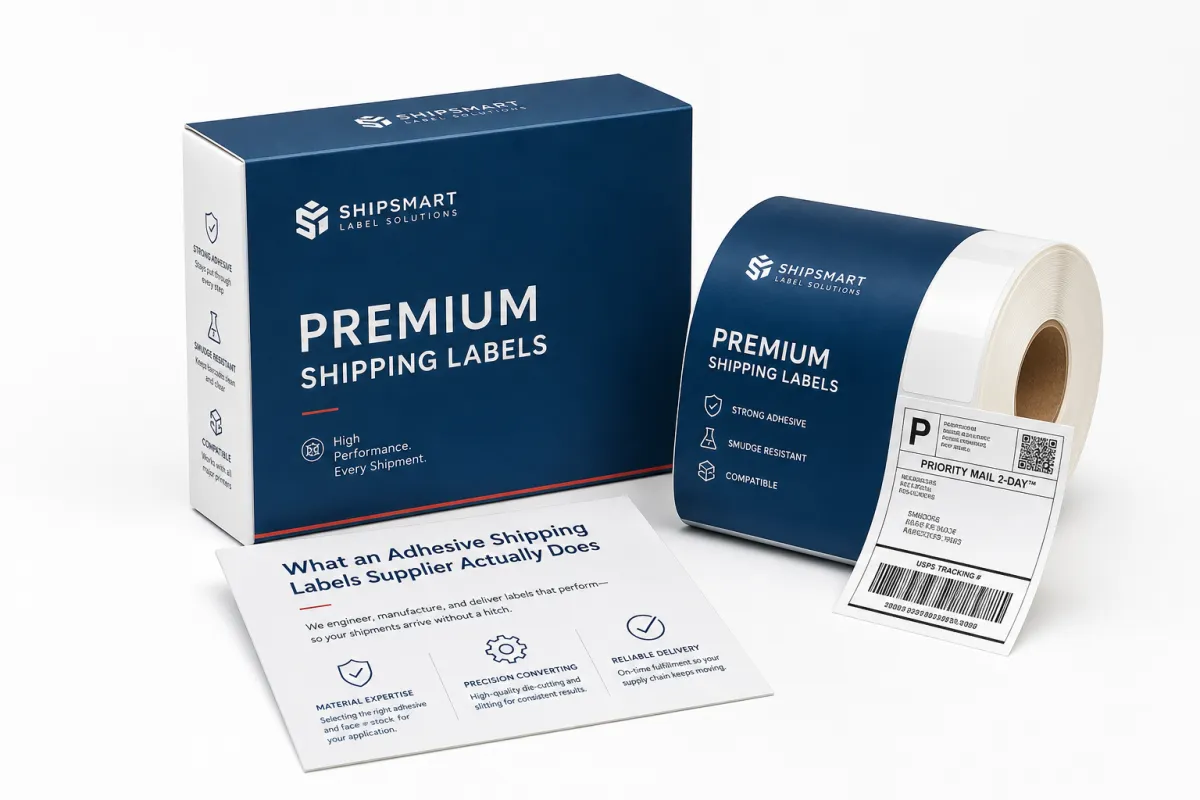
An adhesive shipping labels supplier sources the stock, chooses the adhesive build, checks printer compatibility, and delivers labels in a format your team can actually use. That may mean rolls for thermal printers, sheets for a smaller operation, or custom die-cut shapes for branded shipping materials. The supplier's job is to keep the label attached long enough to do its work, then scan cleanly when the carrier or warehouse needs it to.
There is a real gap between a printer vendor, a converter, and a true adhesive shipping labels supplier. A printer vendor may simply put artwork on whatever stock is available. A converter turns raw material into rolls or sheets and controls the adhesive and facestock build. A supplier worth trusting asks about carton finish, application temperature, moisture exposure, handling time, and whether the label needs to live through cold storage or rough last-mile transit.
That difference matters because material behavior, not artwork, usually decides whether the label stays put. Corrugated board, coated paper mailers, glossy plastic mailers, and recycled shipping boxes all behave differently. A label that grips one surface can start lifting at the edges on another. If your operation uses Custom Labels & Tags as part of a larger packaging setup, the supplier should be able to explain those tradeoffs without vague promises.
Start with surface and environment. Ask what the package is made of, what temperature it sees during application and storage, whether the dock area sees moisture, and how quickly the parcel enters carrier lanes. A label applied to a cold box at 35F can behave very differently from the same label on a room-temperature carton. A good adhesive shipping labels supplier should treat that as normal work, not as an unusual request.
There is also a practical difference between a label that merely sticks and one that scans reliably. A barcode with low contrast, a curl at the edge, or ink that rubs off in a sorter can slow the whole chain down. I have watched teams blame the printer when the real issue was the adhesive layer and facestock working against the application surface.
- Surface type: corrugated, coated paper, film, poly mailer, or reusable packaging.
- Temperature: room temperature, refrigerated, frozen, or fluctuating warehouse conditions.
- Moisture: dry storage, condensation, freezer fog, or splash exposure.
- Printer compatibility: direct thermal, thermal transfer, or digital print methods.
- Shipping speed: same-day fulfillment, scheduled runs, or seasonal volume spikes.
How Adhesive Shipping Labels Supplier Processes Work
The process usually follows a more disciplined path than buyers expect. A solid adhesive shipping labels supplier begins with an inquiry, asks for application details, recommends a construction, and then moves into proofing, production, quality checks, and shipment. That order is not paperwork for its own sake. It is how suppliers avoid delivering a label that looks fine on screen and misbehaves on corrugated, film, or refrigerated packaging.
Most projects begin with a material recommendation. For corrugated cartons, permanent adhesive is often the baseline because those boxes have to survive handling, stacking, vibration, and friction along the line. For internal logistics or reusable bins, removable adhesive may make more sense. For cold chain shipments, freezer-grade or low-temperature adhesive is usually the safer choice, especially where condensation or frost can weaken the bond before the parcel even leaves the dock.
Print method matters too. Direct thermal labels are common in ecommerce shipping because they are fast and easy to run, but they can fade under heat, abrasion, or long dwell times. Thermal transfer printing tends to hold up better for longer life or more demanding package protection requirements. Digital printing works well for custom graphics and short runs, yet coatings, facestock selection, and ink behavior still need to match the printer and the adhesive build. A capable adhesive shipping labels supplier will line up those variables rather than forcing one generic answer.
Timelines usually move with a handful of predictable factors: artwork approval, stock availability, die-cutting, and freight distance. A new size can add tooling time. A supplier may have the facestock in stock but not the exact adhesive or liner, and that can shift the schedule. Long freight lanes can matter as much as production time. A seasoned adhesive shipping labels supplier will tell you where the clock may slip before the quote turns into a commitment.
If the label program sits inside a larger packaging reset, it helps to look at the whole flow. Labels rarely operate alone; they work alongside Custom Packaging Products, cartons, void fill, tape, and in some operations Custom Poly Mailers. A tighter system leaves less room for surprises in the shipping lane.
Transit testing standards can help buyers set a quality benchmark. Organizations like ISTA focus on distribution testing, which is useful for understanding how labels and packaging behave under vibration, drop, compression, and temperature swings. A supplier that can speak in those terms is usually more grounded than one that only talks about "strong stick" and "bright print."
In practice, the best conversations feel pretty plainspoken. You describe the box, the route, the printer, and the rough spots. They translate that into material choices, and the choices make sense on the bench as well as in the warehouse.
Key Factors When Choosing an Adhesive Shipping Labels Supplier
The biggest decision point is substrate and adhesive quality. Paper labels are often the most economical choice for standard carton labeling, but they can scuff or tear if the shipment sees heavy friction. Polypropylene and other synthetic facestocks cost more, yet they resist moisture, abrasion, and rough handling better. The right adhesive shipping labels supplier should explain that tradeoff clearly instead of pretending one material wins every time.
Pricing needs a wider lens than the headline quote. Unit cost matters, and so do setup fees, die charges, freight, reorders, and the labor lost when labels jam printers or fail to scan. In many warehouse environments, one bad roll costs more than the savings from a cheaper order. A buyer focused on order fulfillment speed will usually care less about pennies per label than about consistency, because inconsistency creates hidden labor and service costs.
Minimum order quantities can reshape the economics as well. Smaller ecommerce shipping teams may not want 10,000 labels sitting in a storage room, especially if branding or compliance copy changes often. Larger operations often want the opposite, since a bigger run can keep unit pricing in check and reduce how often they reorder. An experienced adhesive shipping labels supplier should be able to talk through both sides and recommend a practical range instead of pushing the largest volume every time.
Credibility checks deserve real attention. Ask for spec sheets, sample availability, proof of print compatibility, and a clear explanation of adhesive performance under actual use conditions. If the labels are tied to recyclable shipping materials or FSC-sensitive paper sourcing, ask how that chain is documented. The FSC system helps clarify responsible fiber sourcing, which matters to brands trying to keep transit packaging decisions consistent with their sustainability claims. A good adhesive shipping labels supplier should welcome those questions.
A practical supplier checklist usually looks like this:
- Material data: facestock, adhesive type, liner, and finish.
- Performance proof: sample rolls or sheets for real-world testing.
- Support speed: fast answers when an artwork or stock issue appears.
- Capacity: ability to handle seasonal spikes without changing quality.
- Documentation: print, adhesion, and sourcing details you can keep on file.
One detail often gets missed: dimensional weight has nothing to do with the label itself, yet it still affects the economics of the shipment the label supports. Right-sized cartons can lower freight cost, but only if the label survives the route and keeps the parcel moving. That link is easy to overlook, which is one reason an adhesive shipping labels supplier should be judged as part of the larger packaging system, not as an isolated line item.
Another quiet issue is label storage. Roll labels that sit too close to heat, direct sunlight, or damp concrete can change behavior before they ever hit the printer. That kind of thing gets skipped in a lot of sales conversations, but in a real facility it can absolutely make the difference between a clean run and a headache.
Cost and Pricing: What Drives Label Spend
Label spend is shaped by more than size. Material grade, adhesive formula, finish, color count, die-cut complexity, packaging format, and whether the order is stock or custom all affect the final number. A standard white paper label for simple shipping use can be inexpensive, while a synthetic label with stronger moisture resistance and custom printing costs more. A practical adhesive shipping labels supplier should break those drivers apart rather than hiding them inside one quote.
The cheapest quote often turns into the most expensive choice later. If labels lift from corrugated board, smear in the printer, or leave residue in the wrong place, the warehouse pays for it in rework. Add reprints, customer service friction, and damaged cartons in transit, and the low bid starts to look less attractive. That is especially true in high-throughput ecommerce shipping, where even a small failure rate can become a measurable budget leak.
A simple way to compare bids is to look at cost per thousand labels, cost per successful application, and cost per shipment sent without exception. The first number is easy to quote. The second and third are the ones that matter. A decent adhesive shipping labels supplier will not hesitate when you ask for sample-based testing before you commit, because performance-based buying is usually the smarter path.
There are times to spend more. Cold storage, rough handling, long dwell times, compliance-heavy shipments, and moisture-heavy routes often justify a higher-spec label. In those cases, paying extra for a better adhesive or stronger facestock can reduce waste and protect scanability. That is not a luxury move; it is package protection in practical form.
Some buyers try to save by ordering a generic label and making the warehouse adjust printer settings later. That can work in a pinch, but it is not a real strategy. If the stock, ribbon, or adhesive is off, someone in the building ends up paying for the difference with time.
| Label Type | Typical Use | Performance Profile | Typical Cost Range per 1,000 |
|---|---|---|---|
| Paper permanent | Standard corrugated cartons | Good for dry, moderate handling; best on clean flat surfaces | $12-$28 |
| Polypropylene | Mailers, moisture exposure, longer dwell times | More abrasion resistant; better against scuffing and light moisture | $24-$52 |
| Synthetic freezer-grade | Cold chain and refrigerated shipping | Designed for low temperatures and condensation risk | $35-$75 |
| Custom printed roll | Brand-led ecommerce shipping and promotions | Can combine branding with variable data, but setup adds cost | $30-$90 |
Those ranges are intentionally broad. A label with heavy print coverage, a special liner, or a difficult die shape can move the price quickly. Freight can also shift the all-in cost more than people expect, especially for smaller orders. That is why a thoughtful adhesive shipping labels supplier will talk in terms of landed cost, not just unit price.
Step-by-Step Timeline for Working With a Supplier
A reliable adhesive shipping labels supplier follows a predictable path, and buyers can use that path to avoid surprises. Start by defining the application in plain language: what the package is, what it touches, how it is stored, and how it moves through the warehouse. Then ask for samples, because spec sheets only tell part of the story. Real boxes, real mailers, and real printer settings reveal the issues that matter.
Next comes the test phase. Apply samples to the exact packaging you ship most often, not to a clean desk in a conference room. Let the labels sit, compress them, expose them to the same temperatures they will see in daily use, and check whether the barcode still scans. A strong adhesive shipping labels supplier should encourage that kind of pilot run, because the results help both sides avoid waste.
Artwork approval is often where easy projects stall. If the label includes a logo, compliance copy, or serialized data, every field should be checked before production begins. That includes spelling, barcode contrast, size, and placement relative to the die line. A small error here can ripple into wasted shipping materials later, especially if the issue is caught after the full run is printed.
Lock the production schedule only after confirming quantities, packaging format, and reorder logic. Same-day sample requests can happen with stock items, but custom sizes or specialty adhesives usually need a longer window. A practical adhesive shipping labels supplier will give a timeline with contingencies, such as what happens if artwork changes or stock runs short. Buyers who ask for that upfront tend to get fewer late-stage problems.
- Define the use case: carton, mailer, frozen pack, or internal logistics.
- Request samples: ask for the exact facestock and adhesive build.
- Test on real packaging: check adhesion, scanability, and edge lift.
- Approve artwork: confirm colors, copy, barcode, and die line.
- Confirm quantities: decide on pilot volume and full-run volume.
- Schedule production: reserve time for print, finishing, and freight.
There is a useful distinction between a quick quote and a workable timeline. A quick quote may appear in hours. A workable timeline depends on stock availability, proofing speed, and whether the application is simple or specialty. In many cases, the shortest route is not the cheapest route, and a strong adhesive shipping labels supplier will say that plainly instead of pretending every job is standard.
If you're building a launch calendar around a new product line, add label lead time early instead of treating it like a final detail. That small habit prevents a lot of scrambling, and it keeps the packaging team from getting cornered by a late artwork change.
Common Mistakes When Selecting an Adhesive Shipping Labels Supplier
The biggest mistake is choosing by price alone and ignoring the surface the label must stick to. Corrugated cartons, plastic mailers, refrigerated packs, and coated boxes do not behave the same way. A label that looks fine on a smooth sample sheet may fail once it meets dusty board or cold condensation. That is why an adhesive shipping labels supplier should ask about substrate before quoting.
Skipping adhesion testing in the real shipping environment is another common miss. Lab data can help, but warehouse floors are rarely clean rooms. Cartons get stacked, bumped, flexed, and exposed to temperature swings. A label that passes a basic test and then lifts during transit packaging stress is still a failure. Buyers who run even a short pilot usually catch those problems before they reach customers.
Mismatching label format to printer type is another expensive error. Direct thermal printers are fast, but the wrong label stock can smear or fade. Thermal transfer can solve more durability issues, but only if ribbons, facestock, and settings are aligned. If a label jams or prints illegibly, the labor cost shows up immediately. A careful adhesive shipping labels supplier should ask about the printer model and the environment rather than assuming the old setup still fits.
Overordering custom labels before demand is proven can also cause pain. Artwork changes, compliance updates, and SKU shifts happen more often than people like to admit. A warehouse that buys a year of custom stock too early may end up with obsolete inventory and awkward write-offs. That risk is especially common in ecommerce shipping, where product lines and promotions change faster than traditional packaging cycles. A better adhesive shipping labels supplier will often suggest a pilot quantity first.
One more mistake hides in plain sight: not telling the supplier about the dock conditions. A label may behave one way in a climate-controlled office and another way in a cold, damp shipping area. If the supplier does not know that, they are guessing, and guessing is not a great plan for anything that has to survive a carrier network.
Expert Tips and Next Steps With an Adhesive Shipping Labels Supplier
Before you place an order, ask for three things: a material spec sheet, sample rolls or sheets, and a clear timeline with backup options if the schedule slips. Those three items tell you a lot about how an adhesive shipping labels supplier works under pressure. If the answers come back slowly, vaguely, or defensively, that is useful information too.
Test labels on the exact packaging you ship most often. Not a similar box. Not a cleaner version of the box. The exact one. Then check adhesion after compression, moisture, and temperature changes, because labels often look perfect right after application and fail later. If the package is part of a larger brand presentation, pair that test with the rest of the shipping materials, such as outer cartons and mailers, so the full system is evaluated together.
Build a simple supplier scorecard. Give more weight to performance, responsiveness, pricing transparency, and reorder simplicity than to one quote. A supplier that saves two dollars per thousand labels but creates extra labor is not actually cheaper. A strong adhesive shipping labels supplier should help you reduce uncertainty, not add more of it.
If paper sourcing, recycled content, or environmental claims matter to your brand, ask about the substrate chain of custody and how it fits your broader packaging story. That is where sustainability and transit packaging stop being marketing language and become operational questions. The right adhesive shipping labels supplier should be able to answer those questions in plain language.
For teams comparing labels with other transit packaging upgrades, it can also help to review adjacent items like Custom Shipping Boxes. The more the carton, label, and mailer choices fit together, the fewer exceptions your operation has to manage later.
The most useful mindset here is simple: treat labels as a working part of the package, not decoration. Once you do that, the buying conversation gets sharper, the testing gets cleaner, and the whole shipping line tends to behave better.
How do I choose the right adhesive shipping labels supplier for my packaging?
Match the adhesive shipping labels supplier to your real shipping conditions first. Carton type, temperature, moisture exposure, and printer compatibility matter more than a generic catalog. Ask for samples, apply them to the exact packaging you use, and test adhesion before you approve a full order. Compare total cost, not just unit price, because freight, setup, and failed labels can change the real number fast.
What affects adhesive shipping label pricing the most?
Material type, adhesive chemistry, size, finish, and custom printing usually drive the biggest price differences. A paper label with permanent adhesive will usually cost less than a synthetic label built for moisture or freezer exposure. Minimum order quantities and setup charges can also shift the effective cost, especially for smaller buyers. A careful adhesive shipping labels supplier should explain those tradeoffs clearly.
How long does it take to get custom labels from a supplier?
Stock labels can often move quickly, while custom labels usually take longer because proofing and production add steps. Artwork approval, special die cuts, and specialty adhesives can extend the schedule. A practical adhesive shipping labels supplier should give you a realistic timeline before you commit, including whether the project depends on in-stock material or fresh production.
What adhesive type is best for shipping boxes and mailers?
Permanent adhesive is usually the default for corrugated boxes because it needs to stay put through handling and transit. Removable adhesive can work for internal logistics or reusable packaging, but it is not the usual choice for outbound parcels. If your shipment sees cold storage or moisture, ask the adhesive shipping labels supplier about specialty adhesive options instead of assuming one formula fits all.
Should I test samples before ordering from an adhesive shipping labels supplier?
Yes. Sample testing shows real-world problems that spec sheets often miss. Check adhesion after time, pressure, and environmental changes, not just immediately after application. Test barcode scan quality too, especially if your operation depends on fast order fulfillment. A good adhesive shipping labels supplier will expect that testing and may even suggest the test plan.
If you are choosing a supplier now, the most reliable next step is to test three things in order: the exact package surface, the exact printer setup, and the exact warehouse conditions the label will face. Do that, and the decision gets a lot clearer before the first full production run is ever printed.


