A wine shop cap can look expensive on the tasting-room counter and oddly cheap once someone puts it on. The difference often comes down to the artwork proof, which is why a performance golf caps artwork proof checklist for wine shops is more than paperwork before stitching, printing, packing, or shipping begins.
An artwork proof is the pre-production approval file that tells the supplier what to make. It should show logo placement, decoration method, thread or print colors, cap style, sizing, quantity, and any production notes the decorator will follow. A polished mockup is helpful. An accurate proof is what protects the order.
Wine retailers have a few headwear challenges that apparel buyers in other categories may not face. Wine brands often rely on fine-line crests, serif lettering, estate illustrations, bottle sketches, metallic accents, and tiny regional text that looks beautiful on a label or shelf talker. On curved performance fabric, some of those details can turn into fuzz. Not romantic. Just fuzz.
Approval rule: if the proof is vague, production will not guess your brand standards. Decorators are skilled. They are not psychic.
Performance Golf Caps Artwork Proof Checklist for Wine Shops
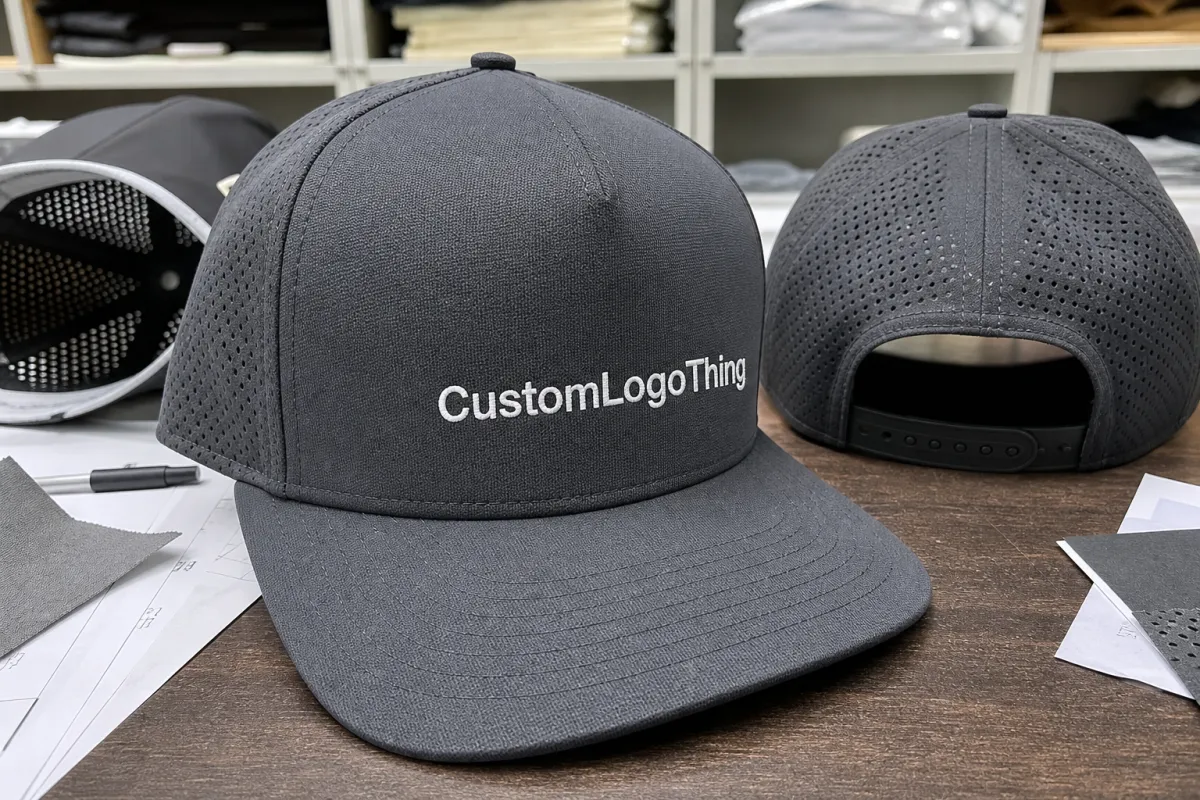
The proof is not just a visual for the approval email. It is the last practical checkpoint before money, inventory, and brand presentation get locked into 48, 96, 144, or 500 caps. For a wine shop, that order may be used across staff uniforms, club pickup weekends, golf outings, vendor gifts, tasting-room retail, or holiday bundles. One casual approval can follow the business for a full season.
A useful proof checklist slows the process down in the right places. Logo width. Cap color name. Thread color. Decoration type. Placement from the brim. Whether the back strap has text. Whether the side panel carries an event sponsor. Whether the proof says “flat embroidery” when the buyer pictured a woven patch. These are not exciting details, but this is where expensive corrections usually hide.
Start with the cap itself. Confirm the exact style, material, closure, crown structure, and profile. A structured mid-profile performance golf cap carries embroidery differently than an unstructured lightweight cap. Moisture-wicking polyester is practical for tournaments, patio tastings, and warm-weather events, yet it may not feel as substantial as cotton twill or a cotton-blend rope cap in a retail gift display. Neither option is automatically better. The intended use should make the decision.
Then look at the decoration. Direct embroidery is reliable for clean marks, short text, and simplified crests. Woven patches can preserve smaller detail better than stitching directly into the crown. Heat transfers can handle gradients and fine art, though they change the hand feel and may not suit every performance fabric. If the logo includes a founding date, fine vineyard rows, or a delicate script, get production guidance before approval rather than hoping the thread behaves.
The goal is simple: approve what can be produced well, not what looks impressive at 200% zoom on a screen.
How the Artwork Proof Process Works Before Production
The process usually starts with the buyer sending logo files, cap style, cap color, quantity, decoration preference, and deadline. The supplier reviews the artwork, checks whether the logo can be decorated cleanly, and prepares a digital proof. A low-resolution PNG pulled from a website will slow this down. A clean vector file, usually AI, EPS, or a production-ready PDF, gives the decorator sharper information and less room for interpretation.
A digital proof confirms the layout and specifications. It should include the front view and any side, back, or underbrim decoration. It should also list logo dimensions, placement measurements, decoration type, thread or ink colors, cap model, quantity, and approval notes. If any of those fields are missing, ask for clarification before signing off.
A physical pre-production sample goes further. It shows real embroidery, fabric interaction, thread density, color behavior, crown shape, fit, and overall feel. You can see whether a burgundy thread disappears into navy fabric, whether a crest is too tall for the crown, or whether the cap feels retail-worthy next to higher-margin merchandise.
Do you always need a physical sample? No. For a 48-piece staff reorder using a logo and cap style that have already run successfully, a digital proof may be enough. For a premium retail drop, a resort partnership, a large wine club gift, or a complicated estate mark, a sample is often worth the extra time and cost. Depending on the decoration method and production queue, sampling can add several business days, sometimes more.
Keep the review team small but useful. Marketing checks brand accuracy. Retail checks whether the cap has shelf appeal. Operations checks quantity, deadline, and shipping assumptions. Ownership or leadership confirms whether the finished direction fits the shop. One person still needs to own the final approval. Group approval without one accountable decision maker is how cream caps become beige caps and somehow nobody remembers choosing beige.
Revisions are normal. One or two proof rounds are healthy. Five rounds usually means the brief was unclear, the artwork was not production-ready, or the cap choice was not settled before proofing began.
Logo, Color, and Cap Specs Wine Shops Should Check
Readability comes first. Wine shop branding can be elegant and detailed, but thread has physical thickness, needles have limits, and cap crowns curve. Hairline vines, tiny serifs, foil-style flourishes, and miniature appellation text may work beautifully on a printed label while failing on embroidery. Physics remains undefeated.
Your artwork review should include these core checks:
- Correct logo version, not an old event mark, social avatar, or cropped label file
- Approved lockup, spacing, and proportions with no stretching or squeezing
- Minimum readable text size, especially on serif, script, or condensed fonts
- Clean vector file or supplier-approved production artwork
- Simplified detail where embroidery cannot hold the original linework
- Clear decoration method: flat embroidery, puff embroidery, woven patch, transfer, or print
Color matching needs a practical conversation. Thread colors and cap fabrics do not behave like coated paper, glass labels, foil labels, or websites. Pantone references help, especially for ink and some thread matching, but exact matches are not always possible. Burgundy thread on black performance fabric can sound moody and refined. It may also disappear from six feet away. Very exclusive. Also unreadable.
Placement has limits too. Center front is the classic position, often around 2 to 2.75 inches wide for many logos, depending on the crown shape and artwork. A 3.25-inch crest may work on some structured caps, but it can look like a billboard at a charity scramble. Side hits are useful for wine club names, event dates, or short taglines. Back strap decoration works best with small, simple text. Underbrim artwork is more specialized and should be confirmed against the cap style before anyone gets attached to the idea.
Check the cap specs against use. Performance fabric, moisture-wicking construction, structured versus unstructured crown, closure type, sweatband, UV features, and cap color all matter. A lightweight polyester cap may be right for a summer golf tournament. A cotton-blend rope cap may feel more at home near curated gift boxes and bottle bags. A laser-perforated back panel may be comfortable outside, while a brushed cotton cap may feel more premium but warmer.
If sustainability claims are part of the brand, ask specific questions. Recycled polyester content, recycled paper hangtags, reduced plastic packaging, and documented material claims are not interchangeable. For paper components and tags, FSC certification can be relevant. For shipping durability, especially when caps are packed into mixed merchandise kits, ISTA test concepts are useful. A crushed gift box does not feel premium, even if the cap inside is technically fine.
Pricing, MOQ, and Unit Cost Factors on Custom Golf Caps
Pricing is shaped by the blank cap quality, decoration method, logo complexity, stitch colors or print colors, order quantity, packaging, and shipping speed. Smaller runs cost more per unit because setup, digitizing, proofing, and production labor are spread across fewer caps. That is not supplier drama. That is math.
As a practical range, basic decorated caps can land around $9 to $16 per unit at moderate quantities, while better performance golf caps often sit around $16 to $28 per unit depending on brand, fabric, decoration, and order size. Premium retail-ready builds with patches, private labels, specialty trims, or individual packaging can move higher. Freight, rush service, and split shipments can change the final number quickly.
| Order Size | Typical Buyer Use | Common Unit Cost Range | Tradeoff |
|---|---|---|---|
| 48 pieces | Small staff run or test merchandise | $18-$32 per cap | Lower inventory risk, higher unit cost |
| 96 pieces | Wine club event, tasting-room retail, golf outing | $14-$26 per cap | Better pricing, still manageable storage |
| 144 pieces | Retail shelf plus staff and event use | $12-$24 per cap | Stronger unit economics, more upfront spend |
| 288+ pieces | Multi-location, resort partner, larger campaign | $10-$22 per cap | Best efficiency, higher inventory commitment |
MOQ matters. A 48-piece run may be possible with some suppliers, but 96 to 144 pieces often unlock better unit pricing and fit wine clubs, staff uniforms, golf events, and retail shelves more comfortably. If the cap sells for $32 to $45 in-store, the extra quantity may make sense. If it is a giveaway, tighter quantities can protect cash and storage space.
Watch the adders. Embroidery digitizing may be a one-time charge or folded into the order. Oversized logos, puff embroidery, side or back decoration, woven patches, private labels, individual poly bags, rush fees, and split shipments can all move the quote. Ask for the full landed cost, not only the cap price. A low unit price with ugly freight math is still ugly.
I would not choose the cheapest cap if it sits next to $70 bottles, imported cheese boards, and carefully built gift sets. Cheap headwear can make the whole display feel discounted, even if the logo is technically correct. Funny how that works.
Step-by-Step Proof Approval Checklist for Wine Retailers
Use this performance golf caps Artwork Proof Checklist for Wine shops before approval, not after production starts. Once the caps are stitched or printed, options narrow quickly.
- Confirm the cap details. Check style, color, material, crown type, closure, quantity, and intended use. A white structured performance cap and a cream unstructured cap are not close enough.
- Check the logo file. Match it against brand guidelines. Verify the correct mark, spacing, proportions, and approved color version.
- Review size in inches. Do not rely on screen scale. A 2.25-inch mark and a 3-inch mark can feel completely different on the front of a cap.
- Confirm placement measurements. Look for distance from the brim, center line, seams, or side panel boundaries. Measurements beat eyeballing.
- Review thread or ink colors. Compare them against wine labels, shelf signage, club collateral, staff apparel, and existing promotional products.
- Read every production note. Tonal embroidery, flat embroidery, puff embroidery, woven patch, and transfer print are different decoration choices. Approve the one you actually want.
- Confirm all extra locations. Side, back, strap, and underbrim artwork should have separate views, dimensions, and notes.
- Save the final proof. Keep the approved proof with the date, approver name, version number, and quote. Later, nobody gets to say, “Wait, I thought we picked the cream cap.” Classic.
For complex wine shop logos, ask for a cap-specific artwork version. That may mean removing tiny text, thickening lines, simplifying a crest, or replacing a full bottle illustration with a cleaner icon. It can feel like a compromise, but the finished cap usually looks more polished. A simplified logo that stitches crisply beats a full label design that turns into thread soup.
Also check legal and sponsor details. If the cap includes an event sponsor, regional association, charity partner, or wine club name, that artwork deserves the same proof discipline as the main logo. Side decoration is not a junk drawer. Small mistakes there still look public.
Timeline, Lead Time, and Turnaround Expectations
A normal timeline includes quote review, artwork review, digital proof, revisions, approval, production, quality control, packing, and shipping. Digital proofs often take 1 to 3 business days after complete artwork is received. Production for custom golf caps commonly runs about 10 to 20 business days after proof approval for many standard jobs, though quantity, decoration method, sample needs, factory load, and season can push that around.
Wine shops run into predictable deadline pressure. Spring golf outings. Harvest events. Holiday gift sets. Wine club pickup weekends. Regional festivals. Sponsor commitments. Demand bunches up, and everyone suddenly needs caps “as soon as possible,” which is not a production schedule. It is a wish with a purchase order attached.
Rush orders may be available, but they usually bring tradeoffs. You may have fewer cap color choices, fewer decoration options, higher freight costs, and less room for corrections. If a physical sample is needed, rush timing gets tighter. The supplier may offer a sew-out photo or production photo instead of a full sample, which can help, but it is not the same as holding the cap.
Work backward from the true in-hands date. If caps are needed on a Friday, do not build the plan around production finishing on Thursday. Shipping delays happen. Quality control takes time. Internal approvals drift. Build in room for at least one proof revision, freight movement, and a final count check. The cap does not care that a tournament sponsor asked late.
For larger or higher-risk orders, a conservative schedule might include 2 to 4 business days for proofing, 2 to 5 business days for revisions or sample review, 12 to 20 business days for production, and 2 to 6 business days for shipping. The exact range depends on supplier, location, decoration, and freight method. It is still safer than planning as if the boxes will teleport.
Common Proof Mistakes That Make Caps Look Cheap
The first mistake is approving artwork that is too detailed for embroidery. Tiny grape clusters, script text, shield lines, vintage ornaments, and detailed bottle illustrations may need simplification. If the supplier recommends removing a 0.06-inch line or enlarging type, listen. They are not attacking the brand. They are trying to keep the cap from looking like a lint accident.
The second mistake is ignoring contrast. Tone-on-tone can be beautiful, especially for premium shops, but there is a difference between subtle and invisible. Charcoal thread on black fabric, burgundy on navy, or cream on light khaki can all work in the right setting. Ask for thread references and consider the lighting where the cap will be sold or worn. Tasting-room lighting, outdoor tournament sun, and warehouse fluorescents tell three different stories.
The third mistake is treating mockup scale as reality. Screen previews lie because every monitor, zoom setting, and mockup template behaves differently. Confirm actual logo width and height. If the proof says 2.5 inches wide, picture that on a curved crown. Better yet, measure it with a ruler against a cap you already own.
The fourth mistake is forgetting side and back decoration. A wine club name, website, sponsor logo, or event title needs its own view and measurements. Side panels curve and taper. Back straps have hardware, openings, and stitching limits. Small decoration areas are not forgiving.
The fifth mistake is skipping stakeholder review until after approval. Get decision makers aligned before production. The owner, retail manager, and event lead do not all need to rewrite the proof, but they should agree on the essentials: cap color, logo, decoration style, quantity, and deadline.
The sixth mistake is changing the logo after digitizing without understanding the cost and timeline impact. Tiny edits can trigger new setup work. A revised serif, thicker line, or removed date may seem minor, but it can require a new embroidery file and another proof round. That costs time, and sometimes money.
Before You Approve the Final Cap Proof
Create a simple approval folder before saying yes. Include the final logo file, brand color references, quote, cap style, proof version, and email notes about changes. Name the file clearly, such as “approved-front-logo-navy-performance-cap-version-3.” Not glamorous. Very useful.
Ask the supplier to clarify anything vague. Decoration method. Logo size. Cap color name. Thread colors. Sample availability. Production lead time. Shipping method. In-hands date. If the proof says “navy cap,” ask whether that means dark navy, true navy, heather navy, or whatever poetic name the cap brand uses. Color names are not a controlled language.
If the order supports an event or retail launch, confirm the in-hands date instead of only asking when production finishes. Those are not the same thing. Freight has opinions. So do warehouses, weather, missed pickups, and address errors.
Decide whether a physical sample is worth the added time and cost. For high-end wine shops, resort partnerships, premium retail merchandise, or orders above a few hundred pieces, it often is. For smaller staff runs with simple artwork, a tight digital proof and clear written approval may be enough. The right call depends on risk tolerance, budget, and deadline.
A good custom cap should feel like part of the brand, not a leftover promo item from a vendor closet. Use the checklist while the order can still be corrected, before the invoice is paid and the caps are already stitched.
Frequently Asked Questions
What should be included in a performance golf cap artwork proof for a wine shop?
It should show cap style, cap color, logo placement, logo size, decoration method, thread or ink colors, quantity, and all production notes. It should also identify the exact logo file or version being used, especially if the shop has separate marks for labels, events, clubs, and retail merchandise. If side, back, or sponsor decoration is included, each location needs its own view and measurements.
Do wine shops need a physical sample before approving custom performance golf caps?
Not always. A digital proof may be enough for a small reorder, simple logo, or familiar cap style. A physical sample is smart for premium retail programs, large orders, complex embroidery, woven patches, or high-visibility events. The digital proof confirms layout and specs, while the sample shows stitch quality, fabric interaction, color behavior, fit, and overall feel.
What logo details cause the most problems on wine shop golf caps?
Tiny serif text, thin lines, estate crests, detailed grapevines, bottle illustrations, and founding dates cause the most trouble. These elements often lose clarity in embroidery, especially below practical minimum text heights. Simplifying the logo for cap use usually produces a cleaner result than forcing a full wine label design onto a curved crown.
How much should wine shops budget for custom performance golf caps?
Budget depends on cap quality, quantity, decoration method, logo complexity, packaging, freight, and rush needs. Many decorated performance golf cap projects land around $14-$28 per unit at practical quantities, though small runs and premium builds can move higher. Watch for adders such as digitizing, extra decoration locations, puff embroidery, woven patches, private labels, poly bags, and expedited shipping.
How long does the proof and production timeline usually take for custom golf caps?
The timeline usually includes quote review, artwork setup, digital proofing, revisions, approval, production, quality control, packing, and shipping. Digital proofs often take 1 to 3 business days once complete artwork is supplied, while production commonly takes about 10 to 20 business days after approval for many standard jobs. Wine shops ordering for tournaments, pickup weekends, or holiday gifting should build in extra buffer for revisions and freight.
How should a wine shop use a performance golf caps artwork proof checklist for wine shops before approval?
Use the performance golf caps artwork proof checklist for wine shops as a final gate before production. Confirm the cap style, logo version, decoration method, logo size, placement, thread or ink colors, quantity, deadline, and all production notes. Save the approved proof with a version number and approver name so future reorders start from facts, not memory.