A frosted zipper bag can look polished in the first unboxing photo and still fail in two quiet places: the logo sits 4 mm too close to the zipper track, and the barcode scans only after the third try. That is why a Frosted Zipper Bags artwork proof checklist for ecommerce brands matters before plates, screens, digital files, or bulk film are committed.
The costliest packaging mistakes rarely look dramatic on a screen. They are usually small alignment, contrast, sizing, or copy issues that slide through because everyone is focused on the “look” of the bag rather than how the package will be printed, filled, photographed, scanned, shipped, and opened by a real customer.
Frosted Zipper Bags Artwork Proof Checklist for Ecommerce Brands
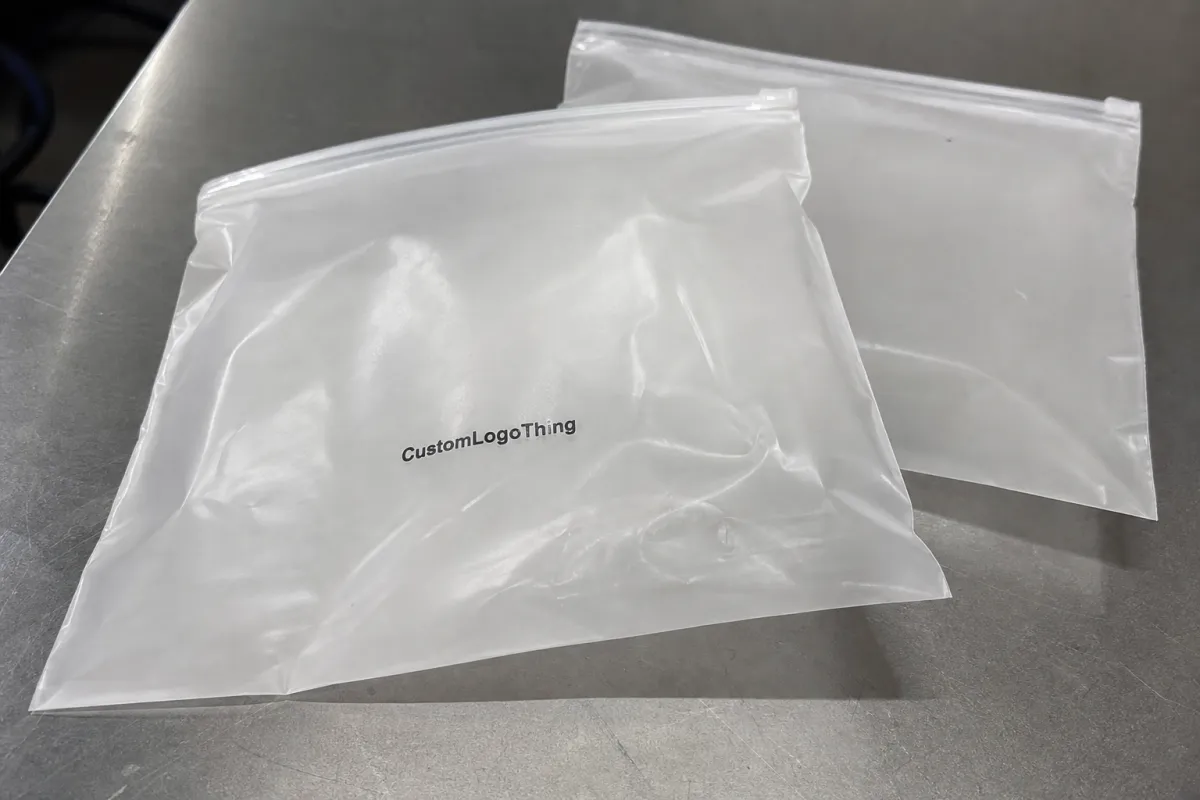
An artwork proof is the manufacturer’s production-facing preview of how your design will translate onto the actual bag specification. It should show finished dimensions, zipper placement, heat seals, gusset, hang hole, tear notch, print position, color callouts, warning copy, barcode location, and caution zones where artwork should not sit. A good proof is not just a neat PDF. It is a technical checkpoint.
Frosted bags need a sharper eye than clear or fully opaque pouches because the material changes how artwork behaves. The semi-translucent surface softens contrast, mutes fine detail, and can make light ink colors disappear once product is inside. A pale beige logo may look calm and premium on a monitor, then weaken against a tan cookie, cream powder, soap bar, apparel item, or botanical product showing through the film.
The checklist has to cover both brand presentation and package function. Your bag needs to look right in a hero image, but it also has to protect the product, reseal cleanly, pass basic barcode scanning, carry required warning text, and survive normal fulfillment handling without the front panel looking crooked or crowded.
Production-floor mindset: approve the proof as if the bag is already running at full speed. If a detail would bother you after 5,000 bags are printed, fix it before approval.
From a packaging buyer’s point of view, proof review is the point where design, operations, compliance, photography, and purchasing all meet. If each team reviews only its own piece, gaps appear. The stronger approach is to review the proof as one working package, not as isolated artwork.
How Artwork Proofs Translate Digital Design onto Frosted Plastic
The path usually starts with a customer submitting AI, EPS, PDF, or another high-resolution vector file. The packaging team checks the dieline, bag size, material note, print zones, zipper style, and quantity, then prepares a proof for approval. If the file is clean, outlined, layered properly, and tied to a confirmed bag specification, the first proof can often be prepared faster than a file built from screenshots, low-resolution logos, or artwork without a dieline.
Most Frosted Zipper Bags are made from polyethylene-based film or similar flexible plastic structures. The frosted appearance may come from the resin, an additive, a surface treatment, or the selected film finish. Typical retail and ecommerce bags often run around 2.5 mil to 5 mil, depending on product weight, puncture risk, and desired hand feel. Thicker is not automatically better, but very thin film can feel flimsy, wrinkle more in photography, and make the zipper feel less substantial.
The full physical bag is not the full print area. Zipper tracks, top seals, bottom gussets, side seals, tear notches, euro holes, rounded corners, and machine tolerances all create areas where artwork should either be avoided or treated carefully. A 6 inch by 9 inch bag, for example, may have a front print-safe area closer to 5.25 inches by 6.5 inches after zipper clearance, bottom seal, and edge allowances are respected.
Print method matters too. Digital print can suit lower quantities, multiple SKUs, or complex artwork because it avoids some plate costs, though unit cost may stay higher. Plate-based or cylinder-based printing is usually better for larger runs, especially where repeat orders, tighter brand color, and lower unit cost matter. Setup can be higher, but the cost per bag may improve once the order reaches efficient volume.
A proof shows placement and technical interpretation. It does not always show the final tactile result. There is a real difference between a digital proof, a printed sample, a pre-production sample, and a finished production lot. If color, opacity, zipper feel, or barcode performance is critical, ask whether the proof represents layout only or whether it reflects the actual print method and film.
Proof Details That Affect Shelf Appeal and Ecommerce Photography
The front panel should have a clear order of information: logo first, product name second, variant or scent third, then supporting copy. On a small 4 inch by 6 inch pouch, a 2 inch logo may dominate the face; on a larger apparel bag, the same logo may feel modest. Print the proof at actual size before deciding.
Frosted space can look premium when it is intentional. It can look unfinished when the artwork is too small, too low, or floating without structure. I like to see at least one clear alignment logic on the front panel: centered stack, left rail, framed label area, or a strong top-to-bottom hierarchy. Random placement reads as a mistake, especially in ecommerce thumbnails where customers have only a second to understand the product.
Contrast is the next checkpoint. White ink, pale neutrals, fine-line illustrations, metallic tones, and thin script fonts all need review against the real film and product color. A white ink underlay can help printed colors hold their strength on translucent material. Without it, some colors visually sink into the frosted surface.
Barcode and QR code review should be non-negotiable in any Frosted Zipper Bags Artwork Proof checklist for ecommerce brands. Confirm quiet zones, size, contrast, and placement on a flat scannable area. Do not place a barcode over a gusset fold, zipper ridge, heavy texture, or curved edge. For many retail-style UPCs, the bars need enough height and clean contrast; trimming them too aggressively to “make it fit” is asking for trouble.
Photography adds another layer. Frosted film creates soft glare, shadowing, and product show-through. If the bag will be used for Amazon, Shopify, Etsy, Faire, or wholesale line sheets, the proof should support a clean hero image and readable variant recognition at thumbnail size. Put similar SKUs side by side and ask whether a customer can tell lavender from unscented, medium from large, or almond from vanilla in two seconds.
The back panel deserves the same discipline. Ingredients, instructions, suffocation warnings where applicable, country-of-origin statements, recycling symbols, batch-code areas, and fulfillment labels all need space. For recyclability and environmental claims, avoid vague language and check current guidance from sources such as the EPA recycling resources before printing claims that customers may read as absolute.
Process and Timeline: From Proof Review to Production Approval
A typical custom bag project follows a simple sequence: submit artwork and bag specs, receive the first proof, mark corrections, receive a revised proof if needed, approve the final proof, then move into printed sample production or bulk production. The order sounds tidy. In practice, timing depends heavily on how complete the first submission is.
A clean vector file with confirmed bag width, height, gusset, film thickness, zipper style, print colors, and quantity can move quickly. A screenshot logo, missing barcode file, uncertain fill weight, or incomplete dieline slows everything down because the supplier has to ask basic setup questions before the proof can be trusted. If your launch date is tight, file quality becomes schedule control.
Proof timing can be as short as a few business days for straightforward layouts, but revisions add time. Printed samples may add 7 to 15 business days depending on the print method, material availability, and queue. Bulk production can commonly run 12 to 25 business days after proof approval for many custom flexible packaging jobs, although quantity, complexity, specialty material, and seasonal capacity can change that range.
Several variables often surprise newer ecommerce teams: Pantone matching, custom zipper color, hang hole position, gusset testing, special die-cut shapes, matte-gloss contrast, metallic effects, and white ink layers. A change from a standard top zipper to a slider-style closure is not a small artwork edit; it can change structure, cost, sampling, and lead time.
Every proof revision has a cost in calendar days, even if it does not carry a separate fee. Text swaps and logo scaling are usually easier. Structural changes such as bag dimensions, seal width, zipper placement, or gusset depth can require a new technical review. Build proof review into the launch calendar before product photography, listing setup, fulfillment prep, and inventory arrival dates. Packaging delays can hold up an otherwise ready launch.
If you want to see how packaging presentation affects real buying moments, the Custom Logo Things case studies are useful because they show how small branding and format decisions can change the way a product is perceived before anyone reads the fine print.
Cost, MOQ, and Unit Cost Factors Hidden Inside the Proof
The proof is also a cost control document. It confirms choices that affect setup charges, material usage, scrap risk, packing efficiency, and final unit cost. A bag that is 0.5 inch taller than necessary may not sound expensive, but across 10,000 units it can increase film consumption, carton volume, and freight.
Bag size drives pricing through width, height, gusset depth, and how efficiently the layout runs on converting equipment. A standard flat frosted zipper bag may price very differently from a stand-up version with a wide bottom gusset. Larger bags also take more carton space, which matters for brands paying for inbound freight, warehouse storage, and pick-pack handling.
Print coverage is another driver. One-color front print is usually more economical than full-coverage, double-sided artwork with tight registration. White ink underlays improve readability on frosted film, but they add ink usage and production control. Metallic effects, dense backgrounds, and matte-gloss contrast can look sharp, yet they may increase setup and inspection requirements.
| Proof Decision | Typical Cost Impact | Practical Buyer Check |
|---|---|---|
| Bag size and gusset | Changes film use, carton count, and freight volume | Test with the actual filled product, not only the empty bag dimensions |
| White ink underlay | May add print cost, but improves color strength on frosted film | Use under light colors, small type, and brand-critical marks |
| Print colors | More colors can increase setup, plates, or inspection time | Ask whether one strong color works better than three weak ones |
| MOQ | Custom runs often need enough units to spread setup and changeover cost | Compare 2,500, 5,000, and 10,000 unit breaks if available |
| Printed sample | Adds time and sample cost, but reduces reprint risk | Request one for first-time frosted film, premium launches, or barcode-sensitive packaging |
Custom Frosted Zipper Bags usually have minimums because film setup, printing setup, zipper stock, machine changeover, and quality checks need to be spread across enough units. As a broad planning range, simple custom printed zipper bags may land around $0.18 to $0.45 per unit at mid-volume, while specialty structures, heavier film, large sizes, or high coverage can move higher. Specifications, freight, and order size can move the number quickly, so treat ranges as planning figures, not quotes.
False economy is a real risk. Reducing film thickness, choosing a weaker zipper, shrinking the barcode, or removing a white ink layer may lower the quote, but the customer experiences the finished package, not the spreadsheet. If a $0.03 savings creates a bag that feels limp or scans poorly, the math may not hold.
Step-by-Step Artwork Proof Review Before You Approve
A practical checklist starts with structure, not decoration. Confirm finished width, finished height, bottom or side gusset, film thickness, zipper location, hang hole, tear notch, corner style, and seal allowances against the product that will actually go inside. Fill a sample bag if you have one. If not, mock the size with paper and tape, then compare it with the product in the same orientation customers will receive it.
- Check the bag body: verify width, height, gusset, seal allowance, and zipper clearance against fill weight and product shape.
- Check artwork placement: confirm the logo, product name, net weight, variant color, usage copy, and brand marks sit inside the safe print area.
- Check print specs: review Pantone or CMYK references, white ink callouts, overprint settings, transparency effects, minimum line weight, and font outlines.
- Check scannable elements: test barcode and QR code at final size, preferably from a printed proof rather than only a screen view.
- Check operational copy: confirm warnings, legal text, country-of-origin language, lot-code space, expiration-date area, and any fulfillment label zone.
Minimum line weight matters on frosted material. Very fine lines below roughly 0.25 pt can break up depending on print method and film behavior. Small reversed-out type can fill in or lose edge definition. If a typeface looks elegant only at 300 percent zoom, it probably needs a heavier weight or more breathing room.
Color mode and artwork construction should match the print process. Vector logos are preferred. Fonts should be outlined or packaged properly. Placed images need enough resolution at final size; 300 dpi is a common target for raster imagery, but line art and QR codes should stay crisp. Transparency effects can behave unpredictably if flattened poorly, so ask the packaging team how they want the final file supplied.
Do the human check last. Print the proof at actual size, mark the zipper and gusset areas with a pen, hold it at arm’s length, then place it next to the product. Hand it to someone outside the design team and ask them to read the product name, variant, net weight, and barcode area without coaching. That five-minute exercise catches more than many people expect.
For broader transit testing, especially if the filled bags ship inside cartons or mailers, review guidance from the International Safe Transit Association. ISTA protocols focus on distribution performance, but the mindset is helpful: packaging is judged by what happens after it leaves the design screen.
Common Proofing Mistakes That Create Reprints or Weak First Impressions
The first mistake is approving only on a laptop screen. A logo that feels balanced at 150 percent zoom may overpower a small pouch, while a delicate product descriptor may become unreadable in a 900 pixel ecommerce thumbnail. Actual-size review is not optional for small packaging.
The second mistake is crowding functional areas. Keep important information away from the zipper, heat seal, gusset fold, tear notch, and side seal. Normal production tolerance can shift print slightly, and flexible film moves more than rigid paperboard. A 2 mm shift on a folding carton may be tolerable; on a small frosted bag with a centered logo, it can be obvious.
Low-contrast ink is another common issue. Beige, pale gray, soft pink, and thin gold lines all need caution on frosted film. They can look refined in the PDF and weak after filling. Stronger color separation, heavier type, or a white ink underlay often solves the problem.
Version control causes painful reprints. Old flavor names, discontinued SKU codes, previous website URLs, expired certification marks, and barcodes borrowed from a similar product can all slip into final files. One person should own the final proof packet and compare it against the live ecommerce listing, inventory system, and approved compliance copy.
Over-designing the frosted surface is less technical but just as real. Dense patterns, tiny icons, and full-panel graphics can fight the natural soft look of the material. Frosted zipper bags often work best with confident spacing, clear typography, and one or two strong brand elements. Many brands would improve their first impression by removing 20 percent of the artwork before adding anything new.
Final Checks Before Sending Approval
Before you reply with approval, gather the approved dieline, final artwork file, product dimensions, fill weight, barcode files, compliance copy, target quantity, and preferred launch date. Keep everything in one proof packet if possible. Scattered comments across email threads, chat messages, and old PDFs create confusion.
Mark the proof directly. Specific notes help production teams move faster: “move logo up 3 mm,” “increase QR code to 22 mm square,” “keep barcode clear of bottom gusset,” or “add 6 mm more zipper clearance.” Loose notes such as “make it cleaner” or “center this better” can mean three different things to three different people.
Ask for clarification on anything that is not clear. Print-safe area, white ink layer, zipper clearance, MOQ break, sample timing, and final color representation are all fair questions. A good supplier would rather explain the proof before production than debate a finished result after cartons arrive.
Keep one internal owner for final approval. Design, operations, compliance, and purchasing should all give input, but conflicting feedback in separate rounds slows the job and increases the chance of approving the wrong version. If you are building a launch process, save the final checklist alongside product photography notes, fulfillment specs, and the packaging examples in the Custom Logo Things case studies.
A frosted zipper bags Artwork Proof Checklist for ecommerce brands is not paperwork for paperwork’s sake. It is the practical bridge between a nice package concept and a clean, scannable, durable bag that looks right in a listing photo and earns trust when it lands on a customer’s doorstep.
FAQ
What should be included in a frosted zipper bag artwork proof checklist?
Include finished bag size, gusset type, zipper and seal locations, print-safe area, logo placement, color callouts, white ink layers, barcode and QR code size, warning copy, material thickness, and any date-code or label areas. Also confirm whether the proof is for layout only or whether it reflects final print color, texture, and opacity.
Why do colors look different on frosted zipper bags than on screen?
Frosted film is semi-translucent, so it softens contrast and allows some product color or shadow to influence the printed artwork. Light ink colors, thin lines, and low-contrast designs often need a white ink underlay, heavier type, or stronger color separation to stay readable.
Should ecommerce brands request a printed sample before approving frosted zipper bags?
A printed sample is wise when color accuracy, barcode scanning, premium appearance, or retail photography is critical. For simple one-color designs or repeat orders, a digital proof may be enough, but first-time custom frosted zipper bag projects benefit from seeing the material and print together.
How does artwork proof approval affect frosted zipper bag lead time?
Production usually cannot begin until the proof is approved, so delayed feedback or multiple revision rounds can push back the full schedule. Clean vector artwork, confirmed specifications, quick barcode checks, and one consolidated approval contact help keep the timeline moving.
What proofing mistakes increase the cost of custom frosted zipper bags?
Late changes to bag size, zipper position, print colors, or coverage can trigger new setup work, revised tooling, extra samples, or production delays. Missed barcode errors, outdated copy, or low-contrast artwork may require reprints, which are far more expensive than careful proof review before approval.


