Buyer Fit Snapshot
| Best fit | cartons for parcel consolidation for packaging buyers comparing material specs, print proof, MOQ, unit cost, freight, and repeat-order risk where brand print, material, artwork control, and repeat-order consistency matter. |
|---|---|
| Quote inputs | Share finished size, material target, print colors, finish, packing count, annual reorder estimate, and delivery region. |
| Proofing check | Approve dieline scale, logo placement, barcode or warning zones, color tolerance, and any recyclable or compostable wording before bulk production. |
| Main risk | Vague material claims, crowded artwork, or missing packing details can create delays even when the unit price looks attractive. |
Fast answer: Cartons for Parcel Consolidation: Dieline, Finish, Proof, and Buyer Review should be specified like a repeatable production item. The safest quote includes material, print method, finish, artwork proof, carton packing, and reorder notes in one written spec.
What to confirm before approving the packaging proof
Check the product dimensions against the actual filled item, not only the sales mockup. Ask for tolerance on folds, seals, hang holes, label areas, and retail display edges. If the package carries a logo, QR code, warning copy, or legal claim, reserve that space before decorative graphics fill the panel.
How to compare quotes without losing quality
Compare board or film grade, print process, finish, sampling route, tooling charges, carton quantity, and freight assumptions side by side. A lower quote is only useful if the supplier can repeat the same color, closure quality, and packing count on the next order.
Best Cartons for Parcel Consolidation: Honest Picks
The best cartons for parcel consolidation are rarely the boxes that look strongest on a sample table. I learned that on a Friday night pack-out in a 24,000-square-foot facility outside Charlotte, North Carolina, when a mixed-SKU order of glass tumblers, a 26 oz steel bottle, and two folded apparel cartons rode in a clean-looking single-wall RSC, then came back from parcel testing with one crushed corner and about three inches of product drift inside. The better carton was a plain double-wall B-flute RSC with a 16 x 12 x 10 footprint, less headspace, less tape, and a lower damage rate after the same 36-inch corner drop. I still remember staring at that first box and thinking, “Well, that looked impressive right up until it failed like a cheap lawn chair.”
At Custom Logo Things, I talk about the best cartons for parcel consolidation the way I would on a plant floor in Dongguan or Grand Rapids: double-wall RSCs, die-cut mailer cartons, and heavy-duty telescoping cartons usually win, but the real answer depends on item mix, cube efficiency, and how hard your carriers beat up the load. I have seen a carton that looked perfect on a designer’s desk fail in the back of a fulfillment center because the packer had to add four pillows of void fill just to stop a mug from knocking against a metal candle jar. That is the kind of moment where everybody gets very quiet, then suddenly cares a lot about board grade, flute profile, and whether the glue line was laid down at 145 degrees Fahrenheit or a little too cold.
Quick Answer: Best Cartons for Parcel Consolidation
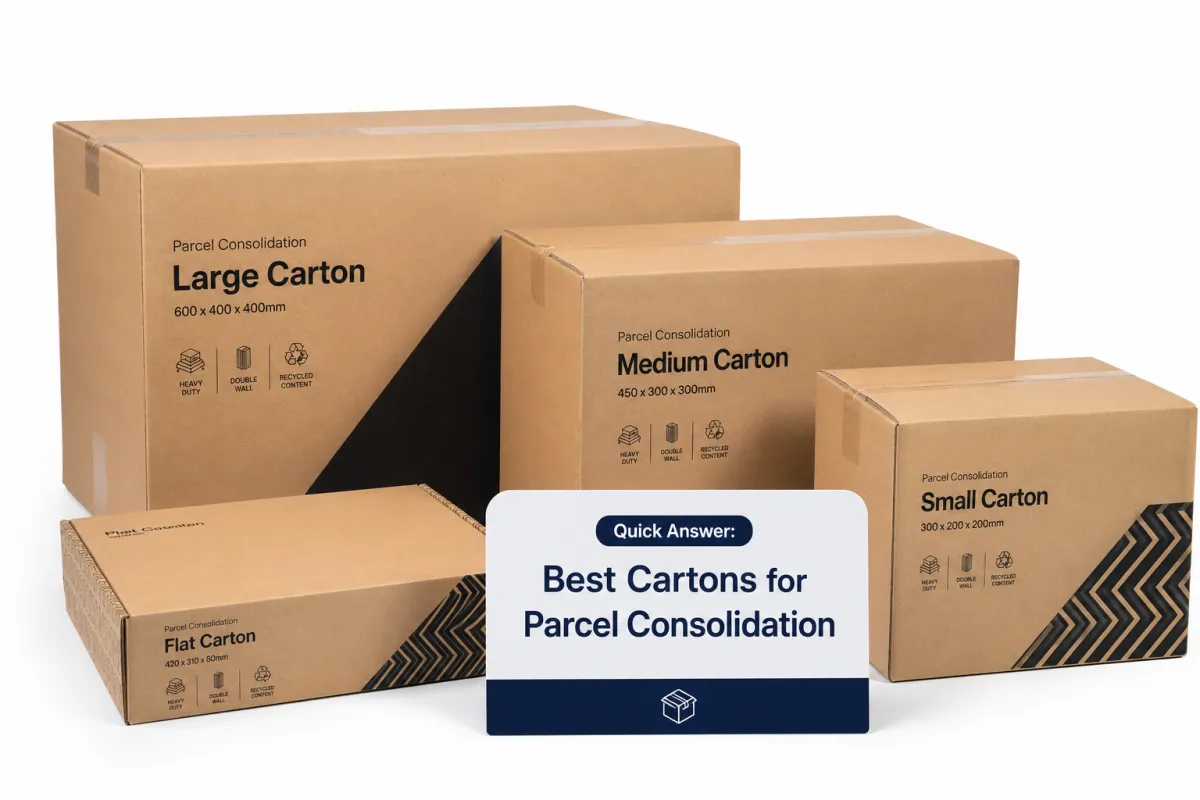
The best cartons for parcel consolidation are usually double-wall RSCs, die-cut mailer cartons, and heavy-duty telescoping cartons, with the final choice shaped by weight, fragility, and how tightly your mixed items fit together. A carton that hugs the load and stays intact through a rough conveyor ride beats a bigger box that drinks up air and demands extra dunnage. I say that with some feeling, because I have watched oversized cartons eat freight budget like they were invited to a buffet in Atlanta and nobody bothered to stop them.
The tradeoff shows up fast on the packing bench. You want the fewest breaks, the least void fill, and the lowest billed weight without overboxing every order, especially on lanes that start in Dallas and finish in Denver. In parcel consolidation, a box that saves 20 seconds at the bench but adds $1.40 in shipping cost on every parcel is not a win, even if the carton looks tidy on a pallet. I have had more than one operations manager tell me they “saved” money with a lighter box, then spend the next quarter paying for damages, repacks, and one very unhappy customer service team.
I keep coming back to the same point with buyers and operations teams: the best cartons for parcel consolidation are the ones that cut down on decisions. A small set of footprints, a clear weight limit, and one tape pattern do more for consistency than a stack of glossy specs printed on a sell sheet from a plant in Suzhou or Monterrey. I have watched teams lose more money to indecision than to a slightly heavier carton. The carton itself is only part of the story; the real savings come when the bench stops improvising every single order and the packout table uses the same 48 mm tape head, the same insert sequence, and the same closure every shift.
My short answer, after plenty of test shipments and more than a few client meetings, is simple. Start with a double-wall RSC for mixed orders, move to a die-cut mailer when the product set is fixed and presentation matters, and keep telescoping cartons ready for awkward, tall, or changing kits. That is the field-tested starting point for the best cartons for parcel consolidation, not a polished catalog answer. It is also the answer I trust when a warehouse floor is noisy, the clock is moving too fast, and nobody has patience for a packaging theory seminar at 6:30 a.m. before the outbound trailers start backing in.
For operations that ship one carton per order and see the contents change hour by hour, the best cartons for parcel consolidation are the ones that let the packer close the box cleanly, pass a drop test, and stay under a sane cubic rate. The carrier does not care that the box was expensive; the carrier only cares whether it survives sortation and arrives without rattling like a bucket of bolts. And if it sounds like a bucket of bolts, the customer notices too, usually before the warehouse manager sees the first claim from Chicago or Phoenix.
Best Cartons for Parcel Consolidation Compared
Here is the practical comparison I give clients when they ask for the best cartons for parcel consolidation. I compare strength, cube use, pack speed, and how the box feels on a real shipping bench, because a carton that scores well on paper can still slow a line when the flaps fight the operator or the glue seam keeps springing back. I have seen perfectly respectable cartons turn into tiny paper rebellions the second a tired packer tries to close them at 4:45 p.m. in a plant outside Nashville.
- Double-wall RSC: the safest all-rounder for mixed-SKU consolidation, especially when the load is 8 to 25 lb and the route includes conveyor merges, truck transfer, and last-mile abuse.
- Die-cut mailer carton: the most efficient shape for fixed kits, presentation-heavy orders, and shallow products that would otherwise swim in a taller box.
- Telescoping carton: the better answer for long items, odd bundles, and kits that change depth during a promotion or seasonal reset.
- High-depth RSC: useful when you need more vertical room but still want the familiar folding sequence and wide board availability.
- Single-wall RSC: fine for light, non-fragile consolidation, but it is often the carton people overuse because it is cheap on the quote sheet.
The best cartons for parcel consolidation do more than protect product; they protect labor. A rotary die cutter and folder-gluer line in Guangzhou can make a die-cut mailer economical when volumes are fixed, but on a hand-packed kitting table in Columbus the same design may add one or two extra motions that pile up over 2,000 orders. I saw that in a client’s Midwest facility where the fastest line was not the fanciest line, just the one with the fewest awkward folds. The supervisor told me, dead serious, that “pretty” was costing him lunch breaks. He was only half joking, especially after the line had to hit 1,200 parcels before 2 p.m.
Where the best cartons for parcel consolidation differ most is in how much they control movement. A double-wall RSC gives you edge strength and stacking stability. A die-cut mailer gives you a tighter interior and fewer voids. A telescoping carton lets you tune height without redesigning the whole package, which is handy when a SKU set changes after a retail promotion or a bundle program gets updated by marketing in New Jersey on a Thursday afternoon. That flexibility matters more than people expect, especially when product teams move fast and packaging gets handed the mess afterward.
One mistake shows up again and again: people assume the biggest box is the safest box. It is not. If the internal clearance is 1.5 inches on every side, you are paying for air, tape, and filler, and the carton may still fail because the load can shift into one corner. The best cartons for parcel consolidation are the ones that keep the product centered and stop the package from turning into a rattle trap after the first vibration event on a route that might bounce through Memphis, St. Louis, and Indianapolis before final delivery. I have heard that sound too many times, and I never get used to it.
For same-day e-commerce fulfillment, I usually rank these options this way: double-wall RSC for general use, die-cut mailer for repeat kits, telescoping carton for odd shapes, then single-wall RSC only when the order is light and the route is gentle. That ranking may sound blunt, but I have seen too many “budget” boxes generate expensive claims later. A small savings on the front end can become a giant headache on the back end, which is a trade I never enjoy making, especially when a claims report lands with 47 damaged units and a freight bill from the Ohio Valley that nobody wants to explain.
Detailed Reviews of the Top Cartons
Below is the kind of review I wish more buyers had before they ordered the best cartons for parcel consolidation by the truckload. I am not grading these by catalog beauty. I am grading them by how they behave when a packer is moving fast, the carton is heavier than expected, and the parcel system is chewing through a peak-day wave of mixed orders in a 60,000-square-foot facility in Southern California or a distribution center outside Toronto. That difference matters, because a carton that looks graceful in a brochure can still be a complete nuisance on a real bench.
Single-wall RSC: This is the easiest carton to source, stack, and understand, which is why it shows up everywhere. For light consolidation under about 8 lb, it can work well, especially in 200# test or 32ECT board, but I would not use it for glass, metal, or anything with a dense center of gravity unless the route is unusually gentle. In my experience, it is one of the best cartons for parcel consolidation only when the contents are soft goods, printed inserts, or light boxed sets. If someone tries to make it do a job it was never built for, the box usually tells on them before the customer does, often by the time the parcel reaches Kansas City.
Double-wall RSC: This is the workhorse. A 44ECT or 275# test double-wall carton gives you better compression resistance, better corner survival, and less panic when someone adds one extra item to the kit at the last minute. I watched a cosmetics client in Orange County switch from a single-wall 18 x 12 x 10 to a double-wall 16 x 12 x 10, cut the void fill by nearly half, and still reduce damages because the packout was tighter and the corners were not folding under tape tension. If you ask me for the carton style I trust most for mixed orders, this is usually the first place I start. I like how boringly dependable it is, which sounds unromantic until you have to explain a damage spike to finance at month-end.
Die-cut mailer carton: This style shines when the assortment is fixed and you care about presentation, opening experience, and a precise inside fit. E-flute and B-flute die-cuts can look clean and premium, especially for subscription kits, samples, or curated bundles that should arrive with the contents locked in place. I have seen a 350gsm C1S artboard wrap laminated over E-flute turn a simple apparel set into a polished unboxing piece for a brand shipping from Portland and Nashville. The downside is that they can be unforgiving if the product mix drifts by even 1/4 inch, and that is why I only call them a top choice when the SKU set is stable and the marketing team is not changing the bundle every week. Marketing can be wonderful, by the way, but they do have a talent for moving the goalposts with a cheerful smile.
Telescoping carton: This is the carton style I recommend when your length or height changes often, like a bundle of framed prints, a long accessory set, or a seasonal gift package with different internal builds. The overlap gives you flexibility and better protection for long edges, but it also adds board usage and often more tape, so it is not the cheapest option. Still, when a client in one of our supplier reviews could not settle on a single stack height, telescoping was the most practical answer and one of the better answers for that line. It is the kind of solution that makes a production manager nod once, then ask where the coffee is, usually before the 7:00 a.m. shift change in Monterrey.
High-depth carton: I use this term for an RSC or custom style with extra depth that handles tall items without forcing the packer to jam everything down. It is helpful for mixed apparel-plus-hardgoods orders, small appliances, and kits with awkward internal clearance. The failure point is usually not the board; it is the packer’s temptation to leave too much headspace, which invites movement and corner crush. When the depth is right, though, it belongs in the conversation for parcel consolidation. I have seen a good high-depth spec save a team from using three different fillers just to make one box behave, and I have seen that same spec hold up across three shifts in a plant near Savannah.
Here is my honest ranking for most parcel jobs: double-wall RSC first, die-cut mailer second, telescoping carton third, high-depth carton fourth, and single-wall RSC only for lighter loads. That ranking changes if presentation is the top priority or if the packout is a fixed kit, but for rough, mixed, multi-item shipping, the double-wall box usually earns the floor manager’s approval because it reduces repacks and keeps the line moving. I have yet to meet a floor manager who gets excited about repacks. They tend to look at me the way a mechanic looks at a loose bolt rolling under a workbench.
“We stopped buying the strongest box and started buying the best-fit box,” one operations manager in Louisville told me after a pilot run, and that sentence has stuck with me for years because it is exactly how the best cartons for parcel consolidation should be chosen.
Price Comparison and Total Cost
Carton price matters, but the best cartons for parcel consolidation are the ones that lower the total landed packout cost. I have seen a carton that was $0.14 cheaper per unit end up costing more because it needed an extra strip of tape, a Kraft Paper Void fill bag, and thirty seconds more labor on every order. Multiply that by 5,000 units and the “cheaper” carton is quietly draining margin. Quietly, annoyingly, and with the kind of confidence only a poorly chosen box can have, especially when the boxes are being used on second shift in a plant outside Reno.
When I quote a program, I look at four cost buckets: carton unit price, tape and filler, labor time, and freight impact from dimensional weight. If a carton saves 1 inch on two sides, the DIM weight savings can beat a 10% board price increase very quickly. That is why the right consolidation cartons are often not the lowest-priced boxes on the order form. The real trick is not paying less for the box; it is paying less for the whole shipping habit that comes with the box, including the 12 to 15 seconds per pack that can disappear if the fit is right.
In a simple volume band, this is how the numbers usually behave for the best cartons for parcel consolidation: stock single-wall RSCs can land around $0.48 to $0.72 at 5,000 pieces, double-wall RSCs often sit around $0.82 to $1.25, die-cut mailers can range from $0.55 to $0.95 depending on flute and print, telescoping cartons commonly run $1.10 to $1.80, and custom high-depth cartons often sit in the middle depending on board grade and tooling. Those are real-world planning numbers, not final quotes, because print coverage, board market swings, and freight lanes all move the needle. A plain die-cut with no print from a factory in Foshan may land near the low end, while a printed custom mailer with specialty die-cutting in Dongguan can move higher fast. I wish pricing were more stable than it is, but carton markets have their own mood swings.
Custom runs usually become viable when the order pattern is stable enough that a stock carton wastes more than 10% to 15% of the internal volume. If the same grouped items ship every day and the packer keeps adding filler to make the box behave, the case for the best cartons for parcel consolidation gets stronger very fast. I have watched a client move from three stock sizes to one custom die-cut and shave enough labor and freight cost to pay for the tooling inside the first production cycle. That is the kind of math that makes everybody suddenly very interested in board caliper, flute direction, and whether a 250# test spec is really enough for the route to Houston.
For buyers who want a quick commercial rule, use this: if the carton upgrade lowers damage claims by even 1% to 2%, saves 15 to 20 seconds of pack time, and trims billed weight by one zone on a large share of orders, it is usually worth more than the board premium. That is the real math behind the best carton choices for parcel consolidation. The invoice is only the first line of the story. The second line is usually where the headache lives, and the third line is where the savings finally show up, often right next to the freight reconciliation from week 6.
| Carton Style | Typical Structure | Approx. Unit Price at 5,000 | Labor and Void Fill Impact | Best Fit |
|---|---|---|---|---|
| Single-wall RSC | 32ECT or 200# test, E-flute or B-flute | $0.48-$0.72 | Fast to pack, but often needs more filler | Light mixed orders under 8 lb |
| Double-wall RSC | 44ECT or 275# test, B/C combination | $0.82-$1.25 | Less rework, less crush, moderate tape use | Most parcel consolidation jobs |
| Die-cut mailer | E-flute or B-flute custom cut | $0.55-$0.95 | Very efficient when fit is fixed, slower if SKU mix changes | Repeat kits and presentation orders |
| Telescoping carton | Two-piece design, often B/C flute | $1.10-$1.80 | More board and tape, but less oversized void | Long or changing SKUs |
| High-depth custom carton | RSC or custom die-cut with added height | $0.70-$1.15 | Good pack speed if the depth is right | Tall mixed bundles |
When a supplier tries to sell me on a low carton price without talking about board grade, cut quality, or glue line consistency, I push back hard. I have sat in price meetings in Minneapolis and Shenzhen where one plant quoted a bargain unit cost, then admitted the carton was running with a looser score line and a higher reject rate. The best cartons for parcel consolidation are never judged by carton price alone; they are judged by landed cost, and that includes damage, time, and the hidden cost of packing frustration. If a box makes the bench miserable, the cost shows up somewhere. It always does, usually on the same spreadsheet where the overtime line starts creeping up.
How Do You Choose the Best Cartons for Parcel Consolidation?
If you want the best cartons for parcel consolidation, start with the load, not the box catalog. I ask five questions before I recommend a structure: how heavy is the grouped order, how fragile is the worst item in the kit, how much empty space is left after packout, how often does the item mix change, and whether the carton needs to look retail-ready or just survive the parcel stream. It is not glamorous, but it saves everyone from ordering the wrong thing and pretending the sample “almost worked” after a 14-day prototype cycle in a plant near Cleveland.
For loads under 8 lb with soft goods or low-risk accessories, a single-wall RSC or a well-sized die-cut mailer may be enough. Once the load moves above 10 to 12 lb, or you start mixing glass, ceramic, or metal parts, I usually step up to double-wall because the extra board gives you better corner protection and better resistance to the compression that happens when cartons stack on a conveyor or in a vehicle. I have watched carton sides bow just enough to make a packer mutter under their breath, which is often the first sign that the spec is too soft, especially when the route runs through a hot sortation hub in Phoenix in July.
When the product dimensions change often, I prefer carton options that stay flexible on depth before they get fancy on print. That means telescoping cartons, adjustable die-cuts, or a family of one base footprint with two depth options. I watched a packaging line in a contract fulfillment center lose almost nine minutes every hundred orders because the team had to hunt for the right filler pack; the box family was too broad, and the packing bench paid the price. The crew did not need more options. They needed fewer headaches, and they needed them before the 3:00 p.m. wave of small-batch orders hit the dock doors.
Another checkpoint is structural performance. I look at compression strength, edge crush, and how well the carton holds its shape after the first shake test. If the sides bow out before tape is applied, or if the corners round over when the packer lifts the box, that carton is too weak for serious parcel consolidation. The best cartons for parcel consolidation should survive not just packing, but conveyor merges, sortation vibration, and one or two rough landings. I have seen an otherwise decent box collapse at the exact moment someone tried to move it with one hand. Not ideal. Not even close, especially if the load is heading to a hub with 48-hour final-mile handling through the Northeast.
Retail-ready presentation changes the decision too. If the carton opens for unboxing, display, or gift use, a die-cut mailer with clean print and a snug insert often beats an industrial RSC. If the box is pure protection and cost control, I care less about the opening experience and more about cube efficiency, board grade, and whether the flaps close without fighting back. That is the difference between a marketing carton and one of the best choices for parcel consolidation in a fulfillment environment. One is trying to impress somebody on a shelf; the other is trying to survive a Tuesday in sortation with a 12-lb mixed kit and a three-zone freight lane.
For standards, I like to compare any serious carton spec against ISTA test methods, especially if the route includes parcel sortation, drops, and vibration. If sustainability claims matter, I ask for FSC chain-of-custody paperwork on the board before I approve print. Those are not marketing badges to me; they are basic checks that separate the best cartons for parcel consolidation from the ones that only look good in a quote. A neat spec sheet is nice, but I care more about what happens after the box leaves the plant, particularly if the cartons were converted in a facility in Vietnam or south of Monterrey.
A practical workflow helps a lot. Measure the consolidated kit in its final packed state, add the minimum clearance needed for protection, choose the smallest footprint that fits the load without distortion, and then test two carton candidates with the same tape pattern and the same filler. If one carton needs an extra handful of dunnage to behave, it is probably not one of the better cartons for parcel consolidation for your operation. I know that sounds blunt, but packaging has enough gray areas already; the box should not be one of them, especially when the difference between right and wrong is 3/16 inch and a $0.09 insert.
Process and Timeline: From Spec to Shipment
The process for sourcing the best cartons for parcel consolidation starts with measurements, not artwork. I want inside length, width, and depth after the goods are packed, plus the final shipping weight and the carrier profile. If the team only gives me outside dimensions or a rough guess from an old box, the prototype usually comes back wrong, and that burns a week that nobody on the warehouse side has. I have been in enough plant offices from Tacoma to Tampa to know that “rough guess” is often packaging code for “we forgot to measure.”
For stock cartons, the timeline can be quick. If the size is common and the board is in market, you may be shipping in 2 to 5 business days. Custom cartons take longer because you need a structural spec, sample or prototype approval, print approval if there is branding, and then production scheduling. For the best cartons for parcel consolidation, I usually see 10 to 15 business days from final proof approval to production completion, with more time if the board is specialty or the print coverage is heavy. A run with 350gsm C1S artboard lids in addition to corrugated inserts can push closer to 15 business days, while a plain unprinted double-wall job from a plant in Dongguan may come back faster if the schedule is open. That window feels long when a launch date is staring at you, but rushing the carton almost always creates a more expensive problem later.
What slows a project down is rarely the carton plant alone. The delays come from late product samples, changing consolidation recipes, unclear inside dimensions, and the classic “one more item” request from the sales team after the sample is already built. I have sat through supplier negotiations where the buyer wanted a cheaper board, the operations lead wanted a stronger box, and the marketing team wanted bigger print panels; those meetings can stretch a two-day decision into two weeks if nobody owns the spec. By the end of those calls, everyone is tired, and somehow the box is still the most reasonable participant in the room, which says more about the meeting than it does about the packaging.
Carton conversion matters too. If you move from a stock RSC to a custom die-cut or a telescoping format, your line may need a different pack sequence, different tape placement, or a new way to stage inserts. That is why the best cartons for parcel consolidation are the ones the warehouse can repeat under pressure, not just the ones that look elegant in the mockup room. A pretty sample that nobody can pack consistently is just a very expensive piece of cardboard with ambition, and I have seen that ambition cost $4,000 in avoidable labor in a single week.
Here is the factory-floor reality. I once watched a kitting table in a Southern California fulfillment center switch from three stock cartons to one custom footprint, and the team picked up almost 11 seconds per order because the inserts sat the same way every time. The packaging engineer had spent a week tuning the inside dimensions by 3/16 inch, and that small change did more than any flashy print treatment ever could. That is why the best cartons for parcel consolidation often come from careful measurement, not dramatic redesign. The little adjustments are usually the ones that save the day, especially when the same box has to work on 1,800 orders from Tuesday through Friday.
To keep timing predictable, I tell clients to lock three things before ordering: the final load recipe, the required shipping test, and the carton target price. Once those are fixed, the plant can cut samples, run a proof, and move the run forward without endless revisions. That discipline is what turns the best cartons for parcel consolidation from a nice idea into a repeatable shipping system. It also keeps a lot of “just one more tweak” emails from taking over the project like a tiny paper storm, which is useful whether the boxes are converting in Ohio, Mexico, or southern China.
Our Recommendation and Next Steps
If you want my blunt recommendation for the best cartons for parcel consolidation, start with a double-wall RSC for the broadest range of jobs, move to a die-cut mailer when the product set is fixed and the unboxing experience matters, and reserve telescoping cartons for long or awkward bundles that keep changing. That mix covers most parcel programs I have seen in factory audits, client trials, and supplier reviews from New Jersey to Guangdong. It is not fancy, but it is reliable, and reliability is underrated until a claim report lands on your desk with 18 damaged orders and a freight exception code.
For budget-first operations, a well-sized single-wall RSC can still be part of the answer, but only for light loads and low-risk contents. For fragile consolidation, I would choose a double-wall carton with a tighter fit over a prettier carton with too much internal space every single time. The best cartons for parcel consolidation are the ones that survive the route, not the ones that win the quote meeting. I say that as someone who has had to explain both kinds of decisions, and only one of them tends to age well when the first carrier claim comes back 30 days later.
If you run high volume, the real upgrade is not just the carton structure; it is the discipline around carton families. Two footprints, one tape recipe, a clear weight limit, and a test standard will save more than chasing a different box for every order. I have seen operations buy five box sizes to solve a packaging problem that two sizes and one custom insert would have handled better. That is why the best cartons for parcel consolidation often come from simplification, not complexity. The quieter the system, the easier it is to keep under control, and the less likely you are to spend a Friday afternoon hunting for the 18 x 12 x 8 instead of shipping the order.
Here is the checklist I use before I sign off on a carton program:
- Measure the final packed load and confirm the inside dimensions.
- Test at least two carton candidates with the same tape and filler.
- Run a small transit trial through your real carrier lane.
- Compare damage, pack time, and billed weight side by side.
- Pick the carton that lowers the total cost per shipped order.
The best cartons for parcel consolidation should feel boring in the best possible way: same fold, same closure, same result, every shift.
My last piece of advice is simple. Do not buy a carton because it sounds industrial, and do not reject a custom spec because the unit price looks higher on the first line of the quote. Measure the order mix, test the box in transit, and judge the carton by the damage rate, the labor time, and the shipping bill. If you do that, the best cartons for parcel consolidation will usually reveal themselves fast, and they will keep paying back long after the first pallet is gone. I know that sounds plain, but plain is often what holds up when the trucks start rolling, especially across lanes that leave before 5:00 p.m. and deliver into two different time zones. The practical takeaway is this: pick the smallest strong box that fits the consolidated load, verify it with a real transit trial, and lock the packout so the crew can repeat it without guessing.
Frequently Asked Questions
What is the best carton for parcel consolidation when items vary in size?
A double-wall RSC is usually the safest starting point because it gives you strength and packing flexibility without a complicated setup. If the size variation is extreme, a custom die-cut or telescoping carton can reduce empty space and lower the need for fillers, which is often the deciding factor for the best cartons for parcel consolidation. I have seen that simple change turn a messy packout into something the crew could repeat without groaning every five minutes, especially when the orders are flowing through a facility in Indianapolis or Seattle.
Are custom cartons worth it for parcel consolidation?
Yes, when your shipment profile repeats often enough that standard sizes create too much void fill or oversize billing. They are especially valuable when the same grouped items ship every day and the packout needs to stay fast and consistent, which is exactly where the best cartons for parcel consolidation start to pay for themselves. If the carton is doing the same job all day, every day, custom usually stops feeling like a luxury and starts feeling like common sense, particularly when the production run is 10,000 units out of a plant in Dongguan or 7,500 units out of Monterrey.
How do I compare carton price against shipping cost?
Look at the full cost per shipped order, not just the carton invoice, because better sizing can reduce DIM weight and damage claims. Add tape, filler, labor, and replacement cost from transit damage to get the real number; that is the cleanest way to judge the best cartons for parcel consolidation. I usually tell buyers to ignore the first-line price until they have seen the full packout math, because that first line has a habit of lying by omission, especially on quotes that look attractive at $0.62 per unit but turn into $1.19 after filler and labor.
What carton style is fastest to pack for consolidation orders?
Standard RSC cartons are usually fastest because they are familiar, easy to seal, and available in many sizes. Die-cut mailers can also be fast if the product set is fixed and the fit is tightly engineered, and both are worth testing when you are chasing the best cartons for parcel consolidation. Speed is great, but only if the carton does not come back in pieces after the first bumpy ride, and that usually means checking closure time, seam integrity, and whether the pack line can hold 18 to 20 units per minute without rework.
How do I know if my current cartons are too weak for consolidation?
Look for crushed corners, popping seams, excess tape repairs, and product movement after a normal drop or vibration test. If the carton survives in the warehouse but arrives damaged after parcel sortation, the structure is probably underbuilt for the route, which usually means it is not among the best cartons for parcel consolidation for that shipment profile. That is the moment when the box stops being a box and starts being a liability, and I have seen that happen with 32ECT single-wall cartons on routes that really needed 44ECT double-wall from the start.
Related packaging resources
Use these related guides to compare specs, costs, quality checks, and buyer decisions before making the final call.
- Shipping Carton MOQ for Startups: Pricing and Lead Times
- Wholesale Box Dividers for Glassware: Specs and Pricing
- Branded Void Fill Kraft Paper: Smarter Shipping Basics
- Zipper Pouches with Logo: Shipping Packaging Guide


