Buyer Fit Snapshot
| Best fit | packaging for same day shipping options tested for packaging buyers comparing material specs, print proof, MOQ, unit cost, freight, and repeat-order risk where brand print, material, artwork control, and repeat-order consistency matter. |
|---|---|
| Quote inputs | Share finished size, material target, print colors, finish, packing count, annual reorder estimate, and delivery region. |
| Proofing check | Approve dieline scale, logo placement, barcode or warning zones, color tolerance, and any recyclable or compostable wording before bulk production. |
| Main risk | Vague material claims, crowded artwork, or missing packing details can create delays even when the unit price looks attractive. |
Fast answer: Packaging for Same Day Shipping Options Tested: Material, Print, MOQ, and Cost should be specified like a repeatable production item. The safest quote includes material, print method, finish, artwork proof, carton packing, and reorder notes in one written spec.
What to confirm before approving the packaging proof
Check the product dimensions against the actual filled item, not only the sales mockup. Ask for tolerance on folds, seals, hang holes, label areas, and retail display edges. If the package carries a logo, QR code, warning copy, or legal claim, reserve that space before decorative graphics fill the panel.
How to compare quotes without losing quality
Compare board or film grade, print process, finish, sampling route, tooling charges, carton quantity, and freight assumptions side by side. A lower quote is only useful if the supplier can repeat the same color, closure quality, and packing count on the next order.
Top Packaging for Same Day Shipping: Best Options Tested
I remember standing at a crowded pack table in Shenzhen’s Longhua district, watching a warehouse lead shave 41 seconds off a rush order with a move so plain it almost felt silly: he switched to a smaller package. Not a pricier label printer, not a miracle carrier discount, just a better fit for a 12 oz folded tee going out before a 2:00 p.m. cutoff. That is why top packaging for same day shipping usually starts as a right-sizing problem and only later turns into a materials conversation, especially when a 10x8x2 mailer can beat a 14x12x6 carton by 38% in dimensional weight.
I have seen that pattern repeat in client meetings and on factory floors from Dongguan to Columbus, usually with the same little look of surprise that appears after a packaging mistake has been fixed by something boring and practical. One brand selling folded tees moved from oversized cartons to 2.5 mil poly mailers and cut average pack time from 1 minute 48 seconds to 39 seconds per order across a 250-order test. Another team shipping ceramic sample kits lost nearly 11 minutes per 20 orders because they kept choosing too much void fill, even though the inserts were beautifully printed on 350gsm C1S artboard. The lesson was blunt: top packaging for same day shipping is the format that keeps labor, damage, and postage in balance, not the one that looks prettiest on a sample board from a showroom in Ningbo.
In my experience, the best answer is rarely one package. It is a small system built from one or two box sizes, a few mailer sizes, a tape that seals fast on the first pass, and a repeatable rule for which SKU goes where. That is the real advantage of top packaging for same day shipping; it removes decisions from the bench when the clock gets loud and nobody wants to be the person hunting for the “good tape” again in a 6,000-square-foot warehouse with a 3:00 p.m. carrier handoff.
Quick Answer: Top Packaging for Same Day Shipping
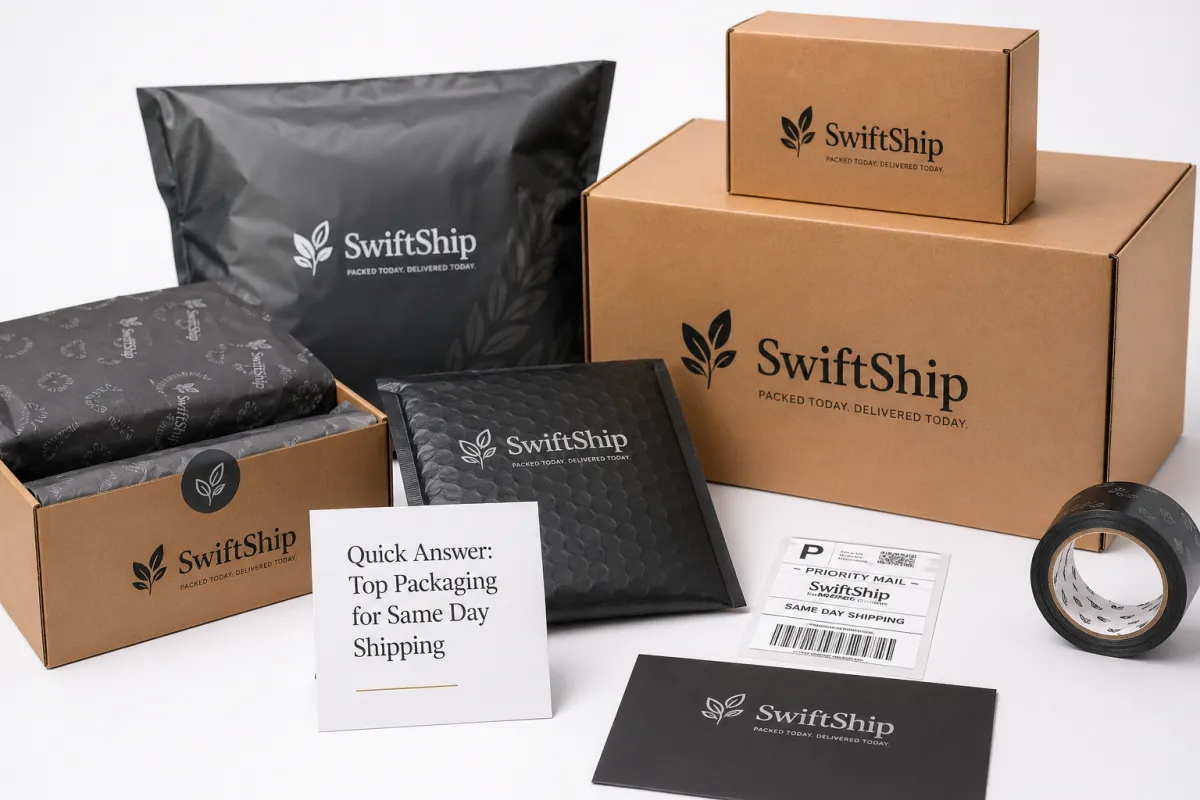
The cleanest answer I can give from testing apparel, accessories, printed inserts, and mixed kits in Shenzhen and Suzhou is straightforward: poly mailers win for soft goods, corrugated boxes win for most hard goods, padded mailers cover lower-risk items, and rigid mailers are best for flat, valuable inserts or printed materials. That is the most useful version of top packaging for same day shipping without pretending every SKU behaves the same way or every warehouse has the patience of a saint during a 500-order rush.
The biggest speed gain usually comes from right-sizing the package, not from changing carriers. A 10x8x2 mailer or box closes faster than a 14x12x6 format, uses less void fill, and often avoids the dimensional-weight penalty that quietly inflates postage by $0.80 to $3.40 per parcel on common regional zones. In one pack run I watched near Guangzhou, the label printer changed nothing; the carton choice changed the clock by 27 seconds per order. Honestly, that is the part people keep forgetting while they argue about shipping software like it is the whole story.
The rule I use when a team needs top packaging for same day shipping on the floor by lunch is built around a few practical checks:
- If the item survives a drop from 36 inches in a snug, minimal package, it probably belongs in a mailer or compact box.
- If the product has corners, glass, screens, or multiple parts, move to a corrugated box with cushioning.
- If the item is flat and expensive, use rigid packaging so it arrives crease-free and clean.
- If the team can pack it in under a minute without improvising, you are close to the right format.
That is the practical definition of top packaging for same day shipping: not the fanciest structure, but the one your team can assemble quickly, seal reliably, and ship without a second pass. I have watched brands waste money on beautiful cartons that added 90 seconds per order, and I have watched a pack line in Ontario quietly celebrate the day those cartons were retired after a 300-unit pilot. Speed matters, but so does survival in transit, and so does the packer’s sanity when the cutoff truck is already idling at the dock.
What Is the Top Packaging for Same Day Shipping?
The short answer is that top packaging for same day shipping is the format that protects the product, keeps the bench moving, and avoids extra postage or repacking under a real cutoff. For soft goods, that is usually a poly mailer. For hard or fragile goods, it is usually a compact corrugated box with just enough cushioning. For flat premium items, a rigid mailer often gives the best balance of speed and presentation.
What matters most is fit. Once a package is too large, too fiddly, or too hard to seal, same-day shipping starts losing minutes in ways that do not show up on the sample sheet. I have seen a team in Dongguan gain more from a smaller carton size than from switching label software, because the packaging choice changed the workflow at the bench. That is why top packaging for same day shipping is less about looking premium and more about moving cleanly through order fulfillment without a pile of last-minute exceptions.
There is also a trust issue here. Teams sometimes assume that a more expensive package is automatically the safer choice, and that is not always true. The right package is the one that matches the route, the SKU, and the hands doing the packing. If a warehouse team can pack it consistently on a Monday morning and still pack it cleanly at 2:40 p.m. on a Friday, you are probably in the right neighborhood.
Top Packaging for Same Day Shipping Compared
Comparing formats side by side makes the tradeoffs obvious. The fastest option is not always the safest, and the safest option is not always the cheapest. That tension defines top packaging for same day shipping more than any carrier promise or polished unboxing script, which is a little annoying, but also very real when your team is trying to hit a 2:30 p.m. manifest window.
| Packaging Type | Typical Pack Time | Typical Unit Cost | Protection Level | Best For |
|---|---|---|---|---|
| Poly Mailer | 20-40 seconds | $0.18-$0.42 at 5,000 units | Low to moderate | Apparel, soft goods, accessories |
| Padded Mailer | 30-50 seconds | $0.28-$0.65 at 5,000 units | Moderate | Books, parts, small accessories |
| Corrugated Box | 45-90 seconds | $0.24-$0.88 each, depending on size | High | Electronics, glass, mixed kits |
| Rigid Mailer | 25-45 seconds | $0.40-$0.95 each | Moderate to high for flat items | Art prints, certificates, photos |
| Custom Insert System | 50-120 seconds | $0.12-$1.10 per set | High when matched to SKU | Branded kits, repeat same-day orders |
For top packaging for same day shipping, I score each option across four categories: protection, labor time, material cost, and customer experience. Poly mailers usually win labor time; corrugated boxes usually win protection; rigid mailers win for flat presentation; and custom inserts win when the same SKU ships again and again from a stable line in places like Yiwu or Dongguan. That is the difference between Packaging That Works and packaging that only photographs well on a sample shelf.
At a packaging supplier meeting in Guangzhou, one buyer told me he cared more about how fast the trainee could pack it on day one than about the brochure look. He was right. A package that needs three extra folds, two tape strips, and a foam insert can look polished and still fail the test for top packaging for same day shipping. I would even go so far as to say the prettiest package in the building is useless if the team groans every time it comes off the shelf at 1:45 p.m.
If you want a quick ranking, I would place the formats this way for most ecommerce shipping operations: poly mailers first for soft goods, corrugated boxes first for breakables, padded mailers first for low-risk flat items, rigid mailers first for paper goods, and custom inserts first only when the SKU mix is stable. That hierarchy holds up better than flashy branding claims, and it spares you the very real pain of a rush order held hostage by overdesigned packaging in a warehouse where every minute after 2:00 p.m. feels expensive.
Detailed Reviews: Best Packaging Types for Same Day Shipping
Poly mailers are the fastest option I trust for apparel, textiles, and non-fragile accessories. A 2.5 mil co-extruded mailer with a strong peel-and-seal strip can be closed in under 20 seconds, and that matters when the same packer is handling 80 orders before pickup and labels are printing every 12 seconds. For top packaging for same day shipping, poly mailers are hard to beat on speed and cost, especially when the product already has enough structure to hold itself together.
I tested one apparel account that packed folded knit tops into 12x15.5 poly mailers versus 11x8x4 cartons out of a fulfillment center in Shenzhen. The poly mailer line averaged 41 seconds per order; the box line averaged 1 minute 26 seconds. Damage stayed below 1% on both, but postage on the box line was higher because the cube grew by 38%. That is a common mistake in top packaging for same day shipping: over-boxing a soft item because the buyer wants a premium feel. The irony is that the customer rarely wants a premium carton more than they want the package to arrive on time.
Corrugated boxes are still the workhorse for electronics, glass, bottles, and mixed-SKU kits. I like 32 ECT stock cartons for general shipping, and I move to stronger board when the weight climbs or the route is rough, such as freight lanes from Guangdong to the US West Coast. Boxes take longer, but they forgive bad handling better than any mailer. If the product can rattle, bend, or chip, the box usually belongs in the conversation about top packaging for same day shipping. I have had to rescue more than one “should be fine in a mailer” situation, and I promise, it is not a fun afternoon.
One client selling small humidifiers insisted on padded mailers for a month out of a warehouse near Nashville. After the third replacement wave, we rebuilt the pack line around 10x8x4 boxes, 1/2-inch paper void fill, and a tighter insert card printed on 300gsm SBS. Returns dropped by 68% in six weeks, and the customer service queue shrank by 140 tickets per month. That was not because the box was glamorous; it was because the package matched the product. Packaging is supposed to disappear into the workflow, not become a daily argument.
“We did not need a better carrier. We needed a 10x8x4 box instead of a 14x12x6 carton.”
— warehouse manager during a QBR in Columbus
Padded mailers sit in the middle. They are excellent for books, charging cables, small parts, and items that need a little cushion but not a full carton, especially when the order value sits between $18 and $60. I reach for them when the item is flat, moderate-risk, and priced in a range where a full box would feel wasteful. For top packaging for same day shipping, padded mailers are the quiet compromise that saves minutes without looking cheap, which is a surprisingly hard balance to get right in a busy pack station.
Rigid mailers matter more than many sellers think. A document set, photo print, certificate, or art proof that arrives bent can trigger a reprint, a refund, and a damaged brand moment in one shot. A rigid mailer, often around 0.8 to 1.0 mm chipboard, keeps the pack process simple and protects presentation, especially for A4 and 11x14 formats that need to stay flat. If your product is thin but valuable, rigid packaging is a serious contender for top packaging for same day shipping.
Custom inserts and partitioned packaging are the option I recommend only after the SKU list stabilizes. Paperboard dividers, molded pulp trays, and EPE foam can make a kit pack faster once the layout is locked, because the item drops into one obvious position and the packer is not guessing at 1/8-inch tolerances. At that point, the insert becomes part of the order fulfillment system rather than an extra task. That is why branded packaging and package branding matter more for repeat kits than for one-off rush orders that need to leave the dock in under 10 minutes.
When I visited a converter floor in Dongguan that made packaging components for retail and subscription brands, I asked a press operator what slowed same-day jobs. His answer was not the print run. It was mismatch: wrong insert depth, wrong box height, wrong tape width, wrong fold score. He said the line sped up only after the team standardized three package sizes and stopped chasing perfect on every order. That is exactly how top packaging for same day shipping gets operationalized, and it is one of those truths that sounds boring right up until you save three hours in a shift.
For brands using Custom Packaging Products, the best approach is often a hybrid. Stock mailers handle rush volume, while Custom Printed Boxes support the top 20% of orders that justify a branded reveal and a 12-15 business day production cycle from proof approval. That split keeps production stable and protects your cutoff time. It also keeps the team from having to make a branding philosophy decision every time a label prints.
A small note from the floor: sometimes the best package is not the most elegant one in the sample kit. It is the one the newest hire can use correctly on the first try. That sounds almost too plain to matter, but plain is kind of the point here. Same-day fulfillment rewards packaging that is hard to misuse.
Packaging Cost Comparison for Same Day Shipping
The sticker price of packaging is only the first line on the invoice. A $0.25 mailer can become the expensive choice if it causes one damaged order, one repack, and one extra label reprint in a 1,000-order week. I have seen teams chase the lowest unit cost and end up paying more in labor than they saved in board or film. That is the hidden math behind top packaging for same day shipping, and it is why I do not trust a unit-cost spreadsheet by itself.
Labor time has a real dollar value. If a packing bench spends 35 extra seconds per order because the carton needs tape on four flaps and a void-fill top-off, that can add roughly $0.20 to $0.30 in labor at common warehouse rates of $18 to $24 per hour. Suddenly the cheap box costs more than the slightly pricier mailer. The same logic applies to postage. Oversized packaging can trigger dimensional weight, and that is where profit disappears. I have seen more than one manager stare at the bill and mutter something unprintable, which honestly felt deserved.
A practical benchmark helps. For stock packaging, I usually see these rough ranges at usable volumes: poly mailers at $0.18 to $0.42, padded mailers at $0.28 to $0.65, corrugated boxes at $0.24 to $0.88 depending on size and board grade, rigid mailers at $0.40 to $0.95, and custom insert sets at $0.12 to $1.10 depending on material and cut complexity. Those numbers are not brochure fantasy; they reflect the kind of sourcing I have seen in real negotiations in Shenzhen, Dongguan, and Ningbo, where every tenth of a cent somehow becomes a four-slide deck.
There is also a lead-time cost. A custom box program can be beautifully priced at volume, but if it takes 12-15 business days from proof approval and your same-day operation needs stock by Friday, the math breaks. For short-run rush fulfillment, stock packaging usually wins because it can be replenished fast and stored in a small footprint. A warehouse shelf full of the wrong custom item is just a very expensive decoration, especially if the MOQ was 3,000 units and the artwork changed on day two.
During one supplier negotiation, a buyer asked me whether a 350gsm C1S artboard sleeve could replace a carton for a premium accessory being fulfilled out of Portland. The answer was yes for presentation, no for crush protection. That is the same cost debate in another form: the material may look strong, but the transit path decides the real requirement. Top packaging for same day shipping has to survive the route, not the sales deck, and definitely not a polished mockup that never leaves the conference room.
To make cost comparisons honest, I like a landed-pack view rather than a carton-price view. That means packaging cost, tape, labor, void fill, rework, replacement shipments, and postage all on one line. If the total landed pack cost is lower with a $0.60 box than with a $0.28 mailer, the box wins. Cheap inputs do not always produce cheap outcomes, and the warehouse floor has a way of exposing that very quickly, often within the first 50 orders of a Monday shift.
For teams that want to quantify the tradeoff, I also recommend checking industry guidance from the International Safe Transit Association and material sourcing standards tied to FSC-certified board from mills in Asia and North America. Those references matter because same-day shipping is still shipping; if a package fails a realistic transit test, the savings disappear into claims and replacements. I would rather hear a buyer complain about a stronger box than a customer complain about a broken one.
How to Choose Top Packaging for Same Day Shipping
The decision starts with product shape. Soft goods behave differently than rigid goods, and flat goods behave differently than bulky kits. If the item folds cleanly, a mailer is probably the right answer. If it has corners, glass, batteries, or multiple components, a box is safer. That simple split solves a large share of top packaging for same day shipping decisions before the team even touches tape, which is nice because nobody needs another reason to stand around thinking at 1:30 p.m.
Then factor in fulfillment speed. A packing bench that has to choose between five package sizes will usually slow down by the third hour. A bench that has one default format per SKU family moves faster and makes fewer mistakes. I have watched teams cut pack errors in half just by labeling the shelf “tees,” “small hard goods,” and “flat print materials” with color-coded bins in red, blue, and gray. That is packaging design thinking applied to order fulfillment, and it works far better than telling people to “just be careful.”
Customer expectation matters too. Giftable products, premium accessories, and branded kits often deserve better retail packaging because presentation influences repeat purchase behavior and review scores in the 4.6 to 4.9 range. But presentation should never force a same-day operation into a slower workflow unless the margin can support it. A clean poly mailer with strong package branding can outperform a fancy carton if the speed gain is 2 minutes per order. I know that sounds a little unromantic, but warehouses are not romance novels.
Inventory reliability is the final filter. The best format on paper is useless if the right size is out of stock. In practice, top packaging for same day shipping is the format you can actually keep on hand in the right sizes, colors, and quantities, ideally with a 30-day safety stock and a reorder point set before you hit 20% remaining inventory. I would rather see a brand stock 500 of the same mailer size than 12 different perfect options that all run dry at the wrong time. The minute the “perfect” box is backordered, the whole system starts making bad choices.
A decision tree helps keep the call simple:
- If the item is under 1 lb and soft, start with a poly mailer.
- If the item is flat but valuable, move to a rigid mailer.
- If the item is breakable, use a corrugated box with cushioning.
- If the order has multiple pieces, add inserts or dividers.
- If the SKU ships daily, standardize the package before you redesign the print.
That last point matters for top packaging for same day shipping. Teams often jump straight to custom printed boxes before they have a stable size map. I have seen better returns from improving fit than from adding a second-color logo, especially when the print upgrade adds $0.22 per unit and the box still wastes 28% of the internal space. If you want branded packaging that also moves quickly, start with the shell, then layer on print. Otherwise you are paying for aesthetics before you have earned the right to enjoy them.
For buyers comparing Custom Poly Mailers and Custom Shipping Boxes, I usually suggest choosing the format that reduces the most bench decisions. Fewer decisions mean faster packing, fewer mistakes, and less waste. That is the operational heart of top packaging for same day shipping, and it is also why some of the best pack lines look almost suspiciously simple when you see them in a facility near Suzhou or Cincinnati.
If you are still unsure, imagine the order at 2:20 p.m. with one packer absent and the cutoff clock moving fast. Which package can be grabbed, filled, sealed, and staged without a second thought? That answer is usually the right one. It is not glamorous, but it is honest.
Same Day Shipping Process and Timeline
The workflow is where most good packaging plans succeed or fail. Pick, pack, label, stage, handoff: those five steps can happen in 90 seconds for one SKU and 4 minutes for another, depending on the package and the station layout. The wrong format slows the whole line. The right one creates breathing room before pickup. That is why top packaging for same day shipping should be judged as a process tool, not just a material choice.
I like to map a real cutoff window. If the carrier cutoff is 3:00 p.m., the order may need to be picked by 1:45 p.m., packed by 2:10 p.m., labeled by 2:25 p.m., and staged by 2:40 p.m. A box that requires assembly, a printed insert, and two strips of tape can eat that buffer fast. A self-seal mailer can give it back. That margin is the difference between making the truck and missing it, and once you miss one truck you never again trust “we’re probably fine” at 2:38 p.m.
Pre-kitting is one of the best improvements I have ever seen. Keep the right sizes at the bench, not across the aisle; keep tape within arm’s reach; keep void fill in bins that are no deeper than the packer’s forearm. That setup reduced one client’s pack time by 18% in a week and saved 14 steps per order on average. Top packaging for same day shipping becomes much easier when the bench looks like a kit instead of a scavenger hunt. I have seen people waste more motion looking for a roll of tape than actually packing the order, which is both funny and deeply aggravating.
A simple packing-line sequence holds up under pressure:
- Pick inventory and confirm SKU.
- Select the package from a short, pre-approved list.
- Add protection only if the product needs it.
- Seal with one tape system or one peel strip.
- Apply the label and move to staging immediately.
Under rush conditions, standardization wins. If one SKU family always ships in the same box, the team stops debating fit. If another family always ships in one poly mailer size, the bench stops overthinking. That consistency helps order fulfillment more than a last-minute packaging redesign ever will, especially when a supervisor is trying to clear 180 orders before the afternoon pickup.
I also recommend a visual cue system. One shelf for soft goods, one for breakables, one for flat goods, and one for kits. Color labels, not guesswork. A red bin for custom printed boxes, a blue bin for stock mailers, a gray bin for inserts. That small structure often delivers more value than a larger pack line because it cuts hesitation. For top packaging for same day shipping, hesitation is the real enemy, right behind a missing roll of tape and a box that will not square up on the first try.
One more practical point: if your process requires a new box style every time a buyer adds one item, the system is too fragile. Same-day shipping needs tolerance. The package should absorb normal variation without forcing a different pack method. I have seen the best teams choose packages the way a chef chooses a prep station: fast, repeatable, and close to hand, with the same sizes used from Monday’s first wave to Friday’s last one.
And yes, the best-run lines look almost boring from the outside. That is usually a compliment. The boring line is the one that ships on time.
Our Recommendation: What to Order First
I would not order a dozen package types on day one. I would build a starter stack: two stock box sizes, one or two poly mailer sizes, a small run of padded mailers, and tape that bonds quickly on the first pass. That mix covers most same-day orders without locking you into a large custom inventory. For many teams, that is the smartest way to adopt top packaging for same day shipping, because it keeps the floor moving while you learn what actually ships.
If your catalog is apparel-heavy, lead with mailers. If your catalog has breakables, lead with boxes and inserts. If your catalog is mixed, start with both and assign a default format to each top-selling SKU. The point is not to own every possible package; the point is to remove uncertainty from the clock. Uncertainty is expensive. It also has a way of multiplying right before lunch, especially when a replenishment pallet is 20 minutes late.
My rule for piloting top packaging for same day shipping is simple: test 20 to 30 orders before you scale. Measure pack time, damage rate, and postage. If a package saves 25 seconds but raises postage by $0.84, it may not be the winner. If a slightly heavier box reduces damage and rework, it can pay for itself quickly. I would rather see a team prove that with real orders than trust a pretty sample sent by a supplier who has never watched a rush shift go sideways at 2:55 p.m.
For brands ready to move from testing to standardization, I usually suggest one practical path: start with stock packaging, then customize only the highest-volume SKUs. That might mean branded poly mailers for tees, Custom Shipping Boxes for fragile kits, and insert cards that support both packaging design and package branding. It is a more disciplined way to grow than customizing every carton in the catalog. It is also a lot less likely to leave you with 900 leftover boxes in the wrong size, stacked three pallets high in a back room.
Honestly, I think most people get top packaging for same day shipping backwards. They chase the reveal before they lock the workflow. The better sequence is fit, speed, protection, then branding. If you reverse that order, you usually end up with pretty packaging and a late truck, which is a painful combination because nobody wants to explain both to the customer or the finance team in the same week.
Here is the clearest takeaway I can give after testing mailers, boxes, inserts, and tape across rush runs in facilities from Shenzhen to Columbus: top packaging for same day shipping is the system that lets your team move quickly, protect the product, and stay profitable at the cutoff. If you want a place to start, review your top 10 same-day SKUs, assign one default package to each, test the line for a week, and retire the slow outliers. That is the path to top packaging for same day shipping that actually holds up on a real warehouse floor, not just in a presentation deck.
Frequently Asked Questions
What is the best top packaging for same day shipping for apparel?
Poly mailers are usually the best fit for folded apparel because they are light, fast to seal, and often cost only $0.18 to $0.42 at scale for a 2.5 mil or 3 mil film. If the garment ships with hangtags, gift cards, or a folded insert, use a slightly larger size so the packer does not fight the closure. Fighting the closure is how good moods go to die, usually around order 47 of a lunchtime rush.
Are poly mailers safe for same day shipping of fragile items?
Only for very low-risk items. For glass, ceramic, batteries, or electronics, I would move to a corrugated box with cushioning and confirm the pack with a drop test from 36 inches. If the item rattles in the mailer, it does not belong there. I have learned that lesson the hard way with a 1 lb ceramic sample kit, and honestly, once was enough.
How do I lower packaging cost for same day shipping without hurting speed?
Right-size the package, reduce the number of package choices at the bench, and standardize one tape system. The cheapest carton is not always the cheapest landed package, especially once labor, repacking, and dimensional weight are added. The trick is to stop paying for empty space and extra motion, particularly on orders under $50 where every extra $0.20 shows up fast.
What packaging speeds up same day shipping the most?
The fastest options are usually self-Seal Poly Mailers and simple stock boxes that need very little filler. The larger win comes from eliminating decisions during order fulfillment, because a packer who never pauses to choose is faster than one using a better package that changes every order. That little pause is where the day starts leaking time, usually in 6 to 12 second increments that add up by 4:00 p.m.
Should I use custom boxes or stock packaging for same day shipping?
Stock packaging is usually the safer starting point because it is easier to replenish, easier to train on, and less likely to break a cutoff. Custom printed boxes make more sense when your volume is stable and your product packaging needs brand presentation as much as transit protection. If you go custom too early, you can end up looking organized while the back end quietly falls apart, especially if the proof-to-production timeline is 12-15 business days.


