Buyer Fit Snapshot
| Best fit | eco bag printing partners for brands for packaging buyers comparing material specs, print proof, MOQ, unit cost, freight, and repeat-order risk where brand print, material, artwork control, and repeat-order consistency matter. |
|---|---|
| Quote inputs | Share finished size, material target, print colors, finish, packing count, annual reorder estimate, and delivery region. |
| Proofing check | Approve dieline scale, logo placement, barcode or warning zones, color tolerance, and any recyclable or compostable wording before bulk production. |
| Main risk | Vague material claims, crowded artwork, or missing packing details can create delays even when the unit price looks attractive. |
Fast answer: Eco Bag Printing Partners for Brands: Film, Closure, Print, and Fulfillment should be specified like a repeatable production item. The safest quote includes material, print method, finish, artwork proof, carton packing, and reorder notes in one written spec.
What to confirm before approving the packaging proof
Check the product dimensions against the actual filled item, not only the sales mockup. Ask for tolerance on folds, seals, hang holes, label areas, and retail display edges. If the package carries a logo, QR code, warning copy, or legal claim, reserve that space before decorative graphics fill the panel.
How to compare quotes without losing quality
Compare board or film grade, print process, finish, sampling route, tooling charges, carton quantity, and freight assumptions side by side. A lower quote is only useful if the supplier can repeat the same color, closure quality, and packing count on the next order.
Best Eco Bag Printing Partners for Brands: Top Picks
The best eco bag printing partners for brands are rarely the cheapest names on a quote sheet. They are the vendors that can balance ink compatibility, recycled-content claims, and dependable color on the actual bag substrate. That sounds straightforward until a team runs into the practical side of packaging: a bag may look sustainable in a mockup and still become harder to recycle after the wrong coating, laminate, or heavy ink coverage changes the material behavior.
For brands that care about launch timing, margin, and credibility, the real question is not “Who prints eco bags?” It is “Who can print the same bag twice, keep the color steady, and show the material claims in plain language?” The best eco bag printing partners for brands often look different depending on whether you need 250 bags for a product drop, 5,000 retail carriers for a chain rollout, or 50,000 units for replenishment. One supplier may be perfect for one of those jobs and a poor fit for the others.
Price alone does not tell the whole story. A low quote can turn into the most expensive option once reprints, color drift, freight surprises, or missed launch dates enter the picture. I have watched small savings disappear fast when a partner could not hold a CMYK match, could not explain a recycled-content certificate, or suggested a coating that fought the sustainability message the brand was trying to protect. That part is not glamorous, but it is where the real money goes.
Best Eco Bag Printing Partners for Brands: Quick Answer
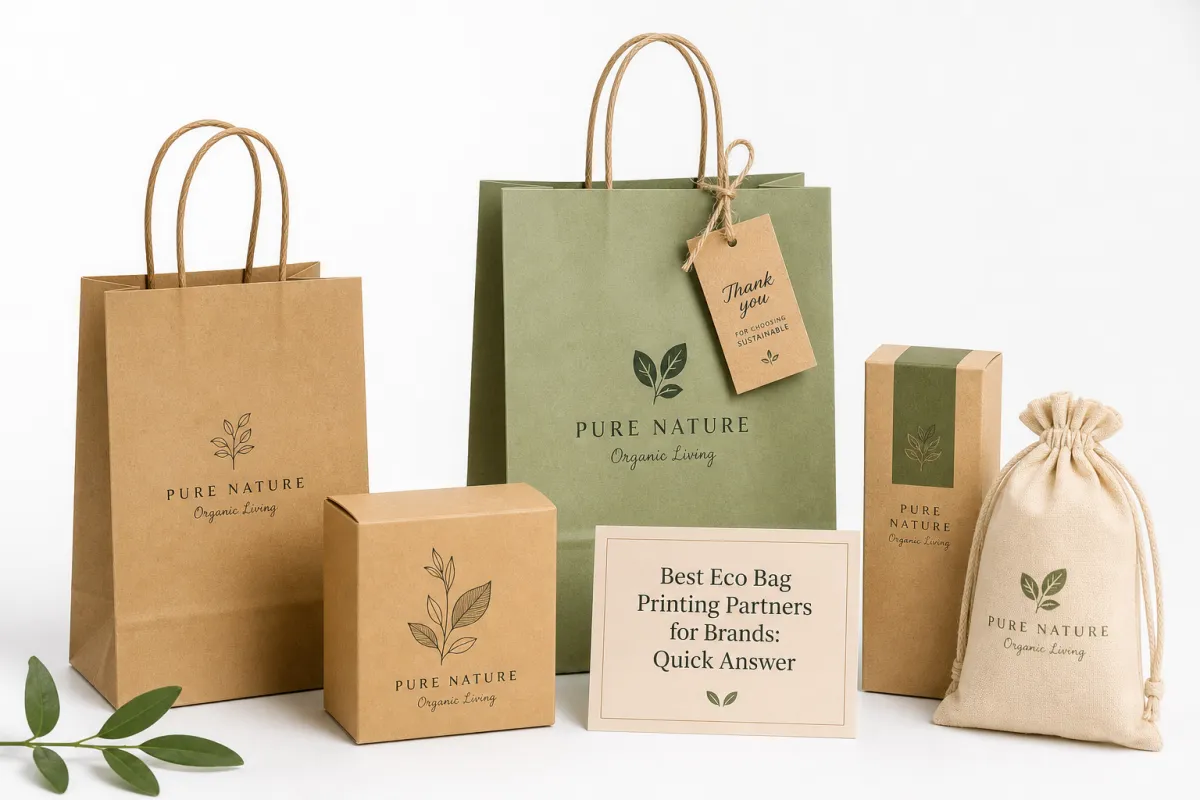
If you want the short version, the best eco bag printing partners for brands are the ones that match print method to material, not just marketing language to the mood board. In practice, that means checking ink compatibility first, then looking at recycled content, then asking what kind of print finishing the bag actually needs. A matte aqueous coat may suit one project well. A soft-touch laminate may be a poor fit for another if recyclability is the priority.
The risk is simple: the more premium the bag looks, the more likely it is that the sustainability profile becomes harder to defend. Heavy coverage in offset printing can work beautifully on the right stock, but on some eco bags the wrong coating or too much ink can reduce fiber recovery or complicate disposal. The same issue shows up with metallic effects, dense full-bleed artwork, and finish-heavy designs. From a packaging buyer’s point of view, the best eco bag printing partners for brands are the ones that warn you before the artwork creates a problem.
Different brand types need different partner profiles. Low-MOQ startups usually do better with a digital printing specialist that can support 100-500 units and fast proofing. Premium retail brands often need a studio or manufacturer that understands CMYK, spot color control, handle construction, and premium print finishing. High-volume programs usually belong with a flexographic printing or offset printing operation that can keep unit cost down on 5,000-plus pieces without letting color drift from one reorder lot to the next. Those needs are not interchangeable, and treating them as if they are is how budgets get blown.
A lower sticker price can also hide setup charges, plate fees, freight markups, or a weak reprint policy. Once those show up, the savings can disappear. The best eco bag printing partners for brands are usually the ones that give you a real landed-cost view up front, not just a headline unit price that looks good in an inbox.
A bag is not sustainable because the mockup says recycled. The proof lives in the substrate, the ink load, the finish, and whether the same result can be repeated six months later.
Best Eco Bag Printing Partners for Brands Compared
The best eco bag printing partners for brands usually fall into four buckets: boutique packaging studios, high-volume manufacturers, marketplace aggregators, and regional sustainability specialists. Each one can work. Each one can also fail in a very specific way if the job does not line up with its strengths.
| Partner Type | Typical MOQ | Unit Cost Range | Proofing Speed | Best For | Main Tradeoff |
|---|---|---|---|---|---|
| Boutique packaging studio | 100-1,000 | $1.20-$4.50 | Fast | Premium launches, short runs, custom artwork | Higher cost and tighter scale limits |
| High-volume manufacturer | 5,000-50,000+ | $0.18-$0.75 | Moderate | Retail replenishment, chain rollouts, stable artwork | Less flexibility on changes and small runs |
| Marketplace aggregator | 250-2,000 | $0.90-$3.25 | Moderate | Simple campaigns, buying convenience, quick sourcing | Quality and documentation can vary by factory |
| Regional sustainability specialist | 500-10,000 | $0.35-$1.80 | Moderate to fast | Brands that need proof, traceability, and local support | May not be the lowest price at scale |
A boutique packaging studio often makes the most sense when artwork changes often or when the bag is part of a higher-end retail moment. These partners usually excel at prepress support, dieline checks, and quick sample handling. If your team needs help adjusting a logo so it does not disappear against a kraft texture, a studio can be worth the premium. The downside is easy to spot: the best eco bag printing partners for brands in this category are not usually the cheapest, and they may steer you toward tighter quantities.
A high-volume manufacturer sits at the other end of the spectrum. This is where flexographic printing and some offset printing programs can make sense, especially when the artwork is stable and the order is large enough to absorb plates or setup. For 10,000-plus bags, the economics can be very attractive. The tradeoff is agility. If you need a redesign three days before proof approval, the process may not move quickly.
Marketplace aggregators are useful when procurement wants speed and breadth, but they demand discipline. The best eco bag printing partners for brands are rarely the first listing you see. Aggregators can get you moving quickly, yet the factory behind the quote may change from one order to the next. That works for simple one-color work, and it works less well for a branded retail bag where color consistency matters. Documentation can also be thinner than buyers expect.
Regional sustainability specialists are often underrated. They usually know their material chain better, and they tend to speak more clearly about FSC, recycled content, water-based inks, and the practical limits of compostable claims. If you need better chain-of-custody visibility, this category often beats a generic low-cost source. For that reason, many brands find the best eco bag printing partners for brands sit here rather than in the cheapest quote bucket.
For buyers who want to see how those choices play out in real programs, our Case Studies page shows the difference between a one-time print win and a repeat-order program that actually holds together. If you want to compare materials and production routes in more detail, our Manufacturing Capabilities overview is a useful starting point.
Detailed Reviews of the Best Eco Bag Printing Partners for Brands
When I review the best eco bag printing partners for brands, I look for the same things every time: prepress support, dieline checks, color discipline, sample management, and whether the team gives specific answers instead of polished generalities. The strongest partner does not just say yes. It explains which material, ink system, and finish will keep the bag usable and the brand legible.
A strong operator also understands that eco bag jobs are rarely just “print and ship.” There is usually a file check, a proof, one or two revisions, a test pull, then production. A good partner keeps the process moving without hiding behind jargon. A weak one sends vague status updates and hopes the bag somehow sorts itself out. That is not good enough for the best eco bag printing partners for brands.
I still remember a run where the artwork looked perfect on screen but lost half its character once it hit a textured recycled stock. The supplier caught the issue during proofing and suggested a minor stroke adjustment instead of pretending the first file was fine. That kind of practical judgment is what saves a launch from becoming a headache.
| Partner Type | Quality Control | Sustainability Evidence | Communication | Repeat-Order Consistency | Overall Fit |
|---|---|---|---|---|---|
| Boutique packaging studio | 9/10 | 7/10 | 9/10 | 7/10 | Best for premium short runs |
| High-volume manufacturer | 8/10 | 7/10 | 6/10 | 9/10 | Best for scale and repeatability |
| Marketplace aggregator | 6/10 | 5/10 | 7/10 | 6/10 | Best for simple sourcing needs |
| Regional sustainability specialist | 8/10 | 9/10 | 8/10 | 8/10 | Best for proof and traceability |
The boutique packaging studio usually performs best on the front end. If your artwork includes fine typography, a textured substrate, or subtle CMYK gradients, this is where the partner’s prepress skill matters most. The best eco bag printing partners for brands in this category usually catch problems before production begins, not after a pallet is already boxed. The weakness is scale: once a program grows, unit cost can climb quickly unless the supplier also has manufacturing depth.
The high-volume manufacturer is the opposite kind of value. On stable designs, this partner can deliver excellent repeat-order consistency. That matters more than many brand teams admit. A bag that prints beautifully once but drifts on reorders is a hidden cost. The best eco bag printing partners for brands in this bucket tend to be stronger on flexographic printing, spot color control, and standardized production windows. They are less forgiving of last-minute artwork changes, but they usually win when the spec is locked.
Marketplace aggregators get mixed reviews because they solve convenience, not necessarily packaging discipline. When reading their feedback, ignore the generic “great service” praise and look for packaging clues: Was the logo centered? Was the print register steady from bag to bag? Did the handles match the approved material? Did the buyer receive usable proof photos? Those details tell you far more than star ratings. A partner can be responsive and still not be among the best eco bag printing partners for brands if the output varies too much.
Regional sustainability specialists often provide the clearest documentation. That matters if you need FSC chain-of-custody proof for paper-based bags or need to explain why a recycled substrate was selected over virgin stock. For paper sourcing, the FSC system is one of the clearest reference points, especially when a buyer wants a traceable paper trail rather than a vague environmental statement. If you are also packaging the bags in transit cartons, ISTA testing standards can help validate that the outer pack survives the ship-to-store or ship-to-warehouse journey.
Here is the red-flag list I use when sorting real operators from polished sales decks:
- Vague answers about recycled content, paper origin, or ink chemistry.
- Hidden setup fees that appear after the quote is approved.
- Promises of perfect color on the first proof without substrate testing.
- No sample archive or no willingness to compare old and new runs.
- Unclear reprint policy if a shipment lands with color drift or scuffing.
Customer reviews are most useful when they mention print-specific details. If a review says the company is “friendly,” that helps very little. If it says the bags arrived with crisp edges, even ink coverage, and no laminate haze, that is the review you should trust. That is how the best eco bag printing partners for brands separate themselves from the pack.
Cost, Pricing, and MOQ: What Brands Actually Pay
Most buyers ask for a unit price, but the best eco bag printing partners for brands quote a system, not a headline. The real cost sits in substrate, ink count, setup or plate charges, finishing, freight, duties if applicable, and any overage or scrap allowance. If one supplier quotes just the bag and another quotes landed cost, the comparison is already broken.
For planning purposes, a simple eco bag program can land in a few very different ranges. A one-color digital printing job on a small run might sit around $1.20-$3.75 per unit, depending on bag style and coverage. A higher-volume flexographic printing job on kraft or Recycled Paper Bags can fall closer to $0.18-$0.75 per unit once the run is large enough to absorb setup. Premium carrier bags with rope handles, heavy board, or more involved print finishing can run materially higher. Those are planning numbers, not final quotes, but they give you a realistic frame.
MOQ changes the math in a non-linear way. Lower minimums usually mean higher unit prices because the setup cost gets spread over fewer bags. A 250-piece order may look expensive next to a 5,000-piece order, but that does not make it wrong if you are testing a new brand concept or launching a limited campaign. The best eco bag printing partners for brands are honest about this tradeoff instead of pretending every order size should behave the same.
The hidden cost is inventory risk. A cheaper large run can still be the wrong decision if your design changes in three months or your retail footprint shifts. I have seen brands save 12% on unit cost and lose that advantage through dead stock, rework, or a second freight move. That is why the best eco bag printing partners for brands will discuss consumption rate, launch calendar, and reorder likelihood before pushing a large MOQ.
To compare quotes properly, keep the inputs identical. Same artwork file. Same bag size. Same handle type. Same color count. Same finish. Same shipping terms. Same target date. If one supplier prices using CMYK and another prices a spot-color version, you are not comparing like for like. A brand can easily waste a week untangling that kind of mismatch.
Below is the quote structure I recommend asking every supplier to itemize:
- Substrate type and basis weight or fabric weight.
- Print method: digital printing, offset printing, or flexographic printing.
- Ink count: one color, spot color, or full CMYK.
- Setup, plate, or file-prep fees.
- Print finishing, coating, or lamination.
- Shipping terms, freight, and duties.
- Overage allowance and reprint policy.
The reason this matters is simple: two quotes that differ by only 8% on the front end can end up 20-30% apart once freight, rush handling, or replacement units are added. That is the part most people miss when they are comparing the best eco bag printing partners for brands. The cheapest number is rarely the final number.
If you are buying paper bags, ask whether the ink load and coating will still allow the bag to be treated as recyclable in your market. If you are buying reusable totes, ask how the print will hold after repeated handling. If the bag is going into a retail program, ask whether the supplier can keep the same color recipe over multiple production lots. The best eco bag printing partners for brands are the ones that make those questions easy to answer.
Process, Timeline, and Lead Time: From Proof to Delivery
The production path for the best eco bag printing partners for brands is usually more structured than buyers expect. It starts with the brief, then artwork prep, then prepress, then proofing, then sampling if needed, then approval, then production, then quality control, then shipping. If a supplier skips any of those steps, it is usually because they are moving too fast or hiding risk somewhere.
Proofing is where many schedules slip. A good team will flag font sizes, bleed, overprint issues, dieline mismatch, and color shifts before the file hits the press. That matters even more if the project uses CMYK gradients or a spot color that has to sit exactly on brand. The best eco bag printing partners for brands do not promise that your design is perfect; they show you where it can break and how to fix it.
In practice, a simple job can move from proof approval to production in about 7-15 business days, with shipping added on top. If the order requires a physical sample, a second proof, or imported substrate, the timeline stretches. Rush work is possible, but only when the material is on hand, the artwork is final, and the production line has room. Anyone who claims otherwise is probably selling hope instead of capacity.
Lead time also depends on the print route. Digital printing is often the fastest for lower MOQs because there are no plates and fewer setup steps. Flexographic printing can be excellent for longer runs, but plates and calibration add time. Offset printing can offer clean detail on the right paper stock, yet it usually rewards well-planned artwork and fewer last-minute changes. The best eco bag printing partners for brands explain these constraints before you commit to a launch date.
Seasonal demand is where planning matters most. If the bags are for a holiday promo, a retail reset, a trade show, or an ecommerce bundle, I would leave a buffer of at least two to three weeks beyond the quoted lead time. Freight delays, artwork revisions, and color corrections happen more often than teams admit. A schedule with no slack is not a schedule; it is a gamble.
For brands that want fewer surprises, here is the rough sequence I trust:
- Day 1-2: brief and artwork review.
- Day 2-5: proofing and corrections.
- Day 5-10: sample or soft proof, if required.
- Day 10-20: production, QC, and packing.
- Shipping: add domestic transit or import time separately.
One thing I hear often from buyers is, “The supplier said business days, but we needed a launch date.” That is a bad surprise only once. After that, the best eco bag printing partners for brands become the ones that give calendar-based milestones, not vague estimates. If a partner cannot tell you when proof approval is due, when production starts, and when cartons leave the dock, you do not yet have a real timeline.
Testing can matter too. If the bags will travel inside retail kits or ship in cartons, transit validation is worth a look. This is where ISTA-style testing can help, especially if the bag surface, handles, or print finish could scuff during transport. For brands selling into multiple channels, that extra discipline can prevent a disappointing first impression at store level. The best eco bag printing partners for brands think beyond the press sheet.
A rushed bag program is usually not a print problem. It is a proofing problem.
How to Choose the Best Eco Bag Printing Partners for Brands
The best eco bag printing partners for brands should be chosen with a scoring model, not a gut feeling. I recommend weighting five areas: sustainability proof, print quality, responsiveness, scale, and total landed cost. If one vendor scores high on price but low on documentation, that may still be fine for a temporary campaign. It is not fine if the bag is meant to signal a durable sustainability position.
Start with the substrate. Ask for recycled-content documentation, chain-of-custody paperwork where relevant, and clear confirmation of what the bag is made from. If the supplier cannot explain the material in plain language, keep looking. The best eco bag printing partners for brands are usually comfortable talking about FSC paper, recycled kraft, cotton, jute, RPET, or other substrates without slipping into vague green language.
Then match the material to the print method. A simple logo on kraft paper may work beautifully with flexographic printing and a spot color. A complex branded illustration may need digital printing or offset printing for cleaner tonal work. The wrong pairing creates problems fast. Too much ink can deaden a recycled look. Too little ink can make the logo disappear. The best eco bag printing partners for brands will tell you which compromise is least damaging.
Here is the request list I would send every finalist:
- Material certificate or recycled-content proof.
- Ink specification and finish specification.
- Sample photos or physical samples on the exact bag type.
- Written quote with all setup, freight, and overage terms.
- Proofing timeline and approval checkpoints.
- Reprint policy if the run misses spec.
Next, look at communication speed. A fast reply is not the same as a useful reply. The best eco bag printing partners for brands answer the right question the first time: what will this artwork do to the bag, how will it print, and what will it cost after freight? That is the level of detail you want.
A simple scoring rubric helps keep emotion out of the decision:
- Documentation: Is the sustainability proof specific?
- Print fidelity: Does the sample match the brand standard?
- Operational clarity: Are timelines and fees written clearly?
- Repeatability: Can the same result be rerun later?
- Total cost: Does the landed cost still make sense after freight and risk?
If you score each partner out of 10 in those five areas, the strongest choice usually becomes obvious. The best eco bag printing partners for brands are rarely the ones with the slickest presentation. They are the ones that look slightly less glamorous and slightly more precise. That is a good sign.
One final point: read reviews with a packaging lens. Look for mention of registration, ink coverage, handle attachment, substrate consistency, and whether reorders matched the original sample. Generic praise is cheap. Packaging-specific praise is valuable. That difference can save a brand from a costly mistake.
Our Recommendation: Next Steps for Brands
If I were narrowing this down for a brand, I would build a three-vendor shortlist based on order size, material, and timeline rather than company name alone. The best eco bag printing partners for brands are the ones that fit your actual job. A startup with 300 units needs a different supplier than a retail chain buying 20,000. That sounds obvious, yet it is where many procurement processes go sideways.
Ask each finalist for the same artwork file, the same bag spec, and the same quote structure. Then request physical samples if the job is important enough to matter. Compare the bags side by side under the same light. Check whether the print edges are clean, whether the brand colors hold, whether the finish feels appropriate, and whether the bag still looks recyclable or reusable in the hand. The best eco bag printing partners for brands should survive that comparison without a sales rep in the room.
I also recommend a small pilot run before any larger commitment. That pilot does three things: it shows print repeatability, it exposes communication gaps, and it tells you how easy reorder management will be. If the first job is flawless but the second is messy, the supplier was never the right long-term fit. The best eco bag printing partners for brands are the ones that can repeat the same result, not just produce one good sample.
For packaging teams that need a practical filter, here is the simplest rule I trust: choose the supplier that gives you the clearest proof, the most honest timeline, and the least ambiguity around cost. That combination usually beats a lower sticker price. In my view, that is what separates the best eco bag printing partners for brands from everyone else.
So if you need one action to take this week, send the same brief to three candidates, request itemized landed pricing, and ask for proof images on the exact substrate you plan to use. That one step will tell you more than a stack of glossy brochures ever will.
If your team is still unsure, return to the basic test: can this partner print the same bag again, at the same quality, without surprises? If the answer is yes, you are close. If the answer is fuzzy, keep looking. The best eco bag printing partners for brands are the ones that make the second run feel boring in the best possible way.
How do I verify the best eco bag printing partners for brands are truly sustainable?
Ask for material certificates, ink specifications, and recycled-content documentation instead of relying on marketing copy. Confirm whether the bag can actually be recycled, composted, or reused in your target market under local rules. Check whether the partner can show a clear chain of custody or supplier documentation for the substrate they are using.
What MOQ should brands expect from eco bag printing partners?
MOQ depends on print method, bag material, and finishing complexity; digital work usually supports lower runs than analog methods. Expect lower MOQs to carry a higher unit price, while larger orders usually reduce unit cost but increase inventory risk. Ask whether the MOQ includes overages or if extras will be billed separately.
How long do eco bag printing partners for brands usually take?
Simple jobs can move quickly after proof approval, but sampling, revisions, and freight often add more time than the print itself. Ask for calendar-based milestones, not vague business-day estimates, so the launch date is tied to real checkpoints. Rush jobs are possible only when the partner already has the right stock, artwork readiness, and production capacity.
Which print method is best for eco bags?
The best method depends on the artwork and material: one-color logos often fit screen or flexo, while more complex artwork may need digital printing. The right method should preserve recyclability and avoid excessive ink coverage or unnecessary coatings. Request a sample or test print on the exact bag material before approving the final run.
What should I include when comparing quotes from eco bag printing partners?
Use the same bag size, material, color count, quantity, shipping terms, and proofing assumptions across every quote. Separate unit cost from setup, freight, customs, and reprint policy so hidden costs do not distort the comparison. Ask each partner to quote the same artwork file and to confirm lead time in writing.


