Buyer Fit Snapshot
| Best fit | Recycled Paper Bags Price projects where brand print, material claims, artwork control, MOQ, and repeat-order consistency need to be specified before quoting. |
|---|---|
| Quote inputs | Share finished size, material target, print colors, finish, packing count, annual reorder estimate, ship-to region, and any compliance wording. |
| Proofing check | Approve dieline scale, logo placement, barcode or warning zones, color tolerance, closure strength, and carton packing before bulk production. |
| Main risk | Vague material claims, crowded artwork, missing packing details, or unclear freight terms can make a low unit price expensive after revisions. |
Fast answer: Recycled Paper Bags Price: What Affects Your Quote Most should be specified like a repeatable production item. The safest quote records material, print method, finish, artwork proof, packing count, and reorder notes in one written spec.
Production checks before approval
Compare the actual filled-product size with the drawing, then confirm tolerance on folds, seals, hang holes, label areas, and retail display edges. Reserve space for logos, QR codes, warning copy, and material claims before decorative graphics fill the panel.
Quote comparison points
Review material grade, print process, finish, sampling route, tooling charges, carton quantity, and freight assumptions side by side. A quote is only useful when the supplier can repeat the same color, closure quality, and packing count on the next order.
Recycled Paper Bags price sounds straightforward until you ask for a quote. Then the number starts moving around. Two bags can look almost identical in a product photo and still land in very different cost brackets because of paper weight, handle style, reinforcement, print coverage, and finishing work.
From a packaging buyer's point of view, the cleanest way to approach recycled paper bags price is as a specification exercise, not a casual comparison shopping exercise. Recycled content matters, sure. The bigger swings usually come from how the bag is built, how much paper it uses, and how much labor the design demands on the line. Paper does not care about optimism. It cares about grams, folds, glue, and time.
A usable quote needs more than a size and a logo file. The supplier needs the load requirement, the bag's end use, the print plan, and whether the order is plain or finished for retail. Give them the full picture and the number gets sharper. Leave out half the details and you get a price that looks tidy right up until production starts asking annoying questions.
I have seen the same thing happen over and over: a buyer sends three bullet points, gets a cheap quote back, then discovers the quote assumed a thinner paper, lighter handles, and no real finishing. That is not a savings plan. That is a surprise waiting to happen.
Recycled Paper Bags Price: The Real Cost Drivers Behind a Quote
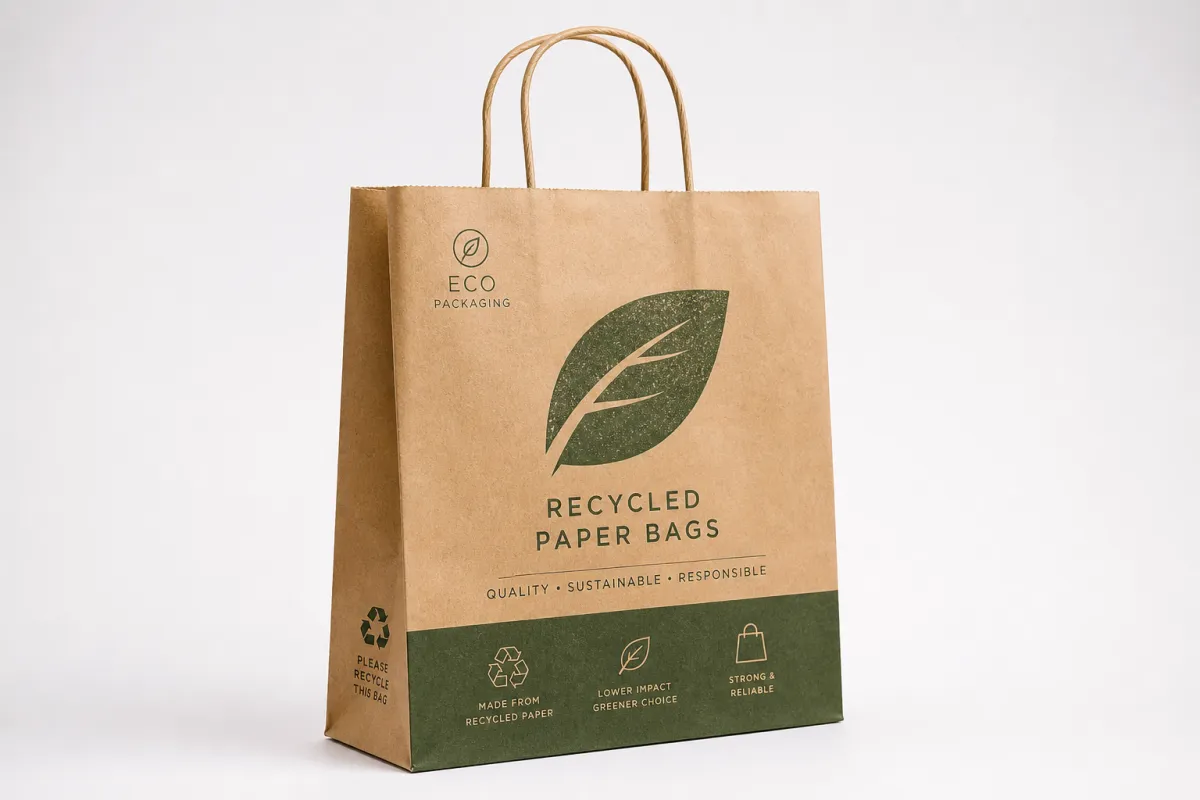
People comparing recycled paper bags price across vendors often make the same mistake: they assume the recycled label sets the cost. It does not. The recycled content is part of the equation, not the whole thing. Bag dimensions, paper grade, gsm, handle system, and printed coverage usually move the number more aggressively than the recycled claim itself.
Take two retail bags that both say "recycled kraft" on the spec sheet. One uses a light 120 gsm sheet with a twisted paper handle and a one-color logo. The other uses 170 gsm board, reinforced mouth folds, die-cut handle reinforcement, and a full-bleed print. Those are not cousins. They are different jobs. Different material pulls. Different machine settings. Different headaches for production.
The biggest drivers are pretty plain:
- Bag size - larger bags use more paper and need more forming time.
- Paper weight - heavier stock raises material cost but improves carry strength.
- Handle type - twisted paper, flat paper, rope, and die-cut handles each bring different setup and assembly costs.
- Reinforcement - top folds, bottom inserts, and board pads add material and labor.
- Print coverage - a simple logo is easier than artwork that wraps across multiple panels.
That is why a vague request like "send me your recycled paper bags price" usually comes back as a rough estimate, not a quote worth building a budget around. Without dimensions, paper weight, handle style, and print details, the supplier is guessing at consumption and setup. Compare two vague numbers and you are not comparing the same bag. You are comparing two guesses wearing business clothes.
A better habit is to request pricing against a fixed spec: length, width, gusset, paper grade, paper weight, handle construction, print count, finish, quantity, and destination. Once those pieces are locked, recycled paper bags price gets much clearer, and the supplier can tell you whether the cost is driven by materials, labor, or finishing.
For buyers who need outside references while sourcing, packaging and recycled-content claims are often discussed alongside FSC chain-of-custody documentation and general recycling guidance from groups such as the FSC and the EPA. Those references do not set the final number, but they help you ask better questions about sourcing and end-of-life claims.
I would rather see a buyer chase a complete specification than chase the lowest headline number. The cheap quote that needs three follow-up emails and a repair job later is not cheap. It is just delayed pain. A good recycled paper bags price lines up with the actual use case, not with wishful thinking.
Product Details: Materials, Handles, and Print Options
Once the bag shape is defined, the next big swing in recycled paper bags price comes from material and finishing choices. Recycled paper bags are not a single product category. They include simple brown kraft carry bags, smoother surfaced papers for sharper printing, mixed recycled fiber stocks, and premium-feel constructions that still rely on recovered content.
Common paper options usually sit somewhere between 100 gsm and 200 gsm for standard retail and takeaway use. Heavier constructions climb above that range when the bag has to support bottles, boxed goods, or gift packaging. Lighter sheets can reduce recycled paper bags price, but they are not always the right answer if the bag needs to stand upright, resist tearing at the top edge, or carry a meaningful load without collapsing like it has given up on life.
Handle choice is another practical cost factor. Twisted paper handles are popular because they are efficient, printable, and easy to run at scale. Flat paper handles can be economical on certain styles and work well for food service or grocery use. Rope handles create a more premium presentation and often feel better in hand, but they usually add cost. Die-cut handles simplify the look of the bag, though reinforcement may be needed around the opening depending on the load.
The print finish matters just as much. A one-color logo on kraft paper usually keeps recycled paper bags price under control. Multi-color branding raises ink use, setup time, and the chance of registration adjustments during press checks. Full-coverage artwork or edge-to-edge graphics usually costs more because the bag needs more careful handling through print and drying stages. Fancy is not free. Shocking, I know.
Useful add-ons can improve performance without blowing up the whole design. A bottom pad can help the bag hold shape. A board insert can improve stacking and support. Reinforced tops can improve hand feel and reduce tearing. Gussets can expand capacity and make loading easier. Each choice adds material or labor, so each one should earn its place.
The rule is simple. The more the bag needs to do, the more the production cost rises. If the bag only needs to carry lightweight apparel, a clean recycled kraft build may be enough. If it needs to carry glass jars, boxed products, or a retail gift presentation, then recycled paper bags price moves up because the bag needs more structure to survive the job.
A good supplier will walk through those trade-offs instead of pushing every possible upgrade. That conversation matters. A bag can look modest and still be engineered properly for the intended load. A bag can also look lovely and fail immediately if the paper is too light or the handle attachment is weak. Packaging is not a mood board. It has to work.
Before sending artwork, buyers should ask three questions:
- What will the bag carry, and how heavy is that load?
- Does the bag need to look premium, or just functional and clean?
- Will the bag be used once, or handed out repeatedly in a retail environment?
Those answers shape recycled paper bags price more than most teams expect. A clearer use case usually means a cleaner quote and fewer revisions later. It also keeps the project from drifting into "kinda nice" upgrades that do not actually help the bag do its job.
Specifications That Change Recycled Paper Bags Price
Specification depth is where recycled paper bags price either becomes understandable or stays foggy. Size is the obvious starting point because bigger bags use more paper, but the real picture shows up when size is paired with finish, carry weight, and market segment. A small boutique bag and a large grocery format may both use recycled paper. They are not built on the same economics.
Paper weight is one of the most direct levers. Lighter stock keeps recycled paper bags price down, but it also cuts body strength and resistance to creasing. Heavier stock improves the feel of the bag, helps it stand more reliably, and usually supports a more confident carry. For premium retail or bottle-carry applications, buyers often choose heavier kraft or surfaced boards because the bag has to hold shape under load without looking tired.
Load requirement gets ignored far too often. If the bag only needs to support 1-2 kg of lightweight retail goods, a simpler construction may be enough. If it needs to carry 5 kg or more, the handle attachment, mouth reinforcement, and bottom structure deserve real attention. Once those performance expectations are stated, recycled paper bags price becomes easier to explain because the quote reflects the actual engineering.
Moisture exposure can shift the spec as well. A bag used for dry apparel is one thing. A bag sitting near chilled bottles, takeaway containers, or damp paper goods is another. In those cases, buyers may need a better paper selection, stronger adhesives, or a finish that resists handling wear. That does not always create a major cost jump, but it does need to be discussed before the quote goes out.
Artwork quality also affects cost indirectly. Clean vector files, clear spot-color definitions, and consistent logo placement reduce proof cycles and press corrections. If the file is fuzzy, inconsistent, or scaled badly, the supplier may need extra prep before production begins. That adds time and sometimes cost. So yes, recycled paper bags price is partly a material number and partly a prepress and coordination number. Packaging people rarely get to enjoy just one thing at a time.
Keep tolerances in mind too. If you need exact dimensions with tight tolerances, say so. If the bag can vary slightly without issue, that flexibility may help the supplier quote more efficiently. The same logic applies to packaging count per carton, pallet pattern, and delivery format. Consistency helps. Ambiguity slows everything down.
For buyers who want a cleaner quote process, I usually suggest listing these details in the request:
- Finished dimensions: length, width, and gusset
- Paper type and gsm
- Handle style and reinforcement method
- Print colors and print coverage
- Quantity and target delivery date
- Ship-to destination and freight preference
Those six points usually do more to stabilize recycled paper bags price than a long thread of back-and-forth messages ever will. The tighter the spec, the easier it is to compare one supplier's offer against another without guessing what got left out.
Being honest about the end use helps too. A bag for a seasonal gift campaign does not need the same construction as a repeat-use shopping bag. A bag for food service may need a different top opening or a different board insert. The more the request reflects actual use, the more trustworthy recycled paper bags price becomes.
One more thing: if your bag is meant for direct food contact or for a market with stricter packaging rules, ask for compliance paperwork early. Different countries handle inks, adhesives, and recycled-content claims differently. That is not glamorous, but it beats discovering a documentation gap after the order is already in motion.
Recycled Paper Bags Price: MOQ, Unit Cost, and Quote Structure
MOQ is where a lot of buyers get their first surprise. Smaller runs usually carry a higher unit price because setup costs are spread across fewer bags. That is why recycled paper bags price can look fine at 10,000 pieces and suddenly feel much higher at 1,000 or 2,000 pieces, even when the design stays exactly the same. The machine setup, plate or print preparation, sampling, and finishing effort do not vanish just because the order is small.
At higher volumes, the unit cost usually improves because paper purchasing, press setup, and labor are distributed over a larger run. The curve is not perfectly linear, but the direction is stable. Buyers who can standardize bag dimensions across multiple product lines often get a better buying position because the same bag size can be reused across promotions or seasonal programs.
A proper quote should not just give one lump sum. It should show the pieces behind recycled paper bags price: unit price, setup or plate charges if applicable, sample or pre-production cost if applicable, packaging method, carton count, and shipping terms. If one supplier gives an all-in number and another breaks the quote down line by line, you are not looking at the same structure yet. Compare carefully. Quotes love to hide in the margins.
Here is a practical comparison buyers can use as a working reference. The ranges below are indicative only, because size, paper grade, and print coverage still matter, but they show how construction choices move recycled paper bags price up or down.
| Bag Style | Typical Spec | Indicative Unit Price at Moderate Volume | What Moves the Cost |
|---|---|---|---|
| Plain recycled kraft carry bag | Standard size, 120-140 gsm, twisted paper handle | $0.18-$0.28 | Paper weight, bag size, carton packing, freight |
| Printed retail bag | Standard size, 140-170 gsm, 1-2 color logo | $0.24-$0.42 | Print coverage, color count, proofing, handle style |
| Premium presentation bag | Heavier board, rope handle, reinforced mouth | $0.45-$0.85 | Paper grade, reinforcement, finish, premium handle |
| Large utility bag | Bigger dimensions, extra gusset, load support | $0.30-$0.60 | Material usage, structure, bottom pad, transit carton size |
These numbers are not promises, and they should not replace a formal quote. They do, though, show the pattern buyers see again and again: simple bags stay near the lower end of the range, while more complex builds push recycled paper bags price upward because the bag needs more material and more production attention.
A lower headline price can hide trouble. A supplier may quote a cheaper unit price by using thinner paper, reducing reinforcement, or limiting print coverage. That can be fine if the bag is genuinely lightweight and temporary. It is not fine if the bag has to perform in retail use, where the first tear or handle failure becomes a very visible brand problem.
A good quote does not just tell you what the bag costs. It tells you why the recycled paper bags price lands there, and which parts of the spec are doing the heavy lifting.
That kind of clarity helps procurement, brand, and operations teams make the same decision from the same data. If the bag is worth spending more on, the quote should show it. If the design can be simplified without hurting performance, that should be visible too.
Process & Timeline: From Specification to Delivery
The production path matters because timing often changes how buyers read recycled paper bags price. A simple unprinted bag can move faster than a custom printed order, and a clean timeline helps separate the cost of making the bag from the cost of rushing the bag. In most cases, the workflow starts with inquiry, spec review, pricing confirmation, artwork setup, proof approval, sample or pre-production check, manufacturing, packing, and shipping.
That proof stage saves money when people actually use it. A good proof can catch logo placement issues, size mismatches, color problems, handle alignment concerns, and panel orientation mistakes before the entire order runs. Skip that step to save a few days and you may spend more later correcting the mess. Proofing does not make the bag perfect, but it lowers the chance of expensive errors. That is usually good enough.
Lead time depends on complexity. Simple plain bags often move quicker because there is less print prep and fewer finishing variables. Printed orders with special handles, coated surfaces, or stricter strength requirements typically take longer. A reasonable planning window for many custom orders is often 12-15 business days after proof approval, though more complex builds can stretch beyond that depending on line load and material availability. Buyers should always ask for both production lead time and transit time. One without the other is just a partial answer dressed as certainty.
Freight needs its own attention. Air shipment shortens transit but adds cost. Ocean freight lowers shipping cost per bag on larger orders but stretches the calendar. Domestic truck or courier options may land somewhere between those two depending on destination. If the bag is needed for a product launch, a store opening, or a seasonal promotion, the delivery window matters as much as the factory schedule.
Packaging method inside the carton can also affect receiving quality. Bags packed too tightly can arrive with crease memory or edge damage. Bags packed too loosely may shift and rub during transit. A supplier who understands the use case will recommend carton counts and pallet patterns that protect the finish without adding unnecessary freight weight. That detail does not always change recycled paper bags price much, but it can affect the total landed cost more than buyers expect.
For buyers comparing multiple suppliers, I recommend splitting the discussion into three buckets:
- Production cost - materials, print, assembly, reinforcement.
- Time cost - proofing speed, setup complexity, schedule priority.
- Freight cost - carton count, shipping method, delivery destination.
That split makes recycled paper bags price easier to evaluate because it stops the quote from being treated like one opaque number. If one vendor is faster but more expensive, you can see whether the difference is in manufacturing or shipping. If another vendor is cheaper but slower, you can decide whether the delay fits the project.
There is another benefit to a clean process. It cuts down on revision fatigue. The more complete the initial spec, the fewer emails it takes to move the order forward. That matters for brands buying packaging on a seasonal cycle, where timing is tight and mistakes cost more than the bags themselves.
Used properly, the process becomes a filter. It shows you which supplier understands the job and which one is just tossing numbers at the wall. That matters because recycled paper bags price should reflect a controlled process, not guesswork.
Why Choose Custom Logo Things for Recycled Paper Bags
Custom Logo Things is built for buyers who want practical packaging guidance, not a loose estimate and a shrug. If you are comparing recycled paper bags price across options, the real value is having someone translate your use case into a bag spec that makes sense on the production side. That means asking the right questions about paper weight, handle style, print layout, and reinforcement before the order is placed.
Fit matters most. A bag for a retail apparel brand should not be specified the same way as a food service carryout bag or a bottle carrier. A gift bag may need a more polished surface and a cleaner print face, while a grocery-style bag may need stronger carry performance and less decorative finishing. Match the bag to the actual use and you stop paying for features that do not improve the outcome.
That is where better quotes start. A useful recycled paper bags price quote should give you confidence about the materials, the build, and the print plan. It should also help you see whether the design is efficient or overbuilt. Sometimes a heavier paper grade is the right answer. Sometimes it is not. A supplier worth working with should be able to explain the difference in plain language.
There is also a strong operational side to this. Clear specifications reduce sampling time, clean artwork files reduce proof delays, and a realistic quantity reduces last-minute production pressure. In practice, those three things often decide whether the order lands smoothly. The lowest quote is not always the best quote if it creates uncertainty later.
Here is the kind of buying discipline that saves time and keeps the budget on track:
- Ask for the quote based on a final size, not an estimate.
- Confirm the paper gsm before discussing quantity.
- Choose the handle style only after deciding the load requirement.
- Keep the artwork simple unless the branding truly needs more coverage.
- Review carton packing and shipping terms before approving the order.
That discipline keeps recycled paper bags price aligned with function, not just appearance. It also reduces the chance of an order being over-specified. Over-specification happens all the time. A buyer wants a strong bag, so the spec gets heavier than necessary. Or a buyer wants a premium impression, so the finish gets more expensive than the brand actually needs. Good packaging decisions avoid both extremes.
Recycled paper bags price also becomes easier to defend internally when the reasoning is clear. If finance asks why the order costs more than last quarter, you can point to the paper grade, the handle upgrade, the higher print coverage, or the increased load requirement. That is a far better position than trying to explain a quote assembled from incomplete assumptions.
From a packaging buyer's point of view, that is the real value of working with a partner who understands structure as well as branding. You get a bag that looks right, performs right, and stays within the budget you planned for.
Next Steps: Get an Accurate Recycled Paper Bags Price
If you are ready to move forward, the fastest way to get a reliable recycled paper bags price is to send complete specs in one message. Start with dimensions, bag style, handle type, paper weight, print colors, quantity, delivery destination, and whether you need plain bags or printed bags. If you already have artwork, send that too. A complete package of information usually gets a cleaner quote back faster.
It also helps to ask for two versions side by side: one plain spec and one printed spec. That comparison shows exactly where recycled paper bags price changes and how much of the budget is tied to branding versus structure. For many buyers, that comparison is the clearest way to decide whether to keep the bag simple or move toward a more finished look.
When the quote arrives, look for separation between unit cost, setup cost, packaging cost, and freight. If those pieces are mixed together, ask for them to be broken out. Transparent pricing makes it easier to compare suppliers and easier to plan future orders, especially if you expect repeat buying.
One practical tip: share your target order quantity even if it is not final yet. Suppliers can often offer a better production plan when they understand whether they are quoting 1,000 pieces, 5,000 pieces, or a larger volume. That one detail often changes recycled paper bags price more than buyers realize.
Send the finalized dimensions, artwork, target quantity, and delivery location together, and ask for a quote that explains the material and process behind it. That is the cleanest way to get a recycled paper bags price you can actually budget against, and it gives you a better base for comparing options without chasing numbers that do not mean the same thing.
What affects recycled paper bags price the most?
Size, paper weight, handle style, and print coverage usually create the biggest price changes. MOQ matters too, because setup costs are spread across fewer bags on smaller orders. Special finishes, reinforcements, and custom artwork can also raise the final unit cost.
Are recycled paper bags more expensive than standard paper bags?
Not always; recycled content itself is only one part of the cost. The final recycled paper bags price depends more on the bag's construction, paper grade, and production volume. A simple recycled bag can be priced competitively against a standard paper bag.
How can I lower my recycled paper bags price without hurting quality?
Keep the design simple, reduce print coverage, and choose a handle style that fits the use case. Standardize dimensions where possible and order in a larger quantity if storage allows. Avoid extra finishing steps unless they solve a real packaging problem.
What MOQ should I expect for custom recycled paper bags?
MOQ varies by bag size, print complexity, and factory setup, so there is no single universal number. Smaller runs are possible, but the unit price is usually higher because setup is spread over fewer bags. Share your target quantity early so the quote reflects a realistic production plan.
How long does it take to produce recycled paper bags after approval?
Timing depends on artwork approval, printing complexity, and current production capacity. Simple orders move faster than printed bags with special handles or finishes. Transit time should be added separately so the delivery window is accurate.
Bottom line: if you want a sharp recycled paper bags price, send one complete spec sheet instead of a loose idea. Include size, paper gsm, handle type, print coverage, quantity, and delivery location, then ask the supplier to break out unit cost, setup, packaging, and freight. That one move usually saves the most time and gives you a quote you can actually trust.
Related packaging resources
Use these related guides to compare specs, costs, quality checks, and buyer decisions before making the final call.


