Buyer Fit Snapshot
| Best fit | low cost recyclable mailer materials buyer review for packaging buyers comparing material specs, print proof, MOQ, unit cost, freight, and repeat-order risk where brand print, material, artwork control, and repeat-order consistency matter. |
|---|---|
| Quote inputs | Share finished size, material target, print colors, finish, packing count, annual reorder estimate, and delivery region. |
| Proofing check | Approve dieline scale, logo placement, barcode or warning zones, color tolerance, and any recyclable or compostable wording before bulk production. |
| Main risk | Vague material claims, crowded artwork, or missing packing details can create delays even when the unit price looks attractive. |
Fast answer: Low Cost Recyclable Mailer Materials Buyer Review: Cost, MOQ, Proof, and Reorder Checks should be specified like a repeatable production item. The safest quote includes material, print method, finish, artwork proof, carton packing, and reorder notes in one written spec.
What to confirm before approving the packaging proof
Check the product dimensions against the actual filled item, not only the sales mockup. Ask for tolerance on folds, seals, hang holes, label areas, and retail display edges. If the package carries a logo, QR code, warning copy, or legal claim, reserve that space before decorative graphics fill the panel.
How to compare quotes without losing quality
Compare board or film grade, print process, finish, sampling route, tooling charges, carton quantity, and freight assumptions side by side. A lower quote is only useful if the supplier can repeat the same color, closure quality, and packing count on the next order.
Best Low Cost Recyclable Mailer Materials for Shipping
Best low cost recyclable mailer materials are rarely the cheapest line item on a quote sheet. That sounds backward until you have watched a parcel fail in transit and then traced the real damage: the replacement item, the second shipping charge, the customer service time, and the little dent in trust that never shows up in procurement software. In one packaging review I sat through, a team saved less than two cents per unit and still ended up paying far more once breakage and rework were counted. The math was not kind.
A high-volume ecommerce operation can trim returns-related losses by a meaningful margin simply by replacing a fragile shell with a material system that survives courier drops, sorting pressure, and longer transit lanes. The benchmark is not sticker price. It is total landed cost, and that includes the hidden costs nobody likes to put in a deck. Best low cost recyclable mailer materials lower cost across the shipment, not just at purchase.
For a startup moving 30,000 units a month, packaging deserves the same discipline as ad spend or inventory planning. Compare conversion impact, complaint rate, reject rate, postage class impact, average claim leakage, and stock-out risk. If one option saves two cents but lifts damage by one percent, the economics collapse fast. Teams need a short list of best low cost recyclable mailer materials, a true apples-to-apples quote model, and a rollout plan that keeps margin intact without slowing fulfillment to a crawl.
Low-cost packaging is not thin packaging. It is the material that survives the lane, the sortation equipment, and the customer's first touchpoint with the brand.
That distinction matters more than most sourcing teams admit. A mailer can look premium in a sample book and still split at the seam, tear on the fold, or arrive with crushed graphics after a series of drops. Best low cost recyclable mailer materials are the ones that hold up across actual shipment conditions while staying aligned with recycling streams, production budgets, and fulfillment timelines. A mailer that only behaves in a calm conference room is not much help in a warehouse at 4:45 p.m.
This article separates the category into material families, measurable specs, pricing traps that distort unit cost, and an implementation timeline that keeps launch risk contained. By the end, you will have a practical framework for selecting the best low cost recyclable mailer materials and defending the decision with operations, finance, and sustainability stakeholders.
What are the best low cost recyclable mailer materials?
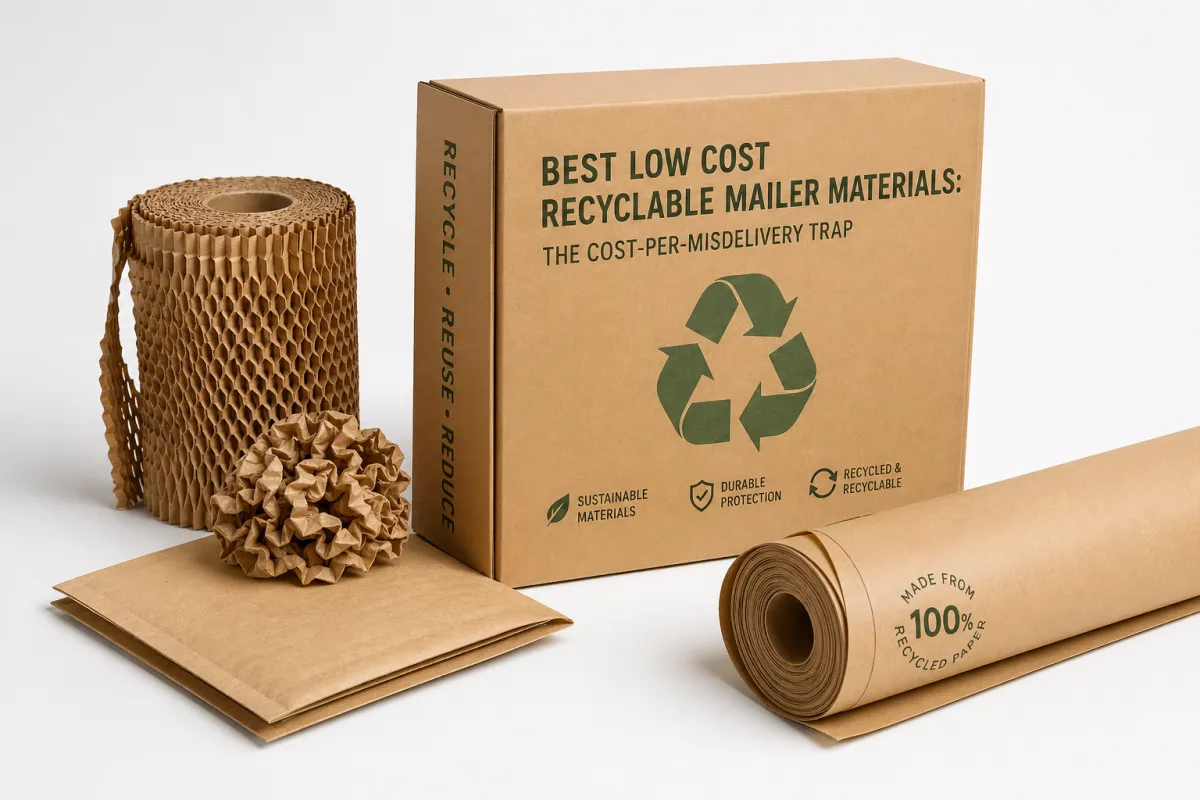
The best low cost recyclable mailer materials are usually Kraft Paper Mailers, mono-material film mailers, and select paper-poly hybrids. The right choice depends on product weight, puncture risk, postage sensitivity, and the recycling routes available in your market. For many brands, the best low cost recyclable mailer materials are the ones that keep damage rates low while preserving speed on the packing line. Simple answer, yes. Simple decision, no.
There is no universal winner. A paper-forward mailer can be the right call for a dry, lightweight SKU, while a mono-material poly mailer may deliver better economics for high-volume soft goods. The best low cost recyclable mailer materials fit the product, the lane, and the disposal pathway at the same time. That balance is why a sample that looks expensive can still be the cheapest option in actual operation. And honestly, a package that feels sturdy in hand can still get shredded by a conveyor edge if the seam geometry is wrong.
Best Low Cost Recyclable Mailer Materials: The Cost-Per-Misdelivery Trap
The first error is treating packaging as a stationery purchase. The second is treating it as a branding prop. Best low cost recyclable mailer materials are a logistics tool. A mailer that saves 1.5 cents at purchase but drives up damage rate can erase margin faster than most process changes. That is why the key number is cost per successful delivery, not cost per unit shipped.
A practical framework starts with raw quote math, then adds freight, printing, setup, warehousing, and expected waste. Next comes expected reject rate from conversion, spoilage from storage, and claim leakage from in-transit damage. Last, layer in postage-class impact if the mailer changes dimensional weight or stackability. Best low cost recyclable mailer materials usually win because they reduce rework and preserve postage efficiency, not because they carry the absolute lowest raw material cost.
A startup shipping 30,000 units a month should treat every mailer as an activation point. If the mailer fails, the order fails. If it is oversized, postage rises. If the seam opens in transit, handling and support costs rise too. Best low cost recyclable mailer materials succeed when they match the product, the lane, and the fulfillment line with enough tolerance for the ordinary abuse a parcel sees. A parcel rarely gets one dramatic impact; it gets a chain of smaller ones.
Try this comparison: the cheapest quote can be a thin poly build with high reject risk, while a slightly heavier build or stronger adhesive can cut overall cost by shrinking reships and credits. In the field, a modest damage reduction often beats a small unit increase. Best low cost recyclable mailer materials should be measured across the full chain from pack-out to final delivery.
- Raw unit price: the number everyone sees, rarely the total.
- Waste rate: trim loss, print spoilage, and rejected samples.
- Reject rate: seam failure, misprint, weak folds, dimensional noncompliance.
- Postage effect: size, thickness, and rigidity can shift shipping class.
- Claim leakage: replacement item cost, labor, and service recovery time.
Buyers need to separate marketing language from measurable performance. "Strong" means little without burst strength, tensile data, seam reliability, and fold integrity under pressure. Best low cost recyclable mailer materials should be tested under production conditions, not only checked in ideal sample-room lighting. If you have ever seen a paper mailer pass a tabletop test and then wrinkle like a cheap shirt in humid storage, you know the gap.
One bad lane can invalidate a specification. A mailer that passes local routes can fail in regional distribution, harsher drop profiles, or warmer storage. That is why best low cost recyclable mailer materials are never selected by appearance alone. They are selected by evidence.
For brands building an initial benchmark, compare paper-first, mono-material film, and hybrid structures against one shipment scenario. If a brand already uses flexible pack formats, Custom Poly Mailers are a useful comparator because they can be efficient in cost and smooth with standardized fulfillment workflows. The winner is the option with the lowest verified cost per successful delivery, and only then.
Product Details of Best Low Cost Recyclable Mailer Materials by Mailer Type
Best low cost recyclable mailer materials generally sit in three families: kraft paper mailers, mono-material film mailers, and paper-poly hybrid wraps. Each family carries a different cost curve, machinability profile, and recycle-route compatibility. The right fit depends on product mass, puncture risk, branding demands, and what the destination market accepts at disposal. This is where sourcing gets a little less tidy than the sales pitch.
Kraft paper mailers are the obvious starting point for brands that want a paper-forward story. A 120-170 gsm build works for inserts, apparel accessories, light books, and non-fragile goods. Reinforced seams push performance far beyond brochure-style construction. Best low cost recyclable mailer materials in this class typically come from optimized grammage, simple die lines, and restrained print coverage. FSC certification can support sourcing claims, and many buyers report better hand feel than thin film. The downside is moisture sensitivity and lower puncture resistance, especially in damp storage or rainy-mile deliveries.
Mono-material film mailers usually deliver the lowest unit costs at scale. A 50-70 micron polyethylene build with post-consumer content can stay efficient, lightweight, and strong for price. When the structure remains mono-material and avoids hard-to-separate layers, many programs can fit established recycling pathways in multiple regions. Best low cost recyclable mailer materials in this family are often the first choice when postage weight matters, because they can be lighter than paper or corrugated alternatives. The trade-off is claim scope: a film that is technically recyclable in one stream does not guarantee acceptance everywhere, and regional guidance can shift faster than buyers expect.
Paper-poly hybrid wraps occupy the middle. They usually pair kraft paper exteriors with thin interior film or barrier coatings. These builds improve stiffness and tear resistance, and they help brands needing stronger brand surfaces without moving to heavier board. Best low cost recyclable mailer materials in this group are useful when product appearance matters, but budgets still have to hold firm. They can be the compromise that saves a launch when design wants paper and operations wants more puncture resistance.
Cost differences are almost never tied to one variable. Raw material quality, print complexity, nesting efficiency, and production waste shape total expense. Even lean materials can hold up if the design reflects the actual product reality. A 1 mm build can be enough for a catalog insert, while angular apparel hardware may demand stronger reinforcement and higher stiffness. Best low cost recyclable mailer materials must be matched to the SKU, not to a category checkbox.
Visual comparison is unreliable. A dark kraft paper style can look tougher than it is, while glossy film can look cheap while tolerating harder lanes. Best low cost recyclable mailer materials should be compared by structure behavior and measured failure modes, not by the packaging equivalent of a first impression.
- Paper GSM tiers: higher GSM improves stiffness but adds weight and cost.
- Film thickness: too thin risks puncture; too thick pushes price and may affect recycling compatibility.
- Barrier coatings: useful for moisture defense, but overuse can complicate recovery.
- Window design: cutouts and mixed materials can weaken both durability and recovery pathways.
- Ink coverage: simpler palettes usually mean faster conversion and lower error rates.
A tiered model works well for mixed product portfolios. Choose kraft paper for light, dry goods where a tactile cue helps conversion. Use mono-material film for high-volume soft goods where postage control dominates. Select hybrids when stiffness is required and the market still rewards a paper-first look. Best low cost recyclable mailer materials are not one-size; they are a branching decision.
Corrugated cardboard also has a place, but it is rarely the lowest-cost answer for mailer-style shipping unless the product is bulky, fragile, or corner-sensitive. Corrugated excels at compression and stacking, yet it can increase volume, freight, and packing labor. In many direct-to-consumer flows, a thinner mailer wins by reducing weight and handling cycles. That does not make corrugated bad. It just means it belongs in a different part of the cost map.
Specifications: Barrier, Burst, and Mailability Benchmarks You Must Set
Best low cost recyclable mailer materials stay affordable only when the specification is explicit. Vague targets invite revisions, repeated samples, and failed production lots. Before requesting a quote, lock the criteria that determine whether the mailer survives your lane: tensile strength, burst index, puncture resistance, seal integrity, ink holdout, moisture sensitivity, and corner crush tolerance. These are not cosmetic requirements. They separate a smooth launch from an expensive rerun.
Recyclability behaves like a chain, not a stamp. A mailer is only as recyclable as its materials, local collection system, and user disposal behavior combined. Confirm polymer type, avoid hard-to-separate laminates where possible, and validate whether paper fibers are compatible with regional recovery routes. For paper-based options, ask about FSC certification and post-consumer waste content. For film-based options, confirm mono-material construction and whether inks and adhesives fit recovery constraints. Best low cost recyclable mailer materials must work across the full end-of-life path.
Sustainability labels often blur at this point. "Recycled materials" by itself does little if the wall still contains mixed layers that are hard to separate. "Biodegradable packaging" can sound convincing and still fail parcel requirements. The right question is practical: what happens after one customer receives it, and does that outcome hold in the specific markets you serve? Best low cost recyclable mailer materials should be recyclable in practice, not only on paper.
Different categories need different thresholds. Dry goods, fragile goods, and apparel do not fail for the same reasons. A lightweight apparel mailer may need stronger seal performance and good fold memory. A fragile accessory can demand puncture resistance and edge reinforcement. A thicker insert may require better burst behavior under compressive load. Best low cost recyclable mailer materials must match item-level risk profiles, not a single sustainability slogan.
Tie testing language to factory reality. Incoming checks should verify caliper or gauge, weight, print placement, and adhesive consistency. In-line vision checks should catch misregistration, missing seams, or fold misalignment before the line compounds defects. Shift-level spot checks should include bend, seal, and burst sampling. Best low cost recyclable mailer materials stay reliable when factory checks match what buying teams care about.
Set acceptance tolerances in plain numbers. A buyer may allow 1-2% reject tolerance during pilot, cap pinholes on film, and set a moisture pickup limit on paper structures. The exact thresholds vary by lane and product, but the principle is stable: clear specs let suppliers quote cleanly and keep production predictable. Best low cost recyclable mailer materials are easier to source when every team reads the same sheet.
Reference points are helpful when you need to defend a choice internally. The ISTA drop-test methods offer practical handling standards. FSC certification can strengthen sourcing evidence for paper-based choices. These references do not replace your internal rules, but they make selection choices easier to justify. If you can point to a standard, your requirement moves from preference to requirement.
What to lock before you quote
Small details generate big delays if they are left loose. Final dieline, barcode placement, seal width, fold tolerances, and ink color count should be agreed before supplier slot time is allocated. A casual approach here is costly. Best low cost recyclable mailer materials stay genuinely low-cost only when approval cycles are tight and revision loops are controlled.
For most programs, a one-page technical specification is enough: product dimensions, target unit weight, accept/reject points, packaging format, and shipping test requirements. That sheet becomes the source of truth across teams. If design, buyer, and production lead use different versions, quote risk rises immediately. Best low cost recyclable mailer materials are easiest to source when the spec is boringly complete.
Pricing and MOQ: Best Low Cost Recyclable Mailer Materials Without Hidden Premiums
Only comparable quotes are useful. Best low cost recyclable mailer materials may appear more expensive because setup, freight, finishing, and inventory carrying costs hide in separate lines. A unit-only comparison often misses the true difference by a wide margin. The correct move is converting all offers to cost per shipment and comparing that number across volume bands.
Use a pricing ladder to prevent false conclusions. Pilot runs are typically expensive per unit because setup is spread across fewer pieces. Medium runs improve efficiency once tooling and conversion costs are absorbed. Larger tiers flatten overhead when the specification does not change. Best low cost recyclable mailer materials perform best when repeat demand supports initial setup recovery.
| Material family | Typical structure | Approx. unit cost at 5,000 units | MOQ behavior | Best use case |
|---|---|---|---|---|
| Kraft paper mailer | 120-170 gsm kraft paper, reinforced seam, simple 1-2 color print | $0.18-$0.34 | Often 5,000-10,000 per style, higher if custom finishing is added | Apparel accessories, inserts, light dry goods |
| Mono-material film mailer | 50-70 micron PE, optional post-consumer waste content, minimal print | $0.09-$0.18 | Often 10,000+ for best pricing, but some pilots start lower | High-volume soft goods and apparel |
| Paper-poly hybrid | Kraft outer layer with thin film or barrier layer | $0.15-$0.28 | Commonly 5,000-8,000, depending on die line and artwork | Brands that want a paper-first look with extra strength |
| Light corrugated mailer | Micro-corrugated board, usually with limited print coverage | $0.24-$0.45 | Higher tooling and more restrictive style MOQ | Fragile items, boxed kits, corner-sensitive products |
Use the table only as a starting point. Size, artwork, adhesive choice, and packing format can move costs quickly. Full-bleed printing, hot-stamped accents, and unusual die lines can push quotes up in short order. Best low cost recyclable mailer materials stay low-cost when design is kept efficient and process-friendly. Fancy embellishment is fun, but it is not free.
MOQ strategy deserves as much planning as the base quote. Minimums can apply per style, color, and finishing option. Split-size orders can multiply setup charges. Split-color orders can do the same. If a supplier permits SKU mixing in one conversion run, average costs improve, but only when technical requirements are similar enough to stay inside the same setup window. Best low cost recyclable mailer materials often depend on this operational math.
Inventory exposure hides another cost layer. Ordering 50,000 units for a tiny unit saving can tie up cash, raise warehousing burn, and leave stock outdated after a redesign. Three scenarios matter in real purchasing decisions: base SKU, seasonal peak, and emergency top-up. Best low cost recyclable mailer materials must be tested against all three.
Expedited freight can wipe out a 3-5% unit saving in one move. Reprint charges do the same. So do late artwork edits and QA fails. A quote that looks low on paper but arrives with weak controls is often a false saving. Best low cost recyclable mailer materials keep their value when quality holds through production, freight, and launch volume.
A stronger commercial read comes from a 3-6 month total-cost view, not one order event. That horizon captures replenishment timing, spoilage, and demand surges. A supplier with slightly higher material input can still win if it protects line throughput and reduces returns. Best low cost recyclable mailer materials should be viewed as margin protection, not a raw materials discount.
Process and Timeline: From Sample to Production in a Predictable Window
Factory delays are not usually the only bottleneck. Most schedule creep starts with late artwork, weak dieline control, approval churn, and fuzzy test expectations. A practical timeline runs through sample request, design validation, material approval, pre-production proof, pilot run, full release, and post-launch audit. Assign owners at every step and set due dates that account for review lag. Without that, even a good supplier can end up waiting on internal indecision.
In a standard program, sample approval can finish in 5-10 business days if the spec is complete and artwork stable. A short pilot often lands in 1-2 weeks. Full production can follow within roughly 12-15 business days after proof approval, depending on complexity and line load. Best low cost recyclable mailer materials move faster when the approval rhythm is disciplined.
Where schedules slip
Artwork correction remains the common delay. Dieline disputes come right after, usually because packaging and design teams never aligned on dimensions. Lot-to-lot variation in paper or film can still alter feel, print clarity, and seal behavior after quoting. Carrier disruptions create more pain if launch windows are chained to a single inbound shipment. Best low cost recyclable mailer materials are easier to deliver on time when these risks are pre-mapped.
Early lock of approvals reduces rework significantly. Final dieline, barcode readability, fold specs, seal margin tolerance, and pack-out instructions should be frozen before pilot approval. Once fixed, revision loops stop running wild. A single technical spec sheet and one change-control form usually prevent the costliest delays. Best low cost recyclable mailer materials do not require fancy governance. They need repeatable governance.
Parallel-path planning helps when launch windows are narrow. Running two vendors is rarely efficient by default, but it can reduce exposure when one supplier is full or SKU dependency is high. Keep test variables controlled and narrow. Change only one variable at a time - paper GSM, adhesive, or seal geometry - to preserve clear learning. Best low cost recyclable mailer materials are selected faster with clean test logic.
The readiness signal is never a polished prototype alone. It is document coherence. Quote, spec sheet, proof, QA checklist, and shipping test plan should agree line by line. When they match, production pressure eases. When they diverge, rework is almost certain. Best low cost recyclable mailer materials are built from documentation as much as from substrate.
Post-launch audit closes the loop. First production lot checks should repeat the metrics used in approval: seal failure, print registration drift, weight variance, and transit damage after route testing. The goal is to prevent silent drift away from the approved spec. Best low cost recyclable mailer materials only remain "best" when the sample-to-lot transition is controlled.
At scale, predictable timing creates operational upside. A stable window reduces emergency freight, avoids line stoppages, and protects promise dates. Many teams learn that this steadiness matters more than extracting one more cent on a unit price. The savings show up later, which is why they are easy to miss in a hurried review.
What a Supplier Should Prove Before You Scale
Brands need less packaging hype and more operational discipline. The strongest reason to work with any supplier is the ability to treat structure, cost, and reliability as one system. Best low cost recyclable mailer materials are worth sourcing only when the vendor can show real production records, clear approvals, and repeatable order control.
Measure reliability in concrete terms. On-time shipment rate drives fulfillment quality. Rejection rate shows the cost of defects in labor, waste, and delay. First-pass yield indicates how often production is right without correction. Time-to-corrective-action reveals how quickly issues are contained when they appear. Best low cost recyclable mailer materials are strongest when suppliers can prove these numbers continuously, not just once during a sales pitch.
Proof integrity protects teams later. Request batch traceability, supplier compliance documents, and test certificates tied directly to your spec. Ask for clear material-change approval logic. Ask who owns escalation if lot quality diverges from sample. These are not admin details; they determine whether replenishment runs smoothly or becomes a crisis. A supplier who shrugs at traceability is asking you to accept avoidable risk.
Commercial support drives cost in ways many teams overlook. A responsive account team can forecast capacity pressure before shortages appear. Transparent reorder modeling can prevent seasonal spikes from triggering emergency shipping. Clear communication can stop a minor issue from becoming a broad fulfillment incident. That support lowers substitutions, trims reprints, and protects delivery windows. Best low cost recyclable mailer materials should come with post-PO operational support, not just a good first quote.
A deeper pattern shows up in mature sourcing teams: they often ask for the lowest price, then discover they really wanted the lowest variance. A cheap lot with unstable quality is not cheap over time; it is volatile. Volatility creates hidden cost and planning noise. Best low cost recyclable mailer materials create confidence when behavior stays stable across lots, shifts, and lanes.
If you are comparing suppliers, ask for the same evidence across every candidate: samples from the intended substrate, testing data from the actual mailer format, and a change-control process that does not depend on one person's memory. A company such as Custom Logo Things earns trust only if it can show that chain from quote to proof to production, but the standard should be the same for any vendor. For teams using flexible packaging as a benchmark, Custom Poly Mailers are often a useful baseline because they are straightforward to price, scalable, and easy to audit against transport performance.
The strongest commercial case is not just a cheap material. It is lower total cost through fewer substitutions, fewer claims, fewer reprints, and tighter fulfillment windows. That is what serious buyers pay for. Best low cost recyclable mailer materials earn their place by performing in the field, not performing in a deck.
Conclusion and Action Plan: Launch the Best Low Cost Recyclable Mailer Materials Next
The best decision is seldom the lowest line item. It is the material that keeps cost low after damage, labor, postage, and replacement orders are included. Best low cost recyclable mailer materials deliver that balance by combining structure performance, realistic recyclability, and production control. That combination protects margin at scale.
A practical path forward starts with two candidate structures: one paper-first format and one film-first or hybrid format. Next, create a tight acceptance sheet with burst, seal, print, and mailability requirements. Add one route trial before scale. Best low cost recyclable mailer materials should be validated on your actual line, with your actual products, in your actual lanes. If the package passes only on paper, it is not ready.
- Submit volume, dimensions, product weight, and handling constraints so suppliers can return a comparable quote for best low cost recyclable mailer materials.
- Run three cost scenarios - base SKU, seasonal peak, emergency top-up - using the same unit-conversion method and MOQ ladder.
- Set a supplier scorecard in advance with quality KPIs, approval ownership, and a weekly reporting rhythm before opening the full production P.O.
Do not approve a structure only because it appears sustainable in a concept room. Approve it because it is recyclable where your customers live, survives the route, and protects the budget. That discipline keeps brands both honest and profitable. Best low cost recyclable mailer materials should always be judged by verified cost per successful delivery, not by quote alone.
For teams moving from test packs toward full launch, the smartest next step is simple: request samples, align the technical spec, and run lane tests before scaling order volume. Compare at least one paper-first option and one film-first option under the same test conditions, then choose the one that keeps damage, postage, and rework lowest over a full month of shipments. That is the cleanest path to the best low cost recyclable mailer materials, and it is the path that usually holds up after the first thousand parcels leave the warehouse.
What is the real cost difference of best low cost recyclable mailer materials versus standard mailers?
Use total landed cost as the comparison point: base unit price, coating and printing add-ons, freight, waste, and returns handling. In many programs, the gap narrows or disappears once damage and rework are included. Best low cost recyclable mailer materials are evaluated on full shipment cost, not sticker price. If you only compare purchase price, you are missing the messy middle where expenses pile up.
How do I choose the right best low cost recyclable mailer materials for fragile but lightweight goods?
Prioritize burst and compression resistance, then test fold fatigue and edge crush. If tear risk is elevated, move up slightly in GSM or film gauge rather than assuming a thin stock will hold. Set a minimum seal-strength target and run a pilot through the actual packing line, not only a lab sample. Best low cost recyclable mailer materials for fragile items must pass the real workflow, because the real workflow is where the surprise costs live.
Do low cost recyclable mailer materials have MOQs that fit pilot launches?
Yes. MOQ terms vary by print complexity and style count. Ask for a pilot-run structure with a limited style scope, controlled color count, and minimal finishing to validate quality before major volume commitment. Confirm whether combining SKUs in one conversion run changes setup fees, since that often lowers average cost. Best low cost recyclable mailer materials can still work for pilots if the structure is planned well.
Can recyclable mailer materials still be compatible with parcel sorting machines?
Machine compatibility needs tests for stiffness, friction, and edge geometry; recyclability alone does not guarantee smooth sorting. Include mailbox slot and carrier drop-test criteria in your acceptance criteria to avoid first-cycle surprises in fulfillment. Best low cost recyclable mailer materials should perform for both recycling pathways and machine handling. A recyclable mailer that jams a sorter is not a win.
How long does it take from first sample request to bulk shipment for best low cost recyclable mailer materials?
A common pattern is 5-10 business days for sample approval, 1-2 weeks for a short pilot, and full production soon after approvals are locked. Timelines shorten when artwork is finalized early and the spec sheet is complete. They lengthen when late revisions and inconsistent prototypes become normal. Best low cost recyclable mailer materials move faster when the approval chain is strict, because everyone knows what "done" looks like.
