Buyer Fit Snapshot
| Best fit | compare frosted vs clear mailers choice for brands for packaging buyers comparing material specs, print proof, MOQ, unit cost, freight, and repeat-order risk where brand print, material, artwork control, and repeat-order consistency matter. |
|---|---|
| Quote inputs | Share finished size, material target, print colors, finish, packing count, annual reorder estimate, and delivery region. |
| Proofing check | Approve dieline scale, logo placement, barcode or warning zones, color tolerance, and any recyclable or compostable wording before bulk production. |
| Main risk | Vague material claims, crowded artwork, or missing packing details can create delays even when the unit price looks attractive. |
Fast answer: Compare Frosted vs Clear Mailers Choice for Brands: Film, Closure, Print, and Fulfillment should be specified like a repeatable production item. The safest quote includes material, print method, finish, artwork proof, carton packing, and reorder notes in one written spec.
What to confirm before approving the packaging proof
Check the product dimensions against the actual filled item, not only the sales mockup. Ask for tolerance on folds, seals, hang holes, label areas, and retail display edges. If the package carries a logo, QR code, warning copy, or legal claim, reserve that space before decorative graphics fill the panel.
How to compare quotes without losing quality
Compare board or film grade, print process, finish, sampling route, tooling charges, carton quantity, and freight assumptions side by side. A lower quote is only useful if the supplier can repeat the same color, closure quality, and packing count on the next order.
Compare Frosted vs Clear Mailers: Best Choice for Brands
If you compare frosted vs clear mailers on a laptop at 9:00 p.m., the frosted sample usually looks like the more polished option. Put both bags on a packing table under 5000K LEDs, though, and the answer can shift fast. I have watched a neon hoodie pop inside a 3 mil clear mailer, then watched a skincare set from Hangzhou feel far more boutique-ready inside a 2.5 mil frosted one. Those differences rarely show up in a design deck, especially after the room light changes from a bright monitor glow to the flat glare of a fulfillment floor in Shenzhen or Dongguan.
In real sourcing work, the decision usually comes down to five things: product visibility, perceived value, privacy, print contrast, and budget. A bag that looks perfect in a Shopify render can behave very differently under 3000K retail lighting, a 48-inch fluorescent strip, or a carrier sort center in Louisville. If you compare frosted vs clear mailers the right way, you are not choosing a style detail. You are choosing how the package performs in photos, on a shelf, and during a pick-and-pack shift that may move 1,500 orders before lunch. The finish also changes the unboxing moment, the way a listing photograph reads, and how much confidence a customer feels before they even break the seal.
Here is the rule I give clients at Custom Logo Things: frosted mailers usually read as more branded and private, while clear mailers usually feel lighter, brighter, and more transparent. Brands shipping gift sets, self-care kits, or seasonal drops often prefer frosted because the package looks more composed at 12 x 15 inches with a white logo and a black insert card. Brands shipping bright tees, patterned socks, or colorful accessories often get more value from clear, because the item itself does the visual work. I have seen both formats succeed once the packaging role matched the product, which is the piece that gets missed in a rushed sourcing call from a buyer in Los Angeles at 4:30 p.m.
There is a practical side people miss too. The finish affects unit price, packing speed, and customer perception all at once. A bag that costs $0.03 more per unit sounds minor until a 10,000-piece reorder hits the invoice and the difference becomes $300 before freight. I have also seen the wrong finish trigger two extra proof rounds, one reprint, and a week of delay out of a factory in Jiaxing. When I compare frosted vs clear mailers for a client, I treat it like a commercial decision, not a taste preference. Pretty is nice. Pretty, on time, and profitable is better.
For readers who want a wider sourcing view, I keep an eye on testing guidance from ISTA and packaging best practices from packaging.org. A mailer has to survive real handling, not just sit cleanly in a product photo shot against a white cyclorama. A shipment that passes a desk-drop test from 30 inches can still fail after three conveyor turns and one carton corner scrape, and that becomes obvious fast when a customer in Chicago posts the damage before noon.
Quick Answer: Compare Frosted vs Clear Mailers at a Glance
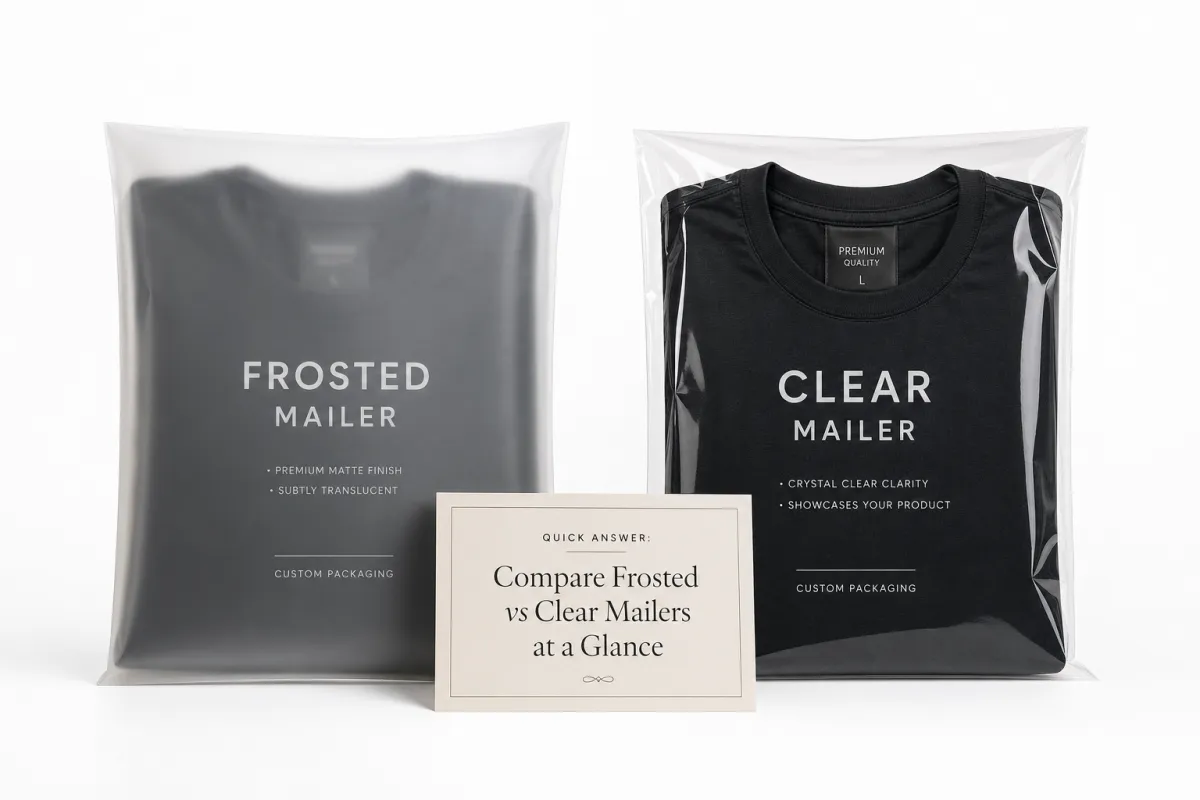
The first time I compared frosted vs clear mailers in a live test, the bag that looked plain on a laptop was the one buyers kept picking up on a sample rack in a 72-degree room. That told me more than a presentation slide ever could. Screen lighting distorts gloss, matte texture, and edge contrast; warehouse lighting at 5000K is less forgiving, but it shows what the customer and the picker will actually see.
If you want the shortest answer, use this:
- Choose frosted if you want a softer premium feel, more privacy, and a presentation that looks polished in 3000K retail lighting.
- Choose clear if you want immediate product visibility, faster item recognition, and a brighter unboxing moment at first open.
- Choose frosted if fingerprints, dust, and minor scuffs would bother your team after a 2-day transit or a conveyor pass.
- Choose clear if the contents are colorful, visually clean, and part of the sales story, like a tie-dye tee or a neon pouch.
- Choose either if you are printing a bold logo, but expect frosted to soften glare and clear to show every reflection from overhead LEDs.
The decision drivers are concrete. A beauty brand may care about privacy because the parcel sits on a front porch in Austin for six hours. An apparel brand may care more about visibility because a bright tee or patterned sock set looks better through the film on a studio table at 24 by 36 inches. A subscription box brand may care about how the package photographs in an influencer reel shot on an iPhone 15 Pro. I have seen all three priorities show up in the same week, usually before coffee, which is when people are at their most opinionated about bags.
My quick verdict stays blunt: frosted tends to win on brand polish, and clear tends to win on transparency and speed. Small runs, seasonal drops, and gift-ready kits often feel more deliberate in frosted at 1,000 to 3,000 pieces. High-volume ecommerce orders, especially ones with pickers moving fast across 20 stations, are usually easier to manage with clear. The rest of this post is about the tradeoffs that decide the winner in a real operation, not just on a mood board in a Manhattan showroom.
Which Mailer Should You Choose When You Compare Frosted vs Clear Mailers?
If you compare frosted vs clear mailers with the actual product in hand, the answer gets clearer very quickly. The better option is the one that matches the product story, the lighting your customers will see, and the way your team packs orders at scale. I have seen a simple poly mailer look expensive in frosted film because the artwork and insert card worked together, and I have seen a clear mailer feel stronger because the product colors were bold enough to carry the presentation on their own.
The right choice usually depends on whether your brand needs more privacy, more visibility, or more perceived value. Frosted often gives a softer, more edited look, which suits boutique labels and giftable shipments. Clear often makes the item feel immediate and easy to verify, which suits high-volume fulfillment and products that are already visually compelling. If you are trying to compare frosted vs clear mailers for a launch, start with the finish that helps the package do its job without extra explanation.
Compare Frosted vs Clear Mailers: Top Options Side by Side
| Factor | Frosted Mailers | Clear Mailers | Best Fit |
|---|---|---|---|
| Appearance | Soft, semi-translucent, more curated | Bright, transparent, highly revealing | Frosted for boutique branding; clear for product-led presentation |
| Privacy | Better obscures contents in transit | Contents visible through the bag | Frosted for gifts, beauty, and sensitive items |
| Print readability | Often cleaner contrast with less glare | Sharp, but reflections can distract | Frosted for logos with fine lines; clear for bold, simple art |
| Scratch and fingerprint visibility | Usually hides minor wear better | Shows fingerprints and scuffs more easily | Frosted for higher-touch handling |
| Photography | More controlled and editorial | More revealing and color-forward | Frosted for premium lifestyle content; clear for colorful products |
| Operational speed | Slightly less instant item visibility | Quick visual confirmation of contents | Clear for fast pick-and-pack teams |
That table gives the short version, yet the real difference shows up in photos, on shelves, and in the customer's hands. A frosted finish usually photographs like a controlled studio object shot on a 24 MP camera with the aperture set at f/4. It quiets the background and keeps the logo in focus. A clear finish behaves more like a window, and that is excellent when the product is the hero, but it can also make the bag feel utilitarian if the contents are plain black basics from a warehouse in Ningbo.
On ecommerce listings, I have seen frosted mailers work especially well for brands that want a calm premium look without moving into rigid packaging such as a 350gsm C1S artboard mailer box. Clear mailers tend to perform better for products that are already color-rich: bright activewear, patterned accessories, or neatly folded limited-edition tees. The brand story changes depending on what the eye sees first. That is why I compare frosted vs clear mailers by product category instead of by general preference alone.
There is also a subtle durability perception issue. The same scuff that disappears on frosted film can stand out on clear film, especially under harsh warehouse LEDs that sit 12 feet above the packing line. During a client review last spring in Dallas, one apparel founder told me she hated the way clear bags "looked tired" after a single courier run. She was right. A cleaner-looking finish keeps the parcel feeling newer for longer, even when the package traveled only 18 miles.
Client note: "We thought clear would look cleaner because you can see the product," one buyer told me after receiving samples from three suppliers in Guangdong and Zhejiang. "Then we put them under office lighting at 4000K. The frosted bag looked like a brand decision. The clear bag looked like a storage bag unless the insert card was perfect." I have heard versions of that line more than once, and it usually arrives with the same exhausted expression and a stack of rejected proofs.
If you are building a small sample set, I recommend judging both options under at least three lighting conditions: daylight at 6500K, a 5000K LED panel, and a warm retail light around 3000K. That test usually exposes the winner quickly. It also keeps you from letting the browser thumbnail make the call. If you compare frosted vs clear mailers honestly, lighting will tell you more than a render ever will.
Detailed Reviews of Frosted Mailers
Frosted mailers have a semi-translucent finish that softens whatever sits inside. They are not fully opaque, but they do not behave like a window either. That middle ground is the reason many brands compare frosted vs clear mailers and end up leaning toward frosted for premium shipping. The package feels less exposed, and the eye reads it as more intentional, especially on a 12 x 16 inch bag with a centered logo.
In hand, a frosted mailer usually gives off a quieter, more composed impression. I have handled 2.5 mil and 3 mil frosted PE mailers that looked far more expensive than they were, especially when the artwork used white ink, a black logo, or a one-color print pulled from a factory in Guangzhou. On a production floor in Shenzhen, one manager lined up three bags from the same press run and pointed to the frosted sample first. It was the least flashy of the three, yet the brand team kept coming back to it because the logo looked sharper under fluorescent lights set 11 feet above the table.
Privacy is the biggest functional advantage. If the contents should not be fully visible in transit, frosted usually handles that better than clear. That matters for beauty, wellness, intimate apparel, seasonal gifts, and anything the recipient might not want exposed on a porch in Phoenix or on a shared office front desk in Boston. When you compare frosted vs clear Mailers for Privacy-sensitive shipments, frosted usually feels like the safer commercial choice.
The print behavior matters too. Frosted film tends to reduce glare, which helps logos read more cleanly. A white logo on frosted can look crisp without shouting. A dark logo can look composed instead of harsh. I have seen this matter more in client approvals than in final production, because the sample simply looks more finished at the proofing table. That can save time in a design review where three stakeholders all have strong opinions and only one printed proof is sitting on the table, still warm from the digital press.
Frosted is not magic, though. It reduces immediate product visibility, which is a real drawback if the brand wants the item itself to sell the package. A frosted bag can mute the color story of a garment or hide the intentional layering of a 5 x 7 insert card printed on 350gsm C1S artboard. That is why I never recommend it blindly. I compare frosted vs clear mailers against the actual contents, not a generic category. Otherwise you end up picking the bag that looks best in a meeting and worst in the real world, which is a bit of a trap.
Best-fit categories usually include higher-margin apparel, curated retail kits, influencer merch, and boutique shipments where the packaging is part of the product feel. If a brand is charging $48 for a limited-edition hoodie or $62 for a three-piece skincare set, a frosted mailer can support that value signal. If a brand is shipping a plain black undershirt in 20,000-unit volume, the effect may be wasted. Honest packaging matches the margin structure, which sounds boring until you see what happens when it does not.
One more practical point: frosted surfaces often disguise minor scuffs better than glossy clear film. That became obvious during a warehouse audit I did for a subscription client whose bags were rubbing against carton edges on a conveyor in Atlanta. The frosted sample came off the line looking calmer after handling. The clear sample looked clean at first, then every scratch line showed up after a few minutes under the strip lights. That difference is small on paper and very visible in real life.
"Our frosted mailers made the whole shipment feel more curated, even though the unit cost only moved by $0.03," a brand manager told me after their first reorder from a plant in Dongguan. "The finance team noticed the price. The customers noticed the packaging."
If your brand story leans toward privacy, polish, and a softer premium look, frosted is usually the safer answer. If you compare frosted vs clear mailers on presentation alone, frosted often feels more deliberate. If you compare frosted vs clear mailers on visibility alone, it can lose. The real task is matching the finish to the value message you want the customer to feel in the first five seconds, whether that package lands in Miami, Minneapolis, or Manchester.
Detailed Reviews of Clear Mailers
Clear mailers do one thing very well: they show the product. That sounds simple, yet packaging tends to reward simple choices because they remove friction. If the customer can see what they ordered, the picker can verify it faster, and the item itself becomes part of the marketing. When I compare frosted vs clear mailers for apparel brands with colorful inventory, clear often has the stronger shelf impact on a retail table 48 inches wide.
The finish feels brighter and more direct. A stack of clear bags on a packing table looks active, not subdued. That can help in a fast-moving ecommerce operation where speed matters as much as presentation. I have watched pick-and-pack staff shave 4 to 6 seconds off each order because they could confirm size, color, or insert placement without opening the bag or checking a second label. Those seconds sound small until you multiply them across 1,200 orders a day in a warehouse that runs two shifts.
Clear also performs well when the product is visually strong. Bright socks, patterned tees, branded inserts, and limited-edition promo packs all benefit from being seen. In one client meeting, a founder selling color-block sportswear told me the clear bag turned her packaging into "free display space." She was right. If the item is the hero, clear packaging can amplify the story instead of competing with it, especially when the garment fold is neat and the insert card is a clean 4 x 6 size.
Clear has tradeoffs that brands discover the hard way. Fingerprints show more. Dust shows more. Minor shipping wear shows more. If a carton slides in the truck and the bag picks up abrasion marks, clear film can make the parcel look older than it is. I have seen teams reject otherwise sound shipments because the visual result felt too exposed after 36 hours in transit. That does not mean clear is worse; it means clear is less forgiving, and sometimes less forgiving is exactly what the brand should expect.
Privacy is the other issue. If a customer is receiving a personal or giftable item, full visibility may not be welcome. Some brands want that transparency because it signals honesty. Others do not want a courier, a front desk, or a neighbor seeing exactly what is inside. When you compare frosted vs clear mailers for privacy, clear is the option that asks the brand to be comfortable with exposure from the moment the parcel leaves the dock.
Print quality can still be excellent on clear film, but it depends more heavily on the artwork and the surrounding environment. A bold logo with strong contrast can look great. A delicate mark with thin strokes can get lost against a busy background or a reflective white wall. I have seen clear bags look stunning in a controlled studio in Los Angeles and mediocre in a room with glossy concrete floors and a skylight. That is why proofing matters so much. The bag might be clear, but the design should not be flimsy.
For brands that want item recognition, retail-ready presentation, and faster order processing, clear often wins. It is especially effective for visually clean products where the package should feel open and efficient, not decorative. If your team packs 3,000 identical units a week and needs a quick visual check, clear can pay for itself in reduced handling time alone. That makes a difference in a season when labor rates move from $18 to $22 per hour.
When I compare frosted vs clear mailers, I think of clear as the stronger operational choice and frosted as the stronger mood choice. That is not a strict rule, because certain high-end brands use clear very deliberately, especially when they want the product to sit front and center in a 9 x 12 format. Still, if the product itself is the marketing, clear packaging can outperform a prettier but less revealing option. Sometimes the simplest answer is the better commercial move, even if it is not the one people expected to hear in the meeting.
Price Comparison: Compare Frosted vs Clear Mailers by Budget
Pricing is where the conversation gets interesting, because the mailer finish is only part of the real cost. I have reviewed quotes where the frosted version added $0.02 to $0.04 per unit over clear at a 5,000-piece run, and I have also seen the gap disappear once the print method changed from one-color flexo to four-color gravure. On another supplier quote from a plant in Zhejiang, clear mailers came in at $0.15 per unit for 5,000 pieces with one-color print, while frosted landed at $0.18 to $0.21 depending on film stock and artwork coverage. Those numbers are not universal, but they are common enough to plan around.
| Volume | Frosted Estimate | Clear Estimate | What Usually Changes |
|---|---|---|---|
| 1,000 pieces | $0.26 to $0.34 each | $0.23 to $0.31 each | Setup and minimum order pressure pricing more than film cost |
| 5,000 pieces | $0.20 to $0.28 each | $0.15 to $0.24 each | Material finish, print coverage, and supplier capacity start to matter |
| 10,000 pieces | $0.16 to $0.23 each | $0.12 to $0.21 each | Film selection and freight planning can swing the final landed cost |
The smarter comparison is total packaging cost, not just unit price. If frosted improves customer perception enough to reduce complaints or increase repeat orders, the extra two or three cents may be cheap. If clear speeds packing by 5 seconds per order, that labor savings can outweigh a slightly higher print correction rate on the sample run. I have seen both outcomes in brands shipping from San Diego, Newark, and Dallas, and the winner depends on the workflow, not the brochure.
There is also a hidden cost many teams miss: reorders. If the wrong finish weakens conversion, hurts social content, or creates a mismatch with the brand, the savings on the initial purchase can vanish quickly. I once sat in a supplier negotiation where the buyer tried to save less than $500 on a 10,000-unit run by switching to a cheaper finish. Two months later, the brand reordered the original version because the cheaper bag looked too plain in user-generated content shot on a phone in natural light. That turned a tiny purchase decision into a much larger lesson, and the finance team did not exactly celebrate.
Labor matters too. A clear mailer may reduce decision time in a warehouse, while a frosted mailer may reduce complaints about presentation and handling marks. If you are packing 3,000 orders a week, even a 4-second difference per order becomes noticeable. Multiply that by labor rates, spoilage, and packing station pressure, and the "cheap" option can stop looking cheap very quickly. A fulfillment team in Columbus feels that difference by Friday afternoon.
For brands that are scaling, I usually recommend requesting both finishes in the same size, the same thickness, and the same print coverage, then comparing landed cost line by line. That means unit price, freight, setup, artwork adjustments, and any extra packaging inserts. If one supplier is quoting a 12- to 15-business-day production window and another is closer to 20 business days, time itself becomes part of the cost. A late launch in Q4 can cost more than the bag difference on a 15,000-piece order.
My honest view is that price should be the last filter, not the first. Compare frosted vs clear mailers on value, then test the price against the actual brand result. A two-cent difference is not meaningful if one finish consistently helps the bag look cleaner, pack faster, or convert better. Packaging is a margin tool, but it is also a sales signal, and a good signal pays back on the next 2,000 orders.
How to Choose: Process, Timeline, and Use-Case Fit
The process should be structured, because guessing wastes weeks. I usually start with a sample request, move to artwork proofing, confirm material availability, and then lock the production slot. For custom mailers, a clean timeline might look like this: 3 to 5 business days for samples, 1 to 2 business days for proof revisions, 12 to 15 business days from proof approval for production, and then shipping time on top. If you need a launch date in October, work backward from the transit window, not the approval date.
That timeline becomes more fragile if the order has custom sizing, multiple print colors, or a finish that the supplier needs to source in a specific gauge. I have seen a frosted run slip by a week because the client changed dimensions after sampling from 10 x 13 inches to 12 x 16 inches. I have also seen a clear run ship early because the artwork stayed simple and the supplier already had the base film in stock in Huizhou. The lesson is boring, but it saves time: final specs matter. Every time someone says, "Can we just tweak one more thing?" I can feel the schedule get shorter.
For fast-moving ecommerce brands, clear mailers can be a strong fit because they help with visual verification and reduce hesitation at the packing table. For boutique drops, frosted mailers often feel more aligned with the brand promise. For subscription boxes, the choice depends on how much the contents should be hidden and how much the mailer contributes to the unboxing story. For seasonal promos, I usually ask whether the item is meant to be seen immediately or revealed later, because that one detail changes the entire packaging plan.
If you are testing both formats, run a small A/B split before committing to a full purchase. Use 100 to 200 orders if your volume allows it. Measure packing time, customer feedback, damage rates, and social shares. I have seen a clear bag win on operations but lose on social appeal. I have also seen frosted win on branding but create a small slowdown because the team double-checked contents more often. Real numbers beat gut feel, and they beat the loudest opinion in the room by a mile.
One practical checklist keeps the process honest:
- Request both samples in the same size and thickness, such as 2.5 mil or 3 mil.
- Check logo visibility under daylight, 5000K LED, and warm 3000K retail light.
- Compare scuff visibility after handling and a short 18-mile transit simulation.
- Verify print contrast with the exact artwork file, not a mockup exported at 72 dpi.
- Confirm lead time, freight, and reorder minimums before approval, especially on 5,000-piece orders.
If you need a broader sourcing view while you compare frosted vs clear mailers, start with our Custom Packaging Products page or go directly to Custom Poly Mailers for mailer-specific options. That keeps the spec conversation in one place, which helps when a buyer in New York, a designer in Portland, and a fulfillment manager in Phoenix all want different things.
I also advise asking for a transit test that reflects how the bag will actually move through your operation. A bag that survives a desk drop is not the same as a bag that survives conveyor friction, carton corners, or a courier van running 55 mph between hubs. If you are comparing frosted vs clear mailers for a national rollout, ask the supplier what testing they have done and whether it maps to the shipment profile you use. Standards matter because they stop everyone from pretending a hand-wave is a method.
For packaging that travels well, I look for evidence that the supplier understands practical handling, not just print aesthetics. That is where the conversation becomes commercial. If the bag looks beautiful but arrives scratched, the brand still loses. If the bag looks plain but moves cleanly through the workflow, the brand may still win. Good packaging serves the operation first and the Instagram shot second, especially when the route runs from Shenzhen to Long Beach in 14 to 18 days.
Our Recommendation: Compare Frosted vs Clear Mailers by Scenario
My recommendation is straightforward, but not rigid. Choose frosted when brand image, privacy, and perceived value matter most. Choose clear when visibility, order verification, and speed matter most. If you compare frosted vs clear mailers only on appearance, you miss the operational difference that can save or cost money every week. The best choice is the one that fits the product, the audience, and the margin structure together, whether the run is 2,000 units or 22,000.
Here is the scenario-based version I use with buyers:
- Luxury or premium apparel: frosted usually feels more polished and less disposable, especially with a 1-color logo and a matte insert card.
- Bright, visual merchandise: clear often works better because the product becomes the display, such as neon socks or color-block tees.
- Giftable or privacy-sensitive orders: frosted is the safer and calmer choice for porch delivery or office reception desks.
- High-volume fulfillment: clear can reduce friction in pick-and-pack and help teams verify contents faster across 20 packing stations.
- Seasonal drops or influencer kits: frosted often makes the packaging feel more edited and memorable, especially for limited runs of 1,000 to 3,000 pieces.
There are exceptions. I have seen clear mailers succeed for higher-end brands when the insert card, the product fold, and the print quality were flawless. I have also seen frosted mailers underperform when the brand wanted maximum product reveal and the customer needed to see the color before opening. That is why no universal winner exists. Packaging is contextual, and good buyers treat it that way instead of chasing whatever looks trendy this quarter.
Industry standard note: If you are evaluating packaging durability, ask about drop performance, seal consistency, and transit behavior using methods that resemble ISTA testing rather than casual handling. The point is to catch failures before customers do. A packaging line can hide a weak spec for a few hours; a shipping network will expose it in a day, usually at the worst possible time and in a ZIP code you were not watching.
"We stopped asking which bag looked nicer on a sample sheet and started asking which one made our product feel more believable in the customer's hands," a brand director told me during a supplier review in 2024. That shift saved them from choosing the wrong finish for a very expensive launch and a 30-day retail calendar.
My last piece of advice is practical and a little old-fashioned: request samples, compare them under real lighting, test one fulfillment batch, and measure customer feedback before you place the larger order. If you compare frosted vs clear mailers against your own product, not a generic category average, the answer becomes much easier to trust. That is the version that holds up in meetings, on the warehouse floor, and in the final reorder.
So if you are ready to compare frosted vs clear mailers for your next launch, start with your actual product, your actual print art, and your actual shipping path. Then score both options on privacy, photo quality, handling marks, packing speed, and landed cost. Pick the finish that wins that scorecard, and you will not be guessing when the first 5,000 units hit the dock.
Compare frosted vs clear mailers: which is better for luxury branding?
Frosted usually feels more premium because it softens the view of the contents and reads less like a basic shipping bag. Clear can still work for luxury if the product is highly visual and the package stays spotless. I would compare frosted vs clear mailers by asking which finish better matches your brand story: reveal and transparency, or privacy and polish, especially if your launch budget sits around $0.20 to $0.25 per unit at 5,000 pieces.
Do frosted mailers hide contents better than clear mailers?
Yes. Frosted film typically obscures details better because it diffuses what is inside, which makes it a stronger choice for privacy-sensitive shipments. Clear mailers are better when showing the product is part of the marketing. If privacy is part of the purchase experience, frosted usually has the advantage, particularly for gifts, beauty items, or apparel shipped to shared office addresses.
How does the print quality differ when you compare frosted vs clear mailers?
Frosted surfaces often reduce glare and can make logo printing look cleaner and more upscale. Clear mailers can look sharp too, but background visibility may make some designs harder to read. High-contrast artwork usually performs best on both finishes, especially if the logo uses strong shapes, a limited color palette, and a proof approved from a factory in Dongguan or Jiaxing.
Which option is cheaper when comparing frosted vs clear mailers?
Clear mailers are often the lower-cost option, but pricing depends on thickness, size, print coverage, and order volume. I have seen clear at about $0.15 per unit on a 5,000-piece run, with frosted landing a few cents higher. Always compare landed cost, not just unit price, because freight from a port like Ningbo or Shenzhen and any reorders can change the real number.
How long does it take to order custom frosted or clear mailers?
Timing depends on sample approval, artwork readiness, and production capacity. A typical custom order might take 3 to 5 business days for samples and 12 to 15 business days from proof approval for production, before transit is added. If you want a fair read, build in time to compare frosted vs clear mailers under real lighting before full production begins, especially if the order ships from East Asia to the U.S. West Coast.