Buyer Fit Snapshot
| Best fit | compare kraft linerboard vs testliner uses cost for packaging buyers comparing material specs, print proof, MOQ, unit cost, freight, and repeat-order risk where brand print, material, artwork control, and repeat-order consistency matter. |
|---|---|
| Quote inputs | Share finished size, material target, print colors, finish, packing count, annual reorder estimate, and delivery region. |
| Proofing check | Approve dieline scale, logo placement, barcode or warning zones, color tolerance, and any recyclable or compostable wording before bulk production. |
| Main risk | Vague material claims, crowded artwork, or missing packing details can create delays even when the unit price looks attractive. |
Fast answer: Compare Kraft Linerboard vs Testliner Uses Cost: Cost, MOQ, Proof, and Reorder Checks should be specified like a repeatable production item. The safest quote includes material, print method, finish, artwork proof, carton packing, and reorder notes in one written spec.
What to confirm before approving the packaging proof
Check the product dimensions against the actual filled item, not only the sales mockup. Ask for tolerance on folds, seals, hang holes, label areas, and retail display edges. If the package carries a logo, QR code, warning copy, or legal claim, reserve that space before decorative graphics fill the panel.
How to compare quotes without losing quality
Compare board or film grade, print process, finish, sampling route, tooling charges, carton quantity, and freight assumptions side by side. A lower quote is only useful if the supplier can repeat the same color, closure quality, and packing count on the next order.
Quick Answer: compare kraft linerboard vs testliner
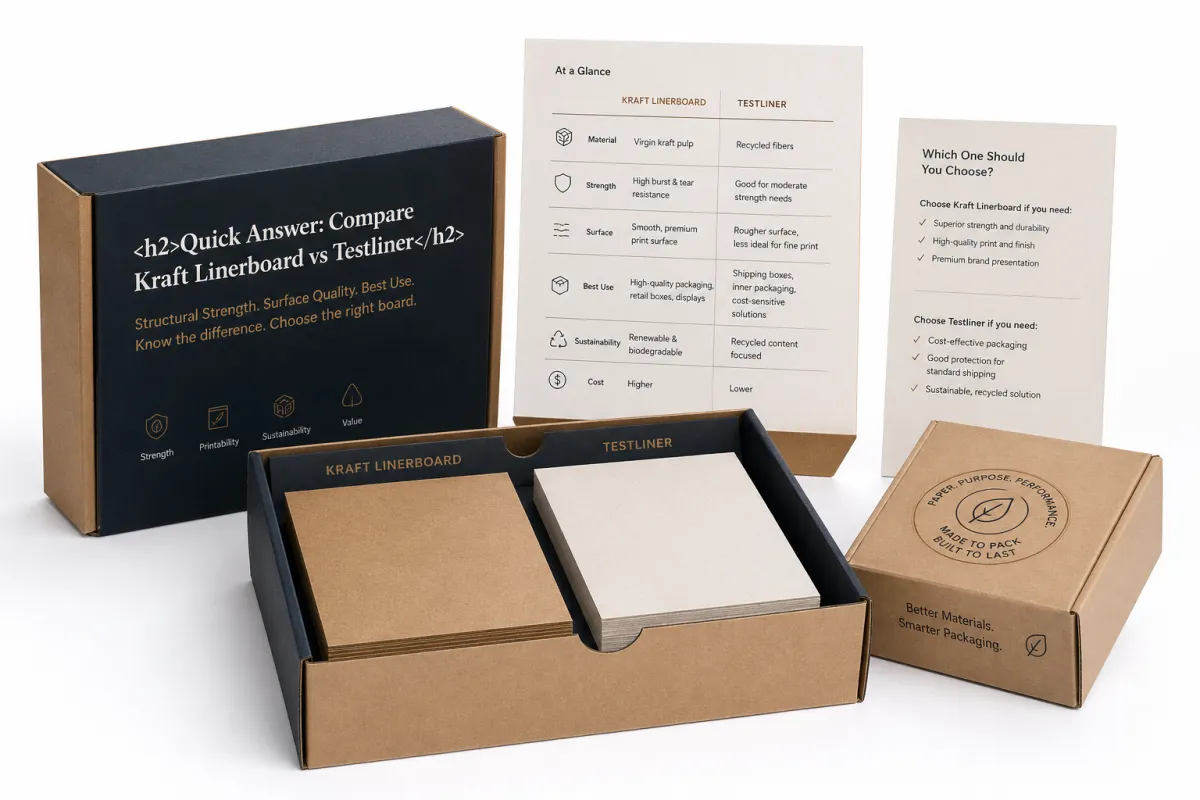
I still think about a sticky August route out of Savannah, Georgia, where a buyer saved about $18 per ton on the liner quote and then paid for it in crushed corners, an extra 6 rolls of tape on the first 1,200 cartons, and two reworked pallets that should have been rejected before they ever hit the trailer. That kind of lesson tends to stick, usually right after the first angry call from the receiving dock in Jacksonville. It is why compare kraft linerboard vs testliner is never only a paper conversation. It is a box-performance decision, a freight decision, and, in plenty of cases, a customer-claim decision tied to a real warehouse lane, a real transit window, and a real dollar amount.
The short version from the shop floor is straightforward. Kraft linerboard usually brings more consistency in strength, better confidence in stacking, and a cleaner presentation for branded work that needs a smooth, predictable kraft face and sharp print definition. Testliner usually brings lower entry cost, recycled-content advantages, and solid service for everyday shipping boxes that move through regional distribution centers in Dallas, Atlanta, or Columbus. For cartons that have to survive long-haul freight, warehouse stacking, or damp summer loading docks, kraft tends to earn the call more often. For routine transit where cost control matters and the handling lane stays predictable, testliner can make better financial sense. That is the practical core of compare kraft linerboard vs testliner, and it is usually decided at the box level rather than the paper mill level.
The real drivers are not abstract. I look at ECT, burst, caliper, moisture response, surface smoothness, print holdout, and mill-to-mill consistency, because a reel that tests beautifully once and drifts badly on the next run can eat away at a corrugator schedule in a hurry. On a 120 fpm line in northern Ohio, even a 3% slowdown across a four-hour shift can erase the savings that looked so attractive on the quote sheet, and downtime is never cheap when the crew is waiting on the next order. One bad roll can wipe out a week of paper savings, which is the sort of thing that makes a buyer stare at the ceiling for a minute and mutter a few words they would never use in a quarterly review.
The fastest rule I can offer is this: if the carton protects heavier goods, stacks for a while, or travels through ugly weather, kraft is often the safer pick; if the box is for routine transit and the budget is tight, testliner often wins on total spend. That is the point where compare kraft linerboard vs testliner stops being a paper debate and starts looking like an operations call, especially once you factor in pallet count, freight lanes from Memphis to Phoenix, and the cost of even one avoidable damage claim.
Which is better when you compare kraft linerboard vs testliner?
When I compare kraft linerboard vs testliner for a real shipping program, I start with the carton’s job, not the invoice. Kraft usually makes more sense for heavier loads, stacked storage, humid warehouses, and long transit lanes because it gives you more compression strength and a wider safety margin. Testliner usually makes more sense for controlled routes, standard shipping boxes, and recycled-content goals where lower sheet cost and steady availability matter more than maximum toughness. If the box has to survive rough handling, kraft is often the safer engineering choice; if the box moves through a predictable lane, testliner can be the smarter commercial choice.
There is a second layer that buyers miss all the time: how forgiving the paper is once the line speeds up or the weather turns sloppy. A box that only behaves in a lab is kinda useless on a wet dock in midsummer. Kraft tends to buy you a little more breathing room in those messy conditions, while testliner can still perform well if the furnish, moisture, and converting controls stay tight. That difference is small on a spec sheet and obvious on a pallet.
Top Ways to Compare Kraft Linerboard vs Testliner
To compare kraft linerboard vs testliner properly, I start with fiber source, then move to surface uniformity, strength retention, print response, and the way the sheet behaves once it reaches the corrugator. Buyers get led astray when they focus only on basis weight. A 42 lb liner that runs dry, flat, and clean can outwork a heavier sheet that brings too much moisture variation or recycled contamination into the plant. I have seen that mistake more than once in facilities from Fort Worth to Richmond, and every time it turns into a “but the spec looked fine” conversation that nobody enjoys.
Kraft linerboard is usually built with a higher share of virgin fiber or a long-fiber furnish that gives the sheet more toughness and better integrity. Those long fibers matter on the line because they help resist tear propagation during converting, trimming, scoring, and rough handling. In a converter outside Milwaukee, Wisconsin, I watched two stacks of finished cartons side by side: the kraft-built stack kept its edges after forklift handling, while the recycled stack showed more fuzzing along the corners and a little more edge collapse after just 15 minutes of staging. It was not dramatic theater. It was just the kind of plain evidence that settles an argument faster than a five-slide presentation ever could.
Testliner is typically made from recycled fiber, so the value story is real, but its performance can move more from mill to mill. Furnish mix, moisture history, and recovered fiber quality all play into the result. One supplier in Wisconsin may hold ash and moisture within a tight window, while another in Ontario sees wider swings because the incoming fiber stream changes too often after a holiday week or a storm-related collection delay. If you want to compare kraft linerboard vs testliner in a meaningful way, supplier discipline matters just as much as the printed spec. Honestly, that part gets ignored because it is less glamorous than talking about basis weight, but it saves more headaches than people admit.
I also compare the actual use case with a blunt eye. Kraft gets chosen often for export cartons, heavier retail packs, and jobs that face rough handling in ports like Long Beach or Newark. Testliner shows up a lot in standard shipping boxes, inner cartons, and high-volume logistics programs where small paper savings turn into real dollars across 10,000 to 50,000 units. That tension is the heart of compare kraft linerboard vs testliner: strength reserve versus recycled efficiency, with the final answer shaped by carton size, ship-from location, and the number of times the pallet changes hands.
Testing belongs in the discussion early. Compression testing, drop tests, humidity exposure, and print rub resistance tell you how the board behaves under abuse instead of how it behaves on a tidy spec sheet. The checklist I use in the plant follows the same practical thinking behind the ISTA transit testing framework, because cartons have to survive actual lanes, not ideal ones. A box that looks perfect in a conference room in Chicago is not much comfort when it is sitting in a warm trailer on a Friday afternoon at 94 degrees Fahrenheit.
- Compression: Judge stack performance, not just paper weight, and ask for ECT data at 32, 44, or 51 grade targets.
- Moisture: Check how the liner reacts at 65% to 85% relative humidity, especially after 24 hours in a dock environment.
- Surface: Inspect print holdout, fiber pick, and rub resistance for logos, barcodes, and lot codes.
- Consistency: Ask for reel-to-reel variation data, not a single favorable sample from one polished mill run.
Detailed Reviews of Kraft Linerboard and Testliner
I like to break down compare kraft linerboard vs testliner the way I do after a day on the floor with sample rolls, rejected cartons, and a converter operator who has already seen too many surprises for one shift. Kraft linerboard usually brings steadier formation, a cleaner-feeling face, and a stronger reputation for holding up when cartons are stacked, banded, or stored longer than planned. That steadiness matters because a warehouse in Atlanta or Louisville does not grade board in a lab; it grades the box under load, under time pressure, and under imperfect handling from a forklift moving every 90 seconds.
Kraft starts to earn its premium on branded packaging, heavier industrial goods, long-haul freight, and cartons that need a cleaner print face or more predictable runnability. I have sat in supplier meetings where the gap was only about $35 to $60 per ton, and the buyer still chose kraft because one customer claim on a damaged pallet would have erased the savings for the whole month. That is not emotion. That is risk math, especially if the product is moving from a plant in Dallas to a retailer distribution center in New Jersey. I am all for saving money, but I am not a fan of pretending a cheap sheet is cheap if it keeps showing up as a problem later.
Testliner has real strengths of its own, and it deserves a fair look. The recycled-content story is strong, the cost profile is friendly, and it performs well in routine distribution when the spec is right and the supply chain stays under control. I have watched good testliner run cleanly through a corrugator in Ohio at 500 sheets per minute, with gluing and scoring that stayed consistent because the furnish was stable and the moisture target was nailed between 7.5% and 9.0%. For a high-volume shipper with a narrow SKU list, that kind of board can keep a line moving without drama.
The limits of testliner show up when the lane gets messy. More variation between mills, softness in humid conditions, and cases where the lower paper price gets erased by higher damage rates are the pain points I watch most closely. A recycled sheet that saves $20 per ton but creates 2% more damage can become the priciest board in the room, especially after returns and rework hit the fulfillment center in Indianapolis. That is why I keep pushing people to compare kraft linerboard vs testliner as a whole-system choice, not a purchase-order choice.
From a converter’s point of view, the differences show up by the time the sheet reaches cutting and scoring. Kraft often cuts with more confidence, glues predictably, and keeps edge integrity better through palletizing. Testliner can run very well, but if moisture swings or surface porosity move outside the sweet spot, glue line quality and score quality can shift fast. On a 16-hour run, that kind of drift turns a paper savings into overtime before anyone notices, and I have watched operators in a plant near Charlotte chase a glue issue for half a shift only to realize the board, not the machine, was the troublemaker.
Kraft linerboard on the floor
When I walk a line with kraft linerboard in the feeder, the boxmaker operator usually has fewer complaints about edge crush, especially on cartons rated 275 ECT or above. The sheet feels more uniform in hand, and that can translate into cleaner die cutting, steadier stacking, and fewer surprises once the load gets banded tight with 3/8-inch strapping. I have seen kraft hold up better after a 24-hour dwell in a humid staging area in Savannah, which matters more than buyers often expect. A box that survives the wait is a lot more useful than one that only behaves on the first pass.
Testliner on the floor
Testliner is the grade I often see winning on programs where the product is moderate in weight, the warehouse is climate-controlled, and the customer wants recycled-content documentation. In one Shenzhen facility I visited during a supplier review, the team was running testliner on a narrow corrugator line and hitting excellent yield because the order spec was tight: 42 lb liner, 32 ECT board, and a moisture target between 7.5% and 9.0%. That kind of discipline makes testliner look very good. Without that discipline, though, the same board can turn temperamental in a hurry, which is a polite way of saying it starts acting like it has somewhere else to be.
Price Comparison: compare kraft linerboard vs testliner costs
If you are trying to compare kraft linerboard vs testliner on price alone, testliner usually shows the lower sheet cost. Sheet cost, though, is only the opening line in the math. The real comparison includes waste, rejects, freight, storage loss, and customer claims. On one Midwest quote I reviewed for a ship-from-Chicago lane, a 42 lb kraft liner came in near $790 per ton delivered, while a comparable 42 lb testliner sat around $735 per ton. Once freight, minimums, and a small amount of line waste were added, the landed gap narrowed to under $20 per ton for that lane.
I build the cost stack from the bottom up. Raw material pricing moves with recovered fiber availability, pulp costs, and mill allocation. Freight shifts with weight and lane. Inventory carrying cost rises when you need to buy beyond your actual requirement just to meet a truckload minimum of 48,000 pounds. Paper consistency also changes conversion speed, and that is an overlooked expense because a line running 7% slower for four hours can cost more in labor than a paper discount ever saves. I have seen people celebrate the invoice and then quietly lose the savings in overtime, scrap, and extra handling. That kind of math has a way of ruining a nice spreadsheet.
Kraft can win on total cost in some programs because it cuts damage, improves stackability, and reduces the odds of expensive failures in transit or on the warehouse floor. I watched a plant manager in Indiana choose kraft after a simple test showed 18% fewer corner-crush incidents during pallet stretch wrapping on a 1,100-box run. The paper premium was modest; the labor saved from rework was bigger, and the shipping team in the Indianapolis warehouse noticed the difference within the first week.
For a real buying decision, I ask people to compare cost per finished box, not just cost per ton of paper. If a kraft-built carton costs $0.03 more at the sheet level but eliminates $0.06 in damage, that is the better business result. If a testliner carton saves $0.02 and performs the same in your own environment, then testliner is the better purchase. That is the financial logic behind compare kraft linerboard vs testliner in a commercial setting. Simple enough in theory, messy in real life, which is usually how procurement goes.
| Factor | Kraft Linerboard | Testliner | Buyer Read |
|---|---|---|---|
| Illustrative delivered quote | $790/ton for 42 lb | $735/ton for 42 lb | Testliner starts cheaper on paper |
| Moisture sensitivity | Usually lower risk in damp lanes | Can soften faster if storage runs humid | Kraft gives more margin in summer warehouses |
| Print surface | Cleaner, more uniform face | Good for utility graphics, less uniform overall | Kraft helps premium logos and fine detail |
| Damage risk | Often lower on heavy or stacked loads | Fine for routine shipping if the spec is tight | Total cost can favor kraft |
| Supply profile | May need more specific sourcing plan | Often broader recycled-fiber availability | Testliner can be easier to source quickly |
A useful comparison tool is landed cost per finished carton, and I mean a real landed cost that includes freight, spoilage, and handling. If you are packaging 50,000 boxes per month, a difference of $30 per ton may sound small, but across a long supply program that gap can disappear inside one damaged shipment or one production stop. That is the commercial truth behind compare kraft linerboard vs testliner: a lower invoice does not always mean a lower total spend. I have seen entire “savings” disappear because someone forgot to count the cost of all the extra tape, which still has to be bought in case quantities of 36 rolls.
Process and Timeline: From Mill Order to Finished Cartons
The process matters because even the right grade turns into a headache if the timeline slips. I usually map the path from specification to delivery like this: grade selection, sample approval, roll or sheet scheduling, corrugator setup, converting, and final shipment to the packing line. If you want to compare kraft linerboard vs testliner, compare the production path too, not just the name printed on the quote. Paper does not ship itself, and a beautiful spec loses a lot of charm when a truck misses the dock appointment in Houston by 14 hours.
Timeline differences usually come from sourcing flexibility. Kraft linerboard can require a more specific sourcing plan if you need a narrow basis-weight window, a certain width, or a moisture target that leaves no room for drift. Testliner may be easier to source quickly from several recycled-fiber streams, especially for standard widths and familiar specs. In a rush, that flexibility can separate a Friday ship date from a job that slips into next week, and I have seen a missed cut-off in St. Louis push a carton launch back by 8 business days because the truckload missed the mill window.
The bottlenecks are practical ones: mill lead times, truck availability, reel widths, slitting schedules, and how quickly the supplier can hit your exact basis weight and moisture target. A paper mill in Wisconsin can promise stock, but if the lane needs a special 49-inch slit width and the converting plant is already booked, the real start date still moves. I prefer a dated schedule to a loose promise every time. I have learned the hard way that “should be fine” is not a shipping plan, especially when a customer in Denver is expecting cartons on a Tuesday morning dock appointment.
I also watch quality checkpoints closely. Incoming paper inspection should include moisture checks, reel edge checks, and a quick look for wrinkles or busted edges. Then I want runnability tests on the corrugator, followed by sample cartons pulled from the line before full production release. That kind of discipline keeps compare kraft linerboard vs testliner grounded in production reality instead of wishful thinking. If a reel arrives looking tired and the edge trim is ugly, that is not a small concern; that is the boxmaker trying to tell you trouble is already walking through the door.
The best board choice is the one that fits your ordering rhythm. A strong grade delivered late is still a problem. I have seen small distributors miss a retail window because the paper landed after the holiday rush had already started, and the savings on the sheet never made up for the missed shipment. Timing belongs in the same discussion as performance, especially if your cartons have to support a product launch tied to a December 1 ship date.
If your team also tracks recycled-content claims or chain-of-custody paperwork, keep the documentation path clean from the start. The FSC system helps buyers who need traceability, while the language used by TAPPI and other corrugated industry groups keeps the discussion tied to performance instead of marketing copy. I appreciate that kind of plain-spoken structure because the paperwork can get ugly fast if nobody owns it early, especially on a multi-plant program that ships from Tennessee, Ohio, and Texas.
How to Choose the Right Board for Your Operation
I tell buyers to choose by product risk first. Heavy goods, fragile contents, stacked storage, and humid lanes usually justify kraft linerboard more often than casual distribution does. If the carton will sit in a warehouse for 10 days, ride in a non-climate-controlled truck, or carry a load that beats up the corners, I lean toward the stronger and more consistent option. That is where compare kraft linerboard vs testliner turns into a risk-management exercise rather than a pricing exercise.
Testliner fits better when the application is predictable: moderate weights, steady warehouse conditions, straightforward branding, and volume-driven programs where paper efficiency matters. I have seen it work well on 32 ECT and 44 ECT styles for e-commerce replenishment, parts distribution, and inner shippers. The key is discipline. If the spec is loose, testliner will show every weakness in the process. It is a decent paper, not a miracle worker, and I say that with affection and a little fatigue from fixing avoidable problems on night shifts in Nashville.
Ask for the right data. I want ECT, burst, caliper, Cobb or moisture resistance data, and any print or coating requirements tied to the brand. If you are running a corrugated box that carries 18 lb of bottled product, the board spec should reflect that load and not sit in a generic product family. A buyer who can read the numbers can compare kraft linerboard vs testliner with more confidence than someone choosing by habit, especially if the carton has to clear a 4-foot stack test on the warehouse floor.
Real-world trials are worth the time. Put a few pallets of each grade in your own warehouse, on your own route, under your own handling conditions, and inspect the corners, scores, and load stability after 48 hours and again after a few days. I have watched a test that looked even on day one reveal a major difference after a weekend in a humid staging area near New Orleans. A short trial usually settles the argument faster than another spreadsheet ever will.
Sustainability and compliance also matter. Recycled-content targets can favor testliner, while tight performance targets may make kraft the cleaner engineering choice. If you are publishing sustainability claims, make sure the paperwork matches the paper. A recycled-content claim only helps if the supply chain documents can stand up to an audit and the board still protects the product. Otherwise the story gets awkward fast, and nobody wants that phone call from compliance on a Monday morning in a plant already short one forklift driver.
"Give me the sheet that survives the back corner of the warehouse in August, not the one that looks cheapest on the PO."
That line came from a plant manager in Michigan after we watched a stack of overbuilt but underperforming cartons buckle under a 2,200 lb pallet load. He was not trying to sound dramatic. He was trying to keep shipping complaints at zero, and that is exactly how I think about compare kraft linerboard vs testliner in actual plant conditions. The box has one job: protect the product without becoming a problem itself, whether it is moving through a climate-controlled DC in Minneapolis or a hot dock in Tampa.
Our Recommendation and Next Steps
My recommendation stays straightforward. Choose kraft linerboard for high-risk, high-value, or high-pressure shipping programs where failure costs more than the paper premium. Choose testliner for cost-sensitive, high-volume cartons where recycled content, steady supply, and practical performance matter most. That split will not settle every spec debate, but it will save a lot of unproductive back-and-forth. Honestly, that alone is worth doing when a packaging team is juggling three product launches and two freight bids in the same month.
To turn the decision into action, request two matched specs and ask for landed pricing on both. Then compare sample cartons after compression testing and a short humidity exposure. I like a 24-hour humidity trial at roughly 75% relative humidity followed by a stack test, because it shows how the board reacts after it has absorbed real moisture, not just room air. If the sample gets mushy or the corners start to sulk, you have your answer faster than any sales pitch can deliver it.
Set a short pilot window with your packaging team, warehouse crew, and freight partners. I want the box to move from the line to the dock to the customer before anyone signs off. If your freight partner sees crushed corners on a certain lane, that is information. If the warehouse team says one grade stacks better on the lower tier of a pallet, that is information too. The people closest to the carton usually know the truth before the spreadsheet does, especially in a 48-hour pilot that covers both receiving and outbound staging.
If the choice is still close, run a dual-spec trial and compare kraft linerboard vs testliner in your own operation before locking the SKU. I have watched a dual trial settle arguments that dragged on for months because the actual handling data finally beat the assumptions. It is the cleanest way I know to buy corrugated board with confidence, and it is especially useful for facilities that ship from multiple regions like Atlanta, Reno, and Philadelphia.
For custom logo work, keep the discussion grounded in the finished box, not just the paper. The artwork, the transit lane, the stacking load, and the supplier’s consistency all matter. If you treat compare kraft linerboard vs testliner as a system decision, you usually end up with fewer surprises, fewer claims, and a better result on the dock, whether the carton is carrying cosmetics, auto parts, or a 24-bottle beverage set. The practical takeaway is simple: buy the grade that survives your worst lane, not the one that merely looks good on the quote sheet.
FAQ
Is kraft linerboard stronger than testliner for shipping cartons?
Often yes, especially when you need more consistent compression strength and better performance in rough handling or humid conditions. The real answer depends on basis weight, furnish mix, and the full carton design, not just the paper name. For heavier loads or longer storage, kraft usually gives more confidence; for routine shipping, a well-spec'd testliner can still perform well. I would not bet a premium shipment on “usually” if I could avoid it, particularly if the lane runs through a hot warehouse in Phoenix or a damp dock in Charleston.
How do I compare kraft linerboard vs testliner for humid storage?
Ask for moisture resistance data and run a simple warehouse trial in the same humidity your cartons will actually see. Look for board that keeps its stiffness after exposure, because humidity can cut box compression fast. If the cartons sit before use or travel through damp lanes, kraft often gives a safer margin. I have seen one wet weekend in a Gulf Coast warehouse turn a good-looking box into a very expensive disappointment, and the fix usually costs more than the original paper premium.
Which is cheaper when I compare kraft linerboard vs testliner by landed cost?
Testliner is often cheaper by paper price, but landed cost can shift once freight, waste, claims, and rework are included. Kraft can become the better value if it reduces damage, improves stackability, or cuts line downtime. Always compare cost per finished carton, not just cost per ton. That one change in how you measure it usually saves a lot of arguing, especially when the quote is only $40 to $60 per ton apart.
Does testliner print as well as kraft linerboard?
Testliner can print well for many shipping and retail applications, but the surface is usually less uniform than kraft. For premium graphics, crisp logos, or fine detail, kraft often gives a cleaner result. If branding matters, ask for printed samples from both grades before you decide. I would rather stare at two actual samples than trust a glossy spec sheet with heroic claims, particularly if the artwork has a fine registration line or a small barcode that needs to scan the first time.
What should I ask a supplier before choosing between the two?
Ask for ECT, burst, caliper, moisture specs, lead time, MOQ, and any recent quality variation reports. Request sample cartons made on the same converting line that will run your order. If your operation is sensitive to damage claims, ask for references from similar shipping lanes or box formats. And if they get vague, that is useful information too, because a supplier that cannot tell you whether a 12-15 business day lead time is realistic is probably not the one you want on your most sensitive carton program.
Related packaging resources
Use these related guides to compare specs, costs, quality checks, and buyer decisions before making the final call.
- Shipping Carton MOQ for Startups: Pricing and Lead Times
- Wholesale Box Dividers for Glassware: Specs and Pricing
- Branded Void Fill Kraft Paper: Smarter Shipping Basics
- Zipper Pouches with Logo: Shipping Packaging Guide