Buyer Fit Snapshot
| Best fit | tissue paper for branding tested options for packaging buyers comparing material specs, print proof, MOQ, unit cost, freight, and repeat-order risk where brand print, material, artwork control, and repeat-order consistency matter. |
|---|---|
| Quote inputs | Share finished size, material target, print colors, finish, packing count, annual reorder estimate, and delivery region. |
| Proofing check | Approve dieline scale, logo placement, barcode or warning zones, color tolerance, and any recyclable or compostable wording before bulk production. |
| Main risk | Vague material claims, crowded artwork, or missing packing details can create delays even when the unit price looks attractive. |
Fast answer: Tissue Paper for Branding Tested Options: Dieline, Finish, Proof, and Buyer Review should be specified like a repeatable production item. The safest quote includes material, print method, finish, artwork proof, carton packing, and reorder notes in one written spec.
What to confirm before approving the packaging proof
Check the product dimensions against the actual filled item, not only the sales mockup. Ask for tolerance on folds, seals, hang holes, label areas, and retail display edges. If the package carries a logo, QR code, warning copy, or legal claim, reserve that space before decorative graphics fill the panel.
How to compare quotes without losing quality
Compare board or film grade, print process, finish, sampling route, tooling charges, carton quantity, and freight assumptions side by side. A lower quote is only useful if the supplier can repeat the same color, closure quality, and packing count on the next order.
The best tissue paper for branding is not usually the heaviest sheet, the brightest color, or the sample that looks the most dramatic under a studio light. More often, it is the tissue that feels intentional in the hand, folds without fuss, and keeps the brand mark readable after the paper has been handled, tucked, and shipped. That small moment at the top of a box can shape how a customer reads the rest of the package, and honestly, it carries more influence than a lot of teams give it credit for.
For e-commerce shipping, retail gift wrap, subscription kits, and premium presentation inserts, the best tissue paper for branding changes with the job. A boutique apparel label might want a soft fold and a quiet logo that supports the product without stealing the scene. A high-volume DTC brand may care more about repeatability, storage efficiency, and cost per order. A gift-driven business may want the tissue itself to do more of the visual talking. Same material family, very different expectations.
I have spent enough time comparing tissue samples to know where the real issues show up: tear resistance, color consistency, print sharpness, fold behavior, sheet size, and how the artwork behaves once it is creased. Those are the things that matter once the paper leaves the mockup stage and lands on a pack line. The first run can be a little humbling if you skip those checks, because the sheet that looked pristine on a desk can turn into a wrinkled headache in a real box.
If you want the short version, start with tissue that fits your margin, pack-out flow, and visual tone instead of chasing the fanciest finish or the most ink-heavy layout. Clean repeat spacing, moderate coverage, and a weight that folds without cracking at the crease usually deliver the strongest result. Fancy can help. Too much can get in the way, kinda like an overdesigned label that makes the whole package feel busier than it needs to be.
Quick Answer: Best Tissue Paper for Branding
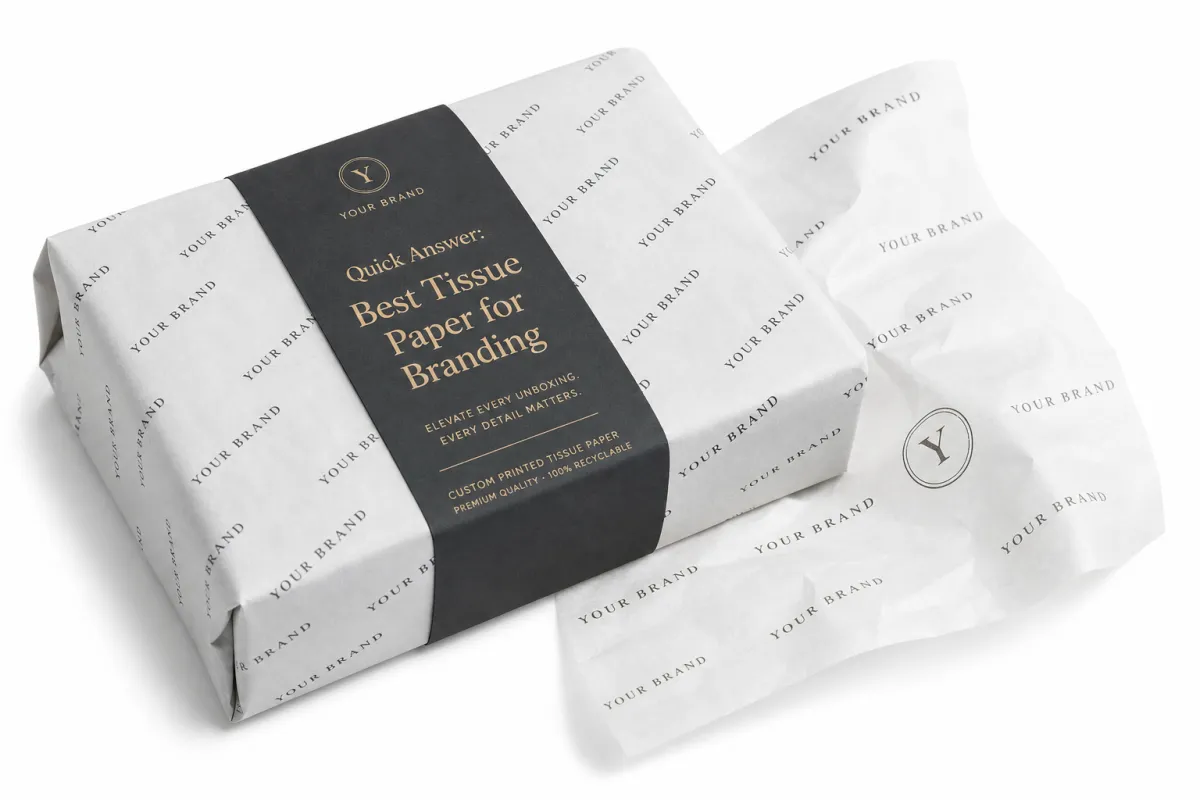
The best tissue paper for branding is usually custom printed tissue with a light-to-moderate repeat pattern, a one- or two-color logo, and a paper weight in the 17- to 24-gsm range. That combination tends to give the best balance of print quality, opacity, and fold behavior for most packaging programs. Lighter weights feel softer and airier. Slightly heavier tissue gives more coverage, less see-through, and a tighter fold inside a mailer box.
High ink coverage is not always the strongest branding move. Full-bleed prints can feel crowded on thin tissue, and they often pull attention away from the product you actually want people to remember. A restrained design usually supports brand consistency and strengthens customer perception because it feels deliberate instead of promotional. The best tissue paper for branding often looks calmer in person than it does in a mockup.
The answer shifts more by use case than most buyers expect. E-commerce orders need tissue that opens neatly and keeps its fold during transit. Retail gift wrap needs a look that photographs cleanly under store lighting. Subscription kits benefit from predictable sheet sizing and quick pack-out. Luxury inserts need crisp edges and a tactile feel that supports the product story. One brand can use the best tissue paper for branding for one of those jobs and still choose the wrong sheet for the others.
I would test each candidate against six questions: Does the logo stay sharp at the fold? Does the color read the same under warm and cool light? Does the sheet wrinkle badly after one handling pass? Does it improve the unboxing experience in a real way? Can the supplier meet your minimum order quantity without creating storage pain? Does it ship flat enough to avoid wasted labor? If the answer is yes to most of those, you are close to the best tissue paper for branding for your brand.
Practical rule: if the tissue looks premium in a folded sample, survives one packing cycle, and still feels intentional in a customer’s hands, it is a stronger candidate than the sheet that only looks impressive on a flat mockup.
For brands still building a packaging system, tissue can pair well with simple stickers or tags. If you want a lighter-touch route, a product sticker from our Custom Labels & Tags page can carry the brand mark while plain or colored tissue does the wrapping. That is not as dramatic as fully printed tissue, but it can still support brand recognition and protect cash flow.
Best Tissue Paper for Branding: Top Options Compared
The main choices are wider than many buyers realize. The best tissue paper for branding can come from custom printed tissue, stock colored tissue with stickers, digitally printed tissue, or specialty alternatives such as metallic-finish tissue and seeded paper-style presentation layers. Each one sends a different signal. Some read polished and commercial. Others feel artisan or gift-led. A few look great in a sample pack and then fall apart once they are folded ten times a day.
Custom printed tissue is usually the safest middle ground for most brands. It supports strong visual branding, gives you steady brand identity across repeat orders, and usually performs well in production once the artwork is approved. The tradeoff is setup. Flexographic and offset-style methods can look sharper at scale, but they often need larger runs. Digital printing offers more flexibility for smaller batches, though saturation may be lighter and color edges may feel softer than expected. For many companies, the best tissue paper for branding is the method that matches the order size without forcing awkward compromises.
Stock colored tissue with stickers is the budget-conscious path. It is not as integrated, but it can still look polished if the color palette is disciplined and the sticker placement stays consistent. That option works well for small shops, seasonal collections, and brands testing new packaging before committing to a full print run. If the goal is the lowest barrier to entry, this can be the best tissue paper for branding by economics alone, even if it is not the most dramatic choice.
Digitally printed tissue works best when design flexibility matters more than scale efficiency. It fits holiday campaigns, small launch runs, artist collaborations, and promotional sleeves where speed matters. It is useful for short-term branding tests, but it does not automatically win on saturation. The best tissue paper for branding in this category depends on whether turnaround or color punch matters more.
Specialty finishes are the wildcard. Metallics can elevate premium gifting, but they are easy to overdo. Seeded alternatives or textured papers may fit a sustainability-forward story, yet they behave differently on the pack line and can crease in less predictable ways. A specialty sheet may create a memorable first impression, but memory alone does not make it the best tissue paper for branding. If it tears too easily or slows pack-out, the shine fades quickly.
| Option | Best Use Case | Typical Look | Common MOQ | Approx. Unit Cost | Main Tradeoff |
|---|---|---|---|---|---|
| Custom printed tissue | Core brand packaging, retail, DTC shipping | Integrated, polished, repeatable | 1,000-10,000 sheets | $0.08-$0.22 per sheet | Setup time and plate or prepress costs |
| Stock colored tissue + stickers | Small brands, test runs, seasonal packs | Clean but less embedded in the sheet | 250-1,000 sheets | $0.03-$0.12 per wrapped order | Less immersive branding |
| Digital printed tissue | Short runs, fast campaigns, varied artwork | Flexible, slightly softer saturation | 250-2,500 sheets | $0.10-$0.28 per sheet | Color depth can vary by file and paper |
| Specialty finish tissue | Luxury gifting, editorial presentation | Distinctive, high-drama, unusual | Often higher than standard tissue | $0.18-$0.45+ per sheet | Can be harder to fold and more expensive |
My recommendation framework stays simple. If you sell at a healthy margin and packaging is part of the product story, custom printed tissue is often the best tissue paper for branding. If your order volume is low and cash flow matters, stock tissue plus a well-placed label may beat a high-minimum print run. If you run frequent limited drops, digital printing offers the most agility. If your brand tone leans premium gifting, specialty paper can work, but only if the process stays tidy and the paper behaves well in real hands.
For larger packaging programs, repeatability matters just as much as appearance. A design that looks beautiful once but shifts tone on every reorder creates friction for the pack team and confusion for the customer. The best tissue paper for branding should support both the launch moment and the sixteenth reorder. Good branding is not a one-time photo shoot; it is a production habit.
If you want to see how packaging choices support different product categories, our Case Studies page is useful because it shows how brands balance presentation, cost, and handling across real pack-out scenarios. The strongest programs are rarely the most elaborate. They are the ones that stay consistent when the order volume doubles.
Detailed Reviews of the Best Tissue Paper for Branding
Here is where the best tissue paper for branding becomes a judgment call instead of a category label. The same paper can feel premium in one brand system and underwhelming in another. I am looking at real packaging behavior here, not only how the swatch looks on a desk. Which option folds cleanly around apparel? Which one keeps its edges from collapsing inside a mailer? Which one still looks intentional after the customer has handled it twice? Those details matter more than most buyers admit.
1. Custom printed tissue with a restrained repeat pattern is usually the strongest all-around performer. It tends to look expensive without shouting, and it supports brand consistency across repeat orders. In my view, this is often the best tissue paper for branding for apparel, accessories, and general DTC shipping because it balances presentation with practicality. The sheet usually reads cleaner if the repeat is spaced generously, the logo is kept at a moderate size, and the background color is not so dark that it swallows fine details. If your identity leans elegant rather than loud, this is the safest bet.
2. Stock colored tissue with a custom sticker is the most underrated everyday choice. It does not have the same integrated feel, but it can still create a polished impression if the color is matched thoughtfully and the sticker placement stays controlled. I have seen this outperform more elaborate solutions when the brand tone is minimalist and the product margin is tight. It is not always the best tissue paper for branding in a luxury sense, but it can be the best operational answer. Clean edges, low waste, and easy reorder logic are hard to ignore.
3. Digitally printed tissue is the flexible option for campaigns that change often. It makes sense for special launches, artwork collaborations, and brands that want small but frequent batches. The limitation is that the print can look a little less saturated than buyers expect, especially on thin tissue. That does not make it bad. It just means the file needs to be designed for the substrate, not just for a screen. If the artwork is busy or full of micro type, the result may disappoint. For limited editions, though, it can still be the best tissue paper for branding because speed and variety matter more than volume economics.
4. Specialty-finish tissue is the high-risk, high-reward path. Metallic accents can look exceptional in premium gifting, but they need restraint. Too much reflectivity and the paper starts feeling theatrical rather than refined. Textured or unusual papers can create a memorable tactile moment, yet they may cost more and behave less predictably in pack-out. This is where many brands confuse novelty with performance. The best tissue paper for branding here is the one that still closes neatly, protects the product, and photographs well without extra wrangling.
5. Neutral tissue plus branded insert card is worth calling out because it often wins in real operations. If your product already has strong packaging structure, the insert card can carry the message while the tissue stays light and protective. That combination often improves customer perception without adding complexity to the sheet itself. It is not the loudest strategy, but it is efficient. In some programs, that makes it the best tissue paper for branding simply because it saves labor while keeping the presentation polished.
For readers who like a disciplined test, compare samples under at least two light sources: daylight and warm indoor lighting. Then fold them around an actual product, not a flat block of cardboard. The differences can be embarrassing. A sheet that looks elegant on a table can look chaotic once it goes through the packing line. If you want a similar review approach from other packaging categories, the packaging examples in our Case Studies archive show how small presentation choices affect the final result.
My honest take: the most expensive-looking tissue is not always the best tissue paper for branding. The winning sheet is usually the one that folds cleanly, photographs well, and survives the journey from warehouse to customer without losing its shape.
Cost, Pricing, MOQ, and Unit Cost
The biggest mistake buyers make is treating tissue pricing like a simple sheet-by-sheet calculation. It is not. The best tissue paper for branding may carry a higher unit price but still cost less per wrapped order if it reduces the need for extra inserts, secondary branding pieces, or labor correction. Setup fees, plate costs, paper weight, sheet size, ink coverage, and finishing all influence the final quote. A quote that looks expensive on paper can still make sense once you spread it across a full pack-out process.
For budget planning, I usually group tissue into three ranges. Low-cost stock tissue with labels often sits around a few cents per wrapped order, which is why it works for small brands and test runs. Mid-range printed tissue often falls into the $0.08-$0.22 per sheet range depending on volume and coverage. Premium or specialty runs can move above that quickly, especially if the design uses dense ink or a complex finish. That is why the best tissue paper for branding is rarely the cheapest quote on the page; it is the one that protects margin without making the package feel thin.
MOQ matters more than many first-time buyers expect. A print run with a low sheet price can be a poor buy if the minimum is 5,000 or 10,000 sheets and your storage space is limited. Cash flow, not just cost, is the real constraint. If your brand ships only a few hundred orders per month, a huge run can tie up money for a long time. In that case, the best tissue paper for branding may be a hybrid solution: smaller printed batches for hero products, plain tissue or stock colors for the rest.
To judge whether a quote is fair, calculate the cost per wrapped order, not only the cost per sheet. A sheet that costs more but wraps more cleanly, tears less, and reduces pack time can produce a lower true cost. I have seen brands save money by paying a slightly higher price for paper that packs faster and needs fewer corrections. That is the practical side of the best tissue paper for branding; it affects labor, not only aesthetics.
Volume plays a big role in negotiating. A brand ordering 1,000 sheets should expect less favorable economics than a brand committing to repeated quarterly runs. Still, do not overbuy just to lower a unit price. I would rather see a smaller, smarter order with a repeatable artwork system than a giant warehouse of tissue that nobody wants to reorder because the design already feels stale. If the packaging system is working, the best tissue paper for branding is the one you can keep buying.
One more point: if your packaging includes paper-sourced claims, ask about FSC certification and recycled fiber content rather than assuming every eco claim means the same thing. The Forest Stewardship Council explains certification clearly on its site, and that matters because sustainability claims can influence customer perception almost as much as print quality does. For a buyer comparing packaging programs, the credibility of the material matters as much as the shine. See the FSC standards at fsc.org.
If you need a practical shipping reference, ISTA guidance is worth a look as well. It is not tissue-specific, but transit testing discipline helps teams understand whether their packaging layers hold up once they leave the warehouse. A material that photographs well but fails in transit is not the best tissue paper for branding; it is just expensive decoration. See the testing framework at ista.org.
Process and Timeline: From Artwork to Delivery
The production path is usually more important than the final spec sheet. The best tissue paper for branding still needs the right workflow to arrive on time and look right. The usual sequence is simple enough: artwork prep, proofing, print method selection, sampling, production, packing, and shipping. Delays often show up at the proof stage or when the design file needs cleanup. A logo with weak vector edges or a pattern that does not repeat cleanly can add days before anyone even approves the order.
Design revisions matter because tissue is less forgiving than many buyers think. Thin lines can disappear. Small text can blur. A rich brand color can shift once it is printed on a lighter substrate. If your file needs color correction or repeat-pattern adjustments, expect the timeline to stretch. That is one reason the best tissue paper for branding is often paired with a simple layout: one or two colors, clear repeats, and enough white space for the logo to breathe. Simplicity is not boring here. It is efficient.
Speed improves when the brand sends print-ready files, chooses a standard sheet size, and avoids unnecessary complexity. A straightforward one-color layout will usually move faster than a dense, full-coverage design. If you need a special paper color or a highly specific tone, plan for extra proofing. The same applies to specialty finishes. The best tissue paper for branding can be produced quickly, but only if the design and spec are not fighting the process.
Slowdowns tend to appear in seasonal periods. Holiday campaigns, Q4 launches, and major retail windows can tighten capacity. Larger quantities and custom color matching also add time. In a typical run, artwork approval might take 1-3 business days, production 10-15 business days, and shipping anywhere from 2-7 business days depending on location and freight method. That is a planning window, not a promise. The best tissue paper for branding is the one that arrives before the product launch, not the one that sounds fastest in a sales email.
Build buffer time into the calendar. If the packaging has to support a photoshoot, a new collection drop, or a wholesale presentation, do not cut the timeline close. Printing and freight both have their own rhythms. I would rather approve the proof early and have room to breathe than discover that a late artwork revision has pushed the whole order into a launch collision. The best tissue paper for branding needs to be reliable under real deadlines.
How to Choose the Right Tissue for Your Brand
Start with the brand promise, then pick the paper. If the promise is premium, the tissue should look calm, precise, and slightly understated. If the promise is playful, the sheet can be brighter and more graphic. If the promise is sustainable, the material story needs to be credible, not decorative. The best tissue paper for branding always reflects the brand identity first and the trend second.
Match the tissue to the product category. Apparel brands usually benefit from tissue that folds cleanly and does not wrinkle too aggressively. Jewelry and small accessories need presentation layers that feel delicate but still keep the item secure. Cosmetics and gift boxes often need stronger visual impact because the packaging is part of the shelf story. In each case, the best tissue paper for branding is the one that fits the object, the shipping method, and the customer expectation at the same time.
Design choices carry real weight. Logo scale changes how premium the package feels. Repeat spacing changes whether the sheet feels editorial or busy. Background color changes whether text stands out or blends in. A dark sheet with low contrast can look elegant in a mockup and muddy in a box. A pale sheet with controlled coverage often performs better in the hand. That is why the best tissue paper for branding is rarely the loudest concept in the room.
Sustainability matters, but it has to be practical. Recycled content, FSC sourcing, and recyclable inks are worth checking, yet the packaging still needs to fit the operation. If the paper tears too easily, uses too much ink, or needs excessive handling, the environmental story weakens because waste rises elsewhere. Good buyers look at the whole system. The best tissue paper for branding should feel intentional, not wasteful, and it should support both visual branding and honest material choices.
Here is the simplest decision rule I use. If your brand promise is premium, choose tissue that looks restrained, folds cleanly, and photographs without glare. If your brand promise is playful, you can be more graphic, more colorful, and more experimental. If your brand promise is value-led, keep the print simple and spend the budget where the customer will notice it most. That rule sounds basic, but it filters out a lot of bad decisions. It also keeps the best tissue paper for branding from becoming the most overdesigned option.
A final practical point: do not ignore the rest of the packaging stack. If your outer carton, tape, insert card, and tissue all speak in different visual languages, the package feels inconsistent even if each item is individually attractive. Consistency is what makes the package feel deliberate. That is where the tissue contributes more than people expect. The best tissue paper for branding helps unify the whole experience, not just wrap the product.
Our Recommendation and Next Steps
My bottom-line recommendation is straightforward. For starter brands, the best tissue paper for branding is often stock colored tissue paired with a clean sticker or tag because it controls risk and keeps MOQ manageable. For growing DTC brands, custom printed tissue with moderate coverage usually offers the strongest balance of cost, presentation, and repeatability. For premium gift-driven businesses, specialty tissue can be worth it, but only if the handling and turnaround still fit the business model. In other words, the best tissue paper for branding depends on scale as much as style.
Before placing a larger order, request two or three samples and compare them under daylight and store lighting. Fold them around a real product. Photograph them. Open and re-fold them. The paper that looks best in a sample pack is not always the one that wins in the warehouse. A small pilot order is usually the smartest test because it reveals how the material behaves in transit, in photos, and in the customer’s hands. That is often the moment you discover whether you have found the best tissue paper for branding or just the most attractive mockup.
Use a short internal checklist before approval: artwork signed off, color palette confirmed, MOQ checked, timeline mapped, and packaging dimensions measured. If your team is still deciding between tissue and other branded inserts, reviewing real-world examples in our Case Studies can help clarify what actually moves the needle. A good packaging system is usually built from small decisions that reinforce one another. That is what creates brand recognition over time.
The most honest answer is also the most useful one: the best tissue paper for branding is the one that fits your product, your margin, and your shipping reality. Not the flashiest. Not the heaviest. Not the one with the most ink. The one that makes the package feel right the first time, the fiftieth time, and the hundredth time. That consistency is what customers remember, and it is usually what keeps the packaging program from turning into a headache six months later.
What is the best tissue paper for branding if I ship small monthly orders?
Choose a lower-MOQ option with a simple one- or two-color print, or use stock colored tissue with a branded sticker if you need more flexibility. For small monthly orders, the best tissue paper for branding is usually the one that folds cleanly, ships flat, and does not tie up too much cash in inventory. That keeps the packaging system practical while still supporting your visual branding.
How much does branded tissue paper usually cost per sheet?
Pricing depends on sheet size, print coverage, order quantity, and setup fees. Small runs tend to cost more per sheet, while larger runs usually lower the unit cost. A fair comparison looks at the full wrapped order, not just the paper price. If the sheet improves the unboxing experience and reduces the need for extra inserts, the best tissue paper for branding may cost more upfront but less overall.
Is custom printed tissue paper better than using stickers on plain tissue?
Custom printed tissue usually looks more integrated and premium because the branding is part of the sheet itself. Stickers can still work very well for smaller brands, seasonal campaigns, or test runs. If you want consistency and a stronger brand identity, printed tissue often wins. If you want lower risk and faster iteration, stickers can be the smarter first step. The best tissue paper for branding depends on volume, tone, and budget.
How long does branded tissue paper production usually take?
Timelines vary by proofing, print method, and quantity, but artwork approval and shipping are often the biggest variables. Simple designs usually move faster than dense full-coverage prints or specialty finishes. A practical planning window is often 1-3 business days for proofs, 10-15 business days for production, and several more days for freight, depending on where the order ships. The best tissue paper for branding is only useful if it arrives before the launch.
What should I test before ordering the best tissue paper for branding at scale?
Check print sharpness, color accuracy, fold performance, and how the tissue looks inside a real package. Test one full packed order to see whether the branding still feels premium after handling and transit. Also check whether the paper wrinkles, tears, or shifts color under different lighting. That kind of testing is the fastest way to confirm you have found the best tissue paper for branding for your operation.
If you are comparing suppliers for the best tissue paper for branding, keep the test simple: sample, fold, ship, photograph, and repeat. That sequence will tell you more than a glossy spec sheet ever will. And if the tissue still looks sharp after transit, still feels right in the hand, and still supports the product story, you are probably looking at the best tissue paper for branding for your business.


