A strong gift set twisted Handle Paper Bags factory quote starts with fit, load, and presentation. Not with a pretty render. A bag can look perfect on a screen and still fail in the real world if the gusset is too tight, the handle patch is undersized, or the gift box shifts around inside the pack.
For a buyer, this is not just a paper bag. It is part of the gift set system. The bag has to carry the product, keep the box upright, and make the handoff feel intentional. If the structure is wrong, the cost shows up later as crushed corners, failed handles, or freight waste that was never visible in the first mockup.
The quote that matters is the one that reflects the full job: material, print, reinforcement, packing count, and the way the finished bag will travel through retail, fulfillment, and final delivery.
Why a gift set bag needs more than a nice print
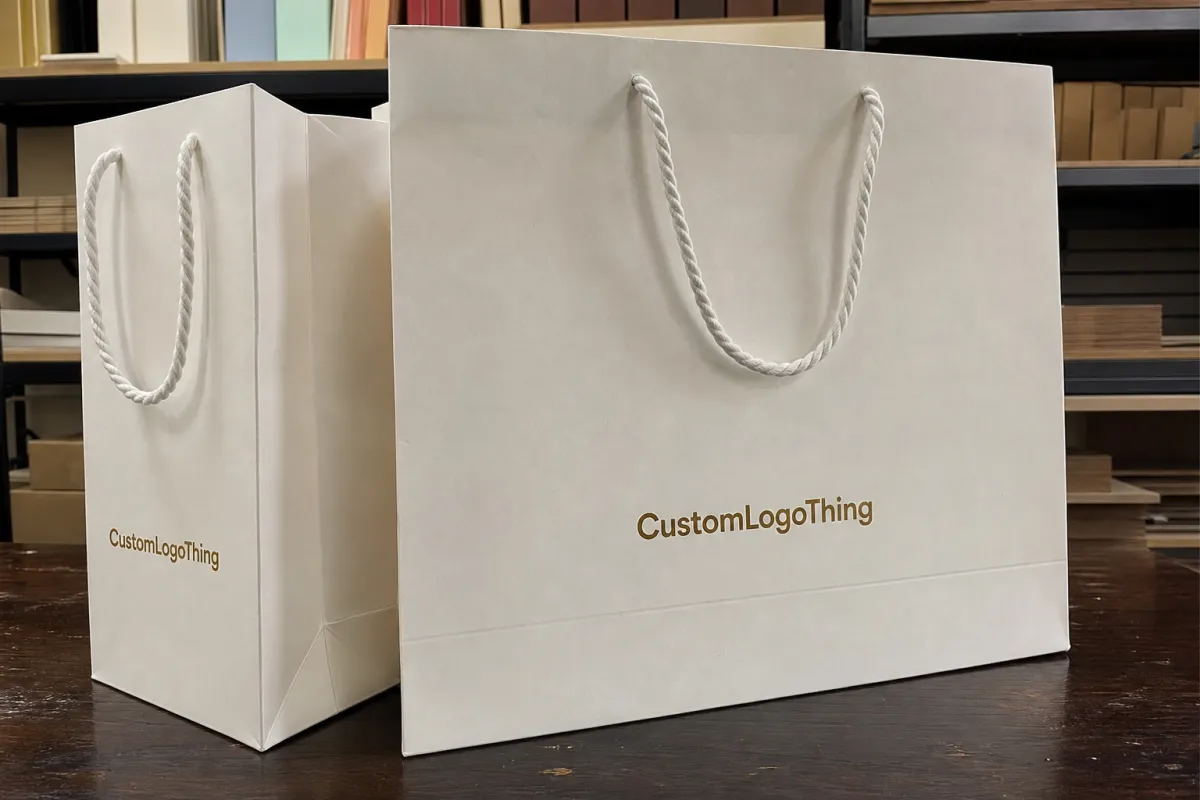
The easiest mistake is to treat the bag as decoration. That works for a display sample. It does not work for shipping. A gift set bag needs enough board strength to hold shape, enough width for easy insertion, and enough gusset to keep the sides from collapsing around the box.
Start from the box dimensions, then build the bag around them. Leave clearance for the gift set to slide in without scuffing the printed carton. Leave enough height so the handles do not rub the top edge. A bag sized from the inside out usually performs better than one guessed from a flat artwork file.
Buyers also need to separate visual impact from packing efficiency. A premium look is useful, but so is a flat pack count that stacks cleanly in cartons. The best bags are the ones that balance appearance, strength, and freight density. The cheapest unit price is not always the cheapest landed result.
This matters even more for heavier gift sets. Skincare kits, glassware, boxed confectionery, and layered promotional packs put more stress on the handle area and the bottom fold. A slightly heavier paper stock or stronger patch often costs less than a replacement run after complaints start coming in.
Gift set twisted handle paper bags factory quote: what buyers should lock in
If you want a usable gift set twisted Handle Paper Bags factory quote, the spec needs to be fixed before the numbers go out. Otherwise every supplier is quoting a different product and the comparison becomes noise.
Begin with the bag size. Give the exact width, gusset, and height. If you have the gift box or assembled set, include those dimensions too. A 10 mm change can shift paper usage, carton count, and shipping weight enough to change the quote. For tall gift packs, the carry height matters as much as the face size because it affects balance in the hand.
Then define the handle properly. Not all twisted handles are built the same, and the cheap-looking difference is often in the patch or glue area rather than the rope itself. Specify the handle color, handle length, attachment method, and whether the patch is plain paper, printed, or reinforced with a heavier insert. Also state the expected carry weight or product class. A factory can only test against what it understands.
- Paper rope color: natural kraft, white, black, or a custom tint.
- Handle length: long enough to carry comfortably without dragging on the sidewall.
- Patch reinforcement: standard patch, printed patch, or a stronger insert.
- Attachment method: glued through the top fold or another reinforced structure.
- Load expectation: approximate carry weight or product category.
Paper stock is the next line item to lock. Kraft paper gives a natural retail look and usually works well for simple graphics. Coated paper or coated board gives cleaner color and finer image detail. If the bag needs a more premium surface, lamination or other finishing can lift the presentation, but it also changes cost, recyclability expectations, and lead time.
Print scope has to be specific. State the number of colors, whether the print is one side or both sides, whether the design bleeds to the edge, and whether the logo needs to align with the gift box artwork. A factory can quote quickly when the artwork is stable. It can also quote badly when the artwork is vague.
One practical rule saves a lot of back-and-forth: send one final specification set. Do not mix two bag sizes, three handle colors, and two finish options in the first request unless you want pricing gaps that are too wide to use. If the brand team has not settled the final look, ask for two clean options instead of one blurred brief.
Paper, printing, and finishing choices that change performance
Material choice changes both the feel and the economics of the bag. Buyers often compare kraft, coated paper, and laminated board without fully accounting for how each one behaves in print, stacking, and handling.
Kraft paper usually suits organic brands, food gifts, wellness sets, and promotional packs that want a more natural look. It hides minor handling marks better than many glossy surfaces, but deep solid colors can look less even than on coated stock. Coated paper gives sharper logos and tighter detail, especially where small type or fine lines matter. Laminated surfaces add surface protection and a smoother finish, though they can increase friction in carton packing and sometimes make a bag feel less recyclable depending on local rules and the exact construction.
Printing changes the quote just as much as the substrate. A one-color logo on kraft is a very different job from a full-coverage CMYK design with metallic accents. Large solid areas can show variation if the paper is not consistent. Fine text and reverse-out details need cleaner registration and more proofing attention. That is why the factory should see artwork before the order is locked.
Finishing is where a bag moves from functional to premium. Matte lamination softens reflections and gives the surface a restrained feel. Gloss lamination adds brightness and makes color blocks pop. Spot UV can highlight a logo or pattern. Foil can look strong, but it needs careful placement because fold lines and creases can change the appearance after shipping.
| Option | Typical quote profile at 5,000 pcs | What pushes cost up | Best fit |
|---|---|---|---|
| 250gsm kraft, 1-color print, twisted paper handles | $0.18-$0.28 per unit | Oversized gusset, reinforced patch, higher carton count | Natural-looking gift sets, light-to-medium loads |
| 300gsm coated board, 4-color print, matte lamination | $0.24-$0.38 per unit | Large ink coverage, color matching, tighter artwork registration | Brand-led gift sets with sharper graphics |
| Laminated board with spot UV or foil detail | $0.32-$0.55 per unit | Special finishing, extra proofing, more careful packing | Premium presentation packs and higher-value retail sets |
Those ranges are illustrative, not universal. The same spec can price differently depending on paper market conditions, yield loss, and freight terms. Still, they show the real pattern: decoration and reinforcement usually move the unit price more than the bag shape itself.
If the sourcing brief includes recycled content or certified fiber, ask for documentation before the order moves forward. For chain-of-custody questions, the FSC certification program is the reference many brands use. The key point is simple: do not assume a paper bag is certified just because it looks natural.
Pricing, MOQ, and unit cost drivers for factory orders
The fastest way to overpay is to Request a Quote without fixing the variables. The second-fastest way is to ask for too many versions at once. A clean gift set twisted handle paper bags factory quote should spell out the size, paper weight, handle style, print colors, finish, quantity, and shipping destination.
The main cost drivers are straightforward. Larger bags use more paper and take more folding time. Heavier stock improves structure but raises cost through material and yield loss. Handle reinforcement adds labor and glue area. More print colors, larger solids, and tighter registration increase setup and inspection work. Special finishes such as foil or spot UV add another step and a little more risk if the artwork is dense. Packing spec matters too; carton size, flat count, moisture protection, and palletization all affect landed cost.
- Bag size: larger face area uses more paper and increases folding time.
- Paper weight: heavier board improves structure, but the price rises with caliper and waste.
- Handle build: twisted paper handles are economical, but reinforcement patches still matter.
- Print coverage: more colors and larger solids raise setup and inspection effort.
- Finish: lamination, spot UV, and foil add steps and more rejection risk if the design is busy.
- Packing spec: master carton size, flat count, moisture protection, and palletization all affect the landed cost.
MOQ is often misunderstood. It is not just a number a factory invents. MOQ reflects the point where setup, waste allowance, and packing labor become practical for a given spec. One design in one size is usually far easier to price than three sizes, two handle colors, and a seasonal split across small volumes.
For a typical customized retail run, many suppliers feel comfortable around 3,000 to 10,000 pieces depending on structure and print complexity. Simple kraft styles can sometimes go lower. More decorative builds often need a higher starting quantity because the setup cost has to be spread across more units. Ask whether similar orders can be combined by artwork family or paper spec. Sometimes that lowers the entry volume without changing the product.
There are also hidden charges worth asking about early. Plate or setup fees can appear with multi-color print. Sample charges may be credited later, or they may not. A dieline revision can create delay if the box size changes after proofing. Export terms matter too; FOB, CIF, and DDP can produce very different landed numbers even if the factory price looks similar at first glance.
For brands comparing several suppliers, ask each one to quote the same spec sheet and the same carton pack-out. That sounds basic because it is. A supplier who quotes lighter paper or a looser pack count may look cheaper until the cartons land and the math changes.
If you need a price benchmark, ask for versions with and without finishing. That gives you a real commercial spread. In many cases, the most expensive part of the order is not the twisted handle. It is the combination of large solid print, special surface finish, and low volume.
Production process and lead time from artwork to shipment
A good factory run follows a simple chain: inquiry, spec review, dieline confirmation, artwork proofing, sample approval, mass production, quality check, packing, and dispatch. The steps are ordinary. The schedule risk comes from how long each one takes to close, not from the actual bag-making.
Artwork approval is usually the first bottleneck. If the logo, text, or color values are not locked, proofing drags. Dieline confirmation is next, especially if the bag has to fit a rigid gift box or an inner tray set. A small geometry change can alter the fold structure and handle position, which means the factory may need a revised proof before it moves into sampling.
For standard orders, production after proof approval often lands in the 12-15 business day range. If the print is more complex, the finish is premium, or packing is strict, 18-25 business days is more realistic. That does not include ocean transit or air freight. A buyer who needs bags for a promotion should back-plan from the delivery date, not from the production start date.
Rush orders are possible in some plants, but they usually come with trade-offs. Simpler artwork. Fewer finishing steps. Faster payment approval. Sometimes a more forgiving paper stock. If a supplier promises an aggressive timeline without asking about proof signoff or carton requirements, that is a signal to slow down and ask better questions.
For transit requirements and pack-out thinking, many packaging teams reference ISTA test methods and packaging guidance. The point is not to over-engineer the bag. The point is to make sure the load survives normal handling, stacking, and shipment without edge damage or handle failure.
One more timing point matters. If the gift set has a holiday launch, a co-branded campaign, or a channel-specific pack, get the artwork and box dimensions approved before asking for final pricing. A factory can hold a slot, but it cannot remove physics. The bag still has to fit the product.
Factory QA, sample checks, and export packing standards
Quality control is where a strong quote becomes a reliable shipment. The checks that matter most for this product are practical: handle pull strength, bottom adhesion, print registration, color consistency, and clean cut edges. If any one of those slips, the bag may still ship, but it will not perform the way the buyer expected.
A pre-production sample is worth the time, especially for a gift set. Check it against the actual box or assembled set, not just the artwork mockup. The eye catches proportion fast. A bag that is technically correct but visually cramped will still feel wrong on a shelf. If the product includes inserts, sleeves, or tissue, put those items into the sample too.
For handle checks, ask the factory what load level it uses for internal testing. There is no single universal number because bag size, paper grade, and handle patch all affect performance. A practical buyer request is simple: provide a tested load recommendation for the exact spec, and state whether the goal is retail carry, gift handover, or heavier transport support.
Export packing matters more than many teams expect. Flat packing keeps volume down and reduces crease damage. Fixed carton counts help receiving teams count stock accurately. Moisture protection is useful in humid lanes or during long ocean shipments. Palletization reduces compression on outer cartons, especially if the order will pass through multiple warehouses before final distribution.
For fiber sourcing, environmental claims, or retail compliance, keep documentation in the order file. If the bag uses certified paper, ask for the certificate number and the supplier’s chain-of-custody records. That protects the brand if a retailer or distributor asks for verification later. It also stops vague claims from slipping into a sales sheet without support.
Factory control is a business advantage, not just a quality badge. Fewer handoffs mean fewer defects. Fewer defects mean fewer replacements. Fewer replacements mean the quote you approved is closer to the cost you actually carry.
If the sample passes, lock the final spec in writing. If it does not, fix the bag before mass production starts. Small corrections are cheap early and expensive late. That is the part buyers learn the hard way, usually once.
What to prepare for an accurate quote and faster approval
Suppliers move faster when the buyer sends a complete brief. The most useful quote request includes bag dimensions, paper stock, handle style, print colors, finish, order quantity, destination country, and required delivery date. That sounds basic because it is basic. Yet incomplete requests still slow down sourcing teams every week.
Send the artwork files and a reference photo of the gift set packaging. If possible, include the outer box dimensions and a note about the expected product weight. That lets the factory check fit, branding space, and practical carry strength before it returns the price. For a premium campaign, even the spacing around the logo can matter.
Use this checklist before you request pricing:
- Final bag size and gift box size.
- Paper grade and gsm.
- Twisted handle color, length, and reinforcement.
- Print method, color count, and coverage.
- Finish, if any.
- Order quantity and split by SKU, if relevant.
- Sample expectation and approval deadline.
- Shipping term and destination.
Compare quotes on the same basis. A lower unit price means little if the carton pack-out is weaker, the sample fee is nonrefundable, or the lead time pushes delivery past launch. Ask for the same conditions from every supplier, then compare total cost and production risk together.
From a commercial standpoint, the smartest buyers keep one stable spec and one backup spec. If the premium finish runs tight on time, there is a simpler version ready to price and produce. That is a practical way to protect launch dates without losing the brand look.
For teams that source this category regularly, the pattern is clear: the best gift set twisted handle paper bags factory quote is specific, not flashy. It tells you exactly what you are buying, how the bag will hold up, and where the money goes. That is far more useful than a polished number with missing details.
What details do I need for a gift set twisted handle paper bags factory quote?
Send the exact bag size, quantity, paper stock, handle type, and print colors. Add artwork files, destination country, target delivery date, and any sample or packing requirements so the quote reflects the full job.
What MOQ is typical for custom gift set twisted handle paper bags?
MOQ depends on size, paper weight, print complexity, and whether the factory already has matching tooling. One design and one size usually price more efficiently than several versions split across SKUs. Ask whether similar orders can be combined to lower the entry volume.
How do twisted handles affect price and strength on gift set paper bags?
Twisted paper handles are usually cost-effective and give a clean retail look. Reinforcement patches, handle gauge, and glue area all affect carry strength and unit cost. If the bag must hold a heavier gift set, ask for a tested load recommendation for the exact spec.
What is the usual lead time after artwork approval?
Lead time depends on sample approval, production quantity, and print and finish complexity. Bulk production is only one part of the schedule, and proofing often takes longer than the bag-making step. Ask for separate timelines for sampling, production, and shipping.
Can I approve samples before placing a bulk order?
Yes. Pre-production samples help confirm size, color, handle strength, and overall presentation. Check the sample against the actual gift set or box, not just the artwork mockup. Also ask whether sample fees are refundable or credited against the final order.

