Buyer Fit Snapshot
| Best fit | white mailers for luxury ecommerce tests for packaging buyers comparing material specs, print proof, MOQ, unit cost, freight, and repeat-order risk where brand print, material, artwork control, and repeat-order consistency matter. |
|---|---|
| Quote inputs | Share finished size, material target, print colors, finish, packing count, annual reorder estimate, and delivery region. |
| Proofing check | Approve dieline scale, logo placement, barcode or warning zones, color tolerance, and any recyclable or compostable wording before bulk production. |
| Main risk | Vague material claims, crowded artwork, or missing packing details can create delays even when the unit price looks attractive. |
Fast answer: White Mailers for Luxury Ecommerce Tests: Film, Closure, Print, and Fulfillment should be specified like a repeatable production item. The safest quote includes material, print method, finish, artwork proof, carton packing, and reorder notes in one written spec.
What to confirm before approving the packaging proof
Check the product dimensions against the actual filled item, not only the sales mockup. Ask for tolerance on folds, seals, hang holes, label areas, and retail display edges. If the package carries a logo, QR code, warning copy, or legal claim, reserve that space before decorative graphics fill the panel.
How to compare quotes without losing quality
Compare board or film grade, print process, finish, sampling route, tooling charges, carton quantity, and freight assumptions side by side. A lower quote is only useful if the supplier can repeat the same color, closure quality, and packing count on the next order.
The best white mailers for luxury ecommerce are not the ones that only look clean in a catalog photo. The ones that deserve that label keep their composure after courier scans, warehouse tosses, a customer’s unboxing reel, and a return trip when the parcel comes back looking a little worse for wear. The first three seconds in that social screenshot can either reinforce premium positioning or flatten it into basic logistics. A plain envelope can erase expensive design thinking in the span of one handoff, which is why white mailers deserve more scrutiny than they usually get.
After running samples for soft goods, accessories, and beauty-adjacent orders, one pattern shows up fast: there is no single winner. Premium Matte Poly Mailers usually lead on product photography and brand perception, while high-rigidity glossy options can sometimes beat them on visual impact and shape retention. The right answer moves with shipment fragility, return behavior, and whether the mailer is expected to perform as protection, brand statement, or both. If you are comparing options from Custom Packaging Products or narrowing down a specific build such as Custom Poly Mailers, the real choice is not only about price, it is about protecting margin, preserving brand equity, and keeping repeat order rates steady. The same logic applies to broader premium packaging choices, where luxury shipping materials shape the customer’s first tactile impression.
For luxury ecommerce, the best white mailers for luxury ecommerce usually hold their shape under courier handling, keep white tone stable under mixed lighting, and print with enough precision that logos never disappear into the surface. In real operation terms, you evaluate drop resistance, seal reliability, print fidelity, and total landed cost, not a marketing sample that looks good under one lamp. I have watched brands burn through money chasing a brighter white that turned blue under ring light. That kind of mistake is avoidable, but only if the packaging gets tested like packaging, not like a prop.
What Makes the Best White Mailers for Luxury Ecommerce?
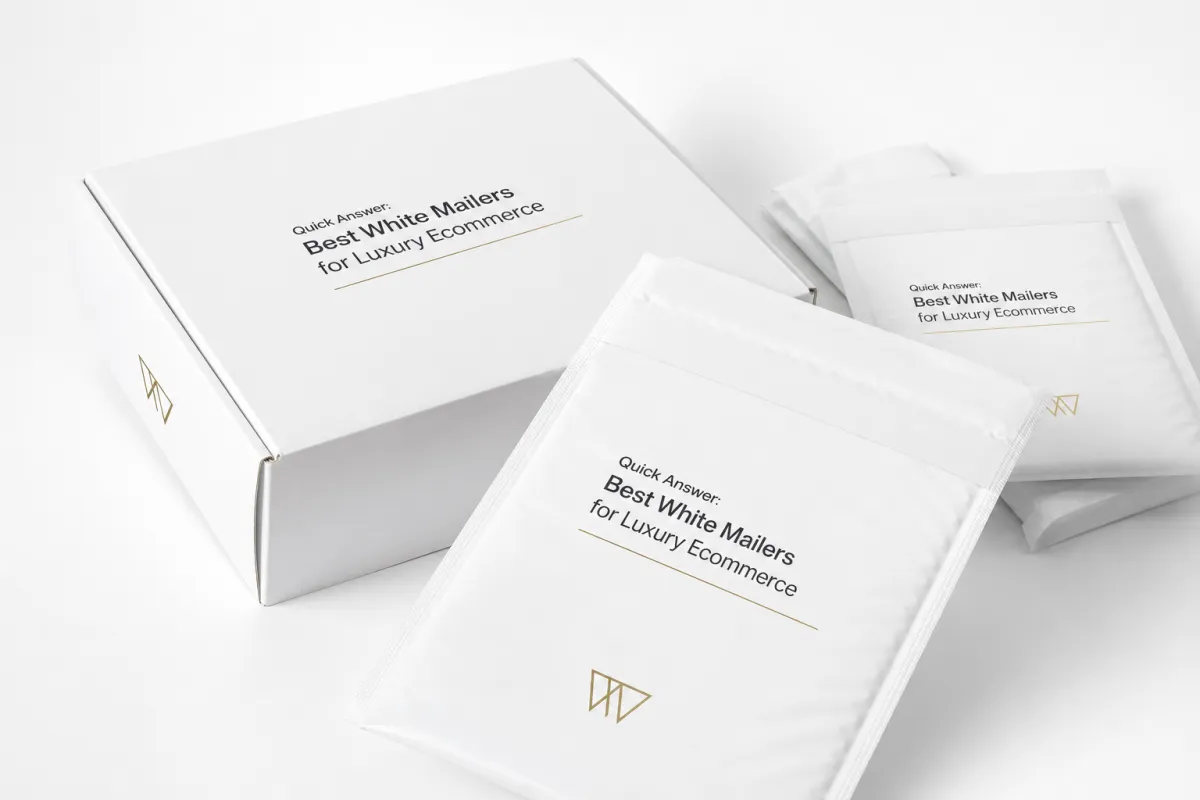
When the brief is simple—upscale shipping, strong first impression, and low failure rate—the safest default is a premium matte White Poly Mailer in the 60-80 micron range for apparel, accessories, and lightweight gift sets. It photographs with less glare, resists scuffing better than most glossy films, and usually holds a cleaner print edge than lower-grade white stock. If shipment weight and product rigidity rise, a reinforced glossy white mailer or thicker high-rigidity film usually keeps shape better in transit and feels more deliberate in hand.
The verdict is practical, not absolute. Shipment mix changes the answer. A fragrance order with a rigid insert wants crush resistance first. A cashmere wrap route may survive on lighter construction. A brand packing 400 parcels daily often values pack line speed and seal confidence more than extra visual depth. A returns-heavy operation needs a closure that tolerates second opening without edge shredding and without turning the package into labor.
Use this review lens:
- Durability under drops - does the mailer keep seam and structure after realistic handling?
- Seal strength - does the adhesive strip remain locked in warm, cold, or humid conditions?
- Print quality - does the white stay bright, or does it drift into gray or blue?
- Premium finish - does the surface feel intentional rather than generic?
- Total landed cost - does the unit still look efficient after freight, rework, and waste are included?
A useful benchmark shows itself quickly: convincing white mailers stay flat, resist finger marks, and avoid wrinkling into a tired package after one sorting cycle. That is a basic requirement, yet many entries fail there. Mailers can be technically white and still read as cheap once they hit true courier conditions.
Premium white mailers need to survive a difficult day in courier handling and still read intentionally. If they only look good on a studio table, they are not luxury packaging—they are props.
For brands that want a consistent buyer-facing standard, the best white mailers for luxury ecommerce frequently come down to two families: matte-finish poly for the best balance of photography and durability, or glossy reinforced stock for a stronger, sharper premium look. Both are valid, and the strongest error is treating white as one bucket instead of a material decision. The right choice also supports premium packaging cues that strengthen the brand story before the box is even opened.
Top Options Compared: Performance Criteria for Luxury Ecommerce
Comparing the best white mailers for luxury ecommerce requires looking beneath the color. White is only the canvas. Weight in micron, seal width, fold memory, print consistency, and handling behavior after repeated motion are what really decide the winner.
For luxury ecommerce, I compare five tiers: standard white, heavy-duty white, low-gloss premium white, self-seal reinforced, and anti-static coated variants. The anti-static version is niche, yet it matters for accessories with static sensitivity, electronics-adjacent gifts, or metal-heavy SKUs where internal handling conditions can affect appearance and user confidence.
| Tier | Best For | Typical Build | Strength Profile | Typical Landed Cost at 5,000 Units | Premium Look |
|---|---|---|---|---|---|
| Standard white poly | Light apparel, slim accessories | 50-60 micron, basic peel-and-seal | Moderate puncture resistance, acceptable for low-risk SKUs | $0.10-$0.18 | Fair |
| Heavy-duty white | Multiple garments, boxed items, busy returns | 70-90 micron, wider seal strip | Better burst resistance and seam confidence | $0.18-$0.30 | Good |
| Low-gloss premium white | Luxury fashion, soft goods, beauty kits | 60-80 micron, matte or satin surface | Balanced puncture and better scuff control | $0.22-$0.38 | Very good |
| Self-seal reinforced | Returns-heavy brands, mixed parcel sizes | 80-100 micron, double-adhesive or tamper strip | Strong closure reliability, less edge failure | $0.28-$0.45 | Very good |
| Paper-feel white composite | Gifting, premium presentation, sustainability-led brands | Paper-laminate hybrid, often FSC-aligned stock | Strong brand feel, moderate moisture resistance | $0.35-$0.70 | Excellent |
The best white mailers for luxury ecommerce are not always the thickest profile. Thickness helps until it starts to hurt logistics. Too much mass can make the package bulky, awkward to fold, and expensive to freight. A 90 micron mailer with a reliable seal and stable surface can beat a thicker variant that fails consistency in actual use. Packaging that is hard to pack is usually expensive twice: once on the purchase order, then again on the line.
Print behavior changes ranking faster than people expect. Cheaper white films often appear clean in daylight, then shift under softbox or ring light. Logos lose definition, and foil accents can flatten if the base white adds a blue tint or too much glare. A luxury operation needs a white close to photographic paper: neutral, stable, and capable of holding fine line work without visual noise. That is especially true for fashion ecommerce, where the packaging becomes part of the visual identity.
Supplier claims on performance should come with context. If durability is promised, verify whether testing follows a discipline like ISTA drop and vibration logic or another recognized transit method. Sustainability claims in paper-based hybrid options demand similar rigor—ask for chain-of-custody language from FSC and avoid vague green-only copy. Pretty language is cheap; test data is not.
Heat-affected closure behavior often gets ignored until invoices arrive. Some seals that pass a room-temperature peel test fail quickly in hot warehouses or humid loading docks. That is why any best white mailers for luxury ecommerce shortlist has to include handling tests in the actual environment where the product ships from, not only in a sample room. If your team packs in a warm mezzanine in July, that environment belongs in the test plan.
In practice, the best white mailers for luxury ecommerce also protect an unboxing language. Fold memory, soft crinkle, scuff pickup speed, and appearance after being packed inside delivery sacks all determine whether the premium story holds after handling. One rough cycle is enough to downgrade a package from premium to ordinary. That is why the material conversation matters so much.
Detailed Reviews of Top White Mailers for Luxury Ecommerce
Here is the practical review layer for the best white mailers for luxury ecommerce. This is not a ranking by vibe alone. I test for perfume, skincare, accessories, and apparel against four criteria: protection, print sharpness, seal consistency, and how the package performs in front of a camera. That blend is closer to how premium brands actually sell.
Economy white poly mailer
This is the baseline category, and it has legitimate use. Low-fragility apparel, socks, lightweight scarves, and straightforward accessory orders can work inside economy white poly without harming brand standards—if expectations are set properly. The trade-off is narrow: 50-60 micron stock, basic peel strip, and a finish that can read flat or overly synthetic under hard light.
My call: practical for price-sensitive lines, not the top choice for luxury ecommerce. It fits when the brand ecosystem already carries most of the visual weight and the shipper needs low front-end spend. A thin print layer or blue-toned white can quickly shift a premium label into the ordinary category, so this is usually entry material, not final. If the brand is aspiring to luxury rather than living there, this tier can feel kind of half-finished.
Score: Protection 6/10, print quality 6/10, premium feel 5/10, cost 9/10.
Premium matte-white poly mailer
This option returns often for fashion and accessories teams. Matte texture cuts glare and lets logos remain readable in mobile imagery, while the package looks less like commodity mail than glossy stock. Fingerprint tolerance is stronger, and tiny handling marks disappear better. That is often more valuable than people admit, because a clean look survives shipping stress better than any launch hero shot.
Build quality generally sits in the 60-80 micron range, with some suppliers offering thicker, more structured versions. Better constructions include a clean seal strip, consistent white tone, and enough opacity to block shape visibility from the inside. Opacity protects privacy and preserves the premium impression of the outer face. It also helps when products are photographed by customers in bright rooms, which is where a lot of premium perception is won or lost.
My call: the most reliable default within the best white mailers for luxury ecommerce family when balancing brand appearance with protection. This remains a strong fit for DTC fashion, beauty tools, and gift-ready accessories.
Score: Protection 8/10, print quality 9/10, premium feel 9/10, cost 7/10.
Glossy white mailer
Glossy white speaks in a different voice. It reads bright and intentional, with a polished tone that can look deliberate in overhead shots and premium social imagery. Scuff visibility, however, becomes more pronounced. Bright surfaces reveal wear faster when parcels rub, especially in mixed loads and conveyor motion.
Packaging teams often use glossy white when the business wants sharper visual output without moving to rigid cartons. It fits lightweight gifting, promotional drops, and products whose first-touch aesthetics matter more than exceptional compressive strength.
My call: strong for presentation, weaker for rough courier environments. In the best white mailers for luxury ecommerce set, glossy is the right option when visual impact clearly outranks anti-scuff performance. If your customers mainly share the package before opening it, gloss can be a smart move. If the shipment is going through a few rough hubs, I would think twice.
Score: Protection 7/10, print quality 8/10, premium feel 8/10, cost 7/10.
Reinforced white mailer with wider gusset
This is the dependable option for heavier loads and mixed parcels. A wider gusset gives extra room for folded garments, small boxed items, and mixed-content orders. Reinforcement improves shape retention when loads stack unevenly, reducing seam stress and minimizing bulges that make expensive orders look rushed.
Returns-heavy brands usually get the most value from this build. A wide seal and controlled corner strength reduce edge failures after first opening. In that use case, the best white mailers for luxury ecommerce are often selected by their logistics behavior first, aesthetics second. That sounds unglamorous, but it is how costs get controlled without sacrificing the premium look.
My call: ideal for high-volume premium operations handling heavier SKUs, return cycles, or fluctuating parcel sizes.
Score: Protection 9/10, print quality 8/10, premium feel 8/10, cost 6/10.
Paper-feel recyclable white composite
Demand for this category keeps rising because it adds a tactile cue that feels less polymer and more editorial. Sustainability-led brands using a premium gifting language find this format especially compelling. Monochrome logos and restrained typography often look best here, while light diffusion creates a softer, controlled photograph.
The category is inconsistent across vendors. Certain composites perform well in moisture and transit, while others hold a beautiful handfeel that weakens after warehouse motion. I would never endorse one without confirming seam integrity and moisture tolerance in real movement tests. The strongest entrants in best white mailers for luxury ecommerce pair tactile finish with measurable durability, not marketing sentiment. If a supplier cannot answer how the seal behaves after compression, keep walking.
My call: excellent when the narrative and route are controlled and supplier quality can stay tight. It is visually strong, but it demands more pre-launch scrutiny than standard poly.
Score: Protection 7/10, print quality 9/10, premium feel 10/10, cost 6/10.
False economy warning: a low unit price can hide bigger costs. Saving $0.06 per order is meaningless if damage, rewrap labor, or complaint handling rise. On a 10,000-order run, only 1.5% extra problem shipments can erase that saving before the margin review even ends. That is the sort of math that looks neat on a spreadsheet and ugly in the warehouse.
That is why the best white mailers for luxury ecommerce are not necessarily the thickest or the shiniest. They are the ones reducing friction at every touchpoint: picking, packing, movement, and unboxing. A mailer that appears premium yet slows packing by three seconds per order can cost far more than it appears. At 600 orders a day, three seconds is a visible hit to throughput. Over time, the difference shows up in labor, customer sentiment, and the quality of the luxury shipping experience.
Process & Timeline: From Sample to Full Rollout
Treat buying the best white mailers for luxury ecommerce as a short production project, not a decorative decision. The common failure is approving a sample that looks clean under controlled light and then discovering failed seals, muddy print, or line-speed drag at launch. A disciplined sequence reduces late surprises and unplanned rework.
- Write the requirement list. Capture product weight, target finish, print coverage, sealing method, return-use expectations, and sustainability requirements.
- Order samples across more than one material family. Evaluate matte poly, glossy poly, reinforced stock, and paper-feel composite as a side-by-side set.
- Run a stress test. Drop the packed mailer, flex the seams, and verify whether the seal opens or corners split under pressure.
- Test under realistic light conditions. Use warehouse light, phone light, and softbox or studio lighting to check white tone behavior.
- Pilot a small batch. Move the shortlisted option into live orders and monitor handling damage, packing speed, and feedback data.
- Scale only after repeatability is proven. The final production spec must perform consistently across two sample rounds before full release.
A realistic timeline can be structured like this: 2-4 business days to define requirements and finalize proof specs, 3-7 days for first samples depending on location and complexity, and 7-14 days for the first production batch at moderate volumes. Custom print adds proof cycles, and artwork corrections extend planning.
The clock stretches if unusual white tones, foil accents, or specialized closures are required. Rushing this stage often causes MOQ waste and avoids accountability. Buying time for proofing and validation usually saves money, because correcting 5,000 units that are visually off is far costlier than two extra days in planning. Brands hate delays, sure, but they hate reorders more.
Warehouse flow cannot be ignored. A difficult peel strip or awkward stiffness can reduce packer speed and increase training requirements, especially for teams shipping 500-800 parcels a day. Staff instructions for opening, sealing, and folding behavior should be built into rollout. Unseen friction here quickly turns into visible operating cost.
For a serious launch, tie the process to a recognized shipping discipline. That means using drop, compression, and transport testing logic as part of regular supplier checks. The goal is a package that behaves like shipping packaging instead of a concept prop. That is the gap between the best white mailers for luxury ecommerce on paper and the ones that actually perform.
Price Comparison: Landed Cost of Best White Mailers for Luxury Ecommerce
Quoted unit cost is the easiest number to communicate and one of the easiest to misread. Freight, setup fees, waste, storage, and first-batch mistakes usually determine true cost. The best white mailers for luxury ecommerce should always be judged by landed cost per order, not just invoice sticker price.
These are the core levers:
- Tooling or setup - expect one-time charges for custom formats and special print prep.
- Print complexity - one-color marks are cheaper than heavy coverage, foil, or precision registration.
- Material weight - stronger or reinforced stock raises raw material and freight spend.
- MOQ - smaller quantities typically carry higher per-unit rates.
- Shipping and storage - bulky, rigid-feel mailers generally cost more in movement and handling.
- Waste - failed proofs and rework can multiply your starting numbers quickly.
A practical model at 5,000 units often looks like: standard white poly $0.10-$0.18, premium matte white $0.22-$0.38, glossy white $0.20-$0.36, reinforced white $0.28-$0.45, and paper-feel composite $0.35-$0.70. Exact values still move with artwork, dimensions, and route-to-route freight.
Cost per order is the right yardstick, especially after accounting for issue reduction. A premium mailer may cost $0.12 extra but lower handling claims, prevent return friction, and reduce rebagging. The gap can disappear quickly and often flips in favor of the higher ticket option over one quarter. That is the part that rarely makes it into the first quote comparison.
Hidden cost flags show up later. Rush production can add a surcharge with little warning. Heavier glossy laminates may increase freight more than expected. A proof that misses white balance or logo opacity can force another sample cycle. Inconsistent dimensional tolerance from a supplier creates operational sorting costs that surpass unit-price savings. A cheap mailer that confuses packers is not cheap for long.
In many operations, the best white mailers for luxury ecommerce become the lowest-cost option after considering reduced damage, better customer satisfaction, and fewer replacement shipments. Unit pricing rises, service total falls, and margin behavior becomes more predictable over the quarter. The biggest surprise is that premium mailers can reduce hidden labor spend enough to beat basic stock on total cost.
| Mailer Type | Estimated Unit Cost | Freight Sensitivity | Return Handling Impact | Value Read |
|---|---|---|---|---|
| Standard white poly | $0.10-$0.18 | Low | Modest | Best for tight budgets |
| Premium matte white | $0.22-$0.38 | Moderate | Strong | Best balance for most luxury brands |
| Glossy white | $0.20-$0.36 | Moderate | Moderate | Best for visual impact |
| Reinforced white | $0.28-$0.45 | Moderate to high | Very strong | Best for heavy or variable orders |
| Paper-feel composite | $0.35-$0.70 | High | Strong | Best for premium storytelling |
That table captures why best white mailers for luxury ecommerce is a framework, not a product label. The cheapest option can be correct for one brand and a costly mistake for another. Minimal-brand stories and low-risk products may justify basic mailers; anything designed to feel special generally pays for a premium tier through better retention and stronger customer perception.
How to Choose the Best White Mailers for Luxury Ecommerce
One practical weighting model for these decisions: 40% customer perception, 35% protection performance, 25% margin impact. That split is a working baseline, then adapt it to your order profile and risk tolerance.
Start with product type. Perfume, skincare, and glass-adjacent goods need caution around wall behavior and seal confidence. Apparel tolerates lighter build when folded well and protected by an insert. Jewelry and compact accessories usually prioritize presentation and closure accuracy more than brute-force strength. In short, the best white mailers for luxury ecommerce should follow product behavior, not mood-board language.
Match build to courier profile next. Long-haul routes and rough network handling increase the value of thicker film and wider seals. Controlled short routes can work with cleaner matte options when visual tone is the main objective. Ask not only whether the mailer looks right, but what your shipping lane will do to it over time. If your parcels spend a lot of time in van transfers and hub sorting, the package needs more backbone.
Supplier agility can matter more than print depth. Seasonal spikes need short reprint windows and realistic MOQ flexibility. Some suppliers optimize only for one large run; others handle frequent changes well. If demand is still volatile, flexible reorders can outperform lower unit price at launch scale.
The decision logic That Actually Works:
- Low fragility + high dispatch speed - select matte-white or premium matte-gloss hybrid stock.
- High returns + premium gifting - use reinforced white with wider seal and higher closure confidence.
- Visual-first positioning + light products - choose glossy white or a carefully printed paper-feel composite.
- Mixed SKUs + repeated handling - keep a heavier reinforced white that preserves shape across cycles.
White is never neutral in practice. Tone, surface texture, and contrast change typography tone and brand voice. A warm white feels softer and cosmetic. A cooler white reads sharper and more architectural. The strongest best white mailers for luxury ecommerce decisions treat these differences as strategic, not accidental. That is the sort of detail customers may not name, but they absolutely feel.
Before signing off on supplier selection, request three samples: plain white, printed sample, and a pilot batch with final artwork. Evaluate all three under the exact light used for product photography. The gap between a desk-clean sample and a photo-light sample is where many packaging decisions fail. If you need to explain why a proof looks different in a studio versus a warehouse, the spec is not done yet.
Our Recommendation and Action Plan for Luxury Ecommerce Buyers
If asked to assign confidence levels for the best white mailers for luxury ecommerce by use case, I separate outcomes into three bands. One-size guidance creates expensive mistakes for mixed product portfolios.
Top default: premium matte-white poly mailer. The strongest balance for most luxury ecommerce brands. It photographs well, hides marks better than expected, and preserves a polished identity without driving major freight or seal risk. Apparel, accessories, and lightweight gift sets usually start here.
Value-first option: standard or heavy-duty white poly, depending on weight profile. This route works for teams with tighter margins and lower SKU risk. A cleaner print and reliable seal can still protect the unboxing standard. The constraint is avoiding ultra-thin stock that becomes brittle or translucent under stress.
Performance-first option: reinforced white or paper-feel composite. Use these for difficult SKUs, heavy return cycles, or brands where unboxing itself carries marketing value. If social sharing is central to the product narrative, this is usually the better bet and often worth the added cost.
Use this 30-day plan to keep execution practical:
- Days 1-5: lock the spec: size, micron range, finish, print coverage, and seal type.
- Days 6-12: run four sample variants across matte, glossy, reinforced, and paper-feel formats.
- Days 13-18: complete handling tests using real products, real packers, and real shipping labels.
- Days 19-24: pilot the final two options on top-tier orders, capture feedback data, and monitor damage.
- Day 25 onward: finalize the winner, pre-approve backup artwork, and keep a second qualified supplier in reserve.
Defining best performance means mapping expected damage, social unboxing tone, and CAC pressure against each mailer profile. If damage rates are already controlled and brand image is central, premium tiers usually clear the hurdle. If margins are compressed and packaging is not the hero asset, a middle tier may be the better fit. At that point, the best white mailers for luxury ecommerce become an economic call, not merely an aesthetic one.
My close is practical: pick two candidates, run a side-by-side courier drop test, approve the final print proof before lock-in, and confirm backup sourcing before full scale. This avoids two common mistakes—a beautiful mailer that performs poorly in transit and a functional mailer that never supports premium positioning. It is not glamorous, but it works.
For luxury ecommerce, the best white mailers for luxury ecommerce are the ones that preserve brand equity under stress. If the package stays composed after transit, the brand promise remains intact. If it breaks down in motion, the savings were never real. Choose the mailer that can survive the route your customers actually live on, not the one that only wins the sample table.
FAQ
How do I find the best white mailers for luxury ecommerce without overbuying samples?
Order a controlled sample set across multiple material families, then run them against real products. Evaluate closure strength, seal behavior, and print clarity using courier simulation plus the same lighting setup used for your official photography. A scorecard with minimum pass thresholds prevents emotional decisions. Most buyers do best with one premium choice and one backup, which cuts waste while preserving launch quality. This is how the best white mailers for luxury ecommerce are separated from options that only appear strong in a sample kit.
What timeline should I expect when ordering best white mailers for luxury ecommerce in small batches?
Plan for roughly 2-4 weeks from first sample request to launch when artwork is mostly ready. Proofing, feedback, minor corrections, and a focused pilot batch normally sit inside that window. Slow sample arrivals often shift the schedule, so start preflight checks early and remove artwork as a bottleneck before it grows. A second supplier in reserve helps when production or courier timing slips. That is when the best white mailers for luxury ecommerce become valuable in real terms: they have to arrive in time for launch, not just match a sample.
Are matte or glossy white mailers better for premium fashion ecommerce?
Matte white usually holds color and contrast more consistently, and it suppresses glare in product imagery for social and lifestyle assets. Glossy white can create a jewel-like, highly polished look, though it exposes scuffs faster. If frequent phone content and clean feed imagery are part of the strategy, matte tends to be the safer production choice. If a brand wants a more formal, gift-focused visual with higher shine, glossy can still deliver. The strongest selection among the best white mailers for luxury ecommerce reflects whether subtlety or visual statement has priority.
Can best white mailers for luxury ecommerce reduce returns from poor first impression?
They can reduce friction, especially where first-touch confidence is part of the buying equation. A premium outer layer with reliable closure and a consistent insert strategy can improve complaint tone and initial user trust. Mailer upgrades alone do not fix weak product quality, thin cushioning, or poor inserts. Track complaint logs by mailer type for at least 30 days before deciding whether any upgrade produces a durable return-rate impact.
How should I compare price differences between luxury white poly mailers and standard options?
Use landed cost per order as your baseline. Include unit price, shipping and freight surcharges, setup, storage overhead, and waste from failed prints or sample rejections. Add rewrap labor and replacement shipping if lower-tier options increase claims. A higher unit-cost mailer can become the lower total-cost solution once operational losses are counted. This is why the best white mailers for luxury ecommerce often appear pricier on paper while actually protecting margin in real operations.