Buyer Fit Snapshot
| Best fit | Biodegradable Mailers for Small Business projects where brand print, material claims, artwork control, MOQ, and repeat-order consistency need to be specified before quoting. |
|---|---|
| Quote inputs | Share finished size, material target, print colors, finish, packing count, annual reorder estimate, ship-to region, and any compliance wording. |
| Proofing check | Approve dieline scale, logo placement, barcode or warning zones, color tolerance, closure strength, and carton packing before bulk production. |
| Main risk | Vague material claims, crowded artwork, missing packing details, or unclear freight terms can make a low unit price expensive after revisions. |
Fast answer: Biodegradable Mailers for Small Business: Production Spec, Color Control, and Delivery Risk should be specified like a repeatable production item. The safest quote records material, print method, finish, artwork proof, packing count, and reorder notes in one written spec.
Production checks before approval
Compare the actual filled-product size with the drawing, then confirm tolerance on folds, seals, hang holes, label areas, and retail display edges. Reserve space for logos, QR codes, warning copy, and material claims before decorative graphics fill the panel.
Quote comparison points
Review material grade, print process, finish, sampling route, tooling charges, carton quantity, and freight assumptions side by side. A quote is only useful when the supplier can repeat the same color, closure quality, and packing count on the next order.
A small brand can cut visible plastic, keep shipping weight in check, and still make the unboxing feel intentional with biodegradable Mailers for Small business. The catch is that the material claim, seal strength, and order size have to match the shipment. A polished mailer that splits at a corner or leaves a customer guessing about disposal kind of defeats the point.
Biodegradable Mailers for Small business deserve a practical review, not a label scan. Apparel, accessories, beauty products, and other light goods usually need Packaging That Stays slim enough to control postage, strong enough to survive carrier handling, and clear enough that the buyer knows what to do after opening the parcel.
Used carefully, biodegradable mailers for small business can support trust, reduce excess plastic, and simplify fulfillment while fitting into a broader sustainable packaging plan. Chosen badly, they can trigger damage claims, returns, and customer service headaches that cost more than the packaging ever saved. I have seen that happen with a boutique apparel client: the mailer looked great on a sample table, then the first rainy transit week exposed weak seams and a lot of unhappy emails.
Biodegradable Mailers for Small Business: What They Really Mean
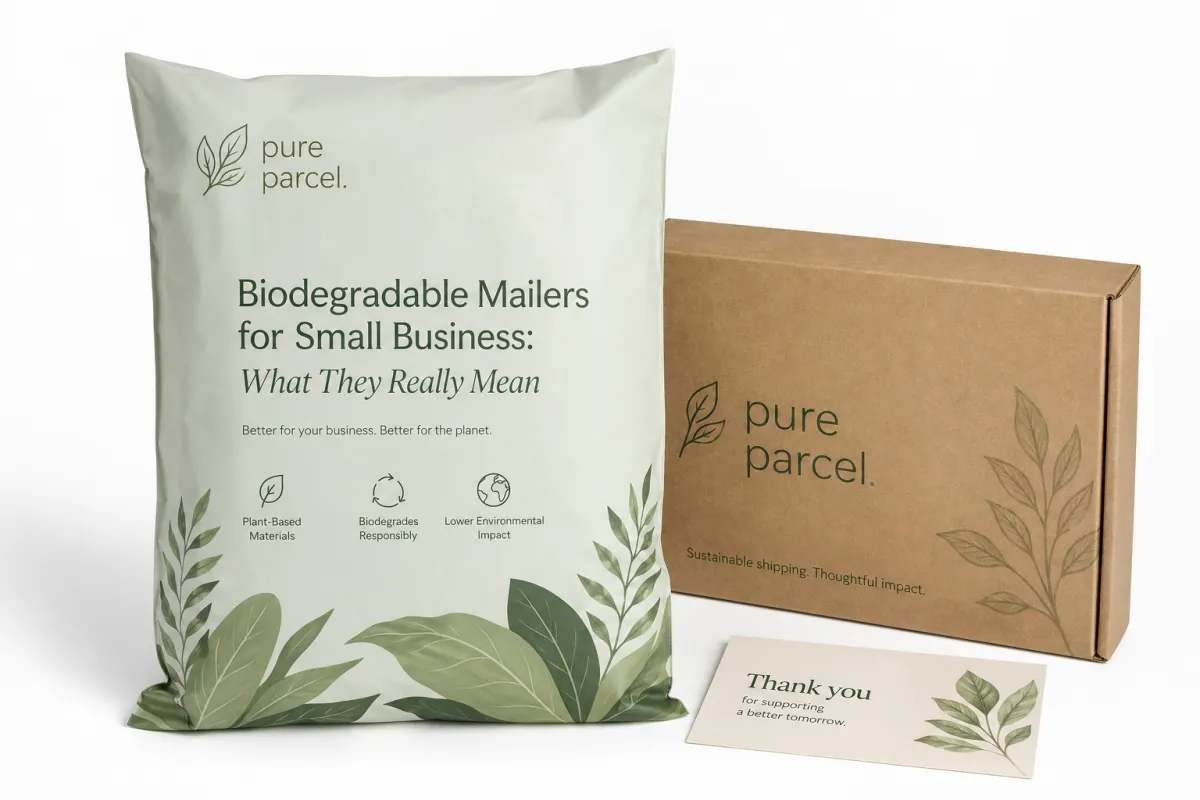
Biodegradable mailers for small business are made with materials that can break down into simpler compounds over time, but the speed and completeness of that process depend on the environment. Oxygen, moisture, microbes, temperature, and time all shape the outcome. Marketing copy often skips that part. A mailer can be biodegradable in theory and still sit almost unchanged in a landfill, where the conditions for decomposition are poor. For a small brand, that distinction matters because the claim only matters if it reflects real-world disposal.
Picture a boutique clothing shop sending folded tees, a beauty brand mailing sachets, or a jewelry seller shipping small accessories. In each case, biodegradable mailers for small business can do three jobs at once: protect the item, keep the parcel looking tidy, and signal a lower-plastic packaging choice. The tradeoff is simple. No sustainability claim can fix a bad fit. If the mailer is oversized, the product shifts around. If it is too thin, a seam fails. If the disposal story is unclear, the customer is left to guess.
Biodegradable sounds final, but it is really a description of a process, not a promise about where or how quickly the breakdown happens. Some mailers are built for industrial composting. Some are blended with conventional polymers. Some rely on additives that encourage fragmentation under specific conditions, which is not the same thing as disappearing cleanly into soil or a backyard bin. Biodegradable mailers for small business should be judged the way any protective package is judged: by the product, the route, the shelf life, and the customer experience together.
A mailer only earns its keep if it survives the trip and gives the customer a clear end-of-life path. Leave out either piece and the sustainability story gets weaker, not stronger.
From a packaging buyer's point of view, the decision is not only environmental. Biodegradable mailers for small business also shape the unboxing feel, the pace of warehouse work, and the shipping math. A cleaner exterior can make a modest order feel more considered. A lighter structure can lower total weight. A dependable seal keeps packing teams from adding extra tape to every parcel. Those are ordinary wins, and ordinary wins are often the ones that actually matter.
How Do Biodegradable Mailers for Small Business Work?
Most biodegradable mailers for small business use a film structure rather than a single raw material. The outer layer usually handles printability, surface finish, and basic puncture resistance. The inner layer or sealing layer helps the mailer close securely. Some designs blend materials so the mailer keeps its strength in transit while still supporting eventual breakdown under the right disposal conditions. Thickness matters here. A light apparel mailer may work in the 1.5 to 2.5 mil range, while heavier shipments or rougher routes often need a thicker build to stand up to conveyor handling, sorting bins, and parcel compression.
Performance in transit comes down to a few practical tests: tear resistance, puncture resistance, seal strength, and moisture protection. A mailer that passes one and fails the others is not much help. If the seam opens, the product escapes. If the outer film is too soft, sharp corners punch through. If humidity weakens the material, warehouse storage becomes a problem long before the parcel reaches the carrier network. Biodegradable mailers for small business need to satisfy all four conditions at once, because customers judge the package by arrival, not by a spec sheet.
The labels can blur together, so the distinctions help. Biodegradable means a material can break down through biological action over time. Compostable is narrower and should tie to a recognized standard, such as ASTM D6400 or EN 13432, with breakdown expected under specific composting conditions. Recyclable means the material can be collected and reprocessed through an existing recycling stream, which is a separate system entirely. A mailer can be biodegradable and still not be recyclable. It can be compostable and still require industrial composting rather than backyard bins. That is why biodegradable mailers for small business should never be bought on the claim alone.
If you want a reality check, the EPA has public guidance on composting and material handling at epa.gov, and ISTA explains packaging testing logic at ista.org. Those references are not there for decoration. They matter because package claims should survive contact with shipping conditions. For paper-faced or fiber-heavy options, FSC certification can also matter, but it only tells you the fiber came from responsibly managed forests; it does not by itself make a mailer biodegradable.
In practice, biodegradable mailers for small business work best when the supplier can show actual test data instead of a glossy product page. Ask about seal integrity, film gauge, storage limits, and the disposal conditions the product was designed for. If the supplier cannot explain the end-of-life path in plain terms, the mailer may still be usable, but the claim deserves skepticism.
Biodegradable Mailers for Small Business: Cost, Pricing, and Value
Price matters, but unit price alone can fool you. A cheaper mailer can become expensive if it tears in transit, forces a larger outer carton, or pushes postage into the next weight or dimensional tier. Biodegradable mailers for small business should be judged by total landed cost: the unit price, freight, damage rate, storage impact, and any extra packing labor. A mailer that costs a few cents more yet reduces damage and saves tape can win easily on the spreadsheet.
Several things move the price. Size is the first one. Bigger mailers use more material and often need wider seals. Thickness comes next, because thicker films consume more resin and usually cost more to produce. Print coverage matters too; a single-color logo is not the same as full-bleed artwork. Certification requirements can add cost, especially if you want compostability documentation or third-party verification. Minimum order quantities matter as well, because small orders usually carry a higher per-unit price. Freight can be surprisingly important too, especially if you are shipping a heavy carton of mailers across long distances.
| Option | Typical Unit Price | Best For | Main Tradeoff |
|---|---|---|---|
| Stock biodegradable mailers | $0.10-$0.20 each at 1,000-5,000 units | Fast restocks, low-volume sellers, simple SKUs | Less branding control and fewer size choices |
| Custom-printed biodegradable mailers | $0.18-$0.38 each at 5,000 units and up | Brands that want a polished unboxing experience | Higher MOQ and longer lead time |
| Certified compostable mailers | $0.24-$0.45 each depending on spec and testing | Brands that need stronger disposal messaging | Certification paperwork and stricter disposal conditions |
| Paper-based mailer alternatives | $0.12-$0.30 each | Light goods, fiber-forward packaging strategies | Different protection profile and moisture behavior |
Those ranges are not universal quotes, but they are close enough to guide a buyer. For biodegradable mailers for small business, the real question is whether the added spend produces better outcomes: fewer returns, a cleaner brand impression, easier disposal instructions, and a lower chance of product damage. A mailer that saves three cents but causes a 2% return rate is not a bargain.
There is a point where stock is the smarter move. If your business ships only a handful of common sizes, does not need custom print, and wants to test adoption before committing, stock biodegradable mailers for small business are usually the lowest-risk starting point. If you are building a more polished brand system, custom print can still make sense, especially when packaging is one of the few physical touchpoints your customer sees. For a broader packaging reset, it can help to compare options inside Custom Packaging Products and then look at Custom Poly Mailers as a reference point if you are balancing branding against budget and other shipping supplies.
Here is the cleanest way to frame value: if the mailer supports a stronger first impression, protects the product, and keeps the shipping math under control, it is earning its place. Biodegradable mailers for small business do not need to be the cheapest packaging on the market. They need to be the cheapest packaging that still does the job properly.
Step-by-Step Guide to Choosing the Right Mailer
The best starting point is the product itself. Measure the item at its widest, thickest, and most fragile points, not just the flat dimensions. A folded hoodie, a boxed serum, and a small accessory may all share a similar shipping weight, yet they behave very differently inside a mailer. Biodegradable mailers for small business should fit the product with enough room for a secure seal, but not so much empty space that the item slides around and bangs into the seams.
Shipping channel comes next. Postal systems, parcel carriers, and fulfillment centers each impose different demands. Some need stronger seals. Some are harsher on corners and edges. Some are unforgiving about dimensional weight, which means a slightly oversized mailer can push the shipment into a pricier bracket. If your team ships through multiple channels, the mailer needs to handle the toughest route, not the easiest one.
Then test the real product, not a sample sitting alone on a desk. A sample can look perfect until you insert the actual item, close the flap, and send it through handling. Check for rubbing, corner stress, seal failure, scuffing, and how the package feels when the customer opens it. Biodegradable mailers for small business are supposed to make operations easier, so a trial order should reveal where the friction lives before you commit to a larger run.
Measure, match, and verify
- Measure the product at its thickest point and note any sharp edges, boxes, or fragile surfaces.
- Choose a mailer size that allows a clean seal without excess empty space.
- Ask for material data on thickness, seal performance, and moisture resistance.
- Run live tests with the actual packed item, not just a dummy sample.
- Compare postage before and after, because size changes often affect the shipping rate.
A simple decision path keeps the process from getting tangled. Identify the top priority: lower waste, better branding, stronger protection, or lower total cost. Shortlist two or three biodegradable mailers for small business that fit the shipment. Request samples and compare them against the real product. Review pricing at multiple volume tiers. Place a pilot order before you scale up. That sequence sounds basic, yet it saves buyers from the mistakes that matter most.
One detail gets missed more often than it should: if you are already using custom inserts, tissue, or branded labels, the mailer does not have to carry the entire brand story by itself. Biodegradable mailers for small business can work alongside a simple insert or a printed thank-you card. That often lets a smaller business keep the outer packaging practical while still building a polished, consistent look. If you need a stepping stone rather than a full packaging overhaul, that middle path is usually the smartest one.
Biodegradable Mailers for Small Business: Ordering Process and Timeline
The usual ordering path is straightforward, but each step can add time. It begins with an inquiry and a quote, then sample review, then artwork proofing if the mailer is custom printed, then production, quality check, and freight transit. Biodegradable mailers for small business often move faster when you buy stock sizes, because the supplier can pull from existing inventory. Custom-printed runs usually take longer because the artwork, plate setup, and print schedule all have to line up.
For stock mailers, a realistic timeline can be as short as a few business days to ship if inventory is available and the freight lane is simple. For custom-printed biodegradable mailers for small business, a more typical window is 12-20 business days after proof approval, and sometimes longer if the supplier is busy or the size is unusual. Special colors, a custom seal, or a very specific thickness can add time. Freight itself can also add several days, especially if the order crosses regions or moves by less-than-truckload shipment.
Small businesses often underestimate how much calendar time gets swallowed by approval cycles. One owner wants to see the first proof. Another wants to compare the artwork against the current label system. A third person asks for a second sample because the first one looked too glossy or too matte. None of that is wrong. It just means biodegradable mailers for small business should be ordered with a buffer, not on the edge of a launch date.
Seasonal demand makes that buffer even more useful. If a sale event, subscription drop, or holiday rush is coming, build safety stock into the plan. The most comfortable place to stand is usually a little earlier than you think. A late reorder is far more expensive than a well-timed one, especially if your packaging ties into customer expectations and fulfillment deadlines. That is also the point where a reliable supplier conversation matters more than a one-line price quote.
For teams that reorder often, keep a simple internal spec sheet: size, thickness, color, print placement, seal style, and approved supplier notes. That file cuts down on guesswork the next time you buy biodegradable mailers for small business. It also keeps the team from accidentally switching to a cheaper option that does not match the first order.
Common Mistakes When Buying Biodegradable Mailers
The first mistake is assuming every biodegradable claim means the same thing. It does not. One supplier may be describing a material that breaks down in industrial composting only, while another may be using a broader marketing term without a clear standard behind it. Biodegradable mailers for small business should come with a plain explanation of the disposal conditions, the certification status if any, and the exact material composition. If the supplier is vague, that is a warning sign.
The second mistake is buying the thinnest option simply because it is cheaper. That is how brands end up with torn seams, crushed product corners, and repeat replacements. A mailer that saves a fraction of a cent but creates damage is the wrong kind of saving. Biodegradable mailers for small business need enough structure to protect what is inside, especially if the parcel moves through multi-stop carrier handling or a fulfillment center with fast-paced sorting.
The third mistake is ignoring storage conditions. Heat, humidity, and long warehouse dwell times can affect seal performance and material integrity. That does not mean the package is fragile in a dramatic sense, but it does mean you should ask how the mailer behaves in storage and how long the supplier recommends keeping it before use. If your stockroom gets warm in summer or your goods sit for months before shipping, those details matter.
The fourth mistake is forgetting customer instructions. If the mailer needs industrial composting, tell the customer clearly. If it should not go into curbside recycling, say that too. A package cannot carry the disposal burden alone. Biodegradable mailers for small business work best when the end-of-life message is short, accurate, and visible. The customer should not have to hunt through your website for an answer after opening the order.
- Do not buy on the claim alone. Ask for the standard, the test method, and the disposal path.
- Do not skip samples. Real transit can expose weak seams and poor moisture behavior.
- Do not under-spec thickness. The cheapest film can become the most expensive choice.
- Do not leave customers guessing. Disposal instructions should be simple and visible.
There is also a quieter mistake that shows up in growing brands: inconsistent reorders. One month the team buys a slightly different size because the original was out of stock. The next month they change the print placement. Before long, the shipping line has three versions of a package and no clear standard. Biodegradable mailers for small business work better when the company treats them like part of a repeatable system instead of a one-off purchase.
Expert Tips and Next Steps for Small Businesses
If you want to make a smart decision without overbuying, start with a short checklist. Confirm the material claim. Compare sample performance. Review price at a few volume tiers. Verify the disposal story. Check storage guidance. That sounds simple, and it is, but simple is usually what keeps packaging decisions grounded. Biodegradable mailers for small business do not need a long theory lesson; they need a reliable buying process.
I also recommend a small test program before a full rollout. Track damage rates, shipping costs, seal performance, and customer feedback for one or two product categories. After 100 to 300 shipments, you will know far more than a sample packet can tell you. If the mailer performs well, expand it. If the damage rate creeps up or postage gets worse, adjust the size or thickness before ordering again. That kind of measured testing is usually the most practical way to judge biodegradable mailers for small business.
For the team handling fulfillment, create one packaging standard and keep it visible. List the approved mailer sizes, the reorder point, the storage notes, and the supplier contact. A single standard reduces errors and speeds up training. It also makes it easier to compare a future quote against the current setup, which helps prevent random changes that quietly add cost. If your brand has multiple product lines, that standard can sit beside other approved formats from Custom Packaging Products so the whole operation stays consistent.
Here is the practical takeaway: the best biodegradable mailers for small business are the ones that align product fit, shipping demands, disposal clarity, and budget. Keep those four pieces in balance and you are much more likely to land on a mailer that helps the brand instead of complicating it. Request samples, ask for spec sheets, compare landed cost, and choose the option your team can reorder confidently without second-guessing every shipment.
Frequently Asked Questions
Are biodegradable mailers for small business the same as compostable mailers?
No, those claims are not interchangeable. Compostable products should meet a defined standard and break down under specific composting conditions, while biodegradable claims can be broader and less specific. Ask for certification details and disposal instructions before you buy biodegradable mailers for small business.
How do I know which size biodegradable mailer my products need?
Measure the product at its widest and thickest points, not just the flat dimensions. Leave enough room for a secure seal without forcing the item into the mailer. Test with the actual packaged item so you can check fit, stress points, and postage impact before ordering at scale.
Do biodegradable mailers hold up in rain or rough shipping conditions?
Some do, but performance depends on the exact material blend and thickness. Look for tear resistance, seal strength, and moisture protection in the supplier spec sheet. If your products ship through harsh routes, request samples and stress test them before you commit to a packaging line.
Are custom printed biodegradable mailers worth the extra cost?
They can be if packaging plays a visible role in branding or repeat purchases. The added cost is easier to justify when the print is simple, the order quantity is steady, and the mailer becomes part of a polished unboxing experience. If volume is low, start with stock mailers and add branded inserts first before upgrading to printed mailers.
What should I ask a supplier before ordering biodegradable mailers for small business?
Ask for the material composition, certification documents, minimum order quantity, lead time, and sample availability. Request pricing at a few volume tiers so you can compare unit cost and landed cost. Confirm storage guidance and disposal instructions so your team can communicate clearly to customers. Once those pieces line up, biodegradable mailers for small business become a repeatable packaging choice instead of a guess.
