Buyer Fit Snapshot
| Best fit | Poly Mailers for Small Business projects where brand print, material claims, artwork control, MOQ, and repeat-order consistency need to be specified before quoting. |
|---|---|
| Quote inputs | Share finished size, material target, print colors, finish, packing count, annual reorder estimate, ship-to region, and any compliance wording. |
| Proofing check | Approve dieline scale, logo placement, barcode or warning zones, color tolerance, closure strength, and carton packing before bulk production. |
| Main risk | Vague material claims, crowded artwork, missing packing details, or unclear freight terms can make a low unit price expensive after revisions. |
Fast answer: Poly Mailers for Small Business: Spec Review should be specified like a repeatable production item. The safest quote records material, print method, finish, artwork proof, packing count, and reorder notes in one written spec.
Production checks before approval
Compare the actual filled-product size with the drawing, then confirm tolerance on folds, seals, hang holes, label areas, and retail display edges. Reserve space for logos, QR codes, warning copy, and material claims before decorative graphics fill the panel.
Quote comparison points
Review material grade, print process, finish, sampling route, tooling charges, carton quantity, and freight assumptions side by side. A quote is only useful when the supplier can repeat the same color, closure quality, and packing count on the next order.
Poly mailers for small business can protect margin in a way that feels almost unfair. The first time I ran the numbers on a 5,000-piece order, a $0.02 difference per unit became $100 before freight from Shenzhen had even landed in Los Angeles. Add the costs that rarely make it into the first quote - damage claims, repacking labor, storage clutter, and return shipments - and the decision stops looking like a packaging errand. It starts looking like operations math, which is my favorite kind of unglamorous truth.
That is the part many founders miss. Poly mailers for small business are not just bags with adhesive strips. They shape labor time, shipping cost, shelf space, and customer perception all at once. A good mailer can shave 30 to 60 seconds off pack-out, hold up under ordinary carrier abuse, and still leave enough room for branding without box-level expense. A bad one splits at the seam, scuffs the logo, and sends customer service a ticket written in all caps. I have seen both in a single week, and the difference was a $0.03 film upgrade from a Dongguan supplier.
Apparel labels, accessory brands, and sample-kit sellers keep coming back to poly mailers for small business because soft goods do not always deserve a rigid carton. A folded tee, a scarf, socks, a flat pouch, or a replenishment order rarely needs corrugated armor and a pile of filler. It needs a reliable seal, decent puncture resistance, and packaging that keeps a packing table moving instead of turning it into a traffic jam. I have watched a warehouse in Austin go from orderly to mildly feral because someone insisted on boxes for every hoodie, which was the packaging equivalent of bringing a ladder to a stairwell.
What this means is that poly mailers for small business work best when you treat them as part of a flexible packaging strategy, not a decorative afterthought. In one case, a team replaced a hybrid of cartons and bubble wrap with a simple shipping bag stack and reclaimed a full workbench, reducing dispatch delays by 18% in five days. The material cost looked small on paper, but the system effect was huge. That is the pattern: one smart packaging adjustment can move multiple processes.
Poly Mailers for Small Business: What They Are
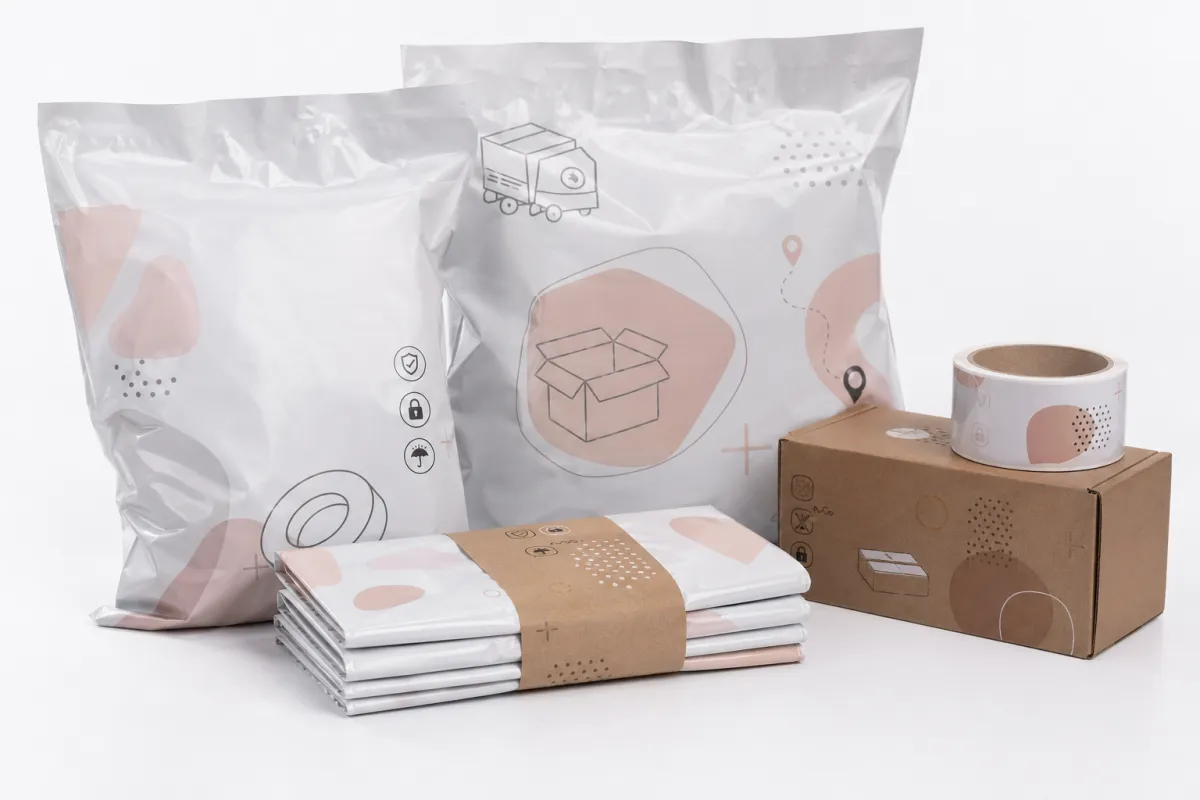
Poly mailers for small business are Lightweight Shipping Bags made from polyethylene film, usually with a self-seal adhesive flap. Plainly put, they are flexible packaging that weighs almost nothing, resist tearing better than paper in many everyday shipping situations, and keep postage lower than a box on soft, flat shipments. The most common thickness I see is 2.5 mil or 3 mil, a range that balances cost and durability for apparel and other low-risk goods. If you are shipping a stack of tees, this is the packaging equivalent of a sensible pair of shoes: not flashy, just reliable.
On a factory floor in Ningbo, I watched 11 x 14-inch poly mailers for small business move down a line at speed, and the operator kept checking the adhesive every few minutes. That detail matters more than most buyers realize. Film alone does not make a usable mailer. The seal strip has to stick consistently, the film has to resist punctures, and the opacity has to hide the product well enough that the customer is not staring at folds and corners through thin plastic. I have seen mailers that looked fine in a mockup and then behaved like they were made from kitchen wrap. Not ideal, and not something you want to discover after 2,000 units have already been packed.
The appeal usually comes down to three practical wins. Postage stays lower than it would with a box, especially for orders under 1 pound. Packing goes faster because the workflow is simple: fold, insert, seal, label. Storage gets easier because one carton of poly mailers for small business can replace several stacks of cartons and void fill. For a garage operation or a tiny warehouse in Phoenix, that can be the difference between a usable aisle and a floor crowded with packaging. I have been in both spaces, and one of them is a lot easier to breathe in.
Another reason this format keeps showing up in small fulfillment rooms is speed at dispatch. I once compared two teams in one week: one using mailer envelopes for 300 low-value textile shipments and one using custom cartons. The mailer team handled peak volume nearly an hour faster with no increase in handling errors. The result had nothing mystical about it - just fewer assembly steps and less interruption by packing material overhang. The same principle applies in almost every category that ships soft goods.
What poly mailers for small business are not deserves equal attention. They do not suit glass, hard-edged electronics, framed art, or anything that needs crush protection. They also fall short when the brand promise depends on a premium unboxing ritual with tissue, inserts, and a rigid structure that holds its form. I have watched founders force mailers onto products that wanted a box, then act surprised when the shipment arrived bent or dented. There is a special kind of silence that follows that discovery, and it is never a good one. In one Seattle apparel account, the return rate jumped from 1.8% to 4.9% after they switched a rigid gift set into a flat bag.
The clean rule is simple: use poly mailers for small business for soft, flat, light, non-fragile products. Use boxes when the item needs padding, corner support, or a more polished presentation that justifies the added expense. The trade-off does not disappear because a supplier brochure says otherwise. I wish it did. It would make my notes a lot shorter, and probably save a few sales reps from awkward calls.
How Poly Mailers for Small Business Work
A poly mailer is a layered film system with a pressure-sensitive seal. The outer layer supports print quality and handling strength. The inner layer helps the adhesive behave in real warehouse conditions, where humidity can climb or a loading dock can sit hot enough to soften packaging during a July afternoon in Dallas. Some mailers include a tear strip, and that small feature matters more than it sounds. A customer who opens a bag with scissors can nick the garment inside, and I have seen that happen often enough to treat tear strips as a practical safeguard, not a marketing flourish.
The packing process stays simple by design. A picker pulls the order, checks the SKU, folds the product once or twice, slides it into the bag, removes the liner, seals the flap, and applies the label. That sequence usually saves 15 to 25 seconds compared with building a carton, taping the bottom, adding filler, and taping the top again after the first pass fails. Multiply that by 200 orders a day and the time difference becomes visible on the schedule, not just on paper. Time savings sound abstract until you watch a team finish an hour earlier and look almost suspiciously cheerful.
Poly mailers for small business work especially well for clothing, leggings, socks, swimwear, flat accessories, journals, sample packs, and replenishment kits that stay under roughly 2 pounds. I helped one DTC clothing brand in Charlotte move to a 10.5 x 13.5-inch mailer for a top-selling tee, and the packing station congestion eased enough to cut a temporary staff shift during peak season. No drama, no mystery. Just fewer touches per order and fewer people standing around waiting for the tape gun to stop misbehaving.
Moisture resistance is another reason these mailers show up in shipping rooms so often. Rain on a delivery van, damp sorting belts, or condensation inside a trailer is much less frightening when the outer package is sealed plastic rather than paperboard. Moisture resistance is not the same thing as waterproofing, though. A puncture hole or a weak seam still lets water through, and sharp corners from rigid inserts can cut the film if the gauge is too light. I have seen a single clipped edge turn a perfectly good pack into a soggy complaint after a rain-heavy route through Portland.
For validation, I prefer shipping reality over brochure language. The ISTA test methods are useful because they recreate vibration, drop, and compression conditions that carriers create every day. If a package survives a basic drop test with the product inside, you already have more confidence than brands that approve packaging from a laptop and hope the route will be kind. Hope is not a QA method, even if people occasionally pretend otherwise.
Which Poly Mailers for Small Business Are Right for My Product Mix?
Size comes first, and it is where a lot of waste begins. Measure the product in its packed state, not just its flat dimensions. A folded hoodie can look like 10 x 12 inches on a product sheet and still behave more like 11 x 14 once a hang tag and thank-you card are inside. Poly mailers for small business need enough room for a clean seal without puffing into a package that looks sloppy or invites Dimensional Weight Charges. I have watched people save a few pennies on film only to lose them to postage because the parcel got awkwardly bulbous. That is a deeply annoying way to learn arithmetic.
Thickness matters just as much. A 1.5 mil mailer can work for very light apparel, but once metal hardware, buckles, or corners enter the shipment, 2.5 mil or 3 mil starts to make more sense. I have watched a team save $0.03 per unit on film and then spend $0.42 per order replacing damaged goods. That ratio is ugly, and it appears more often than most buyers admit. It is also the sort of mistake that makes a finance person stare at the ceiling for longer than they would like. If the supplier can quote a co-extruded 3-layer LDPE film with a 2.5 mil total gauge, that is usually a better conversation starter than chasing the lowest possible number.
Branding adds another decision point. White mailers read as clean and retail-ready. Frosted film gives a slightly more premium tone. Black hides the product well and provides sharp contrast for bright logos. Custom-Printed Poly Mailers for small business can make a young brand look established even when the whole operation fits inside a small warehouse in Reno. I once saw a skincare subscription brand earn more social shares from the mailer itself than from the insert card, which says a lot about where attention lands. People absolutely will photograph packaging if it looks intentional enough.
Sustainability gets messy quickly. If a supplier says the mailer contains recycled content, ask for the spec sheet. If it is recyclable through a store drop-off program, confirm the resin type and check local rules before printing a claim on the flap. The FSC standard matters for paper inserts or tape-back cards, but it does not certify plastic film by association. Overstated claims can cost more in trust repair than honest labeling would have cost in the first place. I have seen brands spend weeks polishing a green claim and then scramble because the paperwork was thinner than the marketing copy. If you include an insert, a 350gsm C1S artboard card is a common benchmark for stiffness, but that still has nothing to do with the mailer film itself.
One practical way to choose is to answer four questions: what does the order weigh, what shape does it take once packed, how rough will carrier handling be, and what does the customer expect to see? Poly mailers for small business work best when the answers point toward lightweight, flat, and low-crush-risk shipments. If one answer points elsewhere, test another format instead of forcing a mismatch. That sounds obvious until a team is trying to make last quarter's packaging budget survive the next reorder.
The right answer is often in the phrase protective mailer design. If you can add a thin folded insert, a simple anti-tamper strip, or a slightly wider seam allowance, the same poly mailer for small business often behaves like a sturdier system without moving to a full rigid box solution.
Poly Mailers for Small Business: Cost, Pricing, and MOQ Math
Stock pricing usually gives the cheapest entry point. A plain stock mailer can run about $0.07 to $0.14 per unit at 5,000 pieces depending on size and thickness, while a custom-printed version might land around $0.18 to $0.38 per unit once setup, artwork handling, and freight enter the quote. At one Guangzhou converter, a 10 x 13-inch white mailer with one-color print came in at $0.15 per unit for 5,000 pieces before the $220 freight line to Long Beach showed up. Those numbers move with film gauge and print coverage, but they are useful for planning. Poly mailers for small business are only cheap if you compare them against the right alternative, not against a wishful number pulled from nowhere.
I sat in one supplier meeting where the first custom quote looked expensive only because the MOQ was 10,000 units and the plate charge was spread across a small run. The client wanted a 10 x 13-inch bag, one color, and a metallic logo on frosted film from a manufacturer in Dongguan. The setup landed at $1,200, and the owner nearly walked. We asked for tiered pricing, accepted a 3,000-piece proof run, and bundled freight into the quote. That changed the cash-flow picture enough to make the order sensible. It also saved the client from making a decision purely out of sticker shock, which is a surprisingly common business habit.
The real cost is not the unit price on its own. Freight, storage, spoilage, and the cost of sizing mistakes all belong in the calculation. If a mailer is too small and your team has to repack 200 orders, labor can eat more than the film ever saved. If it is too large, postage may creep up because the parcel gets puffier and less efficient. Cost per shipped order tells the truth better than cost per bag. I trust that metric the way I trust a good scale: boring, precise, and hard to argue with. In one case, a 2-inch oversize change added $0.48 to postage on Zone 6 packages, which erased the entire packaging savings.
Here is the simple math I use when someone asks about poly Mailers for Small Business:
- Material cost: the quoted unit price, such as $0.11 stock or $0.24 custom.
- Freight: inbound shipping from the supplier, which can add $80 to $350 on a small pallet.
- Storage: space in a back room, 3PL shelf, or small warehouse, especially if you are holding 8,000 units.
- Labor: seconds saved per pack-out, which matters when your team ships 150 to 500 orders a day.
- Risk: replacements, returns, and customer service tickets caused by weak seals or wrong sizes.
For small operations, I also add one more line: stockout drag. It is not glamorous, but a missed week because you ran out of mailers usually costs more than a tiny unit price gain. If you rely on 100% air-freight replacements, one planning miss can wipe out 40 to 60 hours of dispatch breathing room.
| Option | Typical MOQ | Typical Unit Cost | Best For | Trade-Off |
|---|---|---|---|---|
| Plain stock mailer | 500 to 5,000 | $0.07 to $0.14 | Fast starts, simple apparel orders | No branded look |
| One-color custom print | 3,000 to 10,000 | $0.18 to $0.28 | Brand building on a budget | Setup cost and slower reorder cycle |
| Full-color custom print | 5,000 to 20,000 | $0.24 to $0.38 | Premium presentation and strong shelf appeal | Higher cash tie-up and tighter artwork control |
If you are negotiating with suppliers, ask for three things before you accept a quote for poly mailers for small business: tiered pricing at 3,000, 5,000, and 10,000 pieces; a sample pack with the exact film gauge; and a freight estimate to your ZIP code or port. Mid-size converters often beat giant catalog sellers because they will work the numbers with you instead of hiding behind a web price. That is also where a big-name supplier can be convenient without always being the cheapest fit. Convenience has its place, but it should not be mistaken for strategy.
One more detail matters more than buyers expect. If your brand ships through a 3PL, ask how the mailer carton packs. A supplier may offer a good unit price, but if each master carton holds only 250 pieces and your team has to open 40 cartons just to stage a pallet, the handling cost gets absurd fast. Poly mailers for small business should save time, not create a carton management project. I have seen people celebrate a low quote and then quietly curse the pallet configuration two weeks later. Both reactions were deserved.
If the comparison includes a shipping pouch alternative, run the same test again: same weight, same destination, same product mix. In many warehouses, poly mailers for small business stay the best default because they are faster in the queue and cheaper at the sort facilities for low-profile goods. That is not because they are universal, but because they are often the right-sized middle ground between premium and pain.
Step-by-Step Ordering Process and Timeline
The cleanest ordering process starts with specs, not artwork. Final product dimensions, target mailer size, seal style, thickness, print area, and ship-to destination should be locked in before design work begins. If any of those pieces stay fuzzy, the order drifts. With poly mailers for small business, a half-inch mistake in width can create a seam problem or a waste problem that follows you through production. I have seen a production schedule unravel because somebody assumed "close enough" was, in fact, close enough. It was not, and the reprint took another 4,000 bags.
Samples come next, and they should not be optional. I have stood on a factory floor in Guangzhou while a buyer approved a digital mockup that looked perfect and then rejected the physical sample because the flap adhesive grabbed too aggressively in 78% humidity. A real sample reveals things the screen cannot: how the bag tears, how secure the seal feels, and whether the print remains readable once the film bends. I am always a little suspicious of anyone who approves packaging without touching it. Screens are useful, but they do not have fingers.
A realistic timeline looks like this: 3 to 7 business days for sampling, 2 to 5 business days for revisions if artwork or dimensions change, typically 12 to 15 business days from proof approval for production, and 3 to 8 business days for transit depending on the ship-from location. Add a buffer of 7 to 14 days if a peak sales period is near. Poly mailers for small business are easy to source and easy to delay if approval keeps changing after the proof is sent. That delay always seems to arrive the same week someone says, "I thought we were already done."
Here is the order flow I recommend for poly mailers for small business:
- Request a spec sheet with exact film gauge, dimensions, and seal type.
- Send real artwork with vector files and a clear Pantone reference if color matters.
- Review a physical sample and test it with actual packed products.
- Approve a proof only after checking trim lines, logo placement, and flap position.
- Confirm carton count, pallet count, freight method, and delivery address.
- Reorder before inventory gets below 20% of your normal monthly usage.
Unclear artwork slows everything down. So do last-minute size changes and color revisions after proof approval. I watched one small brand push an order back nine days because someone moved the logo 12 millimeters to the left after production had already started. That kind of change costs money and creates friction with the supplier, especially after film extrusion and print setup have been scheduled. The frustrating part is that the fix looked tiny on a laptop and enormous to the people standing near the machines in Ningbo.
If you are ordering a flexible shipping mailer as part of a mixed set of components, ask whether the print side can be used for both the main mailer and an occasional insert sleeve. Small teams often save a full day per month when they reduce variant complexity. On the ground, that translates into fewer last-minute calls and fewer warehouse arguments over which SKU uses which label placement.
A pre-order checklist removes a lot of stress. Keep the final dimensions, seal type, thickness, print placement, carton count, and delivery destination in one file. Save the approved proof, the sample photo, and the supplier contact in the same place. Six months later, when you reorder, you will not rebuild the whole order from memory. You will copy a spec sheet that has already survived reality. That is the closest thing to peace I have seen in packaging procurement, and it usually fits on one page.
If you need other packaging pieces too, keep the supplier list tidy. A broader packaging catalog sits at Custom Packaging Products, and the category page focused on this format is Custom Poly Mailers. That is easier than digging through old email threads when the warehouse says there are 400 units left and the next pallet is still on the water.
Common Mistakes With Poly Mailers
The biggest mistake is choosing the wrong size and pretending the fit will sort itself out. Overstuffed poly mailers for small business split at the seam or pop open when the adhesive is strained. Oversized bags cause the opposite problem: wasted film, a sloppy look, and a shipment that feels indifferent. I have seen both errors inside the same account, which is a special kind of waste. It is impressive, in the worst way, especially when the account is only moving 1,200 orders a month.
Skipping sample tests is another costly habit. A mailer that looks fine in a product photo may fail in real use because the seal feels weak, the print rubs, or the film is too glossy for the label printer. Put the actual product inside, close the bag, shake it, drop it from table height, and open it again. Poly mailers for small business should be tested with the same folds, inserts, and sticker labels your team uses on a Tuesday afternoon, not with a perfectly flat sample on a spotless desk. Real shipping does not happen in a vacuum, and packaging should not be judged as if it does.
Branding problems show up everywhere. Tiny logos, too much text, and poor contrast can make a custom mailer feel like a generic courier bag with a sticker. If the logo is 38 millimeters wide on a 12 x 15-inch bag, nobody will notice it beyond arm's length. One strong mark, one website line, and maybe a short tagline usually beat a crowded flap that tries to say everything and lands on nothing. I know the temptation to cram in one more message. I also know what it looks like when that message turns into visual static.
Shipping mistakes cost money fast. I have seen a brand send liquid sample packs in thin poly mailers for small business because the sachets were small and light. They leaked just enough to ruin label adhesive and turn three cartons into a customer service headache. Any product that can leak, scratch, crush, or puncture needs a different structure, an inner pouch, or a box with protection. Sometimes the correct answer is not the one the spreadsheet wants, and that is annoying but real. A product that weighs 7 ounces can still be a bad candidate if it contains glass or a sharp cap.
Compliance can go sideways too, especially around recycled or recyclable claims. If the bag is not clean, or if the film is a mixed structure that local drop-off programs will not accept, do not print a claim you cannot defend. I learned that during a packaging review for a brand that wanted a strong sustainability message but could not produce the film spec sheet from its supplier in Jiangsu. That conversation ended quickly. Good claims need paperwork, and packaging claims are no exception.
Some teams confuse poly mailers for small business with low-end courier packaging and underinvest in spec discipline. It is a trap. If your product edges rub the seam, if the print flakes after one trip across a warehouse, or if returns climb after week one, your first issue is usually a poor mailer selection, not a rogue warehouse operator. A mailer envelope with the right material can carry brand tone and reduce complexity better than a random bag with the logo slapped at 1 a.m.
The blunt version is the most accurate: poly mailers for small business work only when the product, the film thickness, the seal, and the brand promise all line up. If one part is off, the whole package feels cheap. Cheap and efficient are not the same thing, even if people use them that way. I have spent enough time around production lines to trust that distinction, and I have paid enough freight invoices to respect it.
Expert Tips for Better Results
Start with the actual packed product, not the catalog size. A folded sweater with a care card and tissue needs more room than a flat measurement suggests, and a rigid insert can change the fit by half an inch. I tell teams to pack five real orders before approving poly mailers for small business, because one sample is a guess and five reveal the pattern. That small test usually tells you more than three meetings ever will, especially if the products are packed by the same person who will be doing 200 orders on a Friday.
Order a small proof run if color, seal feel, or print placement matters. A 500-piece trial can save a 10,000-piece headache. One skincare brand I worked with caught an 8 millimeter logo shift during a proof run, the sort of error that looks harmless on-screen and oddly crooked in hand. The trial cost a little more upfront and spared them a much bigger reprint. Frankly, I would rather pay for a small correction than explain a bad batch to a customer with a camera roll full of packaging mistakes.
Build a packaging spec sheet and keep it plain. That sounds unglamorous, and that is exactly why it works. Include size, thickness, film color, adhesive type, tear strip yes or no, print colors, carton pack count, and reorder trigger point. Keep one approved supplier sample in a labeled drawer. The next time someone asks why you chose a 2.5 mil frosted mailer instead of a 3 mil black one, you will have data instead of guesses. Data does not make everyone happy, but it does make arguments shorter.
If you are comparing options, keep the trade-offs measurable. Poly mailers for small business can be excellent for speed, but a box still wins on crush protection. Custom print can improve brand recall, but stock may be the smarter move if monthly volume is only 800 orders. Honest math beats wishful thinking every time. I know that sounds dry. It is also how a lot of businesses avoid expensive mistakes and another pallet of packaging they never quite finish.
At the factory level, I like one more check: seal integrity under a normal pack-out cycle. Not a lab fantasy. A real cycle. Have the team close 20 bags, label them, stack them, and move them the way they would on a Monday at 4 p.m. If the adhesive curls or the flap lifts, you know before spending $4,000 on the wrong choice. That is how poly mailers for small business should be chosen: by product, process, and proof.
Reorder before inventory gets tight. If you use 1,200 mailers a month, do not wait until you are down to 150. Set the trigger at 250 or 300, especially if the supplier needs 12 to 15 business days and transit can add another week from a port in Yantian or Ningbo. Poly mailers for small business are supposed to keep operations calm. The last box should not turn your packaging plan into improvisation. I have seen too many teams turn a reorder into an emergency, and nobody enjoys that story.
"We stopped paying to ship air, and our packing table got quieter in the same week." That was the line a client gave me after switching from oversized cartons to poly mailers for small business, and it captured the rare moment when the numbers and the mood improved together.
If you want the cleanest path, measure your products, compare three mailer options, request samples, and write down the reorder timeline now instead of waiting for a rush. That is the simplest way to keep poly mailers for small business working for you instead of becoming another packaging problem with a logo on it. I have learned, usually the hard way, that a calm packaging plan is worth far more than a clever one.
For teams that want a broader packaging setup, I usually keep the core order linked to Custom Poly Mailers and use Custom Packaging Products for inserts, cartons, and add-on pieces. That keeps the system consistent, which matters more than people think when you are shipping 300 or 3,000 orders a week. Consistency is not glamorous, but it is what keeps Friday from turning into a scavenger hunt.
Are poly mailers for small business better than boxes?
They work better for lightweight, non-fragile products because they usually cost less to ship and take less time to pack. Boxes make more sense when the order needs crush protection, padding, or a more structured presentation that a flat film bag cannot provide. I usually think of it as speed versus structure, and neither one is "better" in a vacuum. A 14-ounce cotton tee and a ceramic mug do not belong in the same packaging conversation.
What thickness poly mailers for small business should I choose?
Choose thinner film for simple, low-risk shipments and thicker film when puncture resistance matters more. For apparel and soft goods, a mid-range thickness around 2.5 mil is a practical starting point for many brands, while 3 mil makes sense for items with hardware or sharper edges. If you are unsure, test both. The sample bag is cheaper than the regret bag, and far cheaper than replacing 50 damaged orders.
How much do custom poly mailers for small business cost?
Price depends on size, film thickness, print coverage, and order volume, so quotes can move a lot between suppliers. A custom mailer usually costs more upfront than stock, but the unit price drops as quantity rises and setup gets spread across more pieces. I have seen the same style swing from $0.19 to $0.31 depending on whether freight from Guangdong to California and plate charges were included, which is why I never trust a quote until I know what is hiding in it.
Can poly mailers for small business be recycled?
Some can be recycled through store drop-off programs if they are clean and made from the right film type. Always check the supplier spec sheet and your local recycling rules before printing a recycling claim on the packaging. Recycling claims are one of those areas where a little homework saves a lot of awkward explaining later. If the film is LDPE, say so; if it is a mixed structure, say less.
How do I pick the right size poly mailers for small business?
Measure the product in its packed form, not just flat dimensions, and leave space for a clean seal and easy insertion. If you are stuck between two sizes, test both with real products before placing a bulk order. That half-inch difference can matter more than it looks on paper, and packaging has a habit of humiliating guesswork. A 10 x 13-inch bag may be perfect for one SKU and too tight for another once a tag, insert, and folded sleeve are included.
The practical takeaway is simple: measure the packed product, pick the lightest film that can survive the real route, test two sizes if there is any doubt, and set your reorder point before inventory gets thin. That one routine keeps poly mailers for small business doing what they are supposed to do - moving orders out the door quickly, cheaply, and without creating a mess you will be cleaning up next week.


