Buyer Fit Snapshot
| Best fit | Custom Folding Carton Minimum Order Quantity projects where brand print, material claims, artwork control, MOQ, and repeat-order consistency need to be specified before quoting. |
|---|---|
| Quote inputs | Share finished size, material target, print colors, finish, packing count, annual reorder estimate, ship-to region, and any compliance wording. |
| Proofing check | Approve dieline scale, logo placement, barcode or warning zones, color tolerance, closure strength, and carton packing before bulk production. |
| Main risk | Vague material claims, crowded artwork, missing packing details, or unclear freight terms can make a low unit price expensive after revisions. |
Fast answer: Custom Folding Carton Minimum Order Quantity: Structure, Print Proof, Packing, and Reorder Risk should be specified like a repeatable production item. The safest quote records material, print method, finish, artwork proof, packing count, and reorder notes in one written spec.
Production checks before approval
Compare the actual filled-product size with the drawing, then confirm tolerance on folds, seals, hang holes, label areas, and retail display edges. Reserve space for logos, QR codes, warning copy, and material claims before decorative graphics fill the panel.
Quote comparison points
Review material grade, print process, finish, sampling route, tooling charges, carton quantity, and freight assumptions side by side. A quote is only useful when the supplier can repeat the same color, closure quality, and packing count on the next order.
For a lot of buyers, Custom Folding Carton minimum order quantity sounds like a brick wall. It does not have to be. I have seen launch teams delay packaging decisions for weeks because they assumed the minimum would be far higher than it really was. Once the spec gets grounded in actual production constraints, the number often becomes more manageable than expected. A clean structure, standard paperboard, and a sensible print plan can bring the custom folding carton minimum order quantity into a range that works for a first commercial run, not just a giant national rollout.
The better question is not whether a supplier can make cartons. The better question is whether the Custom Folding Carton minimum order quantity matches your launch volume, your margin, and your appetite for inventory risk. A limited seasonal food item, a pilot skincare line, or a retail test for a new accessory can all support a smaller opening order if the packaging spec is built around real production conditions instead of wishful thinking. That distinction saves time. It also saves money, which is kinda the point.
Why Custom Folding Carton Minimum Order Quantity Is Often Smaller Than Brands Expect
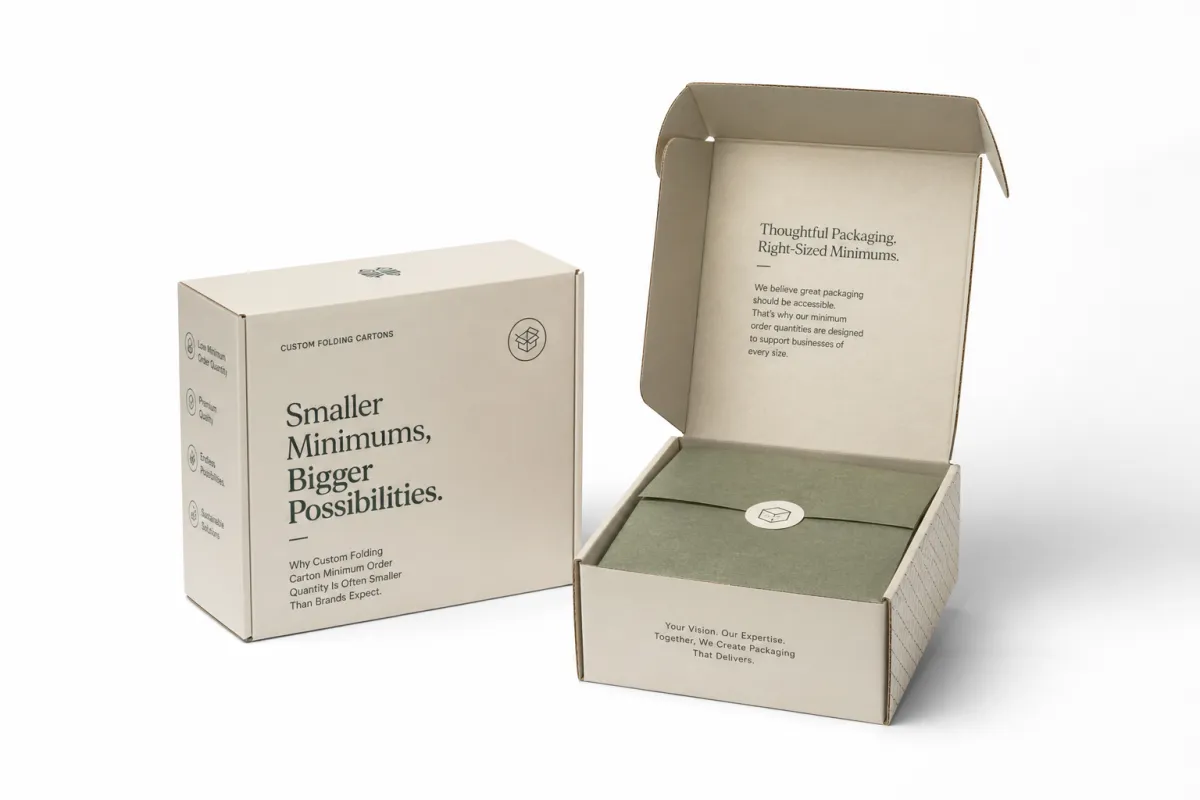
Brands routinely overestimate the hurdle. They picture a factory commitment so large that the whole conversation feels out of reach, then wait until the product is nearly finished before asking about packaging. That delay has a cost. By the time the carton is discussed, the team has usually made assumptions about size, finish, and budget that may not fit the actual press setup. Once the custom folding carton minimum order quantity is discussed early, the carton can be designed around a workable production run instead of an abstract ideal.
MOQ is not just a vendor rule. It reflects setup time, press calibration, sheet yield, trim waste, finishing complexity, and the way cartons nest on the sheet. A straight-tuck carton on standard SBS board may support a much lower custom folding carton minimum order quantity than a design with foil, embossing, a window patch, and an insert. The equipment does not care about branding language. It cares about throughput, spoilage, and repeatability.
That distinction matters in real launches. A skincare startup may only need enough custom printed boxes for an ecommerce push and a few boutique retail placements. A food brand may want a short-run seasonal carton to test sell-through before placing a larger inventory order. An electronics accessory line may need branded packaging that looks premium without trapping working capital in cartons that will sit in storage for months. In each case, the custom folding carton minimum order quantity becomes a business decision rather than a procurement footnote.
“The cheapest packaging is not always the lowest-risk packaging. If you overbuy cartons for a launch that is still being tested, a packaging win can turn into a cash-flow problem fast.”
Timing has its own price. Wait too long to ask about the custom folding carton minimum order quantity, and the launch date can slip, especially if the first quote reveals a structural adjustment or a higher-than-expected minimum. Miss that window and the budget starts absorbing rushed freight, temporary storage, or a second packaging revision. None of those expenses improve the economics of the product.
One thing I tell teams early is simple: define the first commercial purpose, not the dream version of the box. Is the run a pilot, a seasonal release, or a full retail rollout? That answer changes the custom folding carton minimum order quantity more than almost any other factor. The right quantity protects margin, supports the calendar, and keeps dead inventory out of the warehouse.
If you want a broader view of available formats, start with the Custom Packaging Products page and compare carton structures before asking for pricing. That is usually faster than trying to reverse-engineer the spec after the quote has already come back.
Choose the Right Carton Style, Structure, and Use Case
The carton style you choose has a direct effect on the custom folding carton minimum order quantity. A straight tuck end is usually simpler to produce than a lock-bottom or auto-bottom design. A reverse tuck can suit lighter products well, while a tuck-end with locking features can add security for heavier fills. Specialty inserts raise the bar again because they add assembly steps, handling time, and dimensional checks. Structure shapes cost long before artwork enters the conversation.
Product category changes the equation too. Cosmetics often demand shelf appeal and tight tolerances. Supplements may need more copy space, regulatory clarity, and consistent closure performance. Candles need sturdy carton geometry because glass vessels or fragile finishes can scuff quickly. Food items may bring barrier or compliance considerations depending on the application. The cleaner the match between structure and product, the easier it is to keep the custom folding carton minimum order quantity practical.
For first runs, simpler is often smarter. That sounds less dramatic than a fully custom concept with internal compartments and decorative openings, but those extras rarely pay for themselves on a test launch. A clean, well-proportioned carton can still look polished, support package branding, and print beautifully. That is the real aim. The box should help sell the product without draining the budget before the product has proven itself.
Dimensions add another layer that buyers miss. A carton that fits the product closely can reduce board usage and packing inefficiency. Too much headroom can create rattling, weak shelf presence, and a more expensive unit structure. Too little room can slow line filling or create damage in transit. If the carton size is not thought through carefully, the custom folding carton minimum order quantity may rise because the supplier has to compensate for wasted sheet area or awkward handling.
A practical test helps here: ask whether the carton has to do three jobs at once. If it must protect the item, carry shelf impact, and support efficient fulfillment, the structure needs to be stable and easy to assemble. That usually leads to fewer production surprises and a more manageable custom folding carton minimum order quantity. If the design tries to be clever in every direction, the quote will usually reveal the cost of that ambition.
Brand perception matters, but not every premium effect earns its keep. Retail packaging that feels purposeful does not need every finish on the sample board. Strong die lines, precise folds, and clean typography can carry more weight than a pile of extras. Good packaging design is often restraint with a budget attached. That is a useful reminder for anyone trying to force a lower custom folding carton minimum order quantity out of a concept built for a high-end launch.
Custom Folding Carton Minimum Order Quantity: Specs That Move the Number
Spec choices can move the custom folding carton minimum order quantity more than most buyers realize. Board grade is a good place to start. A standard 14pt or 16pt SBS carton is often easier to quote than a specialty board with an unusual coating or recycled composition. Thickness, caliper, and stiffness all affect die-cut behavior and run efficiency. A carton that looks minor on paper can still force a higher MOQ if it creates frequent machine adjustments or waste.
Print coverage matters as well. Light ink coverage on a white board is generally more efficient than deep solids, heavy reverse type, or dense full-coverage artwork that demands tight color control. Add foil stamping, embossing, debossing, spot UV, or a window patch and the custom folding carton minimum order quantity can climb because each finishing step adds setup time and quality control. None of that is unusual. It is simply the cost of asking the carton to do more work.
Artwork complexity affects speed too. Multi-pass printing, fine registration, and dense special effects can slow the line and increase spoilage risk. If a buyer sends a file with too many tiny elements or inconsistent bleed, the supplier may need longer proofing, more corrections, or a wider production buffer. That can push the custom folding carton minimum order quantity higher than planned because the job needs more margin to stay efficient.
A smart buyer prepares a clear input checklist before requesting a quote:
- Finished carton dimensions
- Product weight and shape
- Board preference or target thickness
- Print coverage level and color count
- Coating or finish preference
- Barcode placement and compliance copy
- Whether a dieline already exists
- Target launch date and quantity tiers
That list is not busywork. It is the fastest route to a useful answer on the custom folding carton minimum order quantity. A vague inquiry usually gets a vague quote. A precise brief gets a realistic one.
If your team is weighing a premium carton against a production-efficient carton, compare the first run with repeat orders. The initial custom folding carton minimum order quantity can be slightly higher because setup costs sit heavily at the start, but later runs are often smoother once the spec is locked. That is one reason buyers should treat the first order as a learning run rather than a final verdict on the cost structure.
For teams concerned about sustainability claims, packaging decisions should align with verified materials and sourcing standards. Organizations such as the FSC provide guidance around responsible fiber sourcing, while the EPA offers practical information on recycling and material management. Those standards do not remove MOQ from the equation, but they do shape material selection and spec tradeoffs.
Repeatability lowers friction too. Once the final carton spec is approved, the next order is often easier to place and easier to forecast. The custom folding carton minimum order quantity feels less intimidating when the supplier already understands the board, finish, and tolerances that work for your product packaging.
How Pricing Works at Different Custom Folding Carton Minimum Order Quantity Levels
Pricing starts with a simple reality: setup costs have to be spread somewhere. On a low-volume order, every carton absorbs more of the fixed cost of plates, cutting, setup, proofing, and press time. As quantity rises, the unit price usually falls. That is why the custom folding carton minimum order quantity matters so much to final unit economics.
The lowest Price Per Unit is not always the smartest buy. A smaller order may cost more on paper, but it can reduce inventory risk, especially for launches that are still being tested. A larger order may look efficient until storage, obsolescence, and cash timing enter the picture. Buyers often focus on the carton price itself and ignore the cost of holding packaging that may not sell through. The right custom folding carton minimum order quantity balances unit cost against commercial reality.
Below is a simplified comparison showing how quantity affects value. Numbers vary by board, coverage, and finish, but the pattern stays the same.
| Quantity Tier | Typical Use Case | Approx. Unit Price | What Usually Changes |
|---|---|---|---|
| 500-1,000 | Pilot run, sample launch, seasonal test | $0.65-$1.20 | Higher setup share, limited finishing, tighter proof control |
| 2,500-5,000 | Small commercial rollout | $0.28-$0.55 | Better sheet efficiency, more finishing options possible |
| 10,000+ | Broader retail or ecommerce scale | $0.18-$0.38 | Lower per-unit setup burden, more favorable press economics |
Those numbers are directional, not universal. A carton with foil or a specialty coating can sit above those ranges. A simpler structure can sit below them. Even so, the logic holds. The custom folding carton minimum order quantity is rarely an arbitrary number. It is the point where setup and production begin to make economic sense for both sides.
There are hidden cost drivers that should never be left out of the comparison:
- Plate or die charges
- Proofing and sample revisions
- Finishing fees for foil, embossing, or coating
- Freight, especially for larger cartons
- Storage if you do not have room for the full shipment
- Rush fees when artwork approval slips
Ask for tiered quotes. A competent supplier should be able to show the pricing at a pilot quantity, a launch quantity, and a scale quantity. That gives the buyer a real picture of the custom folding carton minimum order quantity curve instead of forcing a guess. In practice, that comparison often shows that the best value sits one tier above the quantity the buyer first had in mind.
Shipping cost can distort the economics of small runs as well. A carton with a larger footprint may ship less efficiently than a compact one, even if the board price is similar. That is why smart buyers evaluate total landed cost, not just the base carton price. The custom folding carton minimum order quantity should be judged against the full purchase, including freight and storage, or the numbers tell only half the story.
If your team also buys inserts, labels, or outer shippers, there may be opportunities to coordinate quantities across SKUs. Broader buying programs can help there. For recurring packaging needs, our Wholesale Programs page is a useful place to review how volume planning can support better pricing discipline without overcommitting inventory.
What is the custom folding carton minimum order quantity?
The custom folding carton minimum order quantity is the smallest run a supplier can produce without pricing the job as a one-off sample or a highly inefficient special project. In practice, it sits at the intersection of setup time, board efficiency, die-cutting, and finishing complexity. A simple paperboard carton with standard print may start lower; a folding carton with foil, embossing, or a window patch usually starts higher. The number is less a sales trick than a map of production reality.
That is why two cartons with the same footprint can land in very different quantity tiers. One may be a straightforward folding carton; the other may ask for more proofing, more trimming, and more spoilage tolerance. If you want the shortest answer, the custom folding carton minimum order quantity is the point where the press, the finish, and the economics all agree.
From Quote to Delivery: Process and Timeline
The strongest orders move through a predictable sequence, and the custom folding carton minimum order quantity is only one part of it. The workflow usually starts with an inquiry, then a spec review, then dieline confirmation, proofing, production, finishing, inspection, and shipping. Each step has a failure point. The more complete the initial brief, the fewer steps need to be repeated.
Here is the fast track: send dimensions, product weight, print requirements, finish preferences, and target quantity in one clean package. Missing information is the biggest timeline killer. If the supplier has to chase details, the custom folding carton minimum order quantity discussion slows down too, because the quote cannot be finalized until the production method is clear.
Typical timing depends on complexity. A straightforward straight-tuck carton with standard print and no special finish may move from approved proof to shipment in about 10-15 business days, depending on queue and freight location. Add custom die features, special coatings, or a structural revision, and the window can stretch. That is not a problem by itself. It simply means the custom folding carton minimum order quantity should be evaluated alongside the production calendar, not apart from it.
For launch planning, work backward from the shelf date or ecommerce release date. Sample approval should happen before the final artwork lock if the carton is dimensionally tight or if the product is fragile. Freight booking should happen before the cartons finish if the order is large enough to need coordinated shipping. Buyers who leave those steps until the last minute usually pay more than they expected. The custom folding carton minimum order quantity can be reasonable and still create pressure if the timeline is compressed.
Standards matter here. Packaging buyers who deal with distribution often reference performance testing protocols from bodies such as the ISTA and material expectations from the Packaging Alliance. Those references help frame expectations for transport, handling, and product protection. A carton that looks beautiful but fails in transit is not a win. A carton that survives distribution and prints cleanly is.
One useful way to reduce timeline risk is to split the order into phases. For example, a small proofing quantity can validate size and structure before the full custom folding carton minimum order quantity is released. That approach works especially well for cosmetic launches, premium food items, or any product that needs packaging clearance before a wider rollout. It also gives the team a chance to check the unboxing experience, which is increasingly tied to product packaging perception online.
Remember that production speed is not just about the supplier. It is about how quickly the buyer responds. Every day spent waiting on artwork revisions, missing barcodes, or undecided finish selections adds risk. The most efficient orders are usually the ones where the custom folding carton minimum order quantity, the dieline, and the artwork are all aligned before the purchase order is issued.
Why Buyers Choose Us for Custom Folding Cartons
Buyers usually come back for the same reasons: consistent quality, fast quoting, clear communication, and Packaging That Fits the product instead of forcing the product to fit the packaging. That may sound basic, but basic is where a lot of packaging vendors stumble. The custom folding carton minimum order quantity should not be a mystery. It should be explained with enough detail that a purchasing lead can compare options confidently.
Good service starts with spec discipline. Material sourcing, dieline checks, proof review, and final inspection all matter because errors compound quickly once a launch date is set. A cut line that is off by a few millimeters, a barcode that lands too close to a fold, or a finish that muddies the typography can turn a good concept into a delayed job. Buyers do not pay for drama. They pay for results. A realistic custom folding carton minimum order quantity lowers the odds of expensive correction.
Technical support matters more than people admit. Many teams know what they want the carton to look like, but not what that means in board weight, closure type, or finishing sequence. That is normal. Packaging development is practical work, not a guessing contest. The right conversation helps a buyer decide whether to use 14pt SBS or a heavier stock, whether a matte aqueous coating is enough, and whether the custom folding carton minimum order quantity should be set for a test run or a broader launch.
Another reason buyers value a strong supplier relationship is fewer revisions. Once the carton spec is locked, repeat orders become easier to forecast and easier to manage. The learning curve drops. Lead times stabilize. Cost comparisons get cleaner. That helps branded packaging because marketing and operations can work from the same playbook instead of renegotiating every new run from scratch.
Plain talk about tradeoffs also helps. If a buyer wants foil, embossing, and a small quantity, the answer should include the practical consequence: higher setup, longer proofing, and a likely increase in the custom folding carton minimum order quantity. That honesty is worth more than a flattering promise that cannot be executed on time.
For teams that need a broader view of specs, product categories, and packaging formats, our FAQ page can answer common operational questions before the quoting stage. The goal is not to sell complexity. The goal is to make the right carton easier to buy.
What to Do Next Before You Request a Quote
Before you request a quote, get the basics in order. The best custom folding carton minimum order quantity answer comes from a brief that includes product dimensions, target quantity, carton style, expected finish, and launch timing. If you are still deciding whether the run is a test, a pilot, or a full release, say so. That context matters more than a rough guess.
Have your artwork and copy requirements close at hand. Include barcode placement, regulatory text, and any claims that need to stay visible on the carton. If the packaging design needs to accommodate a legal panel or multilingual copy, that can change the dieline and the usable print area. It can also change the custom folding carton minimum order quantity because the supplier may need to account for additional proofing and layout time.
Request at least two quantity tiers. One should reflect the quantity you think you need. The other should reflect the level where the unit price begins to improve materially. That comparison reveals the tradeoff between inventory risk and cost efficiency. In many cases, the better business decision is not the lowest quantity or the lowest unit price. It is the one that keeps cash available while still producing enough cartons to support the launch. That is the commercial logic behind a smart custom folding carton minimum order quantity.
If the product is fragile, premium, or unusually sized, request a sample or structural proof. That single step can prevent costly rework later. A physical sample shows how the folds behave, how the product sits inside the carton, and whether the artwork aligns as expected. For buyers who are serious about retail packaging, that extra check is not overhead. It is insurance.
One practical note: do not wait until the last week before launch to ask about a custom folding carton minimum order quantity. The sooner the conversation begins, the easier it is to shape the spec around your actual business needs. That is the difference between a carton order that supports growth and one that creates friction.
Send first: product specs, target quantity, carton style, finish preference, and launch timeline. That set of information is enough to start a useful conversation about the custom folding carton minimum order quantity and move the job toward a real quote instead of a rough estimate.
What is the custom folding carton minimum order quantity for a first run?
It depends on the carton style, board, print method, and finishing. A standard straight-tuck carton can often start lower than a premium carton with multiple finishes. The best first-run custom folding carton minimum order quantity is the smallest quantity that still covers setup efficiently without leaving you with excess inventory. Ask for tiered quotes so you can compare a pilot run, a launch run, and a scale-up run before committing.
Can I reduce the custom folding carton minimum order quantity by simplifying the design?
Yes. Simpler structures and fewer finishing steps usually make lower quantities more practical. Removing foil, embossing, windows, or complex die cuts can lower production complexity and improve pricing. A cleaner spec often shortens approval time too, which helps if you need cartons faster. In many cases, that is the most direct way to improve the custom folding carton minimum order quantity without sacrificing brand presentation.
Does size affect custom folding carton minimum order quantity?
Yes. Larger cartons use more board and can change how efficiently sheets are nested during production. Very small cartons can also create handling and die-cut challenges, so the size sweet spot depends on the product and the production method. Provide finished dimensions early so the supplier can tell you whether the size helps or hurts the custom folding carton minimum order quantity.
How long does a low-MOQ custom folding carton order take?
Timing depends on artwork readiness, proof approval, and whether the carton uses standard or specialty finishing. A straightforward order moves faster when the dieline, dimensions, and print files are complete at the start. If launch timing matters, ask for a production schedule that separates proofing time from manufacturing and freight time. A low custom folding carton minimum order quantity can still move quickly when the design is straightforward and the approval process stays tight.
What should I have ready before asking about custom folding carton minimum order quantity?
Have your product dimensions, estimated order quantity, and target launch date ready first. Also share the carton style, board preference, finish, and any compliance copy or barcode requirements. The more complete the brief, the more accurate the MOQ and pricing answer will be. That is the fastest path to a reliable custom folding carton minimum order quantity quote and a packaging plan that makes sense commercially.