Buyer Fit Snapshot
| Best fit | Black Poly Mailers for Brands projects where brand print, material claims, artwork control, MOQ, and repeat-order consistency need to be specified before quoting. |
|---|---|
| Quote inputs | Share finished size, material target, print colors, finish, packing count, annual reorder estimate, ship-to region, and any compliance wording. |
| Proofing check | Approve dieline scale, logo placement, barcode or warning zones, color tolerance, closure strength, and carton packing before bulk production. |
| Main risk | Vague material claims, crowded artwork, missing packing details, or unclear freight terms can make a low unit price expensive after revisions. |
Fast answer: Black Poly Mailers for Brands: Film, Print, MOQ, and Carton Packing should be specified like a repeatable production item. The safest quote records material, print method, finish, artwork proof, packing count, and reorder notes in one written spec.
Production checks before approval
Compare the actual filled-product size with the drawing, then confirm tolerance on folds, seals, hang holes, label areas, and retail display edges. Reserve space for logos, QR codes, warning copy, and material claims before decorative graphics fill the panel.
Quote comparison points
Review material grade, print process, finish, sampling route, tooling charges, carton quantity, and freight assumptions side by side. A quote is only useful when the supplier can repeat the same color, closure quality, and packing count on the next order.
Black Poly Mailers for Brands can turn an ordinary apparel shipment into something that feels deliberate before the customer even opens it, and that first physical impression usually carries more weight than teams expect. The parcel often arrives before the product story has had a chance to do any real work, so the outer bag has to pull its own weight: it needs to look right, fit the product cleanly, survive transit, and keep fulfillment moving without adding friction on the line.
From a packaging buyer's perspective, black poly mailers for brands sit in a useful middle ground. They are lightweight polyethylene shipping bags with a self-seal adhesive flap, they suit soft goods exceptionally well, and they create a consistent visual presence that translucent or plain white mailers often struggle to match. If you are comparing options alongside Custom Packaging Products or sorting through formats such as Custom Poly Mailers, the real question is usually not whether black looks better. It is whether the format fits the product mix, the packing process, and the budget without creating avoidable waste.
Black poly mailers for brands work especially well for tees, hoodies, socks, accessories, subscription kits, beauty soft goods, and other items that compress cleanly. Fragile products, rigid pieces, or goods with sharp corners still need a closer look, since a mailer alone may not provide enough structure or puncture resistance. The strongest packaging decisions usually come from matching the mailer to the packed product instead of forcing a product into a bag because the mockup looked good on screen.
Why black poly mailers for brands stand out fast
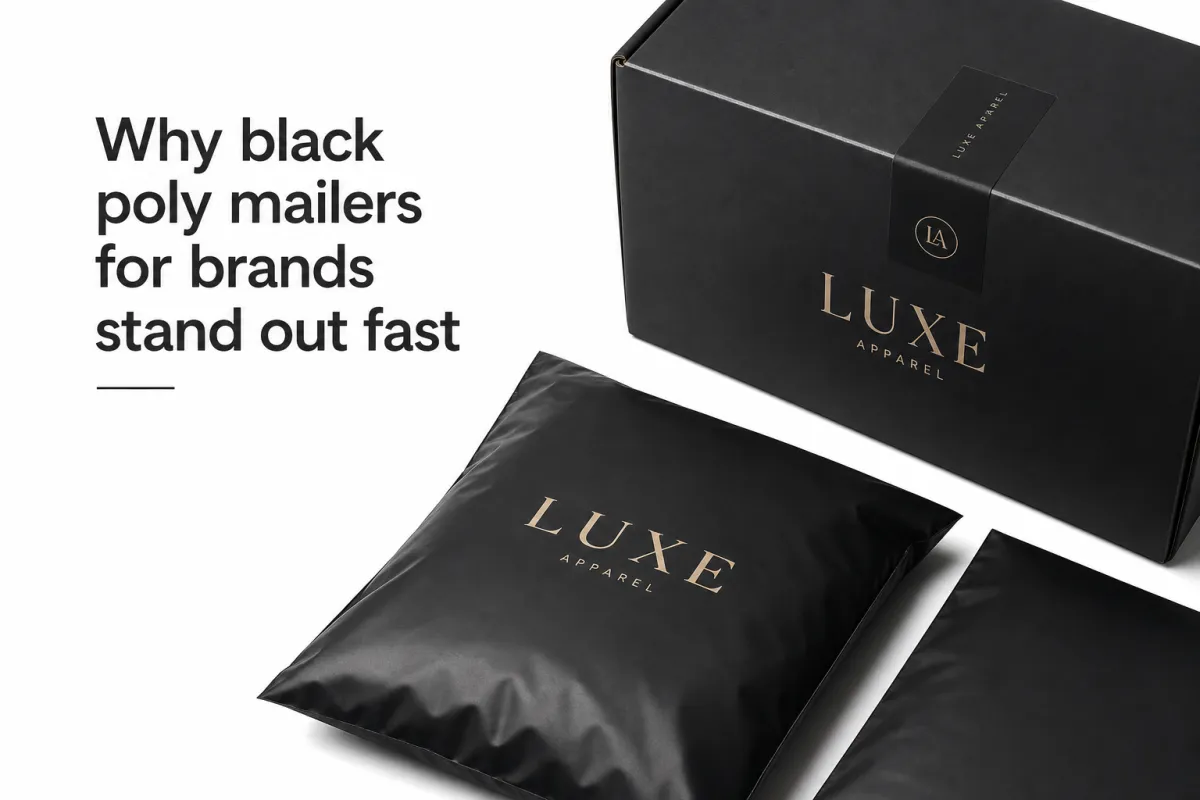
Black poly mailers for brands stand out because black film gives the parcel a tighter, more controlled visual field from the moment it leaves fulfillment. Product shading, fold lines, and minor handling marks are less obvious through the bag, which means the shipment tends to read as intentional on the porch, at the locker, or in the customer’s hands. For brands trying to project a sharper impression without jumping into luxury pricing, that visual consistency matters more than people usually admit.
The construction is refreshingly straightforward. A standard poly mailer uses one or more layers of polyethylene film, often co-extruded to balance flexibility with tear resistance, then finished with a pressure-sensitive adhesive flap so the bag can be closed quickly during packing. That simple build is a big reason black poly mailers for brands show up so often in apparel and direct-to-consumer shipping. They are fast to pack, light enough to help with postage, and durable enough for everyday parcel handling when the spec is chosen carefully.
The Best Use Cases are fairly predictable, although the details still matter. Tees, sweats, joggers, leggings, knit accessories, small bundles, and subscription kits fit neatly because they can be flattened or folded without crushing the product. Black poly mailers for brands also make sense when the same exterior look needs to carry across a wide SKU range, since one bag size can sometimes cover a family of products if the fold pattern and packed bundle are planned with a little discipline.
The visual advantage goes beyond the simple “black looks premium” shorthand. Black film creates strong color consistency from lot to lot, it hides the outline of mixed textile colors better than translucent mailers, and it can make a logo or printed message feel sharper because the contrast is immediate. A plain black shipper can feel restrained and modern, while a printed version can become a small but repeatable part of the brand identity. That is part of why black poly mailers for brands show up so often in apparel, wellness, and creator-led labels.
There is a tradeoff worth calling out early. Black poly mailers for brands are strongest when the product compresses well and can tolerate a little flex in transit. If the item has hard corners, delicate surfaces, or a shape that can punch through film, the bag alone may not be enough. In those cases, a heavier gauge, a secondary inner wrap, or a different pack format can save both the shipment and the customer experience.
I have watched more than one brand pick a mailer by mockup alone, then spend the next month fighting label wrinkles, popped seals, and too much empty air inside the bag. That kind of fix sounds small on paper, but it can slow down packing in a way that is kinda annoying once orders start piling up.
“A good mailer should disappear into the workflow and show up in the customer’s hands looking deliberate, not improvised.”
For brands comparing aesthetics against operational fit, I usually point them toward the full journey: packing speed, carrier handling, shelf presentation, and the unboxing moment itself. Black poly mailers for brands can handle all four reasonably well, which is why they remain such a dependable starting point for many packaging programs.
How black poly mailers for brands protect products in transit
Protection begins with the film structure, and black poly mailers for brands typically rely on layered polyethylene to balance stretch, tear resistance, and low shipping weight. A lighter gauge bag can work well for soft tees or a single garment, while heavier packs and more pointed products place much more demand on the film. In practical terms, many apparel programs begin around 1.5 to 2 mil for lighter loads and move closer to 2.5 to 3 mil or more for heavier content, longer routes, or a higher chance of rough handling.
The seal matters just as much as the film. A pressure-sensitive adhesive flap creates a fast closure that operators can use without slowing the line, yet it still needs enough holding strength to stay closed through sorting, tote movement, and final delivery. On black poly mailers for brands, the flap contributes to the perceived quality of the package too. If the closure looks dusty, crooked, or undersized, the mailer can feel cheap even when the film itself performs exactly as intended.
The format also gives a practical barrier against everyday shipping grime. Poly mailers resist light moisture, splashes, and the ordinary dirt that parcels pick up on trucks, conveyor belts, and loading docks. Nobody should pretend they are waterproof armor, because they are not, but black poly mailers for brands can shield apparel and other soft goods from the kinds of conditions that often ruin a clean presentation: a damp porch, a little road spray, or a scuffed outer surface from rubbing against other parcels during transit.
Snug sizing makes a bigger difference than most teams expect. When the product slides around inside the mailer, the parcel can balloon, crease, or rub internally, which raises the chance of abrasion and gives the outer package a sloppy appearance. Properly sized black poly mailers for brands stay flatter, take labels better, and usually create a cleaner opening experience because the product is not tumbling around inside excess film. That is one reason I prefer measuring the packed kit instead of the naked garment.
Testing standards matter here too. Parcelized goods are often evaluated with transit and drop profiles, and it helps to understand the thinking behind standards like ISTA, even if your team is not running a full certification program. A standard does not magically fix a weak mailer, yet it does remind brands to test the package against the actual route instead of relying on a best-case sample pulled from a table.
Operationally, black poly mailers for brands can speed up fulfillment because they are fast to fill, fast to seal, and easy to label. That matters in batch shipping workflows where operators are moving dozens or hundreds of units per hour and need a package that does not slow them down with tape, extra folds, or excess inserts. A properly sized mailer can reduce void fill, trim packing time, and keep the line moving with less fuss.
There is a practical trust issue too. Customers usually never see the shipping lane, but they do notice if a parcel arrives wet, torn, or crushed. Once a brand fixes that problem with the right mailer spec, the packaging starts doing quiet work in the background instead of creating customer service headaches.
Cost, pricing, and MOQ for black poly mailers for brands
Cost gets clearer once the spec is broken down, because black poly mailers for brands may look simple while the pricing shifts quite a bit depending on the details. Bag size drives the first change, then film gauge, then print coverage, then the number of ink colors, and then any special finish or adhesive upgrade. Freight can swing the total too, especially when the order volume is modest and the cartons take up more space than the unit count suggests.
MOQ, or minimum order quantity, deserves a plain-English explanation. Blank stock black mailers may be available in smaller quantities because they do not need a custom plate or dedicated print setup, while custom printed black poly mailers for brands usually require a larger run so the setup cost spreads across enough units. For some programs, that means 500 to 1,000 units for plain stock, then 2,500, 5,000, or more for custom print, depending on the supplier and the design.
Unit cost is not the same thing as landed cost, and that difference prevents a lot of expensive mistakes. A bag that appears cheap on a quote can become costly once freight, setup, overs, waste, and storage are added back in. When I evaluate black poly mailers for brands, I want the real cost per shipped order, because a slightly better mailer can reduce damage, cut repack labor, and keep the customer experience consistent from order to order.
| Option | Typical use | Approx. unit cost at 5,000 pcs | Notes |
|---|---|---|---|
| Blank stock black mailer | Fast-moving apparel, test runs, low-setup programs | $0.12-$0.22 | Lower entry cost, limited branding, best for speed |
| Custom printed one-color | Core DTC apparel and accessory shipments | $0.18-$0.32 | Good balance of cost and brand presence |
| Custom printed full-coverage | High-visibility branding, launches, campaigns | $0.24-$0.45 | More ink, more setup, stronger shelf and shipping impact |
| Heavier gauge / premium adhesive | Heavier packs, longer routes, more abuse risk | $0.26-$0.60 | Higher protection, usually worth it if returns are costly |
Those numbers are a framework, not a promise, because black poly mailers for brands move in price quickly with size, coverage, gauge, and freight mode. A 9 x 12 inch bag with a simple logo and a 2 mil film will not price the same as a 14 x 19 inch bag with full-coverage print, thicker film, and a wider adhesive strip. That is why line-by-line comparison is more useful than comparing a single bag price in isolation.
Stock versus custom is the other major choice. Stock black mailers can help with cash flow, speed, and flexibility, especially while you are still learning the exact pack sizes that fit your assortment. Custom black poly mailers for brands, though, often start paying off once the volume is steady enough that the packaging itself becomes part of the remembered look. If the mailer is going to move a lot of units, the printed version often earns its place by making each shipment feel more deliberate.
There is also a second-order cost that gets overlooked all the time: waste. If the bag is too small, too thin, or too generic for the product line, teams may repack damaged shipments, add unnecessary inserts, or absorb returns that should have been avoidable. For that reason, black poly mailers for brands should be judged by the total cost of shipping a saleable order, not by the purchase price of the bag alone.
Process, timeline, and lead time for black poly mailers for brands
The production flow for black poly mailers for brands usually starts with artwork prep and specification, then moves through proofing, film conversion, printing, bag making, sealing, and final inspection. Each stage has a job to do, and skipping one tends to show up later as a problem in the warehouse or on the customer’s doorstep. Even a simple design still needs a clean dieline, and a more complex design still has to respect the way the bag folds, seals, and labels in real use.
Proofing is often the point where a project either settles down or becomes expensive. The artwork needs correct bleed, safe zones, and logo placement, but the pack also has to leave usable room for shipping labels, barcodes, and any fulfillment stickers the team plans to apply. Black poly mailers for brands often need extra care here because dark film can hide small alignment issues that become obvious once the bag is under warehouse lighting and a white label is placed on top.
Samples deserve more attention than they usually get. A digital proof confirms placement and color intent, but a physical sample tells you how the film feels, how the adhesive behaves, and whether the bag actually fits the packed product. A preproduction sample is even better for custom work because it catches print registration, seal quality, and handling behavior before the full run begins. For black poly mailers for brands, that sample stage is often the cheapest insurance in the whole order.
Lead time depends on several moving parts: print complexity, quantity, factory scheduling, seasonality, and the transit method after production. A blank stock order may ship quickly if the size is already in inventory, while custom printed black poly mailers for brands usually need more time because the supplier has to approve the artwork, schedule the run, and finish the bags before freight even starts. A practical planning window is often 7 to 14 business days for stock and 12 to 25 business days or more for custom, though the exact timeline always depends on the run and the ship-to location.
If you are launching a new product or restocking for a promotion, work backward from the hard date instead of forward from the quote. That means allowing space for proofs, sample approval, transit delays, and a buffer in case the first sample needs adjustment. Black poly mailers for brands can move quickly once the spec is locked, but the early choices have a way of echoing all the way through fulfillment.
A simple packaging calendar helps more than most teams expect. If apparel lands two weeks before launch, the mailers should not arrive the same day. Time is needed to test packing speed, confirm adhesive performance, and verify that black poly mailers for brands store well without curling, scuffing, or collecting warehouse dust before they ever reach the line.
In practice, the brands that stay out of trouble are the ones that build a little breathing room into the schedule. That extra buffer is not glamorous, but it is cheaper than rushing a reorder and accepting whatever size or finish happens to be available.
Step-by-step setup for black poly mailers for brands
Start by measuring the final packed product, not just the garment or accessory by itself. That detail sounds basic, yet it is where a lot of orders drift off course because the folded tee, tissue wrap, hang tag, insert card, or interior polybag changes the actual finished size. Black poly mailers for brands should be chosen against the real packed bundle, with enough room for a flat seal and no awkward strain on the flap.
Next, choose a size that gives a clean fit without leaving a large pocket of empty air inside the bag. Too much slack makes the parcel bulky, which can push postage upward and create a package that looks underpacked. Too little room can stress the adhesive flap and make the seal difficult to close. I like to see a mailer that allows the product to lie in a single layer or a neat soft fold, because black poly mailers for brands feel better when the contents sit naturally inside the format.
Film gauge should follow the product and the shipping route, not just the lowest price on the quote. Light apparel moving short distances may perform well in a standard gauge, while hoodies, denim, bundled kits, or anything facing a rougher transit path often need a sturdier spec. If the route includes heavier sortation, higher drop risk, or longer carrier handling, black poly mailers for brands usually benefit more from a little extra thickness than from a lot of extra hope.
Branding comes next, and several directions can work well. Some teams want a simple logo mark in white or metallic ink. Others want full-coverage art that wraps the bag and creates a strong shelf impression. Some prefer a plain black exterior with branded inserts inside. Black poly mailers for brands can support each of those approaches, but the choice should match how much visual responsibility the exterior package needs to carry versus how much work the unboxing moment can do later.
A live packing test will tell you more than a stack of spec sheets. Use actual products, actual inserts, actual shipping labels, and the same hands that will pack production orders. Watch how the bag seals, how much air is trapped, whether the label sits flat, and whether the finished parcel still looks tidy after a few minutes on the table. A quick test like that often shows whether black poly mailers for brands are ready to order or whether the size needs one more adjustment.
If you want the internal process to stay clean, create a simple packaging spec sheet and keep it with the rest of the order data. Include the bag size, film gauge, adhesive width, print placement, tolerance range, and reorder quantity. That little document saves time months later, because black poly mailers for brands tend to get reordered quickly once the team likes them, and memory alone is a weak system for keeping packaging consistent.
- Measure the final packed bundle, not the bare item.
- Confirm the seal closes with no stretch.
- Test label placement before approving the run.
- Pack a small batch at line speed, not just one sample.
- Store a few spare units for QA and rework checks.
Common mistakes when choosing black poly mailers for brands
The first mistake is choosing a bag that is too small. Overstuffed black poly mailers for brands look awkward, stress the seal, and create a rougher customer experience because the product is squeezed in rather than packed with care. Even when the bag technically closes, too much tension can lead to popped seals, torn corners, or a shipment that looks like it barely made it through the trip.
The second mistake is chasing the lowest possible price by going too thin. A thin film can work for the right product, but the savings disappear quickly if the bag tears in transit, scuffs badly, or forces rework on the packing line. Black poly mailers for brands are often chosen because they feel efficient, so it helps to remember that efficiency includes avoiding damage and labor, not just lowering the buy price.
Black color can hide some issues, but it can also make others more visible. Dust, lint, and light scuffing can stand out against a dark surface, and poor print contrast can make branding look muddy if the ink choice or coverage is off. On black poly mailers for brands, white ink usually gives the sharpest visual pop, while metallics and specialty inks can look excellent if the supplier holds registration tightly enough for the artwork.
Skipping real-world testing is another common trap. A bag that looks perfect with one folded shirt may behave differently once a hoodie, a tissue wrap, a return label, or a bundled two-pack goes inside it. Black poly mailers for brands should be tested with the actual assortment, because the moment the pack profile changes, the size and seal behavior can change too.
Storage and replenishment get overlooked more often than they should. Mailers take up space, and custom printed black poly mailers for brands are not always easy to split into tiny reorders without hurting pricing. If the warehouse is tight on room or the SKU count is wide, standardizing where possible and setting reorder points before the first pallet becomes a problem is usually the better move.
Carrier requirements, label placement, fulfillment hardware, and return handling all affect whether the packaging still works after launch. A mailer that looks perfect on a sample table can still create friction if it jams a printer, blocks a scan zone, or fits poorly into the team’s packing flow. Black poly mailers for brands work best when they are built into a clean process rather than treated as an afterthought.
The final mistake is treating the mailer like a brand accessory and forgetting that it is also a shipping component. If the spec is not protecting the product, the outer look stops mattering pretty quickly.
Expert tips and next steps for black poly mailers for brands
Order a small sample set in more than one size if you can. A lot of brands think they know the right bag from a spreadsheet, yet the handling feel, seal strength, and shelf appearance often tell a different story once the actual product is inside. With black poly mailers for brands, the difference between “close enough” and excellent is often just one size step or one gauge step.
Build a spec sheet and treat it like part of the product master. Record the size, gauge, adhesive width, print area, ink color, and reorder quantity, then keep that information with the packaging records so future orders stay consistent. That simple habit makes black poly mailers for brands easier to manage across seasonal restocks, new product drops, and different fulfillment teams.
Ask for quotes at several quantity breaks. A supplier can usually show where the unit price improves sharply and where the next discount stops being practical because storage, cash flow, or forecast uncertainty becomes the real limit. Black poly mailers for brands often look most attractive when the team understands the full pricing curve instead of only the cheapest line item at one volume.
Standardizing on two or three sizes usually beats keeping a wide range of bag SKUs. Fewer sizes simplify procurement, inventory control, and training on the fulfillment line. If one of those sizes covers most of the assortment, black poly mailers for brands become easier to reorder, easier to store, and easier to spot-check during receiving.
It also helps to compare packaging choices against actual brand goals rather than abstract preference. If speed is the priority, a blank stock bag may be the smartest choice. If shelf presence and repeatable visual identity matter more, custom printed black poly mailers for brands may make greater sense. If the goal is a polished unboxing without a large spend, a simple black exterior with a modest logo can sit in a very practical middle ground.
For teams looking at broader packaging upgrades, the whole portfolio matters, not just one bag. Our Case Studies can be useful for seeing how packaging choices map to real fulfillment decisions, and that is often the fastest way to narrow down what belongs on your line. Black poly mailers for brands are rarely a one-size-fits-all decision; they work best when they fit the product mix, the volume, and the story the brand wants to tell.
If you want the short version, start with measurement, test a few sizes, compare landed cost, and pack real orders before placing the full run. That sequence keeps black poly mailers for brands grounded in reality instead of in a mockup file, and it gives you a better chance of ending up with a package that looks right, ships well, and stays manageable for the team.
For brands that want a dependable path forward, black poly mailers for brands usually come down to three things: the right size, the right gauge, and the right print approach. Get those right, and the mailer starts doing real work for the brand instead of merely holding the product.
Are black poly mailers for brands better than white mailers?
Black usually gives a more premium, unified look and hides product silhouettes better during shipping, which is why many apparel teams prefer black poly mailers for brands. White can show dirt and handling marks more easily, while black can make printed branding stand out with stronger contrast. The better choice depends on the product type, the brand style, and whether you want a minimalist or high-contrast unboxing feel.
What thickness should black poly mailers for brands use for apparel?
Light apparel often works with standard film, while heavier hoodies, denim, or multi-item packs usually need a sturdier gauge. A practical starting point is to match thickness to puncture risk, packing route, and how much compression the garment can handle without damage. Always test with the actual product inside the mailer before finalizing the spec, because black poly mailers for brands behave differently once the pack has real weight and real folds.
How do I estimate the cost of custom black poly mailers for brands?
Start with size, quantity, print coverage, and film gauge, since those are the biggest unit-price drivers. Then add setup, freight, and any waste from wrong sizing or overpacking to understand the real landed cost. The best comparison is cost per shipped order, not just the bag price, because black poly mailers for brands can affect returns, packing speed, and the customer’s first impression all at once.
Can black poly mailers for brands be recycled?
Many poly mailers are made from recyclable polyethylene, but local drop-off rules and curbside acceptance vary by area, so you need to check the exact guidance for your market. If recyclability matters to your brand story, ask for material details before ordering and avoid making assumptions. The EPA recycling guidance is a good reference point, but the final answer still depends on your local program and the specific material used in the bag.
How long do black poly mailers for brands usually take to produce?
Blank stock mailers are often faster because they do not need a custom print or dedicated setup, while printed custom runs take longer because of proofing, approval, manufacturing, and shipping time. The safest move is to plan backward from your launch date and leave time for sampling plus a production buffer. That is usually the difference between black poly mailers for brands arriving as planned and arriving just a little too late for the first shipment.
The practical next move is simple: measure the packed product, request two sample sizes, pack a short test run at actual line speed, and lock a spec sheet before placing the full order. That keeps black poly mailers for brands tied to real shipping conditions instead of a guess, which is the difference between packaging that merely looks good and packaging that holds up in daily use.