Buyer Fit Snapshot
| Best fit | compare bubble mailers and poly mailers use cases for packaging buyers comparing material specs, print proof, MOQ, unit cost, freight, and repeat-order risk where brand print, material, artwork control, and repeat-order consistency matter. |
|---|---|
| Quote inputs | Share finished size, material target, print colors, finish, packing count, annual reorder estimate, and delivery region. |
| Proofing check | Approve dieline scale, logo placement, barcode or warning zones, color tolerance, and any recyclable or compostable wording before bulk production. |
| Main risk | Vague material claims, crowded artwork, or missing packing details can create delays even when the unit price looks attractive. |
Fast answer: Compare Bubble Mailers and Poly Mailers Use Cases: Film, Closure, Print, and Fulfillment should be specified like a repeatable production item. The safest quote includes material, print method, finish, artwork proof, carton packing, and reorder notes in one written spec.
What to confirm before approving the packaging proof
Check the product dimensions against the actual filled item, not only the sales mockup. Ask for tolerance on folds, seals, hang holes, label areas, and retail display edges. If the package carries a logo, QR code, warning copy, or legal claim, reserve that space before decorative graphics fill the panel.
How to compare quotes without losing quality
Compare board or film grade, print process, finish, sampling route, tooling charges, carton quantity, and freight assumptions side by side. A lower quote is only useful if the supplier can repeat the same color, closure quality, and packing count on the next order.
Buyers often treat bubble mailers and poly mailers like two simple envelope choices, but the real decision reaches into postage, damage risk, labor, and the way a customer reads the package when it lands at the door. If you compare bubble mailers and Poly Mailers on purchase price alone, you miss the part that actually moves margin. A difference of less than an ounce can feel tiny during sampling and then show up as a real expense once it repeats across thousands of orders.
That is why this comparison deserves a careful pass. To compare bubble mailers and poly mailers properly, you need to look at cushioning, compression, tare weight, print presentation, and the chance of a complaint or replacement. Bubble mailers usually come out ahead on protection. Poly mailers usually win on weight, speed, and shipping cost. The right choice depends on the product, the return policy, and how much rough handling the shipment needs to survive without a refund or a reship.
Compare Bubble Mailers and Poly Mailers: The Fast Answer
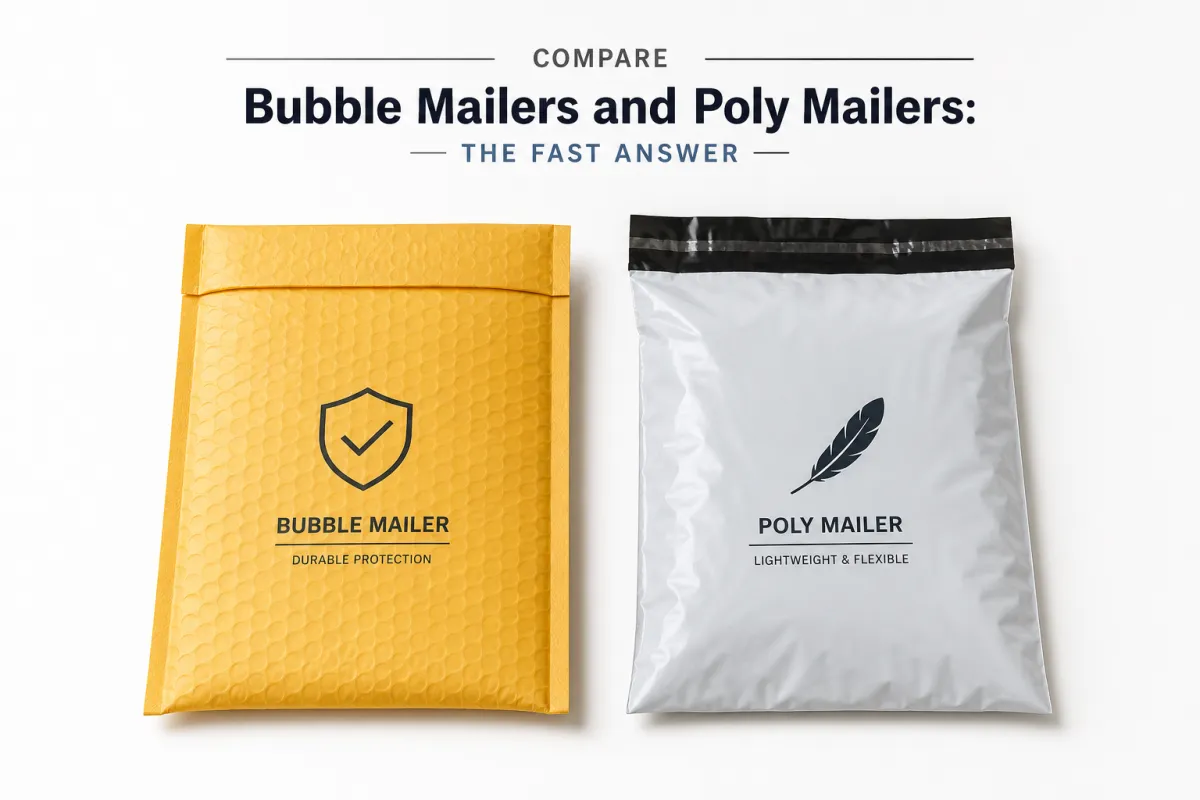
Here is the shortest useful way to compare bubble mailers and poly mailers: if the item can crack, dent, scratch, or shift enough to lose value, start with bubble mailers. If the item is soft, flexible, low-breakage, and already protected by its own box or folded structure, poly mailers are usually the better default. That answer may sound plain, but it holds up in real fulfillment work a lot better than polished supplier language.
I have watched sellers compare bubble mailers and poly mailers on a spreadsheet, choose the cheaper unit price, and then spend more on replacements within a quarter than they saved on packaging. I have also seen the reverse, where teams overpack apparel in padded mailers, raise postage for no real gain, and slow the packing line because every order needs extra handling. The surprise is not that packaging matters. The surprise is how fast a small change in weight and a few extra seconds per order can compound.
For a small catalog, the choice can look minor. For a catalog shipping 300 orders a day, it becomes structural. A mailer that saves 1 ounce on average may free up enough postage to support better inserts, better print, or better service. A mailer that prevents a 2% damage rate may protect margin more than any supplier discount. That is the real reason teams compare bubble mailers and poly mailers instead of asking only which one costs less.
There is also a branding side to it. A bubble mailer can signal "protected and intentional," while a crisp printed poly mailer can signal "light, efficient, and retail-ready." Neither is inherently better. The wrong choice is the one that fights the product story. A premium skincare sample that rattles around in a thin poly bag reads as careless. A T-shirt sent in a thick padded mailer can feel overbuilt and wasteful. The packaging should match the shipment, not simply cover it.
In practice, the decision usually comes down to five questions:
- Can the product tolerate compression without losing function or appearance?
- Does the shipment need shock absorption, or just containment and moisture resistance?
- How much does the packaging add to tare weight and postage?
- Will customers judge the unboxing as premium, practical, or cheap?
- How costly is one damaged order versus one extra ounce of packaging?
That framework is enough to compare bubble mailers and poly mailers without guesswork. It is also why I recommend testing both formats on the same SKU set before placing a large custom order. Stock mailers are easy to sample, but the final answer should come from your product mix, not from a supplier's best-case scenario.
One more practical point: if you sell across multiple channels, the "best" mailer can change by channel. Marketplace orders may tolerate simpler packaging if the item is low-risk, while direct-to-consumer orders often need cleaner branding. For that reason, compare bubble mailers and poly mailers by SKU group, not by brand identity alone. A subscription insert, a softgood, and a small accessory do not face the same transit risk.
The cheapest mailer on paper is often the most expensive one after returns, reships, and customer service time.
Top Options to Compare: Bubble Mailers and Poly Mailers
If you compare bubble mailers and poly mailers across their common versions, the choice becomes clearer. Not all bubble mailers behave the same way, and not all poly mailers perform the same in production. Construction, thickness, closure style, and print finish matter more than many buyers expect. A padded mailer with weak adhesive is a liability. A thin poly mailer with a strong seal and the right gauge can outperform a thicker option that was chosen for the wrong reason.
Standard bubble mailers usually combine a paper or poly outer layer with an air-cell cushioning layer inside. That bubble film absorbs small impacts and reduces abrasion. Metallic bubble mailers bring a more polished look and can work well for promotional shipments, but they can create recycling complications if the structure mixes materials. Lightweight Poly Mailers are simpler: one flexible film, often in the 1.5 to 2.5 mil range for stock retail use, with peel-and-seal closures and a narrow side or bottom seal. Recyclable Poly Mailers exist too, though local recycling access varies, so avoid overselling that claim unless you know the destination program can actually process them.
To compare bubble mailers and poly mailers properly, you also need to look at the SKU category. Jewelry, cosmetics, sample kits, small electronics, books, and supplements each carry different risks. Apparel and soft goods usually reward poly mailers because they compress efficiently and keep postage down. Books can go either way depending on corner protection, dust jackets, and whether the item needs abrasion resistance. Small electronics often need an outer mailer plus an inner sleeve or carton if internal parts can move.
Here is a practical comparison framework that works well before sample ordering:
- Drop resistance: Can the package survive a 30 to 36 inch drop onto a hard surface without damage?
- Crush resistance: Does the mailer protect against stack pressure in a bin, tote, or carrier bag?
- Tare weight: How many ounces does the packaging add to the shipment?
- Presentation: Does the outside look premium, clean, or utilitarian?
- Packing speed: Can a picker close, label, and stage the order without extra steps?
Those five points help compare bubble mailers and poly mailers without drifting into vague supplier language. They also reveal a common mistake: buying more protection than the product needs. I see that most often with apparel brands that default to padded mailers because they feel safer, even though the product is soft and already folded flat. I also see the opposite with small hard goods that go into plain poly mailers because the team wants to save a few cents and ends up absorbing the cost of damaged shipments over and over.
For printed programs, the material choice affects the visual result too. Bubble mailers can support full-color branding, but heavy coverage may add cost and can look busy if the design does not respect the format. Poly mailers often look cleaner with bold typography and a single color field. If you want to compare bubble mailers and poly mailers from a brand standpoint, think about what the customer should feel in the first three seconds: protected, efficient, premium, playful, or practical.
Detailed Reviews: Protection, Branding, and Fit
Protection is where bubble mailers earn their keep. If the product is rigid, fragile, or easily marred by corner impact, a bubble interior does real work. Compare bubble mailers and poly mailers on shock absorption and the difference shows up fast. A bubble mailer cushions small shocks, reduces scuffing on boxes, and helps protect surfaces that would otherwise get beat up during carrier handling. That does not make it a substitute for a carton, but it does make it a smarter envelope-style option for many hard goods.
Poly mailers are better at another job entirely. They are flexible, low-profile, and good at hugging the shape of the product. That tight packout matters. A properly sized poly mailer can reduce air space, keep the parcel thin, and avoid the bulky profile that pushes postage higher or makes the package awkward to stack. When you compare bubble mailers and poly mailers for apparel, soft accessories, or non-fragile replenishment goods, poly often wins because it is simply more efficient.
Fit is the hidden variable. Bubble mailers can create wasted volume if the item is too thin for the padded cavity, while poly mailers can cling neatly to the product and reduce shifting. A poly mailer that is too small can also stretch at the seams or force a bad fold line through the product. That is why mailer width, gusset behavior, and closure placement matter. A 9 x 12 poly mailer may fit a folded shirt beautifully, while a 6 x 10 padded mailer may be the right fit for a compact cosmetic box. Compare bubble mailers and poly mailers by actual packout, not by category label.
Branding deserves equal attention. A printed poly mailer can look modern and deliberate with a matte finish, a single strong logo, and a restrained palette. Bubble mailers can look more protective and substantial, especially if the outer face is kraft or a clean white film. Metallic finishes can elevate the unboxing, but they can also make the package feel louder than the product. For a brand that sells simplicity, a quiet poly mailer often looks better. For a brand that sells fragile luxury, the added cushion of a bubble mailer can reinforce the idea that the item has been handled with care.
There is a practical durability issue too. Bubble mailers generally handle abrasion well, but the outer layer can crease or puncture if the film is thin or the seam is weak. Poly mailers resist moisture better than paper-heavy options and often ride through wet delivery routes with less concern. Still, low-cost poly mailers can split at stress points if the item is sharp-edged or overstuffed. Compare bubble mailers and poly mailers in the same rough-handling scenario and the result usually depends on seam quality more than on the marketing description.
For transit validation, some teams borrow from ISTA test methods, or at least adapt the thinking behind them. A drop test, a short compression check, and a vibration pass through normal carrier sorts reveal more than a glossy spec sheet. If you are sourcing with sustainability in mind, the material story matters as well; paper-based outer layers may support FSC-sourced fiber where applicable, and the FSC system is one of the clearest reference points for that conversation. Neither link solves the packaging decision for you, but both give the discussion a firmer base than broad "eco-friendly" claims.
The best way to compare bubble mailers and poly mailers is to think like the customer and the carrier at the same time. The customer wants the product intact and the package easy to open. The carrier wants a parcel that survives sorting, stacking, and the occasional drop. The mailer that satisfies both sides without overspending is usually the right choice. That is the sweet spot, even if getting there takes a few ugly sample rounds and one or two that are kinda disappointing.
Price Comparison: Unit Cost, Shipping, and Damage Rates
Unit price is the trap. It is the first number buyers see, and it is rarely the number that decides total cost. To compare bubble mailers and poly mailers on economics, you need to combine purchase price, postage impact, damage rate, labor, and storage footprint. A mailer that costs 4 cents less may still cost more overall if it adds enough weight to push a shipment into a higher postage tier or creates more replacements.
Typical stock pricing gives a rough starting point. In common wholesale orders, stock poly mailers often land around $0.03 to $0.09 per unit depending on size, thickness, and order volume. Stock bubble mailers often sit closer to $0.12 to $0.30 per unit, with custom printed or specialty finishes moving higher. Custom Printed Poly Mailers can range roughly from $0.06 to $0.18 or more, while custom printed bubble mailers may run from about $0.18 to $0.35 or beyond depending on coverage and structure. Those are broad ranges, not a quote, but they are realistic enough to compare bubble mailers and poly mailers in planning meetings.
Now add postage. A poly mailer is typically lighter, and that alone can make it the better fit for apparel, soft goods, and flat items that are already protected. Bubble mailers add protection, but the extra material can push smaller parcels into a higher ounce bracket or, if the format is oversized, increase dimensional pricing pressure. On a single shipment, the difference may be 20 to 60 cents. Over thousands of orders, it becomes a line item finance can actually see.
Damage rate changes the math again. If a bubble mailer reduces breakage from 2% to 0.5% on a product that costs $18 to replace, the savings can outweigh the mailer premium quickly. If a poly mailer works perfectly for a soft product, the leaner package wins because there is no reason to pay for padding that will never be used. That is the key point when you compare bubble mailers and poly mailers: the cheapest package is not always the cheapest outcome.
Storage and labor also show up in cost. Bulk bubble mailers occupy more space per order than flat poly mailers, which can matter in a tight pack room. If pickers are reaching for oversized padded mailers when a flat film would do, the line can slow down just enough to matter at scale. A few extra seconds per order sounds trivial until the team is processing hundreds of units per hour. Compare bubble mailers and poly mailers on pack speed and warehouse footprint, and the lighter format often wins even before postage is counted.
| Factor | Bubble Mailers | Poly Mailers | Best Reading |
|---|---|---|---|
| Typical unit cost | $0.12-$0.30 stock; more for custom | $0.03-$0.09 stock; more for custom | Poly usually wins on raw unit price |
| Packaging weight | Higher due to cushioning layer | Lower and easier to keep under ounce thresholds | Poly usually wins on postage efficiency |
| Protection | Good for shock, scuffing, and minor crush | Good for containment and moisture, not cushioning | Bubble wins for fragile or rigid items |
| Packing speed | Moderate; bulkier to handle | Fast; flat, light, easy to stage | Poly usually wins on throughput |
| Damage risk | Lower for fragile items | Lower only when the product is inherently non-fragile | Depends on SKU, not packaging preference |
That table is the right place to compare bubble mailers and poly mailers because it forces the real tradeoff onto one page. The mailer that looks more expensive may lower total landed cost once postage and damage are included. The mailer that looks cheaper may quietly create returns, reships, and a customer service headache that never appears on the packaging invoice.
For teams building a margin model, I recommend tracking four numbers for each format: unit price, postage tier, damage rate, and labor minutes per 100 orders. If those four numbers are in front of you, compare bubble mailers and poly mailers by total cost per successful delivery, not by procurement price alone. That is the number management actually cares about.
Practical note: For a 5,000-unit buy, the difference between a $0.08 poly mailer and a $0.22 bubble mailer feels dramatic. If the bubble mailer prevents even a handful of failed shipments on fragile items, the gap narrows fast. That is why many buyers compare bubble mailers and poly mailers twice: once for budget approval, and again for operational reality.
Process and Timeline: From Packout Test to Ship Day
Most packaging mistakes happen because someone skips the boring steps. Compare bubble mailers and poly mailers the right way and the process should begin with sample ordering, not a mass purchase. Order both options in the actual sizes you plan to use. Put the real product inside. Seal it the way your team will seal it on the line. Then run the package through handling that resembles the carrier, not a showroom floor.
A practical internal test does not need to be elaborate. I would start with a 10 to 20 unit trial for each SKU, then move to a rough drop test from about 30 to 36 inches, a short compression hold, and a visual check for seam stress, surface scuffing, and product movement. If the product is brittle, add a second pass with corner impact. If the product is apparel, test whether folding, label placement, and opening behavior still feel clean after packing. When teams compare bubble mailers and poly mailers this way, the answer usually appears within a day.
Timelines vary by format. Stock mailers can arrive quickly, often in a matter of days if the supplier has inventory. Custom printed versions take longer because artwork, proofing, cylinder or plate setup, and production all add time. A simple custom poly mailer order may move in 12 to 15 business days after proof approval, while more complex bubble mailer runs can take longer if the print coverage is high or the structure is specialty. The exact lead time depends on the factory, order size, and seasonality, so leave room in the plan.
Delay usually comes from rework, not from manufacturing. Teams compare bubble mailers and poly mailers, like one option, and then discover too late that the product fit is off by half an inch. That means new samples, new approvals, and a reorder pushed into panic mode. Another common delay is waiting until the warehouse is nearly out of stock before placing the next buy. By then, there is no room for testing, and the team ends up using whatever is available. That is how bad packaging becomes the default.
Workflow matters as much as protection. A lighter poly mailer can speed up label application and staging because the packer is handling less material and flattening fewer bulky edges. A bubble mailer can save time later by reducing damage handling and customer service follow-up. Compare bubble mailers and poly mailers in terms of labor and you may discover the "faster" format is not the same as the "cheaper" format. That is normal. Real operations are full of those tradeoffs.
For fulfillment teams, I usually recommend this sequence:
- Choose 2 to 3 likely mailers by size and structure.
- Pack the same SKU in each option under normal line conditions.
- Measure tare weight, seal time, and label placement consistency.
- Run a short transit test or rough handling simulation.
- Review customer-facing appearance and unboxing behavior.
- Pick the format that performs best across the whole workflow, not just one metric.
That is the point where compare bubble mailers and poly mailers stops being an abstract sourcing exercise and becomes a real operations decision. If you need help mapping that decision across multiple packaging categories, start with the broader mix in Custom Packaging Products and narrow down by SKU behavior. If apparel makes up most of your volume, it also helps to review Custom Poly Mailers as a baseline, then decide whether any product needs a padded exception.
How to Choose Between Bubble Mailers and Poly Mailers
Start with the product, not the package. That is the simplest way to compare bubble mailers and poly mailers without getting lost in supplier pitches. If the item is fragile, angular, glossy, or sensitive to scratches, the bubble format has a clear edge. If the item is soft, flat, and unlikely to lose value from compression, the poly format is usually the better economic choice. The decision should follow the item's physical behavior in transit.
Think in categories. Bubble mailers are a strong fit for small electronics, printed accessories, cosmetics in rigid boxes, sample kits, books with delicate covers, and subscription components that should not rub against each other. Poly mailers fit apparel, soft goods, textile samples, promotional inserts, return kits, and low-risk retail orders where speed and tare weight matter more than cushioning. Compare bubble mailers and poly mailers by category first, then refine by product dimensions.
Brand position changes the answer too. A premium skincare brand may prefer a bubble mailer because the extra protection mirrors the customer expectation around care. A fast-fashion brand may prefer a slim printed poly mailer because it telegraphs efficiency and keeps shipping costs tight. A premium-but-light brand can go either way, but it should not confuse "premium" with "thick." Sometimes the strongest premium signal is a clean, sharply printed poly mailer with precise fold geometry and a well-sized label panel.
Sustainability deserves a careful, non-slogan answer. Less material is not automatically better if the shipment fails. More material is not automatically wasteful if it prevents reships and replacement product. Compare bubble mailers and poly mailers on material use, recyclability claims, and actual damage reduction. If a recyclable poly mailer is available and the destination markets can handle it, that may be the right move for soft goods. If a bubble mailer lets you ship an item safely without a box, that can also reduce total material compared with a more complex package structure. It depends on the product and the route.
Here is the checklist I would use before approving a purchase:
- Does the product crack, dent, or scratch if squeezed?
- Can the item move inside the mailer during transit?
- Will the mailer change the postage tier?
- Does the outer surface need a premium print finish?
- Is the pack line more sensitive to speed or to damage reduction?
- Will return shipping or reverse logistics require a second-use mailer?
If you compare bubble mailers and poly mailers with those six checks, the answer is usually obvious before you ever call a sales rep. The only time it gets murky is when the product mix is mixed. In that case, I strongly recommend two formats: one as the default and one as the exception. That keeps the warehouse from forcing every SKU into the same envelope logic.
A quick example helps. A brand shipping hoodies, tees, and socks can often standardize on poly mailers and save weight across the board. A brand shipping ceramic mugs, boxed jewelry, and compact electronics should not push everything into the same poly format just because it is cheaper. Compare bubble mailers and poly mailers by failure cost, not just by shipping cost. The product tells you where the line is.
Our Recommendation and Next Steps
If I had to choose a default, I would say this: bubble mailers are the safer default for fragile or rigid products, and poly mailers are the safer default for soft, low-breakage products. That is the simplest truthful recommendation after you compare bubble mailers and poly mailers across protection, postage, and workflow. It is not fancy. It is just what tends to hold up.
For most apparel and soft-good programs, poly is the better starting point. For most small hard goods, bubble is the better starting point. Still, do not stop there. Order samples, pack 10 to 20 real orders per format, and track the metrics that affect margin. I would watch tare weight, seal time, damage rate, customer complaints, and replacement cost. If the team can do a rough transit test before rollout, even better. Compare bubble mailers and poly mailers on live behavior, not on a catalog image.
If the winning format is obvious, scale it across the core SKU set and keep the other format for exceptions. That avoids the mess of forcing every product into a single packaging rule. A good packaging system is not a single answer. It is a set of rules that are easy for the warehouse to follow and hard for the carrier to break.
There is also a sourcing strategy here. If your business is still growing, start with stock options to learn the actual performance of each SKU. Once volumes stabilize, move into custom print where it adds value: logo visibility, color consistency, or a better unboxing moment. If you compare bubble mailers and poly mailers after the first test cycle, you will usually know whether the custom version should be padded, lightweight, or a mix of both depending on the catalog.
My honest advice: do not let a small unit price difference create a big operational mistake. A penny saved on the mailer can become a dollar lost on the return. A heavier package can still be cheaper if it keeps the product safe. That is why compare bubble mailers and poly mailers should never stop at procurement. The real answer lives in transit performance, postage, and customer experience.
For Custom Logo Things, the best next step is simple: request both formats, test them against your top three SKUs, and compare bubble mailers and poly mailers using the same order sample, the same packing team, and the same shipping lane. If the product is soft, a poly mailer probably wins. If the product is fragile, a bubble mailer probably wins. If the answer is still unclear, the numbers from your test will settle it faster than another round of supplier promises.
FAQ
When should I compare bubble mailers and poly mailers for fragile products?
Start with bubble mailers if the item can crack, dent, or scratch from impact. Use poly mailers only when the product has its own protective packaging or can safely handle compression. If there is any doubt, compare bubble mailers and poly mailers with a drop test and a short compression test before you buy in volume.
Are bubble mailers always more expensive than poly mailers?
Usually the mailer itself costs more, but the real comparison includes postage, damage, and replacement expense. A slightly pricier bubble mailer can be cheaper overall if it prevents one failed shipment out of many. That is why compare bubble mailers and poly mailers using total landed cost, not just unit price.
Which works better for clothing orders: bubble mailers or poly mailers?
Poly mailers are usually better for clothing because they stay light and pack tightly around soft goods. Bubble mailers make more sense only if the apparel includes accessories or fragile add-ons that need cushioning. For standard tees, hoodies, and soft sets, compare bubble mailers and poly mailers and the lighter format will usually win.
Can I use bubble mailers for electronics?
Yes, for small electronics with low crush risk, but only if the item is wrapped and cannot shift inside the mailer. For higher-value electronics, add internal protection or choose a stronger packaging structure than a mailer alone. Compare bubble mailers and poly mailers carefully here, because the wrong fit can erase the savings very fast.
How do I compare bubble mailers and poly mailers for custom branding?
Look at print coverage, finish, and how well the material supports a premium unboxing moment. Choose the option that matches the product story: padded reassurance for fragile goods, streamlined efficiency for soft goods. If branding is central to the shipment, compare bubble mailers and poly mailers with a sample in hand, not just a mockup on screen.
Final takeaway: pick one default mailer by SKU type, test it against real orders, and keep the other format for the exceptions that truly need it. That is the simplest way to compare bubble mailers and poly mailers without wasting money on packaging that looks right but performs wrong.