Buyer Fit Snapshot
| Best fit | Branded Bottle Labels Bulk for Clean, Fast Packaging projects where brand print, material claims, artwork control, MOQ, and repeat-order consistency need to be specified before quoting. |
|---|---|
| Quote inputs | Share finished size, material target, print colors, finish, packing count, annual reorder estimate, ship-to region, and any compliance wording. |
| Proofing check | Approve dieline scale, logo placement, barcode or warning zones, color tolerance, closure strength, and carton packing before bulk production. |
| Main risk | Vague material claims, crowded artwork, missing packing details, or unclear freight terms can make a low unit price expensive after revisions. |
Fast answer: Branded Bottle Labels Bulk for Clean, Fast Packaging should be specified like a repeatable production item. The safest quote records material, print method, finish, artwork proof, packing count, and reorder notes in one written spec.
Production checks before approval
Compare the actual filled-product size with the drawing, then confirm tolerance on folds, seals, hang holes, label areas, and retail display edges. Reserve space for logos, QR codes, warning copy, and material claims before decorative graphics fill the panel.
Quote comparison points
Review material grade, print process, finish, sampling route, tooling charges, carton quantity, and freight assumptions side by side. A quote is only useful when the supplier can repeat the same color, closure quality, and packing count on the next order.
A label can look perfect on a screen and still cause trouble the moment it meets a real bottle. I have seen labels lift at the seam, drift on a rounded shoulder, or wrinkle just enough to make a line operator slow the whole run and start babysitting the applicator. That is why branded bottle labels bulk orders should be handled as a production decision first and a print purchase second. For beverages, oils, sauces, supplements, and specialty bottles, branded bottle labels bulk needs to support cleaner application, steadier shelf presentation, and less rework from the first pallet to the last.
The strongest bulk label program takes the guesswork out before the first roll hits the press. The material stays consistent, the adhesive behaves the same from reorder to reorder, and the finished bottles look like they belong to the same family even as the SKU count grows. That matters whether you are filling 500 cases or 50,000, because branded bottle labels bulk only saves time if the labels help the line move cleanly instead of forcing operators to stop and adjust.
Most buyers end up asking for the same three things, even if they phrase it differently: keep the brand sharp, keep the line moving, and keep the cost predictable. The details that protect margin are not flashy, but they matter every day: bottle shape, liner direction, finish choice, moisture exposure, and how the labels behave after refrigeration or handling. That is the real value of branded bottle labels bulk, and it is what separates a tidy packaging run from one that keeps creating small problems.
Why branded bottle labels bulk orders streamline bottling
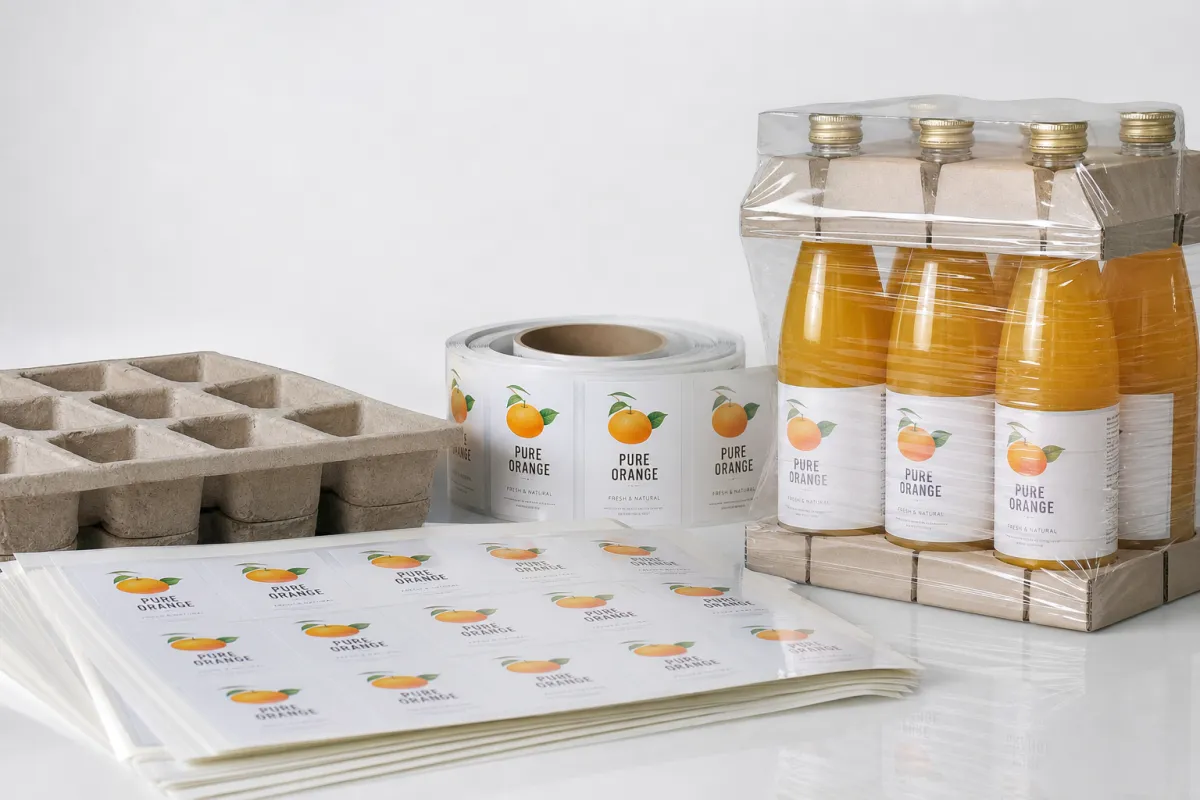
When a line is moving quickly, even a minor label issue becomes an operational headache. If a label edge catches, if the stock is too stiff for a curved bottle, or if the adhesive grabs too slowly, the operator starts compensating. And once people start compensating, waste usually follows close behind. Branded bottle labels bulk orders reduce that risk because the material, adhesive, and print setup are standardized before production starts, which makes application behavior much easier to control.
That consistency matters for more than speed. A label that sits square, trims cleanly, and repeats color accurately gives every bottle the same shelf presence, which is especially useful for product families with multiple flavors, scents, or formulas. I have watched teams lose a surprising amount of confidence over a batch that looked just a shade different from the last one. Buyers usually notice the payoff in three places: fewer stoppages on the line, fewer rejected bottles, and cleaner repeat orders. That is why branded bottle labels bulk is not only about a lower unit cost; it is about making the whole packaging process calmer and more predictable.
There is also a branding side that gets overlooked more often than it should. If one batch of labels is slightly warmer in color, or one roll has a different finish, the inconsistency can stand out on a pallet or a retail shelf. The customer may not know why the product looks off, but they do feel that it looks less polished. With branded bottle labels bulk, the goal is to keep that visual gap as small as possible so the packaging keeps supporting the product story.
A good bottle label should disappear into the workflow in the best possible way: it should apply cleanly, stay put, and keep the brand looking deliberate from first fill to final shipment.
From an operations point of view, bulk labeling also makes reorder planning easier. Once the spec is locked, the team can reorder the same branded bottle labels bulk run without rethinking the construction each time. That helps with inventory planning, especially for brands with seasonal demand, private label commitments, or several distribution channels that all need the same look.
The practical question I would ask before approving any run is simple: can the label survive the full journey, from filling to warehousing to retail handling, without creating extra work? If the answer is yes, the order is doing its job. If the answer is no, branded bottle labels bulk is not really saving money, because the hidden cost shows up later as waste, relabeling, and labor.
For businesses that want to scale packaging without making the line more complicated, branded bottle labels bulk is often the cleanest path. It gives you repeatable materials, simpler purchasing, and a label format that can be tuned for real bottle behavior rather than a best-case mockup.
Branded bottle labels bulk: materials, adhesives, and finishes
The right construction starts with the bottle itself. Paper, film, and specialty stocks all have a place, but they perform very differently once moisture, friction, or refrigeration enter the picture. For branded bottle labels bulk, paper labels are often a solid choice for dry storage, indoor display, or lower-cost applications where the bottle will not see much condensation. If the product lives in a cold room, near ice, or in a wet environment, film stocks such as BOPP or PET are usually the safer call because they hold up better against scuffing and moisture.
Adhesive choice matters just as much as face stock, and many buyers underestimate it. A permanent adhesive is often the right answer for retail products that need the label to stay in place for the life of the bottle. Removable or repositionable adhesives can work in narrower applications, but they should be selected carefully because they are not meant for every package type. On chilled bottles, in humid storage, or on oily surfaces, the wrong adhesive can fail even if the print itself looks excellent.
Finish changes both appearance and handling. Gloss gives a bright, crisp retail look. Matte softens the image and can make text feel more premium and restrained. Soft-touch adds a tactile layer that is easy to notice in hand, and clear or metallic effects can help a bottle stand out when the shelf is crowded. None of those finishes is automatically better; the right choice depends on the bottle content, the brand position, and how the label will be touched, stacked, and shipped.
For branded bottle labels bulk, the safest approach is to match the construction to the environment first and the visual effect second. A label that looks elegant in a mockup but fails on a chilled beverage bottle is not a good buy. A label that feels simple but stays flat, sharp, and readable is often the better commercial decision. I know that sounds a little plain, but packaging has a habit of punishing pretty choices that ignore real conditions.
| Material option | Best use case | Typical unit cost at 5,000 | Typical unit cost at 10,000 | Practical note |
|---|---|---|---|---|
| Paper | Dry goods, indoor storage, short distribution runs | $0.06-$0.12 | $0.04-$0.08 | Economical, but not ideal for condensation or heavy handling |
| BOPP film | Beverages, sauces, oils, refrigerated items | $0.09-$0.18 | $0.06-$0.12 | Strong moisture resistance and good overall durability |
| Clear PET | Transparent bottles, premium cosmetic and specialty packaging | $0.11-$0.22 | $0.08-$0.15 | Good clarity, with stronger scuff resistance than paper |
| Metallic or soft-touch specialty stock | Premium shelf positioning and higher-impact branding | $0.14-$0.30 | $0.10-$0.22 | Higher visual impact, but usually higher setup and material cost |
Those numbers are only a starting point, because size, coverage, die cutting, and ink density can move the quote up or down. Still, they give buyers a realistic frame of reference. If the brand is putting product into a wet cooler, a paper label that saves a few cents can become expensive very quickly once the labels start peeling. That is why branded bottle labels bulk should be compared on performance, not unit cost alone.
There is also a sourcing angle worth considering. If your packaging program calls for responsible fiber sourcing, ask whether paper options can be supplied with FSC certification. If your bottles or shipper packs need transit validation, check relevant test methods through ISTA. Those standards do not choose the label for you, but they do help frame packaging decisions in a way that makes sense for real distribution conditions.
For branded bottle labels bulk, the best combination is usually the one that balances three things: appearance, durability, and application speed. A label that is over-specified can raise cost without improving performance. A label that is under-specified can create failures that cost far more than the savings ever justified.
Specifications to lock down before you order
Before a quote turns into production, the bottle dimensions need to be clear. Not approximate, clear. Measure the label panel, the wrap width, the height, and any taper or shoulder that changes how the label sits on the container. A cylindrical bottle can usually tolerate a straightforward wrap, while a taper, curved shoulder, or faceted shape may require a custom dieline so the artwork aligns properly on every panel. That is especially true for branded bottle labels bulk, where a small fit problem becomes a large recurring problem.
Dielines deserve more attention than they usually get. They are not just a technical file; they are the shape that protects the design. If the text is too close to the trim, if the barcode sits across a seam, or if the logo is placed where the bottle curves most aggressively, the label can look fine on screen and awkward on the bottle. A good dieline gives the designer room to keep copy readable and keeps the printer from forcing an awkward compromise.
Print quality also needs to be defined in practical terms. Buyers should confirm the expected resolution, how spot colors will be matched, whether white ink is needed under clear stock, and how small text or ingredient lines will reproduce. If the label includes a barcode, it should be positioned where scanning is reliable and where the bottle geometry will not distort the bars. These details matter more than decorative effects, because readability is a functional requirement for branded bottle labels bulk.
Application method is another detail that affects the spec. Hand-applied labels can tolerate a little more flexibility. Semi-automatic and high-speed automated lines usually need tighter roll direction, spacing, and unwind control so the label feeds correctly through the machine. If those details are not set early, the product may print well but still create trouble on the floor.
There is also the regulatory side. Beverage bottles may need ingredient declarations, nutrition panels, warnings, or batch coding. Cosmetic and supplement labels can have their own copy requirements, and those lines need room. A label should not be treated as a decorative wrap that happens to carry information; it is a functional component of the pack. For branded bottle labels bulk, the layout has to support both brand expression and the practical copy that keeps the product ready for sale.
- Bottle shape: flat panel, round, tapered, shoulder transition, or contoured surface
- Label size: height, wrap width, bleed, and safe text area
- Artwork needs: logo, ingredients, barcode, lot code, warnings, and legal copy
- Application method: hand-applied, semi-automatic, or automated line
- Environment: dry storage, refrigeration, condensation, oil exposure, or frequent handling
Buyers who lock down those points early tend to move faster and avoid revision cycles. A good proof process is not just about catching typos. It is about confirming that the label will fit the bottle, survive the environment, and run the way the line expects. That discipline is one of the main reasons branded bottle labels bulk orders can be smooth instead of stressful.
Pricing, MOQ, and how bulk volume affects unit cost
Pricing for branded bottle labels bulk is shaped by several moving parts, and the quote usually makes the most sense once you look at the whole structure instead of a single per-label number. Setup, print method, face stock, finish, adhesive, die cutting, and quantity all matter. The bigger the order, the more those fixed costs are spread out, which is why larger runs usually deliver a better unit cost than small ones.
MOQ exists because custom labels are not identical to stock items pulled from a shelf. The printer has to prepare the press, cut the shape, manage the material, and verify the output. For a custom dieline, that work has a real cost whether you order 1,000 labels or 20,000. A sensible MOQ covers that setup while still giving a buyer a price point that makes sense for repeat production. For branded bottle labels bulk, a modest minimum can still be a smart investment if the label will be reordered regularly.
The cost drivers are usually easy to spot once you know where to look. Heavy white ink coverage raises ink use and production complexity. Metallic films and specialty textures add material cost. Unusual shapes can require more precise cutting and slower press handling. High registration demands, such as multi-pass or very fine color alignment, take more control on press. Special adhesives, especially those designed for cold, moisture, or oil resistance, can also push pricing upward. None of those features is wrong; they just need to be justified by the bottle's actual environment.
The practical rule I would use is direct: if the added feature protects the product or reduces waste, it is probably worth the spend. If it only looks impressive in a mockup, the value is less certain. That is the difference between buying branded bottle labels bulk as a packaging asset and buying it as decoration.
Volume also affects production efficiency. Once a job is running, longer press runs reduce changeover time and material waste. That is part of why the unit price often improves meaningfully at larger quantities. If you reorder the same spec several times a year, the savings can compound because the file, die, and print setup stay familiar. Over time, branded bottle labels bulk becomes less about the initial price quote and more about the predictability of repeated production.
The table below shows the kind of tradeoff buyers usually see. The exact price will shift with size and coverage, but the pattern is consistent.
| Quantity | Expected unit cost trend | What usually improves | What can raise cost |
|---|---|---|---|
| 1,000-2,500 | Highest unit cost | Good for trials, samples, and low-volume launches | Setup cost is spread across fewer labels |
| 5,000 | Moderate unit cost | Better balance of price and flexibility for steady sellers | Special finishes or custom shapes still add noticeable cost |
| 10,000+ | Lower unit cost | Strong value for repeat orders and stable packaging programs | Storage, lead time, and artwork changes need planning |
Buyers sometimes fixate on the lowest line item and miss the larger picture. If a cheaper label peels in condensation, the real cost is not the label itself; it is the labor, relabeling, and product loss that follows. If the cheapest stock slows the line, the production hit can wipe out any material savings. That is why branded bottle labels bulk should always be evaluated on total package performance, not a single quote number.
For companies with recurring demand, it can also help to think beyond one purchase order. If the product is likely to reorder every quarter, the best cost structure may come from a slightly larger run that lowers unit cost and reduces press repeats. That kind of planning is often the quiet advantage of branded bottle labels bulk.
Process and timeline: from artwork to delivery
The standard workflow is straightforward, but every step matters. It usually starts with an inquiry, then a quote, then artwork review, then proof approval, then production, finishing, inspection, packing, and shipment. If the customer can provide bottle dimensions, final artwork, quantity, and finish preferences early, the whole process moves faster. Most delays do not come from printing itself; they come from missing details or late approvals.
Artwork review is where many label jobs gain or lose time. If the file needs a dieline adjustment, barcode correction, or a copy edit, that should be resolved before the press starts. A proof is not a formality. It is the point where size, orientation, bleed, and material choice get confirmed. For branded bottle labels bulk, a good proof stage can save an expensive correction later.
Realistic turnaround depends on complexity. A simple print-on-label order with finalized art and a familiar stock can move quickly. A custom shape, specialty finish, or unusual adhesive may add days because it needs more checking before production and inspection after. If a test output is needed, allow extra time. That is not a sign of delay; it is the cost of getting the label right before a larger run begins.
Rush work is possible in some cases, but only when the basics are already in place. If the quantity is confirmed, the design is final, the bottle fit has been checked, and the material is available, branded bottle labels bulk can often be scheduled more aggressively. If those pieces are still open, speed becomes much harder to guarantee without risking avoidable errors.
Good communication checkpoints keep the job on track. Before production starts, the buyer should confirm quantity, finish, roll direction, core size if applicable, and the shipping method. If the labels will be applied by machine, that confirmation becomes even more important. A small mismatch in roll orientation or spacing can create a stop on the line, and a stop on the line usually costs more than the label order saved.
For brands managing broader packaging programs, it can help to review related assets together. The Case Studies page is useful for seeing how packaging choices affect shelf presentation, and Custom Labels & Tags is a practical starting point for comparing label constructions across different products. If your buying team needs repeat volume across product families, the Wholesale Programs page can also help frame larger reorder planning.
In a typical production cycle, the fastest jobs are the ones that arrive organized. Clean art files, accurate bottle measurements, and clear expectations reduce friction at every stage. That is exactly why branded bottle labels bulk can be a smooth order when the buyer treats it like a packaging system instead of a loose print request.
Why choose us for branded bottle labels bulk
A label supplier should understand what happens after the order leaves the screen and lands on a real bottle. That means understanding condensation, curvature, handling, storage, and the way a label has to feed through a line without surprising the operator. The advantage is not just appearance; it is consistency. That is where branded bottle labels bulk earns its place in a packaging program.
Consistency matters because bulk orders are rarely one-time events. If the color holds, the die cuts cleanly, and the adhesive performs the same way on every reorder, the packaging team can trust the spec. That trust is valuable. It shortens approval cycles, makes budgeting easier, and reduces the pressure on the production team when demand picks up. For branded bottle labels bulk, reliability is part of the product.
Technical guidance also makes a real difference. Many buyers know what they want the bottle to look like, but not the exact stock or finish that will produce that look without causing trouble later. A good packaging partner helps sort through those decisions with practical questions: Will the bottle be chilled? Will it sit near oil or moisture? Is the surface flat enough for a standard wrap? Does the label need to look premium or simply clean and readable? Those answers shape the right label build.
Proofing discipline is another area where the right partner adds value. If a label carries a barcode, regulatory copy, or fine type, the proof needs careful review. If the bottle has an unusual curve or a narrow panel, the layout needs to be checked against the exact geometry. That is the kind of work that protects branded bottle labels bulk from expensive mistakes.
Good bulk label work is rarely about flash. It is about repeatability, accurate specs, and a finished label that behaves the same way every time the line runs.
For buyers comparing suppliers, communication style matters too. Straight answers on material, quantity, timing, and finish are worth more than broad promises. A clear quote, a clear proof, and a clear production plan make the order easier to manage. That is the standard we think buyers should expect from branded bottle labels bulk, because packaging teams do not need drama; they need dependable execution.
If your product portfolio includes multiple bottle shapes, the value of technical support becomes even stronger. One label spec might work beautifully on a straight-sided bottle and fail on a tapered cosmetic container. Another might be perfect in dry storage but not in a cold pack-out environment. The job is to match the build to the use case, not to force one generic solution across every bottle. That is the kind of thinking that keeps branded bottle labels bulk useful over the long term.
Next steps for ordering branded bottle labels bulk
The easiest way to move from estimate to production is to gather the basics before you request a quote. Start with a bottle sample or clear photos, then measure the label area carefully. Note whether the container is round, flat, tapered, or heavily curved. Confirm the quantity you want, the finish you prefer, and whether the bottle will face moisture, refrigeration, or oil exposure. Those few details can prevent a lot of back-and-forth on branded bottle labels bulk.
Artwork files matter as well. If you already have a logo, ingredients, barcode, or required warnings, send the cleanest version available. Final copy always helps, but even a strong draft is useful if the layout is mostly set. The more complete the file set, the faster the quote and proof stage usually move. For branded bottle labels bulk, speed often comes from preparation rather than pressure.
Before you approve production, ask for a spec review. That review should confirm fit, adhesive choice, finish, and application method. It is the best moment to catch small issues, like a label that is a little too tall for the bottle shoulder or a roll direction that does not suit the applicator. Correcting those points early is far easier than discovering them after printing.
A simple decision path helps most buyers:
- Choose the bottle type and measure the label area.
- Select the stock and adhesive based on storage and handling conditions.
- Confirm the finish and any special visual requirements.
- Check artwork, compliance copy, and barcode placement.
- Compare quantity, MOQ, and reorder plan before moving forward.
If you want a more efficient buying process, keep the request narrow and specific. The best branded bottle labels bulk orders usually start with a bottle spec, an artwork file, and a clear idea of how the labels will be applied. From there, the quote can be shaped around real production needs instead of assumptions.
For the final order step, send the label dimensions, bottle photos, quantity, preferred finish, and any handling concerns first. If you are asking for branded bottle labels bulk, that information gives the fastest route to a useful quote and a production plan that actually fits the bottle, the line, and the shelf. In packaging, that combination saves time and keeps the brand looking right.
What should I know before ordering branded bottle labels bulk?
Confirm the bottle dimensions, the label area, and whether the surface is flat, curved, or tapered. Choose a stock and adhesive that match moisture, refrigeration, or oil exposure. Have final artwork ready so the quote and proofing process move faster.
How does MOQ affect branded bottle labels bulk pricing?
A higher quantity usually lowers the unit cost because setup and press time are spread across more labels. MOQ helps cover die cutting, material use, and production setup for custom work. If you reorder often, a slightly higher MOQ can still be the better value.
Which material is best for branded bottle labels bulk on beverage bottles?
Film stocks like BOPP are often preferred when bottles may face condensation or chilling. Paper can work well for dry storage or less demanding environments. Finish and adhesive matter as much as the face stock for long-term performance.
How long does the process usually take for branded bottle labels bulk?
Timing depends on artwork readiness, proof approval, and the production queue. Simple orders move faster when the dieline, quantity, and finish are already decided. Special finishes or complex shapes can add time before shipment.
Can branded bottle labels bulk be customized for different bottle shapes?
Yes, but each shape needs accurate measurements so the label fits properly. Tapered or rounded bottles may need a custom dieline instead of a standard rectangle. A proof or sample check is helpful before full production.


