Buyer Fit Snapshot
| Best fit | Branded Carton Sealing Tape projects where brand print, material claims, artwork control, MOQ, and repeat-order consistency need to be specified before quoting. |
|---|---|
| Quote inputs | Share finished size, material target, print colors, finish, packing count, annual reorder estimate, ship-to region, and any compliance wording. |
| Proofing check | Approve dieline scale, logo placement, barcode or warning zones, color tolerance, closure strength, and carton packing before bulk production. |
| Main risk | Vague material claims, crowded artwork, missing packing details, or unclear freight terms can make a low unit price expensive after revisions. |
Fast answer: Branded Carton Sealing Tape: Design, Cost, and Setup should be specified like a repeatable production item. The safest quote records material, print method, finish, artwork proof, packing count, and reorder notes in one written spec.
Production checks before approval
Compare the actual filled-product size with the drawing, then confirm tolerance on folds, seals, hang holes, label areas, and retail display edges. Reserve space for logos, QR codes, warning copy, and material claims before decorative graphics fill the panel.
Quote comparison points
Review material grade, print process, finish, sampling route, tooling charges, carton quantity, and freight assumptions side by side. A quote is only useful when the supplier can repeat the same color, closure quality, and packing count on the next order.
Branded Carton Sealing Tape does a lot more than close a case. In many shipping programs, it is the first branded surface a customer sees, sometimes before the carton artwork, the insert, or the product itself has had a chance to make an impression. That single printed strip can change the feel of a plain corrugated box, giving it a more deliberate finish and a sense that the package was handled with care.
For e-commerce brands that ship every day, for subscription programs that depend on repeat recognition, and for retail replenishment shipments that move through busy back rooms, branded carton sealing tape often becomes the simplest way to add identity without rebuilding the entire package from scratch. It can also support warehouse control, carton identification, and tamper signaling. The real challenge is balancing all of that without letting the tape become expensive, hard to apply, or unreliable on the carton stock being used.
That balance matters more than most teams expect. A packaging buyer does not usually get praised for picking the flashiest tape. The win comes from choosing a version that grips the actual carton surface, prints clearly enough to be recognized at a glance, and repeats the same way from one production run to the next. Once branded carton sealing tape is treated as part of the packaging system instead of a decorative afterthought, the decision gets a lot easier to make with confidence.
Branded Carton Sealing Tape: Why It Gets Noticed
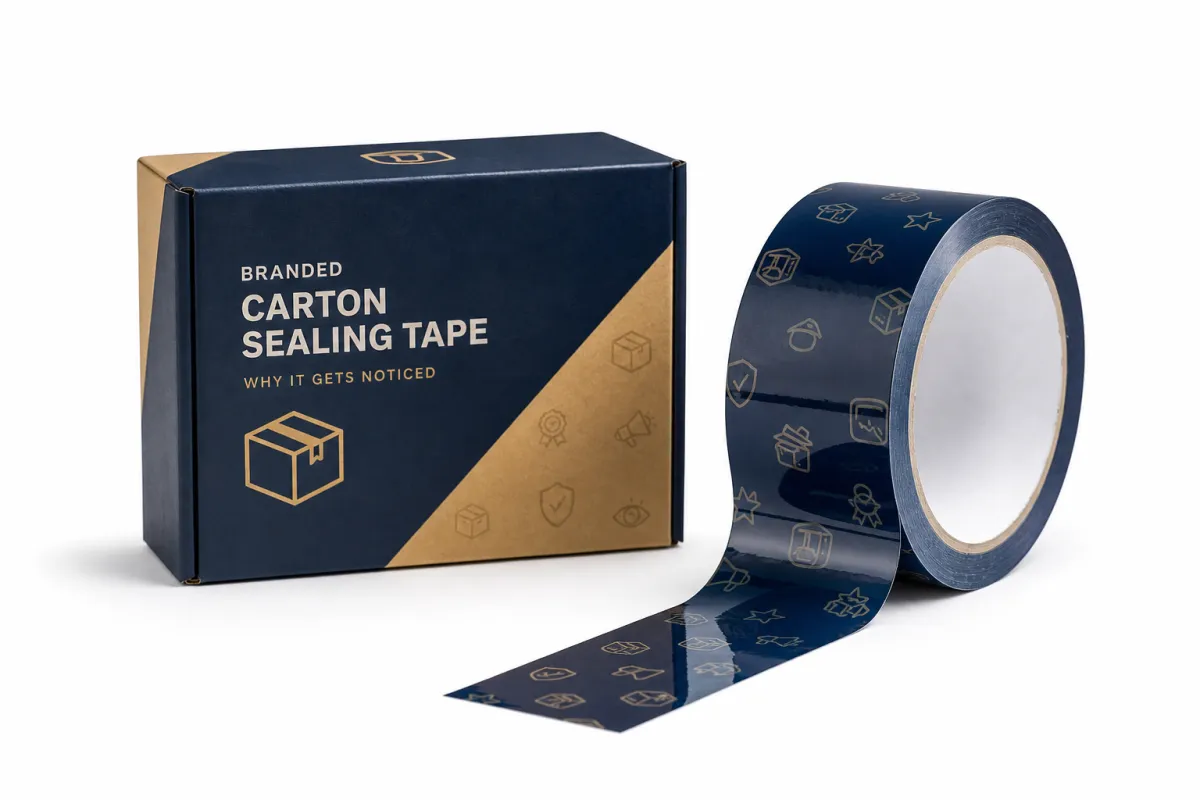
Shipping cartons have a habit of being noticed by their closure line before they are noticed by their graphics. That becomes especially true when the outer case is plain kraft or white corrugate and the tape is the only branded element on the outside. In that setting, branded carton sealing tape becomes the first cue for recognition. It lands exactly where the package is opened, stacked, handled, photographed, and passed from one set of hands to another.
That matters because perceived value is rarely created by large graphics alone. It is built through repetition, consistency, and the small details that tell a customer the brand cares about presentation. A strip of printed tape can make a standard shipping carton feel more intentional, more organized, and more complete. Even a simple pack can gain a better unboxing feel when the closure line is handled thoughtfully.
The use cases are easy to picture. E-commerce brands want the customer to know the parcel came from them, not from a generic fulfillment operation. Subscription boxes need a repeatable moment of brand recognition without adding complexity to the carton itself. Retail replenishment programs need cases that can move through stockrooms while still looking orderly. In each of those settings, branded carton sealing tape carries branding and practical function at the same time.
"The box can stay plain, but the tape still has a job to do: identify the shipment, seal the case, and show that somebody paid attention to the details."
That last piece is easy to overlook. A lot of packaging discussions center on the carton board or the printed shipper, while the tape gets less attention even though it often receives more hand contact than any other exterior component. Warehouse staff see it first. Customers tear through it first. Receiving teams use it as a quick visual cue when cases are being sorted. So when brands ask whether branded carton sealing tape is worth the effort, the better question is where else they can buy that much repeated visibility on such a small surface.
It also creates a practical distinction. Two cartons of the same size and construction can look completely different on a conveyor or pallet if one uses plain tape and the other carries a bold logo repeat. That difference can support carton sorting, reduce mix-ups, and strengthen brand recognition without adding another label or insert. That is one reason packaging teams keep returning to branded carton sealing tape after testing more elaborate ideas that looked good in theory but were harder to run in practice.
I have seen teams spend weeks polishing a box print, then end up with a plain seal tape choice that undercuts the whole package. A better tape spec does not need to be flashy. It just needs to show up reliably, every single time, and kind of quietly do the job.
How Branded Carton Sealing Tape Works on the Line
The workflow is straightforward. The carton is packed, the flaps are folded, and the tape is applied by hand, with a dispenser, or through a semi-automatic case sealer. The print shows immediately on the finished case. If the process stays consistent, branded carton sealing tape turns every sealed carton into a repeatable brand touchpoint without adding a separate labeling step.
That simple sequence hides a fair amount of material choice. A buyer might select paper-based tape, polypropylene, PVC, acrylic, hot-melt, or water-activated constructions depending on how the tape needs to behave. Each option changes the outcome. Paper constructions often suit brands that want a more natural look. Polypropylene is common where everyday case sealing and cost control matter. PVC can give a quieter unwind and a different handling feel. Water-activated tape is often chosen when the brand wants a fiber-forward appearance and strong carton bonding, especially on recycled board. The right version of branded carton sealing tape depends on the carton, the temperature, the application method, and the visual goal.
Adhesion is where theory meets the real line. A tape that looks excellent on a roll can behave very differently on dusty corrugate, on low-energy recycled board, or on cartons that have spent time in a cold storage area before packing. If the adhesive does not wet out properly, the edge can lift or the seal can weaken during transit. The package does not care how polished the mockup looked. It only responds to surface energy, pressure, and dwell time. Good branded carton sealing tape has to respect all three.
Application method matters for the same reason. Hand-applied lines are often easier to change over, but they depend heavily on operator consistency. Semi-automatic sealers move faster and reduce variation, yet they need the right tape width, roll diameter, core size, and unwind behavior. If the tape feeds poorly, the line slows down. In that sense, branded carton sealing tape is not only a print decision. It is also a machine-compatibility decision.
There is another layer of value that often gets missed: information control. Printed tape can help warehouse teams identify SKUs, production runs, or outbound channels when the cartons themselves look nearly identical. That can reduce mix-ups in facilities that use the same box size for multiple product families. It also helps in partial packs, kitting operations, and high-volume fulfillment zones where a quick visual check carries real operational value.
For brands with more demanding transit needs, package testing is worth the effort. The ISTA test methods offer a helpful reference point when comparing how different box-and-tape combinations respond to vibration, drop, and compression. I would not treat those standards as a final answer, but they do give buyers a more disciplined way to evaluate branded carton sealing tape before moving into regular production.
Key Factors That Affect Performance and Branding
Not every tape spec behaves the same, and the wrong assumption can create expensive problems. The carton itself is usually the place to start: board grade, flute type, recycled content, coating, and surface dust all affect how well branded carton sealing tape bonds. A heavier case with a rough recycled surface may need stronger adhesion than a light retail shipper. A coated carton may respond differently than a raw kraft box. Even the same tape can act differently on a fresh corrugate run than on cartons that have sat in a humid storage area for a few days.
The shipping environment adds another layer. Cold rooms, freezer-adjacent packing, high humidity, dusty warehouses, and long transit cycles all push the seal in different directions. If the tape sees temperature swings, the adhesive may need more dwell time or higher initial tack. That is why the most dependable branded carton sealing tape decisions come from testing on the actual carton stock rather than on a generic sample board.
Brand visibility versus coverage
Logo scale matters more than many teams expect. A repeat that looks bold on a flat art board can fade once it wraps around the seam of a carton. The repeat length should be checked against the box width, flap overlap, and the visible panel after folding. In many cases, a strong one-color logo performs better than a crowded multi-color layout because it reads faster from a distance. branded carton sealing tape is a small canvas, and clarity usually wins over busy artwork.
Print coverage deserves the same kind of attention. Heavy ink can look striking, but it can also raise cost and create more sensitivity to color variation from run to run. A simpler design with more negative space can feel more premium than a dense pattern. That is especially true on kraft cartons, where a high-contrast print can sit naturally on the surface instead of fighting it.
Function first, then decoration
Here is where many teams misstep: they design the tape as if it will only ever be seen in a clean mockup. Real cartons fold, crease, compress, scuff, and collect dust. If the strip sits too close to a flap edge, it can break at the hinge. If the repeat is too small, the branding can disappear into the seal line. If the adhesive is too aggressive for a lower-quality surface, the tape can tear board fibers or make rework harder. A good branded carton sealing tape specification has to survive the line, the truck, and the receiving dock.
One useful way to think about the choice is simple: the tape should solve at least two problems. It should close the carton reliably, and it should carry the branding role without making operations harder. When those two goals line up, the result feels obvious. When they do not, the hidden costs show up later as line stoppages, damaged cartons, or a disappointing customer experience.
Sustainability can also shape the decision, especially for brands that want packaging aligned with broader material goals. Some buyers prefer paper-based constructions or certified fiber sourcing. If that is part of the brief, the FSC framework can help clarify responsible sourcing for fiber-based materials. Performance still needs to come first, because a responsible material choice is not helpful if the tape fails on the carton.
Noise and unwind are smaller details that turn out to matter a great deal. In a busy fulfillment area, a tape that screams off the roll is more than an annoyance. It can wear on operator comfort over a full shift, and comfort affects consistency. That is not a luxury concern. It is a production concern. Branded carton sealing tape that feeds cleanly, cuts neatly, and holds consistently is easier to standardize across shifts and facilities.
There is also the matter of color consistency. A rich black or deep red can look excellent on the first sample, then shift slightly across reprints if the substrate, ink load, or curing conditions change. That is normal in print production, but it means brand teams should approve against a physical sample whenever possible. Screen images are useful, yet they do not tell you how a roll will really look in a bright warehouse light.
Branded Carton Sealing Tape Production Steps, Timeline, and Lead Time
Production starts with artwork preparation. The supplier needs a clean file, a clear repeat size, and confirmation of the brand colors. Proofing comes next. That is the point where many schedules drift, because the proof is the first time logo scale, repeat spacing, and print placement can be judged against the real tape format. For branded carton sealing tape, the proof stage is not just paperwork. It is the moment when misunderstandings can still be corrected before they turn into costly material.
After proof approval, setup or plates are prepared depending on the print method. The base material is sourced, the press run is scheduled, and the printed web moves through curing or drying as needed. Slitting follows, then roll winding, packaging, and final inspection. A repeat order with ready artwork may move through quickly. A new spec takes longer. That is normal, especially when the print format or adhesive structure has not been run before.
A realistic framework for many standard runs is about 12-15 business days from proof approval, though repeat orders can sometimes move faster and custom specs may take longer. First-time orders usually need extra time for artwork refinement, plate preparation, and sample signoff. Large volumes, specialty adhesives, or unusual widths can add days because the job has to be matched to the right line and the correct material lot. Branded carton sealing tape rewards early decisions. Late changes almost always cost time.
The biggest schedule risks are easy to predict:
- Artwork sent without a repeat size.
- Color expectations described only in general terms.
- Missing carton dimensions or dispenser details.
- Late changes after the run has already been queued.
- No test order on the actual carton stock.
If the goal is a smooth launch, the approval process should sit on a spec sheet instead of memory and email threads. Include tape width, roll length, adhesive type, print colors, repeat size, carton material, dispenser model, and the target application method. That way, branded carton sealing tape becomes a repeatable product instead of a one-off order that has to be rediscovered every time the brand needs a replenishment run.
Separating design approval from performance approval also helps. A mockup may look finished while the real carton test reveals lift at the flap edge or drag in the dispenser. Keeping those reviews distinct saves time because the team knows exactly what has been approved and what still needs to prove itself on the line.
For teams that manage several packaging formats, internal examples are useful before finalizing specs. Our Case Studies page is a practical place to compare how different packaging decisions play out across real use cases, especially when the same outer carton size is used for more than one product line.
Branded Carton Sealing Tape Cost, Pricing, and MOQ Basics
Cost starts with the material choice, but it does not end there. Width, roll length, print colors, shipping weight, and the quantity ordered all affect the final number. In practical terms, branded carton sealing tape usually becomes cheaper per roll as volume rises because setup fees and print preparation are spread across more units. Smaller runs carry a higher unit cost because the fixed work does not shrink just because the order is smaller.
MOQ is where many buyers get their first surprise. Minimum order quantities often sit in the low thousands for custom printed tape, although the exact floor depends on the material and print method. A simple one-color design on a standard polypropylene tape may be easier to place than a special paper construction or a multi-color print. The takeaway is straightforward: branded carton sealing tape is usually more economical when the spec is standardized.
| Tape type | Best fit | Typical MOQ behavior | Relative cost level | Operational notes |
|---|---|---|---|---|
| Printed polypropylene | Everyday e-commerce and warehouse cartons | Often the easiest to quote at moderate volumes | Lower to mid | Good for standard case sealing and clear logo repeats |
| Printed PVC | Cleaner unwind and quieter application | Usually manageable, but depends on format | Mid | Can feel more premium and handle well in manual packing |
| Printed paper tape | Brand-led packaging with a natural look | Sometimes higher because of material and process | Mid to higher | Strong aesthetic value, especially on kraft cartons |
| Water-activated printed tape | Premium shipper programs and stronger seal requirements | Frequently tied to first-run setup and volume planning | Higher | Excellent seal behavior when paired with the right carton stock |
As a practical example, a 48 mm x 50 m roll with a simple one-color print can land in a very different range than a reinforced water-activated version with broader ink coverage. The first may be relatively affordable at scale, while the second can command a premium because of material basis weight, adhesive behavior, and production complexity. For branded carton sealing tape, the only fair comparison is an apples-to-apples one: same width, same length, same adhesive, same print method.
That is where quote comparisons often start to drift. One vendor may quote a roll with one adhesive while another quotes a different adhesive that is not equivalent. One quote may include plate fees while another breaks them out. One may use a different repeat length, which changes how much branding is visible on the box. If the numbers seem far apart, check the specification line by line before deciding that one price is high or low. Branded carton sealing tape is easy to compare badly and hard to compare honestly unless the format is identical.
There are also hidden savings worth tracking. A cleaner design with fewer colors can reduce setup complexity. A standardized roll length can make ordering more consistent. A shared tape spec across several SKUs can reduce the chance of rush orders. These are not flashy savings, yet they matter in a packaging budget because they cut administrative friction and make replenishment easier to forecast.
If tighter control is the goal, ask these five questions before approving a quote:
- Is the quote based on the exact carton sealing tape construction we need?
- Are tooling, plates, or setup fees included?
- Does the price change if we simplify the artwork?
- What is the MOQ for the same adhesive and print method?
- How much lead time does a repeat order usually save?
Those questions protect more than the budget. They help build a better purchasing habit. Over time, that is what makes branded carton sealing tape dependable instead of mysterious.
One thing I tell buyers early on: if a quote seems almost too clean, ask what is not included. A missing plate charge, an assumed roll length, or a different carton test assumption can make a quote look better than it really is. That is the kinda detail that saves headaches later.
Common Mistakes When Ordering Branded Carton Sealing Tape
The most common mistake is designing for a neat mockup instead of the real carton. On screen, the logo sits cleanly across the center seam. In the warehouse, the tape lands on a folded flap, the carton is filled a little high, and the visible area shrinks. The branding that looked bold in proof can suddenly feel too small. Branded carton sealing tape has to be designed against the actual package geometry, not an ideal flat template.
A second mistake is expecting print clarity to match a screen preview. It will not. Ink behavior, substrate color, and repeat spacing all affect how the logo reads in real life. A multi-color design that looked crisp in PDF form may print softer than expected if the contrast is weak or the repeat is too busy. Brands sometimes forget that the viewer is usually walking past a pallet, not holding a sample card six inches from their face. For branded carton sealing tape, recognition usually matters more than fine detail.
Adhesion creates trouble for another reason. A carton with dust, recycled fibers, or humidity exposure may need stronger hold than a generic sample board suggests. Operators often test on a fresh carton, approve the result, and later discover problems when the real board lot changes. That is why testing on the actual corrugated stock matters so much. If the goods are cold-chain items or the cartons are stored in a non-conditioned area, the risk rises again. The tape that behaves well at room temperature on a clean box may act very differently under production conditions.
Dispenser compatibility is another easy miss. A roll can be printed perfectly and still create headaches if the core size, outer diameter, or unwind direction does not suit the line. That can slow packing, frustrate operators, and erase the goodwill created by the branding. There is no benefit to beautiful branded carton sealing tape if it jams a hand dispenser or slips on a case sealer.
Here are the operational details worth checking before the order is placed:
- Box material and surface texture.
- Manual, semi-automatic, or automated application method.
- Expected dust, moisture, and temperature exposure.
- Roll core diameter and dispenser compatibility.
- Visible logo area once the carton is folded and filled.
One more mistake deserves its own mention: brands sometimes buy for one product line and forget that the tape may later be used elsewhere. If the seal is later applied to heavier cartons, or if the warehouse switches corrugate suppliers, the old spec may no longer be enough. The best branded carton sealing tape programs are reviewed like any other production input, not filed away after the first purchase.
Experienced packaging teams keep notes on what worked, what failed, and what changed. Small details add up. A carton stock change, a shift in humidity, or a new dispenser model can alter tape behavior enough to matter. That is not a flaw in the concept. It is a reminder that packaging lives in the real world, not in a render.
If you want to see how packaging choices translate into real output, our Case Studies page is useful for comparing formats, finishes, and operational constraints across different projects.
It also helps to keep a few photos from the pilot run. A quick snapshot of the carton seam, the tape repeat, and the final packed case gives the team a practical record the next time the spec needs a refresh. That little archive can save a lot of guesswork later.
Expert Tips and Next Steps for Better Packaging
The fastest path to better results is a small pilot on real cartons. Test one or two tape constructions, then compare seal strength, print visibility, dispenser behavior, and pack-out speed. Do not rely on a single sample strip. Use actual cartons, actual packing conditions, and the actual team that will apply the tape every day. That is where branded carton sealing tape proves itself or runs into trouble.
Keep the comparison tight. Change only one variable at a time if possible. Test a polypropylene version against a paper version with the same logo repeat. Compare a one-color design to a two-color version. Try two adhesives on the same carton stock. When the variables stay narrow, the results tell you something useful instead of leaving you with a stack of opinions and no clear direction.
A one-page spec sheet is one of the best tools a packaging team can build before the order goes live. Lock in width, length, adhesive, print colors, repeat size, carton type, dispenser format, and approved use cases. That document saves time later because repeat orders become easier to quote and easier to reproduce. It also keeps the brand protected if different departments start asking for tape across multiple packs. Once branded carton sealing tape becomes a governed spec rather than an ad hoc request, the whole process gets cleaner.
A few practical benchmarks help keep the process grounded:
- Standardize widths before experimenting with artwork.
- Keep repeats bold and readable at pallet distance.
- Use fewer colors unless the design truly needs more.
- Test on the carton stock, not on a generic sample board.
- Review storage and application conditions before signing off.
If sustainability is part of the packaging brief, align the material choice with the wider carton system. A paper-based option may fit a fiber-forward story better than plastic film, but it still has to perform. The same logic applies to any recyclable or certified substrate. The material story should support the package, not become an excuse for choosing a weak seal. That is where branded carton sealing tape can do real work: it can carry the brand, fit the production line, and still support responsible sourcing conversations when the spec is chosen carefully.
Finally, create a short review cycle after launch. Ask warehouse staff whether the roll feeds well, ask customer service whether unboxing complaints changed, and check whether the branding is visible enough on the receiving side. A two-week or one-month review is enough to catch patterns early. The goal is not perfection on day one. The goal is a tape spec that can be repeated without drama.
That is the real upside of branded carton sealing tape: once the spec is right, it keeps paying back in small ways every day. It seals cartons, supports identification, sharpens presentation, and gives a brand a visible edge without forcing a box redesign. For many teams, that is exactly the kind of packaging improvement that survives budget reviews and still feels smart after the novelty wears off.
If you are setting up a new spec, start with the carton stock, the dispenser model, and one real-line pilot. Get those three pieces right before you lock artwork or place a larger order, and the tape will do its job a lot better in the warehouse than it ever could in a mockup.
What is branded carton sealing tape used for?
It seals shipping cartons while also adding a visible brand mark on the outside of the box. Teams use branded carton sealing tape to strengthen unboxing, improve warehouse identification, and add a basic tamper cue. It is especially useful when the outer carton is plain and the tape needs to do more of the branding work.
Is branded carton sealing tape better than labels for cartons?
Usually, yes, if the goal is to seal and brand in one step. Labels are better for variable information, while branded carton sealing tape is better for repeated identity and package consistency. Many brands use both: tape for the brand layer and labels for logistics or compliance.
How long does branded carton sealing tape production usually take?
Simple reorders can move quickly once artwork and specs are approved. Custom colors, new constructions, or first-time artwork setups usually add approval and production time. The biggest schedule risks are delayed proofs, missing print specs, and late changes after the run is queued for branded carton sealing tape.
What affects branded carton sealing tape pricing the most?
Material type, print colors, roll size, and total quantity are the biggest price drivers. Setup fees and plate costs matter more on small runs because they are spread across fewer rolls. A cleaner, simpler design can sometimes lower cost without reducing the brand impact of branded carton sealing tape.
Will branded carton sealing tape stick to recycled cartons?
Usually yes, but performance depends on the carton surface, dust level, and adhesive choice. Heavier recycled board may need stronger adhesive or a different tape construction for reliable seals. Testing on the actual carton stock is the safest way to confirm adhesion before a full order, especially for branded carton sealing tape.