Buyer Fit Snapshot
| Best fit | Branded corner boards for pallets projects where brand print, material claims, artwork control, MOQ, and repeat-order consistency need to be specified before quoting. |
|---|---|
| Quote inputs | Share finished size, material target, print colors, finish, packing count, annual reorder estimate, ship-to region, and any compliance wording. |
| Proofing check | Approve dieline scale, logo placement, barcode or warning zones, color tolerance, closure strength, and carton packing before bulk production. |
| Main risk | Vague material claims, crowded artwork, missing packing details, or unclear freight terms can make a low unit price expensive after revisions. |
Fast answer: Branded corner boards for pallets: cost, fit, and use should be specified like a repeatable production item. The safest quote records material, print method, finish, artwork proof, packing count, and reorder notes in one written spec.
Production checks before approval
Compare the actual filled-product size with the drawing, then confirm tolerance on folds, seals, hang holes, label areas, and retail display edges. Reserve space for logos, QR codes, warning copy, and material claims before decorative graphics fill the panel.
Quote comparison points
Review material grade, print process, finish, sampling route, tooling charges, carton quantity, and freight assumptions side by side. A quote is only useful when the supplier can repeat the same color, closure quality, and packing count on the next order.
Branded corner boards for pallets can feel like a minor spec line right up until a crushed edge turns an ordinary delivery into a claim file. The part that gets missed is simple: the same component that keeps straps from biting through cartons can also carry a logo, a color cue, or a printed mark that shows up at receiving docks, warehouse aisles, and retail back rooms.
For a packaging buyer, branded corner boards for pallets sit in a strange middle ground. They are not glamorous, and they rarely make it into a marketing brief first. They still influence damage rates, presentation, freight efficiency, and the way a shipment looks after a long ride and a rough unload. That puts them among the few packaging items that affect operations and brand perception at the same time.
In supplier reviews, I keep seeing the same sequence: the conversation starts with the logo and ends with load resistance, moisture tolerance, and a unit cost that still works at scale. That sequence makes sense. Branded corner boards for pallets only earn their place when protection, presentation, and sourcing are treated as one decision instead of three disconnected ones.
Branded corner boards for pallets: why they matter
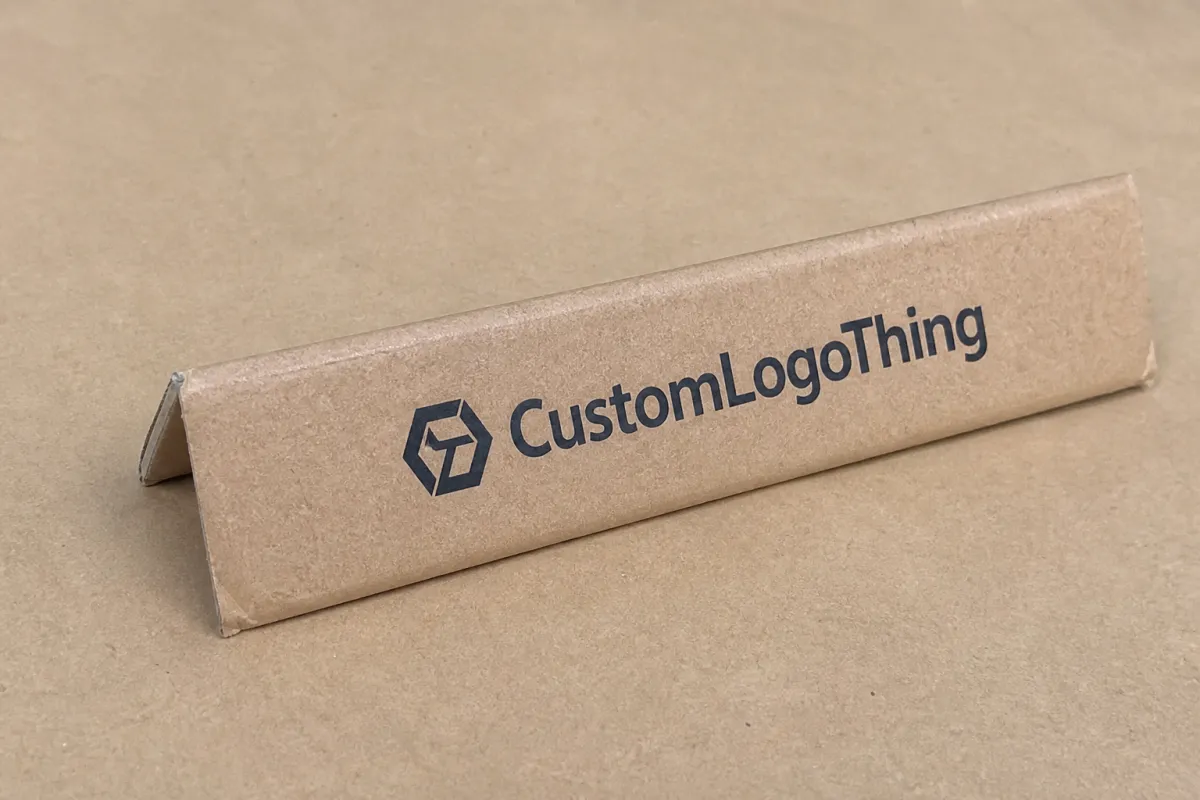
At the simplest level, branded corner boards for pallets are rigid angle pieces made from paperboard, recycled fiber board, laminated board, or a composite build that sits on the edges of a palletized load. Their job is direct: spread pressure, protect corners, and give stretch film or strapping a firm surface to press against instead of cutting into cartons or product edges.
The reason they matter is not hard to see. A pallet can look stable during wrapping, then fail after one forklift bump, one strap pulled too tight, or one corner crush during transit. The break usually starts at the edge. Once a load corner is damaged, wrap tension changes, cartons begin shifting, and the stack loses the square shape that holds everything together. Branded corner boards for pallets are one of the least expensive ways to interrupt that chain.
The branding side is practical too. A printed corner board turns a functional component into visible brand real estate. That matters at the dock, in the distribution center, and during retail replenishment, where a pallet may sit long enough for staff to notice the logo, color, or message. Good print treatment does not need to shout. It needs to stay consistent, readable, and aligned with the rest of the pack.
A packaging manager might put it plainly: if the load edges are the first thing to fail, branded corner boards for pallets are a sensible place to add discipline.
There is also a trust signal in play. A load with branded corner boards for pallets often reads as more controlled and more deliberate than a plain brown pallet build, especially in B2B supply chains where receivers see the same neutral look all day. Branding does not replace protection. It tells the receiver that the shipment was planned rather than improvised.
Standards matter here too. Distribution testing frameworks like ISTA focus on the real stresses loads face in transit, and sustainability claims are easier to defend when the board stock is backed by credible chain-of-custody or recycled-content documentation from a supplier with FSC certification or an equivalent program. Branded corner boards for pallets deserve to be judged as both an engineering choice and a communication choice.
A useful comparison point is the way freight teams think about a load: what stops movement, what protects the edges, what keeps the pallet square, and what does the receiver notice first? Branded corner boards for pallets can answer all four questions, which is why they deserve more attention than they usually get. For broader examples of how presentation and protection show up in finished packaging projects, our Case Studies are a useful reference.
How branded corner boards for pallets work
The physics are simple, but the effect is larger than the part looks. Branded corner boards for pallets create a rigid edge that resists compression from strapping, reduces the bite of stretch film, and gives a vertical load surface something stable to press against. Instead of concentrating force on a carton seam or product box corner, the pressure gets distributed over a longer, stiffer edge.
That matters because most pallet damage is not dramatic. It is repetitive. A strap gets pulled a little too tight. A film tail is wrapped a little too aggressively. A forklift shifts the pallet and the edge takes the hit. Branded corner boards for pallets can absorb that abuse in a way exposed cartons cannot, especially when thickness, length, and fiber grade match the real load profile.
Placement styles vary, and they are not interchangeable. Vertical edge boards cover the full height of the load. Shorter corner guards reinforce only the top section where strap pressure is highest. Full-height styles are common for fragile mixed loads, while partial-length guards can work for lighter unitized shipments with a consistent box stack. In some programs, branded corner boards for pallets appear only on the most visible faces, which keeps cost lower while still giving the receiver a clear brand cue.
Print methods vary more than many buyers expect. Flexographic print is common for repeat runs and cleaner unit economics. Labels can work for smaller programs or variable messaging. Preprinted liner stock gives a cleaner face if the board construction supports it. Direct color treatment or tinted board stock can also work, especially when the goal is a strong visual identity rather than detailed artwork. The right choice depends on quantity, logo complexity, and whether the job calls for one-color branding or a fuller brand panel.
Placement in the packout sequence matters too. In many operations, branded corner boards for pallets are applied after the load is stacked but before stretch wrap. If banding is used, the board should usually go in first so the strap runs against the board instead of against the carton edge. For assembled pallets that are built on a line, the board can be placed during pallet formation, but the process needs to be repeatable or the board ends up doing only part of its job.
The small detail that gets ignored most often is fit. A board that is too short leaves the corner exposed. A board that is too narrow does not spread pressure properly. A board with the wrong angle can float away from the load or shift during transport. Branded corner boards for pallets work best when the dimensions match the actual pallet build rather than an assumed standard stack. Sample testing earns its keep there.
Cost, pricing, MOQ, and quote factors
Pricing for branded corner boards for pallets usually comes down to six variables: board grade, length, thickness, print coverage, color count, and freight. If a supplier gives you only a unit price and skips the rest, the comparison is incomplete. A lighter board with more print can look cheap until it fails under strap pressure. A heavy board can look expensive until you compare it against damage savings and fewer claims.
Short runs almost always cost more per piece because setup time, print prep, and proofing get spread across fewer units. High-volume orders usually bring the unit cost down, but only after you clear the supplier's minimum run threshold. For branded corner boards for pallets, that threshold can be shaped by print method as much as by board construction. One-color runs behave differently from multi-color jobs, and digital or label-based programs follow a different cost curve than flexo.
Hidden costs distort the picture quickly. Tooling or dieline setup, artwork correction, sample shipment, revised proof rounds, and pallet configuration changes all add friction. Freight matters too. A board that looks competitive at the plant can become less attractive if it ships inefficiently because of length, stack pattern, or volume weight. That is why buying branded corner boards for pallets on a landed-cost basis usually gives a truer answer than comparing ex-works unit price alone.
| Option | Typical spec | Indicative price at 5,000 units | Best fit |
|---|---|---|---|
| Standard kraft angle | 3/4 in x 3/4 in legs, mid-range board weight | $0.18-$0.28 per piece | General pallet stabilization with basic protection |
| Printed branded angle | Single-color or two-color flexo print | $0.24-$0.38 per piece | Visible branding with moderate protection needs |
| Heavy-duty laminated board | Thicker build, stronger compression resistance | $0.32-$0.55 per piece | Heavier loads, tighter strap pressure, longer transit |
| Premium presentation board | Preprinted liner, color treatment, cleaner finish | $0.40-$0.75 per piece | Retail-facing or high-visibility shipments |
Those figures are directional, not universal. They still help frame the real question: what does each pallet cost to protect? A board at $0.30 can look more expensive than a board at $0.20 until you factor in a crushed corner, a repack event, or a chargeback. On many programs, branded corner boards for pallets pay for themselves by cutting even a small share of damage events.
When you request quotes, ask for multiple thicknesses and lengths side by side. Ask whether the print price changes with coverage or number of colors. Ask if freight is included or added later. Ask whether the supplier has a sample policy and whether the sample is production-grade or only a visual mockup. If you compare branded corner boards for pallets using the same assumptions, the price differences become easier to read. If the assumptions change from quote to quote, the cheapest line item may not be the best option.
It also helps to budget against the whole pallet program. If one load uses four corners and another uses six, the unit price matters less than the cost per protected pallet. That shift in thinking is small on paper and big in practice. Branded corner boards for pallets should be priced as part of load integrity, not treated like a decorative accessory with a freight bill attached.
Production process and timeline for custom boards
The production path for branded corner boards for pallets usually starts with a short requirements brief. A supplier needs the board dimensions, the expected pallet height range, the weight of the load, the print artwork, and any special handling concerns such as moisture exposure or strap tension. If the brief is vague, the quote will be vague too. A precise brief tends to move the rest of the process faster.
Artwork review comes next, and this is where many delays begin. Low-resolution logos, color-matching requests without reference files, and last-minute layout changes can push everything back by days. If the board will carry a brand mark, the logo should be supplied in a clean vector format whenever possible. That saves production time and lowers the risk that branded corner boards for pallets arrive with fuzzy lines or uneven print density.
After the artwork, the structure needs approval. Buyers sometimes focus only on print, but the board geometry matters more than the graphics. Length, leg width, thickness, and angle all affect how branded corner boards for pallets perform under pressure. A sample that looks correct on a desk may still be the wrong fit for the actual load, especially if the pallet stack varies by SKU or case count.
Realistic lead times often move in stages. Artwork proofing might take one to three business days if files are ready. Sampling can add a few more days, especially if a physical sample has to ship. Production itself may take around 10 to 15 business days after final approval, depending on line availability and print complexity. Freight adds its own clock. Rush programs are possible, but they become risky if the load spec is still changing while the boards are already in production.
The timeline is not just manufacturing time. It is decision time. The more finished the brief, the faster branded corner boards for pallets can be approved and released. That is why the strongest vendors ask pointed questions early. They are not slowing the process. They are preventing a rework cycle that would cost more later.
For teams that want evidence before scaling, a sample run should be tied to a real pallet build. Test it with the actual carton mix, actual strapping method, and actual stretch-wrap pattern. Then document the results. That kind of trial tells you more than a desktop approval ever will. If you need examples of how operational details affect finished packaging choices, our Case Studies are a good starting point.
Step-by-step buying guide for branded corner boards for pallets
Start with the load profile. How heavy is the pallet? How tall is it? Does it stack? Are the corners brittle, rounded, or exposed? Will the shipment move by forklift, conveyor, or manual handling? Those questions shape the spec for branded corner boards for pallets more than any logo choice does. Protection needs should set the baseline first.
Then choose the board dimensions around the highest-risk point on the load. If the top carton edge is vulnerable, the board should reach beyond that point. If strap pressure is concentrated in one area, the leg length and thickness should be enough to spread that force without crushing the cases underneath. In many programs, branded corner boards for pallets are sized to the tallest critical edge rather than the nominal pallet height.
Only after the structural spec is settled should you move to print and placement. That sequence matters because branding can tempt teams to over-specify a nicer-looking board that does not add real value. A cleaner print on the wrong board is still the wrong board. A slightly simpler print on the right board usually wins because branded corner boards for pallets have to survive the same handling as the load they protect.
A practical supplier checklist keeps the comparison honest. Ask for sample availability, quote tiers by quantity, lead-time commitments, print method, recycled-content or FSC documentation if that matters to your customer, and a written description of the board construction. Ask how the board behaves under banding, stretch wrap, and stacking pressure. If the supplier cannot answer those questions clearly, that tells you something too.
Standardization helps more than many teams expect. Most operations do not need twenty corner-board sizes. They need three or four sizes that fit the most common pallet builds. Standardizing branded corner boards for pallets reduces inventory confusion, simplifies reordering, and makes quotes easier to compare because the assumptions stay stable. That kind of discipline matters even more if your load mix changes at the SKU level but not at the pallet geometry level.
One more habit pays off: compare two quotes using the same pallet assumptions. Same height. Same quantity. Same print coverage. Same freight term. Same sampling requirement. Without that discipline, a quote can appear cheaper simply because it leaves one of those pieces out. Branded corner boards for pallets are easy to misprice if you compare them as isolated parts instead of as part of a pallet protection system.
If you are narrowing down suppliers, ask for one sample that matches the current pallet build and one sample that reflects the most fragile load in the range. That tells you whether the spec has enough margin. Review the results with packaging, operations, and procurement together. The best decision is usually the one that keeps branded corner boards for pallets strong enough for the load, simple enough to reorder, and visible enough to carry the brand cleanly.
Common mistakes when sourcing pallet corner boards
The first mistake is undersizing. A board can feel sturdy in hand and still be too short, too thin, or too soft for the actual pallet load. That happens because a sample on a desk does not experience strap compression or forklift impact. Branded corner boards for pallets need to be chosen against the real physical load, not against a guess or a quick visual impression.
The second mistake is print-first thinking. I see this often: a team picks the nicest-looking graphic treatment before deciding whether the board construction can survive shipment. That is backwards. Branded corner boards for pallets are not a poster. They are a load-bearing protective component with a branding layer on top. If the structure is weak, the print quality does not matter for long.
The third mistake is comparing quotes that are not actually comparable. One supplier may quote a heavier board, another may quote a shorter leg, and a third may include freight or tooling while the others do not. Suddenly the cheapest option is not the same product. Branded corner boards for pallets create false savings if the spec is not written tightly enough. If the quote language is loose, the final result will be loose too.
The fourth mistake is over-customizing a board that needs to be replenished quickly. Beautiful custom options are attractive, but if the pallet formats change every few months, a highly specific board can create inventory waste or trigger delays when the load spec shifts. In those situations, branded corner boards for pallets work better as a modular system: a few standard sizes, a consistent print zone, and a clear reorder path.
There is also a sustainability trap. Some buyers ask for recycled content or recyclable fiber, which is sensible, but then forget to ask how the board behaves after print, coating, or lamination. If the finish undermines recovery or creates avoidable waste, the claim becomes harder to support. For that reason, branded corner boards for pallets should be evaluated against the full material build, not just the headline fiber content.
If you want a more disciplined sourcing process, treat every sample as both a performance test and a documentation test. Can the supplier explain the board grade? Can they show the print method? Can they confirm whether the board is FSC-certified or otherwise documented? Can they tell you how repeat orders are controlled so the next batch matches the first? Those questions separate a workable program from a fragile one.
Expert tips for better performance and cleaner sourcing
Test with a real load before scaling. That sounds obvious, but many teams skip it because the board appears fine on paper. Then the warehouse exposes the weakness: the wrap bites too hard, the strap settles into the edge, or a corner collapses during outbound staging. Branded corner boards for pallets are best validated under actual handling conditions, not in a slide deck.
Standardize the most common sizes first. A small set of board lengths and heights is easier to keep in stock, easier to reorder, and easier to explain internally. It also helps suppliers quote more cleanly because they are not pricing one-off dimensions every time. In practice, branded corner boards for pallets become far easier to manage once the operation has two or three approved specs instead of a long list of exceptions.
Get the construction details in writing. Ask for board thickness, leg dimensions, flute or board composition if relevant, print method, coating, and any handling limits. That written record matters because reorders can drift over time. A supplier may assume the previous job should be repeated exactly, while your team assumes the spec is already locked. Written specs protect branded corner boards for pallets from that slow drift.
Coordinate procurement, packaging, and operations before you approve the final buy. Procurement wants price discipline. Packaging wants performance. Operations wants something quick to place and easy to store. Brand wants a clean face. Those goals do not always line up, so the discussion should happen early. When branded corner boards for pallets are aligned across those teams, the result is usually simpler, cheaper to run, and more reliable in transit.
For sustainability claims, be precise. If the board uses recycled fiber, say so only if you can document it. If it carries FSC certification, make sure the supplier can support that claim. If the board is intended to improve transport efficiency by reducing damage, describe that as a performance benefit rather than a vague environmental promise. Clarity is easier to defend and easier to repeat.
My practical takeaway is straightforward. Branded corner boards for pallets should protect the load first, support the brand second, and fit the supply chain third. If a board fails any one of those three tests, keep looking. If it passes all three, you have something worth standardizing, documenting, and reordering with confidence. For most packaging teams, that is the real win: branded corner boards for pallets that are strong enough for the pallet, visible enough for the customer, and disciplined enough for the budget.
The next move is concrete. Measure the pallet build, request samples that match the real load, and compare two quotes using the same size, print, freight, and sampling assumptions. That keeps branded corner boards for pallets grounded in facts instead of guesses, which is usually where the better purchasing decision starts.
Frequently asked questions
How do branded corner boards for pallets reduce shipping damage?
They reinforce vulnerable edges, spread strap and wrap pressure, and help prevent crushed corners during transit and warehouse handling. Branded corner boards for pallets work best when the board height, thickness, and leg width match the actual load and palletizing method, because the protection comes from fit as much as from material strength.
What affects the price of branded corner boards for pallets most?
Material grade, dimensions, print coverage, quantity, and freight usually matter most. Setup charges and sample costs can make small runs look expensive even when unit pricing is strong at scale. If you want a clean comparison, ask suppliers to quote branded corner boards for pallets with the same size, same print method, and same freight assumptions.
What MOQ is typical for custom branded corner boards?
MOQ varies by manufacturer, but custom print usually requires enough volume to justify setup and run efficiency. Some suppliers are comfortable with smaller quantities if the print is simple, while others need larger volumes to price branded corner boards for pallets efficiently. Ask for multiple quote tiers so you can see where unit cost improves as quantity increases.
How long is the lead time for branded corner boards for pallets?
Lead time depends on artwork approval, sampling, and production queue length. In many cases, production lands in the 10 to 15 business day range after final approval, with extra time for proofing and freight. Rush jobs are possible, but they are safer when the size and print layout are already finalized for branded corner boards for pallets.
What should I ask before approving a quote for branded corner boards for pallets?
Confirm board size, thickness, print method, MOQ, sample policy, freight terms, and whether the quote includes artwork setup. Also ask how the board performs under banding, stretch wrap, and stacking pressure for your exact load type. The best quotes for branded corner boards for pallets are the ones that make the spec, the cost, and the performance assumptions visible before you sign off.