Buyer Fit Snapshot
| Best fit | Branded Folding Cartons Wholesale for Eco Packaging projects where brand print, material claims, artwork control, MOQ, and repeat-order consistency need to be specified before quoting. |
|---|---|
| Quote inputs | Share finished size, material target, print colors, finish, packing count, annual reorder estimate, ship-to region, and any compliance wording. |
| Proofing check | Approve dieline scale, logo placement, barcode or warning zones, color tolerance, closure strength, and carton packing before bulk production. |
| Main risk | Vague material claims, crowded artwork, missing packing details, or unclear freight terms can make a low unit price expensive after revisions. |
Fast answer: Branded Folding Cartons Wholesale for Eco Packaging should be specified like a repeatable production item. The safest quote records material, print method, finish, artwork proof, packing count, and reorder notes in one written spec.
Production checks before approval
Compare the actual filled-product size with the drawing, then confirm tolerance on folds, seals, hang holes, label areas, and retail display edges. Reserve space for logos, QR codes, warning copy, and material claims before decorative graphics fill the panel.
Quote comparison points
Review material grade, print process, finish, sampling route, tooling charges, carton quantity, and freight assumptions side by side. A quote is only useful when the supplier can repeat the same color, closure quality, and packing count on the next order.
Branded Folding Cartons wholesale looks like a packaging line item. It is not. It changes how the product feels the second someone picks it up. The carton is usually the first real touchpoint, and people make fast judgments off that moment. Premium. Practical. Cheap. Sloppy. Packaging sets the tone before the product gets a chance to speak.
Brands moving away from plain mailers or generic outer boxes usually feel the difference right away. A printed carton upgrades shelf presence, improves pack-out, and trims dead space without forcing the product into a giant shipper that chews through freight. With the right spec, branded Folding Cartons Wholesale also makes repeat ordering predictable. That matters more than the glossy mockup. Pretty pictures do not save you from a bad dieline.
Wholesale buying only works when the spec is settled before production starts. Size, board grade, print coverage, and finish all affect the unit price. Change those after the quote and the number changes too. Factories do not absorb chaos for fun. If the goal is strong presentation, efficient packing, and reorder pricing that stays put, branded folding cartons wholesale is the right lane.
A carton that fits cleanly and prints sharp does more than hold a product. It tells the buyer the brand paid attention.
Branded Folding Cartons Wholesale: Why Buyers Notice
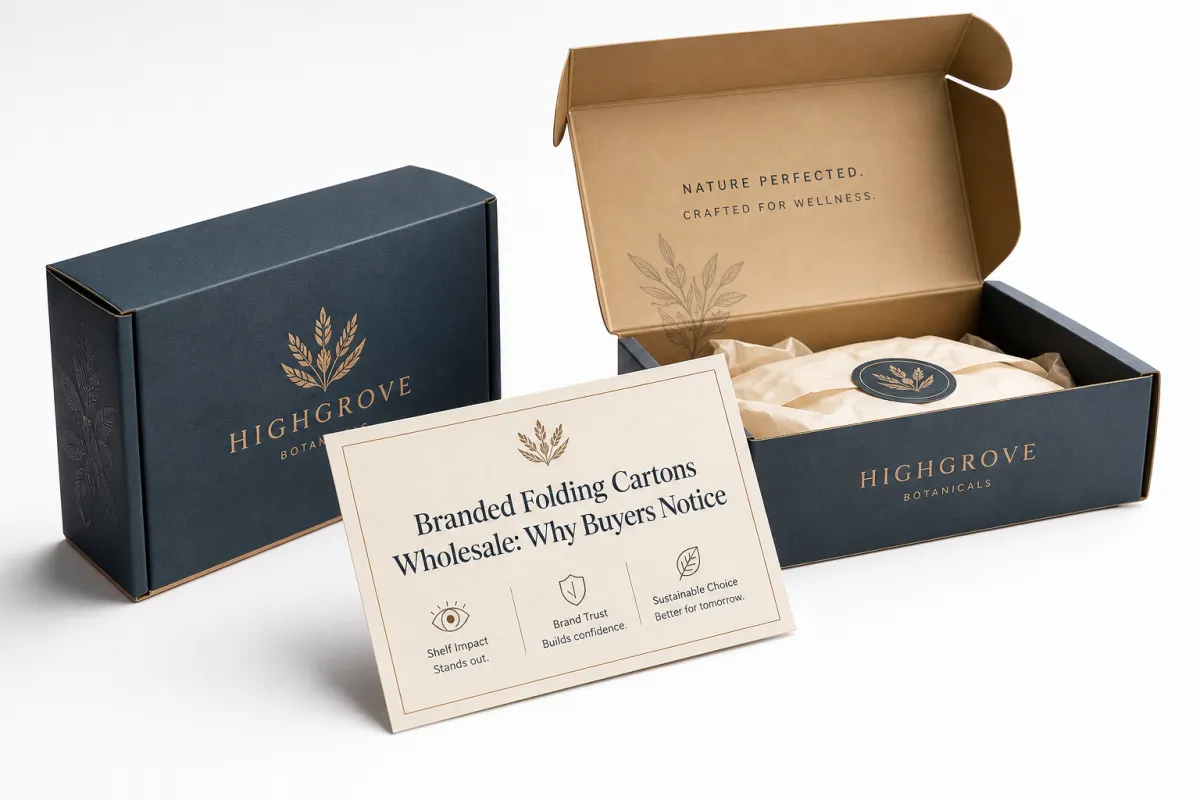
Branded folding cartons wholesale gets attention because the carton carries both the structure and the message. It holds the logo, the color system, compliance copy, and the product story on the surface people touch before they even see what is inside. That gives it more influence than a plain shipper that gets tossed aside. A folding carton stays visible on a shelf, in a shipping stack, or in an unboxing pile long enough to matter.
People usually judge the fit first. Not the slogan. Not the brand manifesto. If a carton looks loose, bent, or overstuffed, the product feels less intentional. If the folds land square and the print lines up properly, the brand looks established. I have watched buyers forgive a simple design and still reject it because the edges looked tired or the panels sat crooked. That is how quick the judgment is. So yes, branded folding cartons wholesale matters even for small products. The box does not need to be fancy. It needs to look like someone cared.
A common shift goes like this. A brand starts with plain mailers or unprinted shippers, then moves into Printed Folding Cartons for retail and direct-to-consumer orders. The product stays the same. The presentation changes everything. The box gets flatter in transit, easier to stack, and easier to merchandise. branded folding cartons wholesale supports that move without stuffing the brand into a packaging format that wastes warehouse space.
Wholesale pricing improves once the artwork, structure, and board are locked. Setup, die cutting, and print prep spread across more units. That is why a 1,000-piece run usually costs more per carton than a 5,000-piece run with the same spec. With branded folding cartons wholesale, the buyer who finalizes the dieline early usually gets the cleaner price and fewer headaches.
Sustainability matters too, though the marketing copy around it often gets ridiculous. Flat-shipped cartons save storage space, cut outbound freight volume, and keep material from sitting around waiting for use. That is useful when warehouse space is tight or replenishment happens often. When a brand chooses branded folding cartons wholesale with recycled board or FSC-certified stock, the sustainability story is visible and easy to explain. Better than vague green language nobody can verify.
- Retail value: sharper shelf presence and cleaner product presentation.
- Operations value: flat-packed cartons use less storage space than pre-assembled packaging.
- Cost value: repeatable wholesale pricing becomes easier once the structure is fixed.
- Brand value: print space gives you room for logos, claims, and regulatory details in one place.
Most buyers are not chasing luxury just to feel fancy. They want packaging that looks good, packs fast, and does not waste space at the dock. That is the real business case for branded folding cartons wholesale.
Product Details That Make the Format Work
Branded folding cartons wholesale works because the format is flexible. One structure can cover a wide range of products as long as the dimensions and closure style fit the item. A tuck-end carton works well for lightweight cosmetics, supplements, and small consumer goods. An auto-lock bottom carton handles heavier products better because the base carries more load and closes more securely. Sleeve cartons add a premium layer without forcing a full box redesign, and window cartons let the buyer see the product while still carrying brand graphics.
The print surface does more than hold a logo. It carries product names, claims, ingredients, warnings, barcodes, and the brand story in one compact space. That makes artwork planning a real job instead of a creative afterthought. A smart branded folding cartons wholesale program leaves room for legal copy and SKU variation without turning the carton into a crowded wall of text. Good packaging design is not about filling every inch. It is about using the front panel to pull the eye and the side panels to back up the sale.
Different channels can run the same base format. Retail shelves need stronger shelf appeal. Subscription kits need consistent pack-out and less void space. Influencer mailers need a carton that photographs well and arrives flat. Direct-to-consumer shipments need something that stacks efficiently. branded folding cartons wholesale matters because it bridges those uses with one structure family instead of forcing the brand into a different carton for every channel.
Fit is where a lot of projects go sideways. A carton that is too large wastes board and rattles in transit. A carton that is too tight creates assembly problems and can crush the product. Internal dimensions should account for the item, any insert, and protective wrap. If the spec is based only on the outer size in your head, the run can drift off target fast. That is not a creative problem. It is a measurement problem. And branded folding cartons wholesale punishes measurement problems quickly.
The usual mistakes are boring, which is exactly why they keep showing up. Oversized cartons burn material. Weak closures hurt shelf confidence. Artwork with too little bleed causes trim issues. Vague instructions slow proof approval. Most of those problems disappear once the buyer gives the supplier product dimensions, pack-out method, finish preferences, and regulatory copy before quoting starts. That is the unglamorous part of branded folding cartons wholesale, and it matters more than the mockup on a mood board.
One more detail gets ignored far too often: how the carton behaves on the line. If the locking tabs are awkward, packers lose time. If the fold lines are too stiff for the board, the carton cracks at the crease. A packaging buyer should ask about assembly behavior, not just appearance. A carton that looks great but slows production is bad packaging. Full stop.
Materials, Finishes, and Structural Specs
Branded folding cartons wholesale depends on board choice more than many buyers expect. SBS paperboard gives a clean, premium print surface with strong color reproduction. Kraft board gives a more natural presentation that fits wellness, food, and eco-forward brands. Recycled board supports a sustainability story that is easy to defend, especially when the buyer wants a visibly lower-impact package without changing the structure.
Thickness matters too. Lightweight retail products often work with 14pt to 18pt board. Moderate products usually move into 18pt to 24pt. Heavier or fragile products may need 24pt to 28pt or a stronger structure with locking bottoms and inserts. There is no magic number. The right board depends on product weight, shipping stress, and how much stiffness the carton needs to hold a crisp face on shelf. If you are comparing branded folding cartons wholesale quotes, ask what board each supplier is quoting, not just the unit price.
Finish choices change the feel immediately. Matte keeps the look restrained and modern. Gloss makes color pop and can help with saturated graphics. Soft-touch gives a smoother, more tactile surface, but it adds cost and may show scuffs differently depending on the coating. UV coating can protect high-touch areas and improve durability. Foil, embossing, and spot effects add shelf appeal, though each one brings setup time and extra spend. A good branded folding cartons wholesale spec balances visual impact with the reality of the budget.
If recycled content and chain-of-custody matter, ask for FSC-certified materials instead of assuming every eco claim means something. That certification does not make the carton perfect, but it does provide a traceable standard buyers can verify. In a market crowded with vague green labels, that helps. A lot.
Print methods also affect cost and consistency. Digital printing works well for smaller runs, multiple SKUs, and frequent artwork changes. Offset printing usually fits larger wholesale quantities better because the per-unit cost drops once setup is spread across the run. If your branded folding cartons wholesale program has seasonal artwork, digital may save money upfront. If the graphics stay stable and the volume is real, offset usually wins on unit economics.
- SBS board: best for sharp color, crisp branding, and a premium retail feel.
- Kraft board: best for a natural look and a more obvious eco presentation.
- Recycled board: best when the sustainability story needs to be visible and easy to prove.
- Soft-touch or matte coating: best when you want a restrained, tactile finish.
- Foil, emboss, window cutout: best when shelf differentiation matters enough to justify the extra setup.
Finish choice also affects reorders. A soft-touch carton with foil and a custom window is not just more expensive to produce. It is also less forgiving if the artwork changes later. Standard matte or aqueous-coated cartons are easier to repeat at scale. Experienced packaging teams keep some SKUs simple and save premium treatments for products that actually need them. That is the kind of boring discipline that keeps budgets from wandering off.
Branded Folding Cartons Wholesale Pricing, MOQ, and Savings
Branded folding cartons wholesale pricing is driven by more than quantity. Size, board grade, color count, finish level, window cutouts, and production method all matter. A small carton with full-coverage printing may cost less than a larger carton with foil and embossing, but not by much if setup complexity climbs. Buyers who compare only unit price without checking spec detail usually end up comparing apples to a forklift.
The MOQ pattern is pretty simple. Smaller runs carry a higher per-unit cost because setup is spread across fewer pieces. Larger wholesale orders lower the unit price once tooling, proofing, and print prep are absorbed. In many programs, the first serious pricing break shows up around 1,000 to 3,000 units, and another better rate appears at 5,000 or more. That does not mean every project should chase volume for the sake of volume. It means branded folding cartons wholesale should be priced at more than one quantity so the buyer can see the real break point.
| Spec Tier | Typical Structure | Best Use | Typical Unit Price at 5,000 Units | Notes |
|---|---|---|---|---|
| Entry | 18pt kraft or SBS, one-color print, tuck-end | Light products, simple retail needs | $0.18-$0.28 | Lowest setup burden; good for straightforward branded folding cartons wholesale runs |
| Mid-range | 18pt-24pt SBS, full-color print, matte or aqueous coating | Cosmetics, supplements, small consumer goods | $0.24-$0.40 | Best balance of shelf appeal and cost control |
| Premium | 24pt board, soft-touch, foil, emboss, or window cutout | Giftable products, high-margin SKUs | $0.42-$0.85 | Higher visual impact, higher setup complexity, less flexibility on revisions |
| Custom structural | Special dieline, inserts, locking features, mixed finishes | Fragile or unusual product shapes | Quoted case by case | Requires more prepress review and usually a sample approval stage |
Those ranges are not fantasy pricing. They are the kind of numbers a buyer can actually use to budget. A simple carton with limited print coverage sits at the low end. A premium carton with multiple finishes moves up quickly. If the project includes rush production, artwork revisions after proofing, or a nonstandard dieline, the quote rises. That is normal. It is also why branded folding cartons wholesale projects should be scoped before anyone asks for final pricing.
Hidden costs are where margins leak. Late copy changes force new proofs. A nonstandard size may require a custom die. Decorative effects add setup and run time. If the carton must be glued, pre-assembled, or packed in a special pallet pattern, labor rises too. A cheap quote that ignores those items is not cheap. It is incomplete. Branded folding cartons wholesale should be compared on the full job, not just the press sheet.
If you want to reduce cost without flattening the brand, start with standard carton dimensions, keep artwork on one or two panels, and repeat the same board spec across related SKUs. That saves tooling and makes reorders easier. It also lowers the chance that a second run drifts away from the first. In wholesale packaging, consistency is money. More exactly, inconsistency is what eats the money.
A low quote that falls apart in proofing is not a low quote. It is a future problem with a prettier number.
Many buyers save money by splitting the spec into tiers. Use a clean, practical carton for the core line and reserve premium finish options for hero products or seasonal sets. That approach keeps branded folding cartons wholesale pricing under control while still giving the brand a strong visual point of view where it matters. It is a little less romantic than making every box sparkle, but it usually works better.
Ordering Process, Proofing, and Timeline
Branded folding cartons wholesale moves in a predictable sequence if the buyer brings complete information. The usual flow is quote request, dieline confirmation, artwork upload, proof review, production, finishing, and shipment. Simple enough. The part that slows everything down is usually the input, not the machine. Missing measurements, low-resolution art, or late copy changes can turn a tidy schedule into a mess.
A good supplier should ask for product dimensions, target quantity, print sides, finish preference, and any special requirements before locking the price. If the carton needs to fit a bottle, jar, device, or accessory, include the actual sample or a precise measurement sheet. That saves time during structural review. For branded folding cartons wholesale, a few careful minutes up front are worth far more than a rushed reprint later.
Proofing usually has two layers. A structural proof checks the dieline, fold behavior, and fit. A print proof checks color placement, copy accuracy, barcode legibility, and regulatory text. Structural work can take a few days, especially if the carton needs insert changes or tab adjustments. Print proof approval depends on how fast the brand responds. If the artwork is ready and the feedback is clear, the project moves. If three departments need to weigh in on a paragraph of legal copy, the schedule stretches. That is not mysterious. It is just business being business.
Most wholesale carton jobs need a few weeks once the proof is approved. Simple runs can move faster. Custom shapes, specialty finishes, or multiple SKUs take longer. A common planning window is 3-7 business days for sampling or proof development, then about 10-15 business days for production after final approval, though more complex projects can run longer. That is a practical range for branded folding cartons wholesale, not a promise carved in stone.
For shipping validation, ask whether the carton spec has any transit testing behind it. If the packaging is going into e-commerce or rough handling channels, match the structure to the relevant ISTA transit testing expectations. The press sheet is not a drop test. If the product is fragile, expensive, or oddly shaped, that testing step is sensible insurance.
Logistics matter too. Confirm whether the cartons need to arrive flat-packed or pre-assembled, how many cartons belong on a pallet, and whether the delivery site has dock access. Flat-packed cartons usually save freight and storage space, which is one reason branded folding cartons wholesale stays popular with brands that need to manage warehouse space carefully.
The rule that keeps projects clean is simple: measure twice, approve once, and do not treat the proof like decoration. Once production starts, every correction costs time.
What usually slows a job down
Missing dieline dimensions, low-resolution artwork, poor barcode placement, and last-minute claims edits are the usual suspects. Most of them are preventable. Most of them still happen. The best way around that is a preflight checklist that somebody actually uses, not the one sitting in a folder nobody opens.
What a good proof should show
The proof should show the final trim size, bleed, fold lines, closure behavior, print placement, and text that has been checked against the final copy sheet. If any of those pieces are vague, the approval is not ready. A blurry proof is a red flag, not a progress update.
Why Choose Us for Sustainable Packaging Runs
Branded folding cartons wholesale is not the place for vague promises. Buyers need consistent print registration, predictable lead times, and spec checks that catch problems before they turn into waste. That is the baseline. If a supplier cannot keep folding behavior stable, the unit price does not matter because the run itself becomes a headache.
Sustainable options should be concrete. Recycled paperboard, FSC-certified materials, and flat-pack shipping are easy to verify. They also make operational sense. Flat-packed cartons reduce warehouse footprint and outbound freight volume. Recycled and certified board support the brand story without forcing the customer to decode a long environmental claim. That is why branded folding cartons wholesale should be evaluated on real materials and real handling, not just a green badge.
Prepress discipline matters more than a lot of buyers expect. In-house dieline support and preflight review reduce reprints, size errors, and legal copy mistakes. If the carton needs to fit an insert or protect a fragile item, a careful structural check is worth far more than a cheap quote with sloppy setup. A supplier that catches those issues early protects both margin and schedule. That is the kind of support that makes branded folding cartons wholesale repeatable instead of annoying.
Brands with multiple SKUs need flexibility. Sizes change. Seasonal artwork changes. Promotions happen. A packaging partner should handle those shifts without turning every reorder into a new project from scratch. Our Wholesale Programs are built for that reality: repeat ordering, practical MOQ tiers, and enough structure control to keep the line moving.
There is also value in seeing how packaging performs outside the mockup. Our Case Studies show the specs, finishes, and production choices that actually hold up across retail and direct-to-consumer programs. Not theory. Just the details that tend to matter after the boxes leave the press room.
Wholesale value is not just about lowering unit cost. It is about protecting the brand from waste, rework, and inconsistency across repeat runs. A reliable supplier keeps the board spec steady, keeps the print clean, and keeps the reorder process boring in the best way. That is what branded folding cartons wholesale should deliver.
Next Steps: Lock Specs and Request a Quote
If you are ready to move, start with the basics: product dimensions, target quantity, print sides, finish preference, and any sustainability requirements. Those five items are enough to get a useful quote on branded folding cartons wholesale without wasting time on guesses. If the product is fragile or unusually shaped, add a sample or a detailed measurement sheet. That is how the quote gets accurate instead of optimistic.
Ask for two or three pricing scenarios. One should show the simplest workable carton. One should show the version with the finish you actually want. One should show a higher quantity so you can see where the unit price drops. That comparison tells the real story fast. It also keeps the buyer from paying for a feature just because it sounded nice in the meeting. With branded folding cartons wholesale, the right quote is the one that matches the real packaging need.
If fit is critical, start with a structural proof or sample run before committing to a full production quantity. That is especially smart for expensive products, fragile contents, and items with inserts or odd geometry. A little testing now avoids a costly stack of boxes that look fine and pack badly. Nobody wants a pallet of almost-right.
The cleanest outcome is simple: a clear spec, a realistic timeline, and a quote that reflects the actual packaging job. Lock the dimensions, confirm the board, approve the proof carefully, then order the quantity that matches your real demand. That is how branded folding cartons wholesale stays useful instead of becoming another line item nobody wants to revisit.
Frequently Asked Questions
What is the minimum order for branded folding cartons wholesale?
Branded folding cartons wholesale MOQ usually starts around 1,000 to 3,000 units, depending on carton size, print method, and finish. Digital printing can support lower quantities, while offset often makes more sense once volume climbs. Standardizing the carton size usually lowers MOQ pain faster than chasing a fancy finish.
How much do branded folding cartons wholesale orders cost per unit?
Branded folding cartons wholesale unit price depends on board grade, dimensions, color count, coating, and total quantity. Simple cartons with light print land at the low end; premium finishes, windows, and custom structures push the number up. Ask for pricing at multiple quantities so you can see where the best cost break actually happens.
Which materials are best for sustainable branded folding cartons wholesale?
Branded folding cartons wholesale usually works best with recycled paperboard or FSC-certified SBS. Kraft board is useful when the brand wants a natural look, though it can limit color brightness a bit. The best material is the one that balances recyclability, stiffness, and print quality for the product.
How long do branded folding cartons wholesale orders take?
Branded folding cartons wholesale timing depends on proof approval, print method, and finish complexity. Simple orders can move quickly after approval, while custom structures and specialty coatings take longer. Plan extra time if you need samples, structural testing, or regulatory copy review.
Do branded folding cartons wholesale orders include dieline support?
Most suppliers provide a dieline or structural template before print approval, but you should confirm whether dieline changes are included or billed separately. Good dieline support saves money by preventing bad folds, sizing errors, and reprint waste. For any brand that reorders often, that support is not a nice extra. It is part of what makes branded folding cartons wholesale work at scale.


