Buyer Fit Snapshot
| Best fit | Branded Folding Cartons Cmyk Print projects where brand print, material claims, artwork control, MOQ, and repeat-order consistency need to be specified before quoting. |
|---|---|
| Quote inputs | Share finished size, material target, print colors, finish, packing count, annual reorder estimate, ship-to region, and any compliance wording. |
| Proofing check | Approve dieline scale, logo placement, barcode or warning zones, color tolerance, closure strength, and carton packing before bulk production. |
| Main risk | Vague material claims, crowded artwork, missing packing details, or unclear freight terms can make a low unit price expensive after revisions. |
Fast answer: Branded Folding Cartons Cmyk Print: Board, Finish, Dieline, and Unit Cost should be specified like a repeatable production item. The safest quote records material, print method, finish, artwork proof, packing count, and reorder notes in one written spec.
Production checks before approval
Compare the actual filled-product size with the drawing, then confirm tolerance on folds, seals, hang holes, label areas, and retail display edges. Reserve space for logos, QR codes, warning copy, and material claims before decorative graphics fill the panel.
Quote comparison points
Review material grade, print process, finish, sampling route, tooling charges, carton quantity, and freight assumptions side by side. A quote is only useful when the supplier can repeat the same color, closure quality, and packing count on the next order.
Branded Folding Cartons CMYK Print: Smart Packaging, If You Spec It Right
Branded folding cartons cmyk print looks easy right up until the same brand red lands on recycled board, coated stock, and uncoated paperboard. Then everyone suddenly becomes a color scientist. The shift is usually small, but small is enough. CMYK builds color from four inks in halftone dots, not from one clean spot ink, and that difference shows up fast once the carton leaves the screen and hits real paperboard.
Cartons are not just artwork wrapped around a product. They are artwork, substrate, press behavior, finishing, die-cutting, folding, glue, and shipping all trying to behave at the same time. Miss one piece and the shelf result changes. Packaging is kind of annoying like that.
For a custom product launch, the real question is not whether branded folding cartons cmyk print can work. It can. The real question is how to spec it so the carton looks intentional, stays inside budget, and still supports sustainability goals without turning the package into a compromise nobody likes.
Branded folding cartons are paperboard structures that get printed, cut, folded, and glued to hold and present a product. You see them in cosmetics, supplements, food, electronics, and gift packaging because they do two jobs at once: protect the product and sell the idea of the product. CMYK print fits that structure well when a brand needs image-heavy graphics, multiple versions, or shorter runs without setting up a custom ink mix for every SKU.
For launches, branded folding cartons cmyk print usually sits in the middle of speed and presentation. It is often faster and more flexible than multiple spot-color setups, and less rigid than a single-color system that starts wobbling the moment the product line expands. If you want a useful reference point, compare how different carton setups are handled across Case Studies.
CMYK is strong, but it does not magically equal perfect Pantone matching. That is not a flaw. It just means the file, proof, and substrate all need discipline from the first review, especially when branded folding cartons cmyk print has to stay consistent across several SKUs and pack sizes.
What Branded Folding Cartons CMYK Print Really Means
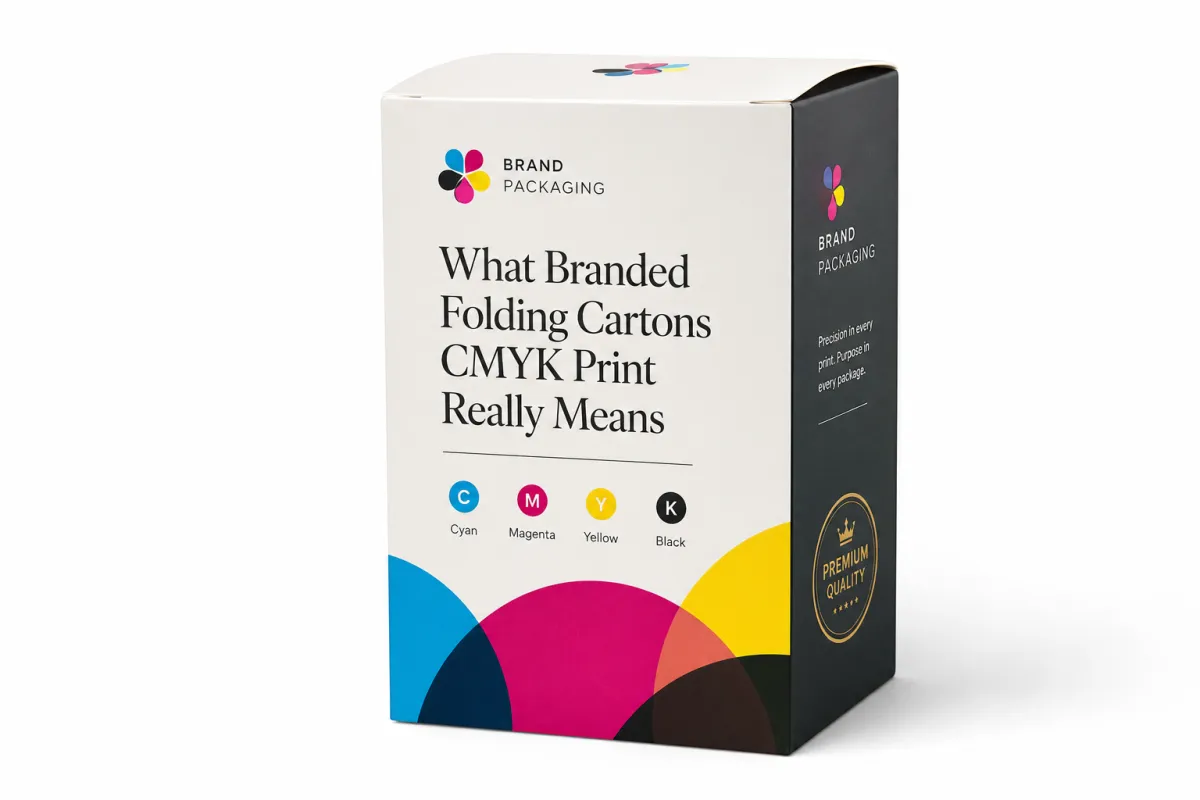
Branded folding cartons cmyk print is process printing on carton board. The image is built from cyan, magenta, yellow, and black, which combine in halftones to create gradients, photographs, brand blocks, and all the little visual details that make a package feel finished. That makes it a strong fit for packaging that needs more than flat branding: ingredient imagery, lifestyle visuals, QR codes, regulated text blocks, and product variants all sit comfortably inside branded folding cartons cmyk print.
The same brand color can look different on a recycled gray-toned board, a bright white coated stock, and an uncoated paperboard that drinks more ink. That is not a defect. It is the material doing what material does. Branded folding cartons cmyk print responds to the board beneath it, and the board changes how ink sits, dries, and reads to the eye.
Carton printing has to be planned as a stack, not a single decision. Artwork, substrate, press type, finishing, die-cutting, and assembly all shape the final result. A glossy label mindset does not transfer cleanly to paperboard. A carton is its own object with its own rules, and pretending otherwise is usually where the trouble starts.
For packaging buyers, branded folding cartons cmyk print is often the sweet spot for short to medium runs, especially when product lines change fast. Four flavors. Two sizes. Seasonal artwork. Process printing keeps that mess manageable without ordering separate custom inks for every version. That flexibility matters when forecasts are still fuzzy and nobody wants a warehouse full of obsolete cartons.
It also fits paper-based sustainability goals. Paperboard cartons can be designed for recycling streams more easily than mixed-material packs, and CMYK printing can reduce setup waste because there is less need to create and clean up multiple spot ink stations. According to the EPA recycling guidance, paper and paperboard remain among the most commonly recovered packaging materials, which is one reason branded folding cartons cmyk print keeps showing up in brand packaging plans.
There is a tradeoff, because of course there is. Branded folding cartons cmyk print gives broad color range and efficient production, but it does not guarantee identical color to a spot-color job. If a brand color is mission-critical, the team needs to decide early whether process printing is enough or whether a hybrid approach with a spot color makes more sense. That decision belongs in the first proof review, not after the cartons are already on press.
“The file might look perfect on screen and still lose half a step on the board.” I hear some version of that on press checks all the time. It is not a printer problem so much as a reminder that branded folding cartons cmyk print lives in the real world, where substrate and ink behavior matter as much as design intent.
For premium or regulated products, the real skill is not avoiding CMYK. It is using branded folding cartons cmyk print with enough control that the carton feels deliberate, repeatable, and on brand. Teams that understand that difference usually get better results with fewer surprises.
How Branded Folding Cartons CMYK Print Works
The production flow starts with artwork, but it does not end there. In branded folding cartons cmyk print, the file is checked against the dieline so panels, folds, glue zones, barcodes, and legal copy land where they should. Then prepress prepares output for either offset printing or digital printing, depending on run length, detail level, and lead time.
Offset printing remains the workhorse for many carton jobs because it delivers stable color and a strong cost profile once the run gets large enough. Digital printing is often the better call for prototypes, test launches, and smaller quantities because it skips some of the setup overhead. Flexographic printing shows up less often in premium folding carton conversations, but it still matters in certain paperboard or secondary-packaging situations, especially where speed and inline production matter more than ultra-fine detail.
Branded folding cartons cmyk print works by transferring the four inks in microscopic dots. Those dots are controlled by screen ruling, ink density, paper absorbency, and press calibration. When the dots are too heavy, images darken and shadows fill in. When they are too light, colors wash out and the carton can look thin or unfinished.
Proofing matters a lot. A screen mockup is useful for design direction, but a printed proof on the intended stock tells the truth. Brightness, coating, caliper, and even humidity can alter the look. A carton that looked rich on your monitor may print dull on recycled board, while a heavy gloss coating can make the same artwork read punchier than intended. I have seen teams spend days debating a color that was never going to survive the stock choice anyway.
Registration is another quiet detail that separates decent packaging from polished packaging. In branded folding cartons cmyk print, registration keeps the cyan, magenta, yellow, and black layers aligned. If the register slips, tiny halos appear around type or edges, and the carton starts to look rushed. Trapping helps prevent white gaps where colors meet, and print finishing can sharpen or soften the visual effect after the ink lands.
Think of the flow like this:
- Artwork is built to the dieline and checked for bleed, safe zones, and folding risk.
- Prepress converts the design into print-ready output and separates CMYK elements.
- The press lays down the inks, usually after color calibration and test sheets.
- Drying or curing stabilizes the ink before finishing begins.
- Print finishing such as aqueous coating, varnish, foil, embossing, or laminating is applied if specified.
- The sheet is die-cut, folded, glued, packed, and prepared for shipment.
That sequence sounds simple. It is not. Branded folding cartons cmyk print is only as strong as the handoffs between each step. A good design can still fail if the artwork ignores grain direction, glue flaps, or post-print cracking on a fold. A well-prepared file can look excellent even on a modest board because the whole system was planned with care.
If you want a benchmark for how production choices affect outcomes, compare projects that used digital printing for sampling with those that moved into offset printing for full production. The differences usually show up in color stability, make-ready time, and unit economics. For many brands, that comparison is the moment branded folding cartons cmyk print stops sounding abstract and starts looking practical.
Key Factors That Affect Color, Quality, and Sustainability
Substrate choice is the first lever. Paperboard type, caliper, recycled content, and surface coating all change how branded folding cartons cmyk print behaves. A 16 pt SBS board with a bright white face will not absorb ink the same way as an 18 pt recycled board with a more open fiber structure. The result shows up quickly: one carton holds a saturated blue cleanly, while the other reads flatter or warmer.
Coatings and finishes come next. An aqueous coating can improve scuff resistance while keeping the pack broadly recyclable. A varnish can protect the print and adjust sheen. Soft-touch film can add a tactile premium feel, but it can complicate recycling in some markets and usually adds cost. Branded folding cartons cmyk print needs a sober tradeoff discussion, not a mood board full of adjectives and wishful thinking.
Color management is the hidden engine. Dot gain, ink density, gray balance, and calibration determine whether branded folding cartons cmyk print stays consistent from proof to press run. If the black plate is too heavy, shadows muddy. If the cyan shifts, cool palettes drift toward green or dull gray. Process control is not glamorous, but it is the difference between repeatable cartons and unpredictable ones.
Structural design matters too. Fold lines and panels can distort artwork if the layout is careless. Fine text should not sit too close to a crease, and important logos should avoid glue flaps and cut edges. When a carton is right-sized, artwork stays cleaner, shipping waste drops, and the brand avoids paying for empty air inside the pack. That is one of the quieter sustainability wins in branded folding cartons cmyk print.
There is also an end-of-life angle. Brands often say they want recyclable packaging, but the finished pack has to support that claim. Paper-based cartons are easier to position as recovery-friendly than mixed plastic structures, and FSC-certified board can strengthen that story when sourcing aligns. The FSC certification system is one way buyers verify responsible forestry inputs, which matters when branded folding cartons cmyk print sits inside a larger sustainability narrative.
From a technical standpoint, the difference between spot color and CMYK becomes useful here. Spot color gives a specific ink target, which helps with brand-critical reds, blues, and blacks. CMYK gives versatility, especially when photos and gradients are carrying the design. Many cartons end up using both: branded folding cartons cmyk print for the art and a spot color for a logo or panel line that must stay exact.
From a commercial standpoint, sustainability and appearance do not need to fight each other. A well-chosen paperboard, a right-sized carton, and a finish that protects without overcomplicating recycling can make branded folding cartons cmyk print feel premium and responsible at the same time. That balance takes discipline, but it is not mysterious.
For teams comparing options, one useful exercise is to look at how paperboard thickness, print method, and finish choices changed the outcome on similar jobs. A second pass through Case Studies often reveals that the best-looking carton was not the most expensive one; it was the one whose structure and print method were aligned from the start.
Branded Folding Cartons CMYK Print: Cost and Pricing Factors
Price in packaging is rarely just price. In branded folding cartons cmyk print, the main cost drivers are run length, board grade, number of printed sides, finishing complexity, and any tooling or handling requirements outside standard production. If the carton needs a window, foil, embossing, or a weird fold nobody else asked for, the quote changes quickly. Packaging quotes have a way of exposing the truth.
Short runs often cost more per carton because the setup work gets spread across fewer pieces. That does not make them a bad idea. Branded folding cartons cmyk print can be a smarter commercial choice for seasonal products, test launches, or fast-changing SKUs because it reduces overproduction and obsolete inventory. Paying a bit more per unit can still save money when the alternative is warehousing cartons that never ship.
To make the tradeoffs clearer, here is a practical comparison. These numbers are illustrative, not universal, because artwork coverage, board choice, and finishing can shift pricing fast.
| Print Method | Best Fit | Typical Strengths | Watch-Outs | Approx. Unit Cost at 5,000 Units |
|---|---|---|---|---|
| Digital printing | Prototypes, short runs, many SKU changes | Fast setup, easy versioning, economical for small quantities | Higher unit cost at scale, some finish limits, color variation across lots | $0.55-$1.10 |
| Offset printing | Mid-to-large production runs, image-rich cartons | Strong consistency, efficient at volume, good for branded folding cartons cmyk print | Longer setup, proof discipline required, plate costs | $0.18-$0.35 |
| Flexographic printing | Some secondary packaging and high-speed jobs | Fast inline production, good for simpler graphics | Less ideal for fine detail or premium carton aesthetics | $0.20-$0.45 |
| Offset + spot color | Brand-critical cartons needing tighter color control | Better color specificity, useful for logos and key panels | Higher setup complexity, more press management | $0.25-$0.40 |
That table leaves out a useful truth: packaging specs influence cost more than many buyers expect. A simple tuck-end carton on standard board with one coating can be economical. Add a custom window, a specialty varnish, foil, and a complicated die line, and the budget moves. Branded folding cartons cmyk print can still be the right solution, but the quote needs to reflect what the carton is actually doing.
There is a sustainability lens here too. Recycled or specialty boards may cost a bit more, but they can strengthen the brand story and reduce pressure to overprint or overbuy. If a brand orders 20,000 cartons but only needs 12,000 in the next quarter, the cheapest unit price may not be the lowest real cost. Branded folding cartons cmyk print is most useful when it helps teams buy closer to demand.
For premium applications, the smartest move is often to spend on the right thing and save on the wrong one. If the structure is elegant and the print system is controlled, a carton does not need excess embellishment to look intentional. That holds especially when the product itself carries most of the perceived value.
The Process and Timeline From File to Finished Carton
A realistic workflow starts with discovery. The brand confirms carton dimensions, product fit, closure style, print coverage, finish, target quantity, and launch date. Then the supplier selects or confirms a dieline, and artwork begins around the structure rather than the other way around. Branded folding cartons cmyk print performs best when the file is built for the carton, not forced onto it later.
Prepress is where a surprising number of delays begin. Low-resolution images, missing fonts, incorrect bleed, thin type sitting too close to folds, and neglected barcodes are all common. They are also avoidable. If the team catches those issues early, branded folding cartons cmyk print moves faster and costs less because the press schedule does not have to pause for preventable fixes.
How long does it take? That depends on the product mix, but some useful ranges help with planning. A simple prototype might be ready in a few business days after artwork approval, especially with digital printing. A standard production run can often take 12-15 business days from proof approval to shipment, while more complex jobs with custom finishes may need longer. If the carton has to coordinate with filling, kitting, or retail distribution, compressed timing gets expensive very quickly.
For Brands That Ship through distribution channels, transit testing matters too. If the carton will be stacked, palletized, or moved through a long supply chain, ask whether ISTA testing or ASTM-based package testing is appropriate. The ISTA framework is widely used for transport packaging verification, and it can expose whether a carton needs more crush resistance, a different board grade, or a finish change before full rollout.
That kind of planning protects both the product and the budget. A rushed carton program usually costs more because there is less room for proofing, more room for error, and fewer options for sustainable material selection. Branded folding cartons cmyk print works best when the team gives prepress enough time to solve problems before they become pressroom problems.
One practical way to keep the schedule honest is to map the project into clear milestones:
- Confirm carton dimensions and product weight.
- Lock the dieline before artwork starts.
- Approve the substrate and finish in writing.
- Review a printed proof on the intended board when color matters.
- Leave time for converting, inspection, and freight.
When those steps are visible, branded folding cartons cmyk print becomes much easier to manage. The process looks less like a scramble and more like a production plan, which is what packaging needs to be if the carton has to arrive on time and look right the first time.
Common Mistakes in CMYK Carton Production
The most common mistake is designing for a screen instead of for paperboard. Screens glow. Cartons reflect light. That difference sounds obvious until the team approves a saturated mockup and expects the same punch on uncoated stock. Branded folding cartons cmyk print needs artwork that respects the substrate, not a display panel.
Another frequent error is treating proofing as optional. A digital mockup is helpful, but it is not a substitute for a real proof on the intended material when color matters. The texture, brightness, and coating of the board can change the visual outcome enough that a brand color looks slightly off even when the file is technically correct. In branded folding cartons cmyk print, that small difference can become a shelf issue.
People also underestimate structural risk. A logo placed too close to a fold can crack or distort. Small copy near a seam can disappear after gluing. A QR code that looks fine on the flat proof may become awkward once the carton is folded. These are not rare failures. They are common because the pack design and the art design were handled as separate tasks.
Recycled board assumptions create another trap. Not every recycled paperboard prints the same way. Fiber mix, brightness, clay coating, and caliper all affect the final appearance. A carton printed beautifully on one recycled board can look muted on another. Branded folding cartons cmyk print can absolutely support recycled substrates, but consistency starts with testing, not optimism.
Cost mistakes matter as well. Teams sometimes over-specify embellishment because they want the carton to feel premium, then discover that the product price cannot absorb the packaging cost. Others ignore minimum order quantities until the quote arrives and the economics look upside down. The safest path is to define what the carton must do, what it should do, and what would simply be nice to have. Everything else can wait.
There is also a color-management mistake that shows up when brands use multiple suppliers. If one vendor builds files with a spot color workflow and another uses standard CMYK, the carton family can drift. That does not mean branded folding cartons cmyk print is inconsistent. It means the process changed without a shared spec sheet. Packaging consistency depends on repeatable inputs.
One of the cleanest ways to avoid these issues is to document every SKU in a reusable spec sheet. Include carton dimensions, board grade, target finish, proof type, color expectations, and tolerances for key brand elements. That document becomes the reference point when the line expands later. It also makes it easier to compare current jobs against earlier runs, including the ones summarized in Case Studies.
The deeper lesson is simple. Branded folding cartons cmyk print is not fragile, but it is sensitive. If the team understands where the sensitivity sits, most surprises disappear before the cartons reach the pressroom.
Expert Tips and Actionable Next Steps
Start with the spec, not the quote. Before asking for pricing, confirm the carton dimensions, print method, board grade, finish, color target, target quantity, and launch date. When those basics are clear, branded folding cartons cmyk print can be priced accurately instead of guessed at. That saves time and usually improves the final result.
Ask for a printed proof on the intended substrate whenever color matters. A proof on generic stock may be useful for layout, but branded folding cartons cmyk print behaves differently from board to board. If the brand has a strict red, blue, or black, it is better to confirm that color in the actual material than to hope it translates later.
Build one master spec sheet for all related SKUs. That sheet should include die line version, artwork file naming, ink expectations, finishing notes, and any retail or shipping requirements. Consistency is easier to maintain when branded folding cartons cmyk print is managed as a system rather than as a series of one-off files. Small companies benefit from this as much as large ones.
Compare total value, not just the lowest unit price. A quote that looks cheaper may hide higher waste, more storage, slower turnaround, or less suitable finishes. The best carton is not always the cheapest carton. It is the carton that balances appearance, function, and supply-chain reality without creating avoidable cost later. That sounds boring, but it saves money.
If the carton must survive distribution, ask about transit testing early. Packaging validation is not an academic exercise when the product is actually moving through freight, pallets, and retail handling. That is where branded folding cartons cmyk print gets tested in the most practical way possible: by whether the pack still looks right after the journey.
Here is the simplest next-step sequence I recommend for teams that want fewer surprises:
- Audit the current packaging and identify what is failing or wasting budget.
- Collect one clean dieline and lock the structural spec.
- Request two process-print quotes, ideally one digital printing option and one offset printing option.
- Ask whether a spot color is needed for any brand-critical element.
- Review one printed sample before committing to the full run.
That sequence is unglamorous, but it works. It also gives the team a clearer view of how branded folding cartons cmyk print supports the larger business goal: a carton that ships efficiently, looks credible, and stays consistent enough to scale.
When the structure, board, and finish are aligned, branded folding cartons cmyk print can deliver strong shelf appeal without overcomplicating procurement. For most brands, that is the real win: a carton system that is easier to buy, easier to reproduce, and easier to explain internally when the next SKU or launch cycle arrives. Keep the spec tight, keep the proof honest, and the rest stops being a guessing game.
Frequently Asked Questions
Are branded folding cartons cmyk print suitable for premium packaging?
Yes, especially when the design uses strong typography, controlled imagery, and a board or coating that supports the brand position. For a more premium feel, pair branded folding cartons cmyk print with matte varnish, embossing, or selective gloss rather than relying on color alone. The finish choice often does more visual work than people expect.
How accurate is color on branded folding cartons cmyk print?
Color can be very consistent, but the final result depends on proofing, substrate, press control, and finish. If a brand color must match exactly every time, ask whether a spot color or a tighter color-management workflow is needed. CMYK gives flexibility; spot color gives specificity.
What affects the cost of branded folding cartons cmyk print the most?
Run length, board choice, print coverage, finishing complexity, and carton structure usually drive pricing the most. Late artwork changes can add prepress and proofing charges, so it helps to lock the file early. In many cases, the structure costs more than the ink.
How long does the branded folding cartons cmyk print process usually take?
Prototype jobs can move quickly, while production runs take longer because of proofing, printing, converting, and inspection. The fastest way to reduce delays is to approve the dieline, artwork, and substrate choices before the quote is finalized. That gives the supplier less room to chase missing information.
Can branded folding cartons cmyk print support sustainable packaging goals?
Yes. Paper-based cartons are widely recyclable, and CMYK can reduce setup waste and excess inventory compared with more rigid custom ink setups. To strengthen the sustainability case, choose the lightest board that still protects the product and avoid unnecessary plastic-heavy finishes. Branded folding cartons cmyk print can be part of a cleaner packaging strategy when the spec is disciplined.
For teams making the next packaging decision, the takeaway is straightforward: lock the structure, Choose the Right board, proof on the actual stock, and decide early whether CMYK alone is enough or whether one spot color belongs in the mix. Do that, and branded folding cartons cmyk print stops being a gamble and starts acting like a dependable production tool.


