Buyer Fit Snapshot
| Best fit | printed folding carton supplier quotes for packaging buyers comparing material specs, print proof, MOQ, unit cost, freight, and repeat-order risk where brand print, material, artwork control, and repeat-order consistency matter. |
|---|---|
| Quote inputs | Share finished size, material target, print colors, finish, packing count, annual reorder estimate, and delivery region. |
| Proofing check | Approve dieline scale, logo placement, barcode or warning zones, color tolerance, and any recyclable or compostable wording before bulk production. |
| Main risk | Vague material claims, crowded artwork, or missing packing details can create delays even when the unit price looks attractive. |
Fast answer: Printed Folding Carton Supplier Quotes: Pricing & Specs should be specified like a repeatable production item. The safest quote includes material, print method, finish, artwork proof, carton packing, and reorder notes in one written spec.
What to confirm before approving the packaging proof
Check the product dimensions against the actual filled item, not only the sales mockup. Ask for tolerance on folds, seals, hang holes, label areas, and retail display edges. If the package carries a logo, QR code, warning copy, or legal claim, reserve that space before decorative graphics fill the panel.
How to compare quotes without losing quality
Compare board or film grade, print process, finish, sampling route, tooling charges, carton quantity, and freight assumptions side by side. A lower quote is only useful if the supplier can repeat the same color, closure quality, and packing count on the next order.
Two cartons can look almost identical on a screen and still come back with very different printed folding carton supplier quotes. That is not a mystery. It is packaging reality. Paperboard grade, coating, print coverage, die complexity, and finishing all move the price in different directions. A quote is not just a price. It is a production snapshot. If the carton is going to hold product, survive handling, and still look decent on shelf, the quote has to match the real build, not the pretty render.
From a buyer's point of view, the best printed folding carton supplier quotes make the hidden work visible. They show what gets printed, how it gets converted, what is included in setup, and where the supplier is guessing. That clarity helps a brand avoid the usual surprise costs that pop up after concept approval, especially when a nice-looking mockup turns into a press-ready carton with actual folds, glue points, and tolerances. Packaging has a habit of getting less poetic the closer you get to production. Funny how that works.
If you are requesting printed folding carton supplier quotes for a retail product, subscription item, cosmetic line, or food-safe secondary pack, the goal stays simple: compare like with like. Not a vague total against a carefully detailed build. That approach saves time, cuts revision loops, and gives your team a cleaner path to production. It also keeps everyone from arguing about numbers that were never measuring the same thing in the first place.
Why Printed Folding Carton Supplier Quotes Reveal More Than Price
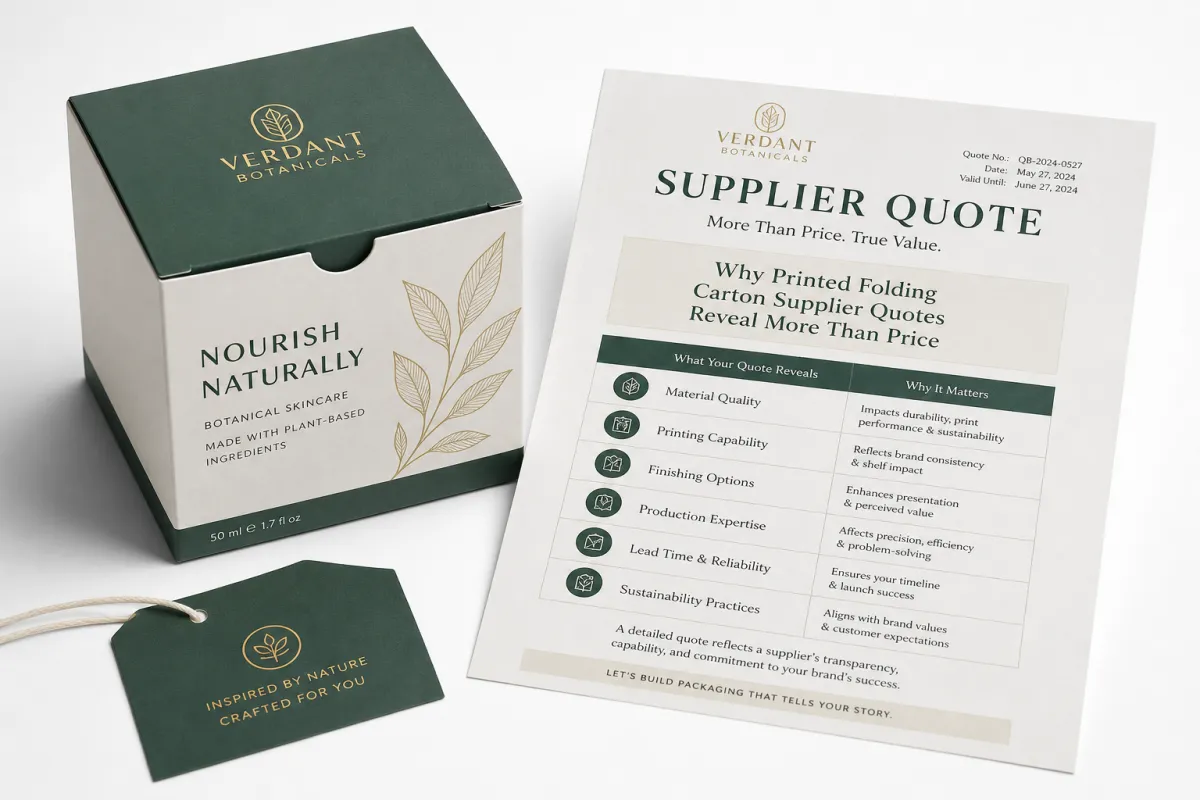
A quote is not just a number. It is the supplier's best estimate of how much material, press time, converting labor, and logistics your carton will require. Good printed folding carton supplier quotes reflect the whole chain, from board purchase and print setup to cutting, folding, gluing, packing, and shipment. If one vendor is quoting 18pt SBS with aqueous coating and another is quoting 20pt C1S with a different finishing path, those are not equivalent numbers even if the cartons look close in a render.
That is where buyers can get tripped up. On screen, a matte white folding carton with a clean logo and a few lines of text may seem simple, but the production quote shifts if the artwork uses full bleed on both sides, if the carton needs a window patch, or if the fold style needs tighter registration. In practice, printed folding carton supplier quotes often change because of details that stay invisible in a mockup but show up fast on press and on the gluer. The machine does not care that the design looked calm in a PDF.
A clear quote also protects the launch schedule. If the supplier spells out the board grade, the print method, the finish, and the pack-out assumptions, then your team can spot misalignment before a tool is made or a press is booked. That is one of the biggest reasons I push buyers to request printed folding carton supplier quotes with exact specs. A tidy quote cuts back-and-forth later, especially when the packaging has to support a launch date, a retailer window, or a seasonal promotion.
The number that matters is the one tied to the carton you will actually run, not the one tied to a simplified sketch.
Honestly, a lot of packaging problems start with a quote that was too loose. The fastest path to a reliable procurement decision is to ask whether the printed folding carton supplier quotes are based on the same assumptions: same dieline, same board, same finish, same quantity, same freight terms. Once those match, the price comparison becomes useful instead of misleading.
If you need a starting point for the discussion, treat the quote as a checklist. Does it include prepress review, proofing, die cutting, gluing, and fulfillment to the correct destination? Does it show whether the price assumes virgin board or recycled-content sheet? Does it mention whether the carton is approved for a standard folding carton line or if the structure needs special handling? Those are the questions that separate useful printed folding carton supplier quotes from numbers that look neat but do not survive production.
I have seen teams lose a week because they compared a quote built on a customer-supplied dieline with another quote based on a finished structural drawing. Same carton? Not even close. If the assumptions are not spelled out, the total is basically decorative.
What Printed Folding Carton Supplier Quotes Should Cover
The cleanest printed folding carton supplier quotes usually begin with the basics: finished dimensions, carton style, board stock, print method, coating or lamination, and quantity. That sounds simple, but every one of those items can change the outcome. A quote for a straight tuck end carton in 18pt SBS is not the same as a quote for a reverse tuck end in 24pt board, even if the outer dimensions are almost identical. The structure, the board behavior, and the amount of converting work all matter.
Strong quotes also separate estimate language from production language. A rough estimate helps a buyer decide whether to pursue a concept. A production quote should be detailed enough to release tooling and reserve a run on the schedule. If you are comparing printed folding carton supplier quotes, ask whether the supplier is pricing from a rough concept or from a completed dieline. That one question can explain a surprising amount of variance.
Another area that deserves attention is what the quote leaves out. Freight can be excluded. Proofing can be excluded. Inserts, window patches, embossing dies, and foil tooling can be excluded. Sometimes a supplier will include a basic proof but not a full structural sample. Sometimes the quote assumes a standard carton lock and does not account for a custom flap geometry. Good printed folding carton supplier quotes should call out assumptions in plain language so you can verify them before approving the order.
Here is a practical way to think about it: a complete quote should answer what, how, how many, where, and when. What carton is being built? How is it printed and finished? How many units are included? Where is it shipping? When does production start after proof approval? If a supplier cannot answer those questions clearly inside the printed folding carton supplier quotes, the proposal needs more detail before it is ready to compare.
In day-to-day packaging work, the difference between a rough number and a real production quote often shows up in the fine print. A rough number may look attractive because it does not include the die, the plate charge, or the protective overrun allowance. A true production quote should reflect the full run economics. That is why buyers who want reliable printed folding carton supplier quotes should ask for the assumptions in writing and make sure the same assumptions are used across every vendor response.
What to ask for in writing
When a supplier replies to your RFQ, request a line that spells out the finished carton size, the board grade, the print coverage, the coating or lamination, the quantity tier, and the shipping point. That way the printed folding carton supplier quotes can be reviewed against the same structure. If a vendor includes a note such as "based on customer-supplied dieline" or "based on one-color print with no flood coat," pay attention. Those are clues that the proposal may not match the package you actually want.
- Finished dimensions: specify length, width, and depth after folding.
- Carton style: straight tuck, reverse tuck, auto-bottom, sleeve, or custom lock.
- Board type: SBS, C1S, recycled paperboard, or another approved substrate.
- Print and finish: one-side, two-side, aqueous, matte, gloss, soft-touch, foil, or emboss.
- Quantity and destination: the order tier and where it ships.
One more useful habit: ask every supplier to identify any quote exclusions directly. That helps you line up the printed folding carton supplier quotes and keeps a low number from hiding a long list of add-ons. A cheap quote with missing pieces is not cheap for long.
Folding Carton Specifications That Change a Quote
Specifications drive pricing more than many buyers expect. Two cartons can share the same footprint and still create very different printed folding carton supplier quotes if one uses heavier paperboard, more print coverage, a special finish, or a more complex structure. The board caliper alone can affect carton rigidity, glue performance, folding accuracy, and pallet efficiency. A thicker sheet may protect the product better, but it can also raise material cost and reduce the number of cartons that fit per skid.
Dimensions matter in a direct way. Larger cartons use more board, create more waste on the sheet, and can push the dieline into a less efficient layout. Very small cartons may look easy, but they can require tighter registration and more careful folding on the converting line. That is why printed folding carton supplier quotes often rise when a seemingly minor size adjustment changes the sheet nesting or the number of cartons per press sheet.
Print coverage also changes the math. A simple one-color mark on white board is very different from a carton with full-bleed process color, heavy ink density, and back-side print. Registration sensitivity goes up as the design gets more elaborate. Spot colors, metallic inks, and tight reverse type all add inspection pressure. If your artwork relies on rich solids, gradients, or fine-line detail, expect printed folding carton supplier quotes to account for the extra press setup and make-ready time.
Finishing is another big driver. Aqueous coating is often the baseline for protection and appearance, but matte lamination, gloss lamination, soft-touch lamination, foil stamping, embossing, debossing, and clear windows each add Cost and Process steps. A soft-touch finish, for example, usually feels premium in hand, yet it adds another layer of material and another pass through the finishing workflow. That is why printed folding carton supplier quotes with premium finishes should be compared only against other quotes with the same finish callout.
Structural details matter too. A tuck-end carton is usually easier to run than a custom locking design with gussets, reinforced tabs, or a glued window patch. Every extra feature adds opportunity for variability, and that tends to show up in both cost and lead time. If a design uses perforations, tear strips, hang tabs, or an unusual assembly sequence, the supplier may need extra setup attention. In many cases, that means the printed folding carton supplier quotes need a structural review before they can be trusted as final numbers.
One thing I tell teams often: if the carton is going to sit on a crowded shelf, the finish is not just decoration. Scuff resistance, fingerprinting, and color shift under different lighting matter. A gorgeous carton that shows every rub mark is still a bad carton. Annoying, yes. Common, also yes.
For buyers who want a cleaner way to read the proposal, the following table helps isolate the features that usually change the quote the most.
| Specification | Typical effect on pricing | Buyer takeaway |
|---|---|---|
| 18pt SBS vs. heavier board | Higher material cost and sometimes lower sheet yield | Confirm whether the product needs the extra stiffness or just the look |
| Full-bleed, 4-color print | More press setup, ink coverage, and inspection time | Compare only against quotes with the same print coverage |
| Soft-touch or lamination | Additional finishing pass and material layer | Ask whether the premium feel is needed for the product channel |
| Foil, emboss, or window patch | Tooling and extra labor | Request tooling cost separately inside the printed folding carton supplier quotes |
| Custom structural lock or gusset | More converting complexity and possible slower throughput | Verify die line, assembly method, and lead time before approving |
A good technical discussion here can save real money later. If the product is going into a retail display, the carton may need better scuff resistance; if it is going into a shipping bundle, the finish may be secondary to cost and foldability. Buyers who understand those tradeoffs usually get better printed folding carton supplier quotes because they can make specification decisions based on actual use, not just appearance.
For sustainable sourcing, ask about FSC-certified board options and any recycled-content claims that can be supported by documentation. If your procurement team needs chain-of-custody guidance, the FSC organization is a solid starting point. If the cartons are being packaged for e-commerce or shipment and need performance validation, standards from the International Safe Transit Association can help you think more clearly about testing expectations. Those standards do not replace good packaging design, but they do give buyers a vocabulary for asking smarter questions.
Pricing and MOQ in Printed Folding Carton Supplier Quotes
Pricing for folding cartons usually comes down to setup economics, material yield, finishing complexity, and quantity. The way those pieces interact explains why printed folding carton supplier quotes can seem high on a small run and much more efficient on a larger run. Press setup, die cutting, stripping, gluing, and pack-out all carry fixed effort. Once those fixed steps are spread over more units, the per-carton number often drops in a noticeable way.
MOQ, or minimum order quantity, is closely tied to that setup math. If a supplier needs to buy board in a standard sheet size, make a die, prepare the press, and run spoilage allowance, the order has to be large enough to absorb those costs. That is why small runs sometimes look expensive on a unit basis. It is not always about margin; sometimes it is simply the reality of the machine time and material waste behind the job. The best printed folding carton supplier quotes are honest about that structure so buyers can Choose the Right run size.
For planning purposes, many simple folding cartons might fall in these broad ranges, depending on size, coverage, and finish:
- 5,000 units: about $0.18-$0.28 per carton for a simple 4-color, coated board build.
- 10,000 units: about $0.12-$0.20 per carton when the layout is efficient and finishing is standard.
- 25,000 units: about $0.08-$0.14 per carton when setup is spread across a larger run.
Those numbers are only planning ranges, not promises. A carton with foil, embossing, a special insert, or a difficult window patch can land above them quickly. A simple shipper-style retail carton may come in lower. That is why buyers should always compare printed folding carton supplier quotes at the same quantity tier and with the same specification package. A quote at 5,000 units is not directly comparable with a quote at 10,000 units if the supplier has stepped into a different price break.
It helps to separate costs into visible buckets. Tooling, plates, and dies may be one-time or setup-related expenses. Printing and finishing reflect the run itself. Freight and pack-out depend on destination and cartons-per-case assumptions. If a supplier bundles all of that into one line, ask for a more detailed breakdown. Clear printed folding carton supplier quotes should let you see whether the lowest total is actually the lowest-risk option or simply the least transparent one.
Here is a practical comparison of how similar-looking jobs can quote differently:
| Run profile | Typical quote pattern | What usually drives it |
|---|---|---|
| Simple tuck carton, 4-color, aqueous coat | Lowest setup burden, steadier unit cost | Standard board, standard finishing, fewer production steps |
| Same carton with soft-touch lamination | Moderate increase | Extra finishing material and pass-through time |
| Same carton with foil and emboss | Higher setup and tooling cost | Special dies, extra inspection, tighter schedule control |
| Custom structural carton with window patch | Highest complexity among these examples | Extra converting steps and more variables in assembly |
In real buying work, the MOQ conversation should not be about chasing the absolute smallest order. It should be about finding the quantity where the unit cost makes sense and the schedule still fits the launch. If your team is buying for a test market, a seasonal promotion, or a product pilot, a smaller run may be justified even if the unit price is higher. If the item is a core SKU, higher volume often produces better economics. Either way, the smartest printed folding carton supplier quotes are the ones that let you see how quantity changes the curve.
If you are unsure whether the quote is balanced, ask the supplier to show what happens at two or three quantity tiers. Good packaging partners usually can do that quickly. The comparison often reveals whether the pricing step-down is meaningful or whether the smallest run is carrying too much of the setup burden. That kind of clarity is one reason buyers value printed folding carton supplier quotes that are presented in a structured, line-by-line format.
For brands that are still developing the package, it can be smart to request one quote for a prototype quantity and another for the planned production volume. That gives procurement and marketing a more realistic path to budget planning, and it reduces the risk of approving artwork or structural details that are not compatible with the final run economics. When the numbers are separated by phase, printed folding carton supplier quotes become much easier to use as a decision tool.
Process, Proofing, and Production Timeline
A reliable timeline starts with a clean RFQ. Once the supplier receives the dieline, the artwork, the quantity, and the spec sheet, the quote can move from preliminary pricing into production planning. That is why printed folding carton supplier quotes should be tied to a clear process: file review, structural confirmation, digital proof, sample approval if needed, press scheduling, converting, inspection, and shipment. The more complete the front-end information, the less likely the project is to stall later.
Delays usually happen for predictable reasons. Artwork may not be print-ready. Bleed may be missing. Fonts may be outlined incorrectly. A logo may be placed across a fold line in a way that causes registration risk. Sometimes a structural revision changes the dieline after the quote has already been reviewed. In those cases, the original printed folding carton supplier quotes may no longer match the finished build, and a revised proposal is the correct next step rather than forcing the old number to fit the new design.
Proofing deserves real attention. A digital proof can confirm layout and copy, but it does not always capture board behavior, coating feel, or fold performance. For a premium carton, a physical sample or structural mockup may be worth the extra time. That is not wasted effort; it is insurance against costly surprises. In my experience, buyers who allow room for proofing inside the schedule get stronger results from their printed folding carton supplier quotes because they are not trying to compress every decision into the last minute.
Lead time depends on the build. A straightforward carton with standard board and standard finishing can move fairly quickly once artwork is approved, sometimes in a matter of a couple of weeks. A more complicated carton with specialty finish, tooling, or an inserted component will usually need more review and more machine time. The right printed folding carton supplier quotes should state the expected production window after approval, not just the number of days before the first proof.
Here is a simple way to think about the workflow:
- Submit the RFQ with size, structure, quantity, board, finish, and destination.
- Review the quote assumptions and confirm the dieline basis.
- Approve a digital proof or request a physical sample.
- Lock artwork, color targets, and finish callouts.
- Schedule production and confirm freight timing.
- Inspect the shipment against the approved spec.
That sequence sounds basic, but it prevents a lot of friction. It also improves the odds that the final cartons match the quote. Buyers sometimes focus so heavily on price that they forget process quality is part of the real value. The cleanest printed folding carton supplier quotes are the ones that support the whole path from artwork to delivery.
One more point worth mentioning: if the cartons need to meet retail display requirements, product safety rules, or industry-specific handling expectations, the schedule may need extra checkpoints. Those checkpoints can include carton compression checks, shipping simulation, or color approval against a master sample. Standards from groups like ISTA are useful because they remind teams that packaging does more than look good on a shelf. It has to hold up through the part of the journey people do not see.
Why Choose a Folding Carton Partner That Quotes Clearly
A supplier that quotes clearly is usually a supplier that understands the production path. That does not mean every answer has to be long, but it does mean the assumptions are visible. When a partner explains board options, flags finishing risk, and translates packaging jargon into plain language, the buyer can make better decisions faster. Strong printed folding carton supplier quotes often reveal the supplier's broader discipline in prepress, scheduling, and quality control.
Communication matters just as much after the quote lands. Buyers often need to revise quantity, adjust a finish, or change a shipping destination before the order is released. If the supplier responds quickly and updates the quote without confusion, that is a good sign. If the response is vague or slow, the project may face friction later. In practical terms, the responsiveness behind printed folding carton supplier quotes often tells you how the rest of the job will feel.
Transparency also helps the brand team align internal expectations. Marketing wants appearance. Procurement wants cost control. Operations wants a carton that runs cleanly. A clear quote gives all three groups something concrete to discuss. That is especially helpful for launch planning, because packaging is one of the few elements that has to satisfy branding, manufacturing, and logistics at the same time. Good printed folding carton supplier quotes make that balancing act easier by keeping the discussion grounded in specs rather than guesswork.
There is also a trust element that should not be ignored. A supplier willing to point out a weak part of the spec is usually protecting the buyer from a future headache. For example, if the artwork contains large solid areas that may scuff during transit, or if the chosen board is a bit light for the product weight, a candid partner will say so. I respect that a lot. It is better to hear about a risk before approval than to discover it after the cartons arrive. That kind of honesty is one of the strongest indicators that the printed folding carton supplier quotes are backed by real production awareness.
If you are comparing vendors and one of them gives you a tighter quote with more detail, do not automatically assume that number is higher for no reason. It may actually be the cleaner path because it includes the tooling, the proofing, and the freight assumptions that another supplier left out. That is why the best printed folding carton supplier quotes are not just competitive; they are readable, complete, and easy to audit.
Clear quoting also tends to predict cleaner handoff later. If a supplier can write down the difference between a standard aqueous coat and a soft-touch laminate without turning it into a fog machine, they probably know how the job will run. That matters more than a flashy number. Always did.
Next Steps for Better Printed Folding Carton Supplier Quotes
Before you ask for pricing, gather the essentials: finished size, carton style, board preference, print coverage, finish, quantity, and target ship date. If you can send a dieline or even a rough sketch, do it. The more specific the starting point, the more accurate the printed folding carton supplier quotes will be. It sounds basic, but buyers often lose time because every supplier is quoting from a slightly different assumption.
Ask for the quote to be split into separate components if possible: tooling, printing, finishing, freight, and any special services such as proofing or sampling. That line-by-line view makes comparison much easier. It also helps you see whether one supplier is bundling costs that another supplier is showing separately. The total may be close, but the structure of the printed folding carton supplier quotes can still tell you which option carries less execution risk.
When you compare responses, focus on the lowest-risk option, not only the lowest number. A quote that is a little higher but includes the right board, the right finish, and a realistic lead time may be the smarter choice than a bargain number that relies on assumptions no one has checked. That is the practical way to use printed folding carton supplier quotes as a procurement tool instead of treating them like a simple price sheet.
Once you pick the supplier, move quickly to proof approval and schedule confirmation. Delays after the quote is accepted can shift machine time and freight timing, and those changes can ripple through the whole launch plan. The sooner the final spec is locked, the more likely the order is to stay close to the original printed folding carton supplier quotes. That matters for both budget control and shelf readiness.
It also helps to document your final comparison internally. Keep the chosen dieline, board callout, finish spec, and quantity tier in one place so the team does not drift back into a vague description later. Packaging projects often get muddy because the original quote and the final approved build are not stored together. If the file trail is clean, the next round of printed folding carton supplier quotes becomes easier, faster, and more accurate.
For Brands That Ship multiple SKUs, this process becomes even more valuable. A system for comparing printed folding carton supplier quotes across product lines can reveal where standardization is possible, where premium finishing is truly justified, and where a simpler structure would deliver the same shelf result for less money. That is the kind of practical discipline that keeps packaging budgets under control without flattening the brand presentation.
The real takeaway is simple: send the same spec sheet to every supplier, force the quote to show assumptions, and compare the builds instead of the totals. That is how you get printed folding carton supplier quotes you can actually trust. No drama. No guessing. Just a cleaner path to a carton that works.
FAQs
What information should be included in printed folding carton supplier quotes?
Finished dimensions, carton style, board stock, print sides, coating or lamination, quantity, and shipping destination should all be included. A strong quote should also note tooling, proofing, and any special finishing so there are no missing charges later. Good printed folding carton supplier quotes also state assumptions about dielines, waste allowance, and freight terms.
Why do printed folding carton supplier quotes vary so much between vendors?
Differences usually come from material grade, press setup, finishing method, waste allowance, and the way each supplier structures minimums. One vendor may include services another leaves out, so the lowest price is not always the most complete quote. That is why buyers should review printed folding carton supplier quotes line by line rather than relying on a single total.
How do MOQ and quantity affect folding carton quote pricing?
Setup costs are spread across the run, so higher quantities often lower the per-unit price. Small runs can cost more per carton because make-ready, tooling, and changeover time take up a larger share of the order. When you compare printed folding carton supplier quotes, make sure every supplier is pricing the same quantity tier.
Which carton specs have the biggest impact on quote accuracy?
Board thickness, carton dimensions, print coverage, coating choice, and any special finishing have the biggest impact on pricing. Structural details like windows, inserts, locking tabs, and glue complexity can also change both cost and production time. The more precise the spec sheet, the more accurate the printed folding carton supplier quotes will be.
How can I compare printed folding carton supplier quotes fairly?
Confirm that every supplier is quoting the same dieline, material, quantity, finish, and freight terms before comparing totals. Ask for a line-by-line breakdown so you can spot tooling, proofing, and logistics differences instead of relying on a single number. That is the cleanest way to compare printed folding carton supplier quotes without being misled by hidden assumptions.