Buyer Fit Snapshot
| Best fit | Printed Folding Cartons Wholesale for Brand Packaging projects where brand print, material claims, artwork control, MOQ, and repeat-order consistency need to be specified before quoting. |
|---|---|
| Quote inputs | Share finished size, material target, print colors, finish, packing count, annual reorder estimate, ship-to region, and any compliance wording. |
| Proofing check | Approve dieline scale, logo placement, barcode or warning zones, color tolerance, closure strength, and carton packing before bulk production. |
| Main risk | Vague material claims, crowded artwork, missing packing details, or unclear freight terms can make a low unit price expensive after revisions. |
Fast answer: Printed Folding Cartons Wholesale for Brand Packaging should be specified like a repeatable production item. The safest quote records material, print method, finish, artwork proof, packing count, and reorder notes in one written spec.
Production checks before approval
Compare the actual filled-product size with the drawing, then confirm tolerance on folds, seals, hang holes, label areas, and retail display edges. Reserve space for logos, QR codes, warning copy, and material claims before decorative graphics fill the panel.
Quote comparison points
Review material grade, print process, finish, sampling route, tooling charges, carton quantity, and freight assumptions side by side. A quote is only useful when the supplier can repeat the same color, closure quality, and packing count on the next order.
Printed Folding Cartons Wholesale for Brand Packaging
On a crowded shelf, the carton is usually the first real sales pitch a buyer sees. That is why Printed Folding Cartons wholesale make so much sense for brands that want a polished, consistent look without paying rigid-box prices for a job that does not need a rigid box. Need a few SKUs to read like one family? Printed Folding Cartons wholesale keep the line tight, trim freight weight, simplify storage, and make the unboxing experience feel intentional instead of thrown together.
The value is not just lower unit cost. The real win is repeatability. printed folding cartons wholesale work best when board, structure, print method, and finish all support the product rather than fight it. Those choices sound small until cartons are stacked in a warehouse, folded on a line, and sitting under ugly retail lighting. Then every detail gets loud.
For a launch, a seasonal refresh, or a steady replenishment program, treat printed folding cartons wholesale like a production system, not a one-off buy. Know the materials, size, artwork, pricing, minimums, and lead times before the order is locked. That sounds basic. It saves real money.
Why printed folding cartons wholesale punch above their weight
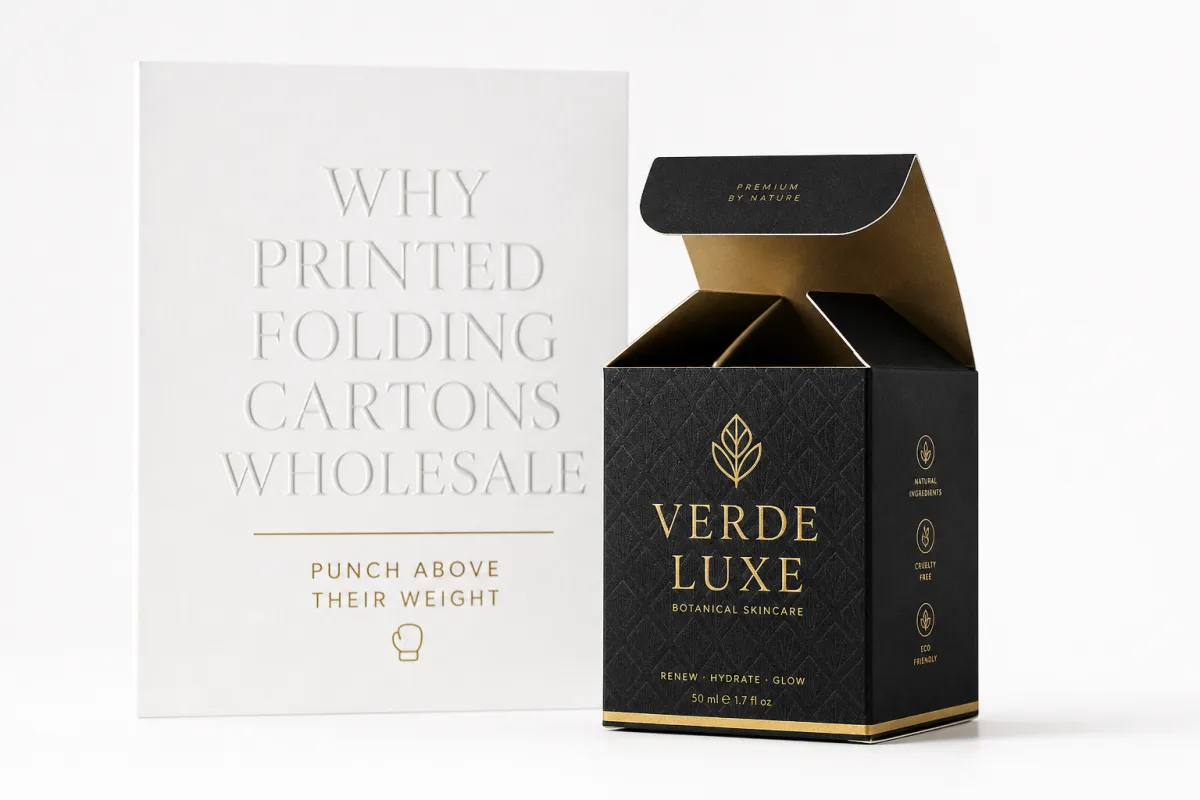
Walk any retail aisle and the pattern is obvious: the carton sells before a hand touches the product. That is why printed folding cartons wholesale are such a practical packaging choice. They give you a big visual surface for brand color, typography, claims, and product story while staying lighter and easier to store than rigid packaging. For buyers comparing packaging options, that matters because cost, logistics, and shelf impact all show up at the same time.
In a lot of categories, printed folding cartons wholesale are the point where a brand stops looking improvised. A cosmetics line with six shades, a supplement program with three bottle sizes, or an accessory brand with multiple SKUs can use one carton family and still look consistent. The payoff is not only visual. Consistent carton dimensions make pallet planning simpler, reduce warehouse clutter, and keep packing less chaotic when volume picks up.
Most buyers notice the look first. Fair enough. The part they miss is the supply chain reality. printed folding cartons wholesale can be built with board grades, scoring, closures, and coatings that improve stacking and handling. A carton that looks premium but crushes in transit is not premium. A carton that closes badly slows packing and burns labor. Good packaging has to do both jobs: look good and behave.
Wholesale buying changes the standard too. With printed folding cartons wholesale, the goal is repeatable quality, stable color, and reliable supply from run to run. The carton on the shelf today has to match the one that arrives three months later. When print density, board brightness, coating, and folding tolerances stay controlled, the brand looks established even if the line is still growing.
Printed folding cartons wholesale also make sense for brands selling through retail and ecommerce at the same time. One carton can support shelf display, warehouse handling, and secondary packing without forcing a separate rigid box for every channel. For many products, that is the sweet spot: enough structure to protect the item, enough print surface to sell it, and enough efficiency to keep margins sane. If a rollout is coming, this is the point to ask sharper questions before artwork gets locked.
A good carton should fit on the first sample, not the fifth. Get the dimensions, board, and closure right early, and the budget stops bleeding on fixes.
For practical wholesale packaging support, see our Wholesale Programs. Quotes go better when the dieline, spec, and use case are discussed together instead of being dragged through separate email threads like a bad group project.
Printed folding cartons wholesale materials, styles, and finishes
The material choice shapes the whole job. For printed folding cartons wholesale, common board options include SBS, kraft, C1S, C2S, and recycled board. Each one brings a different mix of stiffness, print quality, and brand feel. SBS, or solid bleached sulfate, gives a bright white face and crisp graphics. Kraft leans natural and grounded. C1S and C2S each handle print differently depending on whether one side or both sides need coating. Recycled board can support a sustainability message, but it often comes with more visible variation in shade and surface texture.
Brands that want premium shelf presence without moving into rigid packaging often use printed folding cartons wholesale with board in the 14pt to 24pt range. The right spec still depends on product weight and the feel the buyer wants in hand. Heavier products usually need thicker caliper or a structural insert. Lighter products can use slimmer board and still feel upscale if the print and finish are handled well. Picking board by appearance alone is how people end up with cartons that look fine and perform badly. Stiffness, folding behavior, and closure performance matter just as much as touch.
| Board option | Typical look | Best use | Practical note |
|---|---|---|---|
| SBS | Bright white, clean print face | Cosmetics, wellness, premium retail | Strong choice when color fidelity and sharp typography matter |
| Kraft | Natural, warm, textured feel | Natural brands, food, eco-positioned products | Great for a grounded look, but dark inks and fine detail need careful prepress |
| C1S | Coated outside, uncoated inside | Retail cartons with basic interior print needs | Good compromise when the outer face carries the brand and the inside stays simple |
| C2S | Coated on both sides | Giftable cartons, inserts, presentation packaging | Useful when inside printing or a cleaner interior finish adds value |
| Recycled board | Natural, slightly muted surface | Earth-conscious brands, subscription programs | Check for print contrast and finish compatibility before locking the design |
Structure matters just as much as paper stock. Straight tuck cartons are common because they are efficient, familiar, and easy to run. Reverse tuck cartons can help with certain assembly patterns. Auto-lock bottoms make sense when the product needs faster packing or a stronger base. Sleeve-style cartons work well when the goal is a premium wraparound presentation over a tray or inner pack. Display-ready formats deserve a look for products that move straight from case to shelf. With printed folding cartons wholesale, the right shape depends on how the item is packed, stored, displayed, and opened.
Finishes need the same level of judgment. Matte coatings create a quieter, more restrained look. Gloss coatings push color harder and add surface protection. Aqueous coating is the workhorse because it gives solid handling protection without slowing production too much. Soft-touch coating adds a velvety feel and can make a carton feel more premium in hand. Foil stamping, embossing, debossing, and spot UV all add cost, so they need a clear brand reason, not decoration for decoration’s sake. In printed folding cartons wholesale, finishing should reinforce the message the product already wants to send.
The recommendation changes by category. A supplement carton may need cleaner barcode placement, more legal copy space, and room for tamper-evident details. A cosmetic carton may need stronger visual hierarchy and a more refined tactile finish. Food packaging may need attention to ink coverage, barrier expectations, and regulatory copy. Electronics accessories may need better corner protection and inserts so components do not rattle around like they own the place. That is why printed folding cartons wholesale should never be built from a generic template alone.
If sustainability is part of the brief, ask for FSC-certified board where appropriate and check the source carefully. The Forest Stewardship Council explains certified paper and board standards at fsc.org. For shipping-heavy programs, transit testing matters too. The International Safe Transit Association outlines common test methods at ista.org. Neither replaces packaging judgment. They just give the team a common language for performance.
One useful rule: if the carton is doing more than one job, say that early. Printed folding cartons wholesale can sell, protect, display, and organize, but every one of those goals changes the board and finish stack. Clean brief, fewer surprises.
Printed folding cartons wholesale specifications that protect the product
Good packaging starts with the product, not the mockup. For printed folding cartons wholesale, the specs that actually drive fit and performance are finished dimensions, board caliper, score depth, tuck style, insert requirements, and any window or cutout detail. A lot of rework happens because the first measurement came from the product alone instead of the product plus the clearance needed for loading, folding, and presentation. Too tight and the item scuffs or the line slows down. Too loose and the carton looks sloppy and shifts in transit.
The right approach is to map the loading path. Does the product slide in from the top, nest from the side, or sit in a tray? Does it need finger notches, a dust flap, or an internal hold-down? Are the corners sharp enough to catch during insertion? These are not tiny details. In printed folding cartons wholesale, they decide whether the line runs cleanly or operators start fighting the box by the hundredth unit. A small change in score depth or flap length can be the difference between a carton that folds cleanly and one that springs open at the seam.
Artwork needs the same discipline. Bleed, safe area, and barcode placement should be set before design gets too far along. If the carton includes regulatory copy, supplement facts, ingredients, warnings, or legal marks, the text has to stay readable after folding and gluing. For printed folding cartons wholesale, CMYK printing is common, but spot colors can be worth it when exact brand color matching matters or when a corporate color has to stay consistent across runs. Dark boards need extra attention because heavy ink coverage changes how the surface takes light and how small type reads.
Performance checks are where real packaging experience shows up. Ask whether the carton has enough stacking strength for how it will be stored. Check whether closure tension matches board thickness. Review ink coverage on darker or textured boards. Confirm whether the print face will scuff if cartons are bulk packed before filling. If the cartons are moving through a distribution network, consider whether shipping method and case count create pressure points the structure must tolerate. Printed folding cartons wholesale should not be judged only by a flat proof on a desk; they need to be seen as folded, loaded, handled units.
Proofing is not ceremony. It saves money. A clean dieline catches bad panel sizes, misplaced fold lines, and wrong flap geometry before the full run starts. A sample with the actual product inside can expose print misalignment, awkward closures, or a window that lands too close to a critical brand mark. In printed folding cartons wholesale, fit checking is one of the highest-value steps in the whole process because it protects both budget and launch date.
The best buyers treat sample approval as a decision point, not a checkbox. Once the proof is approved, the run should move with fewer surprises. If a structural change gets requested after proofing, the schedule moves. If artwork is still being edited, prepress stretches. That is not drama. It is what happens when a mockup turns into a production-ready carton. Strong printed folding cartons wholesale programs are built on that reality.
For buyers who need packaging coordination as well, our Wholesale Programs page is a useful place to start. It keeps specification, pricing, and timeline in the same conversation, which is usually where better decisions happen.
Pricing and MOQ for printed folding cartons wholesale
Price is where most packaging conversations start. It should not be where they end. For printed folding cartons wholesale, the main cost drivers are board choice, carton size, print coverage, number of colors, coatings, special finishing, and total run quantity. A small carton with simple one-color print on standard board can cost far less than a large carton with full-coverage graphics, foil, embossing, and a specialty insert. That sounds obvious, yet buyers still get trapped when they compare quotes without matching the actual specs line by line.
MOQ, or minimum order quantity, is tied to setup efficiency as much as raw material cost. Simpler printed folding cartons wholesale orders may allow lower quantities because the press setup, cutting, and folding operations are straightforward. Add windows, custom inserts, foil, multiple coatings, or a complicated structure and the practical minimum usually rises because the production line needs enough volume to justify the setup. Lower quantities are possible in some cases, but the unit price usually reflects the extra burden.
For planning, these are common cost bands buyers often see, though the exact number depends on size, board, and decoration:
| Order profile | Approx. unit range | What drives the price | Typical note |
|---|---|---|---|
| Simple short run | $0.35-$0.85 | Lower quantity, basic print, standard board | Good for tests, pilots, or early-stage launches |
| Mid-volume retail run | $0.18-$0.38 | Better press efficiency, standard finishing | Often the sweet spot for stable SKU demand |
| Higher-volume program | $0.09-$0.22 | Large quantity, simpler finish stack, optimized setup | Best for established products with predictable replenishment |
Those numbers are directional, not a promise, because printed folding cartons wholesale pricing shifts with paper markets, freight, and finish complexity. A carton with foil, embossing, or a Custom Die Cut will not behave like a plain tuck box. The table still helps buyers think clearly: quantity usually lowers unit cost, while complexity pushes it up.
When requesting a quote, send the finished carton dimensions, product weight, expected quantity, artwork status, finish preferences, packing method, and delivery destination. That is the minimum useful set of information. If the product needs a window, insert, or special closure, say so immediately. If the cartons need to ship flat to a fulfillment center, include that too. The faster the vendor understands the real use case, the faster the quote reflects real production cost instead of guesswork.
Watch for hidden or easy-to-miss costs. Tooling, plates, window film, inserts, rush handling, proof revisions, and freight can all change the landed cost. Even in printed folding cartons wholesale, a low unit price can hide a weak spec: lighter board, fewer finishes, or a longer lead time that does not fit the launch plan. Comparing quotes only works when the specs are close enough to be truly comparable.
Another practical point: a cheaper carton that slows packing can cost more overall. If the closure is awkward or the board is too flimsy, labor and breakage can wipe out the savings fast. Buyers who handle printed folding cartons wholesale well think about total package cost, not just the print invoice.
It also helps to ask what is included. Is the dieline charged separately? Is the sample included? Is freight estimated or firm? Are there plate charges? The more direct the answer, the easier it is to compare vendors without getting trapped by vague estimates. On a real production schedule, clarity is worth money.
Printed folding cartons wholesale process and timeline
The cleaner the input, the cleaner the run. A typical printed folding cartons wholesale order moves through spec review, dieline creation or review, artwork prep, proofing, sample approval, production, finishing, folding and gluing, then shipment. Each step looks simple until one piece is missing. If the dimensions are incomplete, prepress stops. If the art is not final, proofing drags. If the finish choice changes late, the schedule slips by days or more.
Good timelines are built on decisions that stay still. The fastest printed folding cartons wholesale jobs are the ones where the carton size is known, the copy is final, the logo files are prepared correctly, and the finish stack is settled early. Once those inputs hold steady, the production team can move with fewer handoffs and less back-and-forth. That does not make the job magical. It just cuts the risk of avoidable delay.
As a rough guide, straightforward orders often land in the 12-15 business day range after proof approval, while more complex projects can take longer depending on tooling, special finishes, and sample requirements. If the carton needs structural changes after the first review, add time. If the artwork still needs legal review, add time. If freight crosses multiple zones, add buffer. Printed folding cartons wholesale rewards planning, not optimism.
Seasonal launches and retail resets need extra caution. A packaging order that looks comfortable on paper can get tight fast once approval cycles, transit, and warehouse receiving are added. Build slack for the small interruptions that happen in real production: a barcode tweak, a spelling correction, a dieline cleanup, or an unexpected second sample review. None of those are dramatic alone. Stack three of them together and the schedule starts to wobble.
Communication keeps the job on track. If the cartons must arrive ready for packing with no room for surprises, say that early. If the order will ship in multiple drops, note it up front. If the business wants a pilot quantity now and a fast reorder later, the production plan should reflect that. Printed folding cartons wholesale works best when both sides know what success looks like before the press starts.
There is a quality-control side to timing too. Folding and gluing should be checked for alignment, seam integrity, and consistent closure. If the product is delicate, ask whether the cartons need added support or a small insert to keep the item centered. If the cartons will be handled repeatedly in store, test scuff resistance on the print and coating combination. A disciplined process protects the brand from the kind of small defects that are easy to miss on a screen and impossible to ignore in a store.
For packaging buyers who want a practical supply path, printed folding cartons wholesale usually works best when the vendor can guide the spec early, review files carefully, and keep the schedule realistic. The right production partner does not promise magic. It just removes friction by catching the things that cause trouble later.
Why choose us and next steps for printed folding cartons wholesale
What matters in a carton program is not just that the box exists. It has to behave the way the product needs it to behave. A packaging partner who understands board behavior, print consistency, and folding tolerances can save a buyer a lot of time. With printed folding cartons wholesale, small specification changes can have large effects on the finished carton, especially when the design has a tight closure, a window, a premium coating, or a multi-step assembly. Technical guidance at the start keeps those changes from turning into expensive surprises later.
Experienced support matters for another reason: generic advice creates generic packaging. A supplement bottle, a cosmetic set, and a promotional kit may all be “just cartons” on a spreadsheet, but they do not behave the same way on press or in packing. That is why printed folding cartons wholesale should be matched to the product, the channel, and the use case. The carton should fit the item, fit the budget, and fit the launch calendar. Miss one, and the whole system starts to wobble.
Production discipline matters too. Clear proofs, careful spec checking, and organized scheduling protect margins and keep the launch realistic. A buyer does not need drama from a packaging order. The best result is a carton program that lands on time, folds correctly, and looks consistent across the run. That is the standard worth aiming for with printed folding cartons wholesale. Not flashy promises. Reliable packaging that does the job.
For the next step, gather the product dimensions, estimate the quantity, note the target finish, and confirm shipping needs. If you already have artwork, send it. If not, request a dieline and design around the actual structure. Better inputs create a better quote and a better sample. That is especially true for printed folding cartons wholesale, where board, finish, and structure affect the final cost far more than most buyers expect.
If you are comparing sourcing paths, our Wholesale Programs page is a practical place to start the conversation. It keeps the order grounded in dimensions, finishes, and quantity instead of vague estimates. From there, the path is simple: review the spec, approve the proof, confirm the sample, and move into production.
Honestly, the cleanest packaging jobs are rarely the loudest ones. They are the ones where the carton looks right, opens right, stacks right, and arrives right. That is the promise behind printed folding cartons wholesale when it is handled with care, practical judgment, and a clear production plan.
How do I choose the right board for printed folding cartons wholesale?
Start with the product weight, the crush protection it needs, and the look you want on shelf. SBS usually gives a cleaner print face, while kraft and recycled boards create a more natural feel. For the safest choice, ask for a sample or proof with the actual product inside so you can check fit, closure tension, and presentation before the full run. I have seen a pretty carton fail because the board was just a little too soft, and nobody wants that kind of surprise on a launch week.
What is a typical MOQ for printed folding cartons wholesale orders?
MOQ depends on carton size, print complexity, finishing, and how efficiently the job can be set up on press and in finishing. Simpler cartons often allow lower minimums, while foil, windows, inserts, and specialty coatings usually push the minimum higher. A strong quote shows how quantity changes unit cost, so you can compare a test run with a larger production run in a fair way.
How long does printed folding cartons wholesale production usually take?
Lead time depends on proof approval, artwork readiness, structural complexity, and whether the carton needs special finishing or inserts. Straightforward jobs move faster when dimensions and copy are final, while revisions or added embellishments extend the schedule. Build in extra time for freight and launch buffers, especially if the cartons need to arrive before a retail reset or seasonal shipment.
Can I get samples before full production?
Yes, and a preproduction sample is the safest way to confirm sizing, closure fit, and print expectations before the full order runs. A proof lets you verify logo placement, barcode legibility, and any small legal text that must stay readable. If the carton has a window, insert, or special fold, sampling is especially useful because those details can change fit and assembly.
What information should I send for an accurate quote on printed folding cartons wholesale?
Send the finished product dimensions, expected quantity, board preference if you have one, and whether the carton needs a window or insert. Include your artwork status, finish requests, shipping destination, and any deadline tied to a launch or retail commitment. The more complete the request, the faster the quote can reflect real production costs instead of assumptions.


