Branded Hang Tags bulk orders make sense for brands that need the same presentation to hold up across multiple shipments, season after season. The savings are real, but they are not magic. They come from spreading setup, cutting, finishing, and packout costs across a larger run while keeping color, stock, and attachment details consistent from one batch to the next.
That consistency matters more than it sounds. A hang tag is small, yet it carries brand cues, pricing, care instructions, barcodes, and sometimes compliance text. If the board feels flimsy, the print is muddy, or the hole punches drift, the product looks less finished before a customer even touches it.
Buyers who reorder often already know the pattern: the cheapest unit price rarely tells the full story. Freight, stringing, kitting, and proof corrections can move the landed cost more than a few cents on paper board ever will.
Branded hang tags bulk: where the savings actually come from
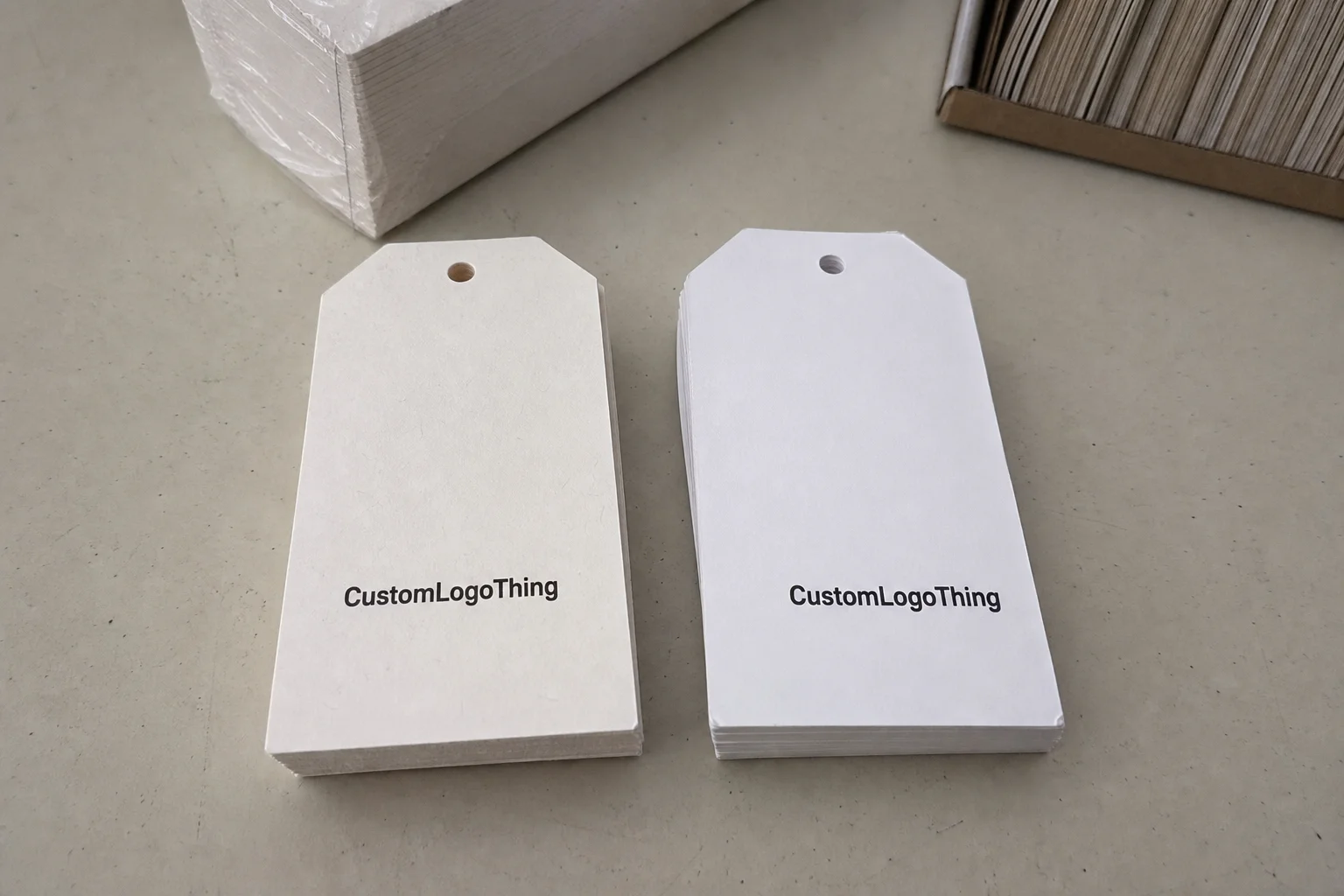
Bulk ordering works best when the design is locked, the SKU count is stable, and repeat orders are likely. In that setup, press setup, dieline prep, trimming, and any finishing passes get amortized over a larger quantity. The bigger the run, the more those fixed steps fade into the background.
That is why two quotes that look close at first glance can end up far apart once the real job is defined. One supplier may include die cutting, hole punching, stringing, and basic packaging. Another may quote only the print run and tack on the rest later. The invoice is not the landed cost.
Three variables usually drive the budget:
- Format: a plain rectangle with a standard hole is easier and cheaper than a custom shape with cutouts or multiple punch points.
- Material: 14pt or 16pt C1S board is generally efficient for standard retail tags, while textured, heavier, or specialty papers raise the cost.
- Finish: matte aqueous coating is a practical middle ground; foil, spot UV, embossing, debossing, and soft-touch lamination add labor and tooling.
For brands that sell the same style in multiple stores, bulk ordering also helps hold the visual line steady. The tag that ships with the first carton should not look materially different from the one used six weeks later in a replenishment order. That sounds basic. It is not always basic in production.
A tag should do two jobs well: it should sell the product, and it should not slow the line down.
Choose the stock, shape, and finish that fit the product
Stock choice changes the whole feel of the piece. Uncoated cardstock takes ink cleanly and reads as more natural, which suits denim, workwear, and heritage products. Coated board gives sharper type and denser solids, so it is usually better for fashion, beauty, and premium gift items where color accuracy matters. Textured paper can feel elevated in hand, but it is not forgiving on tiny type or small QR codes.
Heavier boards, such as 18pt or specialty stock, create more stiffness and presence. That can be useful for outerwear, accessories, and boxed sets. The tradeoff is practical: thicker tags can curl less, but they also stack less efficiently and can become awkward on folded garments if the tag sits where a seam or fold already adds bulk.
Shape does more than change appearance. A standard rectangle is still the most efficient option for most programs. Rounded corners reduce scuffing and can make the piece feel more polished. Custom die cuts are memorable, but they take tighter proofing discipline and usually a longer approval cycle because small deviations show up quickly on a non-standard silhouette.
Oversized tags work well on coats, bags, and higher-ticket items because they create shelf presence and leave room for larger copy, longer product descriptions, or a more visible barcode. They also carry risk. If the tag is too large for the garment, it stops reading as premium and starts looking cumbersome.
Finish should follow function first. Matte is quiet and readable. Gloss adds contrast and helps images pop, though it can reflect under harsh retail lighting. Soft-touch lamination has a velvety surface and a strong premium feel, but it can be expensive for products that will be handled roughly or packed tightly. Foil, spot UV, embossing, and debossing work best when they reinforce a clear brand cue instead of being used as decoration for its own sake.
Attachment details deserve the same attention. A 3 mm or 5 mm hang hole, center-punched or corner-punched, changes how the tag hangs and whether it twists on the garment. String choice matters too: cotton string, elastic loop, ball chain, and plastic fastener each affect the look and the packing speed. On a fast-moving line, the simplest attachment usually wins.
| Option | Typical Use | Relative Cost | Notes |
|---|---|---|---|
| 14pt C1S, matte | Everyday retail tags | Lowest | Good for clean print and efficient bulk runs |
| 16pt coated board, gloss or matte | Fashion and mid-premium goods | Moderate | Better stiffness and sharper image reproduction |
| Textured premium stock | Gift, boutique, and heritage products | Higher | Strong tactile appeal, but small type needs careful proofing |
| Soft-touch laminated board | Premium apparel and accessories | Higher | Luxury feel, but usually not the right choice for cost-sensitive lines |
For material and handling standards, the ISTA test protocols are useful if tags are packed with other components and need to survive transit without damage. The FSC program is relevant when the board source needs forest stewardship documentation. Neither one designs the tag for you. Both are useful because they give buyers a clearer vocabulary for asking the right production questions.
Artwork and print specifications that prevent costly rework
Most avoidable problems start before the press ever runs. The buyer should lock the exact size, print sides, bleed, safe area, color targets, and any variable data requirements before the quote is finalized. If the art team is still deciding whether the tag carries pricing, SKU codes, size icons, or care instructions, the layout can become crowded fast once the trim line is applied.
Barcode placement deserves special care. A barcode that sits too close to the edge, or too close to foil or spot UV, can become difficult to scan. The same problem shows up with small care icons and legal copy. Those elements need room, especially on compact hang tags where every millimeter matters. For compliance-heavy products, sending the regulatory text late is one of the fastest ways to create a second round of proofs.
File preparation affects timing more than many buyers expect. Low-resolution logos, missing fonts, incorrect dielines, and artwork built on the wrong template are common sources of delay. If a tag is die cut, foil stamped, or embossed, the file has to reflect those production steps clearly. A file that looks acceptable on a monitor can still fail once registration, trim, and finishing alignment are checked on press.
A practical proofing sequence is straightforward:
- Review the digital proof for layout, spelling, barcode readability, and copy placement.
- Approve a hard proof or press match when color accuracy is critical, especially for branded apparel or premium gift lines.
- Confirm the final dieline, hole position, and finish notes before production starts.
If the order includes multiple SKUs or variable fields, send those details early. That keeps the quote tied to the actual job instead of an assumption, and it reduces the odds of a correction after pricing has already been issued. Buyers who need broader packaging support often coordinate tag orders with Custom Labels & Tags so the brand language stays aligned across products.
A clean proof is cheaper than a reprint, and a reprint is usually more expensive than the original mistake by the time freight and schedule impact are included.
Pricing and MOQ: how quantity breaks change unit cost
Pricing for branded Hang Tags Bulk usually comes down to material weight, print method, finishing, die cutting, stringing, and whether the order needs packing by style or SKU. Those are the levers that move the quote. A simple single-color tag on standard board sits at one end of the range; a foil-stamped, soft-touch, die-cut tag with stringing and kitting sits at the other.
For common retail runs, a rough pricing band might look like this: simple digital tags can sometimes land around $0.18-$0.28 per unit at 5,000 pieces, depending on size and coverage, while offset runs on standard board can come in lower at higher quantities. Specialty finishes or custom shapes can move the unit price into the $0.30-$0.70 range or higher, especially when labor-heavy finishing is involved. Those figures are directional, not fixed. Shipping, packout, and rejection rates can change the true landed cost.
Minimum order quantity depends on production method. Digital printing usually gives more flexibility for smaller runs, shorter launches, or artwork that changes by SKU. Offset printing tends to make more sense for larger repeatable orders because the press setup is spread across more pieces. If the buyer expects ongoing replenishment, bulk ordering is often the cleaner choice because it reduces the risk of color drift between batches and keeps tag inventory aligned with product inventory.
The quantity break is where buyers can save money, but only if storage and forecast risk are realistic. Ordering 25,000 tags when the near-term sell-through supports 8,000 can save a few cents per unit and still create waste if the branding changes later. A better approach is to match the order size to launch volume plus a modest buffer, then reassess once the style proves itself.
Ask for quotes that separate the cost components clearly:
- Setup: art review, plates or digital setup, and die preparation
- Printing: the actual press run
- Finishing: coating, foil, embossing, lamination, or spot UV
- Conversion: cutting, punching, stringing, and kitting
- Freight: shipping from the plant to your receiving point
That breakdown makes comparison easier and exposes the hidden extras. A quote with a lower unit price can still be more expensive once freight, packout, or SKU sorting are added. If volumes and reorder cadence are already known, Wholesale Programs can help structure recurring buys more cleanly.
Common mistakes that raise the bill
Most cost overruns are not dramatic. They are small specification mistakes that pile up. A tag that changes size after proofing needs a new die or at least a new setup check. A barcode moved three millimeters can force a revised layout. A finish added late in the process can change the paper choice, the drying window, or the trim behavior.
One common issue is over-specifying the job before the brand actually needs that level of finish. Soft-touch coating, foil, and embossing all have legitimate uses, but stacking them on a low-margin item is a quick way to turn a tag into a cost center instead of a branding asset. A cleaner board with a well-printed logo often does more work than a crowded finish plan.
Another mistake is treating all tags as though they will be handled the same way. A tag for a folded shirt that sits in a polybag has different wear demands than a tag for a coat displayed on a hanger. The first can usually stay simpler. The second may justify heavier stock or a stronger attachment because it is visible for longer and touched more often.
Packing instructions can raise cost faster than artwork. If tags must be sorted by style, banded by warehouse, or inserted with cards, the plant needs that detail before quoting. Otherwise the labor gets estimated loosely and corrected later, which is where surprises appear.
The cleanest bulk programs keep one rule: if a change affects the structure, finish, or packout, it belongs in the quote request before approval. Not after. That discipline saves time and usually protects the budget more effectively than chasing small material discounts.
Production steps and lead time from proof to shipment
The usual sequence is simple: request for quote, artwork review, proof approval, production scheduling, printing, finishing, inspection, and shipment. Delays usually show up at the front end, not the end. First-time orders often take longer because the dieline, font usage, color target, or copy approval is still moving when the quote is already in motion.
Lead time depends on complexity as much as quantity. A standard printed tag may move through production in roughly 7 to 12 business days after proof approval, while foil, embossing, custom cutting, or kitting can extend that to 12 to 18 business days or more. Transit time is separate, and it needs to be counted from the start if the tags are tied to a store reset or a product launch.
Buyers should share the in-hand date, not just the order date. That distinction matters. A supplier may be able to print quickly, but if the shipment has to cross multiple zones or clear a warehouse receiving window, the calendar has to include freight time, appointment scheduling, and any receiving restrictions.
Custom packing instructions also affect schedule. If the order must be sorted by style, bagged by SKU, labeled for multiple warehouses, or inserted with care cards, the plant needs that information before production begins. On more complex programs, the schedule should include a small cushion because packing labor is usually the part that grows fastest when instructions are incomplete.
For buyers who care about waste and material selection, the EPA guidance on paper and paperboard materials is a useful reference point when discussing sourcing, recycling streams, and material efficiency with a supplier.
What dependable suppliers do better on repeat tag orders
Dependable suppliers make reorder work boring in the best sense. They keep spec sheets clear, preserve color expectations, and correct proofs quickly without drifting away from the original approved format. They also flag when a requested finish does not suit the chosen stock, which is a sign of judgment rather than resistance.
Inventory consistency matters when a brand runs multiple colorways or seasonal drops. If one batch uses slightly different board thickness, hole placement, or black density, the product line starts to look uneven even though the artwork itself has not changed. That is especially visible on racks where several SKUs sit side by side under the same lighting.
Quality control on hang tags is basic, but it has to be done carefully. Trim accuracy, punch alignment, print registration, and attachment checks all affect how the tag looks once it is hung. A slightly shifted hole can make the tag tilt. Poor trim can make a clean brand feel rushed. Misregistered color can make the whole order look off, even if the file was correct.
Good suppliers also help buyers balance presentation and cost instead of steering every job toward the most expensive stock or finish. Sometimes a 16pt coated board with a matte aqueous finish performs better than a heavier premium sheet simply because it reproduces the logo more cleanly and ships flatter. Value often lives in the middle of the spec, not at the far edge.
Repeat buyers tend to stay with suppliers that document the approved size, stock, coating, and attachment method well. Once that history exists, the next reorder can move faster and with fewer surprises. For Branded Hang Tags bulk orders, that kind of consistency is usually worth more than a minor price reduction.
How to move from quote to approved order without delays
The fastest path from inquiry to production is a clean first message. Send quantity, dimensions, stock preference, finish preference, attachment method, delivery location, and the date the first shipment must arrive. If the order includes multiple styles, say so early. If the tags need to be packed by SKU or by store, include that as well. Hidden complexity is what turns a simple job into a slow one.
Artwork should go in with the quote request, along with PMS references and any variable fields. If the brand needs exact color control, mention that clearly so proofing reflects the real target rather than a loose approximation. If the tag includes legal text, care instructions, barcodes, or QR codes, those elements should be in the first file set so layout can be checked once, not twice.
Before approving the proof, confirm these points:
- Final dimensions and bleed
- Hole position and attachment style
- Finish type and whether both sides are coated or printed
- Packaging method for SKUs, styles, or store allocations
- Delivery deadline with transit time included
That last step matters more than many buyers think. A proof can look correct while still creating receiving problems if the packing method is wrong. If tags need to be insert-ready, separated by style, or labeled for multiple warehouses, those instructions should be part of the approval, not a later email.
The cleanest orders are the ones where the supplier does not have to guess. Clear dimensions, complete artwork, a realistic in-hand date, and a defined packout plan remove most of the friction.
FAQs
What is a typical MOQ for branded hang tags bulk orders?
MOQ depends on print method, stock, and finishing. Digital runs can be lower, while offset and specialty finishes usually need larger quantities. A practical approach is to plan around launch volume plus a small buffer so you are not forced into a rush reorder.
How do I get the most accurate bulk hang tag quote?
Provide the exact size, quantity, paper or board choice, print sides, finish, hole style, and shipping destination. Attach artwork and note any variable data so the quote reflects the real job rather than a rough assumption.
Which print method works best for large hang tag runs?
Offset printing usually makes sense for larger, repeatable runs with tight unit cost targets. Digital printing is often better when the quantity is smaller, the timeline is tighter, or the artwork changes by SKU.
How long does production usually take after approval?
Standard production is often a few business days to a couple of weeks after proof approval, depending on finish complexity and order size. Custom cutting, foil, embossing, or kitting can extend the schedule, so the shipping deadline should be shared early.
Can branded hang tags be packed by style or SKU in bulk?
Yes, but the packing method should be specified before quoting because kitting, sorting, and label control can change labor and lead time. If the order includes multiple styles, ask how the tags will be separated and labeled so receiving is simple at the warehouse.
Branded Hang Tags bulk orders work best when the spec is tight, the artwork is ready, and the buyer knows what needs to happen after print. Get the size, stock, finish, and packout right, then request a detailed quote, review the proof carefully, and place the order with enough time for production and transit. That is the cleanest way to hold unit cost under control while protecting how the product looks from the first carton to the last.


