Compare Branded Hang Tags for Ecommerce Finish Options starts with a practical question, not a design one: how will the tag hold up once it leaves the press? A hang tag can carry the same logo, size, and copy across multiple versions, yet feel like a different product once the surface changes. That is the real job of Branded Hang Tags for Ecommerce fulfillment Print Finish Comparison. The finish is not decorative garnish. It affects scuff resistance, readability, tactile feel, and how the brand looks after packing, sorting, and delivery.
For packaging teams, the useful comparison is rarely between “good” and “bad.” It is between finishes that survive fulfillment cleanly and finishes that look expensive only in a controlled proof. A tag that photographs well but comes out of the carton with edge wear or glare on the barcode is not premium. It is just fragile.
Most of the decision comes down to channel behavior. Ecommerce tags do not sit on a retail hook under stable lighting. They get stacked, rubbed, boxed, unboxed, and handled by people who are not trying to preserve them. A finish that can tolerate that environment is usually worth more than one that looks impressive for ten seconds on a sample sheet.
Why Finish Changes More Than the Artwork
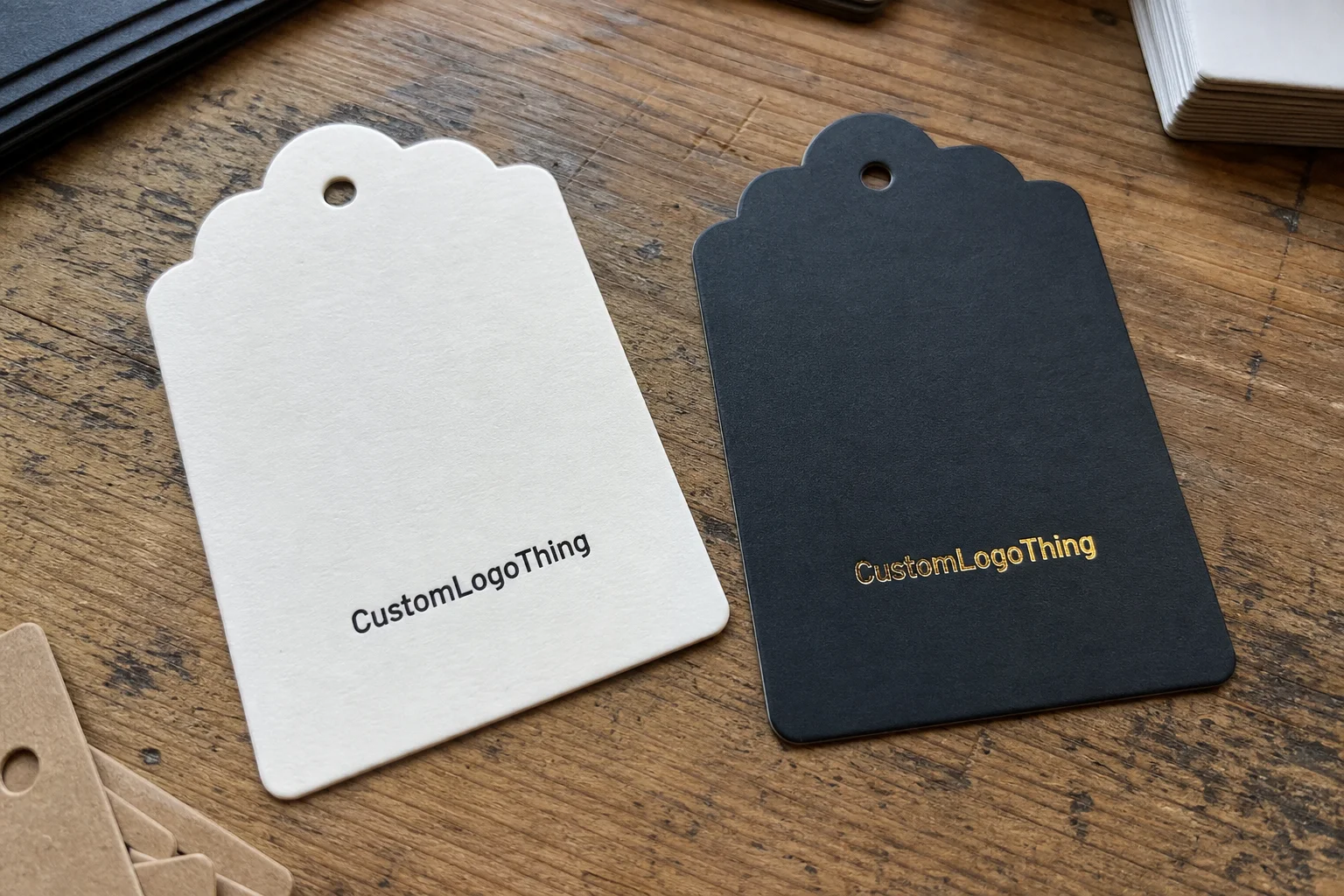
Buyers often start with layout, which makes sense. The artwork is visible, and it is easy to compare on screen. But the finish often does the heavier brand work. A minimal logo on uncoated stock reads as restrained and natural. The same logo with matte varnish feels more intentional. Add gloss or foil and the brand suddenly signals something else entirely. On small tags, where there is not much ink to carry the story, the surface becomes part of the identity.
That matters even more when the design is simple. Dense artwork can hide a lot of surface variation. Sparse layouts cannot. A white tag with one black mark will show finger oil, surface dulling, and print gloss differences faster than a busy full-bleed design. That is why finish choice should be treated as a brand decision, not a last-minute production checkbox.
There is also a technical side that gets missed. Offset, digital, and flexographic printing behave differently under coatings and laminates. Heavy solids can deepen under gloss. Fine typography can appear crisper on matte. Foil can lift a logo nicely, but it can also make nearby barcode areas harder to scan if the layout is too crowded. The finish either supports the art or complicates it. There is no neutral option.
The finish is part of the communication system. If it fails in handling, the message fails with it.
The comparison becomes more concrete once you look at the environment. A tag made for a soft-touch beauty kit faces different stress than a tag on a bulk apparel order. One is judged by hand feel. The other is judged by durability through a warehouse and a shipping network. The wrong finish can make both look worse than they should.
How Print Finishes Work on Hang Tags
Finish starts with the substrate, then the print method, then the coating or effect, then the converting stage. That order matters. A coating is not a standalone choice. It has to work with the paper weight, the ink coverage, the die cut, and the way the tags will be packed.
Most ecommerce hang tags fall into a fairly narrow set of materials: 14pt to 18pt cover stock, coated or uncoated paperboard, and occasionally a heavier premium board when the brand wants more stiffness. The finish changes how that stock behaves. Coated paper tends to make gloss and UV effects more vivid. Uncoated stock takes a softer, quieter print and is easier to write on. Soft-touch usually needs a substrate that is stable enough to avoid edge wear showing too quickly.
Here is the working list of common finishes:
- Uncoated - natural, writable, and usually the easiest to annotate in fulfillment, but it marks faster and can pick up dirt.
- Matte varnish - clean, low-glare, and practical for most brands that want a polished but not shiny result.
- Gloss varnish - bright and reflective, useful for saturated color and sharper visual punch, but it shows scratching sooner.
- Aqueous coating - common and economical, with enough protection for ordinary packing and light abrasion.
- UV coating - harder surface and stronger shine, often chosen when visual impact matters more than subtlety.
- Soft-touch - tactile and premium, but more sensitive to handling and usually less forgiving in bulk workflows.
- Foil - metallic accent for logos or marks; strongest when used sparingly.
- Spot UV - selective gloss on a matte base, useful for contrast and emphasis if the register is tight.
The print method matters just as much. Digital printing is useful for shorter runs, test programs, and variable data. Offset is still the best fit when color consistency and clean detail matter across larger quantities. Flexographic printing appears less often in premium hang tag work, but it can be part of a label-and-tag workflow where speed is more important than fine texture. None of these methods are inherently better. The finish just has to match the process.
One common mistake is assuming the coating only affects looks. It also affects legibility. A gloss surface can create glare under warehouse lighting. Soft-touch can mute contrast if the artwork is already low-contrast. Foil can interfere with barcode placement. QR codes are especially unforgiving because the scanning tolerance is narrower than many teams expect. If the tag includes data that matters after packing, the finish has to be tested under ordinary light, not ideal studio conditions.
For brands comparing finish options against the rest of the packaging system, the tag should not feel like an isolated object. A premium tag paired with a plain shipping box can create a visual mismatch. The opposite is also true. A basic tag on a highly finished carton can make the whole pack feel underdeveloped. You can review adjacent packaging formats in Custom Labels & Tags and see how different projects were handled in Case Studies.
Choosing the Right Finish for Shipping and Handling
Different product categories abuse hang tags in different ways. Apparel tags are touched often, folded, and seen at close range. Accessories need a compact tag that still looks deliberate. Beauty products tend to push buyers toward more tactile or high-end finishes. Home goods often need the practical route, especially if the tag is expected to survive long storage and repeat handling. Subscription kits can be hardest on the surface because every extra packing step increases abrasion.
For most fulfillment-driven programs, matte or satin is the safest default. It hides fingerprints and light rub marks better than high gloss. It also reads well in shipping photos, social content, and the actual unboxing moment. Gloss or UV makes sense if the brand depends on saturated color, deep contrast, or a sharper visual hit. On a bold, simple design, gloss can work well. On a delicate layout, it can feel louder than intended.
| Finish | Best For | Durability in Fulfillment | Typical Cost Impact |
|---|---|---|---|
| Uncoated | Writable tags, natural brands | Fair, but marks easily | Lowest |
| Matte / Satin | Most apparel and ecommerce tags | Good | Low to moderate |
| Gloss / UV | Color-heavy graphics, bold branding | Good against moisture, weaker on scuffs | Moderate |
| Soft-touch | Premium beauty, luxury accessories | Moderate, depending on handling | Higher |
| Foil / Spot UV | Accent logos and high-end lines | Good if applied carefully | Highest |
Functional requirements should drive the choice just as much as appearance. If the tag needs handwriting space for a SKU, size note, or inspector mark, matte or uncoated stock is easier to work with. If the tag needs a barcode or QR code, keep those elements away from highly reflective foil or heavy gloss. If the design includes a perforation or tear-away section, verify that the coating will not crack at the fold or split line. Those are the details that create delay in fulfillment because the tag looks fine until someone tries to use it.
Humidity is another real-world constraint. Tags stored in pallets, back rooms, or non-climate-controlled facilities can curl, bow, or pick up edge wear if the stock and finish are not matched well. The coating does not solve that by itself. Paper choice, grain direction, and carton packing all matter too. Sustainable paper options, including FSC-certified stock, can support sourcing goals, but they still need to be selected for the actual environment. For broader reference on packaging and material stewardship, the EPA has useful information at epa.gov, and certification standards are outlined by the FSC.
Process and Timeline: From Proof to Packed Cartons
The cleanest projects follow a simple sequence: spec, dieline, artwork, proof, production, packing. The problems usually begin when one of those steps gets compressed or skipped. A printer cannot fix a weak spec without changing cost, timing, or both.
Finish choice affects schedule more than many teams expect. Standard aqueous or matte coatings are usually straightforward. Specialty work such as foil stamping, spot UV, or soft-touch usually adds setup, curing, or extra handling time. If the tags also need stringing, bundling, or custom carton counts, the schedule becomes tighter. A basic digital run with a common coating may land around 7 to 12 business days after proof approval. A more complex offset order with specialty effects can stretch to 12 to 18 business days, and longer if the sample round takes time.
Quality control changes as well. Coated surfaces can hide some flaws and highlight others. A tiny registration shift may be visible only when the light hits the surface at the right angle. Gloss can exaggerate scratches. Soft-touch can show scuffing at the edges before the center looks worn. The proof should be inspected for more than color. Check hole placement, edge cleanliness, finish consistency, fold behavior, and barcode readability under normal light.
Practical teams tend to use the same review checklist every time:
- Confirm tag size, hole size, corner style, and any perforation.
- Approve stock and finish together, not as separate decisions.
- Check barcodes, QR codes, and small copy at actual size.
- Verify stringing, bundling, and carton pack counts before production.
- Ask how finished tags will be boxed so edges do not crush or scuff in transit.
If the tags are going straight into a fulfillment center, ask how the cartons will be labeled and palletized. Freight damage is easy to ignore until it ruins a clean print run. If the shipment needs to meet a more formal handling standard, ask whether the packaging follows ASTM- or ISTA-aligned methods. That does not require a lab lecture. It simply gives you a benchmark for what “protected in transit” means. The ISTA site is a useful reference if logistics wants a formal standard.
Pricing, MOQ, and Quote Variables That Actually Matter
Unit price depends on more than quantity. The main drivers are stock type, coating, print method, ink coverage, die complexity, hole punching, stringing, and any special effect such as foil or spot UV. A plain matte hang tag on coated board might land around $0.06 to $0.14 per unit at 5,000 pieces, depending on size, coverage, and packing requirements. Add foil or layered effects, and the number can move into the $0.18 to $0.40 range or higher. Smaller runs rise quickly because setup is spread across fewer units.
MOQ behavior is fairly predictable. Digital work usually supports lower quantities because setup is lighter. Specialty finishes often push minimums up because the equipment and labor need enough volume to justify the job. That is standard. What is not acceptable is a quote that hides setup in a vague line item and then adds packing, stringing, or freight later. A clean comparison needs all of those pieces separated.
Use the same data set for every vendor quote:
- Exact stock name and thickness.
- Finish type and whether it is one-sided or two-sided.
- Print method: digital, offset printing, or another process.
- Ink plan: CMYK, spot color, or both.
- Die cut shape, hole size, and any perforation.
- Stringing, bundling, and carton pack count.
- Proof type and sample cost.
- Freight terms and packing method.
The hidden cost is often the reorder. A finish that is hard to match later creates drift between the first run and the replenishment run. Slight changes in paper batch, coating gloss level, or foil registration can make the second batch look off beside the first. For brands that reorder regularly, that consistency issue can matter more than the initial quote difference.
Compare landed cost, not only the print line. A slightly higher bid with lower reject rates, better packing, and stronger color consistency is often cheaper by the time the goods reach the warehouse. That is especially true for Branded Hang Tags for Ecommerce fulfillment print finish comparison, where the tag has to look right both on the line and in the customer’s hands.
Common Mistakes That Make a Good Tag Look Cheap
The first mistake is choosing a finish that fights the design. Ultra-gloss on a restrained luxury layout can make it feel noisy. Heavy soft-touch on a playful consumer line can make the brand seem overworked. The finish should support the design logic, not disguise weak choices.
The second mistake is ignoring the actual fulfillment route. A delicate finish may look excellent in a proof and fail in a warehouse with high friction, fast packing, and repeated handling. Corners scuff. Edges dull. Lamination creases. Then the branding team blames the printer, when the real issue was the wrong finish for the job.
The third mistake is poor readability. Coatings can reduce contrast, especially on small type and machine-readable codes. If the tag carries care copy, pricing, SKU data, or a URL, place those elements on the least reflective part of the layout. Test them on the actual stock. Guessing at scan performance is expensive.
The fourth mistake is overbuilding the spec. A tag with foil, spot UV, soft-touch, complex die cutting, and extra stringing steps is not automatically better. It is usually just harder to produce consistently. In most cases, one strong finish choice produces a cleaner result than four competing effects.
The last mistake is treating the tag as separate from the rest of the package. If the box, tissue, and insert are quiet and practical, a mirror-gloss tag looks disconnected. If the packaging is premium and the tag feels thin and unfinished, the system drops a level. Packaging works as a set. The pieces either reinforce each other or they do not.
Next Steps: Lock the Spec Before You Request Quotes
Start with the shipping environment, then choose the finish. That order is cleaner than picking the prettiest sample and trying to force it into production. If the tags live in a low-touch luxury carton, soft-touch or a foil accent may justify the cost. If they will move through bins, pallets, and bulk cartons, matte or satin usually makes more sense.
Request two or three side-by-side samples on the same stock if you can. That is the only comparison that means much. A gloss sample on one board is not comparable to gloss on another board, and soft-touch can feel completely different depending on paper weight and coating base. If a supplier cannot show consistent samples, that tells you something useful.
Build a one-page spec before requesting pricing. Include size, stock, finish, hole style, string, quantity, barcode needs, and turnaround target. Send the exact same brief to every vendor. That is how you get a real comparison instead of three quotes describing three different jobs.
The brands that get this right treat finish as a production decision, not a mood board choice. The coating affects cost, handling, and the final customer impression. If the spec is sound, the tag arrives looking deliberate instead of lucky.
Which finish is best for branded hang tags for ecommerce fulfillment?
Matte or satin is usually the safest starting point because it resists fingerprints and reads clearly in packing and unboxing. Gloss can work when the artwork needs strong color impact, but it shows scuffs faster during handling. Soft-touch feels premium, though it is not the default choice for rough fulfillment paths.
Does a premium finish always raise the unit cost on hang tags?
Usually yes, but the increase depends on coating type, run size, and whether the finish needs extra setup or curing. A simple matte or aqueous coating may add little compared with uncoated stock, while foil and spot UV can move the quote significantly. The right comparison is total landed cost, not the print line alone.
How does finish choice affect turnaround time?
Standard coatings are typically faster than specialty effects like foil, spot UV, or soft-touch. Some finishes add proofing or curing steps, which can stretch production windows. If timing matters, ask for the finish-specific lead time before approving artwork.
Can I still print barcodes or QR codes on finished hang tags?
Yes, but the finish must preserve contrast and scanability. Test the code on the actual stock and coating, because glossy or highly textured surfaces can hurt readability. Keep critical data away from foil and other reflective areas whenever possible.
What should I send to get an accurate quote for finish comparison?
Send size, stock, quantity, finish options, stringing needs, artwork files, and any barcode or numbering requirements. Ask each supplier to quote the same spec so the differences are real. Request sample photos or physical samples if the finish will influence the decision.