Buyer Fit Snapshot
| Best fit | Branded Instruction Inserts for Boxes projects where brand print, material claims, artwork control, MOQ, and repeat-order consistency need to be specified before quoting. |
|---|---|
| Quote inputs | Share finished size, material target, print colors, finish, packing count, annual reorder estimate, ship-to region, and any compliance wording. |
| Proofing check | Approve dieline scale, logo placement, barcode or warning zones, color tolerance, closure strength, and carton packing before bulk production. |
| Main risk | Vague material claims, crowded artwork, missing packing details, or unclear freight terms can make a low unit price expensive after revisions. |
Fast answer: Branded Instruction Inserts for Boxes: Board, Finish, Dieline, and Unit Cost should be specified like a repeatable production item. The safest quote records material, print method, finish, artwork proof, packing count, and reorder notes in one written spec.
Production checks before approval
Compare the actual filled-product size with the drawing, then confirm tolerance on folds, seals, hang holes, label areas, and retail display edges. Reserve space for logos, QR codes, warning copy, and material claims before decorative graphics fill the panel.
Quote comparison points
Review material grade, print process, finish, sampling route, tooling charges, carton quantity, and freight assumptions side by side. A quote is only useful when the supplier can repeat the same color, closure quality, and packing count on the next order.
Branded instruction inserts for boxes can be the quiet piece of packaging that decides whether a customer feels confident right away or hesitates over something that should have been obvious. A carton can print beautifully, the structure can feel premium, and the product can be packed neatly, yet the experience still falls short if the customer cannot find the first step or has to decode it on their own.
That is where branded instruction inserts for boxes earn their place. They guide the buyer from unboxing to action while carrying the same visual order, tone, and material care as the outer package. When the insert is planned properly, it lowers confusion, trims avoidable support questions, and makes the whole package feel finished rather than patched together after the fact.
From a packaging standpoint, I think it helps to treat these inserts as part of the system, not as a loose page added at the end. If the product needs assembly, charging, care instructions, safety notes, or return details, the insert should be designed with the carton board, the finish, and the packout flow in mind. Otherwise you end up with a nice-looking box and a kinda awkward opening moment.
What Are Branded Instruction Inserts for Boxes?
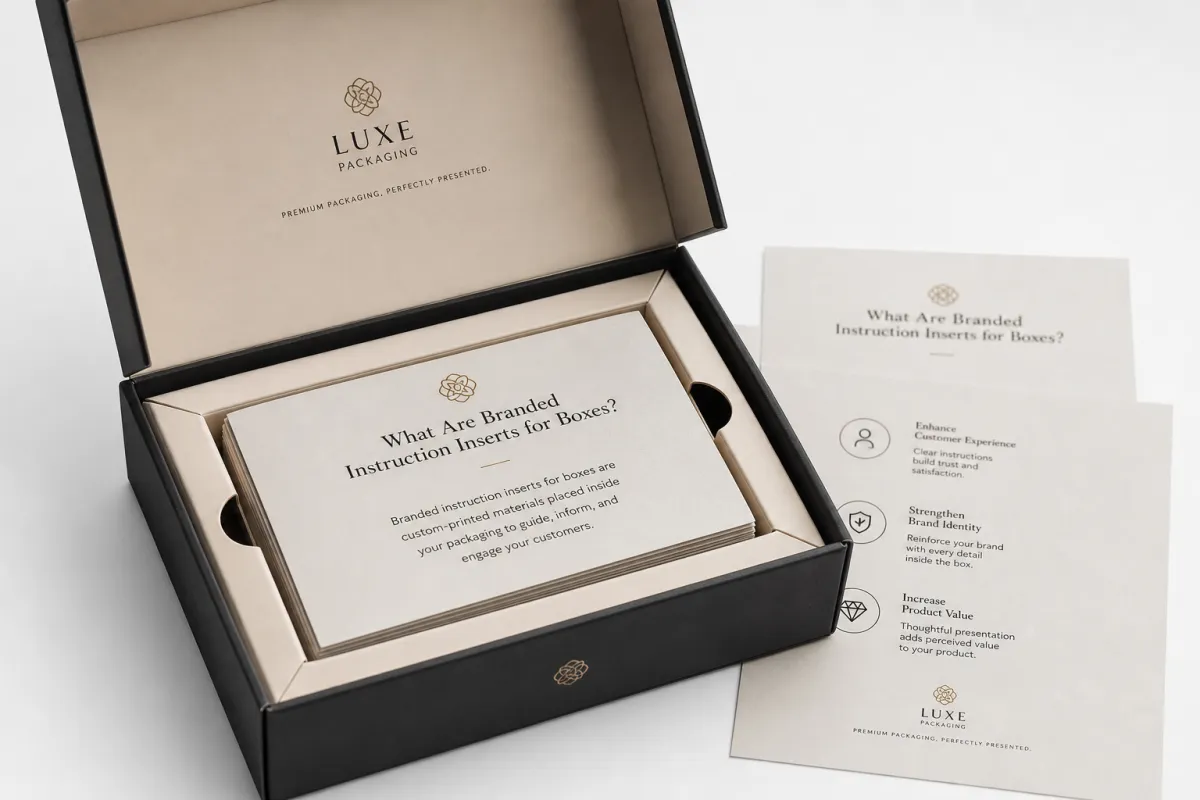
A customer opens a polished box, sees a product that looks ready to use, and then realizes the first move is missing. That tiny gap creates hesitation fast. Branded instruction inserts for boxes exist to close that gap before frustration starts, giving the customer a direct path to the next action whether the task is assembly, activation, charging, washing, storage, or routine care.
At the simplest level, branded instruction inserts for boxes are printed cards, folded leaflets, slim booklets, or single sheets placed inside the package. They explain what the customer should do in a format that still feels like part of the brand experience. The better versions do not look like generic office handouts. They echo the box colors, typography, spacing, and illustration style so the outer package and the inner insert feel like one coordinated system.
From a buyer's point of view, branded instruction inserts for boxes do three jobs at once. They reduce hesitation during unboxing, they make the product feel more complete, and they show that the brand anticipated the customer's questions before the box even left the warehouse. That combination sounds small on paper, but in practice it matters a lot, especially in categories where the first use determines satisfaction quickly.
These inserts are especially useful for subscription kits, fragile goods, cosmetics, food products that need careful handling, technical products, gift packaging, and anything that requires setup or care directions. In retail programs, branded instruction inserts for boxes can also cover warranty registration, returns, support contact details, or QR-linked help content. Used well, they keep the customer experience calm and straightforward instead of forcing people to search emails or websites just to figure out what to do first.
- Subscription kits: Explain the first unbox, the order of use, and any recurring steps.
- Fragile or delicate items: Show care, handling, storage, or cleaning instructions.
- Cosmetics and personal care: Provide usage tips, patch-test language, or refill guidance.
- Technical products: Give setup steps, charging notes, safety warnings, or QR support links.
- Gift packaging: Add a polished branded touch while still helping the recipient use the item correctly.
Branded instruction inserts for boxes are one of the easiest ways to make packaging feel complete. A carton can be structurally sound and visually attractive, yet the user experience still feels unfinished if the insert is missing, buried, or hard to read. The insert acts as the bridge between shelf appeal and the first real use of the product.
How Branded Instruction Inserts for Boxes Work
The process usually begins the moment the customer lifts the lid or breaks the seal. Branded instruction inserts for boxes should sit where the eye naturally lands, because the first few seconds after opening matter more than most teams expect. A card placed on top gets seen right away. A leaflet tucked into a pocket or under a tray can still work, but the placement has to be intentional so the customer does not miss it.
Placement changes behavior in a real way. A top-of-box card feels direct and useful, which suits quick-start or safety information. A tucked-in leaflet feels more refined and less visually busy, which can fit products that want a cleaner opening moment. Either way, branded instruction inserts for boxes need to be easy to spot, easy to lift, and easy to understand on the first read.
These inserts do more than list steps. They can reinforce brand voice through the same icon style, color palette, headline treatment, and illustration language used on the outer carton. That repetition matters because it ties the box, the insert, and the product together as one system. If the outside signals order and clarity, the insert should continue that promise rather than switching to dry, generic instruction copy.
Several formats deserve consideration. A one-sided quick-start card works well for simple products. A folded step-by-step guide gives more room when there are several actions to explain. QR codes can point to setup videos, registration pages, or troubleshooting content, keeping the printed insert compact while offering deeper support when needed. For broader markets, multilingual panels can prevent confusion and reduce the chance that the wrong audience receives the wrong message.
"If the customer has to hunt for the first step, the insert has already missed its mark."
From the production side, branded instruction inserts for boxes should be planned as part of the full packout flow. Dimensions, fold style, loading order, and placement beside other components all matter. If the insert jams the line, curls badly, or hides under another piece, the design is probably too ambitious for the way the box is actually assembled. I've seen clean-looking concepts fall apart for that exact reason.
Design and Material Factors That Shape the Insert
Stock choice is the first material decision that shapes branded instruction inserts for boxes. Uncoated stock is easier to write on and often feels more natural for hands-on instructions, while coated stock gives sharper color and cleaner image reproduction. Heavier cardstock, such as 14pt or 16pt cover, feels durable and holds up better when the insert is handled repeatedly. For high-volume programs, thinner text stock can reduce cost and fit more easily inside tight packaging.
Stock and finish choices
Branded instruction inserts for boxes do not need decorative finishing to do their job, but the surface should fit the purpose. If the insert is meant to be marked, checked off, or annotated by the customer, a writable surface is the better choice. If the insert is mostly visual and needs strong contrast, a coated sheet with a matte or silk finish often reads more clearly. Gloss can work too, though too much shine can make small type harder to read under retail lighting, kitchen light, or workshop conditions.
Layout and reading speed
Size and fold structure shape how quickly the customer gets the information. A simple 4 x 6 card is fast to scan but limited in depth. A folded 8.5 x 11 insert can carry more detail while still fitting inside many cartons. Branded instruction inserts for boxes should follow a clear hierarchy: a bold headline, a short purpose statement, then short steps ordered from most urgent to least urgent. That structure helps the customer act instead of reading in circles.
Compliance and durability
Compliance can change the design in real ways. Some products need warnings, age notices, ingredient disclosures, cleaning precautions, or regulatory wording that cannot be buried in tiny print. In those cases, branded instruction inserts for boxes need enough space and enough contrast to keep the language readable. If the box travels through humid environments, chilled storage, or rough mail handling, moisture resistance or tear resistance may matter more than a fancy coating. For shipment-sensitive programs, it helps to think about transport guidance in the same spirit as the testing frameworks used by the ISTA test programs, especially when the insert travels with delicate product components.
Sustainability can shape the choice too. Many buyers want paper that can be recycled with the carton, and FSC-certified paper can be a useful sourcing signal if your procurement policy values responsible fiber. The FSC certification standard is not a universal answer for every project, but it does give packaging teams a practical framework when they want the insert material to align with broader environmental goals.
One detail gets overlooked often: the insert has to fit the packout process, not just the artwork mockup. If the fold is too tight, the edges can crack. If the sheet is too large, it can bow inside the box and make the product feel crowded. If the finish fingerprints easily, the piece can look worn before it ever reaches the customer. Branded instruction inserts for boxes work best when the physical materials support the reading experience instead of competing with it.
Step-by-Step Guide to Creating Branded Instruction Inserts for Boxes
Creating branded instruction inserts for boxes starts long before layout software opens. The first task is to gather the real customer questions: what people ask support, where they make mistakes, what returns reveal, and what the pack-out team notices while handling the product every day. Once those pain points are clear, the content usually becomes easier to shape. The insert should solve the highest-friction problem first, not the most polished-sounding one.
- Collect the facts: Gather assembly notes, first-use confusion points, safety warnings, care rules, and return or registration steps that branded instruction inserts for boxes must cover.
- Map the flow: Arrange the content in the order the customer will need it, starting with opening, then setup, then warnings, then support details.
- Write simply: Use action verbs, short sentences, and direct instructions so branded instruction inserts for boxes can be scanned in seconds instead of reread in frustration.
- Design for the box: Match the panel count, fold style, and physical size to the packout space so the insert lands cleanly in the package.
- Proof and test: Review for clarity, print accuracy, QR code behavior, and line-side handling before the full run is released.
That flow sounds basic, and that is part of the reason it works. Branded instruction inserts for boxes are often weakened by one weak handoff between teams. Marketing may want polish, operations may want speed, and customer service may want every exception covered. The best insert balances those needs without becoming a crowded sheet that tries to say everything at once. A good rule is to make the first panel immediately useful and move extra detail to the back or to a QR-linked support page.
Copy style carries more weight than many teams expect. A calm tone works better than a sales tone, and short steps beat dense paragraphs almost every time. If the instruction says, "Remove the sleeve, place the tray flat, and wait 30 seconds before use," that reads clearly. A paragraph that tries to sound elegant while hiding the action does not serve the customer. Branded instruction inserts for boxes should sound human, practical, and steady, especially if the product needs caution or special handling.
After copy and layout are approved, the next step is a hard proof. That proof should be checked by someone who knows the product, someone who knows the box, and someone who understands how the insert will be loaded. A small mistake in order, scale, or wording can matter a lot once thousands of units move through the line. If the piece includes a QR code, test it on multiple devices and under different lighting angles so the link works in real use, not just in the prepress file.
For teams building packaging programs across several formats, it often helps to review Custom Packaging Products alongside the insert plan so the carton, the insert, and the protective components feel like one system. It is also useful to study Case Studies to see how different packouts handle instruction content without crowding the box or overwhelming the customer.
Branded Instruction Inserts for Boxes: Cost and Pricing Factors
Pricing for branded instruction inserts for boxes depends on several levers, and quantity is usually the biggest one. A small run spreads setup, proofing, and plate or file preparation across fewer pieces, so the unit price rises quickly. Larger runs lower the per-piece cost because press time and finishing work are distributed over more inserts. Stock choice, print coverage, panel count, fold complexity, and any special handling also move the number up or down.
Setup cost versus unit cost is the part buyers sometimes miss. A simple branded instruction inserts for boxes job might have a modest setup fee, but the per-piece cost can stay very manageable once the run gets larger. A more complex insert with multiple folds, variable data, or specialty finishing may carry a higher prep charge, yet if the volume is high enough, the final per-unit result can still be efficient. The key is to compare total landed cost, not just the headline print price.
| Format | Typical Use | Common Specs | Typical Unit Cost | Notes |
|---|---|---|---|---|
| Single-panel card | Quick-start steps, care reminders, welcome note | 4 x 6 or 5 x 7, 14pt C1S or 16pt matte | $0.10-$0.22 at 5,000 units | Fastest to read and easiest to pack |
| Folded leaflet | Assembly guidance, warnings, multilingual copy | 8.5 x 11 folded to 4 or 6 panels, 100# text | $0.18-$0.40 at 5,000 units | Good balance of detail and compact size |
| Mini booklet | Technical products, compliance details, troubleshooting | 8-16 pages, saddle-stitched or stapled | $0.55-$1.20 at 3,000 units | Best for dense instructions and support content |
| Variable-data insert | Serialized kits, promo codes, custom messages | Digital print, personalized fields, 100# text | $0.25-$0.70 at 2,500 units | Extra data handling increases setup and QC time |
Those ranges are planning numbers, not fixed quotes, but they are useful when a buyer needs to sketch a budget. Branded instruction inserts for boxes with heavy ink coverage, foil accents, die cuts, or specialty coatings will usually cost more than a clean one-color job on text stock. If the budget needs room to breathe, standardize the format across product families, keep the insert size consistent, and reserve expensive finishes for the outer carton or the highest-visibility version of the piece.
Another habit that helps is planning reprints around the packaging forecast. If the product line is likely to change every few months, a high-end insert can become expensive quickly. A more modular branded instruction inserts for boxes program, with a stable template and variable content blocks, often gives a better result because the base structure stays in place while only the necessary details change. That lowers waste and speeds future updates.
Branded Instruction Inserts for Boxes: Process and Timeline
The production path for branded instruction inserts for boxes usually begins with a brief, then moves to content drafting, design, proofing, revision, print approval, production, finishing, and delivery. On a clean job, that can move quickly. On a more complex job with translation, compliance review, or multiple stakeholders, the schedule stretches out because each approval step adds its own delay. The most efficient projects are the ones where the content is nearly ready before the design team starts placing text.
Timeline depends heavily on artwork readiness. If the copy is finished, the measurements are confirmed, and the brand assets are organized, branded instruction inserts for boxes can move through proofing much faster. If the insert still needs legal language, product photographs, or updated instructions from the engineering team, the schedule slows down. Translation adds another layer, especially if the layout has to stretch for longer text blocks or right-to-left reading directions.
The insert schedule should also line up with the box production schedule. There is no benefit to receiving a finished insert two weeks before the carton run if the packaging line cannot use it yet, and there is equal risk in receiving it too late. Branded instruction inserts for boxes should arrive when the packout team is ready to load them, not when the warehouse happens to have shelf space. That sounds obvious, yet mismatched timing creates a surprising amount of rehandling.
Buffer time is smart practice, especially for jobs that include barcodes, QR codes, warranty language, or regulatory statements. A small wording change can affect how the layout wraps, and a poorly tested QR code can send the customer to the wrong page. For that reason, leaving room for proof corrections, sign-off, and a final preflight review before release usually pays off. It is cheaper to catch a mistake in proof than to explain it on the production floor.
A practical schedule for branded instruction inserts for boxes might look like this: two to four business days for content gathering, two to three for design development, one to two for revision rounds, one for final approval, and roughly a week or more for production and finishing depending on quantity and complexity. Fast jobs can move faster, but only if the source material is already tight and the approval chain is short.
Common Mistakes and Expert Tips for Inserts
One of the most common mistakes with branded instruction inserts for boxes is trying to say too much. Teams sometimes treat the insert like a mini brochure and end up with dense paragraphs, tiny type, and a layout that looks polished but is hard to use in real life. If the customer has to slow down just to find the first instruction, the insert has already missed the point.
Another mistake is weak hierarchy. Branded instruction inserts for boxes need a clear visual path: headline, first action, support step, and then secondary notes. Small fonts and pale contrast might look attractive in a mockup, but they often disappear under normal room lighting. If the product is sold to older users, handled by gloved staff, or used in a kitchen or workshop, readability should be tested at arm's length, not only on a monitor.
Several practical habits make a real difference. Put the most important action first. Use one master template so updates stay easy to manage. Keep the tone calm and direct. If the insert has more than one role, such as instruction plus registration plus warranty, separate those functions visually instead of burying them in one block. Branded instruction inserts for boxes work best when the user can see the structure in a second or two.
There is a more advanced side to this work. QR codes can hold more depth than a printed card, which is useful for troubleshooting, assembly video, or multilingual support. But QR codes only help if they are tested, labeled clearly, and linked to a page that loads quickly on mobile devices. If the insert needs to be kept, stored, or recycled easily, think about fold count and paper selection so it does not turn into another piece of clutter in a drawer.
Finally, do not ignore the inside of the package just because the outside looks good. A handsome box can still deliver a poor experience if the insert is poorly placed, hard to read, or inconsistent with the product language. That is why branded instruction inserts for boxes deserve the same discipline as dielines and print specs. They are part of the packaging system, not an afterthought added at the end.
Next Steps for Launching Branded Instruction Inserts for Boxes
The best place to start is with a simple audit. Review the top five customer questions, the most common support tickets, the most frequent returns, and the exact box dimensions the insert has to fit inside. Once those facts are on paper, it becomes much easier to decide whether branded instruction inserts for boxes should be cards, folded leaflets, or small booklets. The shape of the problem usually tells you the shape of the insert.
From there, build a rough content map and assign a purpose to every panel. One panel might handle the first action. Another might hold safety or care notes. A third might carry a QR code or contact path. A fourth might be used for registration or brand reassurance. The important part is deciding which information must be printed and which can live online, because that balance controls both cost and readability.
Before launch, review the draft with operations, marketing, and customer support. Those three teams usually see the product from different angles, and branded instruction inserts for boxes become stronger when each group gets a chance to point out what the customer actually needs. If you want to compare how others organize support content and packout logic, the Case Studies page is a useful place to study practical examples, while Custom Packaging Products can help you see how inserts fit into a broader packaging program.
Then run a small pilot. Put the insert through a real packout, not just a desk review. Watch how quickly it is picked, how it sits inside the carton, and whether the language makes sense the moment the box is opened. Branded instruction inserts for boxes should be measured the same way you would measure any other production component: does it reduce friction, does it fit the line, and does it make the customer more confident?
After launch, track returns, support requests, and customer feedback for a few production cycles. If the insert is doing its job, you should see fewer repeated questions and less hesitation around first use. If not, change the wording, simplify the layout, or move the most important step to a more visible position. Branded instruction inserts for boxes are not static artifacts; they improve when they are treated as working tools that can be updated as the product line matures.
What should branded instruction inserts for boxes include?
They should include the product name, the first action the customer should take, and any essential assembly, care, or safety steps in the order they need to happen. A contact method, a QR code for deeper support, and any required legal or compliance language should also be visible before the product is used.
How are branded instruction inserts for boxes different from thank-you cards?
Thank-you cards are mainly emotional or promotional, while instruction inserts need to solve a practical problem by guiding the customer through setup, use, or care. A strong insert can combine both jobs, but the instructional content should stay clear, direct, and easy to scan first.
What affects the cost of branded instruction inserts for boxes the most?
Quantity, stock choice, number of printed sides, fold complexity, specialty finishes, and any variable-data printing have a major effect on pricing. Small runs usually cost more per piece because setup is spread across fewer inserts, while standardized formats often lower total cost over time.
How long does it take to produce branded instruction inserts for boxes?
Timelines depend on how ready the artwork is, how many revisions are needed, whether a sample is requested, and how quickly approvals move. Simple jobs can move fast, but custom folds, translation, and compliance review add time, so the insert should be scheduled alongside the box production plan.
Can branded instruction inserts for boxes reduce returns or support calls?
Yes, if they answer the questions customers ask most often and explain the first-use steps in a clear, visible way. It helps to track returns, tickets, and feedback before and after launch so you can see where the insert is reducing friction and where the wording still needs work.
Branded instruction inserts for boxes are one of the most practical tools a packaging team can add, because they protect the customer experience without adding much structural complexity. The best version is not the fanciest one; it is the one that fits the box, reads fast, and lands in the place a real person will notice first. If you are planning one, start with the customer's first three actions, print a proof on the actual stock, and test it inside the real packout before you commit to a full run.


